

Role of CFTR in epithelial physiology
Open accessThe DOI matches its Crossref record; 231 of the 232 references it cites were found in a registry or an index.
Abstract
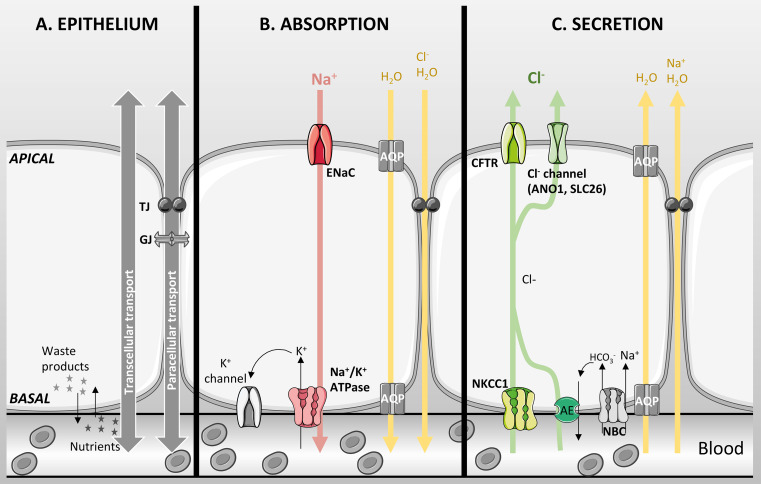
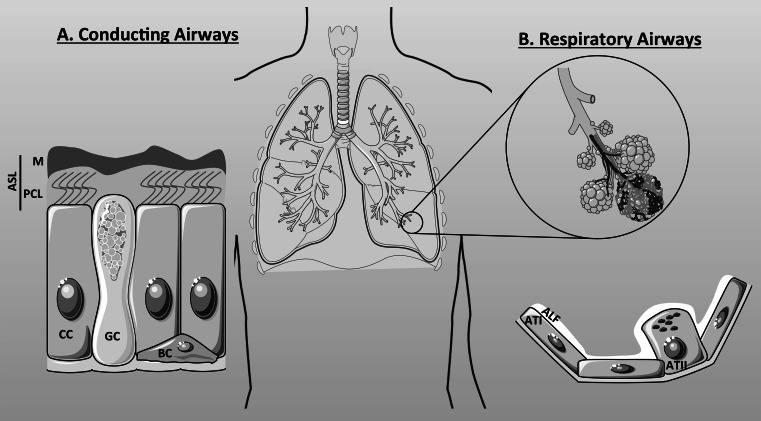
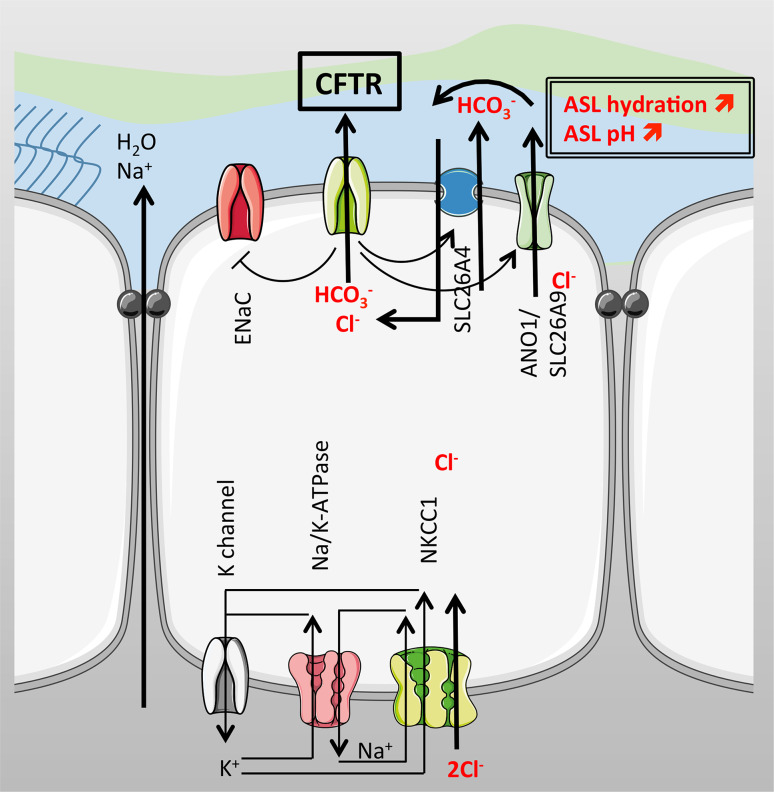
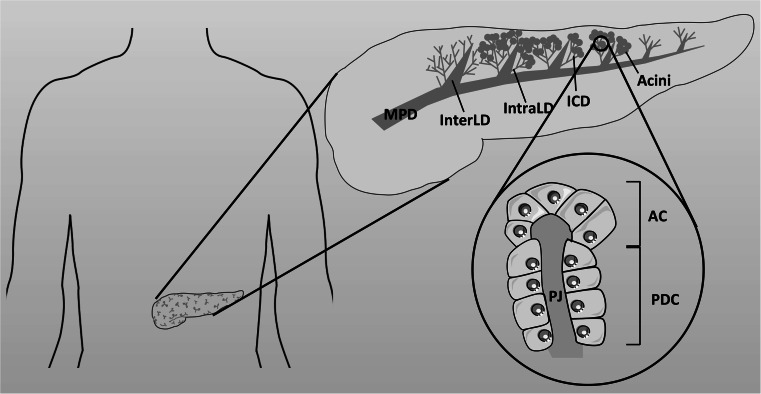
Salt and fluid absorption and secretion are two processes that are fundamental to epithelial function and whole body fluid homeostasis, and as such are tightly regulated in epithelial tissues. The CFTR anion channel plays a major role in regulating both secretion and absorption in a diverse range of epithelial tissues, including the airways, the GI and reproductive tracts, sweat and salivary glands. It is not surprising then that defects in CFTR function are linked to disease, including life-threatening secretory diarrhoeas, such as cholera, as well as the inherited disease, cystic fibrosis (CF), one of the most common life-limiting genetic diseases in Caucasian populations. More recently, CFTR dysfunction has also been implicated in the pathogenesis of acute pancreatitis, chronic obstructive pulmonary disease (COPD), and the hyper-responsiveness in asthma, underscoring its fundamental role in whole body health and disease. CFTR regulates many mechanisms in epithelial physiology, such as maintaining epithelial surface hydration and regulating luminal pH. Indeed, recent studies have identified luminal pH as an important arbiter of epithelial barrier function and innate defence, particularly in the airways and GI tract. In this chapter, we will illustrate the different operational roles of CFTR in epithelial function by describing its characteristics in three different tissues: the airways, the pancreas, and the sweat gland.
Overview
The claims and statistics of this paper haven’t been checked yet.
Free: it reads the open-access text and checks the first 5 claims that cite a source we can check. Create a free account to check every claim.
Integrity signals
Registry
Cites
Statistics
Figures
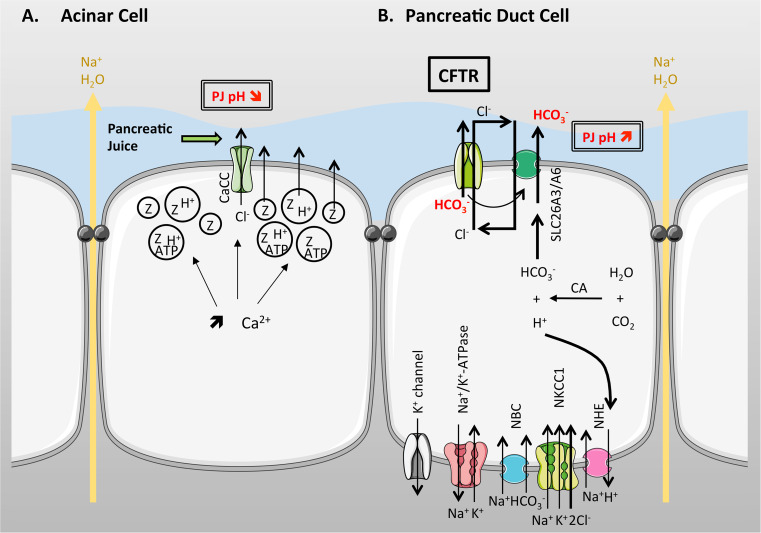
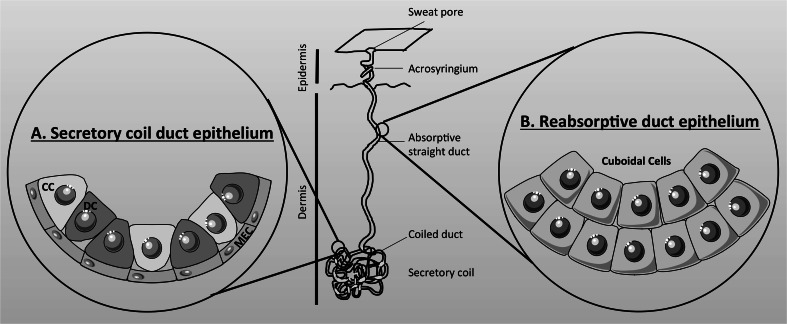
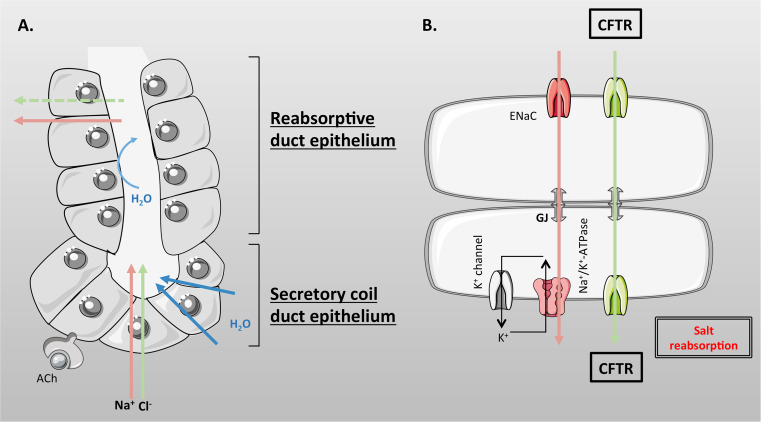
Verification
Claims the paper makes
The claims and statistics of this paper haven’t been checked yet.
Free: it reads the open-access text and checks the first 5 claims that cite a source we can check. Create a free account to check every claim.
Claims other papers make about this one
Each is checked against this paper’s own text: does it say what the citing paper says it does?
The cited source says what the claim attributes to it.
In the citing paper
“CFTR are also expressed on the apical membrane of clear cells and play a role in chloride secretion in response to beta-adrenergic stimulation”
From Physiological mechanisms determining eccrine sweat composition (2020) · cites this paper as Saint-Criq and Gray 2017
Self-check
Percentages, sums and reported differences re-computed from the paper’s own numbers.
The self-check needs the paper’s full text.
Citations
Cites
Items 201–231 of 231
Bijman, J., & Quinton, P. (1987) · Pflügers Archiv - European Journal of Physiology · doi:10.1007/bf00585076 · Cited by 36 · cited 1×
“However, unlike the airways, the paracellular pathway in the absorptive duct has little intrinsic Cl permeability in both normal and CF glands [208, 213] and due to high anion conductance of the apical and basolateral membranes of the duct cells (due to active CFTR), Cl moves transcellularly.”
BackgroundFauth, T., Hochheimer, A., Buescher, J. M., Rapprich, S., & Krohn, M. (2014) · Experimental Dermatology · doi:10.1111/exd.12543 · Cited by 34 · cited 4×
“Clear cells express CFTR [203, 204] as well as a CaCC, most probably TMEM16A (ANO1) [205].”
BackgroundInfluentialReddy, M. M., & Quinton, P. (1989) · American Journal of Physiology-Cell Physiology · doi:10.1152/ajpcell.1989.257.4.c727 · Cited by 34 · cited 2×
“The duct cells express the highest levels of CFTR, and in contrast to all other CF-affected epithelial tissues, the channel is functionally present at both apical and basolateral membranes [193, 208], and appears to be constitutively active [209] via PKA activity.”
BackgroundSystematic Review Focusing on the Excretion and Protection Roles of Sweat in the Skin
Yan, P., Cui, X. B., Liu, Y., Li, Y., Liu, J., & Cheng, B. (2014) · Dermatology · doi:10.1159/000357524 · Cited by 32 · cited 1×
“other important roles which include the production and secretion of a range of AMPs such as LL-37, lactoferrin and dermicidin, an AMP unique to skin [187–189], as well as compounds that maintain skin condition (barrier function) and skin lubricants [190].”
BackgroundCx26 regulates proliferation of repairing basal airway epithelial cells
Crespin, S., Bacchetta, M. D., Saab, J. B., Tantilipikorn, P., Bellec, J., Dudez, T. S., Nguyen, T. H., Kwak, B. R., Lacroix, J. S., Huang, S. X. L., et al. (2014) · The International Journal of Biochemistry & Cell Biology · doi:10.1016/j.biocel.2014.02.010 · Cited by 32 · cited 1×
“Although it is not clear whether a defective CFTR decreases or enhances wound healing, many studies show that bronchial epithelial cells lacking CFTR are not able to reconstitute a fully differentiated epithelium [110–112].”
BackgroundHuang, J., Shan, J., Kim, D., Liao, J., Evagelidis, A., Alper, S. L., & Hanrahan, J. W. (2012) · The Journal of Physiology · doi:10.1113/jphysiol.2012.236919 · Cited by 31 · cited 9×
“/H? exchanger (NHE) and a Cl-/HCO3 - exchanger and (2) parallel operation of a Cl-/HCO3 - exchanger with NBC [12, 37].”
BackgroundInfluentialClarke, L. L., Paradiso, A. M., & Boucher, R. C. (1992) · American Journal of Physiology-Cell Physiology · doi:10.1152/ajpcell.1992.263.6.c1190 · Cited by 28 · cited 1×
“The histamine or UTP peak secretory response was enhanced in cultured CF airway epithelial cells and freshly excised nasal tissues from CF patients, respectively [55, 56].”
BackgroundVenglovecz, V., Rakonczay, Z., Gray, M. A., & Hegyi, P. J. (2014) · Pflügers Archiv - European Journal of Physiology · doi:10.1007/s00424-014-1585-0 · Cited by 27
Self-citationThe Development of Lung Disease in Cystic Fibrosis Pigs
Wine, J. J. (2010) · Science Translational Medicine · doi:10.1126/scitranslmed.3001130 · Cited by 27
Chan, H. C., & Sun, X. (2013) · Cell Biology International · doi:10.1002/cbin.10183 · Cited by 26 · cited 1×
“For the interested reader, several recent reviews describe in detail the role of CFTR in anion (Cl and HCO3 ) and fluid transport in these tissues, together with diseases associated with defective CFTR, such as CF secretory diarrhoeas and infertility [19–24].”
BackgroundIgnáth, I., Hegyi, P. J., Venglovecz, V., Székely, C. A., Carr, G., Hasegawa, M., Inoue, M., Takács, T., Argent, B. E., Gray, M. A., et al. (2009) · Pancreas · doi:10.1097/mpa.0b013e3181b65d34 · Cited by 26 · cited 1×
“At low concentrations, both agents increased HCO3 - secretion, a response that required CFTR and Cl/HCO3 - exchange activity [170–172].”
BackgroundSelf-citationEffect of Cytosolic pH on Epithelial Na+ Channel in Normal and Cystic Fibrosis Sweat Ducts
Reddy, M. M., Wang, X. F., & Quinton, P. (2008) · The Journal of Membrane Biology · doi:10.1007/s00232-008-9126-4 · Cited by 25 · cited 1×
“through ENaC [212].”
Association of CFTR gene mutation with bronchial asthma.
Maurya, N., Awasthi, S., & Dixit, P. (2012) · PubMed Central · Cited by 25
Ahmad, S., Tyrrell, J., Walton, W. G., Tripathy, A., Redinbo, M. R., & Tarran, R. (2016) · Antimicrobial Agents and Chemotherapy · doi:10.1128/aac.00975-16 · Cited by 21
Sato, F., & Sato, K. (2000) · Journal of Histochemistry & Cytochemistry · doi:10.1177/002215540004800304 · Cited by 20 · cited 1×
“Clear cells express CFTR [203, 204] as well as a CaCC, most probably TMEM16A (ANO1) [205].”
BackgroundStimulus-secretion Coupling in Pancreatic Acinar Cells
Williams, J. A., & Yule, D. I. (2012) · Elsevier eBooks · doi:10.1016/b978-0-12-382026-6.00050-6 · Cited by 20 · cited 1×
“These agonists cause a rise in intracellular calcium which stimulates NaCl and fluid secretion, as well the regulated exocytosis of enzyme-containing secretory granules [119].”
BackgroundPKA Mediates Constitutive Activation of CFTR in Human Sweat Duct
Reddy, M. M., & Quinton, P. (2009) · The Journal of Membrane Biology · doi:10.1007/s00232-009-9205-1 · Cited by 18 · cited 1×
“The duct cells express the highest levels of CFTR, and in contrast to all other CF-affected epithelial tissues, the channel is functionally present at both apical and basolateral membranes [193, 208], and appears to be constitutively active [209] via PKA activity.”
BackgroundAmiloride-sensitive fluid resorption in NCI-H441 lung epithelia depends on an apical Cl−conductance
Korbmacher, J. P., Michel, C., Neubauer, D., Thompson, K. E., Mizaikoff, B., Frick, M., Dietl, P., & Wittekindt, O. H. (2014) · Physiological Reports · doi:10.1002/phy2.201 · Cited by 18
Clunes, M., Lindsay, S. L., Roussa, E., Pm, Q., & Bovell, D. (2004) · Journal of Molecular Histology · doi:10.1023/b:hijo.0000039837.45595.a6 · Cited by 17 · cited 1×
“As discussed by Bovell [185], this could be due to a yet unidentified apical Cl/HCO3 - exchanger that is coupled to proton-secretion via a V-type ATPase [216, 217], leading to net Cl”
BackgroundNew Pulmonary Therapies Directed at Targets Other than CFTRPreprint
Donaldson, S. H., & Galietta, L. (2013) · Cold Spring Harbor Perspectives in Medicine · doi:10.1101/cshperspect.a009787 · Cited by 17 · cited 1×
“several groups are pursuing ENaC inhibitors as a therapeutic approach to increase ASL depth, and the available data show that interfering with ENaC activity could potentially be beneficial in CF to rehydrate the ASL [45].”
BackgroundTransgenic hCFTR expression fails to correct β-ENaC mouse lung disease
Grubb, B. R., O’Neal, W. K., Ostrowski, L. E., Kreda, S. M., Button, B. M., & Boucher, R. C. (2011) · American Journal of Physiology-Lung Cellular and Molecular Physiology · doi:10.1152/ajplung.00083.2011 · Cited by 16
Goodwin, J. L., Spitale, N., Yaghi, A., DOLOVICH, M. B., & Nair, P. K. (2012) · Canadian Respiratory Journal · doi:10.1155/2012/546702 · Cited by 16 · cited 1×
“Although the link between CFTR and asthma is still controversial [78–81], it is now well established that COPD shares some common features with CF, including bronchiectasis, mucus plugging, and inflammation.”
BackgroundIdentification of potassium and chloride channels in eccrine sweat glands
Cui, C., Sima, J., Yin, M., Michel, M., Kunisada, M., & Schlessinger, D. (2015) · Journal of Dermatological Science · doi:10.1016/j.jdermsci.2015.11.001 · Cited by 16 · cited 1×
“The latter protein could play a role in HCO3 - secretion [207], as discussed in the section on the airways.”
BackgroundBovell, D. L., Clunes, M. T., Roussa, E., Burry, J., & Elder, H. Y. (2000) · The Histochemical Journal · doi:10.1023/a:1004087120735 · Cited by 12 · cited 1×
“As discussed by Bovell [185], this could be due to a yet unidentified apical Cl/HCO3 - exchanger that is coupled to proton-secretion via a V-type ATPase [216, 217], leading to net Cl”
BackgroundReconstitution of human airway tissue in the humanized xenograft model
Escotte‐Binet, S., Catusse, C., Coraux, C., & Puchelle, É. (2004) · Journal of Cystic Fibrosis · doi:10.1016/j.jcf.2004.05.014 · Cited by 12 · cited 1×
“In a process called epithelial restitution, the injured epithelial cells go through different de-differentiation and re-differentiation stages to proliferate, fill the ‘‘gap’’, and recover their full functionality [109].”
BackgroundThe Role of CFTR Mutations in Asthma
Sandford, A. J. (2012) · Canadian Respiratory Journal · doi:10.1155/2012/267251 · Cited by 11 · cited 1×
“Although the link between CFTR and asthma is still controversial [78–81], it is now well established that COPD shares some common features with CF, including bronchiectasis, mucus plugging, and inflammation.”
BackgroundKemény, L. V., Hegyi, P. J., Rakonczay, Z., Borka, K., Korompay, A., Gray, M. A., Argent, B. E., & Venglovecz, V. (2011) · Pancreas · doi:10.1097/mpa.0b013e3182161d05 · Cited by 9
Self-citationCell Physiology of Pancreatic Ducts
Be, A., Ma, G., Steward, M. C., & CASE, R. M. (2012) · Cited by 9
A synopsis of methods of sweat tests in pathology
Quinton, P. (2014) · Clinical Biochemistry · doi:10.1016/j.clinbiochem.2014.05.047 · Cited by 6 · cited 1×
“in CF glands compared to normal [222], as well as skin impedance and rates of secretion, thus improving overall sensitivity and diagnostic value in sweat gland pathologies (see [221]) for a recent summary of these new tests).”
BackgroundChronic β1‐blockade impairs ischemic tolerance and preconditioning in murine myocardium (652.2)
Hoe, L. E. S., Headrick, J. P., & Peart, J. N. (2014) · The FASEB Journal · doi:10.1096/fasebj.28.1_supplement.652.2 · Cited by 3
Robertson, J., & Bovell, D. L. (2014) · The FASEB Journal · doi:10.1096/fasebj.28.1_supplement.650.2 · Cited by 2
Cited by
Pseudomonas aeruginosa: An Audacious Pathogen with an Adaptable Arsenal of Virulence Factors
Jurado-Martín, I., Sainz-Mejías, M., & McClean, S. (2021) · International Journal of Molecular Sciences · doi:10.3390/ijms22063128 · Cited by 698
“demonstrated that although the antimicrobial composition of the ASL was similar in CF and non-CF pigs, the CF pigs’ airways showed reduced efficiency in bacterial killing, suggesting that the observed acidic environment may contribute the lack of activity of antimicrobial molecules [224,225].”
BackgroundCFTR Modulators: The Changing Face of Cystic Fibrosis in the Era of Precision Medicine
Lopes-Pacheco, M. (2020) · Frontiers in Pharmacology · doi:10.3389/fphar.2019.01662 · Cited by 535
“Furthermore, CFTR modulates the activity of other ion channels, such as the epithelial sodium channel (ENaC) (Saint-Criq and Gray, 2017; Moore and Tarran, 2018).”
BackgroundProtein kinase CK2: a potential therapeutic target for diverse human diseases
Borgo, C., D’Amore, C., Sarno, S., Salvi, M., & Ruzzene, M. (2021) · Signal Transduction and Targeted Therapy · doi:10.1038/s41392-021-00567-7 · Cited by 362
Physiological mechanisms determining eccrine sweat composition
Baker, L. B., & Wolfe, A. S. (2020) · European Journal of Applied Physiology · doi:10.1007/s00421-020-04323-7 · Cited by 367
Grasemann, H., & Ratjen, F. (2023) · New England Journal of Medicine · doi:10.1056/nejmra2216474 · Cited by 334
Metadata
- Authors
- Saint-Criq, V., & Gray, M. A.
- Affiliations
- Newcastle University (GB)
- Corresponding author
- Gray, Michael A.
- ORCID
- Gray, Michael A.
- Venue
- Cellular and Molecular Life Sciences
- Published
- 2016-10-06
- Volume
- 74
- Issue
- 1
- Pages
- 93-115
- ISSN
- 1420-682X (ISSN-L)
- 1420-9071
- PMC
- PMC5209439
- OpenAlex
- W2528194947
- Cited by
- 433
- References
- 232
- Citations by year
- 2026: 35 · 2025: 54 · 2024: 53 · 2023: 45 · 2022: 54 · 2021: 57 · 2020: 61 · 2019: 29 · 2018: 32 · 2017: 10 · 2016: 1
- FWCI
- 4.16
- Type
- journal article
- Language
- en
- Open access
- hybrid
- doi.org
- Locations
- Cellular and Molecular Life Sciences (publishedVersion, cc-by)
- Europe PMC (PubMed Central) (publishedVersion, cc-by)
- PubMed Central (publishedVersion, cc-by)
- PubMed (publishedVersion)
- HAL (submittedVersion, other-oa)
- Newcastle University ePrints (Newcastle Univesity) (cc-by)
- Funders
- Cystic Fibrosis Trust (SRC 003)
- Topics
- Health Sciences › Medicine › Pulmonary and Respiratory Medicine › Cystic Fibrosis Research Advances
- Life Sciences › Biochemistry, Genetics and Molecular Biology › Molecular Biology › Ion Transport and Channel Regulation
- Life Sciences › Biochemistry, Genetics and Molecular Biology › Molecular Biology › Ion channel regulation and function
- Keywords
- CFTR, cystic fibrosis, epithelial physiology, anion channels, secretion, fluid homeostasis, luminal pH, epithelial barrier function, respiratory tract, pancreas, sweat glands, secretory diarrhea, acute pancreatitis, chronic obstructive pulmonary disease
- MeSH terms
- Animals, Bicarbonates, Chlorides, Cystic Fibrosis, Epithelium, Humans, Immunity, Innate, Lung, Pancreas, Sweat Glands, Cystic Fibrosis Transmembrane Conductance Regulator
About these checks
Registry, retraction, Cites and statistics results are computed, not judged, with one exception: a printed reference that no index lists is read once by a model before it counts as a citation error. Claims are extracted by a model and kept only when their quote appears verbatim in the text; each cited source is then checked, with a model’s help, for whether it says what the claim relies on. Those verdicts can be wrong — read the claim’s quote and the cited source before relying on one.
Statistics and arithmetic are recomputed, not judged.
Confidence bands are shown only for fields calibrated on our annotated test set. None is calibrated yet, so no band is shown.
What counts as a claim ›How we measure confidence ›How we check this ›
Are you an author, or do you see a problem with this page? Request a review
Data sources
Bibliographic data: Semantic Scholar, OpenAlex, Crossref.
Contains information from the Semantic Scholar Academic Graph Datasets, made available under the ODC Attribution License (ODC-BY 1.0).
Semantic Scholar’s data is described in: Kinney, R., et al. (2023). The Semantic Scholar Open Data Platform. arXiv:2301.10140.
