

Tackling G × E × M interactions to close on-farm yield-gaps: creating novel pathways for crop improvement by predicting contributions of genetics and management to crop productivity
Open accessThe DOI matches its Crossref record; 118 of the 120 references it cites were found in a registry or an index, and 1 are not checked yet; 34 of the 199 sources its claims cite were checked for support.
Abstract
Key message: Climate change and Genotype-by-Environment-by-Management interactions together challenge our strategies for crop improvement. Research to advance prediction methods for breeding and agronomy is opening new opportunities to tackle these challenges and overcome on-farm crop productivity yield-gaps through design of responsive crop improvement strategies. Genotype-by-Environment-by-Management (G × E × M) interactions underpin many aspects of crop productivity. An important question for crop improvement is “How can breeders and agronomists effectively explore the diverse opportunities within the high dimensionality of the complex G × E × M factorial to achieve sustainable improvements in crop productivity?” Whenever G × E × M interactions make important contributions to attainment of crop productivity, we should consider how to design crop improvement strategies that can explore the potential space of G × E × M possibilities, reveal the interesting Genotype–Management (G–M) technology opportunities for the Target Population of Environments (TPE), and enable the practical exploitation of the associated improved levels of crop productivity under on-farm conditions. Climate change adds additional layers of complexity and uncertainty to this challenge, by introducing directional changes in the environmental dimension of the G × E × M factorial. These directional changes have the potential to create further conditional changes in the contributions of the genetic and management dimensions to future crop productivity. Therefore, in the presence of G × E × M interactions and climate change, the challenge for both breeders and agronomists is to co-design new G–M technologies for a non-stationary TPE. Understanding these conditional changes in crop productivity through the relevant sciences for each dimension, Genotype, Environment, and Management, creates opportunities to predict novel G–M technology combinations suitable to achieve sustainable crop productivity and global food security targets for the likely climate change scenarios. Here we consider critical foundations required for any prediction framework that aims to move us from the current unprepared state of describing G × E × M outcomes to a future responsive state equipped to predict the crop productivity consequences of G–M technology combinations for the range of environmental conditions expected for a complex, non-stationary TPE under the influences of climate change.
Verified 2026-11-22 · 1 reference not checked yet
Overview
CoChat Summary
TL;DR
The paper argues that Genotype-by-Environment-by-Management (G × E × M) interactions and climate change require moving from describing outcomes to predicting productive Genotype–Management (G–M) technology combinations for a non-stationary Target Population of Environments. It illustrates this with a simulated US corn-belt maize case study showing contrasting variance structures and G–M technology rankings between Iowa and Kansas.
Key findings
- G × E × M interactions can create opportunities to select positive G–M technology combinations to close on-farm yield-gaps, but this requires repeatable positive G × M effects, mechanisms for detection and selection, and farmer adoption.
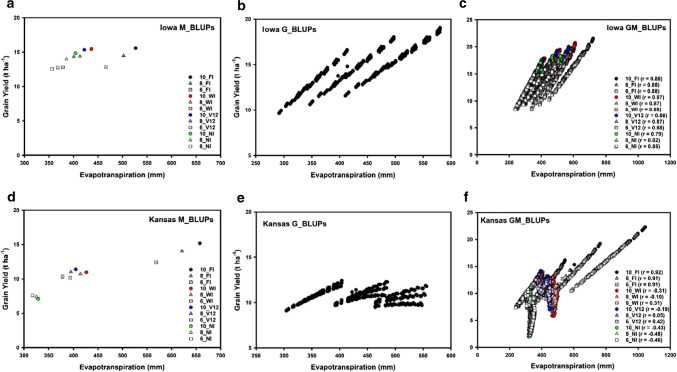
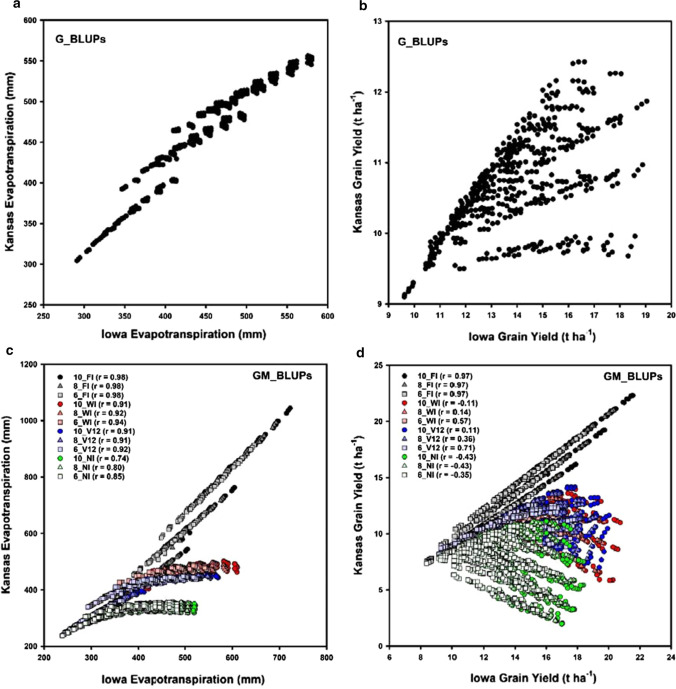
- In the simulated maize case study, Iowa had the largest genotypic variance component for grain yield (4.18 t ha−1) and evapotranspiration (5090.6 mm), whereas Kansas had larger management variance for grain yield (6.31 t ha−1) and evapotranspiration (13,468.4 mm) than genotypic (0.68 t ha−1; 4807.0 mm) and G × M (2.95 t ha−1; 3454.5 mm) components.
- Selection on genotype BLUPs identified different high-yield genotypes in Iowa versus Kansas; at the G–M technology BLUP level, the same G–M technologies were highest under fully irrigated management, but different G–M combinations were best when full irrigation was unavailable, with correlations between Iowa and Kansas ranging from positive (10_FI) to negative (10_NI).
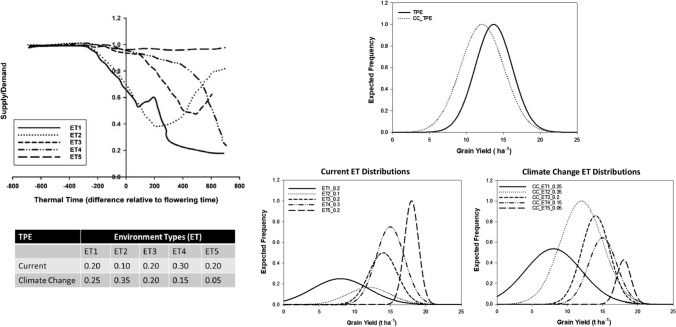
- Climate change makes the TPE non-stationary, requiring quantification of changes in environment-type frequencies and co-design of G–M technologies for current and projected future environments.
Methods
- Review and perspective synthesizing literature and proposing an iterative empirical-modelling framework that combines mechanistic crop models, statistical and machine learning approaches, genomic prediction for breeding, and agronomic prediction for management.
- Simulation case study using a subset of simulated maize grain yield and evapotranspiration data from Cooper et al. (2020): 488 genotypes, 12 management strategies based on three plant densities (6, 8, 10 plants m−2) and four irrigation strategies (NI, FI, V12, WI), nine locations each in Kansas and Iowa, and 20 years (1996–2015).
- Analysis estimated variance components and best linear unbiased predictors (BLUPs) separately for Iowa and Kansas for management (M_BLUPs), genotypes (G_BLUPs), and 5856 G–M technology combinations (GM_BLUPs).
Limitations
- The paper states that the example used simulation results to demonstrate principles and that coordinated simulation and empirical studies are needed in an iterative empirical-modelling process.
- The paper states there is an absence of comprehensive information on the magnitude and form of G × E × M interactions for many crops, cropping systems, and TPEs, and a lack of extensive empirical studies comparing alternative crop improvement strategies.
- Evident from the text: the case study is based on simulated data from one crop model and a subset of a prior study, not field validation, and it does not measure actual on-farm yield-gap closure or farmer adoption outcomes.
Model-written summary. Check it against the paper before relying on it.
Integrity signals
Registry
Cites
Statistics
Figures
Verification
Claims the paper makes
29 Valid · 6 Not valid · 69 Not checked · 89 Own results and interpretations
The sources with a verdict support this claim; the rest weren’t checked yet, have no full text we could read, or their verdicts aren’t rated yet.
In the paper
“Genotype-by-Environment-by-Management (G × E × M) interactions underpin many aspects of crop productivity.”
§ Tackling G × E × M interactions to close on-farm yield-gaps: creating novel pathways for crop improvement by predicting contributions of genetics and management to crop productivity > Abstract
What the sources say
- Not checked — no full text of the sourcecites Messina et al. 2009 matched to “Modelling Crop Improvement in a G×E×M Framework via Gene–Trait–Phenotype Relationships” (2009) source
- Supportedcites Snowdon et al. 2020 matched to “Crop adaptation to climate change as a consequence of long-term breeding” (2021) source
The Introduction says G×E×M interactions affect numerous physiological processes, including water and nutrient uptake, growth, and grain maturation, with consequences for yield. The Conclusions also describe yield performance as an outcome of G×E×M interactions. (LLM, conf=0.94)
plainstates a cause- Asserted: passes — The authors put it forward as true.
- Checkable: passes — It can be checked against evidence.
- Load-bearing: passes — The paper’s conclusions depend on it.
- Based: passes — The paper gives a reason why it holds.
The cited sources support only part of this claim — read each source’s verdict below.
In the paper
“Importantly, the iterative empirical-modelling framework is grounded and motivated by successful outcomes achieved from applications to coordinate the development of improved maize hybrids and agronomy for the heterogeneous environments of the US corn-belt (McFadden et al. 2019; Boyer et al. 2013; Cooper et al. 2014a, 2020; Gaffney et al. 2015).”
§ Tackling G × E × M interactions to close on-farm yield-gaps: creating novel pathways for crop improvement by predicting contributions of genetics and management to crop productivity > Introduction
What the sources say
- Partly supportedcites McFadden et al. 2019 matched to “Development, Adoption, and Management of Drought-Tolerant Corn in the United States” (2019) sourceExperimental — accuracy not yet measured
The section ‘Research Underlying the Development of Drought Tolerance in Corn’ says that several drought-tolerant hybrids were developed with the aid of experimental designs and crop and computational models. The Introduction and Conclusions also describe adoption alongside moisture-conservation practices in the Corn Belt. The paper does not establish that an iterative empirical-modelling framework coordinated hybrid development and agronomy, or attribute successful outcomes to that framework. (LLM, conf=0.84)
- Not checked — no full text of the sourcecites Boyer et al. 2013 matched to “The U.S. drought of 2012 in perspective: A call to action” (2013) source
- Partly supportedcites Cooper et al. 2014a matched to “Breeding drought-tolerant maize hybrids for the US corn-belt: discovery to product” (2014) sourceExperimental — accuracy not yet measured
The Discussion reports successful drought-breeding outcomes, and Additional information says the framework used to develop improved hybrids could also help agronomists select management practices across the US corn-belt (page unavailable). It presents that agronomic use as a possibility, not as an already successful application coordinating hybrid and agronomy development. (LLM, conf=0.83)
plainstates a cause- Asserted: passes — The authors put it forward as true.
- Checkable: passes — It can be checked against evidence.
- Load-bearing: passes — The paper’s conclusions depend on it.
- Based: passes — The paper gives a reason why it holds.
- Partly supported
The cited sources support only part of this claim — read each source’s verdict below.
In the paper
“At present, breeders and agronomists largely work as a sequential tag team, or independently, conducting empirical research and making predictions to seek answers for the pressing questions within their own domains (e.g. Reynolds 2010; Fischer et al. 2014; Cooper et al. 2014b; Assefa et al. 2018; Edreira et al. 2018; Beres et al. 2020; Rotili et al. 2020; Snowdon et al. 2020).”
§ Tackling G × E × M interactions to close on-farm yield-gaps: creating novel pathways for crop improvement by predicting contributions of genetics and management to crop productivity > Introduction > Seeking workable Genotype–Management technology solutions
What the sources say
- Not checked — no full text of the sourcecites Reynolds 2010 matched to “Climate change and crop production” (2010) source
- Not matchedcites Fischer et al. 2014
An author–year citation the paper’s reference list doesn’t settle. We don’t search these by name.
- Partly supportedcites Cooper et al. 2014b matched to “Predicting the future of plant breeding: complementing empirical evaluation with genetic prediction” (2014) sourceExperimental — accuracy not yet measured
The Introduction describes plant breeders using field evaluation and genetic prediction to address breeding questions. It does not establish that breeders and agronomists largely work independently or as a sequential team; instead, the Introduction calls cross-disciplinary integration a hallmark of successful plant breeding and describes continuing interplay between genetic improvement and crop management. Page numbers were not available in our copy. (LLM, conf=0.82)
plain- Asserted: passes — The authors put it forward as true.
- Checkable: passes — It can be checked against evidence.
- Load-bearing: passes — The paper’s conclusions depend on it.
- Based: passes — The paper gives a reason why it holds.
The cited sources support only part of this claim — read each source’s verdict below.
In the paper
“Elements of the theory and practice for exploiting G–M technology combinations, within the context of G × E × M interactions, as defined above, can be recognised in the well-documented contributions of hybrid-by-density interactions to the historical increase in on-farm yield productivity of maize in the US corn-belt (Duvick et al. 2004, Duvick 2005a, b; Hammer et al. 2009; Assefa et al. 2018).”
§ Tackling G × E × M interactions to close on-farm yield-gaps: creating novel pathways for crop improvement by predicting contributions of genetics and management to crop productivity > Introduction > Exploiting workable Genotype–Management technology solutions: an example
What the sources say
- Not matchedcites Duvick et al. 2004
An author–year citation the paper’s reference list doesn’t settle. We don’t search these by name.
- Not checked — no full text of the sourcecites Hammer et al. 2009 matched to “Can Changes in Canopy and/or Root System Architecture Explain Historical Maize Yield Trends in the U.S. Corn Belt?” (2009) source
- Partly supportedcites Assefa et al. 2018 matched to “Analysis of Long Term Study Indicates Both Agronomic Optimal Plant Density and Increase Maize Yield per Plant Contributed to Yield Gain” (2018) sourceExperimental — accuracy not yet measured
Split into 2 atoms — 0 confirmed, 2 partially supported, 0 disputed, 0 misattributed, 0 unverifiable. Expand the claim to see per-atom verdicts.
plainstates an association- Asserted: passes — The authors put it forward as true.
- Checkable: passes — It can be checked against evidence.
- Load-bearing: unclear — It is unclear whether the paper’s conclusions depend on it.
- Based: passes — The paper gives a reason why it holds.
- Not matched
The cited sources support only part of this claim — read each source’s verdict below.
In the paper
“Given the documented long-term trends in [CO2] and temperature, it is likely we are already dealing with their early effects on crop productivity in many of our crop improvement programs (Lobell and Field 2007; Chapman et al. 2012; Lobell et al. 2013, 2015; Hammer et al. 2014, 2020; Zheng et al. 2016; Snowdon et al. 2020).”
§ Tackling G × E × M interactions to close on-farm yield-gaps: creating novel pathways for crop improvement by predicting contributions of genetics and management to crop productivity > Introduction > Climate change and crop improvement
What the sources say
- Partly supportedcites Lobell and Field 2007 matched to “Global scale climate–crop yield relationships and the impacts of recent warming” (2007) sourceExperimental — accuracy not yet measured
The Conclusions (p. 7) say recent warming has had a discernible negative impact on production of several major crops and that rising CO2 likely offset some of it, although the CO2 effect is uncertain. The paper studies global crop yields, not productivity within crop improvement programs, so it does not establish that such programs are already experiencing these effects. (LLM, conf=0.84)
- Not checked — no full text of the sourcecites Chapman et al. 2012 matched to “Plant adaptation to climate change—opportunities and priorities in breeding” (2012) source
- Not checked — no full text of the sourcecites Lobell et al. 2013 matched to “The critical role of extreme heat for maize production in the United States” (2013) source
hedgedstates a possible cause- Asserted: passes — The authors put it forward as true.
- Checkable: passes — It can be checked against evidence.
- Load-bearing: passes — The paper’s conclusions depend on it.
- Based: passes — The paper gives a reason why it holds.
- Partly supported
93 more claims · 12 with their cited sources checked
Create a free account to see all 193 claims and every source verdict.
- Probably not a substantial claim. 81
- It may state two separate claims as one. 25
- The quote only partly states this claim. 1
Citations
Cites
Ainsworth, E. A., & Long, S. P. (2005) · New Phytologist · doi:10.1111/j.1469-8137.2004.01224.x · Cited by 3,624
Watson, R., Albritton, D. L., Barker, T., Baskmakov, I., Canziani, O. F., Christ, R., Ulrich Cubasch, B., Davidson, O., Gitay, H., Griggs, D., et al. (2001) · Cited by 3,473
AINSWORTH, E. A., & ROGERS, A. (2007) · Plant, Cell & Environment · doi:10.1111/j.1365-3040.2007.01641.x · Cited by 2,303 · cited 1×
“The projected increase in [CO2] is predicted to further contribute to a photosynthesis fertilization effect (Ainsworth and Long 2005; Ainsworth and Rogers 2007), reduced stomatal conductance and increased transpiration efficiency (Lobell et al.”
BackgroundClimate variation explains a third of global crop yield variability
Ray, D. K., Gerber, J. S., MacDonald, G. K., & West, P. C. (2015) · Nature Communications · doi:10.1038/ncomms6989 · Cited by 2,046 · cited 1×
“On a global scale, for recent periods, spatial patterns in associations between climate variability and crop yield productivity have been documented (Ray et al. 2015).”
BackgroundQuantitative Genetics in Maize Breeding
Carena, M. J., Hallauer, A. R., & Miranda Filho, J. B. (2010) · Springer eBooks · doi:10.1007/978-1-4419-0766-0 · Cited by 1,959 · cited 3×
“…the E dimension: non‑stationary Target Population of Environments (TPE) Beyond breeding for the average genetic merit of individuals for a TPE (e.g. Hallauer and Fo 1988; Comstock 1996), there is a long history of breeding for adaptation to specific environment-types encountered within a TPE…”
BackgroundAPSIM – evolution towards a new generation of agricultural systems simulation
Holzworth, D. P., Huth, N. I., deVoil, P. G., Zurcher, E. J., Herrmann, N. I., McLean, G., Chenu, K., van Oosterom, E. J., Snow, V., Murphy, C., et al. (2014) · Environmental Modelling & Software · doi:10.1016/j.envsoft.2014.07.009 · Cited by 1,756
Self-citationElevated CO2 effects on plant carbon, nitrogen, and water relations: six important lessons from FACE
Leakey, A. D. B., Ainsworth, E. A., Bernacchi, C. J., Rogers, A., Long, S. P., & Ort, D. R. (2009) · Journal of Experimental Botany · doi:10.1093/jxb/erp096 · Cited by 1,678 · cited 1×
“Experimental and modelling studies have demonstrated that the increases in [CO2] will have a positive photosynthesis fertilisation impact for C3 species (Ainsworth and Long 2005; Leakey et al. 2009).”
BackgroundGenomic Selection for Crop Improvement
Heffner, E. L., Sorrells, M. E., & Jannink, J. (2009) · Crop Science · doi:10.2135/cropsci2008.08.0512 · Cited by 1,652
Yield gap analysis with local to global relevance—A review
van Ittersum, M. K., Cassman, K. G., Grassini, P., Wolf, J., Tittonell, P., & Hochman, Z. (2013) · Field Crops Research · doi:10.1016/j.fcr.2012.09.009 · Cited by 1,652
Plant Breeding for Stress Environments
Blum, A. (2018) · doi:10.1201/9781351075718 · Cited by 1,309
Research works printed but not linked: 1
- (ed) Proceedings of international conference on quantitative genetics, Ames, Iowa. 16-21 Aug. 1976. Iowa State University Press. Ames, IA, USA, pp 705-718
Cited by
Breeding crops for drought-affected environments and improved climate resilience
Cooper, M., & Messina, C. D. (2023) · The Plant Cell · doi:10.1093/plcell/koac321 · Cited by 195
“…workable (GxM)xE solutions that can be evaluated and further improved over cycles of the breeding program as the environmental composition of the TPE shifts due to the effects of climate change (Voss-Fels et al., 2019a; Snowdon et al., 2020; Cooper et al., 2021a, 2021b, 2023; Technow et al., 2021).”
BackgroundMethodInfluentialSelf-citationOpportunities and limits of controlled-environment plant phenotyping for climate response traits
Langstroff, A., Heuermann, M. C., Stahl, A., & Junker, A. (2021) · Theoretical and Applied Genetics · doi:10.1007/s00122-021-03892-1 · Cited by 149
Global wheat production could benefit from closing the genetic yield gap
Senapati, N., Semenov, M. A., Halford, N. G., Hawkesford, M. J., Asseng, S., Cooper, M., Ewert, F. A., van Ittersum, M. K., Martre, P., Olesen, J. E., et al. (2022) · Nature Food · doi:10.1038/s43016-022-00540-9 · Cited by 98
Self-citationCan We Harness “Enviromics” to Accelerate Crop Improvement by Integrating Breeding and Agronomy?
Cooper, M., & Messina, C. D. (2021) · Frontiers in Plant Science · doi:10.3389/fpls.2021.735143 · Cited by 110
“Further, for most crop breeding programs the relationships between the environments sampled in METs and the dominant environmental conditions of the TPE are neither well understood nor adequately quantified (Cooper and DeLacy, 1994; Cooper et al., 2021).”
BackgroundSelf-citationScaling up high-throughput phenotyping for abiotic stress selection in the field
Smith, D., Potgieter, A. B., & Chapman, S. C. (2021) · Theoretical and Applied Genetics · doi:10.1007/s00122-021-03864-5 · Cited by 93
A 3D functional plant modelling framework for agricultural digital twins
Mitsanis, C., Hurst, W., & Tekinerdoğan, B. (2024) · Computers and Electronics in Agriculture · doi:10.1016/j.compag.2024.108733 · Cited by 111
Breeding crops for climate resilience
Langridge, P., Braun, H. J., Hulke, B. S., Ober, E. S., & Prasanna, B. M. (2021) · Theoretical and Applied Genetics · doi:10.1007/s00122-021-03854-7 · Cited by 91
“Cooper et al. (2021) propose a more positive approach by taking advantage of these interactions to reveal opportunities in designing specific genotype-management scenarios for each target environment by using a combination of modeling simulations and large sets of empirical trial data. As climate change alters growing…”
BackgroundInfluentialWelcker, C., Spencer, N. A.-S., Turc, O., Granato, Í. S. C., Chapuis, R., Madur, D., Beauchêne, K., Gouesnard, B., Draye, X., Palaffre, C., et al. (2022) · Nature Communications · doi:10.1038/s41467-022-30872-w · Cited by 85
In pursuit of a better world: crop improvement and the CGIAR
Kholová, J., Urban, M. O., Cock, J. H., Arcos, J., Arnaud, E., Aytekin, D., Azevedo, V., Barnes, A., Ceccarelli, S., Chavarriaga, P., et al. (2021) · Journal of Experimental Botany · doi:10.1093/jxb/erab226 · Cited by 68
Self-citationCan we harness digital technologies and physiology to hasten genetic gain in US maize breeding?
Diepenbrock, C., Tang, T., Jines, M. P., Technow, F., Lira, S., Podlich, D., Cooper, M., & Messina, C. D. (2021) · PLANT PHYSIOLOGY · doi:10.1093/plphys/kiab527 · Cited by 69
Self-citationPredicting phenotypes from genetic, environment, management, and historical data using CNNs
Washburn, J. D., Cimen, E., Ramstein, G., Reeves, T., O’Briant, P., McLean, G., Cooper, M., Hammer, G., & Buckler, E. S. (2021) · Theoretical and Applied Genetics · doi:10.1007/s00122-021-03943-7 · Cited by 57
“…(G), and human-imposed (often referred to as management, M) conditions has been a long-standing challenge in biology and related fields (Messina et al. 2009, 2018; Technow et al. 2015; Cooper et al. 2016, 2021; Var-shney et al. 2017; Washburn et al. 2020; Jarquin et al. 2021; Li et al. 2021).”
BackgroundSelf-citationExtending the breeder’s equation to take aim at the target population of environments
Cooper, M., Powell, O. M., Gho, C., Tang, T., & Messina, C. D. (2023) · Frontiers in Plant Science · doi:10.3389/fpls.2023.1129591 · Cited by 73
“• Secondly, whenever there is evidence of GxE interactions within the TPE, including GxExM interactions, and there is the potential for divergence between the environmental composition and trait data obtained from current METs and those expected for the future TPE, as is often projected for the influences of climate c…”
BackgroundInfluentialSelf-citationGrass Pea (Lathyrus sativus L.)—A Sustainable and Resilient Answer to Climate Challenges
Gonçalves, L., Rubiales, D., Bronze, M. R., & Patto, M. C. V. (2022) · Agronomy · doi:10.3390/agronomy12061324 · Cited by 68
“Breeding for crop productivity and climate resilience is a “big aim” for crop improvement [114].”
Cooper, M., Messina, C. D., Tang, T., Gho, C., Powell, O. M., Podlich, D. W., Technow, F., & Hammer, G. L. (2022) · Plant Breeding Reviews · doi:10.1002/9781119874157.ch8 · Cited by 56
Self-citationGenomic selection: Essence, applications, and prospects
Escamilla, D. M., Li, D., Negus, K. L., Kappelmann, K. L., Kusmec, A., Vanous, A. E., Schnable, P. S., Li, X., & Yu, J. (2025) · The Plant Genome · doi:10.1002/tpg2.70053 · Cited by 76
“For instance, hybrid-by-density interactions have been of great interest for selection in maize breeding and management optimization by agronomists (Cooper et al., 2021).”
Satellite-enabled enviromics to enhance crop improvement
Resende, R. T., Hickey, L. T., do Amaral, C. H., Peixoto, L. L. D. S., Marcatti, G. E., & Xu, Y. (2024) · Molecular Plant · doi:10.1016/j.molp.2024.04.005 · Cited by 61
Messina, C. D., Gho, C., Hammer, G., Tang, T., & Cooper, M. (2023) · Journal of Experimental Botany · doi:10.1093/jxb/erad231 · Cited by 56
“When the combination of genotype and management is inadequate, yield gaps emerge (Hammer et al., 2014, 2020; Hao et al., 2019; Cooper et al., 2020a, 2021, 2023a).”
BackgroundInfluentialSelf-citationvan Etten, J., de Sousa, K., Cairns, J. E., Dell’Acqua, M., Fadda, C., Güereña, D., van Heerwaarden, J., Assefa, T., Manners, R., Müller, A., et al. (2023) · Proceedings of the National Academy of Sciences · doi:10.1073/pnas.2205771120 · Cited by 50
Methodological evolution of potato yield prediction: a comprehensive review
Lin, Y., Li, S., Duan, S., Ye, Y., Li, B., Li, G., Lyv, D., Jin, L., Bian, C., & Liu, J. (2023) · Frontiers in Plant Science · doi:10.3389/fpls.2023.1214006 · Cited by 64
“crops is determined interactively by genotype (G), environment (E), and management practices (M) (Cooper et al., 2021).”
BackgroundA Systematic Narration of Some Key Concepts and Procedures in Plant Breeding
Yan, W. (2021) · Frontiers in Plant Science · doi:10.3389/fpls.2021.724517 · Cited by 57
“Some management factors such as irrigation, fertilizer application, and fungicide application may also lead to repeatable GE (Cooper et al., 2021), which are lumped as “common management practices in the target region or mageenvironment” for simplicity.”
BackgroundCrop Improvement for Circular Bioeconomy Systems
Messina, C. D., van Eeuwijk, F., Tang, T., Truong, S. K., McCormick, R. F., Technow, F., Powell, O. M., Mayor, L., Gutterson, N. I., Jones, J. W., et al. (2022) · Journal of the ASABE · doi:10.13031/ja.14912 · Cited by 47
Self-citationPotential abiotic stress targets for modern genetic manipulation
Bowerman, A. F., Byrt, C. S., Roy, S. J., Whitney, S. M., Mortimer, J. C., Ankeny, R. A., Gilliham, M., Zhang, D., Millar, A. A., Rebetzke, G. J., et al. (2022) · The Plant Cell · doi:10.1093/plcell/koac327 · Cited by 44
Messina, C. D., Ciampitti, I. A., Berning, D., Bubeck, D., Hammer, G., & Cooper, M. (2022) · Crop Science · doi:10.1002/csc2.20781 · Cited by 44
Self-citationGenetic variation in CaTIFY4b contributes to drought adaptation in chickpea
Barmukh, R., Roorkiwal, M., Garg, V., Khan, A. W., German, L., Jaganathan, D., Chitikineni, A., Kholová, J., Kudapa, H., Sivasakthi, K., et al. (2022) · Plant Biotechnology Journal · doi:10.1111/pbi.13840 · Cited by 40
Biocultural diversity and crop improvement
Gepts, P. (2023) · Emerging Topics in Life Sciences · doi:10.1042/etls20230067 · Cited by 53
“…of plant breeding The second central avenue for agricultural biodiversity use to improve production, quantitatively and qualitatively, and the food system, more generally, is genetic improvement or plant breeding, i.e. the development of improved breeding lines or varieties (G factor: [257]).”
BackgroundHow process-based modeling can help plant breeding deal with G x E x M interactions
Hajjarpoor, A., Nelson, W. C. D., & Vadez, V. (2022) · Field Crops Research · doi:10.1016/j.fcr.2022.108554 · Cited by 35
Chickpeas’ Tolerance of Drought and Heat: Current Knowledge and Next Steps
Karalija, E., Vergata, C., Basso, M. F., Negussu, M., Zaccai, M., Grossi‐de‐Sá, M. F., & Martinelli, F. (2022) · Agronomy · doi:10.3390/agronomy12102248 · Cited by 47
“The interactions of plant genotype (G) with E and M, are important in breeding and agronomic activities [5].”
BackgroundEnvironmental context of phenotypic plasticity in flowering time in sorghum and rice
Guo, T., Wei, J., Li, X., & Yu, J. (2023) · Journal of Experimental Botany · doi:10.1093/jxb/erad398 · Cited by 30
Towards grapevine root architectural models to adapt viticulture to drought
Fichtl, L., Hofmann, M., Kahlen, K., Voss‐Fels, K. P., Cast, C. S., Ollat, N., Vivin, P., Loose, S. M., Nsibi, M., Schmid, J., et al. (2023) · Frontiers in Plant Science · doi:10.3389/fpls.2023.1162506 · Cited by 42
Self-citationIntegrating APSIM model with machine learning to predict wheat yield spatial distribution
Kheir, A. M. S., Mkuhlani, S., Mugo, J. W., Elnashar, A., Nangia, V., Devare, M., & Govind, A. (2023) · Agronomy Journal · doi:10.1002/agj2.21470 · Cited by 35
Messina, C. D., Cooper, M., Hammer, G., Berning, D., Ciampitti, I. A., Clark, R., Diepenbrock, C., Gho, C., Jines, M., Lee, T., et al. (2020) · bioRxiv (Cold Spring Harbor Laboratory) · doi:10.1101/2020.10.29.361337 · Cited by 30
Self-citationGenotype x Environment x Management (GEM) Reciprocity and Crop Productivity
Mahmood, T., Ahmed, T. A.-F., & Trethowan, R. M. (2022) · Frontiers in Agronomy · doi:10.3389/fagro.2022.800365 · Cited by 40
Potential approaches to create ultimate genotypes in crops and livestock
Hayes, B., Mahony, T., Villiers, K., Warburton, C., Kemper, K., Dinglasan, E., Robinson, H., Powell, O., Voss-Fels, K., Godwin, I. D., et al. (2024) · Nature Genetics · doi:10.1038/s41588-024-01942-0 · Cited by 26
“…to characterize such genotype-by-management-by-environment interactions at the individual level, for example, considering the target environments into which the breeding lines are to be deployed and estimating performance in these environments 72 , could also be implemented at the haplotype level.”
Self-citationCarcedo, A. J. P., Mayor, L., Demarco, P., Morris, G. P., Lingenfelser, J., Messina, C. D., & Ciampitti, I. A. (2022) · Frontiers in Plant Science · doi:10.3389/fpls.2022.768610 · Cited by 33
Self-citationKhanna, A., Ramos, J., Cruz, M. T. S., Catolos, M., Anumalla, M., Sajise, A. G. C., Gregorio, G. B., Singh, R. K., Dixit, S., Ali, J., et al. (2024) · Theoretical and Applied Genetics · doi:10.1007/s00122-024-04545-9 · Cited by 47
“…mixed-model approaches accounting for spatial trends and G x E interactions have been incorporated into the program to improve heritability and selection accuracy (Voss-Fels et al. 2018; Cooper et al. 2020; Xu et al. 2020; Cooper et al. 2021; Xu et al. 2022; Cooper et al. 2023; Nguyen et al. 2023).”
BackgroundMethodPotato Harvesting Prediction Using an Improved ResNet-59 Model
Abdelhamid, A. A., Alhussan, A. A., Qenawy, A.-S. T., Osman, A. M., Elshewey, A. M., & Eed, M. (2024) · Potato Research · doi:10.1007/s11540-024-09773-6 · Cited by 24
“Farmers, officials, and agricultural industries need these predictions to enhance planting structures, trading policies, resource allocation, and precision management for informed agricultural decision-making (Godfray et al. 2010; Cooper et al. 2021).”
Mauro, G. D., Salvagiotti, F., Gambín, B. L., Condori, A., Gallo, S., Pozzi, R., Boxler, M., & Rotundo, J. L. (2022) · Field Crops Research · doi:10.1016/j.fcr.2022.108434 · Cited by 24
Abdala, L. J., Otegui, M. E., & Mauro, G. D. (2024) · Field Crops Research · doi:10.1016/j.fcr.2024.109277 · Cited by 32
Argaw, T., Fenta, B. A., Zegeye, H., Azmach, G., & Funga, A. (2025) · Frontiers in Research Metrics and Analytics · doi:10.3389/frma.2025.1472282 · Cited by 19
MegaLMM improves genomic predictions in new environments using environmental covariates
Hu, H., Rincent, R., & Runcie, D. E. (2024) · Genetics · doi:10.1093/genetics/iyae171 · Cited by 22
“Also, the efficiency in fitting data with large numbers of traits makes MegaLMM flexible for modeling complex experimental features like management characteristics which can be important contributors to G × E (Cooper et al. 2021).”
BackgroundWaters, D. L., van der Werf, J. H. J., Robinson, H., Hickey, L. T., & Clark, S. (2023) · Theoretical and Applied Genetics · doi:10.1007/s00122-023-04319-9 · Cited by 24
Cooper, M., Tomura, S., Wilkinson, M. J., Powell, O. M., & Messina, C. D. (2025) · Theoretical and Applied Genetics · doi:10.1007/s00122-025-04960-6 · Cited by 20
“If the objective is to accelerate genetic gain through improved breeding methodology, CGMs need to be developed to focus on the traits and their genetic architecture for the context of the RPG and TPE of the breeding program (Fig.”
InfluentialSelf-citationInfluence of management practices on water-related grain yield determinants
Echarte, L., Alfonso, C., González, H., Hernández, M. D., Lewczuk, N. A., Nagore, M. L., & Echarte, M. M. (2023) · Journal of Experimental Botany · doi:10.1093/jxb/erad269 · Cited by 16
Wheat Yield Prediction with Machine Learning based on MODIS and Landsat NDVI Data at Field Scale
TUĞAÇ, M. G., Özbayoğlu, A. M., Torunlar, H., & Karakurt, E. (2022) · International Journal of Environment and Geoinformatics · doi:10.30897/ijegeo.1128985 · Cited by 17
“In our study, the relationship of NDVI data obtained from MODIS satellite image with 250 m spatial resolution and 16-day temporal resolution with yield during flowering and grain-filling period was found to be R2:0.49-0.62 in TIGEM fields and R2:0.38-0.42 in producer fields.”
BackgroundInfluentialKnopf, O., Castro, A., Bendig, J., Pude, R., Kleist, E., Poorter, H., Rascher, U., & Muller, O. (2024) · Frontiers in Plant Science · doi:10.3389/fpls.2023.1304751 · Cited by 19
Berlingeri, J. M., Fuentes, A., Ranario, E., Yun, H., Rim, E. Y., Garrett, O. D., Howard, A., LaPorte, M.-F., Lô, S., Pauli, D., et al. (2025) · Theoretical and Applied Genetics · doi:10.1007/s00122-025-04984-y · Cited by 20
“Multi-environment testing in diverse environment types in the TPE is critical for maximizing on-farm genetic gains (Cooper et al. 2021, 2023; Lasdun et al. 2024).”
Großkinsky, D. K., Faure, J., Gibon, Y., Haslam, R. P., Usadel, B., Zanetti, F., & Jonak, C. (2023) · Frontiers in Plant Science · doi:10.3389/fpls.2023.1216337 · Cited by 12
“Given that future environmental conditions will limit crop productivity (Zhao et al., 2017; Cooper et al., 2021) and the limited potential to continually increase the performance of staple crops by conventional breeding (Hickey et al.”
BackgroundAn experimental dataset on yields of pulses across Europe
Antichi, D., Pampana, S., Tramacere, L. G., Biarnès, V., Stute, I., Kadžiulienė, Ž., Howard, B., Duarte, I., Balodis, O., Bertin, I., et al. (2023) · Scientific Data · doi:10.1038/s41597-023-02606-0 · Cited by 11
Nakajima, K., Tanaka, Y., Katsura, K., Yamaguchi, T., Watanabe, T., & Shiraiwa, T. (2023) · Plant Production Science · doi:10.1080/1343943x.2023.2210767 · Cited by 19
“To meet the rising food demand, crop production per unit area needs to be enhanced through improvements in field management and genetic potential (Cooper et al., 2021).”
BackgroundDeepG2P: fusing multi-modal data to improve crop production
Sharma, S., Partap, A., Balaguer, M. A. D. L., Malvar, S., & Chandra, R. (2022) · arXiv · doi:10.48550/arxiv.2211.05986 · Cited by 11
“Accordingly, prediction of phenotypes from multi-modal datasets consisting of environmental (E), including weather and soil quality information, genetic (G) and field management (M) has gained popularity [14, 15, 16, 17, 18, 19, 20].”
BackgroundReaction norm for genomic prediction of plant growth: modeling drought stress response in soybean
Toda, Y., Sasaki, G., Ohmori, Y., Yamasaki, Y., Takahashi, H., Takanashi, H., Tsuda, M., Kajiya‐Kanegae, H., Tsujimoto, H., Kaga, A., et al. (2024) · Theoretical and Applied Genetics · doi:10.1007/s00122-024-04565-5 · Cited by 14
“In light of current and future climate change, it is crucial to understand and utilize the pattern of genotypes by environmental effects (G × E) for crops’ genetic improvement and cultivation management (Cooper et al. 2021).”
APSIM-based modeling approach to understand sorghum production environments in Mali
Diancoumba, M., Kholová, J., Adam, M., Famanta, M., Clerget, B., Traoré, P., Weltzien, E., Vaksmann, M., McLean, G., Hammer, G., et al. (2024) · Agronomy for Sustainable Development · doi:10.1007/s13593-023-00909-5 · Cited by 16
“Our study supports the generally accepted concept; i.e., the need for the development of geographically specific crop-management production packages (Cooper et al. 2021) and here we provide the tool to design such production strategy in silico.”
MethodSelf-citationYield response of maize hybrids with different ear flex to nitrogen rate and plant density
DeBruin, J. L., Hensley, R., Underwood, H., et al. (2023) · Agronomy Journal · doi:10.1002/agj2.21495 · Cited by 9
Inclusive collaboration across plant physiology and genomics: Now is the time!
Interdisciplinary Plant Science Consortium (2023) · Plant Direct · doi:10.1002/pld3.493 · Cited by 9
“In this way, modeling can advance our knowledge through more rigorous use of the scientific method and more rapid iterative learning and can be a key connection point between scientists from different disciplines (Cooper et al., 2021; Hammer et al., 2006).”
Zorić, M., Gunjača, J., Galić, V., Jukić, G., Varnica, I., & Šimić, D. (2022) · Agronomy · doi:10.3390/agronomy12040922 · Cited by 13
Bagale, S., Enesi, R. O., & Gorim, L. Y. (2025) · Rhizosphere · doi:10.1016/j.rhisph.2025.101105 · Cited by 12
Effect of climate change on potato yield and starch content
Gouerou, M., Visse‐Mansiaux, M., Brostaux, Y., et al. (2025) · Field Crops Research · doi:10.1016/j.fcr.2025.109951 · Cited by 8
Paleari, L., Tondelli, A., Cattivelli, L., Igartua, E., Casas, A. M., Visioni, A., Schulman, A. H., Rossini, L., Waugh, R., Russell, J., et al. (2025) · Agricultural and Forest Meteorology · doi:10.1016/j.agrformet.2025.110560 · Cited by 10
Bibliometric analysis of management practices in US corn (1990–2020)
Sinha, N., & Dhillon, J. S. (2024) · Agrosystems Geosciences & Environment · doi:10.1002/agg2.20536 · Cited by 10
Hybrids Provide More Options for Fine-Tuning Flowering Time Responses of Winter Barley
Fernández‐Calleja, M., Ciudad, F. J., Casas, A. M., & Igartua, E. (2022) · Frontiers in Plant Science · doi:10.3389/fpls.2022.827701 · Cited by 8
Rao, S., Ahmadi, S. H., Leitner, D., Vianna, M. S., Bauer, F., Seidel, S. J., & Schnepf, A. (2026) · in silico Plants · doi:10.1093/insilicoplants/diag002 · Cited by 7
Hu, P., Chapman, S. C., Sukumaran, S., Reynolds, M. P., & Zheng, B. (2022) · Journal of Experimental Botany · doi:10.1093/jxb/erac144 · Cited by 5
“Crop models could be used to augment empirical experiments to evaluate the potential of fine-tuning the development pattern of pre-anthesis in improving yield potentials of wheat through the simulation of genotype × environment × management interactions (Chenu et al., 2017; Cooper et al., 2021).”
MethodPlasticity of source-sink dynamics contributes to wheat yield stability
Wang, T.-C., Moritz, A., Mabrouk, M., Alegria, E. V., Arinalp, B., Ganji, E., Förter, L., Wittkop, B., Herzog, E., Snowdon, R. J., et al. (2026) · Nature Communications · doi:10.1038/s41467-026-72330-x · Cited by 15
Chen, W., Huang, Y., Tan, W. L., et al. (2025) · Remote Sensing · doi:10.3390/rs17122097 · Cited by 5
Kamkar, B., Hoogenboom, G., Alizadeh-Dehkordi, P., Bazkiaee, P. A., & Nehbandani, A. (2025) · Agricultural Systems · doi:10.1016/j.agsy.2025.104392 · Cited by 6
Crop physiology, the technology and the production gap
Barbosa, J. P. R. A. D., Cruz, A. B., Botelho, A. D. S., et al. (2024) · Theoretical and Experimental Plant Physiology · doi:10.1007/s40626-024-00338-z · Cited by 5
Tahir, I. S. A., Elbashier, E. M. E., Mustafa, H. M., et al. (2023) · Agronomy · doi:10.3390/agronomy13061598 · Cited by 5
Fernández-Mena, H., Guilpart, N., Lagacherie, P., Roux, R. L., Plaige, M., Dumont, M., Gautier, M., Graveline, N., Touzard, J.-M., Hannin, H., et al. (2023) · OENO One · doi:10.20870/oeno-one.2023.57.2.7246 · Cited by 17
“…as the differences between the targeted yield and the obtained yield, and they result from a combination of environmental, genetic and management factors (Cooper et al., 2021; Edreira et al., 2017; Van Ittersum et al., 2013), of which we focused on the environmental components in the present study.”
BackgroundYang, Z., & Tang, T. (2026) · Biotechnology Advances · doi:10.1016/j.biotechadv.2026.108908 · Cited by 8
Self-citationYan, J., & Wang, X. (2026) · Frontiers in Plant Science · doi:10.3389/fpls.2025.1754446 · Cited by 5
Morgounov, A. I., Дивашук, М. Г., Chernook, A. G., et al. (2025) · Plants · doi:10.3390/plants14213256 · Cited by 4
“Cooper et al.’s [26] review of the yield gap associated with breeding environments suggests designing crop improvement strategies that can explore genotype–management technology opportunities for the target population of environments and enable practical exploitation of the associated improved crop…”
Grewer, U., de Voil, P. G., MacCarthy, D. S., & Rodríguez, D. (2025) · Resources Environment and Sustainability · doi:10.1016/j.resenv.2025.100204 · Cited by 5
Chiozza, M. V., Parmley, K. A., Schapaugh, W. T., Asebedo, A. R., Singh, A. K., & Miguez, F. E. (2024) · in silico Plants · doi:10.1093/insilicoplants/diae012 · Cited by 6
Turbocharging crop breeding with integrated biotechnology for a climate‐resilient future
Wang, Z., Yang, D., & Cao, X. U. (2026) · Journal of Integrative Plant Biology · doi:10.1111/jipb.70261 · Cited by 5
Cai, D., Zhu, C., Wang, X., Manceau, L., Jezequel, S., Marguerie, M., de Solan, B., Baret, F., Buis, S., Liu, S., et al. (2025) · Plant Phenomics · doi:10.1016/j.plaphe.2025.100149 · Cited by 5
“However, the process is often hindered by genotype-by-environment (G × E) interactions [2,3], introducing significant variability in complex traits such as yield and phenology under different environmental conditions.”
Khaled, A. Y., & Wang, Y. (2024) · Smart Agricultural Technology · doi:10.1016/j.atech.2024.100734 · Cited by 4
Agüero, J. J., Acreche, M. M., Sühring, S. S., Bertero, D., & Curti, R. N. (2023) · Australian Journal of Agricultural Research · doi:10.1071/cp23040 · Cited by 4
Integrating enviromics to predict performance and guide clonal deployment in Eucalyptus spp.
Paludeto, J. G. Z., Marcatti, G. E., Estopa, R. A., Klápště, J., Filho, J. C. B., & Resende, R. T. (2026) · Forest Ecology and Management · doi:10.1016/j.foreco.2026.123604 · Cited by 3
To plow or not to plow: Endogenous strategies for preparing mangrove swamp rice fields
Cossa, V. J., Stomph, T. J., Barbosa, A. M., Goulão, L. F., Temudo, M. P., & Struik, P. C. (2025) · Agronomy for Sustainable Development · doi:10.1007/s13593-025-01070-x · Cited by 2
“Concomitantly, a transdisciplinary approach in sustainable agricultural research has been increasingly employed and recommended to study complex socio-environmental conditions (Baars 2002; Lammerts van Bueren et al. 2018; Almekinders et al. 2019; Cooper et al. 2021).”
Brzozowski, L. J., Smith, K. P., Ohm, J., Clark, A. J., Palakurthi, R., Sorrells, M. E., Gore, M. A., & Jannink, J. (2025) · Journal of Experimental Botany · doi:10.1093/jxb/eraf313 · Cited by 2
Garba, I. I., Fernández, J. A., Chen, Q., Gho, C., de Voil, P. G., Cooper, M., & Chapman, S. C. (2025) · Field Crops Research · doi:10.1016/j.fcr.2025.109858 · Cited by 5
Self-citationRezaei, E. E., Faye, B., Ewert, F. A., et al. (2024) · Scientific Reports · doi:10.1038/s41598-024-74309-4 · Cited by 2
Unlocking the potential of Capsicum Germplasm Collections for Climate Resilience and Fruit QualityPreprint
Halpin-McCormick, A., Nalla, M. K., Radlicz, Z., et al. (2026) · bioRxiv (Cold Spring Harbor Laboratory) · doi:10.64898/2026.03.25.714358 · Cited by 1
Technow, F., Podlich, D., & Cooper, M. (2026) · G3 Genes Genomes Genetics · doi:10.1093/g3journal/jkag044 · Cited by 4
“…crops, like all plant 3 species, depend on the system of biotic and abiotic, natural and like climate change (Chapman et al. 2012; Peng et al. 2020; Cooper et al. 2021) and the evolution of weed, pest and pathogens species (McCann 2020), as well as policy, cultural and economic shifts that affect…”
Self-citationLi, Y., Han, Y., Xia, Y., et al. (2026) · Plants · doi:10.3390/plants15030419 · Cited by 1
“Understanding how crop genotypes interact with rising atmospheric CO 2 to modulate carbon metabolism and yield formation is central to breeding climate-resilient wheat [18].”
Li, L., Zhao, C., Li, H., Tian, X., Liu, J., Wang, D., Wang, K., Fei, S., Wan, G., Zeng, J., et al. (2026) · Computers and Electronics in Agriculture · doi:10.1016/j.compag.2025.111371 · Cited by 1
Vargas-Rojas, L., Reynolds, M. P., & Wang, D. (2026) · in silico Plants · doi:10.1093/insilicoplants/diag001 · Cited by 2
Agrawal, K., Kumar, N., Singh, A., Lu, C., & Leung, M.-F. (2026) · Food & Function · doi:10.1039/d6fo02990f · Cited by 4
Early-stage sparse testing strategies to increase genetic gain in plant breeding programmesPreprint
Werner, C. R., Covarrubias‐Pazaran, G., González-Diéguez, D. O., Gemenet, D. C., Gandhi, H. T., & Atlin, G. N. (2025) · bioRxiv (Cold Spring Harbor Laboratory) · doi:10.1101/2025.08.18.670883 · Cited by 1
Historical changes and yield in the Ohio corn performance test: A 50‐year summary
Medeiros, J. C., Zavala, J., Shahrokhi, M., Minyo, R., Geyer, A. B., Lindsey, A. J., Thomison, P. R., & Ortez, O. A. (2025) · Agronomy Journal · doi:10.1002/agj2.21746 · Cited by 3
MegaLMM improves genomic predictions in new environments using environmental covariatesPreprint
Hu, H., Rincent, R., & Runcie, D. E. (2024) · bioRxiv (Cold Spring Harbor Laboratory) · doi:10.1101/2024.03.06.583749 · Cited by 1
Nabateregga, M., Sølberg, S. Ø., van Etten, J., & de Sousa, K. (2024) · Research Square · doi:10.21203/rs.3.rs-3756160/v1 · Cited by 1
Feil, J., Rötter, R. P., Bakhsh, S. Y., Nelson, W. C., Dalheimer, B., Lam, Q. D., Resende, N. C., Odhiambo, J. J. O., Mujica, G. B., Abdulai, I., et al. (2024) · Ecological studies · doi:10.1007/978-3-031-10948-5_23 · Cited by 1
Root Plasticity for Adaptation and Productivity of Crop Plants Grown Under Various Water Stresses
Kano‐Nakata, M., Mitsuya, S., Inukai, Y., Suralta, R. R., Niones, J. M., Kawai, T., & Yamauchi, A. (2024) · Springer eBooks · doi:10.1007/978-981-99-9112-9_3 · Cited by 1
Root system growth and function response to soil temperature in maize ( Zea mays L.)Preprint
Clark, R., Chamberlain, D., Diepenbrock, C. H., et al. (2023) · bioRxiv (Cold Spring Harbor Laboratory) · doi:10.1101/2023.03.15.532822 · Cited by 1
“…warmer, drier, and volatile climate, our results can open an opportunity to sustain crop improvement to water deficit (Cooper et al., 2014; Messina et al., 2022a) and improve the adaptation of maize and other summer crops to climate change (Cooper et al., 2021; Cooper and Messina, 2023).”
BackgroundSelf-citationTsenov, N., Gubatov, T., & Yanchev, I. (2023) · Agricultural Science and Technology · doi:10.15547/10.15547/ast.2023.01.001 · Cited by 1
Bakala, H. S., Ravelombola, F., Vieira, C. C., Rayaprolu, L., Herritt, M. T., Washburn, J. D., Zhang, R., Lin, F., & Shannon, G. J. (2026) · Theoretical and Applied Genetics · doi:10.1007/s00122-026-05374-8
“In parallel, incorporating environmental covariates using reaction-norm or G×E models has been demonstrated to enhance prediction across diverse environments compared to baseline genomic best linear unbiased prediction (GBLUP) approaches (Jar-quín et al. 2014; Cooper et al. 2021).”
Yelubayev, D., Savin, T., Tokbergenov, I., & Zhanzakov, B. (2026) · Smart Agricultural Technology · doi:10.1016/j.atech.2026.102588 · Cited by 1
Yuan, H., Zhou, Z., Yang, C., Fan, B., Zhou, Q., Li, Z., & Li, X. (2026) · Smart Agricultural Technology · doi:10.1016/j.atech.2026.102565
Ordóñez, C. G. F., Vinueza, J. C. C., Flores, L. P., Ducon, Y. E. M., & Calcina, N. O. (2026) · ASCE MAGAZINE · doi:10.70577/asce.v5i3.1075
Metadata
- Authors
- Cooper, M., Voss-Fels, K. P., Messina, C. D., Tang, T., & Hammer, G. L.
- Affiliations
- The University of Queensland (AU)
- Corteva (United States) (US)
- Corresponding author
- Cooper, Mark
- Venue
- Theoretical and Applied Genetics
- Published
- 2021-03-18
- Volume
- 134
- Issue
- 6
- Pages
- 1625-1644
- ISSN
- 0040-5752 (ISSN-L)
- 1432-2242
- PMC
- PMC8206060
- OpenAlex
- W3137379633
- Semantic Scholar
- 194d92bc43d659e0439c359c12859ac73717f55a
- Cited by
- 119
- References
- 119
- Citations by year
- 2026: 29 · 2025: 22 · 2024: 18 · 2023: 21 · 2022: 19 · 2021: 9
- FWCI
- 1.61
- Type
- journal article
- Language
- en
- Open access
- hybrid
- doi.org
- Licence
- cc-by
- creativecommons.org/licenses/by/4.0 (tdm)
- creativecommons.org/licenses/by/4.0 (vor)
- Locations
- Theoretical and Applied Genetics (publishedVersion, cc-by)
- PubMed Central (publishedVersion, cc-by)
- PubMed (publishedVersion)
- Topics
- Life Sciences › Agricultural and Biological Sciences › Plant Science › Genetics and Plant Breeding
- Life Sciences › Agricultural and Biological Sciences › Agronomy and Crop Science › Agricultural Productivity and Crop Improvement
- Life Sciences › Agricultural and Biological Sciences › Agronomy and Crop Science › Crop Yield and Soil Fertility
- Keywords
- yield gap, crop improvement, climate change, non-stationary environments, breeding strategies, agronomy, food security
- MeSH terms
- Plant Breeding, Farms, Agriculture, Genotype, Crops, Agricultural, Climate Change, Gene-Environment Interaction
About these checks
Registry, retraction, Cites and statistics results are computed, not judged, with one exception: a printed reference that no index lists is read once by a model before it counts as a citation error. Claims are extracted by a model and kept only when their quote appears verbatim in the text; each cited source is then checked, with a model’s help, for whether it says what the claim relies on. Those verdicts can be wrong — read the claim’s quote and the cited source before relying on one.
The claim verdicts this report counts are experimental: their accuracy is not yet measured.
A language model drew the claims from the paper on 2026-10-01, under version 3 of the claim definition (model deepseek-v4.1-flash, prompt extract-v3).
A second model labelled each claim on 2026-10-01 (model jev-1.13-20260917, definition revision gold-guideline-v0.2).
Cited sources are checked with a language model’s help (gpt-6-sol).
Statistics and arithmetic are recomputed, not judged.
Confidence bands are shown only for fields calibrated on our annotated test set. None is calibrated yet, so no band is shown.
What counts as a claim ›How we measure confidence ›How we check this ›
Are you an author, or do you see a problem with this page? Request a review
Data sources
Bibliographic data: Semantic Scholar, OpenAlex, Crossref.
Contains information from the Semantic Scholar Academic Graph Datasets, made available under the ODC Attribution License (ODC-BY 1.0).
Semantic Scholar’s data is described in: Kinney, R., et al. (2023). The Semantic Scholar Open Data Platform. arXiv:2301.10140.
