

Adaptive changes in pancreatic beta cell fractional area and beta cell turnover in human pregnancy
Open accessThe DOI matches its Crossref record; 39 of the 39 references it cites were found in a registry or an index.
Abstract
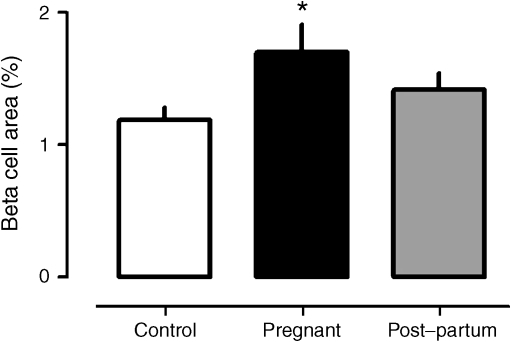
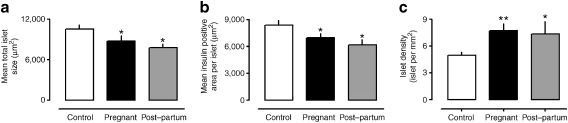
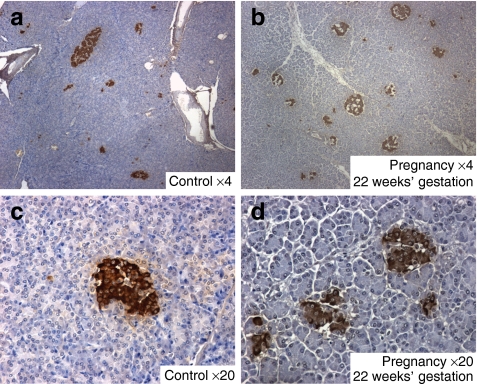
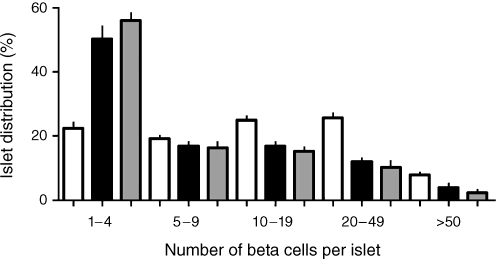
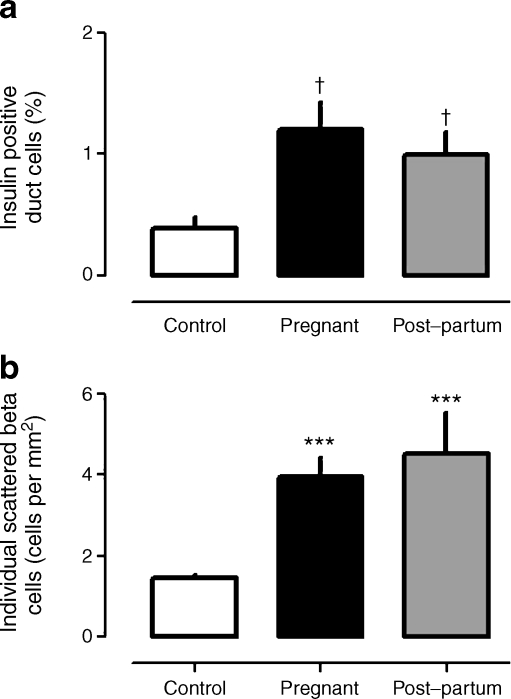
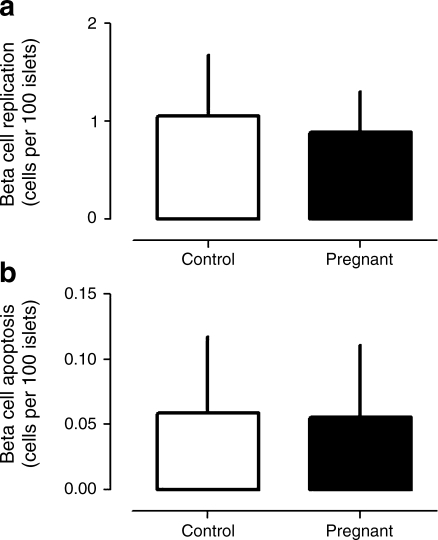
AIMS/HYPOTHESIS: We sought to establish the extent and basis for adaptive changes in beta cell numbers in human pregnancy. METHODS: Pancreas was obtained at autopsy from women who had died while pregnant (n = 18), post-partum (n = 6) or were not pregnant at or shortly before death (controls; n = 20). Pancreases were evaluated for fractional pancreatic beta cell area, islet size and islet fraction of beta cells, beta cell replication (Ki67) and apoptosis (TUNEL), and indirect markers of beta cell neogenesis (insulin-positive cells in ducts and scattered beta cells in pancreas). RESULTS: The pancreatic fractional beta cell area was increased by approximately 1.4-fold in human pregnancy, with no change in mean beta cell size. In pregnancy there were more small islets rather than an increase in islet size or beta cells per islet. No increase in beta cell replication or change in beta cell apoptosis was detected, but duct cells positive for insulin and scattered beta cells were increased with pregnancy. CONCLUSIONS/INTERPRETATION: The adaptive increase in beta cell numbers in human pregnancy is not as great as in most reports in rodents. This increase in humans is achieved by increased numbers of beta cells in apparently new small islets, rather than duplication of beta cells in existing islets, which is characteristic of pregnancy in rodents.
Overview
The claims and statistics of this paper haven’t been checked yet.
Free: it reads the open-access text and checks the first 5 claims that cite a source we can check. Create a free account to check every claim.
Integrity signals
Registry
Cites
Statistics
Figures
Verification
Claims the paper makes
The claims and statistics of this paper haven’t been checked yet.
Free: it reads the open-access text and checks the first 5 claims that cite a source we can check. Create a free account to check every claim.
Claims other papers make about this one
Each is checked against this paper’s own text: does it say what the citing paper says it does?
In the citing paper
“Although the mechanisms underlying pancreatic β-cell expansion in physiological settings may differ between species36,37, age-dependent restriction of β-cell proliferation is a conserved feature in mice and humans9,10.”
From PDGF signalling controls age-dependent proliferation in pancreatic β-cells (2011) · cites this paper as [36]
Self-check
Percentages, sums and reported differences re-computed from the paper’s own numbers.
The self-check needs the paper’s full text.
Citations
Cites
β-Cell Deficit and Increased β-Cell Apoptosis in Humans With Type 2 Diabetes
Butler, A. E., Janson, J., Bonner-Weir, S., Ritzel, R., Rizza, R. A., & Butler, P. C. (2003) · Diabetes · doi:10.2337/diabetes.52.1.102 · Cited by 4,011 · cited 4×
“In the former, a near complete loss of beta cell mass occurs [1], while in the latter, the deficit in beta cell mass is partial [2].”
BackgroundMethodInfluentialSelf-citationAdult pancreatic β-cells are formed by self-duplication rather than stem-cell differentiation
Dor, Y., Brown, J., Martinez, O. I., & Melton, D. A. (2004) · Nature · doi:10.1038/nature02520 · Cited by 2,219 · cited 1×
“Lineage studies in rodents have been interpreted as showing that replication of existing beta cells is the only potential source of new beta cells [20].”
BackgroundPathologic anatomy of the pancreas in juvenile diabetes mellitus
Gepts, W. (1965) · Diabetes · doi:10.2337/diab.14.10.619 · Cited by 1,345 · cited 1×
“In the former, a near complete loss of beta cell mass occurs [1], while in the latter, the deficit in beta cell mass is partial [2].”
BackgroundBuchanan, T. A., Xiang, A. H., Peters, R. K., Kjos, S. L., Marroquin, A., Goico, J., Ochoa, C., Tan, S., Berkowitz, K., Hodis, H. N., et al. (2002) · Diabetes · doi:10.2337/diabetes.51.9.2796 · Cited by 1,339
β Cells Can Be Generated from Endogenous Progenitors in Injured Adult Mouse Pancreas
Xu, X., D'Hoker, J., Stangé, G., Bonné, S., De Leu, N., Xiao, X., Van De Casteele, M., Mellitzer, G., Ling, Z., Pipeleers, D., et al. (2008) · Cell · doi:10.1016/j.cell.2007.12.015 · Cited by 988 · cited 1×
“Recent lineage tracing approaches have also been used to support the concept of beta cell neogenesis in rodents, but these obviously cannot be applied in humans [26, 27].”
BackgroundEndoplasmic reticulum stress contributes to beta cell apoptosis in type 2 diabetes
Laybutt, D. R., Preston, A. M., Åkerfeldt, M. C., Kench, J. G., Busch, A. K., Biankin, A. V., & Biden, T. J. (2007) · Diabetologia · doi:10.1007/s00125-006-0590-z · Cited by 830 · cited 1×
“Since beta cell failure in type 2 diabetes is best predicted by beta cell work load [29] and is characterised by endoplasmic stress [30, 31], it is not surprising that gestational diabetes occurs in those genetically predisposed to type 2 diabetes.”
BackgroundPancreatic β‐cell mass in European subjects with type 2 diabetes
Rahier, J., Guiot, Y., Goebbels, R. M., Sempoux, C., & Henquin, J. C. (2008) · Diabetes, Obesity and Metabolism · doi:10.1111/j.1463-1326.2008.00969.x · Cited by 756 · cited 1×
“Since obesity is associated with an increase in beta cell mass in humans [37], the failure of pancreatic fractional beta cell area to return to pre-pregnant levels in our post-partum women may have been due to the insulin resistance/ inflammation associated with the obesity.”
BackgroundLongitudinal changes in insulin release and insulin resistance in nonobese pregnant women
Catalano, P. M., Tyzbir, E. D., Roman, N. M., Amini, S. B., & Sims, E. A. H. (1991) · American Journal of Obstetrics and Gynecology · doi:10.1016/0002-9378(91)90012-g · Cited by 709 · cited 4×
“These findings are intriguing since it has previously been shown that the increment in first- and second-phase insulin release in response to glucose during pregnancy is present early in pregnancy (first trimester), while the insulin resistance that develops in pregnancy occurs later (third trimester) [7].”
BackgroundInfluentialMeier, J. J., Butler, A. E., Saisho, Y., Monchamp, T., Galasso, R., Bhushan, A., Rizza, R. A., & Butler, P. C. (2008) · Diabetes · doi:10.2337/db07-1369 · Cited by 683 · cited 1×
“By the same approach, moreover, we were readily able to detect beta cell replication in infants [15].”
Self-citationDynamics of β-cell Mass in the Growing Rat Pancreas: Estimation With a Simple Mathematical Model
Finegood, D. T., Scaglia, L., & Bonner-Weir, S. (1995) · Diabetes · doi:10.2337/diab.44.3.249 · Cited by 603
Research works printed but not linked: 2
- Wicksell SD (1926) The corpuscle problem II. Biometrika 18:151–172
- Bach G (1959) Uber die Grossenverteilung von Kugelschnitten in durchsichtigen Schnitten endlicher Dicke. Z Wiss Mikroskopie 64:265–270 (Article in German)
Cited by
Items 401–447 of 447
Influência da prática de exercício físico no pâncreas endócrino de ratas prenhes
MACEDO, N. C. D., & Damasceno, D. C. (2016) · Nutrição Brasil · doi:10.33233/nb.v15i2.223
The Role of Prolactin Receptors in Regulation of Pancreatic Beta Cell Mass and Function
Shrivastava, V. (2016) · Libraries and Cultural Resources (University of Calgary) · doi:10.11575/prism/28348 · Cited by 1
β-cell Heterogeneity: The Key to β-cell Replacement Therapy
Dirice, E. (2018) · Pancreas - Open Journal · doi:10.17140/poj-2-e009
Al-asadi, A. K., Al-Habib, M. F., Al-Kawaz, U. M. R., Selman, M. O., & Al-Ani, I. M. D. (2020) · IIUM Medical Journal Malaysia · doi:10.31436/imjm.v17i2.263
“These mechanisms comprise duplication of preexisting βcells, differentiation of progenitors within the ductal epithelium, trans-differentiation of acinar cells, and differentiation of pancreatic stem cells.(18,24) Other studies in humans proposed that development of new islets is not from the duplication of β-cell in…”
BackgroundResultCRITÉRIOS DE DIAGNÓSTICO DA DIABETES GESTACIONAL
Brandão, E. D. C., da Cruz, M. D. C., & Ferreira, B. (2011)
Metabolic effects of dipeptyl peptidase 4 inhibitor in type 2 diabetes
Macauley, M. (2016)
Gruber, B. L. M. (2021) · Mspace (University of Manitoba)
Maternal Hepatic Adaptations to Pregnancy
Nambiar, S. M. (2021) · Purdue e-Pubs (Purdue University System) · doi:10.25394/pgs.15044022.v1
Altered pancreas remodeling following glucose intolerance in pregnancy in mice
Szlapinski, S. K., Botros, A., Donegan, S., King, R., Retta, G., Strutt, B. J., & Hill, D. J. (2021) · Yearbook of pediatric endocrinology · doi:10.1530/ey.18.2.17
Balahmar, R. M. (2021) · Stem cell biology and regenerative medicine · doi:10.1007/978-3-030-78101-9_7
Penno, J. R. C. Z. (2021) · Digital Library of Theses and Dissertations (Universidade de São Paulo) · doi:10.11606/t.5.2021.tde-11012022-095518 · Cited by 1
Regenerative Medicine for Diabetes
White, M. G., Ellis, C. E., & Kieffer, T. J. (2022) · doi:10.1093/med/9780198870197.003.0263
Esposito, I., & Häberle, L. (2021) · Encyclopedia of pathology · doi:10.1007/978-3-319-28845-1_5524-1
100 anni dopo l’insulina: cosa ancora non sappiamo della sua secrezione nel diabete di tipo 2
Giuseppe, G. D., Mezza, T., Cinti, F., & Giaccari, A. (2022) · il Diabete · doi:10.30682/ildia2201c
Esposito, I., & Häberle, L. (2022) · Encyclopedia of pathology · doi:10.1007/978-3-030-62416-3_5524
Liboz, A. (2022) · theses.fr (ABES) · doi:10.70675/9abd3277zd4c4z48f5za637z73aeb8a7a807 · Cited by 1
Loss-of-function of ALDH3B2 transdifferentiates human pancreatic duct cells into beta-like cellsPreprint
Li, J., Bode, K., Lee, Y., Morrow, N., Ma, A., Wei, S., Pereira, J. D. S., Stewart, T., Lee-Papastavros, A., Hollister‐Lock, J., et al. (2024) · bioRxiv (Cold Spring Harbor Laboratory) · doi:10.1101/2024.05.13.593941
Association of Childbirth and Breastfeeding with Diabetes Mellitus in Korean Women
Kim, S., & Ryu, S. Y. (2024) · Journal of Health Informatics and Statistics · doi:10.21032/jhis.2024.49.2.109
“동안 분비되는 임신 호르몬으로 인해 인슐린 저항성 증가가 일어나고 , 이때 일어나는 췌장의 베타 ( β ) 세포 증식은 임신성 당뇨병을 유발하고 , 이는 출산 이후 여성의 당뇨병 발생과도 관련이 있다 [2].”
Loss-of-function of ALDH3B2 transdifferentiates human pancreatic duct cells into beta-like cellsPreprint
Peng, Y., Li, J., Lee, Y., Morrow, N., Hollister‐Lock, J., Sullivan, B., Stewart, T., Wei, S., Pereira, J. A. D. S., Lee-Papastavros, A., et al. (2024) · Research Square · doi:10.21203/rs.3.rs-2222452/v1
Darwish, R., Alcibahy, Y., Nandakumar, M., Butler, A. E., & Moin, A. S. M. (2025) · Stem Cell Research & Therapy · doi:10.1186/s13287-025-04739-y
“During pregnancy, the β-cell fractional area increases modestly by approximately 1.4-fold, yet studies of human pancreata have not detected a corresponding rise in proliferation markers, implying that expansion occurs largely without substantial replication [17].”
InfluentialSelf-citationKehm, R. (2020) · publish.UP (University of Potsdam) · doi:10.25932/publishup-44109
Oropeza, M. A. A. (2021) · Universidad Peruana Cayetano Heredia Institutional Repository
Maternal metabolic health and neurodevelopmental conditions in offspring
Chen, S. (2023) · Open Archive (Karolinska Institutet)
Chen, Y.-F., & Wang, L.-H. (2025) · Gynecological Endocrinology · doi:10.1080/09513590.2025.2607806
Liu, T., Liang, R., Zhang, L., Ma, W., Xiangyu, W. A. N. G., Ren, H., & Wang, S. (2026) · bioRxiv (Cold Spring Harbor Laboratory) · doi:10.64898/2026.01.29.701913
Adaptive changes of human islets to an obesogenic environment in the mouse
Gargani, S. (2013) · theses.fr (ABES) · doi:10.70675/cebf7176z1bb8z414bzb159ze850f327d2d5
Contrôle de la masse fonctionnelle des cellules β pancréatiques par les glucocorticoïdes et pgc-1α
Besseiche, A. (2015) · theses.fr (ABES) · doi:10.70675/f16ecd6fza687z4a5fzac34zc26774dc9c3f
Dédifférenciation de la cellule bêta pancréatique humaine
Diedisheim, M. (2017) · theses.fr (ABES) · doi:10.70675/9c2e56d4za035z4fa3zafa6z7786e388a812
Rôle des Sérine/Thréonine Kinases dans la cellule bêta pancréatique
Tenenbaum, M. (2018) · theses.fr (ABES) · doi:10.70675/f6355ceazdfe4z4dc2za371z03c7f4f2206b
Effets des oméga-3 et de leurs dérivés oxygénés dans le diabète de type 2
Legroux, I. (2024) · theses.fr (ABES) · doi:10.70675/b865e951z5bdfz4cfaz8162z25ab321cfd7b
Delta‐Cell Area is Unchanged in Human Pregnancy: Evidence From Immunohistochemistry
Seedat, F., Kandžija, N., Drydale, E., Holden, K. L., Bancroft, J. M., Todd, J. A., Stefana, M. I., & Vatish, M. (2026) · Biology of the Cell · doi:10.1111/boc.70067
Zubrzycki, M., Kuśmierczyk, M., Gummert, J. F., Costard‐Jäckle, A., Paluszkiewicz, L., Hecht, T., Birschmann, I., Zubrzycka, A., & Zubrzycka, M. (2026) · Metabolites · doi:10.3390/metabo16050341
Integrated histological and proteomic mapping of pancreatic adaptations during porcine pregnancyPreprint
Karampelias, C., Badeke, S., von Toerne, C., den Bosch, M. M. V., Veselinovic, D., Yang, K., Wolf, E., Kemter, E., & Lickert, H. (2026) · bioRxiv (Cold Spring Harbor Laboratory) · doi:10.64898/2026.05.19.726186
Lee, Y., Tong, M., & Gloyn, A. L. (2026) · FEBS Letters · doi:10.1002/1873-3468.70436
Heterogeneity in cell-cycle dynamics of synthetic mRNA-induced β-cell proliferationPreprint
Bittenglová, K., Zacharovová, K., Tichánek, F., Leontovyč, I., Girman, P., Kříž, J., Saudek, F., & Koblas, T. (2026) · bioRxiv (Cold Spring Harbor Laboratory) · doi:10.64898/2026.09.11.750925
“Physiological conditions such as pregnancy or non-diabetic obesity can induce a modest increase in β-cell mass as an adaptive response to elevated insulin demand (Butler et al , 2010; Saisho et al , 2013; Van Assche et al , 1978).”
Pascua‐Maestro, R., Sartorius-Yáñez, A. M., de la Red, S. H., Boronat‐Belda, T., Arévalo‐Martínez, M., Martín-Martín, M., Royo, M., López‐Corrales, M., Pascual, N., Marco, M. ‐., et al. (2026) · bioRxiv (Cold Spring Harbor Laboratory) · doi:10.64898/2026.09.10.750557
Osman, W. (2026) · Diabetes, Obesity and Metabolism · doi:10.1111/dom.71404
Maternal PFOS exposure impairs β-cell insulin secretion and glucose tolerance in rats
Hofmann, A., Yadav, P., Song, R., Dangudubiyyam, S. V., Mishra, J. S., & Kumar, S. (2026) · Toxicological Sciences · doi:10.1093/toxsci/kfag137
Experimental animal models of GDM
Trivedi, K., & Dolinsky, V. W. (2026) · Elsevier eBooks · doi:10.1016/b978-0-443-13265-0.00012-4
Metadata
- Authors
- Butler, A. E., Cao-Minh, L., Galasso, R., Rizza, R. A., Corradin, A., Cobelli, C., & Butler, P. C.
- Affiliations
- University of California, Los Angeles (US)
- Mayo Clinic (US)
- University of Padua (IT)
- Corresponding author
- Butler, P. C.
- Venue
- Diabetologia
- Published
- 2010-06-05
- Volume
- 53
- Issue
- 10
- Pages
- 2167-2176
- ISSN
- 0012-186X (ISSN-L)
- 1432-0428
- PMC
- PMC2931643
- OpenAlex
- W2036800308
- Cited by
- 435
- References
- 36
- Citations by year
- 2026: 14 · 2025: 17 · 2024: 24 · 2023: 24 · 2022: 31 · 2021: 39 · 2020: 30 · 2019: 34 · 2018: 26 · 2017: 26 · 2016: 27 · 2015: 24 · 2014: 31 · 2013: 31 · 2012: 28
- FWCI
- 29.34
- Type
- journal article
- Language
- en
- Open access
- hybrid
- doi.org
- Licence
- cc-by-nc
- Locations
- Diabetologia (publishedVersion, cc-by-nc)
- PubMed Central (publishedVersion, cc-by-nc)
- PubMed (publishedVersion)
- eScholarship (California Digital Library) (submittedVersion)
- Padua Research Archive (University of Padova) (submittedVersion, cc-by-nc)
- Funders
- Larry L. Hillblom Foundation
- National Institute of Diabetes and Digestive and Kidney Diseases (DK-061539, R01DK061539, DK059579, #DK077967, R01DK077967, R01DK059579)
- Topics
- Health Sciences › Medicine › Endocrinology, Diabetes and Metabolism › Pancreatic function and diabetes
- Health Sciences › Medicine › Obstetrics and Gynecology › Gestational Diabetes Research and Management
- Life Sciences › Biochemistry, Genetics and Molecular Biology › Genetics › Diabetes and associated disorders
- Keywords
- pancreatic beta cells, beta-cell turnover, human pregnancy, beta-cell neogenesis, beta-cell proliferation, Ki-67, TUNEL, islet size
- MeSH terms
- Adolescent, Adult, Cell Count, Female, Humans, Immunohistochemistry, Insulin, Pregnancy, Apoptosis, Cell Size, Cell Proliferation, Insulin-Secreting Cells
About these checks
Registry, retraction, Cites and statistics results are computed, not judged, with one exception: a printed reference that no index lists is read once by a model before it counts as a citation error. Claims are extracted by a model and kept only when their quote appears verbatim in the text; each cited source is then checked, with a model’s help, for whether it says what the claim relies on. Those verdicts can be wrong — read the claim’s quote and the cited source before relying on one.
Statistics and arithmetic are recomputed, not judged.
Confidence bands are shown only for fields calibrated on our annotated test set. None is calibrated yet, so no band is shown.
What counts as a claim ›How we measure confidence ›How we check this ›
Are you an author, or do you see a problem with this page? Request a review
Data sources
Bibliographic data: Semantic Scholar, OpenAlex, Crossref.
Contains information from the Semantic Scholar Academic Graph Datasets, made available under the ODC Attribution License (ODC-BY 1.0).
Semantic Scholar’s data is described in: Kinney, R., et al. (2023). The Semantic Scholar Open Data Platform. arXiv:2301.10140.
