

Adaptive changes in pancreatic beta cell fractional area and beta cell turnover in human pregnancy
Open accessThe DOI matches its Crossref record; 39 of the 39 references it cites were found in a registry or an index.
Abstract
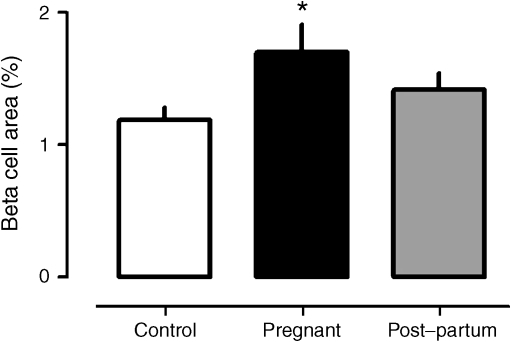
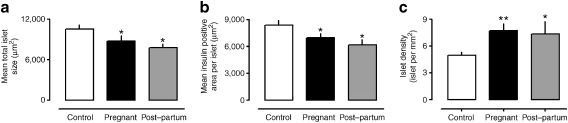
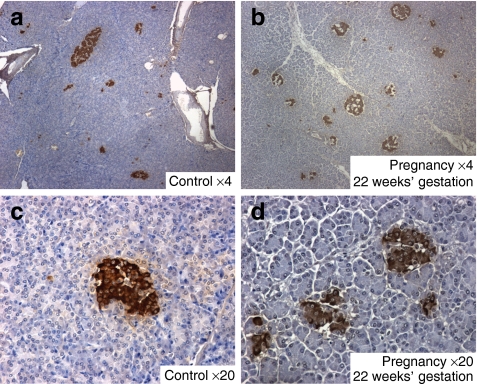
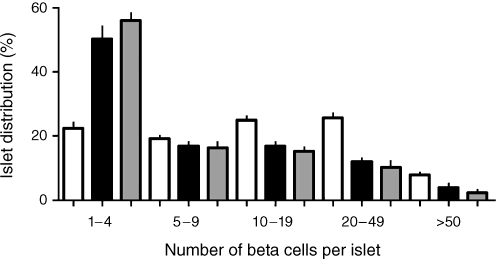
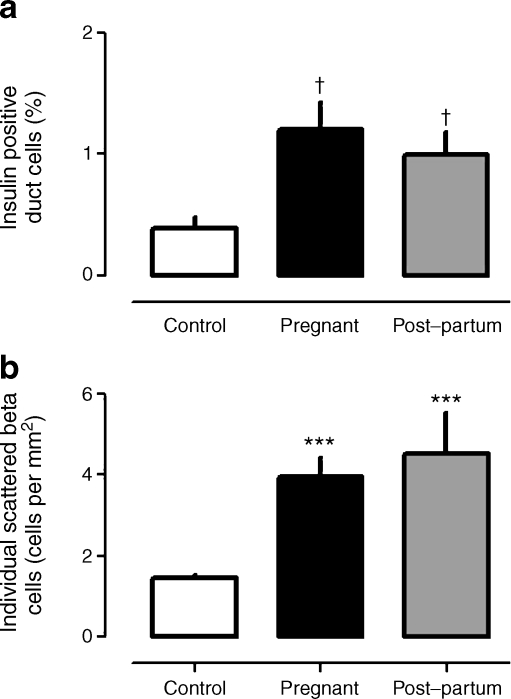
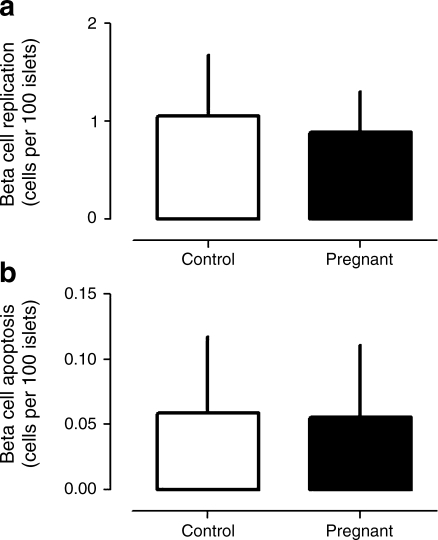
AIMS/HYPOTHESIS: We sought to establish the extent and basis for adaptive changes in beta cell numbers in human pregnancy. METHODS: Pancreas was obtained at autopsy from women who had died while pregnant (n = 18), post-partum (n = 6) or were not pregnant at or shortly before death (controls; n = 20). Pancreases were evaluated for fractional pancreatic beta cell area, islet size and islet fraction of beta cells, beta cell replication (Ki67) and apoptosis (TUNEL), and indirect markers of beta cell neogenesis (insulin-positive cells in ducts and scattered beta cells in pancreas). RESULTS: The pancreatic fractional beta cell area was increased by approximately 1.4-fold in human pregnancy, with no change in mean beta cell size. In pregnancy there were more small islets rather than an increase in islet size or beta cells per islet. No increase in beta cell replication or change in beta cell apoptosis was detected, but duct cells positive for insulin and scattered beta cells were increased with pregnancy. CONCLUSIONS/INTERPRETATION: The adaptive increase in beta cell numbers in human pregnancy is not as great as in most reports in rodents. This increase in humans is achieved by increased numbers of beta cells in apparently new small islets, rather than duplication of beta cells in existing islets, which is characteristic of pregnancy in rodents.
Overview
The claims and statistics of this paper haven’t been checked yet.
Free: it reads the open-access text and checks the first 5 claims that cite a source we can check. Create a free account to check every claim.
Integrity signals
Registry
Cites
Statistics
Figures
Verification
Claims the paper makes
The claims and statistics of this paper haven’t been checked yet.
Free: it reads the open-access text and checks the first 5 claims that cite a source we can check. Create a free account to check every claim.
Claims other papers make about this one
Each is checked against this paper’s own text: does it say what the citing paper says it does?
In the citing paper
“Although the mechanisms underlying pancreatic β-cell expansion in physiological settings may differ between species36,37, age-dependent restriction of β-cell proliferation is a conserved feature in mice and humans9,10.”
From PDGF signalling controls age-dependent proliferation in pancreatic β-cells (2011) · cites this paper as [36]
Self-check
Percentages, sums and reported differences re-computed from the paper’s own numbers.
The self-check needs the paper’s full text.
Citations
Cites
β-Cell Deficit and Increased β-Cell Apoptosis in Humans With Type 2 Diabetes
Butler, A. E., Janson, J., Bonner-Weir, S., Ritzel, R., Rizza, R. A., & Butler, P. C. (2003) · Diabetes · doi:10.2337/diabetes.52.1.102 · Cited by 4,011 · cited 4×
“In the former, a near complete loss of beta cell mass occurs [1], while in the latter, the deficit in beta cell mass is partial [2].”
BackgroundMethodInfluentialSelf-citationAdult pancreatic β-cells are formed by self-duplication rather than stem-cell differentiation
Dor, Y., Brown, J., Martinez, O. I., & Melton, D. A. (2004) · Nature · doi:10.1038/nature02520 · Cited by 2,219 · cited 1×
“Lineage studies in rodents have been interpreted as showing that replication of existing beta cells is the only potential source of new beta cells [20].”
BackgroundPathologic anatomy of the pancreas in juvenile diabetes mellitus
Gepts, W. (1965) · Diabetes · doi:10.2337/diab.14.10.619 · Cited by 1,345 · cited 1×
“In the former, a near complete loss of beta cell mass occurs [1], while in the latter, the deficit in beta cell mass is partial [2].”
BackgroundBuchanan, T. A., Xiang, A. H., Peters, R. K., Kjos, S. L., Marroquin, A., Goico, J., Ochoa, C., Tan, S., Berkowitz, K., Hodis, H. N., et al. (2002) · Diabetes · doi:10.2337/diabetes.51.9.2796 · Cited by 1,339
β Cells Can Be Generated from Endogenous Progenitors in Injured Adult Mouse Pancreas
Xu, X., D'Hoker, J., Stangé, G., Bonné, S., De Leu, N., Xiao, X., Van De Casteele, M., Mellitzer, G., Ling, Z., Pipeleers, D., et al. (2008) · Cell · doi:10.1016/j.cell.2007.12.015 · Cited by 988 · cited 1×
“Recent lineage tracing approaches have also been used to support the concept of beta cell neogenesis in rodents, but these obviously cannot be applied in humans [26, 27].”
BackgroundEndoplasmic reticulum stress contributes to beta cell apoptosis in type 2 diabetes
Laybutt, D. R., Preston, A. M., Åkerfeldt, M. C., Kench, J. G., Busch, A. K., Biankin, A. V., & Biden, T. J. (2007) · Diabetologia · doi:10.1007/s00125-006-0590-z · Cited by 830 · cited 1×
“Since beta cell failure in type 2 diabetes is best predicted by beta cell work load [29] and is characterised by endoplasmic stress [30, 31], it is not surprising that gestational diabetes occurs in those genetically predisposed to type 2 diabetes.”
BackgroundPancreatic β‐cell mass in European subjects with type 2 diabetes
Rahier, J., Guiot, Y., Goebbels, R. M., Sempoux, C., & Henquin, J. C. (2008) · Diabetes, Obesity and Metabolism · doi:10.1111/j.1463-1326.2008.00969.x · Cited by 756 · cited 1×
“Since obesity is associated with an increase in beta cell mass in humans [37], the failure of pancreatic fractional beta cell area to return to pre-pregnant levels in our post-partum women may have been due to the insulin resistance/ inflammation associated with the obesity.”
BackgroundLongitudinal changes in insulin release and insulin resistance in nonobese pregnant women
Catalano, P. M., Tyzbir, E. D., Roman, N. M., Amini, S. B., & Sims, E. A. H. (1991) · American Journal of Obstetrics and Gynecology · doi:10.1016/0002-9378(91)90012-g · Cited by 709 · cited 4×
“These findings are intriguing since it has previously been shown that the increment in first- and second-phase insulin release in response to glucose during pregnancy is present early in pregnancy (first trimester), while the insulin resistance that develops in pregnancy occurs later (third trimester) [7].”
BackgroundInfluentialMeier, J. J., Butler, A. E., Saisho, Y., Monchamp, T., Galasso, R., Bhushan, A., Rizza, R. A., & Butler, P. C. (2008) · Diabetes · doi:10.2337/db07-1369 · Cited by 683 · cited 1×
“By the same approach, moreover, we were readily able to detect beta cell replication in infants [15].”
Self-citationDynamics of β-cell Mass in the Growing Rat Pancreas: Estimation With a Simple Mathematical Model
Finegood, D. T., Scaglia, L., & Bonner-Weir, S. (1995) · Diabetes · doi:10.2337/diab.44.3.249 · Cited by 603
Research works printed but not linked: 2
- Wicksell SD (1926) The corpuscle problem II. Biometrika 18:151–172
- Bach G (1959) Uber die Grossenverteilung von Kugelschnitten in durchsichtigen Schnitten endlicher Dicke. Z Wiss Mikroskopie 64:265–270 (Article in German)
Cited by
Pettersson, U. S., Waldén, T. B., Carlsson, P.-O., Jansson, L., & Phillipson, M. (2012) · PLoS ONE · doi:10.1371/journal.pone.0046057 · Cited by 520
“obesity and pregnancy, the b-cell mass increases [15,16,17].”
BackgroundChen, C., Cohrs, C. M., Stertmann, J., Bozsak, R., & Speier, S. (2017) · Molecular Metabolism · doi:10.1016/j.molmet.2017.06.019 · Cited by 489
“This is not surprising as beta cells demonstrate strong functional plasticity in response to physiological regulation [194e196] or treatment [197,198], while beta cell mass changes in humans are comparatively moderate [73,199].”
BackgroundTaylor, R. (2013) · Diabetes Care · doi:10.2337/dc12-1805 · Cited by 485
“In light of new knowledge about b-cell apoptosis and rates of turnover during adult life, it is conceivable that removal of adverse factors could result in restoration of normalb-cell number, even late in the disease (66,70).”
Alterations in Physiology and Anatomy during Pregnancy
Tan, E. K., & Tan, E. L. (2013) · Best Practice & Research Clinical Obstetrics & Gynaecology · doi:10.1016/j.bpobgyn.2013.08.001 · Cited by 484
“Insulin secretion increases due to hyperplasia of beta cells in the pancreas [59].”
Backgroundβ-Cell Mass and Turnover in Humans
Saisho, Y., Butler, A. E., Manesso, E., Elashoff, D., Rizza, R. A., & Butler, P. C. (2013) · Diabetes Care · doi:10.2337/dc12-0421 · Cited by 402
Self-citationZhou, Q., & Melton, D. A. (2018) · Nature · doi:10.1038/s41586-018-0088-0 · Cited by 385
Pancreatic β-cell identity, glucose sensing and the control of insulin secretion
Rutter, G. A., Pullen, T. J., Hodson, D. J., & Martinez-Sanchez, A. (2015) · Biochemical Journal · doi:10.1042/bj20141384 · Cited by 339
Formation of a human β-cell population within pancreatic islets is set early in life
Gregg, B. E., Moore, P. C., Demozay, D., Hall, B. A., Li, M., Husain, A., Wright, A. J., Atkinson, M. A., & Rhodes, C. J. (2012) · The Journal of Clinical Endocrinology & Metabolism · doi:10.1210/jc.2012-1206 · Cited by 344
Benner, C., van der Meulen, T., Cacéres, E., Tigyi, K., Donaldson, C. J., & Huising, M. O. (2014) · BMC Genomics · doi:10.1186/1471-2164-15-620 · Cited by 302
“However, efforts to use PRL or GH to induce human beta cell proliferation in vitro have been largely unsuccessful [52,53] and expansion of human beta cell mass during pregnancy is modest compared to mouse and driven by neogenesis instead of beta cell proliferation [54].”
Understanding the mechanisms of reversal of type 2 diabetes
Taylor, R., Al-Mrabeh, A., & Sattar, N. (2019) · The Lancet Diabetes & Endocrinology · doi:10.1016/s2213-8587(19)30076-2 · Cited by 299
Anatomical and physiological alterations of pregnancy
Kazma, J. M., van den Anker, J., Allegaert, K., Dallmann, A., & Ahmadzia, H. K. (2020) · Journal of Pharmacokinetics and Pharmacodynamics · doi:10.1007/s10928-020-09677-1 · Cited by 238
PDGF signalling controls age-dependent proliferation in pancreatic β-cells
Chen, H., Gu, X., Liu, Y., Wang, J., Wirt, S. E., Bottino, R., Schorle, H., Sage, J., & Kim, S. K. (2011) · Nature · doi:10.1038/nature10502 · Cited by 278
β-cell dysfunction: Its critical role in prevention and management of type 2 diabetes
Saisho, Y. (2015) · World Journal of Diabetes · doi:10.4239/wjd.v6.i1.109 · Cited by 263
Targeting the pancreatic β-cell to treat diabetes
Vetere, A., Choudhary, A., Burns, S. M., & Wagner, B. K. (2014) · Nature Reviews Drug Discovery · doi:10.1038/nrd4231 · Cited by 252
Natural history of β-cell adaptation and failure in type 2 diabetes
Alejandro, E. U., Gregg, B., Blandino-Rosano, M., Cras-Méneur, C., & Bernal-Mizrachi, E. (2015) · Molecular Aspects of Medicine · doi:10.1016/j.mam.2014.12.002 · Cited by 232
Pancreatic β Cell Regeneration as a Possible Therapy for Diabetes
Aguayo-Mazzucato, C., & Bonner-Weir, S. (2018) · Cell Metabolism · doi:10.1016/j.cmet.2017.08.007 · Cited by 237
β-Cell Growth and Regeneration: Replication Is Only Part of the Story
Bonner-Weir, S., Li, W.-C., Ouziel-Yahalom, L., Guo, L., Weir, G. C., & Sharma, A. (2010) · Diabetes · doi:10.2337/db10-0084 · Cited by 234
“Additionally, in contrast to the data from rodents, the adaptive increase in -cells during pregnancy in humans is accompanied by decreased mean islet size, increased number of -cells in “apparently new small islets” with no change in -cell size, replication, or apoptosis frequency (15).”
ResultVirgin Beta Cells Persist throughout Life at a Neogenic Niche within Pancreatic Islets
van der Meulen, T., Mawla, A. M., DiGruccio, M. R., Adams, M. W., Nies, V., Dólleman, S., Liu, S., Ackermann, A. M., Cáceres, E., Hunter, A. E., et al. (2017) · Cell Metabolism · doi:10.1016/j.cmet.2017.03.017 · Cited by 220
“They have long been considered less reliant on beta cell replication (Butler et al., 2010), although standard replication markers may underestimate human beta cell proliferation rates during post-mortem conditions (Sullivan et al., 2015).”
BackgroundHow to make a functional β-cell
Pagliuca, F. W., & Melton, D. A. (2013) · Development · doi:10.1242/dev.093187 · Cited by 216
“The replication of β-cells also increases during pregnancy, potentially via the activities of prolactin and placental lactogen, although the increase in β-cell mass may be less in humans than in rodents (Butler et al., 2010; Parsons et al., 1992; Van Assche et al., 1978).”
BackgroundO'Sullivan, E. S., Vegas, A., Anderson, D. G., & Weir, G. C. (2011) · Endocrine Reviews · doi:10.1210/er.2010-0026 · Cited by 207
Insulin Resistance Alters Islet Morphology in Nondiabetic Humans
Mezza, T., Muscogiuri, G., Sorice, G. P., Clemente, G., Hu, J., Pontecorvi, A., Holst, J. J., Giaccari, A., & Kulkarni, R. N. (2014) · Diabetes · doi:10.2337/db13-1013 · Cited by 206
“89390, reacting equally with intact GLP-1 (7-36) amide and its primary N-terminally truncated metabolite GLP-1 (9-36) amide.”
Backgroundβ-cell adaptation in pregnancy
Baeyens, L., Hindi, S., Sorenson, R. L., & German, M. S. (2016) · Diabetes, Obesity and Metabolism · doi:10.1111/dom.12716 · Cited by 210
“4-fold, based on two autopsy series.(12,16) The mechanisms for this β-cell expansion in”
BackgroundDiabetes mellitus—advances and challenges in human β-cell proliferation
Wang, P., Fiaschi-Taesch, N. M., Vasavada, R. C., Scott, D. K., García-Ocaña, A., & Stewart, A. F. (2015) · Nature Reviews Endocrinology · doi:10.1038/nrendo.2015.9 · Cited by 205
Inadequate β-cell mass is essential for the pathogenesis of type 2 diabetes
Weir, G. C., Gaglia, J., & Bonner-Weir, S. (2020) · The Lancet Diabetes & Endocrinology · doi:10.1016/s2213-8587(20)30022-x · Cited by 194
Type 2 Diabetes and the Aging Pancreatic Beta Cell
Gunasekaran, U., & Gannon, M. (2011) · Aging · doi:10.18632/aging.100350 · Cited by 183
“In contrast, a review of 44 human pancreata from pregnant, postpartum, and non-pregnant women at autopsy suggested that the increase in insulin-positive area in pregnant and post-partum women was most likely due to islet neogenesis rather than proliferation [53].”
ResultMicroRNA Signatures as Future Biomarkers for Diagnosis of Diabetes States
Vasu, S., Kumano, K., Darden, C. M., Rahman, I., Lawrence, M. C., & Naziruddin, B. (2019) · Cells · doi:10.3390/cells8121533 · Cited by 179
“Placental lactogens induce beta-cell mass expansion, and islet neogenesis (in humans) has been demonstrated [96].”
BackgroundLoomans, C. J. M., Williams Giuliani, N., Balak, J., Ringnalda, F., van Gurp, L., Huch, M., Boj, S. F., Sato, T., Kester, L., de Sousa Lopes, S. M. C., et al. (2018) · Stem Cell Reports · doi:10.1016/j.stemcr.2018.02.005 · Cited by 166
“Histological studies of human pancreas indicate that neogenesis of insulin-producing cells is associated with the ductal tree in obesity and pregnancy (Butler et al., 2003, 2010).”
MicroRNAs contribute to compensatory β cell expansion during pregnancy and obesity
Jacovetti, C., Abderrahmani, A., Parnaud, G., Jonas, J.-C., Peyot, M.-L., Cornu, M., Laybutt, R., Meugnier, E., Rome, S., Thorens, B., et al. (2012) · Journal of Clinical Investigation · doi:10.1172/jci64151 · Cited by 171
“Pregnancy is the strongest physiological stimulus inducing β cell mass plasticity (9–11).”
New Insights Into Gestational Glucose Metabolism: Lessons Learned From 21st Century Approaches
Angueira, A. R., Ludvik, A. E., Reddy, T. E., Wicksteed, B., Lowe, W. L., & Layden, B. T. (2015) · Diabetes · doi:10.2337/db14-0877 · Cited by 160
“Of importance, the research described above has been performed almost exclusively in rodent models, and there are likely differences in b-cell adaptations during pregnancy between humans and rodents, as has been previously reported (12).”
Backgroundβ-Cell Fate in Human Insulin Resistance and Type 2 Diabetes: A Perspective on Islet Plasticity
Mezza, T., Cinti, F., Cefalo, C. M. A., Pontecorvi, A., Kulkarni, R. N., & Giaccari, A. (2019) · Diabetes · doi:10.2337/db18-0856 · Cited by 154
“In contrast to data in rodents (36,37), studies in humans, to date, have found no evidence of replication or apoptosis of b-cells in insulin resistance–induced islet remodeling, whereas increased proportions of small islets, increased numbers of insulin cells within the ducts, and increased numbers in singlet insulin…”
ResultDysfunction of Persisting β Cells Is a Key Feature of Early Type 2 Diabetes Pathogenesis
Cohrs, C. M., Panzer, J. K., Drotar, D. M., Enos, S. J., Kipke, N., Chen, C., Bozsak, R., Schöniger, E., Ehehalt, F., Distler, M., et al. (2020) · Cell Reports · doi:10.1016/j.celrep.2020.03.033 · Cited by 166
“This was slightly less than the fractional area previously reported from histological studies (Butler et al., 2010; Wang et al., 2013).”
ResultMaternal outcomes and follow‐up after gestational diabetes mellitus
Kim, C. (2014) · Diabetic Medicine · doi:10.1111/dme.12382 · Cited by 149
Pancreatic diabetes manifests when beta cell area declines by approximately 65% in humans
Meier, J. J., Breuer, T. G. K., Bonadonna, R. C., Tannapfel, A., Uhl, W. H., Schmidt, W. E., Schrader, H., & Menge, B. (2012) · Diabetologia · doi:10.1007/s00125-012-2466-8 · Cited by 160
“Furthermore, the calculation of beta cell area as a surrogate of beta cell mass is in line with numerous previous studies in human pancreatic tissue [11–15].”
ResultReplication confers β cell immaturity
Puri, S., Roy, N., Russ, H. A., Leonhardt, L., French, E. K., Roy, R., Bengtsson, H., Scott, D. K., Stewart, A. F., & Hebrok, M. (2018) · Nature Communications · doi:10.1038/s41467-018-02939-0 · Cited by 151
Human β-Cell Proliferation and Intracellular Signaling: Part 3
Stewart, A. F., Hussain, M. A., García-Ocaña, A., Vasavada, R. C., Bhushan, A., Bernal-Mizrachi, E., & Kulkarni, R. N. (2015) · Diabetes · doi:10.2337/db14-1843 · Cited by 142
“administration of parathyroid hormone-related peptide(1-36) stimulates endogenous beta cell proliferation while preserving function in adult mice.”
BackgroundBeta cells in type 1 diabetes: mass and function; sleeping or dead?
Oram, R. A., Sims, E. K., & Evans‐Molina, C. (2019) · Diabetologia · doi:10.1007/s00125-019-4822-4 · Cited by 149
Adenosine kinase inhibition selectively promotes rodent and porcine islet β-cell replication
Annes, J. P., Kenty, J. H.-R., Lam, K., Carolan, P. J., Utz, K., Hollister‐Lock, J., Arvanites, A. C., Rubin, L. L., Weir, G. C., & Melton, D. A. (2012) · Proceedings of the National Academy of Sciences · doi:10.1073/pnas.1201149109 · Cited by 155
Alterations in Beta Cell Identity in Type 1 and Type 2 Diabetes
Moin, A. S. M., & Butler, A. E. (2019) · Current Diabetes Reports · doi:10.1007/s11892-019-1194-6 · Cited by 147
Self-citationPancreatic β-Cell Proliferation in Obesity
Linnemann, A. K., Baan, M., & Davis, D. B. (2014) · Advances in Nutrition · doi:10.3945/an.113.005488 · Cited by 132
Gestational Diabetes Mellitus From Inactivation of Prolactin Receptor and MafB in Islet β-Cells
Banerjee, R. R., Cyphert, H. A., Walker, E. M., Chakravarthy, H., Peiris, H., Gu, X., Liu, Y., Conrad, E., Goodrich, L., Stein, R. W., et al. (2016) · Diabetes · doi:10.2337/db15-1527 · Cited by 131
“Prior studies suggest that human b-cells expand in pregnancy, but the molecular and cellular basis of this is not clear (43,44).”
BackgroundResultYoneda, S., Uno, S., Iwahashi, H., Fujita, Y., Yoshikawa, A., Kozawa, J., Okita, K., Takiuchi, D., Eguchi, H., Nagano, H., et al. (2013) · The Journal of Clinical Endocrinology & Metabolism · doi:10.1210/jc.2012-3832 · Cited by 121
Moyce, B. L., & Dolinsky, V. W. (2018) · International Journal of Molecular Sciences · doi:10.3390/ijms19113467 · Cited by 128
“These adaptations have been well characterized in human pregnancy [12].”
BackgroundInfluentialPancreatic β-cell identity in diabetes
Remedi, M. S., & Emfinger, C. (2016) · Diabetes, Obesity and Metabolism · doi:10.1111/dom.12727 · Cited by 128
Demirci, C., Ernst, S., Alvarez-Perez, J. C., Rosa, T., Valle, S., Shridhar, V., Casinelli, G. P., Alonso, L. C., Vasavada, R. C., & García-Ocana, A. (2012) · Diabetes · doi:10.2337/db11-1154 · Cited by 116
Wang, Y., Lanzoni, G., Carpino, G., Cui, C.-B., Domínguez‐Bendala, J., Wauthier, E., Cardinale, V., Oikawa, T., Pileggi, A., Gerber, D. A., et al. (2013) · Stem Cells · doi:10.1002/stem.1460 · Cited by 125
“Signs of human betacell replication and expression of beta-cell markers in pancreatic ductal structures have been described in situations such as pregnancy [11] or with underlying inflammation (e.”
BackgroundPlacental Nutrient Transport in Gestational Diabetic Pregnancies
Castillo-Castrejon, M., & Powell, T. L. (2017) · Frontiers in Endocrinology · doi:10.3389/fendo.2017.00306 · Cited by 112
“In pregnancy, insulin secretion increases due to hyperplasia of beta cells in the pancreas (17).”
BackgroundMechanisms in the adaptation of maternal β-cells during pregnancy
Ernst, S., Demirci, C., Valle, S., Velazquez-Garcia, S., & Garcia-Ocaña, A. (2011) · Diabetes Management · doi:10.2217/dmt.10.24 · Cited by 109
Zhong, F., & Jiang, Y. (2019) · Frontiers in Endocrinology · doi:10.3389/fendo.2019.00101 · Cited by 108
β-Cell Deficit in Obese Type 2 Diabetes, a Minor Role of β-Cell Dedifferentiation and Degranulation
Butler, A. E., Dhawan, S., Hoang, J., Cory, M., Zeng, K., Fritsch, H., Meier, J. J., Rizza, R. A., & Butler, P. C. (2016) · The Journal of Clinical Endocrinology & Metabolism · doi:10.1210/jc.2015-3566 · Cited by 109
Self-citationNon-Coding RNA: Role in Gestational Diabetes Pathophysiology and Complications
Filardi, T., Catanzaro, G., Mardente, S., Zicari, A., Santangelo, C., Lenzi, A., Morano, S., & Ferretti, E. (2020) · International Journal of Molecular Sciences · doi:10.3390/ijms21114020 · Cited by 120
“Hypertrophy and hyperplasia of β-cell mass, explained by enhanced proliferation and reduced apoptosis, have been reported in human pregnancy [21].”
BackgroundLong-term expansion, genomic stability and in vivo safety of adult human pancreas organoids
Georgakopoulos, N., Prior, N., Angres, B., Mastrogiovanni, G., Cagan, A., Harrison, D., Hindley, C. J., Arnes-Benito, R., Liau, S.-S., Curd, A., et al. (2020) · BMC Developmental Biology · doi:10.1186/s12861-020-0209-5 · Cited by 112
Stress-impaired transcription factor expression and insulin secretion in transplanted human islets
Dai, C., Kayton, N. S., Shostak, A., Poffenberger, G., Cyphert, H. A., Aramandla, R., Thompson, C., Papagiannis, I. G., Emfinger, C., Shiota, M., et al. (2016) · Journal of Clinical Investigation · doi:10.1172/jci83657 · Cited by 109
“The lack of increased human β cell proliferation in our models is consistent with human autopsy studies of lean, obese, pregnant, and diabetic patients (95, 96), although a caveat is that human β cells may not respond to in vivo murine stimuli.”
ResultGenetics of Gestational Diabetes Mellitus and Maternal Metabolism
Lowe, W. L., Scholtens, D. M., Sandler, V., & Hayes, M. G. (2016) · Current Diabetes Reports · doi:10.1007/s11892-015-0709-z · Cited by 108
Augmented insulin secretory response in early pregnancy
Powe, C. E., Huston Presley, L. P., Locascio, J. J., & Catalano, P. M. (2019) · Diabetologia · doi:10.1007/s00125-019-4881-6 · Cited by 97
Longevity of human islet α ‐ and β ‐cells
Cnop, M., Igoillo‐Esteve, M., Hughes, S. J., Walker, J. N., Cnop, I., & Clark, A. (2011) · Diabetes, Obesity and Metabolism · doi:10.1111/j.1463-1326.2011.01443.x · Cited by 99
“4-fold) in β-cell mass with no change in the islet or β-cell size [29,30] compared to the larger expansion of islet mass in pregnant rats (two- to threefold) [31].”
Nkx6.1 regulates islet β-cell proliferation via Nr4a1 and Nr4a3 nuclear receptors
Tessem, J. S., Moss, L. G., Chao, L. C., Arlotto, M. E., Lu, D., Jensen, M. V., Stephens, S. B., Tontonoz, P., Hohmeier, H. E., & Newgard, C. B. (2014) · Proceedings of the National Academy of Sciences · doi:10.1073/pnas.1320953111 · Cited by 98
“Adult β cells have a low intrinsic replicative rate but retain some capacity for expansion in response to physiological perturbations such as pregnancy and obesity (3, 4).”
BackgroundEnvironmental pollution and the risk of developing metabolic disorders: obesity and diabetes
Khalil, W. J., Akeblersane, M., Khan, A. S., Moin, A. S. M., & Butler, A. E. (2023) · International Journal of Molecular Sciences · doi:10.3390/ijms24108870 · Cited by 95
Self-citationResidual β cell function and monogenic variants in long-duration type 1 diabetes patients
Yu, M. G., Keenan, H. A., Shah, H., Frodsham, S. G., POBER, D. M., He, Z., Wolfson, E. A., D’Eon, S., TINSLEY, L. J., Bonner‐Weir, S., et al. (2019) · Journal of Clinical Investigation · doi:10.1172/jci127397 · Cited by 98
“Another study examining the autopsied pancreases of pregnant women revealed an increased fractional β cell area with no change in mean β cell size (21).”
BackgroundThe pancreatic β-cell in ageing: Implications in age-related diabetes
Tudurí, E., Soriano, S., Almagro, L., Montanya, E., Alonso‐Magdalena, P., Nadal, Á., & Quesada, I. (2022) · Ageing Research Reviews · doi:10.1016/j.arr.2022.101674 · Cited by 104
“Human β-cell mass and/or volume notably increases during adulthood under conditions of high insulin demand such as pregnancy (Butler et al., 2010) or obesity (Butler et al.”
Pregnancy‐induced changes in β‐cell function: what are the key players?
Salazar‐Petres, E., & Sferruzzi-Perri, A. N. (2021) · The Journal of Physiology · doi:10.1113/jp281082 · Cited by 103
“Examinations of islets from women during pregnancy also vary widely with respect to maternal body mass index (BMI) and gestational age and do not include samples from mothers with GDM (Van Assche et al. 1978; Butler et al. 2010).”
BackgroundResultInfluentialImpact of fetal and neonatal environment on beta cell function and development of diabetes
Nielsen, J. H., Haase, T. N., Jaksch, C., Nalla, A., Søstrup, B., Nalla, A. A., Larsen, L., Rasmussen, M., Dalgaard, L. T., Gaarn, L. W., et al. (2014) · Acta Obstetricia Et Gynecologica Scandinavica · doi:10.1111/aogs.12504 · Cited by 103
“In rodents proliferation seems to be the primary mechanism for increased beta cell mass, whereas in humans there was no evidence of proliferation or increased islet size, whereas an increased number of small islets were identified, suggesting neogenesis from yet unknown progenitor cells (21).”
BackgroundAdvancements and challenges in generating accurate animal models of gestational diabetes mellitus
Pasek, R. C., & Gannon, M. (2013) · American Journal of Physiology-Endocrinology and Metabolism · doi:10.1152/ajpendo.00425.2013 · Cited by 90
“4-fold increase in volume density of -cells, and no evidence of the increased -cell replication and size that has been documented in pregnant rodents (6).”
BackgroundType 2 diabetes and remission: practical management guided by pathophysiology
Taylor, R. (2021) · Journal of Internal Medicine · doi:10.1111/joim.13214 · Cited by 81
Cai, Q., Briššová, M., Reinert, R. B., Pan, F. C., Brahmachary, P. P., Jeansson, M., Shostak, A., Aramandla, R., Poffenberger, G., Quaggin, S. E., et al. (2012) · Developmental Biology · doi:10.1016/j.ydbio.2012.04.022 · Cited by 94
“5), and ductal cells may give rise to new β cells to overcome decreased β cell number (Bonner-Weir et al., 2010; Bonner-Weir et al., 2004; Butler et al., 2010; Huang et al., 2002; Martin-Pagola et al., 2008; Rooman and Bouwens, 2004; Tokui et al., 2006; Weaver et al., 1985; Xu et al., 1999), it is…”
BackgroundThe Human Islet: Mini-Organ With Mega-Impact
Walker, J. T., Saunders, D. C., Briššová, M., & Powers, A. C. (2021) · Endocrine Reviews · doi:10.1210/endrev/bnab010 · Cited by 97
Mørkrid, K., Jenum, A. K., Sletner, L., Vårdal, M. H., Waage, C. W., Nakstad, B., Vangen, S., & Birkeland, K. I. (2012) · European Journal of Endocrinology · doi:10.1530/eje-12-0452 · Cited by 83
Metabolic hormones are integral regulators of female reproductive health and function
Athar, F., Karmani, M., & Templeman, N. M. (2024) · Bioscience Reports · doi:10.1042/bsr20231916 · Cited by 91
A Review of the Pathophysiology and Management of Diabetes in Pregnancy
Egan, A. M., Dow, M. L., & Vella, A. (2020) · Mayo Clinic Proceedings · doi:10.1016/j.mayocp.2020.02.019 · Cited by 67
“Typically a two- to three-fold increase in insulin production is sufficient to meet this challenge, and studies confirm an increase in pancreatic fractional beta cell area in human pregnancy.(22) It would appear”
Backgroundβ-Cell failure in type 2 diabetes
Leibowitz, G., Kaiser, N., & Cerasi, E. (2011) · Journal of Diabetes Investigation · doi:10.1111/j.2040-1124.2010.00094.x · Cited by 78
Gestational Diabetes Mellitus: Mechanisms Underlying Maternal and Fetal Complications
Lee, J., Lee, N. K., & Moon, J. H. (2025) · Endocrinology and Metabolism · doi:10.3803/enm.2024.2264 · Cited by 100
“However, this compensation is expected to induce cellular stress [42-45].”
Gupta, D., Jetton, T. L., LaRock, K., Monga, N., Satish, B., Lausier, J., Peshavaria, M., & Leahy, J. L. (2017) · Journal of Biological Chemistry · doi:10.1074/jbc.m117.781047 · Cited by 79
Report from IPITA-TTS Opinion Leaders Meeting on the Future of β-Cell Replacement
Bartlett, S. T., Markmann, J. F., Johnson, P., Korsgren, O., Hering, B. J., Scharp, D., Kay, T. W. H., Bromberg, J., Odorico, J. S., Weir, G. C., et al. (2016) · Transplantation · doi:10.1097/tp.0000000000001055 · Cited by 75
“For example, the presence of insulin-stained cells in the duct epithelium and the finding of increased numbers of single and small clumps of β cells in human pregnancy and in other situations may be suggestive but are hardly definitive.(340,350,351) One cannot be certain that these small clumps of β cells did not aris…”
BackgroundBeta-cell compensation and gestational diabetes
Usman, T. O., Chhetri, G., Yeh, H., & Dong, H. H. (2023) · Journal of Biological Chemistry · doi:10.1016/j.jbc.2023.105405 · Cited by 83
“These data argue for the idea that clinical β -cell compensation for pregnancy is not due to β -cell hyperplasia but is derived largely from β -cell neogenesis (42).”
BackgroundMethodInfluentialMoffett, R. C., Vasu, S., Thorens, B., Drucker, D. J., & Flatt, P. R. (2014) · PLoS ONE · doi:10.1371/journal.pone.0096863 · Cited by 75
“Pregnancy is one of the very few situations associated with physiological and reversible expansion of beta cell mass not only in animals, which show remarkable plasticity of insulin secreting cells, but also in humans [33–38].”
BackgroundEpigenetic Changes in Gestational Diabetes Mellitus
Dłuski, D. F., Wolińska, E., & Skrzypczak, M. (2021) · International Journal of Molecular Sciences · doi:10.3390/ijms22147649 · Cited by 79
Untereiner, A. A., Abdo, S., Bhattacharjee, A., Gohil, H., Pourasgari, F., Ibeh, N., Lai, M., Batchuluun, B., Wong, A., Khuu, N., et al. (2018) · The FASEB Journal · doi:10.1096/fj.201801397r · Cited by 76
“The comparative cycle threshold (2) method was applied to calculate the relative expression of target gene in each sample, relative to control in the quantitative PCR.”
BackgroundMethodConcise Review: Pancreas Regeneration: Recent Advances and Perspectives
Lysy, P. A., Weir, G. C., & Bonner‐Weir, S. (2012) · Stem Cells Translational Medicine · doi:10.5966/sctm.2011-0025 · Cited by 80
Change in β-Cell Mass in Japanese Nondiabetic Obese Individuals
Kou, K., Saisho, Y., Satoh, S., Yamada, T., & Itoh, H. (2013) · The Journal of Clinical Endocrinology & Metabolism · doi:10.1210/jc.2013-1373 · Cited by 72
Human Pancreatic β-Cell G1/S Molecule Cell Cycle Atlas
Fiaschi-Taesch, N. M., Kleinberger, J. W., Salim, F. G., Troxell, R., Wills, R., Tanwir, M., Casinelli, G., Cox, A. E., Takane, K. K., Scott, D. K., et al. (2013) · Diabetes · doi:10.2337/db12-0777 · Cited by 70
Islet Neogenesis: A Possible Pathway for Beta-Cell Replenishment
Bonner‐Weir, S., Guo, L., Li, W., Ouziel-Yahalom, L., Weir, G. C., & Sharma, A. (2012) · The Review of Diabetic Studies · doi:10.1900/rds.2012.9.407 · Cited by 79
“Meier JJ, Butler AE, Saisho Y, Monchamp T, Galasso R, Bhushan A, Rizza RA, Butler PC. Beta-cell replication is the primary mechanism subserving the postnatal expansion of beta-cell mass in humans.”
BackgroundInfluentialAdvances in β cell replacement and regeneration strategies for treating diabetes
Benthuysen, J. R., Carrano, A. C., & Sander, M. (2016) · Journal of Clinical Investigation · doi:10.1172/jci87439 · Cited by 78
“There is, however, controversy as to whether adaptive β cell proliferation during pregnancy occurs to the same extent in humans (72).”
BackgroundCigliola, V., Ghila, L., Thorel, F., van Gurp, L., Baronnier, D., Oropeza, D., Gupta, S., Miyatsuka, T., Kaneto, H., Magnuson, M. A., et al. (2018) · Nature Cell Biology · doi:10.1038/s41556-018-0216-y · Cited by 72
Genetics, genomics and metabolomics: new insights into maternal metabolism during pregnancy
Lowe, W. L., & Karban, J. (2013) · Diabetic Medicine · doi:10.1111/dme.12352 · Cited by 72
Role of MicroRNAs in Islet Beta-Cell Compensation and Failure during Diabetes
Plaisance, V., Waeber, G., Regazzi, R., & Abderrahmani, A. (2014) · Journal of Diabetes Research · doi:10.1155/2014/618652 · Cited by 71
“Rodent and human beta-cell expansion during pregnancy is likely to occur thanks to enhanced proliferation combinedwith aminimal rate of apoptosis [72, 73, 76].”
BackgroundPrevalence and Determinants of Gestational Diabetes Mellitus: A Cross-Sectional Study in China
Xu, X., Liu, Y., Liu, D., Li, X., Rao, Y., Sharma, M., & Zhao, Y. (2017) · International Journal of Environmental Research and Public Health · doi:10.3390/ijerph14121532 · Cited by 62
Rassie, K. L., Giri, R., Joham, A. E., Teede, H. J., & Mousa, A. (2022) · International Journal of Molecular Sciences · doi:10.3390/ijms232415621 · Cited by 64
“Similarly, autopsy evidence from the pancreata of pregnant women indicates that the adaptive beta cell changes of human pregnancy may be less profound and different in nature to those observed in rodents [56], which immediately suggests that the extrapolation of findings from sub-primate models about the insulinogenic…”
BackgroundMiRNAs in β-Cell Development, Identity, and Disease
Martínez-Sánchez, A., Rutter, G. A., & Latreille, M. (2017) · Frontiers in Genetics · doi:10.3389/fgene.2016.00226 · Cited by 73
“…whereas in both rodents and humans β-cell proliferative capacity decreases with age (Teta et al., 2005; Maedler et al., 2006; Parnaud et al., 2008), proliferation of β-cells is almost undetectable after adulthood in man (Perl et al., 2010), at least outside of pregnancy (Butler et al., 2010).”
BackgroundHuman duct cells contribute to β cell compensation in insulin resistance
Dirice, E., Jesus, D. F. D., Kahraman, S., Basile, G., Ng, R. W. S., Ouaamari, A. E., Teo, A. K. K., Bhatt, S., Hu, J., & Kulkarni, R. (2019) · JCI Insight · doi:10.1172/jci.insight.99576 · Cited by 67
Nutrient Excess Stimulates β-Cell Neogenesis in Zebrafish
Maddison, L. A., & Chen, W. (2012) · Diabetes · doi:10.2337/db11-1841 · Cited by 62
“However, b-cell neogenesis through differentiation of precursor cells or transdifferentiation from another pancreatic cell type may be equally important and occurs in both mice and humans under certain circumstances (4,5).”
BackgroundStem cell approaches for diabetes: towards beta cell replacement
Weir, G. C., Cavelti‐Weder, C., & Bonner‐Weir, S. (2011) · Genome Medicine · doi:10.1186/gm277 · Cited by 66
“The human pancreas is more difficult to study but there are data suggesting that neogenesis can make an important contribution to beta cell turnover during adult life [38,60].”
BackgroundMolecular mechanisms linking stress and insulin resistance
Yaribeygi, H., Maleki, M., Butler, A. E., Jamialahmadi, T., & Sahebkar, A. (2022) · EXCLI journal · doi:10.17179/excli2021-4382 · Cited by 96
“(Butler et al., 2010).”
BackgroundSelf-citationChen, H., Kleinberger, J. W., Takane, K. K., Salim, F., Fiaschi-Taesch, N., Pappas, K., Parsons, R., Jiang, J., Zhang, Y., Liu, H., et al. (2015) · Diabetes · doi:10.2337/db15-0083 · Cited by 59
“These observations may help to explain the failure of human b-cell proliferation during pregnancy (8).”
BackgroundResultInfluentialSferruzzi-Perri, A. N., Lopez-Tello, J., Napso, T., & Yong, H. E. J. (2020) · Placenta · doi:10.1016/j.placenta.2020.01.015 · Cited by 58
Szlapinski, S. K., & Hill, D. J. (2020) · Current Vascular Pharmacology · doi:10.2174/1570161118666200320111209 · Cited by 56
High Folate, Perturbed One-Carbon Metabolism and Gestational Diabetes Mellitus
Williamson, J. M., Arthurs, A. L., Smith, M. D., Roberts, C. T., & Jankovic-Karasoulos, T. (2022) · Nutrients · doi:10.3390/nu14193930 · Cited by 56
“However, further research is needed to confirm conservation to human models, specifically with reference to the adaptive β-cell response that is necessary for pregnancy [46] and implicated in GDM pathogenesis [47,48].”
BackgroundHakonen, E. T., Ustinov, J., Mathijs, I., Palgi, J., Bouwens, L., Miettinen, P. J., & Otonkoski, T. (2011) · Diabetologia · doi:10.1007/s00125-011-2153-1 · Cited by 59
“Also, during pregnancy the maternal pancreatic beta cell mass increases both in rodents and humans to meet the increased physiological demands [6, 14, 15].”
BackgroundAutocrine Action of IGF2 Regulates Adult β-Cell Mass and Function
Modi, H., Jacovetti, C., Tarussio, D., Metref, S., Madsen, O. D., Zhang, F.-P., Rantakari, P., Poutanen, M., Nef, S., Gorman, T., et al. (2015) · Diabetes · doi:10.2337/db14-1735 · Cited by 54
“Increased b-cell proliferation and secretion capacity is a hallmark of pregnancy both in rodents and humans (3,15).”
BackgroundRetnakaran, R. R., Ye, C., Kramer, C. K., Connelly, P. W., Hanley, A. J., Sermer, M., & Zinman, B. (2016) · The Journal of Clinical Endocrinology & Metabolism · doi:10.1210/jc.2016-1402 · Cited by 59
Age‐associated changes of islet endocrine cells and the effects of body mass index in Japanese
Mizukami, H., Takahashi, K., Inaba, W., Osonoi, S., Kamata, K., Tsuboi, K., & Yagihashi, S. (2014) · Journal of Diabetes Investigation · doi:10.1111/jdi.12118 · Cited by 54
Steven, S., Carey, P. E., Small, P. K., & Taylor, R. (2015) · Diabetic Medicine · doi:10.1111/dme.12567 · Cited by 55
Metadata
- Authors
- Butler, A. E., Cao-Minh, L., Galasso, R., Rizza, R. A., Corradin, A., Cobelli, C., & Butler, P. C.
- Affiliations
- University of California, Los Angeles (US)
- Mayo Clinic (US)
- University of Padua (IT)
- Corresponding author
- Butler, P. C.
- Venue
- Diabetologia
- Published
- 2010-06-05
- Volume
- 53
- Issue
- 10
- Pages
- 2167-2176
- ISSN
- 0012-186X (ISSN-L)
- 1432-0428
- PMC
- PMC2931643
- OpenAlex
- W2036800308
- Cited by
- 435
- References
- 36
- Citations by year
- 2026: 14 · 2025: 17 · 2024: 24 · 2023: 24 · 2022: 31 · 2021: 39 · 2020: 30 · 2019: 34 · 2018: 26 · 2017: 26 · 2016: 27 · 2015: 24 · 2014: 31 · 2013: 31 · 2012: 28
- FWCI
- 29.34
- Type
- journal article
- Language
- en
- Open access
- hybrid
- doi.org
- Licence
- cc-by-nc
- Locations
- Diabetologia (publishedVersion, cc-by-nc)
- PubMed Central (publishedVersion, cc-by-nc)
- PubMed (publishedVersion)
- eScholarship (California Digital Library) (submittedVersion)
- Padua Research Archive (University of Padova) (submittedVersion, cc-by-nc)
- Funders
- Larry L. Hillblom Foundation
- National Institute of Diabetes and Digestive and Kidney Diseases (DK-061539, R01DK061539, DK059579, #DK077967, R01DK077967, R01DK059579)
- Topics
- Health Sciences › Medicine › Endocrinology, Diabetes and Metabolism › Pancreatic function and diabetes
- Health Sciences › Medicine › Obstetrics and Gynecology › Gestational Diabetes Research and Management
- Life Sciences › Biochemistry, Genetics and Molecular Biology › Genetics › Diabetes and associated disorders
- Keywords
- pancreatic beta cells, beta-cell turnover, human pregnancy, beta-cell neogenesis, beta-cell proliferation, Ki-67, TUNEL, islet size
- MeSH terms
- Adolescent, Adult, Cell Count, Female, Humans, Immunohistochemistry, Insulin, Pregnancy, Apoptosis, Cell Size, Cell Proliferation, Insulin-Secreting Cells
About these checks
Registry, retraction, Cites and statistics results are computed, not judged, with one exception: a printed reference that no index lists is read once by a model before it counts as a citation error. Claims are extracted by a model and kept only when their quote appears verbatim in the text; each cited source is then checked, with a model’s help, for whether it says what the claim relies on. Those verdicts can be wrong — read the claim’s quote and the cited source before relying on one.
Statistics and arithmetic are recomputed, not judged.
Confidence bands are shown only for fields calibrated on our annotated test set. None is calibrated yet, so no band is shown.
What counts as a claim ›How we measure confidence ›How we check this ›
Are you an author, or do you see a problem with this page? Request a review
Data sources
Bibliographic data: Semantic Scholar, OpenAlex, Crossref.
Contains information from the Semantic Scholar Academic Graph Datasets, made available under the ODC Attribution License (ODC-BY 1.0).
Semantic Scholar’s data is described in: Kinney, R., et al. (2023). The Semantic Scholar Open Data Platform. arXiv:2301.10140.
