

Adaptive changes in pancreatic beta cell fractional area and beta cell turnover in human pregnancy
Open accessThe DOI matches its Crossref record; 39 of the 39 references it cites were found in a registry or an index.
Abstract
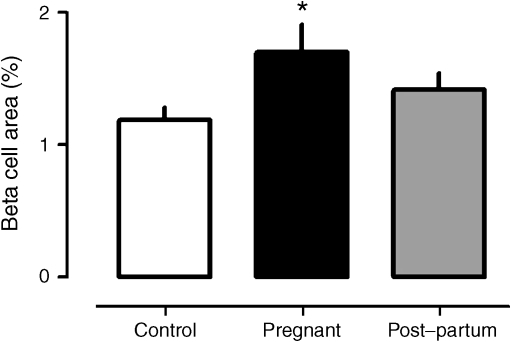
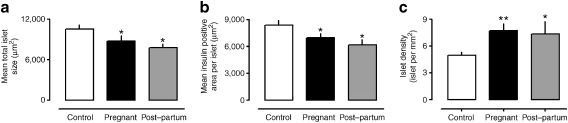
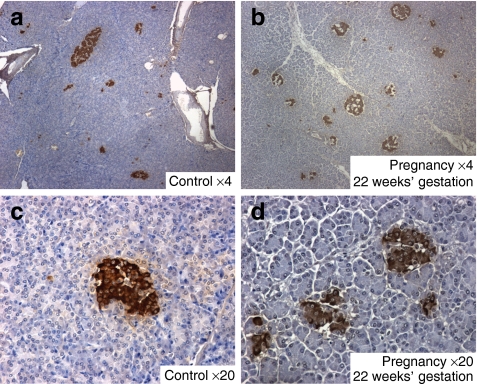
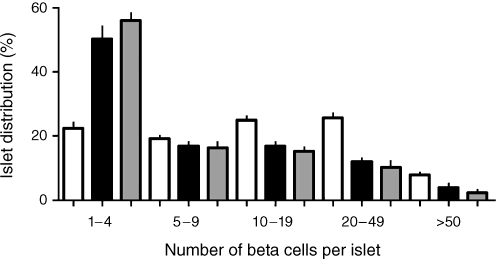
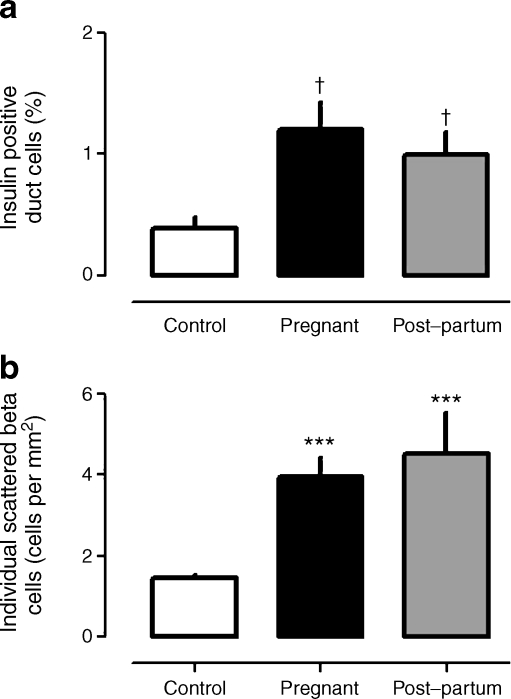
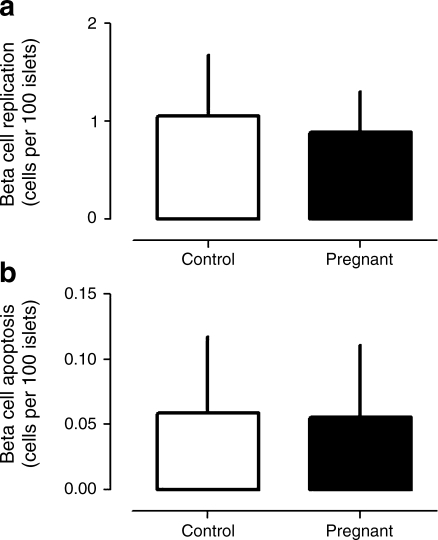
AIMS/HYPOTHESIS: We sought to establish the extent and basis for adaptive changes in beta cell numbers in human pregnancy. METHODS: Pancreas was obtained at autopsy from women who had died while pregnant (n = 18), post-partum (n = 6) or were not pregnant at or shortly before death (controls; n = 20). Pancreases were evaluated for fractional pancreatic beta cell area, islet size and islet fraction of beta cells, beta cell replication (Ki67) and apoptosis (TUNEL), and indirect markers of beta cell neogenesis (insulin-positive cells in ducts and scattered beta cells in pancreas). RESULTS: The pancreatic fractional beta cell area was increased by approximately 1.4-fold in human pregnancy, with no change in mean beta cell size. In pregnancy there were more small islets rather than an increase in islet size or beta cells per islet. No increase in beta cell replication or change in beta cell apoptosis was detected, but duct cells positive for insulin and scattered beta cells were increased with pregnancy. CONCLUSIONS/INTERPRETATION: The adaptive increase in beta cell numbers in human pregnancy is not as great as in most reports in rodents. This increase in humans is achieved by increased numbers of beta cells in apparently new small islets, rather than duplication of beta cells in existing islets, which is characteristic of pregnancy in rodents.
Overview
The claims and statistics of this paper haven’t been checked yet.
Free: it reads the open-access text and checks the first 5 claims that cite a source we can check. Create a free account to check every claim.
Integrity signals
Registry
Cites
Statistics
Figures
Verification
Claims the paper makes
The claims and statistics of this paper haven’t been checked yet.
Free: it reads the open-access text and checks the first 5 claims that cite a source we can check. Create a free account to check every claim.
Claims other papers make about this one
Each is checked against this paper’s own text: does it say what the citing paper says it does?
In the citing paper
“Although the mechanisms underlying pancreatic β-cell expansion in physiological settings may differ between species36,37, age-dependent restriction of β-cell proliferation is a conserved feature in mice and humans9,10.”
From PDGF signalling controls age-dependent proliferation in pancreatic β-cells (2011) · cites this paper as [36]
Self-check
Percentages, sums and reported differences re-computed from the paper’s own numbers.
The self-check needs the paper’s full text.
Citations
Cites
β-Cell Deficit and Increased β-Cell Apoptosis in Humans With Type 2 Diabetes
Butler, A. E., Janson, J., Bonner-Weir, S., Ritzel, R., Rizza, R. A., & Butler, P. C. (2003) · Diabetes · doi:10.2337/diabetes.52.1.102 · Cited by 4,011 · cited 4×
“In the former, a near complete loss of beta cell mass occurs [1], while in the latter, the deficit in beta cell mass is partial [2].”
BackgroundMethodInfluentialSelf-citationAdult pancreatic β-cells are formed by self-duplication rather than stem-cell differentiation
Dor, Y., Brown, J., Martinez, O. I., & Melton, D. A. (2004) · Nature · doi:10.1038/nature02520 · Cited by 2,219 · cited 1×
“Lineage studies in rodents have been interpreted as showing that replication of existing beta cells is the only potential source of new beta cells [20].”
BackgroundPathologic anatomy of the pancreas in juvenile diabetes mellitus
Gepts, W. (1965) · Diabetes · doi:10.2337/diab.14.10.619 · Cited by 1,345 · cited 1×
“In the former, a near complete loss of beta cell mass occurs [1], while in the latter, the deficit in beta cell mass is partial [2].”
BackgroundBuchanan, T. A., Xiang, A. H., Peters, R. K., Kjos, S. L., Marroquin, A., Goico, J., Ochoa, C., Tan, S., Berkowitz, K., Hodis, H. N., et al. (2002) · Diabetes · doi:10.2337/diabetes.51.9.2796 · Cited by 1,339
β Cells Can Be Generated from Endogenous Progenitors in Injured Adult Mouse Pancreas
Xu, X., D'Hoker, J., Stangé, G., Bonné, S., De Leu, N., Xiao, X., Van De Casteele, M., Mellitzer, G., Ling, Z., Pipeleers, D., et al. (2008) · Cell · doi:10.1016/j.cell.2007.12.015 · Cited by 988 · cited 1×
“Recent lineage tracing approaches have also been used to support the concept of beta cell neogenesis in rodents, but these obviously cannot be applied in humans [26, 27].”
BackgroundEndoplasmic reticulum stress contributes to beta cell apoptosis in type 2 diabetes
Laybutt, D. R., Preston, A. M., Åkerfeldt, M. C., Kench, J. G., Busch, A. K., Biankin, A. V., & Biden, T. J. (2007) · Diabetologia · doi:10.1007/s00125-006-0590-z · Cited by 830 · cited 1×
“Since beta cell failure in type 2 diabetes is best predicted by beta cell work load [29] and is characterised by endoplasmic stress [30, 31], it is not surprising that gestational diabetes occurs in those genetically predisposed to type 2 diabetes.”
BackgroundPancreatic β‐cell mass in European subjects with type 2 diabetes
Rahier, J., Guiot, Y., Goebbels, R. M., Sempoux, C., & Henquin, J. C. (2008) · Diabetes, Obesity and Metabolism · doi:10.1111/j.1463-1326.2008.00969.x · Cited by 756 · cited 1×
“Since obesity is associated with an increase in beta cell mass in humans [37], the failure of pancreatic fractional beta cell area to return to pre-pregnant levels in our post-partum women may have been due to the insulin resistance/ inflammation associated with the obesity.”
BackgroundLongitudinal changes in insulin release and insulin resistance in nonobese pregnant women
Catalano, P. M., Tyzbir, E. D., Roman, N. M., Amini, S. B., & Sims, E. A. H. (1991) · American Journal of Obstetrics and Gynecology · doi:10.1016/0002-9378(91)90012-g · Cited by 709 · cited 4×
“These findings are intriguing since it has previously been shown that the increment in first- and second-phase insulin release in response to glucose during pregnancy is present early in pregnancy (first trimester), while the insulin resistance that develops in pregnancy occurs later (third trimester) [7].”
BackgroundInfluentialMeier, J. J., Butler, A. E., Saisho, Y., Monchamp, T., Galasso, R., Bhushan, A., Rizza, R. A., & Butler, P. C. (2008) · Diabetes · doi:10.2337/db07-1369 · Cited by 683 · cited 1×
“By the same approach, moreover, we were readily able to detect beta cell replication in infants [15].”
Self-citationDynamics of β-cell Mass in the Growing Rat Pancreas: Estimation With a Simple Mathematical Model
Finegood, D. T., Scaglia, L., & Bonner-Weir, S. (1995) · Diabetes · doi:10.2337/diab.44.3.249 · Cited by 603
Research works printed but not linked: 2
- Wicksell SD (1926) The corpuscle problem II. Biometrika 18:151–172
- Bach G (1959) Uber die Grossenverteilung von Kugelschnitten in durchsichtigen Schnitten endlicher Dicke. Z Wiss Mikroskopie 64:265–270 (Article in German)
Cited by
Items 201–300 of 447
Téllez, N., Vilaseca, M., Martí, Y., Pla, A., & Montanya, E. (2016) · American Journal of Physiology-Endocrinology and Metabolism · doi:10.1152/ajpendo.00502.2015 · Cited by 25
“In the absence of consistent cell tracing tools for direct analysis and quantification of -cell neogenesis in rat and human pancreases, the number of extraislet -cells scattered throughout the pancreatic tissue has been classically used as an indication of -cell generation outside the islet (7, 10, 28, 56).”
BackgroundDefinition of a Skp2-c-Myc Pathway to Expand Human Beta-cells
Tiwari, S., Roel, C., Tanwir, M., Wills, R. C., Perianayagam, N., Wang, P., & Fiaschi‐Taesch, N. (2016) · Scientific Reports · doi:10.1038/srep28461 · Cited by 21
The Essential Role of Pancreatic α-Cells in Maternal Metabolic Adaptation to Pregnancy
Qiao, L., Saget, S., Lu, C., Zang, T., Dzyuba, B., Hay, W. W., & Shao, J. (2022) · Diabetes · doi:10.2337/db21-0923 · Cited by 22
Kimani, C. N., Reuter, H., Kotzé, S. H., & Muller, C. J. F. (2023) · Current Issues in Molecular Biology · doi:10.3390/cimb45080392 · Cited by 26
Guevara‐Ramírez, P., Paz‐Cruz, E., Cadena-Ullauri, S., Ruiz‐Pozo, V. A., Tamayo‐Trujillo, R., Felix, M. L., Simancas‐Racines, D., & Zambrano, A. K. (2023) · Frontiers in Nutrition · doi:10.3389/fnut.2023.1228703 · Cited by 26
Cdk5r1 Overexpression Induces Primary β -Cell Proliferation
Draney, C., Hobson, A., Grover, S. G., Jack, B. O., & Tessem, J. S. (2015) · Journal of Diabetes Research · doi:10.1155/2016/6375804 · Cited by 26
Dexamethasone during pregnancy impairs maternal pancreatic β-cell renewal during lactation
Teixeira, C. J., Santos-Silva, J. C., de Souza, D. N., Rafacho, A., Anhê, G. F., & Bordin, S. A. (2019) · Endocrine Connections · doi:10.1530/ec-18-0505 · Cited by 23
Szlapinski, S. K., King, R., Retta, G., Yeo, E., Strutt, B. J., & Hill, D. J. (2019) · The Journal of Physiology · doi:10.1113/jp277884 · Cited by 23
“Nonetheless, the only two human studies conducted to date have both reported an increase in β-cell area in pancreata of pregnant women at postmortem (Van Assche et al. 1978; Butler et al. 2010).”
BackgroundProlactin as an Adjunct for Type 1 Diabetes Immunotherapy
Hyslop, C. M., Tsai, S. J., Shrivastava, V., Santamaría, P., & Huang, C. (2015) · Endocrinology · doi:10.1210/en.2015-1549 · Cited by 22
Søstrup, B., Gaarn, L. W., Nalla, A., Billestrup, N., & Nielsen, J. H. (2014) · Acta Obstetricia Et Gynecologica Scandinavica · doi:10.1111/aogs.12495 · Cited by 22
“Although some proliferation has been observed by in vitro exposure of human islets to somatolactogenic hormones (5,13), most studies showed that beta cell proliferation in adult human islets both in vivo and in vitro is extremely rare (14–16).”
BackgroundInfluentialBeta cell adaptation in pregnancy: a tribute to Claes Hellerström
Nielsen, J. H. (2016) · Upsala Journal of Medical Sciences · doi:10.3109/03009734.2016.1165776 · Cited by 28
“4-fold increase in the beta cell area mainly due to an increased number of small islets and not larger islets and no increase in Ki67-positive beta cells, suggesting that in human pregnancy the beta cell adaptation occurs by neogenesis of beta cells from progenitor cells rather than proliferation of existing beta cell…”
BackgroundBucciarelli, V., Moscucci, F., Dei, A., Coppi, F., Angeli, F., Pizzi, C., Renda, G., Nodari, S., Maffei, S., Montisci, R., et al. (2024) · Current Problems in Cardiology · doi:10.1016/j.cpcardiol.2024.102695 · Cited by 20
“66 In normal pregnancy, the pancreatic β -cells are able to compensate by increasing the release of insulin, whereas dysfunctional β -cells show impaired response to IR, leading to the occurrence of GDM. 67 GDM is associated with a greater risk of short-term acute pregnancy and delivery…”
The intestine and the microbiota in maternal glucose homeostasis during pregnancy
Yeo, E., Brubaker, P. L., & Sloboda, D. M. (2022) · Journal of Endocrinology · doi:10.1530/joe-21-0354 · Cited by 22
“Over the course of pregnancy, there is an increase in β-cell area (Butler et al. 2010) primarily driven by an increase in the number of β-cell clusters, which suggests that neogenesis is a driving force of expansion rather than proliferation (Butler et al.”
BackgroundZhang, Z., Piro, A., Dai, F. F., & Wheeler, M. B. (2022) · Frontiers in Endocrinology · doi:10.3389/fendo.2022.852149 · Cited by 21
“During pregnancy, islets undergo compensatory morphological changes such as increases in beta-cell mass, which are likely achieved through a combination of hypertrophic expansion, islet proliferation, potential neogenesis from precursor cells as well as a decrease in apoptosis (34, 37, 38).”
BackgroundHill, T. G., & Hill, D. J. (2024) · International Journal of Molecular Sciences · doi:10.3390/ijms25074070 · Cited by 26
“A second study by Butler et al. [265] reported a 1.4-fold increase in beta-cell fractional area, although the mean age of gestation of the subjects was lower.”
BackgroundInfluentialSleeping Islets and the Relationship Between β-Cell Mass and Function
Weir, G. C., & Bonner‐Weir, S. (2011) · Diabetes · doi:10.2337/db10-1808 · Cited by 20
“collections of b-cells throughout the pancreatic parenchyma (12), but perhaps islet activation was also at play.”
BackgroundMotta, K., Gomes, P. R. L., Sulis, P. M., Bordin, S. A., & Rafacho, A. (2018) · Frontiers in Physiology · doi:10.3389/fphys.2018.00783 · Cited by 21
Conversion of α-Cells to β-Cells in the Postpartum Mouse Pancreas Involves Lgr5 Progeny
Rodriguez, U. A., Socorro, M., Criscimanna, A., Martins, C. P., Mohamed, N., Hu, J., Prasadan, K. L., Gittes, G. K., & Esni, F. (2021) · Diabetes · doi:10.2337/db20-1059 · Cited by 19
“Humans are sexually mature later (?17% of the natural life span), and indirect evidence from the human pancreas during pregnancy and postpartum indicates that the increased number of b-cells is the result of neogenesis rather than replication of preexisting b-cells (49,50).”
BackgroundAn update on pancreatic regeneration mechanisms: Searching for paths to a cure for type 2 diabetes
Soldovieri, L., Giuseppe, G. D., Ciccarelli, G., Quero, G., Cinti, F., Brunetti, M., Nista, E. C., Gasbarrini, A., Alfieri, S., Pontecorvi, A., et al. (2023) · Molecular Metabolism · doi:10.1016/j.molmet.2023.101754 · Cited by 20
“[41] found an increased number of b-cells in apparently new, small islets as well as insulin-positive cells within the ductal epithelium, rather than b-cell replication in existing islets, in pregnant women.”
BackgroundTitle, A. C., Karsai, M., Mir-Coll, J., Grining, Ö. Y., Rufer, C., Sonntag, S., Forschler, F., Jawurek, S., Klein, T., & Yesildag, B. (2022) · Frontiers in Endocrinology · doi:10.3389/fendo.2022.854094 · Cited by 20
“While rodent studies point to a mechanism of increased b-cell proliferation (25, 26), robust data demonstrating increased proliferation rather than neogenesis in humans during pregnancy or obesity is still lacking (27, 28), and the precise contribution of proliferation remains controversial (22, 29–31).”
BackgroundMeek, C. L., Oram, R. A., McDonald, T. J., Feig, D. S., Hattersley, A. T., Murphy, H. R., & the CONCEPTT collaborative group (2021) · Diabetes Care · doi:10.2337/dc21-0028 · Cited by 18
Mitogen Synergy: An Emerging Route to Boosting Human Beta Cell Proliferation
Shcheglova, E. G., Błaszczyk, K., & Borowiak, M. (2022) · Frontiers in Cell and Developmental Biology · doi:10.3389/fcell.2021.734597 · Cited by 18
Betatrophin in Diabetes Mellitus: the Epidemiological Evidence in Humans
Espes, D., Martinell, M., Liljebäck, H., & Carlsson, P. (2015) · Current Diabetes Reports · doi:10.1007/s11892-015-0676-4 · Cited by 21
17β-Estradiol protects against glucosamine-induced pancreatic β-cell dysfunction
Kang, L., Chen, C., Wu, M., Chang, J., Chang, F., & Cheng, J. (2014) · Menopause The Journal of The North American Menopause Society · doi:10.1097/gme.0000000000000232 · Cited by 18
Beta-Cell Adaptation to Pregnancy – Role of Calcium Dynamics
Pretorius, M., & Huang, C. (2022) · Frontiers in Endocrinology · doi:10.3389/fendo.2022.853876 · Cited by 19
“An increase in b-cell mass and number has also been demonstrated in human pregnancy (9, 18).”
BackgroundŠtambuk, T., Kifer, D., Duvnjak, L. S., Lovrenčić, M. V., & Gornik, O. (2023) · PLoS ONE · doi:10.1371/journal.pone.0284838 · Cited by 18
“In light of these hypothesis all potential contributors to beta cell dysfunction in early pregnancy are of significant scientific interest [21].”
BackgroundMedina, A., Yamada, S., Hara, A., Hamamoto, K., & Kojima, I. (2013) · Endocrine Journal · doi:10.1507/endocrj.ej12-0361 · Cited by 17
“Furthermore, in human pancreas, the numbers of ductal cells positive for insulin and scattered β-cells increased with pregnancy [18].”
BackgroundKamal, M. M., Adel, A., Sayed, G. H., Ragab, S. H., & Kassem, D. H. (2020) · Translational research · doi:10.1016/j.trsl.2020.12.004 · Cited by 17
Gayatri, V., Prasad, M. K., Mohandas, S., Nagarajan, S., Kumaran, K., & Ramkumar, K. M. (2023) · European Journal of Pharmacology · doi:10.1016/j.ejphar.2023.176241 · Cited by 19
Diabetes and Obesity Research using Nonhuman Primates
Wagner, J. D., Cann, J. A., Zhang, L., & Harwood, H. J. (2012) · Elsevier eBooks · doi:10.1016/b978-0-12-381366-4.00014-6 · Cited by 19
Micromanaging Glucose Tolerance and Diabetes
Saliani, N., Montazersaheb, S., & Montasser-Kouhsari, S. (2017) · Advanced Pharmaceutical Bulletin · doi:10.15171/apb.2017.066 · Cited by 18
“β-cell mass in the adult human increases in response to insulin resistance (IR) during obesity and pregnancy.(48,57) The loss of β-cell mass is associated with both type 1 (T1D) and type 2 diabetes (T2D).”
BackgroundMillette, K., Cuala, J., Wang, P., Marks, C., Woo, V., Hayun, M., Kang, H., Martín, M. G., Dhawan, S., Chao, L. C., et al. (2021) · Research Square · doi:10.21203/rs.3.rs-592374/v1 · Cited by 17
Increased alpha and beta cell mass during mouse pregnancy is not dependent on transdifferentiation
Szlapinski, S. K., Bennett, J., Strutt, B. J., & Hill, D. J. (2020) · Experimental Biology and Medicine · doi:10.1177/1535370220972686 · Cited by 17
Ramanjaneya, M., Butler, A. E., Bashir, M., Bettahi, I., Moin, A. S. M., Ahmed, L., Elrayess, M. A., Hunt, S. C., Atkin, S. L., & Abou‐Samra, A. (2021) · BMJ Open Diabetes Research & Care · doi:10.1136/bmjdrc-2020-001925 · Cited by 16
Self-citationRevisiting Regulators of Human β-cell Mass to Achieve β-cell–centric Approach Toward Type 2 Diabetes
Sasaki, H., Saisho, Y., Inaishi, J., & Itoh, H. (2021) · Journal of the Endocrine Society · doi:10.1210/jendso/bvab128 · Cited by 18
“Furthermore, there are a few reports suggesting the involvement of increased β-cell replication in the process of a compensatory increase in BCM to increase insulin secretion in adulthood [31, 32].”
BackgroundMethodLindsay, K. L., Gyllenhammer, L. E., Entringer, S., & Wadhwa, P. D. (2021) · The Journal of Clinical Endocrinology & Metabolism · doi:10.1210/clinem/dgab655 · Cited by 18
Stem/progenitor cells in normal physiology and disease of the pancreas
Fallas, M. E. A., Pedraza‐Arévalo, S., Cujba, A.-M., Manea, T., Lambert, C., Morrugares, R., & Sancho, R. (2021) · Molecular and Cellular Endocrinology · doi:10.1016/j.mce.2021.111459 · Cited by 17
“In humans, evidence suggests that obesity induces an increase in β-cell replication (Butler et al., 2010; Saisho et al., 2013).”
BackgroundPregnancy in human IAPP transgenic mice recapitulates beta cell stress in type 2 diabetes
Gurlo, T., Kim, S., Butler, A. E., Liu, C., Pei, L., Rosenberger, M., & Butler, P. C. (2019) · Diabetologia · doi:10.1007/s00125-019-4843-z · Cited by 16
Self-citationBeta-cell function and human islet transplantation: can we improve?
Chen, J. H., & Gunton, J. E. (2021) · Journal of Endocrinology · doi:10.1530/joe-20-0590 · Cited by 16
“However, a small number of studies show that under certain circumstances, human β -cells do display ability to proliferate (Ogilvie 1933, Van Assche et al. 1978, Butler et al. 2010).”
BackgroundThe Potential of Pancreatic Organoids for Diabetes Research and Therapy
Bittenglová, K., Habart, D., Saudek, F., & Koblas, T. (2021) · Islets · doi:10.1080/19382014.2021.1941555 · Cited by 16
“In humans, beta cells noticeably increase their numbers only in the first few years of life and during pregnancy.(108,109) In 1993, Bonner-Weir proposed two pathways of pancreas regeneration after 90% pancreatectomy in mice, when observing a) the replication of preexisting endocrine and exocrine cells, and b) the Ta b…”
BackgroundEguchi, N., Toribio, A. J., Alexander, M., Xu, I., Whaley, D. L., Hernandez, L. F., Dafoe, D. C., & Ichii, H. (2022) · Biomedicines · doi:10.3390/biomedicines10020472 · Cited by 18
“During pregnancy, β-cell mass is increased two- to threefold in rodent models and 40% in humans [71,72].”
BackgroundSugiyama, C., Yamamoto, M., Kotani, T., Kikkawa, F., Murata, Y., & Hayashi, Y. (2012) · PLoS ONE · doi:10.1371/journal.pone.0043745 · Cited by 17
“Both ß-cell mass and insulin secretion are increased and the threshold for glucose-stimulated insulin secretion is decreased during pregnancy [1,2,3,4], and insufficiency in such responses can lead to the development of gestational diabetes mellitus (GDM) [5,6,7].”
BackgroundChernysheva, M. B., Ruchko, E. S., Karimova, M. V., Vorotelyak, E. A., & Vasiliev, А. V. (2024) · Frontiers in Cell and Developmental Biology · doi:10.3389/fcell.2024.1424278 · Cited by 18
Zhao, X. (2014) · Endocrine Journal · doi:10.1507/endocrj.ej14-0040 · Cited by 17
β-Cell Generation: Can Rodent Studies Be Translated to Humans?
Carlotti, F., Zaldumbide, A., Ellenbroek, J. H., Spijker, H. S., Hoeben, R. C., & de Koning, E. J. P. (2011) · Journal of Transplantation · doi:10.1155/2011/892453 · Cited by 17
“observed that ductal cells positive for insulin were increased by 2- and 3-fold during obesity and pregnancy, respectively [32, 33].”
BackgroundMerrill, A. K., Anderson, T., Conrad, K., Marvin, E., James-Todd, T. M., Cory‐Slechta, D. A., & Sobolewski, M. (2021) · Toxics · doi:10.3390/toxics9120346 · Cited by 16
“, lower fasting glucose, increased insulin secretion, elevated adipose volume and decreased insulin sensitivity, occur synchronously with predictable patterns of endocrine alterations [4,5].”
BackgroundTxnip deficiency promotes β-cell proliferation in the HFD-induced obesity mouse model
Lei, Z., Chen, Y., Wang, J., Zhang, Y., Shi, W., Wang, X., Xing, D., Li, D., & Jiao, X. (2022) · Endocrine Connections · doi:10.1530/ec-21-0641 · Cited by 18
In Vitro Differentiation and Expansion of Human Pluripotent Stem Cell-Derived Pancreatic Progenitors
Chmielowiec, J., & Borowiak, M. (2014) · The Review of Diabetic Studies · doi:10.1900/rds.2014.11.19 · Cited by 17
“In the case of pregnancy, hormones such as prolactin and lactogen are suggested to increase beta-cell mass [88, 89].”
BackgroundSeedat, F., Holden, K. L., Davis, S. A., Fischer, R., Bancroft, J. M., Drydale, E., Kandžija, N., Todd, J. A., Vatish, M., & Stefana, M. I. (2025) · Nature Communications · doi:10.1038/s41467-025-61852-5 · Cited by 15
“The increases in fractional and mean β -cell area observed during pregnancy are consistent with previous reports in human pregnancy 15,16 .”
InfluentialZhang, Y., Ye, S., Li, Y., Chen, J., & Zhang, Y. (2022) · Frontiers in Cell and Developmental Biology · doi:10.3389/fcell.2021.739511 · Cited by 16
ALDH Expression Characterizes G1-Phase Proliferating Beta Cells during Pregnancy
Zhang, L., Wang, L., Liu, X., Zheng, D., Liu, S., & Liu, C. (2014) · PLoS ONE · doi:10.1371/journal.pone.0096204 · Cited by 14
Benaim, C., Cocate, P. G., Barros, É. G., Alves‐Santos, N. H., Figueiredo, A. C. C., Franco‐Sena, A. B., Lepsch, J., Adegboye, A. R. A., Mokhtar, R., Holick, M. F., et al. (2018) · British Journal Of Nutrition · doi:10.1017/s0007114518003057 · Cited by 15
“In humans, pregnant women present this phenomenon of β -cell proliferation without increase in islet mass, but this particular study was limited because it was conducted in women who died during pregnancy (64) .”
Cade, W. T., Mittendorfer, B., Patterson, B. W., Haire-Joshu, D. L., Cahill, A. G., Stein, R. I., Schechtman, K. B., Tinius, R. A., Brown, K. M., & Klein, S. (2022) · Obesity · doi:10.1002/oby.23533 · Cited by 15
Beta-Cell ARNT Is Required for Normal Glucose Tolerance in Murine Pregnancy
Lau, S. M., Cha, K. M., Karunatillake, A., Stokes, R., Cheng, K., McLean, M. P., Cheung, N. W., Gonzalez, F. J., & Gunton, J. E. (2013) · PLoS ONE · doi:10.1371/journal.pone.0077419 · Cited by 14
“5-fold increase in beta-cell area [9].”
Donadel, G., Pastore, D., Della‐Morte, D., Capuani, B., Lombardo, M., Pacifici, F., Bugliani, M., Grieco, F. A., Marchetti, P., & Lauro, D. (2017) · International Journal of Molecular Sciences · doi:10.3390/ijms18112234 · Cited by 14
Han, Y., Tong, M., Jin, L., Yu, J., Meng, W., Ren, A., & Jin, L. (2020) · International Journal of Diabetes in Developing Countries · doi:10.1007/s13410-020-00859-8 · Cited by 16
Ramanjaneya, M., Butler, A. E., Alkasem, M., Bashir, M., Jerobin, J., Godwin, A., Moin, A. S. M., Ahmed, L., Elrayess, M. A., Hunt, S. C., et al. (2021) · Frontiers in Endocrinology · doi:10.3389/fendo.2021.641361 · Cited by 17
“In a healthy pregnancy, compensatory mechanisms cause an increase in glucose-stimulated insulin release (10) together with an adaptive increase in beta-cell mass (11) to counterbalance the increase in insulin resistance.”
BackgroundSelf-citationProlactin and oleic acid synergistically stimulate β-cell proliferation and growth in rat islets
Brelje, T. C., Bhagroo, N. V., Stout, L. E., & Sorenson, R. L. (2017) · Islets · doi:10.1080/19382014.2017.1330234 · Cited by 14
“4-fold).(54) Instead, the neogenesis of small islets was proposed.”
BackgroundMoon, J. H., Choe, H. J., & Lim, S. K. (2024) · Journal of Diabetes Investigation · doi:10.1111/jdi.14221 · Cited by 15
“In human pregnancies, b -cell mass and insulin secretion increase by 1.4-fold, primarily due to an increase in small islets rather than islet size or b -cell number per islet, contrasting with rodent pregnancies 41 .”
BackgroundInfluentialPregnancy-induced metabolic reprogramming and regenerative responses to pro-aging stresses
Yu, D., Luo, L., Wang, H., & Shyh‐Chang, N. (2024) · Trends in Endocrinology and Metabolism · doi:10.1016/j.tem.2024.07.011 · Cited by 16
Skog, O., & Korsgren, O. (2019) · Acta Diabetologica · doi:10.1007/s00592-019-01420-8 · Cited by 16
Beta‐cell function in type 2 diabetes ( T2DM ): Can it be preserved or enhanced?
Kassem, L. S., Rajpal, A., Barreiro, M. V. E., & Ismail‐Beigi, F. (2023) · Journal of Diabetes · doi:10.1111/1753-0407.13446 · Cited by 17
Acute effects of thymoquinone on the pregnant rat and embryo-fetal development
AbuKhader, M., Khater, S. H., & Al‐Matubsi, H. Y. (2012) · Drug and Chemical Toxicology · doi:10.3109/01480545.2011.648326 · Cited by 13
“Because of this glucose-demand increase, structural and functional changes occur in the maternal pancreatic islets, which involve an increase of beta-cell proliferation and the stimulation of insulin secretion (Aerts and Assche, 1975; Butler et al., 2010; Sorenson and Brelje, 1997).”
BackgroundCory, M., Moin, A. S. M., Moran, A., Rizza, R. A., Butler, P. C., Dhawan, S., & Butler, A. E. (2018) · Journal of the Endocrine Society · doi:10.1210/js.2018-00143 · Cited by 13
“The patients with CF-D, patients with CF [16], and CS group [24, 25] have been included in previous publications.”
ResultSelf-citationAung, Z. K., Kokay, I. C., Grattan, D. R., & Ladyman, S. R. (2021) · Frontiers in Endocrinology · doi:10.3389/fendo.2021.765976 · Cited by 14
“There is only limited evidence of beta-cell expansion during human pregnancies [reviewed in (1, 56)], and this evidence suggests it is markedly less extensive than that seen in rodent models and potentially involves neogenesis of beta cells rather than cell division of existing beta cells (57).”
BackgroundTaschetto, A. P. D., Zimath, P. L., Silvério, R., dos Santos, C., Boschero, A. C., dos Santos, G. J., & Rafacho, A. (2021) · Life Sciences · doi:10.1016/j.lfs.2021.119509 · Cited by 14
TGF ‐β signalling prevents pancreatic beta cell death after proliferation
Chen, L., Zhou, X., Pang, Y., Mao, Y., Lu, X., Li, M., & Zhang, J. (2015) · Cell Proliferation · doi:10.1111/cpr.12183 · Cited by 14
Li, J., Ying, H., Cai, G., Guo, Q., & Chen, L. (2015) · Cell Proliferation · doi:10.1111/cpr.12164 · Cited by 12
Dirice, E., Basile, G., Kahraman, S., Diegisser, D., Hu, J., & Kulkarni, R. N. (2022) · JCI Insight · doi:10.1172/jci.insight.153877 · Cited by 12
Chung, E., Grue, K. A., Kaur, G., Mallory, B., Serrano, C. R., Ullevig, S. L., Kottapalli, K. R., Lee, S. C., Dufour, J. M., Shen, C., et al. (2019) · Nutrition Research · doi:10.1016/j.nutres.2019.08.002 · Cited by 14
Gomes, P. R. L., Vilas‐Boas, E. A., Leite, E. D. A., Munhoz, A. C., Lucena, C. F., do Amaral, F. G., Carpinelli, Â. R., & Cipolla‐Neto, J. (2021) · Journal of Pineal Research · doi:10.1111/jpi.12717 · Cited by 15
ACSS2 mediates an epigenetic pathway to regulate β-cell adaptation during gestation in mice
Zhang, Y., He, S., Wang, X., Wang, X., He, M., Yu, X., & Xu, C. (2025) · Nature Communications · doi:10.1038/s41467-025-58322-3 · Cited by 12
“Two studies comparing women at various stages of pregnancy with nonpregnant females of comparable age found a 1.4-to 2-fold increase in β -cell area in the pancreas 45,46 , suggesting that β -cell adaptation occurs during pregnancy in humans.”
InfluentialSwimming Program on Mildly Diabetic Rats in Pregnancy
MACEDO, N. C. D., Iessi, I. L., Gallego, F. Q., NETTO, A. O., Sinzato, Y. K., Volpato, G. T., Zambrano, E., & Damasceno, D. C. (2021) · Reproductive Sciences · doi:10.1007/s43032-021-00462-0 · Cited by 11
“Regarding the endocrine pancreatic morphological analyses, some studies showed that pregnancy [42], diabetes [43], and exercise [44] are, separately, factors capable of modifying islet architecture.”
BackgroundImpact of the exposome on the development and function of pancreatic β-cells
Hill, D. J. (2021) · Molecular Aspects of Medicine · doi:10.1016/j.mam.2021.100965 · Cited by 11
Tancredi, M., Marselli, L., Lencioni, C., Masini, M., Bugliani, M., Suleiman, M., Masiello, P., Boggi, U., Filipponi, F., Dotta, F., et al. (2011) · Islets · doi:10.4161/isl.3.5.15940 · Cited by 11
Sex differences in androgen regulation of metabolism in nonhuman primates
True, C., Abbott, D. H., Roberts, C. T., & Varlamov, O. (2017) · Advances in experimental medicine and biology · doi:10.1007/978-3-319-70178-3_24 · Cited by 10
“These differences underlie important differences in function such as proliferative capacity and hormone secretion [31]; [32]; [33].”
BackgroundCovington, B. A., & Chen, W. (2024) · Biomedicines · doi:10.3390/biomedicines12030473 · Cited by 12
“In a study by Butler and colleagues examining autopsies of pregnant women, relative beta cell volume was increased by 40% in pregnant versus non-pregnant women [101].”
BackgroundInfluentialMechanisms linking hyperglycemia in pregnancy to the offspring cardiovascular system dysfunction
Xiao, Z., Wang, Y., Thai, P. N., Li, X., Lu, X., & Pu, J. (2021) · STEMedicine · doi:10.37175/stemedicine.v2i7.91 · Cited by 10
Fu, Q., Qian, Y., Jiang, H., He, Y., Dai, H., Chen, Y., Xia, Z., Liang, Y., Zhou, Y., Gao, R., et al. (2023) · Science China Life Sciences · doi:10.1007/s11427-022-2372-y · Cited by 10
“…(Krentz et al., 2021; Yoneda et al., 2013). β cell expansion or regeneration has been observed in various physiological and pathological processes, such as pregnancy, obesity, and partial pancreatectomy, both in humans and mouse models (Bock et al., 2003; Butler et al., 2010; Elbein et al., 2000).”
Kassem, D. H., Adel, A., Sayed, G. H., & Kamal, M. M. (2020) · Frontiers in Endocrinology · doi:10.3389/fendo.2020.00450 · Cited by 10
“That approach attracted much interest especially that β-cell expansion and compensation capabilities have been reported in various conditions associated with insulin resistance such as obesity (7, 8) or pregnancy (9).”
BackgroundProlactin-regulated Pbk is involved in pregnancy-induced β-cell proliferation in mice
Cao, Y., Feng, Z., He, X., Zhang, X., Xing, B., Wu, Y., Hojnacki, T., Katona, B. W., Ma, J., Zhan, X., et al. (2021) · Journal of Endocrinology · doi:10.1530/joe-21-0114 · Cited by 12
“During pregnancy in rodents (Halban et al. 2014) and humans (Butler et al. 2010), the expansion of pancreatic islets indicates that the adaptive growth of pancreatic islets is a mechanism for maintaining the balance of metabolism for pregnancy, which is a physiological state characterized by…”
BackgroundPlasma C‐peptide concentration in women with Type 1 diabetes during early and late pregnancy
Murphy, H. R., Elleri, D., Allen, J. M., Simmons, D. S., Nodale, M., & Hovorka, R. (2012) · Diabetic Medicine · doi:10.1111/j.1464-5491.2012.03747.x · Cited by 11
Drug-induced regeneration of pancreatic beta cells: An approach to cellular therapeutic targets
Parsi, P., Saharkhiz, S., Farani, M. R., Bakhtiyari, S., & Alipourfard, I. (2025) · Cell Regeneration · doi:10.1186/s13619-025-00255-9 · Cited by 9
“The PLR then transmits signals downstream through two main pathways: the phosphatidylinositol-4,5-bisphosphate 3-kinase (PI3K)-AKT serine/threonine kinase (AKT) pathway and the Janus kinase (JAK)-signal transducer and activator of transcription (STAT) pathway (Bole-Fey-sot et al. 1998).”
Zielińska, A., Maciulewski, R., Siewko, K., Popławska‐Kita, A., Lipińska, D., Kozłowska, G., Górska, M., & Szelachowska, M. (2016) · Diabetes & Metabolism · doi:10.1016/j.diabet.2016.07.029 · Cited by 9
Insulin gene mutations and posttranslational and translocation defects: associations with diabetes
Arneth, B. M. (2020) · Endocrine · doi:10.1007/s12020-020-02413-2 · Cited by 10
Understanding of type 1 diabetes mellitus: what we know and where we go
Cheon, C. K. (2018) · Korean Journal of Pediatrics · doi:10.3345/kjp.2018.06870 · Cited by 11
ERK 5 plays an essential role in gestational beta‐cell proliferation
Chen, C., Wu, S., Lin, X., Wu, D., Fischbach, S., & Xiao, X. (2017) · Cell Proliferation · doi:10.1111/cpr.12410 · Cited by 10
Achong, N., McIntyre, D. H., & Callaway, L. K. (2014) · Obstetric Medicine · doi:10.1177/1753495x13516442 · Cited by 10
“4 fold because of an increase in small islet populations.(33) The increase in insulin-positive cells in ducts and scattered beta cells implies that this is due to beta-cell neogenesis.”
BackgroundNutrient and non-nutrient regulators of insulin secretion
Kolic, J., Assaf, N., & Johnson, J. D. (2026) · Nature Reviews Endocrinology · doi:10.1038/s41574-026-01281-6 · Cited by 183
“Basal insulin secretion is proportional to physical β-cell mass (which can adapt early in life 34,50 and in pregnancy 51 ), the insulin content of individual dense-core granules and the tone through the canonical nutrient sensing machinery, including glucokinase, mitochondrial metabolism and the…”
Deischinger, C., Harreiter, J., Leitner, K., Bancher‐Todesca, D., Baumgartner-Parzer, S. M., & Kautzky‐Willer, A. (2020) · Journal of Clinical Medicine · doi:10.3390/jcm9072277 · Cited by 8
“4–2-fold during gestation [17,18], whereas adult islet cell mass remains steady and proliferates slowly outside of pregnancy [19].”
BackgroundStrutt, B. J., Szlapinski, S. K., Gnaneswaran, T., Donegan, S., Hill, J. L., Bennett, J., & Hill, D. J. (2021) · Scientific Reports · doi:10.1038/s41598-021-94725-0 · Cited by 8
Kong, X., Yang, C., Li, B., Yan, D., Yang, Y., Cao, C., Xing, B., & Ma, X. (2024) · Biochimica et Biophysica Acta (BBA) - Molecular Basis of Disease · doi:10.1016/j.bbadis.2024.167136 · Cited by 8
Implications for the offspring of circulating factors involved in beta cell adaptation in pregnancy
Nalla, A., Ringholm, L., Søstrup, B., Højrup, P., Thim, L., Levery, S. B., Vakhrushev, S. Y., Billestrup, N., Mathiesen, E. R., Damm, P., et al. (2014) · Acta Obstetricia Et Gynecologica Scandinavica · doi:10.1111/aogs.12505 · Cited by 9
“The circulating level of PL increases in proportion to gestational age in rodent and human pregnancy, correlates with an increase in beta cell proliferation and insulin secretion in rodents, and may also be involved in the increased beta cell function and expansion in human pregnancy (6,20,21), although proliferation…”
BackgroundResultWeir, G. C., & Bonner‐Weir, S. (2017) · Frontiers in Genetics · doi:10.3389/fgene.2017.00002 · Cited by 8
“Moreover, in pregnancy, which is a state of insulin resistance, small collections beta cells have been found that could have originated from neogenesis (Butler et al., 2010).”
BackgroundAitken, T. J., Crabtree, J. E., Jensen, D. M., Hess, K. H., Leininger, B., & Tessem, J. S. (2021) · Biology of the Cell · doi:10.1111/boc.202100035 · Cited by 10
“Rodent and human studies, however, have demonstrated that under conditions such as obesity or pregnancy, β-cell proliferation can be induced (Butler et al., 2010; Butler et al., 2007; Cox et al., 2016).”
BackgroundApproaches to Inducing β-Cell Regeneration
Levine, F. (2022) · Biomedicines · doi:10.3390/biomedicines10030571 · Cited by 8
“However, while it is clear that there is substantial expansion of β-cell mass in rodents, the evidence for expansion of β-cell mass in humans is weaker than in rodents [33] and if it does occur is likely to be of a much lower magnitude.”
BackgroundSpinelli, P., Fields, A. M., Falcone, S., Mesaros, C., & Susiarjo, M. (2023) · Endocrinology · doi:10.1210/endocr/bqad130 · Cited by 8
Present Accomplishments and Future Prospects of Cell-Based Therapies for Type 1 Diabetes Mellitus
Chhabra, P., Clark, D. L., Daniel, J., & Kenneth, L. B. (2011) · InTech eBooks · doi:10.5772/22343 · Cited by 10
Anonymous sources: where do adult β cells come from?
German, M. S. (2013) · Journal of Clinical Investigation · doi:10.1172/jci69297 · Cited by 8
Møldrup, A., Lindberg, M. N., Galsgaard, E. D., Henriksen, U. L., Dalgaard, L. T., & Nielsen, J. H. (2020) · Acta Physiologica · doi:10.1111/apha.13454 · Cited by 8
Metadata
- Authors
- Butler, A. E., Cao-Minh, L., Galasso, R., Rizza, R. A., Corradin, A., Cobelli, C., & Butler, P. C.
- Affiliations
- University of California, Los Angeles (US)
- Mayo Clinic (US)
- University of Padua (IT)
- Corresponding author
- Butler, P. C.
- Venue
- Diabetologia
- Published
- 2010-06-05
- Volume
- 53
- Issue
- 10
- Pages
- 2167-2176
- ISSN
- 0012-186X (ISSN-L)
- 1432-0428
- PMC
- PMC2931643
- OpenAlex
- W2036800308
- Cited by
- 435
- References
- 36
- Citations by year
- 2026: 14 · 2025: 17 · 2024: 24 · 2023: 24 · 2022: 31 · 2021: 39 · 2020: 30 · 2019: 34 · 2018: 26 · 2017: 26 · 2016: 27 · 2015: 24 · 2014: 31 · 2013: 31 · 2012: 28
- FWCI
- 29.34
- Type
- journal article
- Language
- en
- Open access
- hybrid
- doi.org
- Licence
- cc-by-nc
- Locations
- Diabetologia (publishedVersion, cc-by-nc)
- PubMed Central (publishedVersion, cc-by-nc)
- PubMed (publishedVersion)
- eScholarship (California Digital Library) (submittedVersion)
- Padua Research Archive (University of Padova) (submittedVersion, cc-by-nc)
- Funders
- Larry L. Hillblom Foundation
- National Institute of Diabetes and Digestive and Kidney Diseases (DK-061539, R01DK061539, DK059579, #DK077967, R01DK077967, R01DK059579)
- Topics
- Health Sciences › Medicine › Endocrinology, Diabetes and Metabolism › Pancreatic function and diabetes
- Health Sciences › Medicine › Obstetrics and Gynecology › Gestational Diabetes Research and Management
- Life Sciences › Biochemistry, Genetics and Molecular Biology › Genetics › Diabetes and associated disorders
- Keywords
- pancreatic beta cells, beta-cell turnover, human pregnancy, beta-cell neogenesis, beta-cell proliferation, Ki-67, TUNEL, islet size
- MeSH terms
- Adolescent, Adult, Cell Count, Female, Humans, Immunohistochemistry, Insulin, Pregnancy, Apoptosis, Cell Size, Cell Proliferation, Insulin-Secreting Cells
About these checks
Registry, retraction, Cites and statistics results are computed, not judged, with one exception: a printed reference that no index lists is read once by a model before it counts as a citation error. Claims are extracted by a model and kept only when their quote appears verbatim in the text; each cited source is then checked, with a model’s help, for whether it says what the claim relies on. Those verdicts can be wrong — read the claim’s quote and the cited source before relying on one.
Statistics and arithmetic are recomputed, not judged.
Confidence bands are shown only for fields calibrated on our annotated test set. None is calibrated yet, so no band is shown.
What counts as a claim ›How we measure confidence ›How we check this ›
Are you an author, or do you see a problem with this page? Request a review
Data sources
Bibliographic data: Semantic Scholar, OpenAlex, Crossref.
Contains information from the Semantic Scholar Academic Graph Datasets, made available under the ODC Attribution License (ODC-BY 1.0).
Semantic Scholar’s data is described in: Kinney, R., et al. (2023). The Semantic Scholar Open Data Platform. arXiv:2301.10140.
