

Osteopontin deficiency protects against obesity-induced hepatic steatosis and attenuates glucose production in mice
Open accessThe DOI matches its Crossref record; 46 of the 46 references it cites were found in a registry or an index.
Abstract
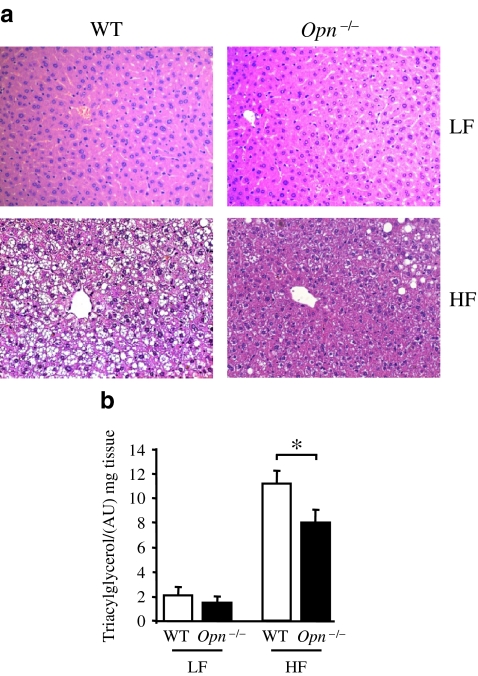
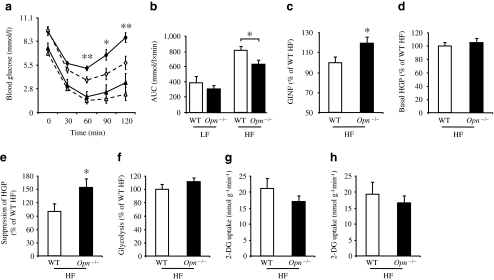
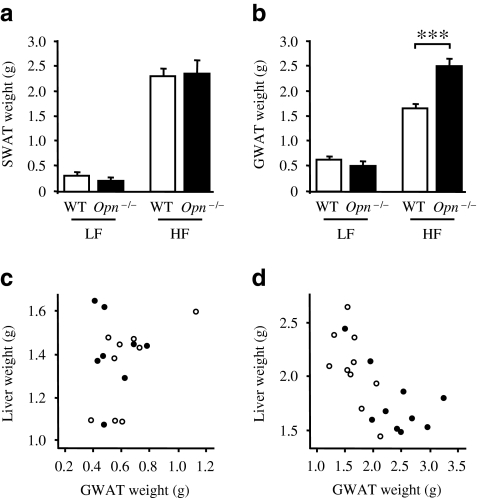
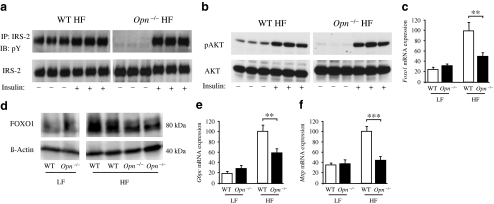
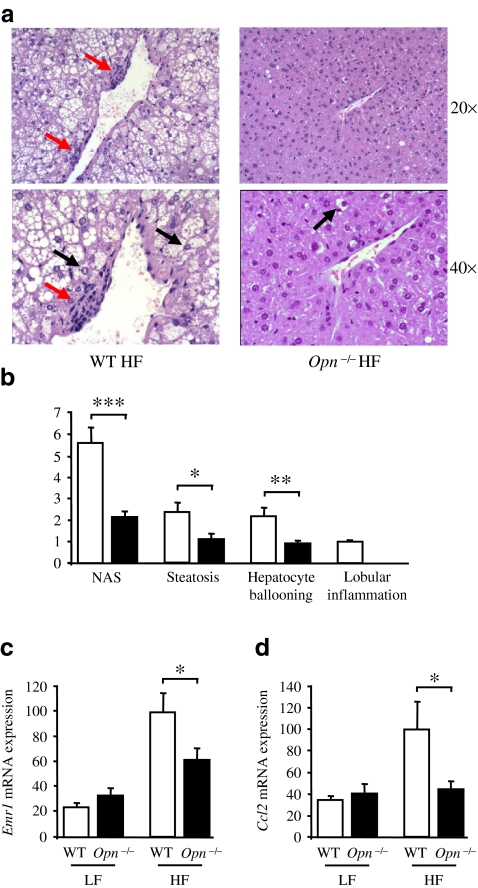
AIMS/HYPOTHESIS: Obesity is strongly associated with the development of non-alcoholic fatty liver disease (NAFLD). The cytokine osteopontin (OPN) was recently shown to be involved in obesity-induced adipose tissue inflammation and reduced insulin response. Accumulating evidence links OPN to the pathogenesis of NAFLD. Here we aimed to identify the role of OPN in obesity-associated hepatic steatosis and impaired hepatic glucose metabolism. METHODS: Wild-type (WT) and Opn (also known as Spp1) knockout (Opn (-/-)) mice were fed a high-fat or low-fat diet to study OPN effects in obesity-driven hepatic alterations. RESULTS: We show that genetic OPN deficiency protected from obesity-induced hepatic steatosis, at least in part, by downregulating hepatic triacylglycerol synthesis. Conversely, absence of OPN promoted fat storage in adipose tissue thereby preventing the obesity-induced shift to ectopic fat accumulation in the liver. Euglycaemic-hyperinsulinaemic clamp studies revealed that insulin resistance and excess hepatic glucose production in obesity were significantly attenuated in Opn (-/-) mice. OPN deficiency markedly improved hepatic insulin signalling as shown by enhanced insulin receptor substrate-2 phosphorylation and prevented upregulation of the major hepatic transcription factor Forkhead box O1 and its gluconeogenic target genes. In addition, obesity-driven hepatic inflammation and macrophage accumulation was blocked by OPN deficiency. CONCLUSIONS/INTERPRETATION: Our data strongly emphasise OPN as mediator of obesity-associated hepatic alterations including steatosis, inflammation, insulin resistance and excess gluconeogenesis. Targeting OPN action could therefore provide a novel therapeutic strategy to prevent obesity-related complications such as NAFLD and type 2 diabetes.
Overview
The claims and statistics of this paper haven’t been checked yet.
Free: it reads the open-access text and checks the first 5 claims that cite a source we can check. Create a free account to check every claim.
Integrity signals
Registry
Cites
Statistics
Figures
Verification
Claims the paper makes
The claims and statistics of this paper haven’t been checked yet.
Free: it reads the open-access text and checks the first 5 claims that cite a source we can check. Create a free account to check every claim.
Claims other papers make about this one
Each is checked against this paper’s own text: does it say what the citing paper says it does?
The cited source says what the claim attributes to it.
In the citing paper
“Moreover, genetic depletion of OPN protected mice fed a high-fat diet from obesity-induced hepatic steatosis [135].”
From Emerging role of liver-bone axis in osteoporosis (2024) · cites this paper as [135]
The cited source says what the claim attributes to it.
In the citing paper
“genes reported to be involved in hepatic insulin resistance, including Il6 45-48 , Spp1 49,50 and Igfbp1 51”
From Amphiregulin from regulatory T cells promotes liver fibrosis and insulin resistance in non-alcoholic steatohepatitis (2024) · cites this paper as [50]
Self-check
Percentages, sums and reported differences re-computed from the paper’s own numbers.
The self-check needs the paper’s full text.
Citations
Cites
Kopelman, P. G. (2000) · Nature · doi:10.1038/35007508 · Cited by 4,795 · cited 1×
“NAFLD has become an important public health issue because of its high prevalence and association with serious cardiometabolic abnormalities, including metabolic syndrome, type 2 diabetes and coronary heart disease [1, 2].”
BackgroundChemokines and leukocyte traffic
Baggiolini, M. (1998) · Nature · doi:10.1038/33340 · Cited by 2,709 · cited 1×
“Since OPN and MCP-1 cooperate in monocyte chemotaxis [15, 44], abrogation of inflammatory cell migration is likely to account for reduced abundance of macrophages in livers from HF-fed Opn”
BackgroundKanda, H. (2006) · Journal of Clinical Investigation · doi:10.1172/jci26498 · Cited by 2,682 · cited 1×
“6d), a chemokine that promotes hepatic macrophage infiltration and steatosis [13, 43].”
BackgroundNonalcoholic Fatty Liver, Steatohepatitis, and the Metabolic Syndrome
Marchesini, G., Bugianesi, E., Forlani, G., Cerrelli, F., Lenzi, M., Manini, R., Natale, S., Vanni, E., Villanova, N., Melchionda, N., et al. (2003) · Hepatology · doi:10.1053/jhep.2003.50161 · Cited by 2,679 · cited 1×
“NAFLD has become an important public health issue because of its high prevalence and association with serious cardiometabolic abnormalities, including metabolic syndrome, type 2 diabetes and coronary heart disease [1, 2].”
BackgroundLocal and systemic insulin resistance resulting from hepatic activation of IKK-β and NF-κB
Cai, D., Yuan, M., Frantz, D. F., Melendez, P. A., Hansen, L., Lee, J., & Shoelson, S. E. (2005) · Nature Medicine · doi:10.1038/nm1166 · Cited by 2,245 · cited 1×
“Similar to its effects on adipose tissue, obesity induces inflammatory alterations in the liver as reflected by a higher abundance of immune cells such as macrophages [8], increased cytokine production [3] and by activation of the nuclear factor κB (NF-κB) pathway [ 9 ].”
BackgroundObesity and nonalcoholic fatty liver disease: biochemical, metabolic, and clinical implications
Fabbrini, E., Sullivan, S., & Klein, S. (2010) · Hepatology · doi:10.1002/hep.23280 · Cited by 2,100 · cited 2×
“Hepatic steatosis is characterised by an imbalance between fatty acid input and output [5].”
BackgroundPuigserver, P., & Spiegelman, B. M. (2003) · Endocrine Reviews · doi:10.1210/er.2002-0012 · Cited by 2,076
TLR4 enhances TGF-β signaling and hepatic fibrosis
Seki, E., De Minicis, S., Österreicher, C. H., Kluwe, J., Osawa, Y., Brenner, D. A., & Schwabe, R. F. (2007) · Nature Medicine · doi:10.1038/nm1663 · Cited by 1,942
Postic, C., & Girard, J. (2008) · Journal of Clinical Investigation · doi:10.1172/jci34275 · Cited by 1,204 · cited 1×
“However, it still remains a matter of debate whether insulin resistance is a cause or consequence of NAFLD [6, 7].”
BackgroundThematic review series: Glycerolipids. DGAT enzymes and triacylglycerol biosynthesis
Yen, C.-L. E., Stone, S. J., Koliwad, S., Harris, C., & Farese, R. V. (2008) · Journal of Lipid Research · doi:10.1194/jlr.r800018-jlr200 · Cited by 1,105 · cited 2×
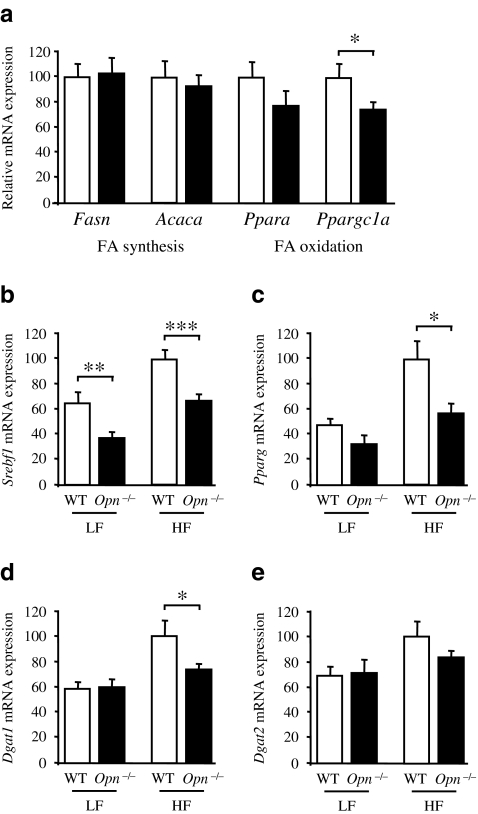
“Consequently, the expression of Dgat1, which is regulated by peroxisome proliferatoractivated receptor (PPAR)-γ [29] and catalyses triacylglycerol formation [ 30 ], was significantly decreased (Fig. 3d).”
Cited by
Macrophage-mediated inflammation in metabolic disease
Chawla, A., Nguyen, K. D., & Goh, Y. P. S. (2011) · Nature reviews. Immunology · doi:10.1038/nri3071 · Cited by 1,314
Osteopontin: A novel regulator at the cross roads of inflammation, obesity and diabetes
Kahles, F., Findeisen, H. M., & Bruemmer, D. (2014) · Molecular Metabolism · doi:10.1016/j.molmet.2014.03.004 · Cited by 408
“This was further supported by three experimental studies demonstrating that antibody-mediated OPN neutralization and OPN deficiency protect against HFD-induced hepatic macrophage infiltration [41,102] and Dgalactosamine-induced inflammatory liver injury [103].”
Rodríguez, A., Ezquerro, S., Méndez-Giménez, L., Becerril, S., & Frühbeck, G. (2015) · American Journal of Physiology-Endocrinology and Metabolism · doi:10.1152/ajpendo.00297.2015 · Cited by 282
Hedgehog signaling in the liver
Omenetti, A., Choi, S., Michelotti, G., & Diehl, A. M. (2011) · Journal of Hepatology · doi:10.1016/j.jhep.2010.10.003 · Cited by 277
Cytokines and abnormal glucose and lipid metabolism
Shi, J., Fan, J., Su, Q., & Yang, Z. (2019) · Frontiers in Endocrinology · doi:10.3389/fendo.2019.00703 · Cited by 282
“Osteopontin acts as a mediator of obesity-related hepatic alterations including steatosis, inflammation, insulin resistance, and excess gluconeogenesis (129).”
BackgroundChen, Q., Shou, P., Zhang, L., Xu, C., Zheng, C., Han, Y., Li, W., Huang, Y., Zhang, X., Shao, C., et al. (2014) · Stem Cells · doi:10.1002/stem.1567 · Cited by 248
“Interestingly, a recent study showed that mice lacking the Opn gene were protected from obesity and insulin resistance induced by a high-fat diet [48, 49].”
BackgroundOsteopontin Takes Center Stage in Chronic Liver Disease
Song, Z., Chen, W., Athavale, D., Ge, X., Desert, R., Das, S., Han, H., & Nieto, N. (2021) · Hepatology · doi:10.1002/hep.31582 · Cited by 213
Jetten, A. M., Kang, H. S., & Takeda, Y. (2013) · Frontiers in Endocrinology · doi:10.3389/fendo.2013.00001 · Cited by 169
“CD44 and Opn null mice are protected against the development of HFD-induced hepatosteatosis, WAT-associated inflammation, and insulin resistance (Nomiyama et al., 2007; Bertola et al., 2009; Kiefer et al., 2011; Kodama et al., 2012).”
BackgroundNAFLD and Extra-Hepatic Comorbidities: Current Evidence on a Multi-Organ Metabolic Syndrome
Rosato, V., Masarone, M., Dallio, M., Federico, A., Aglitti, A., & Persico, M. (2019) · International Journal of Environmental Research and Public Health · doi:10.3390/ijerph16183415 · Cited by 166
Huang, E. Y., Leone, V. A., Devkota, S., Wang, Y., Brady, M. J., & Chang, E. B. (2013) · Journal of Parenteral and Enteral Nutrition · doi:10.1177/0148607113486931 · Cited by 133
Savage, T. M., Fortson, K. T., de los Santos-Alexis, K., Oliveras-Alsina, A., Rouanne, M., Rae, S. S., Gamarra, J. R., Shayya, H., Kornberg, A., Cavero, R., et al. (2024) · Immunity · doi:10.1016/j.immuni.2024.01.009 · Cited by 120
Role of Osteopontin in Liver Diseases
Wen, Y., Jeong, S., Xia, Q., & Kong, X. (2016) · International Journal of Biological Sciences · doi:10.7150/ijbs.16445 · Cited by 95
“obesity-induced hepatic steatosis via enhanced hepatic insulin signaling by promoting IRS-2 phosphorylation and preventing up-regulation of FOXO1 and its gluconeogenic target genes [61].”
BackgroundInteractions among bone, liver, and adipose tissue predisposing to diabesity and fatty liver
Musso, G., Paschetta, E., Gambino, R., Cassader, M., & Molinaro, F. (2013) · Trends in Molecular Medicine · doi:10.1016/j.molmed.2013.05.006 · Cited by 102
Kang, H. S., Liao, G., DeGraff, L. M., Gerrish, K., Bortner, C. D., Garantziotis, S., & Jetten, A. M. (2013) · PLoS ONE · doi:10.1371/journal.pone.0058417 · Cited by 85
“These results indicate that in WAT loss of CD44 results in a selective inhibition of the activation of p38 MAPK.”
BackgroundResultInfluentialOsteopontin: Versatile modulator of liver diseases
Nagoshi, S. (2014) · Hepatology Research · doi:10.1111/hepr.12166 · Cited by 87
Patouraux, S., Bonnafous, S., Voican, C. S., Anty, R., Saint-Paul, M.-C., Rosenthal-Allieri, M.-A., Agostini, H., Njike, M., Barri-Ova, N., Naveau, S., et al. (2012) · PLoS ONE · doi:10.1371/journal.pone.0035612 · Cited by 86
“Similarly, OPN appears to play an important role in the occurrence of liver complications in a mouse model of non alcoholic fatty liver disease (NAFLD) [15,21,22,23].”
BackgroundLancha, A., Rodríguez, A., Catalán, V., Becerril, S., Sáinz, N., Ramírez, B., Burrell, M. A., Salvador, J., Frühbeck, G., & Gómez-Ambrosi, J. (2014) · PLoS ONE · doi:10.1371/journal.pone.0098398 · Cited by 84
“Lack of OPN blunted the HFD-induced increase in body weight and fat mass, despite a higher caloric intake, which agrees with previous reports [12] but contrasts with results reported by others [8,30].”
BackgroundResultKodama, K., Toda, K., Morinaga, S., Yamada, S., & Butte, A. J. (2015) · Diabetes · doi:10.2337/db14-0149 · Cited by 85
Extracellular matrix remodelling in obesity and metabolic disorders
Musale, V., Wasserman, D. H., & Kang, L. (2023) · Life Metabolism · doi:10.1093/lifemeta/load021 · Cited by 84
“…of osteopontin, an ECM glycoprotein that plays a vital role in the development of hepatic steatosis and insulin resistance, is linked to increased expression of TNF-α and the macrophage markers F4/80 and CD68 in the liver as well as abdominal sub-cutaneous adipose tissue in obesity [51, 52].”
Yilmaz, Y. (2012) · Alimentary Pharmacology & Therapeutics · doi:10.1111/j.1365-2036.2012.05196.x · Cited by 82
“Consistent with its putative role in NAFLD, genetic OPN deficiency has been recently shown to protect from obesity-induced hepatic steatosis by downregulating hepatic triacylglycerol synthesis in the mice.(31) Interestingly, Chang et al.”
BackgroundOsteopontin: Relation between Adipose Tissue and Bone Homeostasis
Fusco, C. D., Messina, A., Monda, V., Viggiano, E., Moscatelli, F., Valenzano, A. A., Esposito, T., Chieffi, S., Cibelli, G., Monda, M., et al. (2017) · Stem Cells International · doi:10.1155/2017/4045238 · Cited by 78
“OPN is a multifunctional protein widely distributed in many tissues and body fluids, such as plasma, urine, milk, and bile [10, 11].”
BackgroundOsteopontin induces growth of metastatic tumors in a preclinical model of non-small lung cancer
Shojaei, F., Scott, N., Kang, X., Lappin, P. B., Fitzgerald, A. A., Karlicek, S., Simmons, B. H., Wu, A., Lee, J. H., Bergqvist, S., et al. (2012) · Journal of Experimental & Clinical Cancer Research · doi:10.1186/1756-9966-31-26 · Cited by 77
“A recent report shows that OPN may play a significant role in obesity through regulation of insulin signaling in liver cells and inflammation [43].”
BackgroundOsteopontin is a proximal effector of leptin-mediated non-alcoholic steatohepatitis (NASH) fibrosis
Coombes, J. D., Choi, S. S., Swiderska-Syn, M., Manka, P., Reid, D. T., Palma, E., Briones-Orta, M. A., Xie, G., Younis, R., Kitamura, N., et al. (2016) · Biochimica et Biophysica Acta (BBA) - Molecular Basis of Disease · doi:10.1016/j.bbadis.2015.10.028 · Cited by 57
Novel insights into the relationship between nonalcoholic fatty liver disease and osteoporosis
Filip, R., Radzki, R., & Bieńko, M. (2018) · Clinical Interventions in Aging · doi:10.2147/cia.s170533 · Cited by 60
“Moreover, animal model experiments demonstrated that in the liver of obese mice, OPN expression is significantly upregulated and that hepatic OPN levels correlate with liver triacylglycerol levels.(80) Further studies performed in mice fed methionine- and choline-deficient diet also shed more light on the role of OPN…”
BackgroundThe Value of Osteopontin in the Assessment of Bone Mineral Density Status in Postmenopausal Women
Fodor, D., Bondor, C., Albu, A., Simon, S.-P., Craciun, A., & Muntean, L. (2013) · Journal of Investigative Medicine · doi:10.2310/jim.0b013e3182761264 · Cited by 61
Cytochrome P450 1B1: An unexpected modulator of liver fatty acid homeostasis
Larsen, M. C., Bushkofsky, J. R., Gorman, T., Adhami, V. M., Mukhtar, H., Wang, S., Reeder, S. B., Sheibani, N., & Jefcoate, C. R. E. (2015) · Archives of Biochemistry and Biophysics · doi:10.1016/j.abb.2015.02.010 · Cited by 62
An accelerated mouse model for atherosclerosis and adipose tissue inflammation
Neuhofer, A., Wernly, B., Leitner, L., Sarabi, A., Sommer, N. G., Staffler, G., Zeyda, M., & Stulnig, T. M. (2014) · Cardiovascular Diabetology · doi:10.1186/1475-2840-13-23 · Cited by 62
“Moreover, osteopontin plays a role in the pathogenesis of nonalcoholic fatty liver disease (NAFLD) [16,17].”
BackgroundSelf-citationZhao, M., Zang, B., Cheng, M., Ma, Y., Yang, Y., & Yang, N. (2013) · PLoS ONE · doi:10.1371/journal.pone.0078620 · Cited by 48
“Osteopontin (OPN) is an extracellular matrix protein and inflammatory cytokine which has recently been shown to be involved in human and murine obesity and hepatic steatosis[20].”
BackgroundNon-alcoholic steatohepatitis in morbidly obese patients
Tran, A., & Gual, P. (2013) · Clinics and Research in Hepatology and Gastroenterology · doi:10.1016/j.clinre.2012.07.005 · Cited by 45
Neschen, S., Scheerer, M., Seelig, A., Huypens, P., Schultheiss, J., Wu, M., Wurst, W., Rathkolb, B., Suhre, K., Wolf, E., et al. (2015) · Diabetes · doi:10.2337/db14-0393 · Cited by 40
“Tissue 2-[(14)C]deoxyglucose-6-phosphate was extracted, and glucose uptake rates (Rg) were calculated as previously described (18).”
MethodSelf-citationOsteopontin affects macrophage polarization promoting endocytic but not inflammatory properties
Schuch, K., Wanko, B., Ambroz, K., Castelo‐Rosa, A., Moreno‐Viedma, V., Grün, N. G., Leitner, L., Staffler, G., Zeyda, M., & Stulnig, T. M. (2016) · Obesity · doi:10.1002/oby.21510 · Cited by 42
“Reduced TNF-a expression in ATMs of OPN-knockout animals (Figure 1c) is in accordance with reduced total AT TNF-a expression shown in previous studies (13,19,25).”
ResultSelf-citationVachliotis, I. D., Anastasilakis, A. D., Goulas, A., Goulis, D. G., & Pοlyzos, S. A. (2022) · Diabetes Obesity and Metabolism · doi:10.1111/dom.14774 · Cited by 42
He, W., Huang, C., Zhang, X., Wang, D., Chen, Y.-L., Zhao, Y., & Li, X. (2021) · Endocrine · doi:10.1007/s12020-021-02716-y · Cited by 37
New insight of obesity-associated NAFLD: Dysregulated “crosstalk” between multi-organ and the liver?
Wang, Y., Wu, L.-L., Qi, X.-Y., Wang, Y.-Y., Liao, Z., Liu, J., & Xiao, X. (2022) · Genes & Diseases · doi:10.1016/j.gendis.2021.12.013 · Cited by 40
Emerging role of liver-bone axis in osteoporosis
Gao, H., Peng, X., Li, N., Gou, L., Xu, T., Wang, Y., Qin, J., Liang, H., Ma, P., Li, S., et al. (2024) · Journal of Orthopaedic Translation · doi:10.1016/j.jot.2024.07.008 · Cited by 36
“Moreover, genetic depletion of OPN protected mice fed a high-fat diet from obesity-induced hepatic steatosis [135].”
BackgroundNúñez-García, M., Gómez‐Santos, B., Buqué, X., García‐Rodríguez, J. L., Romero, M. R., Marín, J. J. G., Arteta, B., García‐Monzón, C., Castaño, L. A., Syn, W., et al. (2017) · Journal of Lipid Research · doi:10.1194/jlr.m078980 · Cited by 37
“tenuates glucose production in mice (4) and neutraliza-”
BackgroundGómez‐Santos, B., de Urturi, D. S., Núñez-García, M., González‐Romero, F., Buqué, X., Aurrekoetxea, I., de Juan, V. G., Gonzalez-Rellan, M. J., García‐Monzón, C., González‐Rodríguez, Á., et al. (2020) · Aging Cell · doi:10.1111/acel.13183 · Cited by 34
“Young OPN‐KO mice are protected from diet-induced hepatosteatosis (Kiefer et al., 2011; Lancha et al., 2014).”
BackgroundNardo, A. D., Grün, N. G., Zeyda, M., Dumanic, M., Oberhuber, G., Rivelles, E., Helbich, T. H., Markgraf, D. F., Roden, M., Claudel, T., et al. (2020) · Liver International · doi:10.1111/liv.14464 · Cited by 35
Self-citationXu, Z., Xi, F., Deng, X., Ni, Y., Pu, C., Wang, D., Lou, W., Zeng, X., Su, N., Chen, C., et al. (2022) · Journal of Clinical and Translational Hepatology · doi:10.14218/jcth.2021.00474 · Cited by 36
Myneni, V. D., Mousa, A., & Kaartinen, M. T. (2016) · Scientific Reports · doi:10.1038/srep35574 · Cited by 35
Ito, M., Makino, N., Matsuda, A., Ikeda, Y., Kakizaki, Y., Saito, Y., Ueno, Y., & Kawata, S. (2017) · International Journal of Molecular Sciences · doi:10.3390/ijms18040807 · Cited by 32
You, J. S., Ji, H.-I., Chang, K. J., Yoo, M. C., Yang, H.-I., Jeong, I., & Kim, K. S. (2013) · Molecular Medicine Reports · doi:10.3892/mmr.2013.1522 · Cited by 32
Wogonin suppresses osteopontin expression in adipocytes by activating PPARα
Zhang, Y., Li, M., Tang, Z., & Wang, C. (2015) · Acta Pharmacologica Sinica · doi:10.1038/aps.2015.37 · Cited by 31
Tang, M., Jiang, Y., Jia, H., Patpur, B. K., Yang, B., Li, J., & Yang, C. (2019) · Artificial Cells Nanomedicine and Biotechnology · doi:10.1080/21691401.2019.1699822 · Cited by 30
“Mechanistic studies revealed first that OPN deficiency not only prevents high-fat diet (HFD) induced accumulation of lipids but also the development of inflammation by improving insulin signalling and insulin sensitivity through the enhancement of the phosphorylation of IRS-2 and AKT, both stimulated by insulin, and t…”
BackgroundWu, J., Wu, D., Zhang, L., Lin, C., Liao, J., Xie, R., Li, Z., Wu, S., Liu, A., Hu, W., et al. (2019) · Journal of Leukocyte Biology · doi:10.1002/jlb.3ma1119-173r · Cited by 27
Yilmaz, Y. N., Öztürk, O., Alahdab, Y. Ö., Şenateş, E., Çolak, Y., Doğanay, H. L., Coşkunpınar, E. M., Oltulu, Y. M., Eren, F., Atuğ, Ö., et al. (2012) · Digestive and Liver Disease · doi:10.1016/j.dld.2012.08.017 · Cited by 28
Lancha, A., Moncada, R., Valentí, V., Rodríguez, A., Catalán, V., Becerril, S., Ramírez, B., Méndez-Giménez, L., Gil, M. J., Rotellar, F., et al. (2014) · Surgical Endoscopy · doi:10.1007/s00464-014-3490-1 · Cited by 23
Leitner, L., Schuch, K., Jürets, A., Itariu, B. K., Keck, M. K., Grablowitz, V., Aszmann, O. C., Prager, G., Staffler, G., Zeyda, M., et al. (2015) · Obesity · doi:10.1002/oby.21024 · Cited by 23
“Published data with diet-induced obesity in OPN-deficient mice revealed improved AT inflammation, metabolic, and liver parameters compared with WT littermates (6,7).”
BackgroundSelf-citationJiang, P., Zhang, D., Qiu, H., Yi, X., Zhang, Y., Cao, Y., Zhao, B., Xia, Z., & Wang, C. (2017) · Clinical and Experimental Pharmacology and Physiology · doi:10.1111/1440-1681.12762 · Cited by 24
Huang, B., Wen, W., & Ye, S. (2022) · Frontiers in Immunology · doi:10.3389/fimmu.2022.1009912 · Cited by 27
“Studies have demonstrated a pivotal role of SPP1 in obesity-driven nutrition-dependent diseases, including NAFLD, suggesting SPP1 as a treatment target (13, 31).”
BackgroundWinhofer, Y., Kiefer, F. W., Handisurya, A., Tura, A., Klein, K., Schneider, B., Marculescu, R., Wagner, O. F., Pacini, G., Luger, A., et al. (2012) · PLoS ONE · doi:10.1371/journal.pone.0040947 · Cited by 21
“Furthermore, targeting osteopontin in obesity was shown to prevent the development of hepatic steatosis in animal models [26].”
BackgroundSelf-citationWang, C., He, M., Peng, J., Li, S., Long, M., Chen, W., Liu, D., Yang, G., & Zhang, L. (2019) · Cytokine · doi:10.1016/j.cyto.2019.154837 · Cited by 21
Omar, B., Banke, E., Guirguis, E., Åkesson, L., Manganiello, V., Lyssenko, V., Groop, L., Gomez, M. F., & Degerman, E. (2012) · Biochemical and Biophysical Research Communications · doi:10.1016/j.bbrc.2012.07.157 · Cited by 20
Kaartinen, M. T., Hang, A., Barry, A., Arora, M., Heinonen, S., Lundbom, J., Hakkarainen, A., Lundholm, N., Rissanen, A., Kaprio, J. A., et al. (2022) · Matrix Biology · doi:10.1016/j.matbio.2022.02.005 · Cited by 19
Barchetta, I., Ceccarelli, V., Cimini, F. A., Bertoccini, L., Fraioli, A., Alessandri, C., Lenzi, A., Baroni, M. G., & Cavallo, M. G. (2018) · Journal of Endocrinological Investigation · doi:10.1007/s40618-018-0941-x · Cited by 17
Osteopontin Exacerbates High-Fat Diet-Induced Metabolic Disorders in a Microbiome-Dependent Manner
Chen, J., Zeng, P., Gong, L., Zhang, X., Ling, Z., Bi, K., Shi, F., Wang, K., Zhang, Q., Jiang, J., et al. (2022) · mBio · doi:10.1128/mbio.02531-22 · Cited by 19
Soysouvanh, F., Rousseau, D., Bonnafous, S., Bourinet, M., Strazzulla, A., Patouraux, S., Machowiak, J., Farrugia, M. A., Iannelli, A., Tran, A., et al. (2023) · Obesity · doi:10.1002/oby.23868 · Cited by 19
“AT levels of SPP1 are dramatically elevated and they lead to the recruitment of AT macrophages in diet-induced obesity models [11, 17, 19, 20].”
BackgroundKarampatsou, S., Paltoglou, G., Genitsaridi, S. M., Kassari, P., & Charmandari, E. (2022) · Nutrients · doi:10.3390/nu14183772 · Cited by 16
“Moreover, osteopontin deficiency improved hepatic steatosis, insulin sensitivity and glucose homeostasis [64].”
BackgroundOsteokines in Nonalcoholic Fatty Liver Disease
Vachliotis, I. D., Anastasilakis, A. D., Rafailidis, V. D., & Pοlyzos, S. A. (2024) · Current Obesity Reports · doi:10.1007/s13679-024-00586-9 · Cited by 17
“On the other hand, genetic ablation of OPN ( OPN −/− ) or antibody-mediated OPN neutralization protected mice fed on a HFD from severe NAFLD, thus implying that OPN may contribute to NAFLD progression [56–58].”
Osteopontin-deficient progenitor cells display enhanced differentiation to adipocytes
Moreno‐Viedma, V., Tardelli, M., Zeyda, M., Sibilia, M. C., Burks, J. D., & Stulnig, T. M. (2018) · Obesity Research & Clinical Practice · doi:10.1016/j.orcp.2018.02.006 · Cited by 15
Self-citationOsteopontin’s relationship with malnutrition and oxidative stress in adolescents. A pilot study
Aztatzi-Aguilar, O. G., Sierra-Vargas, M. P., Ortega-Romero, M., & Corona, A. E. J. (2021) · PLoS ONE · doi:10.1371/journal.pone.0249057 · Cited by 16
“On the contrary, the OPN deficiency has improved glucose tolerance and reduced IR in mice [47, 48].”
BackgroundSánchez‐González, C., Moreno, L., López-Chaves, C., Nebot, E., Pietschmann, P., Rodríguez‐Nogales, A., Gálvez, J., Montes‐Bayón, M., Sanz‐Medel, A., & Llopis, J. (2017) · Metallomics · doi:10.1039/c6mt00272b · Cited by 15
Levy, E. H., Marcil, V., Baumel, S. T. É., Dahan, N., DELVIN, E. E., & Spahis, S. (2023) · Nutrients · doi:10.3390/nu15061394 · Cited by 16
“Related references cited in the Figure: (a: [125,126]; b: [127]; c: [128]; d: [129]; e: [130–132]; f: [133]; g: [134]; h: [135]; i: [136]; j: [137]; k: [138]; l: [139,140]; m: [141]; n: [142]; o: [143]; p: [144]; q: [145]; r: [146]; s: [147]; t: [148,149]; u: [150]).”
BackgroundLancha, A., Moncada, R., Valentí, V., Rodríguez, A., Catalán, V., Becerril, S., Ramírez, B., Méndez-Giménez, L., Frühbeck, G., & Gómez‐Ambrosi, J. (2014) · Obesity Surgery · doi:10.1007/s11695-014-1240-z · Cited by 13
Wang, X., Wang, Z., Liu, B., Jin, R., Song, Y., Fei, R., Xu, C., Huang, R., Li, X., Yang, J. N., et al. (2023) · Frontiers in Immunology · doi:10.3389/fimmu.2023.1098056 · Cited by 13
“Previous studies have shown that the expression of SPP1 was positively correlated with liver steatosis, inflammation, fibrosis and insulin resistance in obese individuals or mice (28, 29).”
BackgroundWang, G., Zhao, C., Chen, S., Li, X., Zhang, L., Chang, C., & Xu, C. (2016) · Molecular Biology Reports · doi:10.1007/s11033-016-4071-2 · Cited by 12
Liu, S., Liu, Q., Sun, S., Jiang, Q., Peng, J., & Shen, Z. (2012) · Acta Pharmaceutica Sinica B · doi:10.1016/j.apsb.2012.06.009 · Cited by 12
Li, Y., Wei, M., Yuan, Q., Liu, Y., Tian, T., Hou, L., & Zhang, J. (2022) · Journal of Molecular Medicine · doi:10.1007/s00109-022-02196-1 · Cited by 11
Das, N., Mandala, A., Bhattacharjee, S., Mukherjee, D., Bandyopadhyay, D., & Roy, S. S. (2017) · Food & Function · doi:10.1039/c6fo01326k · Cited by 11
Wang, Y., Zhou, W., Wu, C., Zhang, Y., Lin, T.-C., Sun, Y. W., Liu, W. X., & Tao, T. (2018) · Reproductive Biology and Endocrinology · doi:10.1186/s12958-018-0331-4 · Cited by 11
“Furthermore, previous studies suggest that OPN deficiency can reduce hepatic steatosis and inflammation in obese mice fed a high fat diet [21, 25].”
BackgroundWang, G., Chen, S., Zhao, C., Li, X., Zhang, L., Zhao, W., Chang, C., & Xu, C. (2015) · Gene · doi:10.1016/j.gene.2015.11.008 · Cited by 10
Adipose tissue macrophages in remote modulation of hepatic glucose production
Tao, Y., Jiang, Q., & Wang, Q. (2022) · Frontiers in Immunology · doi:10.3389/fimmu.2022.998947 · Cited by 9
Osteopontin: an indispensable component in common liver, pancreatic, and biliary related disease
Liu, L., Niu, K., Yang, Z., Song, J., Wei, D., Zhang, R., & Tao, K. (2024) · Journal of Cancer Research and Clinical Oncology · doi:10.1007/s00432-024-06038-0 · Cited by 9
Causal effects of non-alcoholic fatty liver disease on osteoporosis: a Mendelian randomization study
Zhou, Y., Ni, Y., Wang, Z., Prud’homme, G. J., & Wang, Q. (2023) · Frontiers in Endocrinology · doi:10.3389/fendo.2023.1283739 · Cited by 8
Lischka, J., Schanzer, A., de Gier, C., Greber‐Platzer, S., & Zeyda, M. (2023) · Cytokine · doi:10.1016/j.cyto.2023.156372 · Cited by 9
Self-citationWang, G., Li, X., Chen, S., Zhao, W., Yang, J., Chang, C., & Xu, C. (2015) · Cell Biology International · doi:10.1002/cbin.10523 · Cited by 7
“In obesity-induced hepatic steatosis, OPN could activate natural killer T (NKT) cells and neutrophils by interacting with its receptors, triggered the infiltration of neutrophils, and then aggravated liver damage (Kiefer et al., 2011).”
BackgroundTang, M., Chen, R., Wang, H., Sun, G., Yin, F., Liang, B., Yang, Y., Sharen, G., Wei, H., Zhou, X., et al. (2019) · Stem Cells International · doi:10.1155/2019/1238153 · Cited by 7
“Controversially, previous studies have shown that mice lacking the OPN gene are protected by obesity and insulin resistance induced by a 24-week HF diet [32], which is due to a long-term HF diet that alters the microenvironment of mice, which results in a significant increase in various proinflammatory cytokines and i…”
BackgroundThe Novel-miR-659/SPP1 Interaction Regulates Fat Deposition in Castrated Male Pigs
Xiao, L., Xu, Q., Liu, X., Chan, S., Luo, Y., He, S., & Fang, M. (2022) · Animals · doi:10.3390/ani12080944 · Cited by 6
“displayed that SPP1 prevents ASCs from becoming adipogenic by connecting to the external receptors’ integrin αν/β1 and CD44 [28].”
BackgroundInfluentialKim, S. J., & Hyun, J. (2024) · Clinical and Molecular Hepatology · doi:10.3350/cmh.2024.0412 · Cited by 6
The liver-bone axis: an emerging player in disease pathogenesis and therapeutic intervention
Han, S., Wei, Y., Yu, G., Jia, W., Liao, W., He, Y., Cheng, K., Zhao, J., Xiang, S., Zhang, W., et al. (2026) · Science China Life Sciences · doi:10.1007/s11427-025-3207-5 · Cited by 5
Obesity, Insulin Resistance, and Inflammaging
Itariu, B. K., & Stulnig, T. M. (2013) · Elsevier eBooks · doi:10.1016/b978-0-12-397803-5.00013-7 · Cited by 5
Self-citationA humanized osteopontin mouse model and its application in immunometabolic obesity studies
Grün, N. G., Zeyda, K., Moreno‐Viedma, V., Strohmeier, K., Staffler, G., Zeyda, M., & Stulnig, T. M. (2016) · Translational research · doi:10.1016/j.trsl.2016.07.009 · Cited by 5
Self-citationDatta, A., Li, X. Y., & Nagpaul, M. (2024) · PLoS ONE · doi:10.1371/journal.pone.0313027 · Cited by 4
RetractedHedgehog signaling in the liver
Machado, M. V., & Diehl, A. M. (2015) · Wiley eBooks · doi:10.1002/9781118663387.ch19 · Cited by 3
Gao, M., Wang, H., Li, N., Qiao, Y., Liu, H., Li, W., Wang, S., Li, J., Yu, Z., Hu, G., et al. (2024) · Journal of Proteomics · doi:10.1016/j.jprot.2024.105268 · Cited by 2
Grün, N. G., Strohmeier, K., Moreno‐Viedma, V., Bras, M. L., Landlinger, C., Zeyda, K., Wanko, B., Leitner, L., Staffler, G., Zeyda, M., et al. (2016) · Immunology Letters · doi:10.1016/j.imlet.2016.09.006 · Cited by 2
“Published data revealed significantly improved AT and liver inflammation, metabolic parameters as well as insulin sensitivity in OPN-deficient mice [30,32].”
BackgroundSelf-citationQin, B., Diao, N., & Bai, L. (2021) · PubMed Central · doi:10.12122/j.issn.1673-4254.2021.07.10 · Cited by 2
“[18]Kiefer FW, Neschen S, Pfau B, et al.”
BackgroundInflammation as a Trigger for Insulin Resistance and Cardiometabolic Disease
Stulnig, T. M. (2014) · Springer eBooks · doi:10.1007/978-3-7091-0968-7_3 · Cited by 3
Self-citationAnálisis Morfométrico de Hepatoesteatosis Microvesicular Alcohólica de Ratas
Cornejo, R., Garrido, O., Sáez, L., Bustamante, C. D. A., & Cartes, G. R. I. (2014) · International Journal of Morphology · doi:10.4067/s0717-95022014000200019 · Cited by 1
Obésité et maladie du foie gras non alcoolique
Anty, R., Patouraux, S., Tran, A., & Gual, P. (2014) · Obésité · doi:10.1007/s11690-014-0414-4 · Cited by 1
Does the RGD region of certain proteins affect metabolic activity?
Nagasaki, K., Gavrilova, O., Hajishengallis, G., & Somerman, M. J. (2022) · Frontiers in Dental Medicine · doi:10.3389/fdmed.2022.974862 · Cited by 1
The Regulation of Bone Metabolism by the Liver
Luo, J., Zhang, Y., Fu, Y., Huang, Y., Zou, Z., & Han, L. (2024) · Nature Cell and Science · doi:10.61474/ncs.2023.00018 · Cited by 1
Heimann, E. (2014) · Lund University Publications (Lund University)
Yao, W., Chen, X., Li, D., Wang, P., Xin, H., & Wang, J. (2014) · Cell Biochemistry and Biophysics · doi:10.1007/s12013-014-9880-0
RetractedMacrophages Are Regulators of Whole Body Metabolism: A Dissertation
Yawe, J. C. (2016) · The Journal of the American Medical Association (JAMA) Network (American Medical Association) · doi:10.13028/m2d30w
“Previous studies have demonstrated that OPN-deficient mice are protected from the complications associated with DIO and T2DM such as insulin resistance, hyperglycemia and hepatic steatosis (208, 213).”
BackgroundPerinatal programming of metabolic dysfunction and obesity-induced inflammation
Ingvorsen, C., Hellgren, L. I., & Brix, S. (2013) · Cited by 1
Holdaway, B. B., Moody, J. D., Brooks, L. F., Fu, M., Kolattukudy, P. E., & Chang, Y. (2015)
Yi, Y., Li, Y., Wang, B., & Chen, D. (2013) · Digestive and Liver Disease · doi:10.1016/j.dld.2013.02.010
Usefulness of serum osteopontin level as a noninvasive parameter of portal hypertension
Fouad, A. M., Hussein, N. R. A., Shaheen, I. A. E.-M., & Ismael, M. A. (2019) · The Egyptian Journal of Internal Medicine · doi:10.4103/ejim.ejim_91_19
Metadata
- Authors
- Kiefer, F. W., Neschen, S., Pfau, B., Legerer, B., Neuhofer, A., Kahle, M., Hrabé de Angelis, M., Schlederer, M., Mair, M., Kenner, L., Plutzky, J., Zeyda, M., & Stulnig, T. M.
- Affiliations
- Medical University of Vienna (AT)
- Helmholtz Munich (DE)
- Ludwig Boltzmann Institute for Cancer Research (AT)
- Brigham and Women's Hospital (US)
- Corresponding author
- Stulnig, T. M.
- Venue
- Diabetologia
- Published
- 2011-05-12
- Volume
- 54
- Issue
- 8
- Pages
- 2132-2142
- ISSN
- 0012-186X (ISSN-L)
- 1432-0428
- PMC
- PMC3131508
- OpenAlex
- W1991671784
- Cited by
- 104
- References
- 46
- Citations by year
- 2026: 3 · 2024: 9 · 2023: 6 · 2022: 11 · 2021: 3 · 2020: 3 · 2019: 9 · 2018: 4 · 2017: 6 · 2016: 7 · 2015: 9 · 2014: 13 · 2013: 12 · 2012: 7
- FWCI
- 7.95
- Type
- journal article
- Language
- en
- Open access
- hybrid
- doi.org
- Licence
- cc-by-nc
- Locations
- Diabetologia (publishedVersion, cc-by-nc)
- PubMed Central (publishedVersion, cc-by-nc)
- PubMed (publishedVersion)
- mediaTUM (Technical University of Munich) (submittedVersion, cc-by)
- Site cant be reached (submittedVersion, cc-by)
- Funders
- Bundesministerium für Bildung und Forschung (201608, 01GS0850)
- Austrian Science Fund (W1205, P 18776)
- Universität Wien
- Medizinische Universität Wien (W1205)
- Topics
- Health Sciences › Medicine › Hepatology › Liver Disease Diagnosis and Treatment
- Health Sciences › Medicine › Endocrinology, Diabetes and Metabolism › Adipokines, Inflammation, and Metabolic Diseases
- Health Sciences › Medicine › Hepatology › Liver physiology and pathology
- Keywords
- osteopontin, non-alcoholic fatty liver disease, hepatic steatosis, obesity, hepatic glucose production, gluconeogenesis, insulin resistance, insulin receptor substrate 2, FOXO1, liver inflammation, hepatic macrophages, triglyceride synthesis, high-fat diet, type 2 diabetes
- MeSH terms
- Animals, Fatty Liver, Glucose, Immunohistochemistry, Male, Obesity, Triglycerides, Immunoblotting, Glucose Clamp Technique, Mice, Knockout, Reverse Transcriptase Polymerase Chain Reaction, Immunoprecipitation, Mice, Osteopontin
About these checks
Registry, retraction, Cites and statistics results are computed, not judged, with one exception: a printed reference that no index lists is read once by a model before it counts as a citation error. Claims are extracted by a model and kept only when their quote appears verbatim in the text; each cited source is then checked, with a model’s help, for whether it says what the claim relies on. Those verdicts can be wrong — read the claim’s quote and the cited source before relying on one.
Statistics and arithmetic are recomputed, not judged.
Confidence bands are shown only for fields calibrated on our annotated test set. None is calibrated yet, so no band is shown.
What counts as a claim ›How we measure confidence ›How we check this ›
Are you an author, or do you see a problem with this page? Request a review
Data sources
Bibliographic data: Semantic Scholar, OpenAlex, Crossref.
Contains information from the Semantic Scholar Academic Graph Datasets, made available under the ODC Attribution License (ODC-BY 1.0).
Semantic Scholar’s data is described in: Kinney, R., et al. (2023). The Semantic Scholar Open Data Platform. arXiv:2301.10140.
