

Osteopontin deficiency protects against obesity-induced hepatic steatosis and attenuates glucose production in mice
Open accessThe DOI matches its Crossref record; 46 of the 46 references it cites were found in a registry or an index.
Abstract
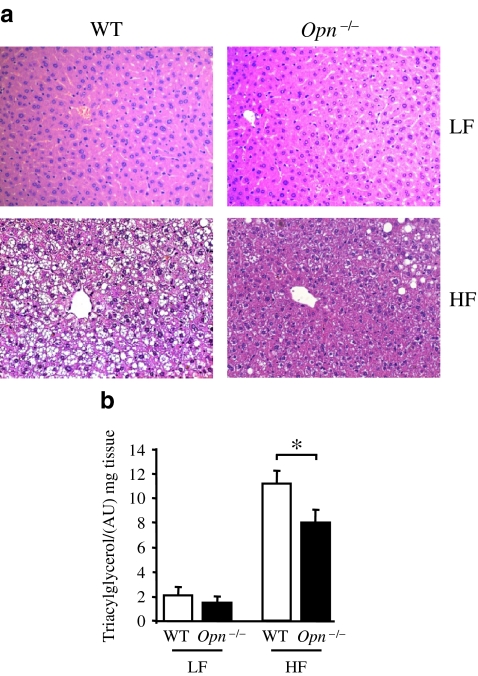
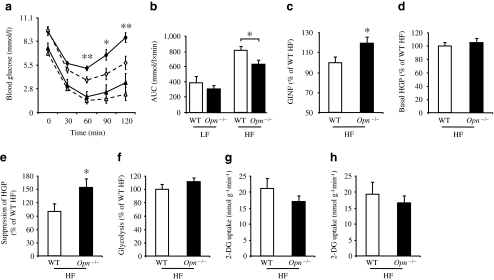
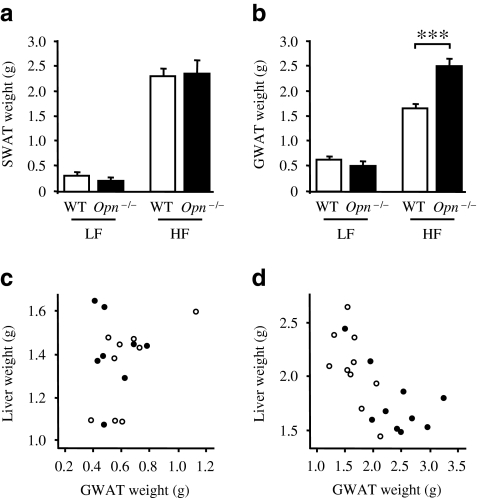
AIMS/HYPOTHESIS: Obesity is strongly associated with the development of non-alcoholic fatty liver disease (NAFLD). The cytokine osteopontin (OPN) was recently shown to be involved in obesity-induced adipose tissue inflammation and reduced insulin response. Accumulating evidence links OPN to the pathogenesis of NAFLD. Here we aimed to identify the role of OPN in obesity-associated hepatic steatosis and impaired hepatic glucose metabolism. METHODS: Wild-type (WT) and Opn (also known as Spp1) knockout (Opn (-/-)) mice were fed a high-fat or low-fat diet to study OPN effects in obesity-driven hepatic alterations. RESULTS: We show that genetic OPN deficiency protected from obesity-induced hepatic steatosis, at least in part, by downregulating hepatic triacylglycerol synthesis. Conversely, absence of OPN promoted fat storage in adipose tissue thereby preventing the obesity-induced shift to ectopic fat accumulation in the liver. Euglycaemic-hyperinsulinaemic clamp studies revealed that insulin resistance and excess hepatic glucose production in obesity were significantly attenuated in Opn (-/-) mice. OPN deficiency markedly improved hepatic insulin signalling as shown by enhanced insulin receptor substrate-2 phosphorylation and prevented upregulation of the major hepatic transcription factor Forkhead box O1 and its gluconeogenic target genes. In addition, obesity-driven hepatic inflammation and macrophage accumulation was blocked by OPN deficiency. CONCLUSIONS/INTERPRETATION: Our data strongly emphasise OPN as mediator of obesity-associated hepatic alterations including steatosis, inflammation, insulin resistance and excess gluconeogenesis. Targeting OPN action could therefore provide a novel therapeutic strategy to prevent obesity-related complications such as NAFLD and type 2 diabetes.
Overview
The claims and statistics of this paper haven’t been checked yet.
Free: it reads the open-access text and checks the first 5 claims that cite a source we can check. Create a free account to check every claim.
Integrity signals
Registry
Cites
Statistics
Figures
Verification
Claims the paper makes
The claims and statistics of this paper haven’t been checked yet.
Free: it reads the open-access text and checks the first 5 claims that cite a source we can check. Create a free account to check every claim.
Claims other papers make about this one
Each is checked against this paper’s own text: does it say what the citing paper says it does?
The cited source says what the claim attributes to it.
In the citing paper
“Moreover, genetic depletion of OPN protected mice fed a high-fat diet from obesity-induced hepatic steatosis [135].”
From Emerging role of liver-bone axis in osteoporosis (2024) · cites this paper as [135]
The cited source says what the claim attributes to it.
In the citing paper
“genes reported to be involved in hepatic insulin resistance, including Il6 45-48 , Spp1 49,50 and Igfbp1 51”
From Amphiregulin from regulatory T cells promotes liver fibrosis and insulin resistance in non-alcoholic steatohepatitis (2024) · cites this paper as [50]
Self-check
Percentages, sums and reported differences re-computed from the paper’s own numbers.
The self-check needs the paper’s full text.
Citations
Cites
Kopelman, P. G. (2000) · Nature · doi:10.1038/35007508 · Cited by 4,795 · cited 1×
“NAFLD has become an important public health issue because of its high prevalence and association with serious cardiometabolic abnormalities, including metabolic syndrome, type 2 diabetes and coronary heart disease [1, 2].”
BackgroundChemokines and leukocyte traffic
Baggiolini, M. (1998) · Nature · doi:10.1038/33340 · Cited by 2,709 · cited 1×
“Since OPN and MCP-1 cooperate in monocyte chemotaxis [15, 44], abrogation of inflammatory cell migration is likely to account for reduced abundance of macrophages in livers from HF-fed Opn”
BackgroundKanda, H. (2006) · Journal of Clinical Investigation · doi:10.1172/jci26498 · Cited by 2,682 · cited 1×
“6d), a chemokine that promotes hepatic macrophage infiltration and steatosis [13, 43].”
BackgroundNonalcoholic Fatty Liver, Steatohepatitis, and the Metabolic Syndrome
Marchesini, G., Bugianesi, E., Forlani, G., Cerrelli, F., Lenzi, M., Manini, R., Natale, S., Vanni, E., Villanova, N., Melchionda, N., et al. (2003) · Hepatology · doi:10.1053/jhep.2003.50161 · Cited by 2,679 · cited 1×
“NAFLD has become an important public health issue because of its high prevalence and association with serious cardiometabolic abnormalities, including metabolic syndrome, type 2 diabetes and coronary heart disease [1, 2].”
BackgroundLocal and systemic insulin resistance resulting from hepatic activation of IKK-β and NF-κB
Cai, D., Yuan, M., Frantz, D. F., Melendez, P. A., Hansen, L., Lee, J., & Shoelson, S. E. (2005) · Nature Medicine · doi:10.1038/nm1166 · Cited by 2,245 · cited 1×
“Similar to its effects on adipose tissue, obesity induces inflammatory alterations in the liver as reflected by a higher abundance of immune cells such as macrophages [8], increased cytokine production [3] and by activation of the nuclear factor κB (NF-κB) pathway [ 9 ].”
BackgroundObesity and nonalcoholic fatty liver disease: biochemical, metabolic, and clinical implications
Fabbrini, E., Sullivan, S., & Klein, S. (2010) · Hepatology · doi:10.1002/hep.23280 · Cited by 2,100 · cited 2×
“Hepatic steatosis is characterised by an imbalance between fatty acid input and output [5].”
BackgroundPuigserver, P., & Spiegelman, B. M. (2003) · Endocrine Reviews · doi:10.1210/er.2002-0012 · Cited by 2,076
TLR4 enhances TGF-β signaling and hepatic fibrosis
Seki, E., De Minicis, S., Österreicher, C. H., Kluwe, J., Osawa, Y., Brenner, D. A., & Schwabe, R. F. (2007) · Nature Medicine · doi:10.1038/nm1663 · Cited by 1,942
Postic, C., & Girard, J. (2008) · Journal of Clinical Investigation · doi:10.1172/jci34275 · Cited by 1,204 · cited 1×
“However, it still remains a matter of debate whether insulin resistance is a cause or consequence of NAFLD [6, 7].”
BackgroundThematic review series: Glycerolipids. DGAT enzymes and triacylglycerol biosynthesis
Yen, C.-L. E., Stone, S. J., Koliwad, S., Harris, C., & Farese, R. V. (2008) · Journal of Lipid Research · doi:10.1194/jlr.r800018-jlr200 · Cited by 1,105 · cited 2×
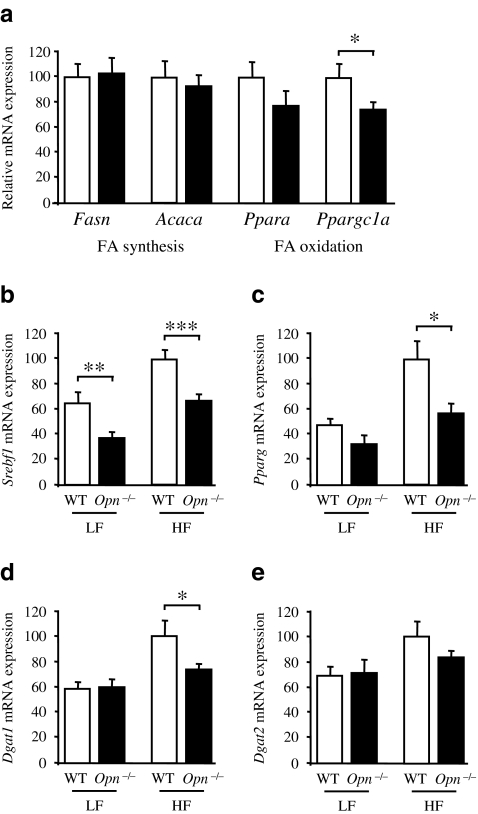
“Consequently, the expression of Dgat1, which is regulated by peroxisome proliferatoractivated receptor (PPAR)-γ [29] and catalyses triacylglycerol formation [ 30 ], was significantly decreased (Fig. 3d).”
Morino, K., Petersen, K. F., & Shulman, G. I. (2006) · Diabetes · doi:10.2337/db06-s002 · Cited by 853 · cited 1×
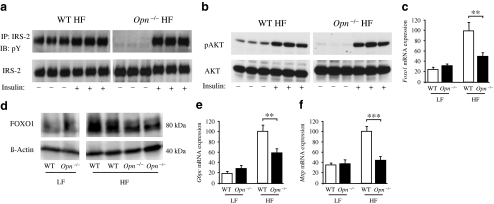
“Genetic OPN deletion improves hepatic insulin signalling in obesity and regulates gluconeogenic enzyme expression via FOXO1 HF-induced obesity impairs insulin-stimulated tyrosine phosphorylation of IRSs, thereby causing insulin resistance [31].”
BackgroundMurano, I., Barbatelli, G., Parisani, V., Latini, C., Muzzonigro, G., Castellucci, M., & Cinti, S. (2008) · Journal of Lipid Research · doi:10.1194/jlr.m800019-jlr200 · Cited by 726
ADD1/SREBP1 activates PPARγ through the production of endogenous ligand
Kim, J. B., Wright, H. M., Wright, M., & Spiegelman, B. M. (1998) · Proceedings of the National Academy of Sciences · doi:10.1073/pnas.95.8.4333 · Cited by 669 · cited 2×
“Consequently, the expression of Dgat1, which is regulated by peroxisome proliferatoractivated receptor (PPAR)-γ [29] and catalyses triacylglycerol formation [30], was significantly decreased (Fig.”
BackgroundKorenblat, K. M., Fabbrini, E., Mohammed, B. S., & Klein, S. (2008) · Gastroenterology · doi:10.1053/j.gastro.2008.01.075 · Cited by 592 · cited 1×
“However, it still remains a matter of debate whether insulin resistance is a cause or consequence of NAFLD [6, 7].”
BackgroundHuang, W., Metlakunta, A., Dedousis, N., Zhang, P., Sipula, I., Dube, J. J., Scott, D. K., & O'Doherty, R. M. (2010) · Diabetes · doi:10.2337/db09-0016 · Cited by 520 · cited 1×
“Only recently, chemical depletion of Kupffer cells was shown to prevent HF-induced hepatic steatosis and insulin resistance [12, 41, 42].”
BackgroundKupffer cells in non-alcoholic fatty liver disease: The emerging view
Baffy, G. (2009) · Journal of Hepatology · doi:10.1016/j.jhep.2009.03.008 · Cited by 473 · cited 2×
“Increasing evidence links macrophage accumulation in the liver to hepatic steatosis and insulin resistance [12, 34].”
BackgroundDong, X. C., Copps, K. D., Guo, S., Li, Y., Kollipara, R., DePinho, R. A., & White, M. F. (2008) · Cell Metabolism · doi:10.1016/j.cmet.2008.06.006 · Cited by 463 · cited 2×
“Foxo1 mRNA and protein levels were significantly enhanced in obese WT livers, whereas absence of OPN protected from HF-induced hepatic FOXO1 upregulation (Fig.”
BackgroundStienstra, R., Saudale, F., Duval, C., Keshtkar, S., Groener, J. E. M., van Rooijen, N., Staels, B., Kersten, S., & Müller, M. (2010) · Hepatology · doi:10.1002/hep.23337 · Cited by 452 · cited 1×
“Only recently, chemical depletion of Kupffer cells was shown to prevent HF-induced hepatic steatosis and insulin resistance [12, 41, 42].”
BackgroundNomiyama, T., Perez-Tilve, D., Ogawa, D., Gizard, F., Zhao, Y., Heywood, E. B., Jones, K. L., Kawamori, R., Cassis, L. A., Tschöp, M. H., et al. (2007) · Journal of Clinical Investigation · doi:10.1172/jci31986 · Cited by 401 · cited 4×
“It has recently been suggested that genetic OPN deficiency and antibody-mediated neutralisation improve obesity-associated adipose tissue inflammation and glucose tolerance [19, 20].”
BackgroundResultInfluentialOsteopontin—a molecule for all seasons
Mazzali, M., Kipari, T., Ophascharoensuk, V., Wesson, J. A., Johnson, R., & Hughes, J. (2002) · QJM: An International Journal of Medicine · doi:10.1093/qjmed/95.1.3 · Cited by 392 · cited 1×
“Osteopontin (OPN) is a multifunctional protein produced in numerous cells including activated macrophages and T cells, osteoclasts, smooth muscle, endothelial cells, and also hepatocytes [14, 15].”
BackgroundRole of osteopontin in adhesion, migration, cell survival and bone remodeling.
Standal, T., Børset, M., & Sundan, A. (2004) · PubMed · Cited by 346
Kolak, M., Westerbacka, J., Velagapudi, V. R., Wågsäter, D., Yetukuri, L., Makkonen, J., Rissanen, A., Häkkinen, A.-M., Lindell, M., Bergholm, R., et al. (2007) · Diabetes · doi:10.2337/db07-0111 · Cited by 317 · cited 1×
“Adipose tissue inflammation and unfavourable adipokine secretion are enhanced in individuals with NAFLD compared with individuals with normal intrahepatic triacylglycerol content [10], indicating that inflammatory factors released by the adipose tissue could be involved in the pathogenesis of NAFLD and hepatic insulin…”
BackgroundObstfeld, A. E., Sugaru, E., Thearle, M., Francisco, A.-M., Gayet, C., Ginsberg, H. N., Ables, E. V., & Ferrante, A. W. (2010) · Diabetes · doi:10.2337/db09-1403 · Cited by 314
Zeyda, M., & Stulnig, T. M. (2007) · Immunology Letters · doi:10.1016/j.imlet.2007.07.003 · Cited by 307 · cited 2×
“SWAT. The enlargement of GWAT, which is regarded as the visceral fat depot in mice, is frequently associated with insulin resistance [ 40 ].”
BackgroundSelf-citationSahai, A., Malladi, P., Pan, X., Paul, R., Melin-Aldana, H., Green, R. M., & Whitington, P. F. (2004) · American Journal of Physiology-Gastrointestinal and Liver Physiology · doi:10.1152/ajpgi.00199.2004 · Cited by 290 · cited 2×
“We and others have recently reported that hepatic OPN production is significantly upregulated in murine HFinduced and genetic obesity [18, 23] and correlates with the severity of hepatic steatosis in humans [21].”
BackgroundQureshi, K. (2007) · World Journal of Gastroenterology · doi:10.3748/wjg.v13.i26.3540 · Cited by 283 · cited 2×
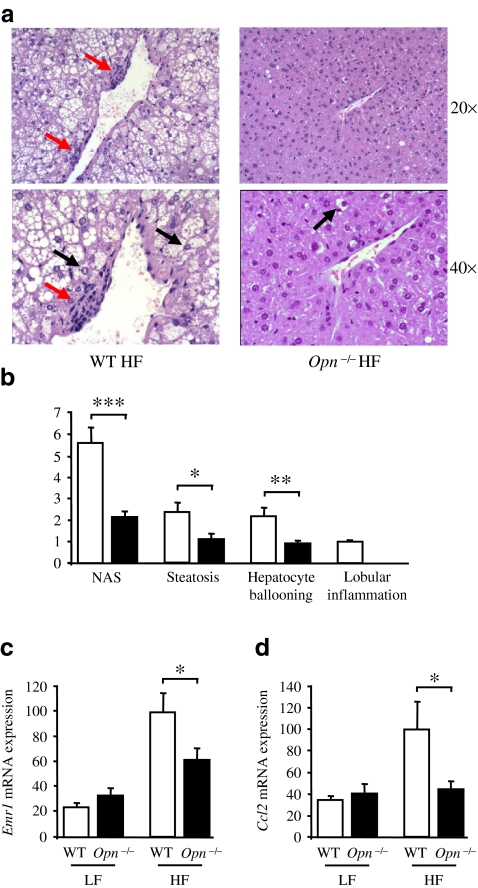
“Hepatic mRNA expression of inflammatory Tnf and Tgfb1, known to be crucially involved in pathogenesis and progression of NAFLD [37, 38] was increased with HF in WT mice but significantly less in Opn mice (Fig.”
BackgroundSyn, W.-K., Choi, S. S., Liaskou, E., Karaca, G. F., Agboola, K. M., Oo, Y. H., Mi, Z., Pereira, T. A., Zdanowicz, M., Malladi, P., et al. (2011) · Hepatology · doi:10.1002/hep.23998 · Cited by 275 · cited 1×
“Moreover, deficiency and neutralisation of OPN improved liver injury and fibrosis elicited by methionineand choline-deficient diet, concanavalin A, and D-galactosamine [22, 24, 45, 46] indicating a general implication of OPN in inflammatory liver damage.”
BackgroundNeschen, S., Morino, K., Hammond, L. E., Zhang, D., Liu, Z.-X., Romanelli, A. J., Cline, G. W., Pongratz, R. L., Zhang, X.-M., Choi, C. S., et al. (2005) · Cell Metabolism · doi:10.1016/j.cmet.2005.06.006 · Cited by 261 · cited 2×
“Tissue 2-[(14)C]DG uptake was calculated from the plasma 2-[(14)C]DG AUC and tissue 2-[(14)C]DG-6phosphate content as previously described [26].”
MethodSelf-citationHepatic Steatosis: A Mediator of the Metabolic Syndrome. Lessons From Animal Models
den Boer, M., Voshol, P. J., Kuipers, F., Havekes, L. M., & Romijn, J. A. (2004) · Arteriosclerosis, Thrombosis, and Vascular Biology · doi:10.1161/01.atv.0000116217.57583.6e · Cited by 260
Kupffer cell activation is a causal factor for hepatic insulin resistance
Lanthier, N., Molendi-Coste, O., Horsmans, Y., van Rooijen, N., Cani, P. D., & Leclercq, I. A. (2010) · American Journal of Physiology-Gastrointestinal and Liver Physiology · doi:10.1152/ajpgi.00391.2009 · Cited by 257 · cited 4×
“Increasing evidence links macrophage accumulation in the liver to hepatic steatosis and insulin resistance [12, 34].”
BackgroundInfluentialNeschen, S., Morino, K., Dong, J., Wang-Fischer, Y., Cline, G. W., Romanelli, A. J., Rossbacher, J. C., Moore, I. K., Regittnig, W., Munoz, D. S., et al. (2007) · Diabetes · doi:10.2337/db06-1206 · Cited by 233
Self-citationPlasma Osteopontin Levels and Expression in Adipose Tissue Are Increased in Obesity
Gómez-Ambrosi, J., Catalán, V., Ramírez, B., Rodríguez, A., Colina, I., Silva, C., Rotellar, F., Mugueta, C., Gil, M. J., Cienfuegos, J. A., et al. (2007) · The Journal of Clinical Endocrinology & Metabolism · doi:10.1210/jc.2007-0349 · Cited by 211 · cited 1×
“Systemic concentrations as well as adipose content of OPN are significantly elevated in obese patients and mice [17, 18].”
BackgroundMacrophage TNF-α contributes to insulin resistance and hepatic steatosis in diet-induced obesity
De Taeye, B. M., Novitskaya, T., McGuinness, O. P., Gleaves, L., Medda, M., Covington, J. W., & Vaughan, D. E. (2007) · American Journal of Physiology-Endocrinology and Metabolism · doi:10.1152/ajpendo.00194.2007 · Cited by 208 · cited 2×
“Macrophages are the major source of obesity-driven cytokine production not only in adipose tissue but also in liver [36].”
BackgroundNeutralization of Osteopontin Inhibits Obesity-Induced Inflammation and Insulin Resistance
Kiefer, F. W., Zeyda, M., Gollinger, K., Pfau, B., Neuhofer, A., Weichhart, T., Säemann, M. D., Geyeregger, R., Schlederer, M., Kenner, L., et al. (2010) · Diabetes · doi:10.2337/db09-0404 · Cited by 200 · cited 5×
“Reverse transcription and gene expression Adipose tissue and liver was homogenised in TRIzol reagent (Invitrogen, Carlsbad, CA, USA) and RNAwas isolated and transcribed to cDNA according to the manufacturer’s protocol [19].”
BackgroundMethodResultInfluentialSelf-citationOsteopontin as a Mediator of NKT Cell Function in T Cell-Mediated Liver Diseases
Diao, H., Kon, S., Iwabuchi, K., Kimura, C., Morimoto, J., Ito, D., Segawa, T., Maeda, M., Hamuro, J., Nakayama, T., et al. (2004) · Immunity · doi:10.1016/j.immuni.2004.08.012 · Cited by 195 · cited 1×
“Moreover, deficiency and neutralisation of OPN improved liver injury and fibrosis elicited by methionineand choline-deficient diet, concanavalin A, and D-galactosamine [22, 24, 45, 46] indicating a general implication of OPN in inflammatory liver damage.”
BackgroundSahai, A., Malladi, P., Melin-Aldana, H., Green, R. M., & Whitington, P. F. (2004) · American Journal of Physiology-Gastrointestinal and Liver Physiology · doi:10.1152/ajpgi.00002.2004 · Cited by 181 · cited 3×
“Haematoxylin–eosin staining was performed in liver as described [22].”
BackgroundMethodPathophysiological Role of Osteopontin in Hepatic Inflammation, Toxicity, and Cancer
Ramaiah, S. K., & Rittling, S. (2008) · Toxicological Sciences · doi:10.1093/toxsci/kfm246 · Cited by 180 · cited 1×
“Osteopontin is an inflammatory cytokine, hepatic content of which is upregulated in the course of human and murine hepatic steatosis and various models of liver injury [18, 21, 39].”
BackgroundKiefer, F. W., Zeyda, M., Todoric, J., Huber, J., Geyeregger, R., Weichhart, T., Aszmann, O., Ludvik, B., Silberhumer, G. R., Prager, G., et al. (2008) · Endocrinology · doi:10.1210/en.2007-1312 · Cited by 161 · cited 3×
“Systemic concentrations as well as adipose content of OPN are significantly elevated in obese patients and mice [17, 18 ].”
BackgroundInfluentialSelf-citationHaemmerle, G., Zimmermann, R., Strauss, J. G., Kratky, D., Riederer, M., Knipping, G., & Zechner, R. (2002) · Journal of Biological Chemistry · doi:10.1074/jbc.m108640200 · Cited by 156
Bertola, A., Deveaux, V., Bonnafous, S., Rousseau, D., Anty, R., Wakkach, A., Dahman, M., Tordjman, J., Clément, K., McQuaid, S. E., et al. (2009) · Diabetes · doi:10.2337/db08-0400 · Cited by 150 · cited 2×
“We and others have recently reported that hepatic OPN production is significantly upregulated in murine HFinduced and genetic obesity [18, 23] and correlates with the severity of hepatic steatosis in humans [21].”
BackgroundZeyda, M., Säemann, M. D., Stuhlmeier, K. M., Mascher, D. G., Nowotny, P. N., Zlabinger, G. J., Waldhäusl, W., & Stulnig, T. M. (2005) · Journal of Biological Chemistry · doi:10.1074/jbc.m410000200 · Cited by 143 · cited 1×
“Immunoprecipitation and immunoblotting Standard immunoblotting techniques were applied as described previously [28] using specific antibodies against forkhead box O1 (FOXO1; Santa Cruz Biotechnology, Santa Cruz, CA, USA), thymoma viral proto-oncogene 1 (AKT) and pAKT (ser473) (Cell Signaling, Danvers, MA, USA).”
MethodSelf-citationTsochatzis, E. A., Papatheodoridis, G. V., & Archimandritis, A. J. (2009) · Mediators of Inflammation · doi:10.1155/2009/831670 · Cited by 141 · cited 1×
“Adipose tissue inflammation and unfavourable adipokine secretion are enhanced in individuals with NAFLD compared with individuals with normal intrahepatic triacylglycerol content [10], indicating that inflammatory factors released by the adipose tissue could be involved in the pathogenesis of NAFLD and hepatic insulin…”
BackgroundKupffer Cell Aggregation and Perivenular Distribution in Steatohepatitis
Lefkowitch, J. H., Haythe, J. H., & Regent, N. (2002) · Modern Pathology · doi:10.1097/01.mp.0000019579.30842.96 · Cited by 112 · cited 1×
“Similar to its effects on adipose tissue, obesity induces inflammatory alterations in the liver as reflected by a higher abundance of immune cells such as macrophages [8], increased cytokine production [3] and by activation of the nuclear factor κB (NF-κB) pathway [9].”
BackgroundBerk, P. D. (2008) · Hepatology · doi:10.1002/hep.22632 · Cited by 45 · cited 2×
“NAFLD spans a spectrum from simple hepatic steatosis through non-alcoholic steatohepatitis (NASH) ultimately leading to liver fibrosis and cirrhosis [3].”
BackgroundXu, G., Sun, W. T., He, D., Wang, L., Zheng, W., Nie, H., Ni, L., Zhang, D., Li, N., & Zhang, J. (2005) · PubMed · Cited by 37
The role of osteopontin in d-galactosamine-induced liver injury in genetically obese mice
Kwon, H., Won, Y.-S., Yoon, W.-K., Nam, K., Kim, D.-Y., & Kim, H.-C. (2009) · Toxicology and Applied Pharmacology · doi:10.1016/j.taap.2009.11.006 · Cited by 14 · cited 3×
“Within the liver, OPN is predominantly produced in inflammatory cells but also hepatocytes [24].”
Background
Cited by
Macrophage-mediated inflammation in metabolic disease
Chawla, A., Nguyen, K. D., & Goh, Y. P. S. (2011) · Nature reviews. Immunology · doi:10.1038/nri3071 · Cited by 1,314
Osteopontin: A novel regulator at the cross roads of inflammation, obesity and diabetes
Kahles, F., Findeisen, H. M., & Bruemmer, D. (2014) · Molecular Metabolism · doi:10.1016/j.molmet.2014.03.004 · Cited by 408
“This was further supported by three experimental studies demonstrating that antibody-mediated OPN neutralization and OPN deficiency protect against HFD-induced hepatic macrophage infiltration [41,102] and Dgalactosamine-induced inflammatory liver injury [103].”
Rodríguez, A., Ezquerro, S., Méndez-Giménez, L., Becerril, S., & Frühbeck, G. (2015) · American Journal of Physiology-Endocrinology and Metabolism · doi:10.1152/ajpendo.00297.2015 · Cited by 282
Hedgehog signaling in the liver
Omenetti, A., Choi, S., Michelotti, G., & Diehl, A. M. (2011) · Journal of Hepatology · doi:10.1016/j.jhep.2010.10.003 · Cited by 277
Cytokines and abnormal glucose and lipid metabolism
Shi, J., Fan, J., Su, Q., & Yang, Z. (2019) · Frontiers in Endocrinology · doi:10.3389/fendo.2019.00703 · Cited by 282
“Osteopontin acts as a mediator of obesity-related hepatic alterations including steatosis, inflammation, insulin resistance, and excess gluconeogenesis (129).”
Background
Metadata
- Authors
- Kiefer, F. W., Neschen, S., Pfau, B., Legerer, B., Neuhofer, A., Kahle, M., Hrabé de Angelis, M., Schlederer, M., Mair, M., Kenner, L., Plutzky, J., Zeyda, M., & Stulnig, T. M.
- Affiliations
- Medical University of Vienna (AT)
- Helmholtz Munich (DE)
- Ludwig Boltzmann Institute for Cancer Research (AT)
- Brigham and Women's Hospital (US)
- Corresponding author
- Stulnig, T. M.
- Venue
- Diabetologia
- Published
- 2011-05-12
- Volume
- 54
- Issue
- 8
- Pages
- 2132-2142
- ISSN
- 0012-186X (ISSN-L)
- 1432-0428
- PMC
- PMC3131508
- OpenAlex
- W1991671784
- Cited by
- 104
- References
- 46
- Citations by year
- 2026: 3 · 2024: 9 · 2023: 6 · 2022: 11 · 2021: 3 · 2020: 3 · 2019: 9 · 2018: 4 · 2017: 6 · 2016: 7 · 2015: 9 · 2014: 13 · 2013: 12 · 2012: 7
- FWCI
- 7.95
- Type
- journal article
- Language
- en
- Open access
- hybrid
- doi.org
- Licence
- cc-by-nc
- Locations
- Diabetologia (publishedVersion, cc-by-nc)
- PubMed Central (publishedVersion, cc-by-nc)
- PubMed (publishedVersion)
- mediaTUM (Technical University of Munich) (submittedVersion, cc-by)
- Site cant be reached (submittedVersion, cc-by)
- Funders
- Bundesministerium für Bildung und Forschung (201608, 01GS0850)
- Austrian Science Fund (W1205, P 18776)
- Universität Wien
- Medizinische Universität Wien (W1205)
- Topics
- Health Sciences › Medicine › Hepatology › Liver Disease Diagnosis and Treatment
- Health Sciences › Medicine › Endocrinology, Diabetes and Metabolism › Adipokines, Inflammation, and Metabolic Diseases
- Health Sciences › Medicine › Hepatology › Liver physiology and pathology
- Keywords
- osteopontin, non-alcoholic fatty liver disease, hepatic steatosis, obesity, hepatic glucose production, gluconeogenesis, insulin resistance, insulin receptor substrate 2, FOXO1, liver inflammation, hepatic macrophages, triglyceride synthesis, high-fat diet, type 2 diabetes
- MeSH terms
- Animals, Fatty Liver, Glucose, Immunohistochemistry, Male, Obesity, Triglycerides, Immunoblotting, Glucose Clamp Technique, Mice, Knockout, Reverse Transcriptase Polymerase Chain Reaction, Immunoprecipitation, Mice, Osteopontin
About these checks
Registry, retraction, Cites and statistics results are computed, not judged, with one exception: a printed reference that no index lists is read once by a model before it counts as a citation error. Claims are extracted by a model and kept only when their quote appears verbatim in the text; each cited source is then checked, with a model’s help, for whether it says what the claim relies on. Those verdicts can be wrong — read the claim’s quote and the cited source before relying on one.
Statistics and arithmetic are recomputed, not judged.
Confidence bands are shown only for fields calibrated on our annotated test set. None is calibrated yet, so no band is shown.
What counts as a claim ›How we measure confidence ›How we check this ›
Are you an author, or do you see a problem with this page? Request a review
Data sources
Bibliographic data: Semantic Scholar, OpenAlex, Crossref.
Contains information from the Semantic Scholar Academic Graph Datasets, made available under the ODC Attribution License (ODC-BY 1.0).
Semantic Scholar’s data is described in: Kinney, R., et al. (2023). The Semantic Scholar Open Data Platform. arXiv:2301.10140.
