

Pioglitazone and risk of bladder cancer among diabetic patients in France: a population-based cohort study
Open accessThe DOI matches its Crossref record; 16 of the 16 references it cites were found in a registry or an index.
Abstract
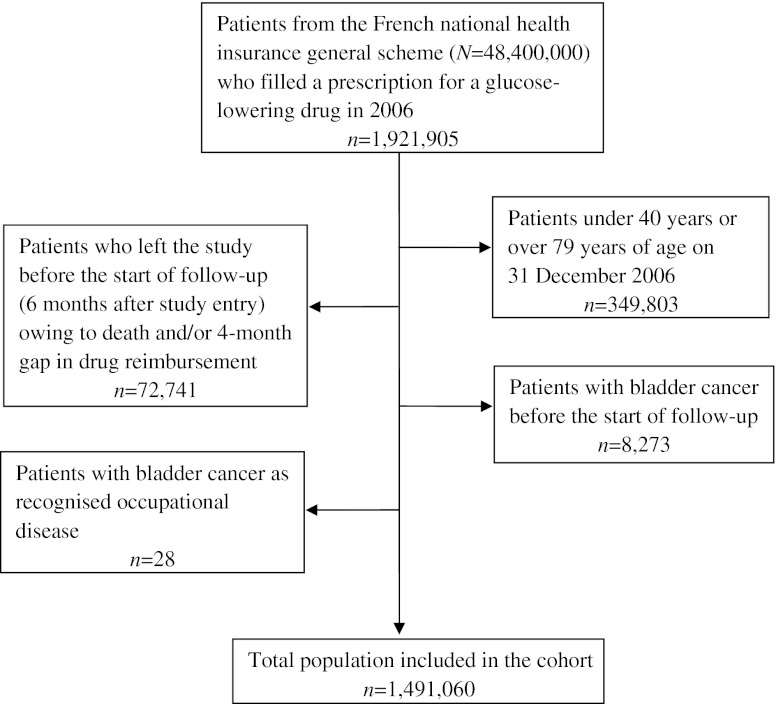
AIMS/HYPOTHESIS: Previous studies have suggested an increased risk of bladder cancer with pioglitazone exposure. We aimed to investigate the association between pioglitazone exposure and bladder cancer in France. METHODS: This cohort study involved use of data from the French national health insurance information system (Système National d'Information Inter-régimes de l'Assurance Maladie; SNIIRAM) linked with the French hospital discharge database (Programme de Médicalisation des Systèmes d'Information; PMSI). The cohort included patients aged 40 to 79 years who filled a prescription for a glucose-lowering drug in 2006. The cohort was followed for up to 42 months. Pioglitazone exposure was modelled as a time-dependent variable and defined by having filled at least two prescriptions over a 6-month period. Incident cases of bladder cancer were identified by a discharge diagnosis of bladder cancer combined with specific aggressive treatment. Statistical analyses involved a multivariate Cox model adjusted for age, sex and exposure to other glucose-lowering drugs. RESULTS: The cohort included 1,491,060 diabetic patients, 155,535 of whom were exposed to pioglitazone. We found 175 cases of bladder cancer among exposed patients and 1,841 among non-exposed patients. Incidence rates were 49.4 and 42.8 per 100,000 person-years, respectively. Pioglitazone exposure was significantly associated with bladder cancer incidence (adjusted HR 1.22 [95% CI 1.05, 1.43]). We observed a dose-effect relationship, with a significantly increased risk for high cumulative doses (≥ 28,000 mg, adjusted HR 1.75 [95% CI 1.22, 2.50]) and long duration of exposure (≥ 24 months, adjusted HR 1.36 [1.04, 1.79]). CONCLUSIONS/INTERPRETATION: In this cohort of diabetic patients from France, pioglitazone exposure was significantly associated with increased risk of bladder cancer.
Overview
The claims and statistics of this paper haven’t been checked yet.
Free: it reads the open-access text and checks the first 5 claims that cite a source we can check. Create a free account to check every claim.
Integrity signals
Registry
Cites
Statistics
Figures
Verification
Claims the paper makes
The claims and statistics of this paper haven’t been checked yet.
Free: it reads the open-access text and checks the first 5 claims that cite a source we can check. Create a free account to check every claim.
Claims other papers make about this one
Each is checked against this paper’s own text: does it say what the citing paper says it does?
The cited source says what the claim attributes to it.
In the citing paper
“Observational research conducted in 2011 and 2012 suggested that pioglitazone may increase the risk of bladder cancer.46,47”
From Pioglitazone after Ischemic Stroke or Transient Ischemic Attack (2016) · cites this paper as [47]
Self-check
Percentages, sums and reported differences re-computed from the paper’s own numbers.
The self-check needs the paper’s full text.
Citations
Cites
Dormandy, J. A., Charbonnel, B., Eckland, D. J., Erdmann, E., Massi-Benedetti, M., Moules, I. K., Skene, A. M., Tan, M. H., Lefèbvre, P. J., Murray, G. D., et al. (2005) · The Lancet · doi:10.1016/s0140-6736(05)67528-9 · Cited by 4,129 · cited 1×
“After a blinded review with external experts, bladder cancer was diagnosed during the second year of exposure in six cases in the pioglitazone group vs three in the placebo group [4, 5].”
BackgroundMetformin and reduced risk of cancer in diabetic patients
Evans, J. M. M., Donnelly, L. A., Emslie-Smith, A. M., Alessi, D. R., & Morris, A. D. (2005) · BMJ · doi:10.1136/bmj.38415.708634.f7 · Cited by 2,388 · cited 1×
“This observation has been previously reported [14–17].”
Association Between Smoking and Risk of Bladder Cancer Among Men and Women
Freedman, N. D. (2011) · JAMA · doi:10.1001/jama.2011.1142 · Cited by 1,141 · cited 1×
“First of all, it lacks data on tobacco use, known to be the third main risk factor for bladder cancer after age and male sex [19, 20].”
BackgroundThe influence of glucose-lowering therapies on cancer risk in type 2 diabetes
Currie, C. J., Poole, C. D., & Gale, E. A. M. (2009) · Diabetologia · doi:10.1007/s00125-009-1440-6 · Cited by 1,124
Bowker, S. L., Majumdar, S. R., Veugelers, P., & Johnson, J. A. (2006) · Diabetes Care · doi:10.2337/diacare.29.02.06.dc05-1558 · Cited by 933
Risk of Bladder Cancer Among Diabetic Patients Treated With Pioglitazone
Lewis, J. D., Ferrara, A., Peng, T., Hedderson, M., Bilker, W. B., Quesenberry, C. P., Vaughn, D. J., Nessel, L., Selby, J., & Strom, B. L. (2011) · Diabetes Care · doi:10.2337/dc10-1068 · Cited by 625
French national health insurance information system and the permanent beneficiaries sample
Tuppin, P., de Roquefeuil, L., Weill, A., Ricordeau, P., & Merlière, Y. (2010) · Revue d'Épidémiologie et de Santé Publique · doi:10.1016/j.respe.2010.04.005 · Cited by 399 · cited 1×
“The national health insurance information system (Système National d'Information Inter-régimes de l'Assurance Maladie; SNIIRAM) contains individualised, anonymous and exhaustive data on all reimbursements for patient health expenditure [10], including medicinal products as well as outpatient medical and nursing care,…”
BackgroundSelf-citationDiabetes mellitus and risk of bladder cancer: a meta-analysis
Larsson, S. C., Orsini, N., Brismar, K., & Wolk, A. (2006) · Diabetologia · doi:10.1007/s00125-006-0468-0 · Cited by 304 · cited 1×
“42]) when comparing type 2 diabetic individuals with non-diabetic individuals [22].”
BackgroundDormandy, J., Bhattacharya, M., & van Troostenburg de Bruyn, A.-R. (2009) · Drug Safety · doi:10.2165/00002018-200932030-00002 · Cited by 227
Cohort Study of Pioglitazone and Cancer Incidence in Patients With Diabetes
Ferrara, A., Lewis, J. D., Quesenberry, C. P., Peng, T., Strom, B. L., Van Den Eeden, S. K., Ehrlich, S. F., & Habel, L. A. (2011) · Diabetes Care · doi:10.2337/dc10-1067 · Cited by 181 · cited 1×
“Another analysis of a similar cohort found no association between pioglitazone exposure and cancer in several other sites [7].”
Result
Research works printed but not linked: 1
- French medicines agency (AFSSAPS) (2011) Use of medications containing pioglitazone (Actos®, Competact®) Suspended. Available from www.afssaps.fr/content/download/34175/447382/version/1/file/Press-release-Suspension-Pioglitazone.pdf, accessed 12 August 2011.
Cited by
Items 201–283 of 283
van Hattum, J. W., de Ruiter, B. M., Oddens, J. R., de Reijke, T. M., Wilmink, J. W., & Molenaar, R. J. (2022) · Bladder Cancer · doi:10.3233/blc-211653 · Cited by 6
“Six studies [21, 23, 27–30] compared metformin monotherapy with single-agent use of other GLDs.”
Cancer biology in diabetes update: Focusing on antidiabetic drugs
Kawakita, E., & Kanasaki, K. (2024) · Journal of Diabetes Investigation · doi:10.1111/jdi.14152 · Cited by 8
Juvenile oral angiofibroma in a female.
Reddy, B. K., Isaac, V., Nayak, M., & Prabhu, S. R. (1979) · PubMed · Cited by 7
Bhushan, S., Ray, R. S., Prakash, J., & Singh, G. (2019) · Clinical Therapeutics · doi:10.1016/j.clinthera.2019.08.018 · Cited by 12
An analysis of legal warnings after drug approval in Thailand
Sriphiromya, P., & Theeraroungchaisri, A. (2014) · Regulatory Toxicology and Pharmacology · doi:10.1016/j.yrtph.2014.10.013 · Cited by 5
Romero, V., Peyton, C. C., Gray, I., Hemal, A. K., & Terlecki, R. P. (2014) · BMC Urology · doi:10.1186/1471-2490-14-10 · Cited by 5
“Another cohort study in France demonstrated a significant dose-dependent association between pioglitizone use and bladder cancer, sparking removal from the French market and the US Food and Drug Administration warning for using pioglitazone in patients with a current or previous bladder cancer [10,12].”
BackgroundPioglitazone and bladder cancer
Warren, H. R., Raison, N. T. J., & Dasgupta, P. (2015) · British Journal of Urology · doi:10.1111/bju.13352 · Cited by 5
Recent Perspective on Thiazolidinedione
Kim, W. J. (2021) · Journal of Korean Diabetes · doi:10.4093/jkd.2021.22.2.97 · Cited by 5
Balancing the risks and benefits for pioglitazone in type 2 diabetes
Johnson, J. A., & Colmers-Gray, I. N. (2012) · Diabetes Research and Clinical Practice · doi:10.1016/j.diabres.2012.08.005 · Cited by 5
Jadhav, S., Shivane, V. K., Lila, A., Bandgar, T., & Shah, N. (2014) · Journal of Postgraduate Medicine · doi:10.4103/0022-3859.138765 · Cited by 5
Song, S. O., Kim, K. J., & Lee, B. (2012) · Diabetes & Metabolism Journal · doi:10.4093/dmj.2012.36.6.462 · Cited by 4
“However, this observation was meaningful only when pioglitazone dose was quantified, and not from solely its use [3-8].”
BackgroundNAFLD therapy and monitoring disease progression
Puri, P., & Arun, V. A. (2017) · Tropical Gastroenterology · doi:10.7869/tg.385 · Cited by 5
Agrawal, P. K., Jain, A., Gautam, A., Nigam, A. K., Pursnani, N., & Farooqui, M. (2019) · Perspectives in Clinical Research · doi:10.4103/picr.picr_192_18 · Cited by 6
Toxicological profile of anti-diabetic drugs and emerging measures to reduce the toxic burden
Dugbartey, G. J., Alornyo, K. K., Dapaa-Addo, C. O., Kwashie, E. K., Harley, Y., & Asiedu, B. N. (2026) · Toxicology Reports · doi:10.1016/j.toxrep.2026.102247 · Cited by 7
“…markets in June 2011 based on national pharmacoepidemiological data indicating a significant duration-dependent increase in bladder cancer risk [114], while the EMA took a more conservative position, concluding that the benefit-risk balance remained positive with appropriate patient selection…”
Hong, E., Min, K. W., Chun, S., Chung, C. H., Oh, S., Lee, C. B., Kim, D., Kim, H. S., Mok, J., Sohn, T. S., et al. (2025) · Diabetes Obesity and Metabolism · doi:10.1111/dom.16625 · Cited by 2
Kelleni, M. T. (2014) · Journal of Diabetes & Metabolism · doi:10.4172/2155-6156.1000411 · Cited by 3
“In June 2011, France National Agency for the Safety of Medicine and Health Products banned pioglitazone relying on the results appearing from large cohort and case control studies; some suggesting a bladder cancer association risk with a duration of intake of more than one to two years, while others conclude that the…”
BackgroundPredictive Patient Care: Survival Model to Prevent Medication Non-adherence
Janssoone, T., Rinder, P., Hornus, P., & Kanoun, D. (2018) · Lecture notes in computer science · doi:10.1007/978-3-030-00320-3_6 · Cited by 3
Ruzafa, J. C., Ulrichsen, S. P., Bennett, D., & Ehrenstein, V. (2019) · Drugs - Real World Outcomes · doi:10.1007/s40801-019-0160-6 · Cited by 3
Sabatier, P., Wack, M., Pouchot, J., Danchin, N., & Jannot, A. (2022) · BMC Medical Research Methodology · doi:10.1186/s12874-022-01628-3 · Cited by 5
Cladosporols and PPARγ: Same Gun, Same Bullet, More Targets
Rapuano, R., Mercuri, A., Dallavalle, S., Moricca, S., Lavecchia, A., & Lupo, A. (2024) · Biomolecules · doi:10.3390/biom14080998 · Cited by 3
“Unfortunately, the oral administration of these molecules, which are able to strongly activate PPAR γ , provoked unwanted side effects at the same time (weight gain, fluid retention, osteoporosis, cardiovascular diseases, and bladder cancer) [43–46].”
Pioglitazone: A prudent prescription
Kalra, S., Dhamija, P., & Sahay, R. K. (2013) · Indian Journal of Endocrinology and Metabolism · doi:10.4103/2230-8210.111594 · Cited by 4
Fraslin, A., Benhamou, S., Lebrét, T., Radvanyi, F., Allory, Y., Karimi, M., & Bonastre, J. (2025) · Clinical Genitourinary Cancer · doi:10.1016/j.clgc.2025.102344 · Cited by 3
Litigation Seeking Access to Data From Ongoing Clinical Trials: A Threat to Clinical Research
Kernan, W. N., Viscoli, C. M., & Varughese, M. C. (2014) · JAMA Internal Medicine · doi:10.1001/jamainternmed.2014.3248 · Cited by 4
Pioglitazone Induced Carcinoma of Urinary Bladder: A Case Report
Takalkar, U. V., Asegaonkar, S. B., & Advani, S. H. (2013) · HAL · Cited by 2
Katsuyama, H., Fukunaga, T., Hamasaki, H., Adachi, H., Moriyama, S., Kawaguchi, A., Mishima, S., Sako, A., & Yanai, H. (2016) · Journal of Clinical Medicine Research · doi:10.14740/jocmr2611w · Cited by 2
Controversies of Pioglitazone in the Management of Diabetes Mellitus
Balasubramanian, T., Karthikeyan, M., & Puthanpurakkal, S. (2016) · Cited by 2
Halimi, S., & Dejager, S. (2016) · Médecine des Maladies Métaboliques · doi:10.1016/s1957-2557(16)30212-7 · Cited by 4
Singh, H., Joshi, D., Narula, S., Singla, M., Rohilla, R., & Singh, J. (2022) · Expert Review of Clinical Pharmacology · doi:10.1080/17512433.2022.2053111 · Cited by 2
Li, S., & Tian, H. (2013) · Diabetes & Metabolism Journal · doi:10.4093/dmj.2013.37.1.81 · Cited by 3
“Despite lack of support from molecular mechanism, several cohorts observed the association between long term application of pioglitazone and the bladder cancer risk [2,3].”
BackgroundResultWill PPAR-γ agonist therapy still have a role in diabetes management in 2013?
Grunberger, G. (2012) · Diabetes Management · doi:10.2217/dmt.12.81 · Cited by 3
Pharmacological agents for nonalcoholic steatohepatitis
Guillaume, M., & Ratziu, V. (2013) · Hepatology International · doi:10.1007/s12072-013-9482-8 · Cited by 2
“pioglitazone [27] that justified its market withdrawal in France.”
BackgroundDiabète de type 2 : pourquoi ne pas proposer une polythérapie antidiabétique d’emblée ?
Halimi, S. (2016) · Médecine des Maladies Métaboliques · doi:10.1016/s1957-2557(16)30028-1 · Cited by 5
Ntaios, G., & Kent, T. A. (2016) · Stroke · doi:10.1161/strokeaha.116.013230 · Cited by 2
Quillet, A., Colin, O., Bourgeois, N., Favrelière, S., Ferru, A., Boinot, L., Lafay‐Chebassier, C., & Pérault‐Pochat, M. (2017) · Fundamental and Clinical Pharmacology · doi:10.1111/fcp.12333 · Cited by 2
Goyal, A., Singh, H., Sehgal, V. K., Jayanthi, C. R., Munshi, R., Bairy, L. K., Kumar, R., Kaushal, S., Kakkar, A. K., Ambwani, S. R., et al. (2017) · The Indian Journal of Medical Research · doi:10.4103/ijmr.ijmr_1416_15 · Cited by 2
Functional network analysis of gene‑phenotype connectivity based on pioglitazone
Wang, W., Zhang, L., Wang, X., Lin, D., Pan, Q., & Guo, L. (2019) · Experimental and Therapeutic Medicine · doi:10.3892/etm.2019.8162 · Cited by 2
“Certain observational and retrospective studies have indicated that pioglitazone increases the risk of bladder cancer in a dose-dependent manner, compared with that in a control group (8,9).”
ResultAssociation between pioglitazone use and head and neck cancer: Population‐based case‐control study
Yang, T., Xirasagar, S., Cheng, Y., Wu, C.-S., Kao, Y., Shia, B., & Lin, H. (2019) · Head & Neck · doi:10.1002/hed.26046 · Cited by 2
“Pioglitazone, an oral anti-hyperglycemic agent used to treat type 2 diabetes mellitus (DM), was the 10th highest volume drug sold in the United States in 2008.10,11 It belongs to the category of thiazolidinedione (TZD), which selectively stimulates the nuclear receptor, peroxisome proliferator-activated receptor gamma…”
MethodInfluentialPolemics of pioglitazone: an appraisal in 2015
Singh, A. K. (2015) · Expert Review of Endocrinology & Metabolism · doi:10.1586/17446651.2015.1054809 · Cited by 2
“Nonetheless, based on these data as well as their own analysis, the French agency CNAMTS (AFSSAPS) suspended pioglitazone use in France with effect from 9 June 2011 suggesting an increased risk of bladder cancer among pioglitazone users [6].”
BackgroundMethodL’internista ospedaliero nella gestione del paziente diabetico complesso
Magnani, G. E. L., Beltramello, G., Brancato, D., Fontanella, A., & Nardi, R. (2018) · Italian Journal of Medicine · doi:10.4081/itjm.q.2018.2 · Cited by 2
Quelle place pour les registres de morbidité à l’ère des données massives de santé ?
Francis-Oliviero, F., Terroba, C. B., Persoz, C., Gagliolo, J., & Alla, F. (2020) · Revue d Épidémiologie et de Santé Publique · doi:10.1016/j.respe.2019.11.018 · Cited by 2
Self-citationThiazolidinediones/insulin use and cancer risk: Insights from the recent meta-analyses
Simon, D. (2013) · Diabetes & Metabolism · doi:10.1016/j.diabet.2013.01.001 · Cited by 3
Diabetes and Cancer: Evidence for Risk, Methodology and Implications
Badrick, E., & Renehan, A. G. (2016) · Wiley eBooks · doi:10.1002/9781118924853.ch54 · Cited by 2
Janssoone, T., Bic, C., Kanoun, D., Hornus, P., & Rinder, P. (2018) · arXiv (Cornell University) · doi:10.48550/arxiv.1811.12234 · Cited by 6
“Previous work has already shown the value of massive data mining to aid diagnosis, either by taking all the information for a "static" approach Neumann et al. [2012], or, more recently, by also incorporating dynamic information Morel et al. [2017].”
BackgroundBadrick, E., Gallagher, E. J., & Renehan, A. G. (2024) · Wiley eBooks · doi:10.1002/9781119697473.ch60 · Cited by 1
ConvSCCS: convolutional self-controlled case series model for lagged adverse event detection
Morel, M., Bacry, E., Gaïffas, S., Guilloux, A., & Leroy, F. (2019) · Biostatistics · doi:10.1093/biostatistics/kxz003 · Cited by 19
“2 Application on data from the French national health insurance information system The association between pioglitazone and risk of bladder cancer among diabetic patients in France was investigated by [24] with a population-based cohort study.”
BackgroundMethodInfluentialPioglitazone Induces Dysplastic Urothelial Changes in Urinary Bladder of Experimental Diabetes
Abdel‐Hamid, A. A. M., & Firgany, A. E. D. (2021) · Journal of Microscopy and Ultrastructure · doi:10.4103/jmau.jmau_34_21 · Cited by 1
“Although some studies suggested that no evidence of association between the risk of bladder cancer and PIO administration,[3,4] others have reported a possible increased risk.[1,5,44] This was particularly proposed in people after long-term and high-dose cumulative administration.”
BackgroundRamezannezhad, P., & Khosravifarsani, M. (2023) · Journal of Nephropathology · doi:10.34172/jnp.2023.21443 · Cited by 4
“Neumann et al (31) France Cohort Never used pioglitazone 3.”
MethodTaş, S., & Özmen, B. (2024) · Commagene Journal of Biology · doi:10.31594/commagene.1587511 · Cited by 2
Nb, G., Rajesh, D., & Muppala, T. (2015) · International Journal of Pharmacy and Pharmaceutical Sciences · Cited by 2
Yaturu, S. (2013) · InTech eBooks · doi:10.5772/56419
“Using data from the French national health insurance information system, in a population based study, pioglitazone use of more than 24 months was reported significantly associated with increased risk of bladder cancer [70].”
MethodTraitement du diabète et cancer : enquête à propos de deux controverses
Simon, D. (2014) · Médecine des Maladies Métaboliques · doi:10.1016/s1957-2557(14)70834-x · Cited by 1
Medjakovic, S. (2014) · Natural Products Chemistry & Research · doi:10.4172/2329-6836.1000136 · Cited by 1
“Safety of pioglitazone has been discussed recently in light of a putative increase of bladder cancer [6,7] and could be the next glitazone drug to be withdrawn.”
BackgroundZheng, T., Liu, C., Zhou, R., Zhu, X., Zhu, Z., Tan, Y., Tan, J., & Zhu, K. (2024) · Journal of Stomatology Oral and Maxillofacial Surgery · doi:10.1016/j.jormas.2024.101836 · Cited by 1
Karunaratna, A., & Ekanayake, S. (2024) · The Natural Products Journal · doi:10.2174/0122103155308948240528050738 · Cited by 2
Noto, H. (2017) · Springer eBooks · doi:10.1007/978-981-10-4376-5_9 · Cited by 1
Pioglitazone Use and Risk of Bladder Cancer
Davies, B. J. (2015) · JAMA · doi:10.1001/jama.2015.13909 · Cited by 1
PPAR agonists in the treatment of diabetes
Mudaliar, S. R. D., & Henry, R. R. (2015) · Wiley eBooks · doi:10.1002/9781118387658.ch44 · Cited by 1
Regulation of Adipocyte Transcription by PPARgamma Ligands
Step, S. E. (2014) · ScholarlyCommons (University of Pennsylvania)
Cancers du pancréas et sécurité des incrétines : état des lieux en 2014
Halimi, S. (2014) · Médecine des Maladies Métaboliques · doi:10.1016/s1957-2557(14)70835-1 · Cited by 2
“En France, après l’« affaire Mediator » [18] et le retrait de la pioglitazone [19], les remous importants autour de l’établissement de nouvelles recommandations de la Haute Autorité de Santé (HAS), la question concernant la sécurité d’emploi des incrétines a pris une tournure parfois polémique [14, Introduction”
BackgroundEditorial. Medicine Shouldn’t Be Considered a Good Business
Ionescu-Tirgoviste, C. (2012) · Romanian Journal of Diabetes Nutrition and Metabolic Diseases · doi:10.2478/v10255-012-0039-8
“Finally, the curtain dropped on the TZD class following the confirmed reports of increased risk of bladder cancer in pioglitazone treated subjects [13,14].”
BackgroundInsulin, Other Hypoglycaemic Drugs, and Glucagon
Bavec, A. (2014) · Side effects of drugs annual · doi:10.1016/b978-0-444-63407-8.00042-3 · Cited by 2
Pioglitazone: lessons and learnings 15 years since launch and beyond
Stempa, O. (2015) · Diabetes Management · doi:10.2217/dmt.15.38 · Cited by 1
Treatment with Thiazolidinediones
Suvag, S., Utzschneider, K. M., & Kahn, S. E. (2013) · Springer eBooks · doi:10.1007/978-3-7091-1331-8_9
OPINION Nonalcoholic fatty liver disease: new treatments
Hardy, T. L., Anstee, Q. M., & Day, C. P. (2015)
Az inzulinrezisztencia farmakológiai befolyásolhatóságának lehetőségei
Kovács, D. K. (2015) · University of Debrecen Electronic Archive (University of Debrecen)
Christ, C. G. (2016) · RIUnB Institutional Repository (University of Brasília) · doi:10.26512/2016.09.d.21073
Obesity: A Complex Disease with Immune Components
Liu, Y., & Clément, K. (2017) · Wiley-VCH eBooks · doi:10.1002/9783527692156.ch46
Fagot‐Campagna, A. (2018) · Médecine des Maladies Métaboliques · doi:10.1016/s1957-2557(18)30047-6
Sharma, M., Azharuddin, A., Faheem, T., Adil, M., & Ghosh, P. (2018) · Journal of Endocrinology and Diabetes · doi:10.15226/2374-6890/5/2/001101
“The ongoing results from the several studies suggested that pioglitazone use was associated with increased risk of bladder cancer [8,9].”
BackgroundGlycemic Variation and Cancer Occurrence—A New Paradigm
Sharma, R. (2019) · The Cancer Journal · doi:10.1097/ppo.0000000000000388
REMOTE RESULTS OF USING THREE-HYPOGLYCEMIC THERAPY IN PATIENTS WITH TYPE 2 DIABETES
Кравчун, Н. А., Kazakov, A., Romanova, I. P., & Chernyavska, I. V. (2012) · PROBLEMS OF ENDOCRINE PATHOLOGY · doi:10.21856/j-pep.2012.4.11
Data from Cell-Intrinsic Tumorigenic Functions of PPARγ in Bladder Urothelial Carcinoma
Sanchez, D. J., Missiaen, R., Skuli, N., Steger, D. J., & Simon, M. C. (2023) · doi:10.1158/1541-7786.c.6545211
Identification of Some Specific Hematological Indicators as Bladder Cancer Risk Factors
Mohammed, H. S., & Hussein, M. M. (2023) · Journal of Kufa for Chemical Sciences · doi:10.36329/jkcm/2023/v3.i1.13378
Pioglitazone-induced cancer of the urinary bladder
Pal, P., Panja, B., & Sen, S. (2023) · National Journal of Pharmacology and Therapeutics · doi:10.4103/njpt.njpt_43_23
Safety Warnings on the Same Harmful Effects of Medicines: A Comparison of Four National Regulators
Perry, L. T., Bhasale, A. L., Hooimeyer, A., McEwin, E. J., Mohammad, A., & Mintzes, B. J. (2025) · Pharmaceutical Medicine · doi:10.1007/s40290-025-00573-y
“The increased risk was seen in male, not female individuals [41].”
InfluentialStatines et artérite à cellules géantes : approche pharmaco-épidémiologique
Pugnet, G. (2015) · theses.fr (ABES) · doi:10.70675/5ecfc962ze5d0z499dza923z35173b3ea62d · Cited by 1
PPARγ et homéostasie intestinale
Fumery, M. (2018) · theses.fr (ABES) · doi:10.70675/e9243732z38a5z419fza39dzbd1668666ca4
Machine learning for large observational datasets in healthcare
Morel, M. (2021) · theses.fr (ABES) · doi:10.70675/4c309e60zdba1z4d73za007zbd512e238110
Surveillance de l'abus de médicaments via le comportement de doctor shopping
Soeiro, T. (2021) · theses.fr (ABES) · doi:10.70675/1a4fd286zaec5z4f59z957ezaa2bf36d8b48
In vivo genotoxicity assessment of oral antidiabetic drugs in Drosophila melanogaster
Flores, M. D. A., Dihl, R. R., & Lehmann, M. (2026) · Journal of Toxicology and Environmental Health · doi:10.1080/15287394.2026.2683796
“Several investigators demonstrated that pioglita-zone was associated with potential carcinogenic risk in epidemiological studies, although results are conflicting (Korhonen et al. 2016; Mamtani et al. 2012; Neumann et al. 2012; Tang et al. 2018).”
Antidiabetic drug exposure and risk of bladder cancer: A systematic review and meta-analysis
MATHEZ, W., Vincentelli, A., Chaoui, I., Bruyère, F., & Bourgi, A. (2026) · Urologia Journal · doi:10.1177/03915603261486088
Metadata
- Authors
- Neumann, A., Weill, A., Ricordeau, P., Fagot, J. P., Alla, F., & Allemand, H.
- Affiliations
- l'Assurance Maladie (FR)
- Corresponding author
- Weill, A.
- Venue
- Diabetologia
- Published
- 2012-03-31
- Volume
- 55
- Issue
- 7
- Pages
- 1953-1962
- ISSN
- 0012-186X (ISSN-L)
- 1432-0428
- PMC
- PMC3369136
- OpenAlex
- W2145777529
- Cited by
- 284
- References
- 16
- Citations by year
- 2026: 3 · 2025: 5 · 2024: 9 · 2023: 6 · 2022: 9 · 2021: 8 · 2020: 8 · 2019: 17 · 2018: 21 · 2017: 24 · 2016: 30 · 2015: 31 · 2014: 40 · 2013: 49 · 2012: 22
- FWCI
- 18.24
- Type
- journal article
- Language
- en
- Open access
- hybrid
- doi.org
- Licence
- cc-by
- Locations
- Diabetologia (publishedVersion, cc-by)
- Europe PMC (PubMed Central) (publishedVersion, cc-by)
- PubMed Central (publishedVersion, cc-by)
- PubMed (publishedVersion)
- Topics
- Life Sciences › Biochemistry, Genetics and Molecular Biology › Molecular Biology › Metabolism, Diabetes, and Cancer
- Health Sciences › Medicine › Surgery › Bladder and Urothelial Cancer Treatments
- Health Sciences › Medicine › Endocrinology, Diabetes and Metabolism › Diabetes Treatment and Management
- Keywords
- pioglitazone, bladder cancer, diabetes mellitus, drug-induced cancer risk, thiazolidinediones, antidiabetic drugs, dose-response relationship, drug exposure duration, cancer incidence
- MeSH terms
- Pioglitazone, Adult, Aged, Urinary Bladder Neoplasms, Diabetes Mellitus, Type 2, Drug Administration Schedule, Female, Follow-Up Studies, France, Humans, Hypoglycemic Agents, Male, Middle Aged, Risk Factors, Cohort Studies, Incidence, Multivariate Analysis, Proportional Hazards Models, Thiazolidinediones
About these checks
Registry, retraction, Cites and statistics results are computed, not judged, with one exception: a printed reference that no index lists is read once by a model before it counts as a citation error. Claims are extracted by a model and kept only when their quote appears verbatim in the text; each cited source is then checked, with a model’s help, for whether it says what the claim relies on. Those verdicts can be wrong — read the claim’s quote and the cited source before relying on one.
Statistics and arithmetic are recomputed, not judged.
Confidence bands are shown only for fields calibrated on our annotated test set. None is calibrated yet, so no band is shown.
What counts as a claim ›How we measure confidence ›How we check this ›
Are you an author, or do you see a problem with this page? Request a review
Data sources
Bibliographic data: Semantic Scholar, OpenAlex, Crossref.
Contains information from the Semantic Scholar Academic Graph Datasets, made available under the ODC Attribution License (ODC-BY 1.0).
Semantic Scholar’s data is described in: Kinney, R., et al. (2023). The Semantic Scholar Open Data Platform. arXiv:2301.10140.
