

Pioglitazone and risk of bladder cancer among diabetic patients in France: a population-based cohort study
Open accessThe DOI matches its Crossref record; 16 of the 16 references it cites were found in a registry or an index.
Abstract
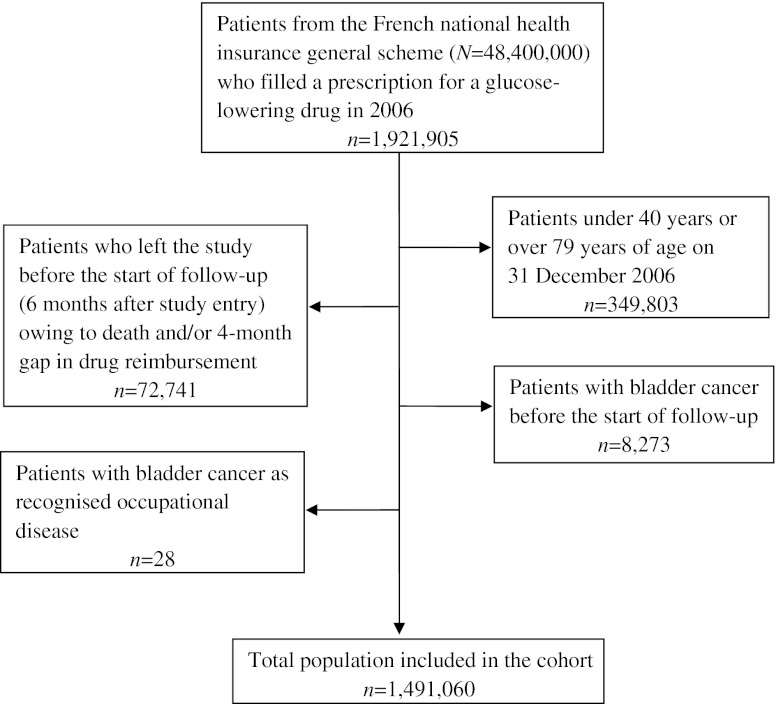
AIMS/HYPOTHESIS: Previous studies have suggested an increased risk of bladder cancer with pioglitazone exposure. We aimed to investigate the association between pioglitazone exposure and bladder cancer in France. METHODS: This cohort study involved use of data from the French national health insurance information system (Système National d'Information Inter-régimes de l'Assurance Maladie; SNIIRAM) linked with the French hospital discharge database (Programme de Médicalisation des Systèmes d'Information; PMSI). The cohort included patients aged 40 to 79 years who filled a prescription for a glucose-lowering drug in 2006. The cohort was followed for up to 42 months. Pioglitazone exposure was modelled as a time-dependent variable and defined by having filled at least two prescriptions over a 6-month period. Incident cases of bladder cancer were identified by a discharge diagnosis of bladder cancer combined with specific aggressive treatment. Statistical analyses involved a multivariate Cox model adjusted for age, sex and exposure to other glucose-lowering drugs. RESULTS: The cohort included 1,491,060 diabetic patients, 155,535 of whom were exposed to pioglitazone. We found 175 cases of bladder cancer among exposed patients and 1,841 among non-exposed patients. Incidence rates were 49.4 and 42.8 per 100,000 person-years, respectively. Pioglitazone exposure was significantly associated with bladder cancer incidence (adjusted HR 1.22 [95% CI 1.05, 1.43]). We observed a dose-effect relationship, with a significantly increased risk for high cumulative doses (≥ 28,000 mg, adjusted HR 1.75 [95% CI 1.22, 2.50]) and long duration of exposure (≥ 24 months, adjusted HR 1.36 [1.04, 1.79]). CONCLUSIONS/INTERPRETATION: In this cohort of diabetic patients from France, pioglitazone exposure was significantly associated with increased risk of bladder cancer.
Overview
The claims and statistics of this paper haven’t been checked yet.
Free: it reads the open-access text and checks the first 5 claims that cite a source we can check. Create a free account to check every claim.
Integrity signals
Registry
Cites
Statistics
Figures
Verification
Claims the paper makes
The claims and statistics of this paper haven’t been checked yet.
Free: it reads the open-access text and checks the first 5 claims that cite a source we can check. Create a free account to check every claim.
Claims other papers make about this one
Each is checked against this paper’s own text: does it say what the citing paper says it does?
The cited source says what the claim attributes to it.
In the citing paper
“Observational research conducted in 2011 and 2012 suggested that pioglitazone may increase the risk of bladder cancer.46,47”
From Pioglitazone after Ischemic Stroke or Transient Ischemic Attack (2016) · cites this paper as [47]
Self-check
Percentages, sums and reported differences re-computed from the paper’s own numbers.
The self-check needs the paper’s full text.
Citations
Cites
Dormandy, J. A., Charbonnel, B., Eckland, D. J., Erdmann, E., Massi-Benedetti, M., Moules, I. K., Skene, A. M., Tan, M. H., Lefèbvre, P. J., Murray, G. D., et al. (2005) · The Lancet · doi:10.1016/s0140-6736(05)67528-9 · Cited by 4,129 · cited 1×
“After a blinded review with external experts, bladder cancer was diagnosed during the second year of exposure in six cases in the pioglitazone group vs three in the placebo group [4, 5].”
BackgroundMetformin and reduced risk of cancer in diabetic patients
Evans, J. M. M., Donnelly, L. A., Emslie-Smith, A. M., Alessi, D. R., & Morris, A. D. (2005) · BMJ · doi:10.1136/bmj.38415.708634.f7 · Cited by 2,388 · cited 1×
“This observation has been previously reported [14–17].”
Association Between Smoking and Risk of Bladder Cancer Among Men and Women
Freedman, N. D. (2011) · JAMA · doi:10.1001/jama.2011.1142 · Cited by 1,141 · cited 1×
“First of all, it lacks data on tobacco use, known to be the third main risk factor for bladder cancer after age and male sex [19, 20].”
BackgroundThe influence of glucose-lowering therapies on cancer risk in type 2 diabetes
Currie, C. J., Poole, C. D., & Gale, E. A. M. (2009) · Diabetologia · doi:10.1007/s00125-009-1440-6 · Cited by 1,124
Bowker, S. L., Majumdar, S. R., Veugelers, P., & Johnson, J. A. (2006) · Diabetes Care · doi:10.2337/diacare.29.02.06.dc05-1558 · Cited by 933
Risk of Bladder Cancer Among Diabetic Patients Treated With Pioglitazone
Lewis, J. D., Ferrara, A., Peng, T., Hedderson, M., Bilker, W. B., Quesenberry, C. P., Vaughn, D. J., Nessel, L., Selby, J., & Strom, B. L. (2011) · Diabetes Care · doi:10.2337/dc10-1068 · Cited by 625
French national health insurance information system and the permanent beneficiaries sample
Tuppin, P., de Roquefeuil, L., Weill, A., Ricordeau, P., & Merlière, Y. (2010) · Revue d'Épidémiologie et de Santé Publique · doi:10.1016/j.respe.2010.04.005 · Cited by 399 · cited 1×
“The national health insurance information system (Système National d'Information Inter-régimes de l'Assurance Maladie; SNIIRAM) contains individualised, anonymous and exhaustive data on all reimbursements for patient health expenditure [10], including medicinal products as well as outpatient medical and nursing care,…”
BackgroundSelf-citationDiabetes mellitus and risk of bladder cancer: a meta-analysis
Larsson, S. C., Orsini, N., Brismar, K., & Wolk, A. (2006) · Diabetologia · doi:10.1007/s00125-006-0468-0 · Cited by 304 · cited 1×
“42]) when comparing type 2 diabetic individuals with non-diabetic individuals [22].”
BackgroundDormandy, J., Bhattacharya, M., & van Troostenburg de Bruyn, A.-R. (2009) · Drug Safety · doi:10.2165/00002018-200932030-00002 · Cited by 227
Cohort Study of Pioglitazone and Cancer Incidence in Patients With Diabetes
Ferrara, A., Lewis, J. D., Quesenberry, C. P., Peng, T., Strom, B. L., Van Den Eeden, S. K., Ehrlich, S. F., & Habel, L. A. (2011) · Diabetes Care · doi:10.2337/dc10-1067 · Cited by 181 · cited 1×
“Another analysis of a similar cohort found no association between pioglitazone exposure and cancer in several other sites [7].”
Result
Research works printed but not linked: 1
- French medicines agency (AFSSAPS) (2011) Use of medications containing pioglitazone (Actos®, Competact®) Suspended. Available from www.afssaps.fr/content/download/34175/447382/version/1/file/Press-release-Suspension-Pioglitazone.pdf, accessed 12 August 2011.
Cited by
Items 101–200 of 283
Managing diabetes in patients with chronic liver disease
Khan, R., Foster, G. R., & Chowdhury, T. A. (2012) · Postgraduate Medicine · doi:10.3810/pgm.2012.07.2574 · Cited by 34
Jin, S.-M., Song, S. O., Jung, C. H., Chang, J.-S., Suh, S., Kang, S. M., Jung, I., Park, C.-Y., Kim, J. H., Cho, J. H., et al. (2014) · Journal of Korean Medical Science · doi:10.3346/jkms.2014.29.2.238 · Cited by 34
“In our multi-center hospital-based cohort (n = 113,193), the incidence of bladder cancer was similar to those in the previous population-based studies (1, 2, 4, 5).”
BackgroundMethodResultInfluentialPossible link of pioglitazone with bladder cancer in Japanese patients with type 2 diabetes
Fujimoto, K., Hamamoto, Y., Honjo, S., Kawasaki, Y., Mori, K., Tatsuoka, H., Matsuoka, A., Wada, Y., Ikeda, H., Fujikawa, J., et al. (2012) · Diabetes Research and Clinical Practice · doi:10.1016/j.diabres.2012.11.013 · Cited by 35
“These findings are different to Caucasian [1,2], possibly because of factors such as genetic and cultural background, diet, low”
BackgroundInfluentialRAGUIDEAU, F., Mezzarobba, M., Zureik, M., Weill, A., Ricordeau, P., & Alla, F. (2015) · Pharmacoepidemiology and Drug Safety · doi:10.1002/pds.3763 · Cited by 39
Self-citationMehtälä, J., Khanfir, H., Bennett, D., Ye, Y., Korhonen, P. A., & Hoti, F. J. (2018) · Diabetology International · doi:10.1007/s13340-018-0360-4 · Cited by 37
Cancer care and public health policy evaluations in France: Usefulness of the national cancer cohort
Bousquet, P., Lefeuvre, D., Tuppin, P., Bendiane, M., Rocchi, M., Bouée-Benhamiche, E., Viguier, J., & Bihan-Benjamin, C. L. (2018) · PLoS ONE · doi:10.1371/journal.pone.0206448 · Cited by 34
Ripamonti, E., Azoulay, L., Abrahamowicz, M., Platt, R. W., & Suissa, S. (2018) · Diabetic Medicine · doi:10.1111/dme.13854 · Cited by 39
Agrinier, N., Altieri, C., Alla, F., Jay, N., Dobre, D., Thilly, N., & Zannad, F. M. (2013) · International Journal of Cardiology · doi:10.1016/j.ijcard.2013.05.090 · Cited by 43
Self-citationDetection Bias and Overestimation of Bladder Cancer Risk in Type 2 Diabetes
Colmers-Gray, I. N., Majumdar, S. R., Yasui, Y., Bowker, S. L., Marra, C. A., & Johnson, J. A. (2013) · Diabetes Care · doi:10.2337/dc13-0045 · Cited by 38
“19 [9–34]) in the 2 years before the index date than those whowere not given a diagnosis of bladder cancer (Table 1).”
BackgroundQuantin, C., Benzenine, É., Velten, M., Huet, F., Farrington, P., & Tubert‐Bitter, P. (2013) · American Journal of Epidemiology · doi:10.1093/aje/kwt207 · Cited by 35
Davidson, M. B., & Pan, D. (2017) · Diabetes Research and Clinical Practice · doi:10.1016/j.diabres.2017.11.002 · Cited by 38
Thiazolidinedione as a Promising Medicinal Scaffold for the Treatment of Type 2 Diabetes
Singh, G., Kumar, R., Desna, D. S., Chaudhary, M., Kaur, C., & Khurana, N. (2023) · Current Diabetes Reviews · doi:10.2174/0115733998254798231005095627 · Cited by 36
Mallet, V. O., Hamed, K. A., & Schwarzinger, M. (2016) · Journal of Hepatology · doi:10.1016/j.jhep.2016.10.031 · Cited by 32
Wu, Y., Liu, H., Shi, X., & Song, Y. (2014) · PLoS ONE · doi:10.1371/journal.pone.0099577 · Cited by 29
Clinical Neuroprotective Drugs for Treatment and Prevention of Stroke
Kikuchi, K., Uchikado, H., Morioka, M., Murai, Y., & Tanaka, E. (2012) · International Journal of Molecular Sciences · doi:10.3390/ijms13067739 · Cited by 31
“Recently, some preclinical in vivo studies and limited human data have suggested a possible increased risk of bladder cancer with pioglitazone therapy [108].”
BackgroundPPARγ in head and neck cancer prevention
Burotto, M., & Szabo, E. M. (2014) · Oral Oncology · doi:10.1016/j.oraloncology.2013.12.020 · Cited by 32
Neuroprotective Properties of a Novel Non-Thiazoledinedione Partial PPAR-γAgonist against MPTP
Swanson, C. R., Du, E. Y., Johnson, D. A., Johnson, J. A., & Emborg, M. E. (2013) · PPAR Research · doi:10.1155/2013/582809 · Cited by 31
“Although the thiazolidinediones PPAR-γ agonists have greatly benefited diabetic patients and have also shown neuroprotective properties associated to anti-inflammation in animal models of PD, publications linking harmful cardiovascular effects to rosiglitazone [20–22] and bladder cancer to pioglitazone [69] have chall…”
BackgroundLee, M., Hsiao, P., Yang, Y., Lin, K., & Shin, S. (2014) · PLoS ONE · doi:10.1371/journal.pone.0085479 · Cited by 30
Diabetes and cancer: A 2013 synopsis
Buysschaert, M., & Sadikot, S. S. (2013) · Diabetes & Metabolic Syndrome Clinical Research & Reviews · doi:10.1016/j.dsx.2013.08.001 · Cited by 33
Faillie, J., Petit, P., Montastruc, J., & Hillaire‐Buys, D. (2013) · Drug Safety · doi:10.1007/s40264-013-0086-y · Cited by 30
Bernardo, A., Simone, R. D., Nuccio, C. D., Visentin, S., & Minghetti, L. (2013) · Biological Chemistry · doi:10.1515/hsz-2013-0152 · Cited by 28
“Although these concerns were not extended to pioglitazone, a recent study identified an increased risk of bladder cancer associated with long term pioglitazone exposure in a French cohort of diabetic patients (Neumann et al., 2012).”
Taurine and tea polyphenols combination ameliorate nonalcoholic steatohepatitis in rats
Zhu, W., Chen, S., Chen, R., Peng, Z., Wan, J., & Wu, B. (2017) · BMC Complementary and Alternative Medicine · doi:10.1186/s12906-017-1961-3 · Cited by 27
Vascular Complications of Diabetes Mellitus
Chiong, Y., & Evans‐Molina, C. (2014) · Springer eBooks · doi:10.1007/978-3-642-37078-6_49 · Cited by 31
Update on Safety Issues Related to Antihyperglycemic Therapy
Carpio, G., & Fonseca, V. A. (2014) · Diabetes Spectrum · doi:10.2337/diaspect.27.2.92 · Cited by 34
Adil, M., Khan, R. A., Ghosh, P., Venkata, S. K., Kandhare, A. D., & Sharma, M. (2017) · Clinical Epidemiology and Global Health · doi:10.1016/j.cegh.2017.08.002 · Cited by 31
Hasan, M. M., El‐Shal, A. S., Mackawy, A. M. H., Ibrahim, E. M., Abdelghany, E. M. A., Saeed, A. A., & El‐Gendy, J. (2019) · Journal of Cellular Biochemistry · doi:10.1002/jcb.29388 · Cited by 29
Thillard, E.-M., Gautier, S., Babykina, E., Carton, L., Amad, A., Bouzillé, G., Beuscart, J., & Chazard, E. (2020) · Frontiers in Pharmacology · doi:10.3389/fphar.2020.00513 · Cited by 28
“Our pharmacovigilance analysis of the PMSI database is an novel technique that has rarely been used to detection adverse events (Weill et al., 2010; Neumann et al., 2012; Heng et al., 2015).”
A New Prognostic Risk Model Based on PPAR Pathway-Related Genes in Kidney Renal Clear Cell Carcinoma
Xu, Y., Li, X., Han, Y., Wang, Z., Han, C., Ruan, N., Li, J., Yu, X., Xia, Q., & Wu, G. (2020) · PPAR Research · doi:10.1155/2020/6937475 · Cited by 28
“However, some studies have found that activation of PPAR γ can promote tumor development [21 – 25].”
Garry, E. M., Buse, J. B., Lund, J. L., Pate, V., & Stürmer, T. (2018) · Diabetes, Obesity and Metabolism · doi:10.1111/dom.13049 · Cited by 25
Yang, J., Vallarino, C. R., Bron, M., Pérez, A., Liang, H., Joseph, G. L., & Yu, S. S. (2014) · Current Medical Research and Opinion · doi:10.1185/03007995.2014.941054 · Cited by 25
Subbaramaiah, K., Howe, L. R., Zhou, X. K., Yang, P., Hudis, C. A., Kopelovich, L., & Dannenberg, A. J. (2012) · Cancer Prevention Research · doi:10.1158/1940-6207.capr-12-0201 · Cited by 25
“report that use of pioglitazone was associated with an increased risk of bladder cancer in a cohort of diabetic patients (37).”
BackgroundRetractedBouillon, K., Bertrand, M., Boudali, L., Ducimetière, P., Dray‐Spira, R., & Zureik, M. (2016) · Journal of the American Heart Association · doi:10.1161/jaha.116.004065 · Cited by 23
Lassalle, M., Tri, T. L., Afchain, P., Camus, M., Kirchgesner, J., Zureik, M., & Dray‐Spira, R. (2022) · Cancer Epidemiology Biomarkers & Prevention · doi:10.1158/1055-9965.epi-21-0786 · Cited by 27
Vegas, L. P., Hoisnard, L., Bastard, L., Sbidian, É., & Claudepierre, P. (2022) · RMD Open · doi:10.1136/rmdopen-2022-002681 · Cited by 24
Pharmacoepidemiology of Immune Thrombocytopenia: Protocols of FAITH and CARMEN Studies
Moulis, G., Sailler, L., Adoué, D., & Lapeyre‐Mestre, M. (2014) · Therapies · doi:10.2515/therapie/2014056 · Cited by 23
“[35] Therefore, the SNIIRAM has been used since the mid-2000s to conduct large epidemiological and pharmacoepidemiologicalpost-authorizationstudies.[36-43] Briefly, it is constituted by several datamarts that include for each patient the following data, prospectively recorded (figure 1): – in the administrative datama…”
MethodDoat, S., Samson, S., Fagot‐Campagna, A., Tuppin, P., & Menegaux, F. (2016) · Revue d Épidémiologie et de Santé Publique · doi:10.1016/j.respe.2015.12.020 · Cited by 22
Senn, L., Costa, A., Avallone, R., Socała, K., Właź, P., & Biagini, G. (2022) · Pharmacology & Therapeutics · doi:10.1016/j.pharmthera.2022.108316 · Cited by 23
Goldberg, M., Carton, M., Gourmelen, J., Genreau, M., Montourcy, M., Got, S. L., & Zins, M. (2016) · Revue d Épidémiologie et de Santé Publique · doi:10.1016/j.respe.2016.02.010 · Cited by 22
The Low-Dose (7.5 mg/day) Pioglitazone Therapy
Yanai, H., & Adachi, H. (2017) · Journal of Clinical Medicine Research · doi:10.14740/jocmr3144w · Cited by 25
Management of Blood Glucose with Noninsulin Therapies in Type 2 Diabetes.
George, C. M., Brujin, L. L., Will, K. J., & Howard-Thompson, A. (2015) · PubMed · Cited by 30
Diabetes and cancer relationships (糖尿病与肿瘤的关联性)
Wang, T., Ning, G., & Bloomgarden, Z. (2013) · Journal of Diabetes · doi:10.1111/1753-0407.12057 · Cited by 21
“79).(71) However, a study conducted in Taiwan, which provided the first data in Asians,”
ResultMio, A., Limleamthong, P., Guillén‐Gosálbez, G., & Fermeglia, M. (2018) · Industrial & Engineering Chemistry Research · doi:10.1021/acs.iecr.7b05126 · Cited by 24
Rivoglitazone: A New Thiazolidinedione for the Treatment of Type 2 Diabetes Mellitus
Koffarnus, R. L., Wargo, K. A., & Phillippe, H. M. (2013) · Annals of Pharmacotherapy · doi:10.1345/aph.1r754 · Cited by 25
Current Therapies for the Medical Management of Diabetes
Inzucchi, S. E., & Majumdar, S. K. (2016) · Obstetrics and Gynecology · doi:10.1097/aog.0000000000001332 · Cited by 22
“associated with a reduction in certain cancers.(43,47,48) Paradoxically, the thiazolidinediones result in weight gain at the same time that they improve insulin sensitivity and reduce glucose levels but are not associated with significant hypoglycemia.”
BackgroundRosiglitazone is not associated with an increased risk of bladder cancer
Tseng, C. (2013) · Cancer Epidemiology · doi:10.1016/j.canep.2013.03.013 · Cited by 21
“Later epidemiological observational studies conducted in the USA [18] and France [19] also suggested a possible higher risk if pioglitazone * Correspondence address: Department of Internal Medicine, National Taiwan University Hospital, No. 7 Chung-Shan South Road, Taipei 100, Taiwan.”
BackgroundArnaud, M., Bégaud, B., Thiessard, F., Jarrion, Q., Bezin, J., Pariente, A., & Salvo, F. (2017) · Drug Safety · doi:10.1007/s40264-017-0618-y · Cited by 26
The Anticancer Potential of Peroxisome Proliferator‐Activated Receptor Antagonists
Lellis, L. D., Cimini, A., Veschi, S., Benedetti, E., Amoroso, R., Cama, A., & Ammazzalorso, A. (2017) · ChemMedChem · doi:10.1002/cmdc.201700703 · Cited by 21
Oh, J. J., Kang, M., Jo, J. K., Lee, H. M., Byun, S., Lee, S.-C., Lee, S.-C., & Hong, S. K. (2015) · International Journal of Urology · doi:10.1111/iju.12901 · Cited by 19
Pioglitazone Use and Risk of Bladder Cancer: an In Vitro Study
Yang, S., Wang, J., Chen, M., Xu, L., Li, N., Luo, Y., Bu, L., Zhang, M., Li, H., & Su, B. (2018) · International Journal of Medical Sciences · doi:10.7150/ijms.22408 · Cited by 20
Anti-Diabetic Drugs: Cure or Risk Factors for Cancer?
Laskar, J., Bhattacharjee, K., Sengupta, M., & Choudhury, Y. (2018) · Pathology & Oncology Research · doi:10.1007/s12253-018-0402-z · Cited by 23
Options for empagliflozin in combination therapy in type 2 diabetes mellitus
Thompson, G., & Hershon, K. S. (2016) · International Journal of General Medicine · doi:10.2147/ijgm.s100288 · Cited by 21
“It has the advantages of improving insulin resistance, low hypoglycemia risk, and generic options/costs; but is commonly associated with peripheral edema and weight gain, as well as less frequently with congestive heart failure and bone fractures,(33) and a possible increased risk of bladder cancer.(33,34) Since safet…”
Oyster extracts attenuate pathological changes in non-alcoholic steatohepatitis (NASH) mouse model
Watanabe, M., Fuda, H., Okabe, H., Joko, S., Miura, Y., Hui, S., Yimin, Hamaoka, N., Miki, E., & Chiba, H. (2015) · Journal of Functional Foods · doi:10.1016/j.jff.2015.11.029 · Cited by 21
Cell-Intrinsic Tumorigenic Functions of PPARγ in Bladder Urothelial Carcinoma
Sanchez, D. J., Missiaen, R., Skuli, N., Steger, D. J., & Simon, M. C. (2021) · Molecular Cancer Research · doi:10.1158/1541-7786.mcr-20-0189 · Cited by 21
Pioglitazone (Actos) and bladder cancer: Legal system triumphs over the evidence
Davidson, M. B. (2016) · Journal of Diabetes and its Complications · doi:10.1016/j.jdiacomp.2016.04.004 · Cited by 18
Qu, H., Zheng, Y., Wang, Y., Zhang, R., Ruan, X. Z., Yang, G., Liu, Z., & Zheng, H. (2017) · Scientific Reports · doi:10.1038/s41598-017-16074-1 · Cited by 16
Moore, N. D., Blin, P., & Droz‐Perroteau, C. (2019) · Handbook of experimental pharmacology · doi:10.1007/164_2019_318 · Cited by 17
Holden, S. E. (2016) · Endocrine development · doi:10.1159/000439410 · Cited by 17
Kim, D., Ahn, B., Kim, Y. S., Hur, D. Y., Yang, J. W., Park, G. B., Jang, J. E., Lee, E. J., Kwon, M. J., Kim, T. N., et al. (2019) · Journal of Diabetes Research · doi:10.1155/2019/2376512 · Cited by 15
Ren, L., & Konger, R. L. (2019) · Molecular Carcinogenesis · doi:10.1002/mc.23041 · Cited by 15
“statistically significant 15% to 21% risk of head and neck cancer.(26,28) In contrast, an epidemiologic study of Taiwanese diabetics failed to find a significant effect of pioglitazone use on”
Bladder cancer with pioglitazone: A case–control study
Malhotra, B., Hiteshi, P., Khalkho, P., Malik, R., Bhadada, S. K., Bhansali, A. K., Shafiq, N., Malhotra, S., Kumar, N., Rajput, R., et al. (2022) · Diabetes & Metabolic Syndrome Clinical Research & Reviews · doi:10.1016/j.dsx.2022.102637 · Cited by 16
Braunstein, D., Hardy, A., Boucherie, Q., Frauger, É., Blin, O., Gentile, G., & Micallef, J. (2017) · Fundamental and Clinical Pharmacology · doi:10.1111/fcp.12252 · Cited by 15
Pai, S. A., & Kshirsagar, N. A. (2016) · The Indian Journal of Medical Research · doi:10.4103/ijmr.ijmr_650_15 · Cited by 18
Therapeutic Potential and Challenges of Pioglitazone in Cancer Treatment
Vasileiou, M., Diamantoudis, S. C., Tsianava, C., & Nguyen, N. P. (2025) · Applied Sciences · doi:10.3390/app15041925 · Cited by 15
Management and diagnosis of fatty liver disease
Schneier, A., Citti, C., & Dieterich, D. T. (2015) · Expert Review of Gastroenterology & Hepatology · doi:10.1586/17474124.2015.1003209 · Cited by 15
“Given the frequency of side effects from this medication class, however, including the risk of bladder cancer [133], they have been removed from French and German markets.”
BackgroundRevisiting PPARγ as a new friend of GPR120 in the treatment of metabolic disorders
Paschoal, V. A., & Oh, D. Y. (2020) · Adipocyte · doi:10.1080/21623945.2020.1838186 · Cited by 13
“However, they can cause adverse effects such as oedema [5–7], weight gain [8,9], heart failure [10–12], bone loss [13,14], and apparently certain cancers [15,16].”
BackgroundThe path to approval of new drugs for diabetes
Rendell, M. (2013) · Expert Opinion on Drug Safety · doi:10.1517/14740338.2013.770470 · Cited by 12
“Now, a decade after market introduction of pioglitazone, several large epidemiologic studies suggest an increased incidence of human bladder cancer with dependence on duration of exposure to the drug [9,10].”
BackgroundMethods in pharmacoepidemiology
Sommet, A., & Pariente, A. (2019) · Therapies · doi:10.1016/j.therap.2018.11.015 · Cited by 17
Garry, E. M., Buse, J. B., Gokhale, M., Lund, J. L., Nielsen, M. E., Pate, V., & Stürmer, T. (2019) · Diabetes Obesity and Metabolism · doi:10.1111/dom.13774 · Cited by 12
“Few studies accounted for duration of exposure(6,11,17-20,26) and only two studies that we reviewed censored follow-up based on change in exposure in addition to outcome, death or end of study.(17,19) Few studies delayed the exposure period to allow for a latency period with sufficient time for development and detecti…”
BackgroundPioglitazone, Bladder Cancer, and the Presumption of Innocence
Papaetis, G. S. (2022) · Current Drug Safety · doi:10.2174/1574886317666220304124756 · Cited by 13
Bojková, B., Orendáš, P., Kubatka, P., Péč, M., Kassayová, M., Kisková, T., & Kajo, K. (2014) · Pathology - Research and Practice · doi:10.1016/j.prp.2014.06.003 · Cited by 11
Winnenburg, R., & Shah, N. H. (2016) · BMC Bioinformatics · doi:10.1186/s12859-016-1080-z · Cited by 11
Goldberg, M. (2017) · Revue d Épidémiologie et de Santé Publique · doi:10.1016/j.respe.2017.01.118 · Cited by 11
Pioglitazone suspension and its aftermath: A wake up call for the Indian drug regulatory authorities
Hashmi, A. (2013) · Journal of Pharmacology and Pharmacotherapeutics · doi:10.4103/0976-500x.119705 · Cited by 11
“The suspension in France was based on the findings of a population-based cohort study, which reported that ‘pioglitazone exposure was significantly associated with increased risk of bladder cancer’.[9] The USFDA in June 2011 mandated the introduction of information on the increased risk for bladder cancer in the piogl…”
Suzuki, H., Sakamoto, M., Hayashi, T., Iuchi, H., Ohashi, K., Isaka, T., Sakamoto, N., Kayama, Y., Tojo, K., Yoshimura, M., et al. (2013) · Cardiovascular Diabetology · doi:10.1186/1475-2840-12-71 · Cited by 11
“In France, analysis revealed a significant association between pioglitazone and bladder cancer in men [27].”
SCALPEL3: A scalable open-source library for healthcare claims databases
Bacry, E., Gaïffas, S., Leroy, F., Morel, M., Nguyen, D.-P., Sebiat, Y., & Sun, D. (2020) · International Journal of Medical Informatics · doi:10.1016/j.ijmedinf.2020.104203 · Cited by 19
Gamdzyk, M., Lenahan, C., Tang, J., & Zhang, J. H. (2020) · Journal of Neuroscience Research · doi:10.1002/jnr.24709 · Cited by 11
“In another study fenofibrate decreased cell death, pro-inflammatory neutrophil infiltration and microglia activation, protected the vasculature by preventing the leukocyte rolling and adhesion, and promoted neurogenesis (Ouk et al., 2014).”
BackgroundChen, H.-F., Chen, S.-W., Chang, Y., & Li, C. (2015) · Medicine · doi:10.1097/md.0000000000001494 · Cited by 11
“Recently, use of oral hypoglycemic agent pioglitazone was also reported to be associated with increased risk of bladder cancer.(34,35)”
BackgroundModelling cumulative exposure for inference about drug effects in observational studies
Farran, B., McGurnaghan, S. J., Looker, H. C., Livingstone, S. J., Lahnsteiner, E., Colhoun, H. M., & McKeigue, P. (2017) · Pharmacoepidemiology and Drug Safety · doi:10.1002/pds.4327 · Cited by 14
“In columns 2 to 5, the model encodes cumulative exposure with unexposed person‐time intervals as the baseline category, corresponding to a standard analysis of a cohort study to evaluate cumulative exposure.(23,24) With this model, those exposed to statins appear to have increased risk for CVD initially, which is inco…”
MethodPioglitazone does not affect the risk of kidney cancer in patients with type 2 diabetes
Tseng, C. (2014) · Metabolism · doi:10.1016/j.metabol.2014.04.014 · Cited by 10
“Few observational studies to date have analyzed the association between pioglitazone use and kidney cancer risk, although two recent cohort studies in western countries suggested they were not associated [23,24].”
BackgroundResultInfluentialPageot, C., Bezin, J., Smith, A., Arnaud, M., Salvo, F., Haramburu, F., Bégaud, B., & Pariente, A. (2017) · Drug Safety · doi:10.1007/s40264-017-0561-y · Cited by 13
“Pioglitazone was withdrawn from the French market on 11 July 2011 [18, 19].”
BackgroundTrends in the incidence of use of noninsulin glucose‐lowering drugs between 2006 and 2013 in France
Arnaud, M., Bezin, J., Bégaud, B., Pariente, A., & Salvo, F. (2017) · Fundamental and Clinical Pharmacology · doi:10.1111/fcp.12298 · Cited by 11
Glycated hemoglobin, diabetes treatment and cancer risk in type 2 diabetes. A case-control study.
Dąbrowski, M. (2013) · PubMed · Cited by 12
Prevention Studies in Alzheimer’s Disease: Progress Towards the Development of New Therapeutics
Coley, N., Gallini, A., & Andrieu, S. (2015) · CNS Drugs · doi:10.1007/s40263-015-0256-9 · Cited by 12
“Furthermore, some prevention trials are testing antiamyloid therapies in autosomal-dominant AD [34, 35].”
BackgroundMoore, N. D., Blin, P., Lassalle, R., Thurin, N. H., Bosco‐Lévy, P., & Droz, C. (2021) · Springer series on epidemiology and public health · doi:10.1007/978-3-030-51455-6_10 · Cited by 13
Interest and challenges of pharmacoepidemiology for the study of drugs used in diabetes
Salvo, F., & Faillie, J. (2018) · Therapies · doi:10.1016/j.therap.2018.09.074 · Cited by 11
Stay vigilant: a glitazone (pioglitazone) can hide a glitazar!
Hillaire‐Buys, D., Faillie, J., Montastruc, J., & Petit, P. (2012) · European Journal of Clinical Pharmacology · doi:10.1007/s00228-012-1299-1 · Cited by 10
“[6], showing a dose-dependent increase in the incidence of bladder cancer in pioglitazone-exposed diabetic patients.”
BackgroundDiabetes medications and cancer risk: review of the literature.
Nguyen, Q. P. H., Sanders, L., Michael, A. P., Anderson, S. R., Nguyen, L. D., & Johnson, Z. A. (2012) · PubMed Central · Cited by 17
Role and application of hysterosalpingography and Fallopian tube recanalization.
Mallarini, G., & Saba, L. (2010) · PubMed · Cited by 11
Hiroi, S., Sugiura, K., Matsuno, K., Hirayama, M., Kuriyama, K., Kaku, K., & Kawakami, K. (2013) · Diabetes Technology & Therapeutics · doi:10.1089/dia.2012.0246 · Cited by 8
“An increased risk of incident bladder cancer with pioglitazone use has been reported in various studies and meta-analyses, 14–17 but the association has generally been relatively”
Étude des algorithmes de repérage de la dépression dans le SNIIRAM par le réseau REDSIAM
Quantin, C., Roussot, A., Besson, J., Cottenet, J., Bismuth, M.-J., Cousin, F., Soudry‐Faure, A., Mariet, A., & Collin, C. (2016) · Revue française des affaires sociales · doi:10.3917/rfas.162.0201 · Cited by 9
Hsu, J. C., Cheng, C., Ross‐Degnan, D., Wagner, A. K., Zhang, F., Yang, Y. K., Liu, L.-L., Tai, H.-Y., Chen, K.-H., Yang, P.-W., et al. (2015) · Pharmacoepidemiology and Drug Safety · doi:10.1002/pds.3834 · Cited by 9
PPAR-γ agonist pioglitazone and the risks of malignancy among type2 diabetes mellitus patients
See, L., Wu, C.-Y., Tsai, C., Lee, C., Chen, J., Jenq, C., Chen, C., Chen, Y., Yen, C., & Yang, H. (2024) · Acta Diabetologica · doi:10.1007/s00592-024-02378-y · Cited by 8
“In fact, following the initial report of an increased risk of bladder cancer in a prospective study, the PROactive study, in 2005, several countries suspended the marketing of pioglitazone because of malignancy concerns [26, 27].”
Pioglitazone: are rumours of its death exaggerated?
Gale, E. (2015) · Diabetic Medicine · doi:10.1111/dme.12708 · Cited by 8
Tseng, C. (2022) · BMC Cancer · doi:10.1186/s12885-022-09660-8 · Cited by 7
Joshi, S., Das, S., Xaviar, S., Samajdar, S. S., Saha, I., Sarkar, S., Mukherjee, S., Tripathi, S. K., Pal, J., & Chatterjee, N. (2023) · Diabetes & Metabolic Syndrome Clinical Research & Reviews · doi:10.1016/j.dsx.2022.102703 · Cited by 11
Fibrates and Risk of Cancer in Tissues with High PPAR-α Concentration: A Nested Case–Control Study
Salvo, F., Bazin, F., Kostrzewa, A., Bandre, C., Robinson, P., Moore, N. D., Bégaud, B., & Pariente, A. (2014) · Drug Safety · doi:10.1007/s40264-014-0157-8 · Cited by 7
Pioglitazone and risk of bladder cancer: clarification of the design of the French study
Perez, A. T. (2012) · Diabetologia · doi:10.1007/s00125-012-2767-y · Cited by 8
“TZDs To the Editor: In the July 2012 issue of this journal, Neumann et al [1] presented results from a cohort study using data from the French national health insurance information system.”
BackgroundMethodNeumann, A., Weill, A., Ricordeau, P., Fagot, J., Alla, F., & Allemand, H. (2012) · Diabetologia · doi:10.1007/s00125-012-2769-9 · Cited by 7
“This result is presented in our article [2] as is the result in relation to smoking that suggests a possible underestimation of the risk of bladder cancer related to exposure to pioglitazone.”
BackgroundResultSelf-citationReassessment of pioglitazone and bladder cancer based on FAERS database
Chen, H.-Y., Zhao, H., Yang, J., Zhang, Q., Yan, M.-M., & Qiu, X. (2024) · Expert Opinion on Drug Safety · doi:10.1080/14740338.2024.2390000 · Cited by 7
Benefits of combination low-dose pioglitazone plus fish oil on aged type 2 diabetes mice
Iizuka, Y., Kim, H., Hirako, S., Chiba, K., Wada, M., & Matsumoto, A. (2018) · Journal of Food and Drug Analysis · doi:10.1016/j.jfda.2018.05.008 · Cited by 6
“[18] Neumann A, Weill A, Ricordeau P, Fagot JP, Alla F, Allemand H.”
Background
Metadata
- Authors
- Neumann, A., Weill, A., Ricordeau, P., Fagot, J. P., Alla, F., & Allemand, H.
- Affiliations
- l'Assurance Maladie (FR)
- Corresponding author
- Weill, A.
- Venue
- Diabetologia
- Published
- 2012-03-31
- Volume
- 55
- Issue
- 7
- Pages
- 1953-1962
- ISSN
- 0012-186X (ISSN-L)
- 1432-0428
- PMC
- PMC3369136
- OpenAlex
- W2145777529
- Cited by
- 284
- References
- 16
- Citations by year
- 2026: 3 · 2025: 5 · 2024: 9 · 2023: 6 · 2022: 9 · 2021: 8 · 2020: 8 · 2019: 17 · 2018: 21 · 2017: 24 · 2016: 30 · 2015: 31 · 2014: 40 · 2013: 49 · 2012: 22
- FWCI
- 18.24
- Type
- journal article
- Language
- en
- Open access
- hybrid
- doi.org
- Licence
- cc-by
- Locations
- Diabetologia (publishedVersion, cc-by)
- Europe PMC (PubMed Central) (publishedVersion, cc-by)
- PubMed Central (publishedVersion, cc-by)
- PubMed (publishedVersion)
- Topics
- Life Sciences › Biochemistry, Genetics and Molecular Biology › Molecular Biology › Metabolism, Diabetes, and Cancer
- Health Sciences › Medicine › Surgery › Bladder and Urothelial Cancer Treatments
- Health Sciences › Medicine › Endocrinology, Diabetes and Metabolism › Diabetes Treatment and Management
- Keywords
- pioglitazone, bladder cancer, diabetes mellitus, drug-induced cancer risk, thiazolidinediones, antidiabetic drugs, dose-response relationship, drug exposure duration, cancer incidence
- MeSH terms
- Pioglitazone, Adult, Aged, Urinary Bladder Neoplasms, Diabetes Mellitus, Type 2, Drug Administration Schedule, Female, Follow-Up Studies, France, Humans, Hypoglycemic Agents, Male, Middle Aged, Risk Factors, Cohort Studies, Incidence, Multivariate Analysis, Proportional Hazards Models, Thiazolidinediones
About these checks
Registry, retraction, Cites and statistics results are computed, not judged, with one exception: a printed reference that no index lists is read once by a model before it counts as a citation error. Claims are extracted by a model and kept only when their quote appears verbatim in the text; each cited source is then checked, with a model’s help, for whether it says what the claim relies on. Those verdicts can be wrong — read the claim’s quote and the cited source before relying on one.
Statistics and arithmetic are recomputed, not judged.
Confidence bands are shown only for fields calibrated on our annotated test set. None is calibrated yet, so no band is shown.
What counts as a claim ›How we measure confidence ›How we check this ›
Are you an author, or do you see a problem with this page? Request a review
Data sources
Bibliographic data: Semantic Scholar, OpenAlex, Crossref.
Contains information from the Semantic Scholar Academic Graph Datasets, made available under the ODC Attribution License (ODC-BY 1.0).
Semantic Scholar’s data is described in: Kinney, R., et al. (2023). The Semantic Scholar Open Data Platform. arXiv:2301.10140.
