

The DOI matches its Crossref record; 31 of the 32 references it cites were found in a registry or an index.
Breaking sitting with light activities vs structured exercise: a randomised crossover study demonstrating benefits for glycaemic control and insulin sensitivity in type 2 diabetes
Open accessAbstract
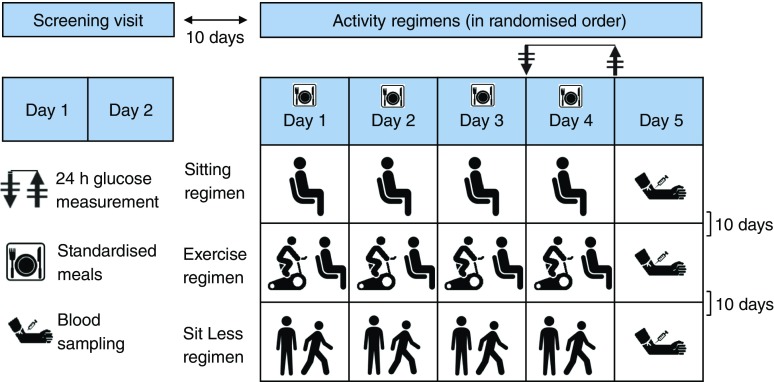
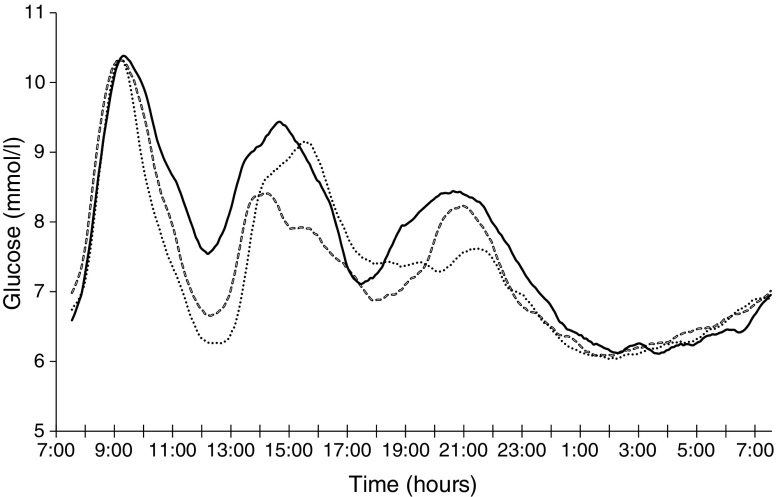
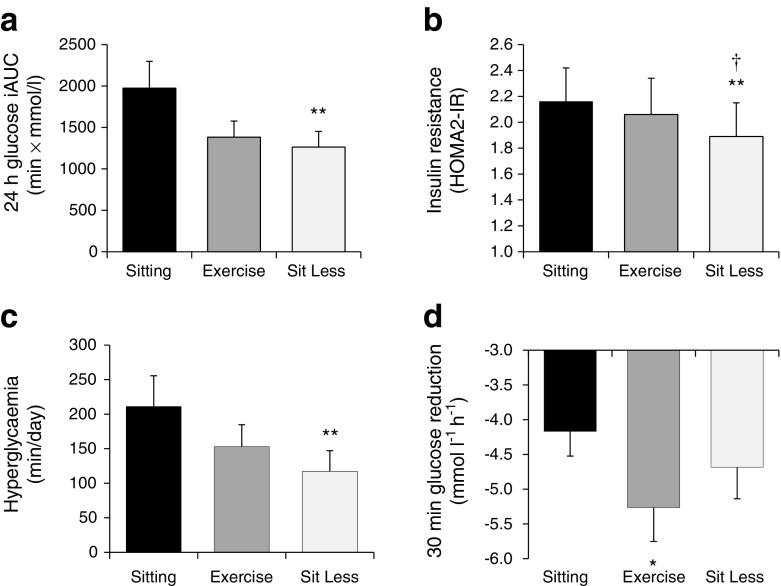
AIMS/HYPOTHESIS: We aimed to examine the effects of breaking sitting with standing and light-intensity walking vs an energy-matched bout of structured exercise on 24 h glucose levels and insulin resistance in patients with type 2 diabetes. METHODS: In a randomised crossover study, 19 patients with type 2 diabetes (13 men/6 women, 63 ± 9 years old) who were not using insulin each followed three regimens under free-living conditions, each lasting 4 days: (1) Sitting: 4415 steps/day with 14 h sitting/day; (2) Exercise: 4823 steps/day with 1.1 h/day of sitting replaced by moderate- to vigorous-intensity cycling (at an intensity of 5.9 metabolic equivalents [METs]); and (3) Sit Less: 17,502 steps/day with 4.7 h/day of sitting replaced by standing and light-intensity walking (an additional 2.5 h and 2.2 h, respectively, compared with the hours spent doing these activities in the Sitting regimen). Blocked randomisation was performed using a block size of six regimen orders using sealed, non-translucent envelopes. Individuals who assessed the outcomes were blinded to group assignment. Meals were standardised during each intervention. Physical activity and glucose levels were assessed for 24 h/day by accelerometry (activPAL) and a glucose monitor (iPro2), respectively. The incremental AUC (iAUC) for 24 h glucose (primary outcome) and insulin resistance (HOMA2-IR) were assessed on days 4 and 5, respectively. RESULTS: The iAUC for 24 h glucose (mean ± SEM) was significantly lower during the Sit Less intervention than in Sitting (1263 ± 189 min × mmol/l vs 1974 ± 324 min × mmol/l; p = 0.002), and was similar between Sit Less and Exercise (Exercise: 1383 ± 194 min × mmol/l; p = 0.499). Exercise failed to improve HOMA2-IR compared with Sitting (2.06 ± 0.28 vs 2.16 ± 0.26; p = 0.177). In contrast, Sit Less (1.89 ± 0.26) significantly reduced HOMA2-IR compared with Exercise (p = 0.015) as well as Sitting (p = 0.001). CONCLUSIONS/INTERPRETATION: Breaking sitting with standing and light-intensity walking effectively improved 24 h glucose levels and improved insulin sensitivity in individuals with type 2 diabetes to a greater extent than structured exercise. Thus, our results suggest that breaking sitting with standing and light-intensity walking may be an alternative to structured exercise to promote glycaemic control in patients type 2 diabetes. TRIAL REGISTRATION: , and the Dutch Heart Foundation. Financial support was also provided by Novo Nordisk BV, and Medtronic and Roche made the equipment available for continuous glucose monitoring.
Overview
The claims and statistics of this paper haven’t been checked yet.
Run the check — free, no account needed. It reads the open-access text and checks the sources it cites.
Integrity signals
Registry
Cites
Statistics
Figures
Verification
Claims the paper makes
The claims and statistics of this paper haven’t been checked yet.
Run the check — free, no account needed. It reads the open-access text and checks the sources it cites.
Claims other papers make about this one
Each is checked against this paper’s own text: does it say what the citing paper says it does?
The source backs part of the claim, not all of it — or backs it for a different population, condition or comparison.
In the citing paper
“However, individuals with diabetes and prediabetes often have barriers to exercise due to being frail or functionally compromised;9 therefore, tolerating long-lasting moderate-to-vigorous intensity PA (MVPA) as recommended (at least 150 min/week) is difficult for them.8”
From Accelerometer-measured physical activity, sedentary behavior, and incidence of macrovascular and microvascular events in individuals with type 2 diabetes mellitus and prediabetes (2025) · cites this paper as [9]
Experimental — accuracy not yet measuredIn the citing paper
“One study compared patients sitting for 14 hours daily against those replacing some of the sitting time with cycling for 65 minutes a day or those performing a combination of light-intensity walking and standing for 4.5 hours a day.Glucose levels over 24 hours, measured as area under the curve, improved in both groups with light-intensity walking and standing (À711 min × mmol/L) and those who cycl”
From The Impact of Physical Activity in Patients With Type 2 Diabetes (2025) · cites this paper as [88]
Self-check
Percentages, sums and reported differences re-computed from the paper’s own numbers.
The self-check needs the paper’s full text.
Citations
Cites
2011 Compendium of Physical Activities: A Second Update of Codes and MET Values
AINSWORTH, B. E., HASKELL, W. L., HERRMANN, S. D., MECKES, N., BASSETT, D. R., TUDOR-LOCKE, C., GREER, J. L., VEZINA, J., WHITT-GLOVER, M. C., & LEON, A. S. (2011) · Medicine & Science in Sports & Exercise · doi:10.1249/mss.0b013e31821ece12 · Cited by 6,317
Biswas, A., Oh, P. I., Faulkner, G. E., Bajaj, R. R., Silver, M. A., Mitchell, M. S., & Alter, D. A. (2015) · Annals of Internal Medicine · doi:10.7326/m14-1651 · Cited by 2,726
Amount of Time Spent in Sedentary Behaviors in the United States, 2003-2004
Matthews, C. E., Chen, K. Y., Freedson, P. S., Buchowski, M. S., Beech, B. M., Pate, R. R., & Troiano, R. P. (2008) · American Journal of Epidemiology · doi:10.1093/aje/kwm390 · Cited by 2,631
Correct Homeostasis Model Assessment (HOMA) Evaluation Uses the Computer Program
Lévy, J., Matthews, D. R., & Hermans, M. P. (1998) · Diabetes Care · doi:10.2337/diacare.21.12.2191 · Cited by 2,023
Breaking Up Prolonged Sitting Reduces Postprandial Glucose and Insulin Responses
Dunstan, D. W., Kingwell, B. A., Larsen, R., Healy, G. N., Cerin, E., Hamilton, M. T., Shaw, J. E., Bertovic, D. A., Zimmet, P. Z., Salmon, J., et al. (2012) · Diabetes Care · doi:10.2337/dc11-1931 · Cited by 1,203
Cryer, P. E., Davis, S. N., & Shamoon, H. (2003) · Diabetes Care · doi:10.2337/diacare.26.6.1902 · Cited by 1,160
Brouns, F., Bjorck, I., Frayn, K. N., Gibbs, A. L., Lang, V., Slama, G., & Wolever, T. M. S. (2005) · Nutrition Research Reviews · doi:10.1079/nrr2005100 · Cited by 1,093 · cited 1×
“The incremental AUC (iAUC) for glucose was calculated using the trapezoid rule [23].”
MethodPhysical Activity in U.S. Adults
Tucker, J. M., Welk, G. J., & Beyler, N. K. (2011) · American Journal of Preventive Medicine · doi:10.1016/j.amepre.2010.12.016 · Cited by 977
Fao, J. (2004) · Medical Entomology and Zoology · Cited by 947
Temelkova-Kurktschiev, T. S., Koehler, C., Henkel, E., Leonhardt, W., Fuecker, K., & Markolf Hanefeld, E. (2000) · Diabetes Care · doi:10.2337/diacare.23.12.1830 · Cited by 543
Research works printed but not linked: 1
- World Health Organization (2010) Global recommendations on physical activity for health. WHO Press, Geneva
Cited by
Sorted by citations
KANALEY, J. A., COLBERG, S. R., CORCORAN, M. H., MALIN, S. K., RODRIGUEZ, N. R., CRESPO, C. J., KIRWAN, J. P., & ZIERATH, J. R. (2022) · Medicine & Science in Sports & Exercise · doi:10.1249/mss.0000000000002800 · Cited by 931
Peçanha, T., Goessler, K. F., Roschel, H., & Gualano, B. (2020) · American Journal of Physiology-Heart and Circulatory Physiology · doi:10.1152/ajpheart.00268.2020 · Cited by 513
Narici, M. V., VITO, G. D., Franchi, M. V., Paoli, A., Moro, T., Marcolin, G., Grassi, B., Baldassarre, G., Zuccarelli, L., Biolo, G., et al. (2020) · European Journal of Sport Science · doi:10.1080/17461391.2020.1761076 · Cited by 494
Chastin, S. F. M., De Craemer, M., De Cocker, K., Powell, L., Van Cauwenberg, J., Dall, P., Hamer, M., & Stamatakis, E. (2019) · British Journal of Sports Medicine · doi:10.1136/bjsports-2017-097563 · Cited by 465
Physiology of sedentary behavior
Pinto, A. J., Bergouignan, A., Dempsey, P. C., Roschel, H., Owen, N. G., Gualano, B., & Dunstan, D. W. (2023) · Physiological Reviews · doi:10.1152/physrev.00022.2022 · Cited by 442
Metadata
- Authors
- Duvivier, B. M. F. M., Schaper, N. C., Hesselink, M. K. C., van Kan, L., Stienen, N., Winkens, B., Koster, A., & Savelberg, H. H. C. M.
- Affiliations
- Maastricht University Medical Centre (NL)
- Corresponding author
- Duvivier, Bernard M. F. M.
- ORCID
- Venue
- Diabetologia
- Published
- 2016-11-30
- Volume
- 60
- Issue
- 3
- Pages
- 490-498
- ISSN
- 0012-186X (ISSN-L)
- 1432-0428
- PMC
- PMC6518091
- OpenAlex
- W2556532561
- Cited by
- 212
- References
- 32
- Citations by year
- 2026: 8 · 2025: 18 · 2024: 20 · 2023: 22 · 2022: 31 · 2021: 36 · 2020: 28 · 2019: 11 · 2018: 24 · 2017: 12 · 2016: 1
- FWCI
- 12.88
- Type
- journal article
- Language
- en
- Open access
- hybrid
- doi.org
- Locations
- Diabetologia (publishedVersion, cc-by)
- Europe PMC (PubMed Central) (publishedVersion, cc-by)
- PubMed Central (publishedVersion, cc-by)
- PubMed (publishedVersion)
- Research Publications (Maastricht University) (publishedVersion, cc-by)
- Research Publications (Maastricht University) (submittedVersion, other-oa)
- Funders
- Novo Nordisk B.V.
- Kootstra Talent Fellowship from the Centre for Research Innovation, Support and Policy of Maastricht University Medical Centre +
- Roche
- Maastricht University Medical Centre +
- Medtronic
- Topics
- Health Sciences › Medicine › Public Health, Environmental and Occupational Health › Physical Activity and Health
- Health Sciences › Medicine › Endocrinology, Diabetes and Metabolism › Diabetes Management and Research
- Health Sciences › Medicine › Endocrinology, Diabetes and Metabolism › Diabetes Treatment and Management
- Keywords
- type 2 diabetes, sedentary behavior, standing, structured exercise, cycling, glycemic control, insulin resistance, HOMA2-IR, free-living physical activity, step count, accelerometry, glucose monitoring, energy expenditure, free-living conditions, non-pharmacological treatment
- MeSH terms
- Aged, Blood Glucose, Diabetes Mellitus, Type 2, Female, Humans, Insulin, Insulin Resistance, Male, Middle Aged, Posture, Exercise, Walking, Cross-Over Studies, Lipid Metabolism, Sedentary Behavior
About these checks
Registry, retraction, Cites and statistics results are computed, not judged, with one exception: a printed reference that no index lists is read once by a model before it counts as a citation error. Claims are extracted by a model and kept only when their quote appears verbatim in the text; each cited source is then checked, with a model’s help, for whether it says what the claim relies on. Those verdicts can be wrong — read the claim’s quote and the cited source before relying on one.
Statistics and arithmetic are recomputed, not judged.
Confidence bands are shown only for fields calibrated on our annotated test set. None is calibrated yet, so no band is shown.
What counts as a claim ›How we measure confidence ›How we check this ›
Are you an author, or do you see a problem with this page? Request a review
