

The DOI matches its Crossref record; 31 of the 32 references it cites were found in a registry or an index.
Breaking sitting with light activities vs structured exercise: a randomised crossover study demonstrating benefits for glycaemic control and insulin sensitivity in type 2 diabetes
Open accessAbstract
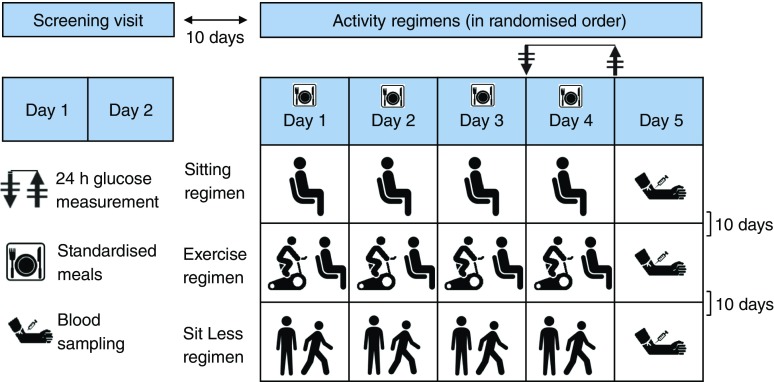
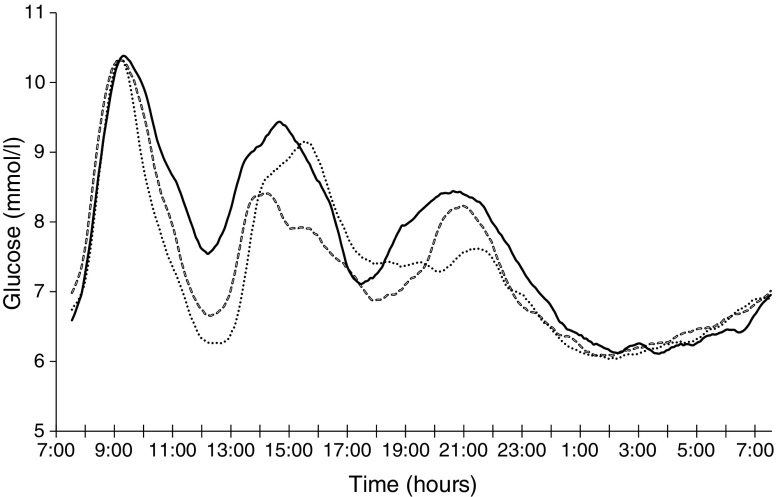
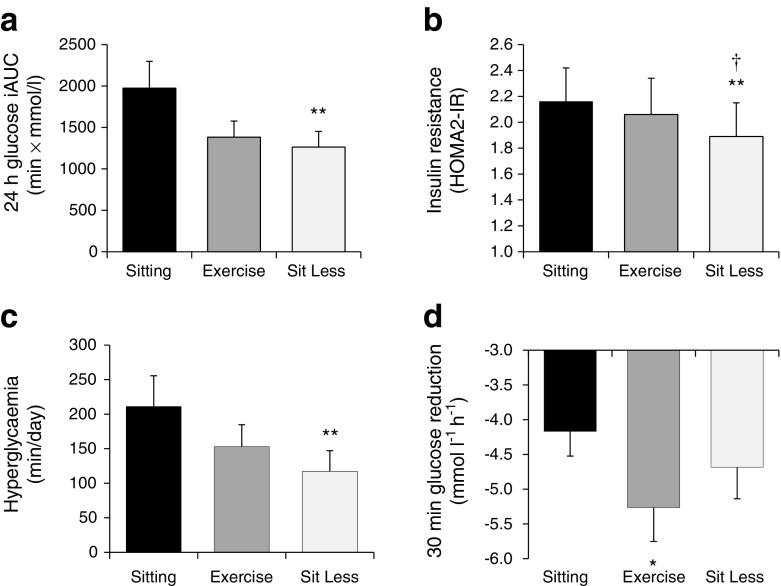
AIMS/HYPOTHESIS: We aimed to examine the effects of breaking sitting with standing and light-intensity walking vs an energy-matched bout of structured exercise on 24 h glucose levels and insulin resistance in patients with type 2 diabetes. METHODS: In a randomised crossover study, 19 patients with type 2 diabetes (13 men/6 women, 63 ± 9 years old) who were not using insulin each followed three regimens under free-living conditions, each lasting 4 days: (1) Sitting: 4415 steps/day with 14 h sitting/day; (2) Exercise: 4823 steps/day with 1.1 h/day of sitting replaced by moderate- to vigorous-intensity cycling (at an intensity of 5.9 metabolic equivalents [METs]); and (3) Sit Less: 17,502 steps/day with 4.7 h/day of sitting replaced by standing and light-intensity walking (an additional 2.5 h and 2.2 h, respectively, compared with the hours spent doing these activities in the Sitting regimen). Blocked randomisation was performed using a block size of six regimen orders using sealed, non-translucent envelopes. Individuals who assessed the outcomes were blinded to group assignment. Meals were standardised during each intervention. Physical activity and glucose levels were assessed for 24 h/day by accelerometry (activPAL) and a glucose monitor (iPro2), respectively. The incremental AUC (iAUC) for 24 h glucose (primary outcome) and insulin resistance (HOMA2-IR) were assessed on days 4 and 5, respectively. RESULTS: The iAUC for 24 h glucose (mean ± SEM) was significantly lower during the Sit Less intervention than in Sitting (1263 ± 189 min × mmol/l vs 1974 ± 324 min × mmol/l; p = 0.002), and was similar between Sit Less and Exercise (Exercise: 1383 ± 194 min × mmol/l; p = 0.499). Exercise failed to improve HOMA2-IR compared with Sitting (2.06 ± 0.28 vs 2.16 ± 0.26; p = 0.177). In contrast, Sit Less (1.89 ± 0.26) significantly reduced HOMA2-IR compared with Exercise (p = 0.015) as well as Sitting (p = 0.001). CONCLUSIONS/INTERPRETATION: Breaking sitting with standing and light-intensity walking effectively improved 24 h glucose levels and improved insulin sensitivity in individuals with type 2 diabetes to a greater extent than structured exercise. Thus, our results suggest that breaking sitting with standing and light-intensity walking may be an alternative to structured exercise to promote glycaemic control in patients type 2 diabetes. TRIAL REGISTRATION: , and the Dutch Heart Foundation. Financial support was also provided by Novo Nordisk BV, and Medtronic and Roche made the equipment available for continuous glucose monitoring.
Overview
The claims and statistics of this paper haven’t been checked yet.
Run the check — free, no account needed. It reads the open-access text and checks the sources it cites.
Integrity signals
Registry
Cites
Statistics
Figures
Verification
Claims the paper makes
The claims and statistics of this paper haven’t been checked yet.
Run the check — free, no account needed. It reads the open-access text and checks the sources it cites.
Claims other papers make about this one
Each is checked against this paper’s own text: does it say what the citing paper says it does?
The source backs part of the claim, not all of it — or backs it for a different population, condition or comparison.
In the citing paper
“However, individuals with diabetes and prediabetes often have barriers to exercise due to being frail or functionally compromised;9 therefore, tolerating long-lasting moderate-to-vigorous intensity PA (MVPA) as recommended (at least 150 min/week) is difficult for them.8”
From Accelerometer-measured physical activity, sedentary behavior, and incidence of macrovascular and microvascular events in individuals with type 2 diabetes mellitus and prediabetes (2025) · cites this paper as [9]
Experimental — accuracy not yet measuredIn the citing paper
“One study compared patients sitting for 14 hours daily against those replacing some of the sitting time with cycling for 65 minutes a day or those performing a combination of light-intensity walking and standing for 4.5 hours a day.Glucose levels over 24 hours, measured as area under the curve, improved in both groups with light-intensity walking and standing (À711 min × mmol/L) and those who cycl”
From The Impact of Physical Activity in Patients With Type 2 Diabetes (2025) · cites this paper as [88]
Self-check
Percentages, sums and reported differences re-computed from the paper’s own numbers.
The self-check needs the paper’s full text.
Citations
Cites
2011 Compendium of Physical Activities: A Second Update of Codes and MET Values
AINSWORTH, B. E., HASKELL, W. L., HERRMANN, S. D., MECKES, N., BASSETT, D. R., TUDOR-LOCKE, C., GREER, J. L., VEZINA, J., WHITT-GLOVER, M. C., & LEON, A. S. (2011) · Medicine & Science in Sports & Exercise · doi:10.1249/mss.0b013e31821ece12 · Cited by 6,317
Biswas, A., Oh, P. I., Faulkner, G. E., Bajaj, R. R., Silver, M. A., Mitchell, M. S., & Alter, D. A. (2015) · Annals of Internal Medicine · doi:10.7326/m14-1651 · Cited by 2,726
Amount of Time Spent in Sedentary Behaviors in the United States, 2003-2004
Matthews, C. E., Chen, K. Y., Freedson, P. S., Buchowski, M. S., Beech, B. M., Pate, R. R., & Troiano, R. P. (2008) · American Journal of Epidemiology · doi:10.1093/aje/kwm390 · Cited by 2,631
Correct Homeostasis Model Assessment (HOMA) Evaluation Uses the Computer Program
Lévy, J., Matthews, D. R., & Hermans, M. P. (1998) · Diabetes Care · doi:10.2337/diacare.21.12.2191 · Cited by 2,023
Breaking Up Prolonged Sitting Reduces Postprandial Glucose and Insulin Responses
Dunstan, D. W., Kingwell, B. A., Larsen, R., Healy, G. N., Cerin, E., Hamilton, M. T., Shaw, J. E., Bertovic, D. A., Zimmet, P. Z., Salmon, J., et al. (2012) · Diabetes Care · doi:10.2337/dc11-1931 · Cited by 1,203
Cryer, P. E., Davis, S. N., & Shamoon, H. (2003) · Diabetes Care · doi:10.2337/diacare.26.6.1902 · Cited by 1,160
Brouns, F., Bjorck, I., Frayn, K. N., Gibbs, A. L., Lang, V., Slama, G., & Wolever, T. M. S. (2005) · Nutrition Research Reviews · doi:10.1079/nrr2005100 · Cited by 1,093 · cited 1×
“The incremental AUC (iAUC) for glucose was calculated using the trapezoid rule [23].”
MethodPhysical Activity in U.S. Adults
Tucker, J. M., Welk, G. J., & Beyler, N. K. (2011) · American Journal of Preventive Medicine · doi:10.1016/j.amepre.2010.12.016 · Cited by 977
Fao, J. (2004) · Medical Entomology and Zoology · Cited by 947
Temelkova-Kurktschiev, T. S., Koehler, C., Henkel, E., Leonhardt, W., Fuecker, K., & Markolf Hanefeld, E. (2000) · Diabetes Care · doi:10.2337/diacare.23.12.1830 · Cited by 543
Research works printed but not linked: 1
- World Health Organization (2010) Global recommendations on physical activity for health. WHO Press, Geneva
Cited by
Sorted by citations
KANALEY, J. A., COLBERG, S. R., CORCORAN, M. H., MALIN, S. K., RODRIGUEZ, N. R., CRESPO, C. J., KIRWAN, J. P., & ZIERATH, J. R. (2022) · Medicine & Science in Sports & Exercise · doi:10.1249/mss.0000000000002800 · Cited by 931
Peçanha, T., Goessler, K. F., Roschel, H., & Gualano, B. (2020) · American Journal of Physiology-Heart and Circulatory Physiology · doi:10.1152/ajpheart.00268.2020 · Cited by 513
Narici, M. V., VITO, G. D., Franchi, M. V., Paoli, A., Moro, T., Marcolin, G., Grassi, B., Baldassarre, G., Zuccarelli, L., Biolo, G., et al. (2020) · European Journal of Sport Science · doi:10.1080/17461391.2020.1761076 · Cited by 494
Chastin, S. F. M., De Craemer, M., De Cocker, K., Powell, L., Van Cauwenberg, J., Dall, P., Hamer, M., & Stamatakis, E. (2019) · British Journal of Sports Medicine · doi:10.1136/bjsports-2017-097563 · Cited by 465
Physiology of sedentary behavior
Pinto, A. J., Bergouignan, A., Dempsey, P. C., Roschel, H., Owen, N. G., Gualano, B., & Dunstan, D. W. (2023) · Physiological Reviews · doi:10.1152/physrev.00022.2022 · Cited by 442
Loh, R., Stamatakis, E., Folkerts, D., Allgrove, J. E., & Moir, H. J. (2020) · Sports Medicine · doi:10.1007/s40279-019-01183-w · Cited by 326
Physical Activity and Diabetes
Sigal, R. J., Armstrong, M. J., Bacon, S., Boulé, N. G., Dasgupta, K., Kenny, G. P., & Riddell, M. C. (2018) · Canadian Journal of Diabetes · doi:10.1016/j.jcjd.2017.10.008 · Cited by 287
Wheeler, M. J., Dempsey, P. C., Grace, M. S., Ellis, K. A., Gardiner, P. A., GREEN, D. J., & Dunstan, D. W. (2017) · Alzheimer s & Dementia Translational Research & Clinical Interventions · doi:10.1016/j.trci.2017.04.001 · Cited by 200
Lynch, B. M., Nguyen, N. H., Moore, M. M., Reeves, M. M., Rosenberg, D. E., Boyle, T., Vallance, J. K., Milton, S., Friedenreich, C. M., & English, D. R. (2019) · Cancer · doi:10.1002/cncr.32143 · Cited by 171
The importance of exercise for glycemic control in type 2 diabetes
Syeda, U. S. A., Battillo, D. J., Visaria, A., & Malin, S. K. (2023) · American Journal of Medicine Open · doi:10.1016/j.ajmo.2023.100031 · Cited by 198
Kemps, H., Kränkel, N., Dörr, M., Moholdt, T. T., Wilhelm, M., Paneni, F., Serratosa, L., Solberg, E. E., Hansen, D., Halle, M., et al. (2019) · European Journal of Preventive Cardiology · doi:10.1177/2047487318820420 · Cited by 154
Wukich, D. K., Schaper, N. C., Gooday, C., Bal, A., Bém, R., Chhabra, A. B., Hastings, M. K., Holmes, C., Petrova, N. L., Araujo, M. G. S., et al. (2023) · Diabetes/Metabolism Research and Reviews · doi:10.1002/dmrr.3646 · Cited by 114
Self-citationSitting, squatting, and the evolutionary biology of human inactivity
Raichlen, D. A., Pontzer, H., Zderic, T. W., Harris, J. A., Mabulla, A. Z. P., Hamilton, M. T., & Wood, B. M. (2020) · Proceedings of the National Academy of Sciences · doi:10.1073/pnas.1911868117 · Cited by 99
Hamilton, M. T. (2017) · The Journal of Physiology · doi:10.1113/jp273284 · Cited by 95
Duvivier, B. M. F. M., Schaper, N. C., Koster, A., van Kan, L., Peters, H. P. F., Adam, J. J., Giesbrecht, T., Moonen‐Kornips, E., Hulsbosch, M. M., Willems, P. J. B., et al. (2017) · Frontiers in Physiology · doi:10.3389/fphys.2017.00353 · Cited by 94
Self-citationContributions of physical inactivity and sedentary behavior to metabolic and endocrine diseases
Kerr, N. R., & Booth, F. W. (2022) · Trends in Endocrinology and Metabolism · doi:10.1016/j.tem.2022.09.002 · Cited by 95
Mesinovic, J., Fyfe, J. J., Talevski, J., Wheeler, M. J., Leung, G. K. W., George, E. S., Hunegnaw, M. T., Glavas, C., Jansons, P., Daly, R. M., et al. (2023) · Diabetes & Metabolism Journal · doi:10.4093/dmj.2023.0112 · Cited by 98
Roux, E. L., Jong, N. P. D., Blanc, S., Simon, C., Bessesen, D. H., & Bergouignan, A. (2021) · The Journal of Physiology · doi:10.1113/jp281064 · Cited by 103
Timing of physical activity in relation to liver fat content and insulin resistance
van der Velde, J. H. P. M., Boone, S. C., Eekelen, E. W.-V., Hesselink, M. K. C., Schrauwen‐Hinderling, V. B., Schrauwen, P., Lamb, H. J., Rosendaal, F. R., & de Mutsert, R. (2022) · Diabetologia · doi:10.1007/s00125-022-05813-3 · Cited by 85
Self-citationPhysical activity in management of persons with obesity
Oppert, J., Bellicha, A., & Ciangura, C. (2021) · European Journal of Internal Medicine · doi:10.1016/j.ejim.2021.04.028 · Cited by 97
Moghetti, P., Balducci, S., Guidetti, L., Mazzuca, P., Rossi, E., & Schena, F. F. (2020) · Nutrition Metabolism and Cardiovascular Diseases · doi:10.1016/j.numecd.2020.08.021 · Cited by 96
Dogra, S., Copeland, J. L., Altenburg, T. M., Heyland, D. K., Owen, N. G., & Dunstan, D. W. (2021) · Patient Education and Counseling · doi:10.1016/j.pec.2021.09.019 · Cited by 91
Munan, M., Oliveira, C. L. P., Marcotte-Chénard, A., Rees, J. L., Prado, C. M., Riesco, E., & Boulé, N. G. (2020) · Frontiers in Endocrinology · doi:10.3389/fendo.2020.00495 · Cited by 70
Sedentary behaviour in the workplace: prevalence, health implications and interventions
Bailey, D. P. (2020) · British Medical Bulletin · doi:10.1093/bmb/ldaa039 · Cited by 85
Continuous Glucose Monitoring As a Behavior Modification Tool
Ehrhardt, N. M., & Zaghal, E. A. (2020) · Clinical Diabetes · doi:10.2337/cd19-0037 · Cited by 77
Duvivier, B. M. F. M., Bolijn, J. E., Koster, A., Schalkwijk, C. G., Savelberg, H. H. C. M., & Schaper, N. C. (2018) · Scientific Reports · doi:10.1038/s41598-018-26616-w · Cited by 64
Self-citationBell, K., Shaw, J. E., Maple-Brown, L., Ferris, W., Gray, S., Murfet, G., Flavel, R., Maynard, B., Ryrie, H., Pritchard, B., et al. (2020) · Diabetes Research and Clinical Practice · doi:10.1016/j.diabres.2020.108188 · Cited by 64
“[76] Duvivier BM, Schaper NC, Hesselink MK, van Kan L, Stienen N, Winkens B, et al.”
BackgroundSubba, R., Sandhir, R., Singh, S. P., Mallick, B. N., & Mondal, A. C. (2021) · European Journal of Neuroscience · doi:10.1111/ejn.15136 · Cited by 69
van der Velde, J. H. P. M., Schaper, N. C., Stehouwer, C. D. A., Kallen, C., Sep, S. J. S., Schram, M. T., Henry, R. M. A., Dagnelie, P. C., Eussen, S. J. P. M., DONGEN, M. C. J. M. V., et al. (2018) · Diabetologia · doi:10.1007/s00125-018-4719-7 · Cited by 60
Self-citationSyncing Exercise With Meals and Circadian Clocks
Heden, T. D., & Kanaley, J. A. (2018) · Exercise and Sport Sciences Reviews · doi:10.1249/jes.0000000000000172 · Cited by 63
Sardinha, L., Magalhães, J., Santos, D., & Júdice, P. (2017) · Frontiers in Physiology · doi:10.3389/fphys.2017.00262 · Cited by 57
Li, X., Zhou, T., Ma, H., Liang, Z., Fonseca, V. A., & Qi, L. (2021) · Diabetes Care · doi:10.2337/dc21-0455 · Cited by 53
Quan, M., Xun, P., Hua, W., Wang, J., Cheng, W., Cao, M., Zhou, T., Huang, T., Gao, Z., & Chen, P. (2020) · Journal of sport and health science/Journal of Sport and Health Science · doi:10.1016/j.jshs.2020.12.006 · Cited by 57
Frequency of interruptions to sitting time: benefits for postprandial metabolism in type 2 diabetes
Homer, A. R., Taylor, F. C., Dempsey, P. C., Wheeler, M. J., Sethi, P., Townsend, M. K., Grace, M. S., Green, D. J., Cohen, N. D., Larsen, R. N., et al. (2021) · Diabetes Care · doi:10.2337/dc20-1410 · Cited by 49
Melville, C. A., McGarty, A. M., Harris, L., Hughes-McCormack, L. A., Baltzer, M., McArthur, L. A., Morrison, J., Allan, L., & Cooper, S. (2017) · Journal of Intellectual Disability Research · doi:10.1111/jir.12454 · Cited by 46
Balducci, S., D’Errico, V., Haxhi, J., Sacchetti, M., Orlando, G., Cardelli, P., Vitale, M., Bollanti, L., Conti, F., Zanuso, S., et al. (2017) · Diabetes Care · doi:10.2337/dc17-0594 · Cited by 42
Ahmadi, M. N., Blodgett, J. M., Atkin, A. J., Chan, H., Cruz, B. D. P., Suorsa, K., Bakker, E. A., Pulsford, R. M., Mielke, G. I., Johansson, P. J., et al. (2024) · Diabetologia · doi:10.1007/s00125-024-06090-y · Cited by 40
Self-citationSedentariness: A Need for a Definition
Magnon, V., Dutheil, F., & Auxiette, C. (2018) · Frontiers in Public Health · doi:10.3389/fpubh.2018.00372 · Cited by 45
Thomsen, T., Aadahl, M., Beyer, N., Hetland, M. L., Løppenthin, K. B., Midtgaard, J., Christensen, R., Nielsen, S. M., Østergaard, M., Jennum, P., et al. (2019) · Arthritis Care & Research · doi:10.1002/acr.24060 · Cited by 42
Paing, A. C., McMillan, K. A., Kirk, A. F., Collier, A., Hewitt, A., & CHASTIN, S. F. M. (2018) · Diabetic Medicine · doi:10.1111/dme.13829 · Cited by 37
Intermittent Standing but not a Moderate Exercise Bout Reduces Postprandial Glycemia
Benatti, F. B., Larsen, S. A., KOFOED, K., Nielsen, S. T., Harder-Lauridsen, N. M., Lyngbæk, M. P. P., Eriksen, D., Karstoft, K., Krogh‐Madsen, R., Pedersen, B. K., et al. (2017) · Medicine & Science in Sports & Exercise · doi:10.1249/mss.0000000000001354 · Cited by 40
Sedentary Behaviour—A Target for the Prevention and Management of Cardiovascular Disease
Bell, A. C., Richards, J. C., Zakrzewski-Fruer, J. K., Smith, L. R., & Bailey, D. P. (2022) · International Journal of Environmental Research and Public Health · doi:10.3390/ijerph20010532 · Cited by 42
Too much sitting and dysglycemia: Mechanistic links and implications for obesity
Homer, A. R., Owen, N. G., & Dunstan, D. W. (2018) · Current Opinion in Endocrine and Metabolic Research · doi:10.1016/j.coemr.2018.09.003 · Cited by 34
The complex relationship between physical activity and diabetes: an overview
Palermi, S., Iacono, O., Sirico, F., Modestino, M., Ruosi, C., Spera, R., & De Luca, M. (2022) · Journal of Basic and Clinical Physiology and Pharmacology · doi:10.1515/jbcpp-2021-0279 · Cited by 35
Paing, A. C., McMillan, K. A., Kirk, A. F., Collier, A., Hewitt, A., & CHASTIN, S. F. M. (2018) · Preventive Medicine Reports · doi:10.1016/j.pmedr.2018.09.002 · Cited by 37
Smith, J. A. B., Savikj, M., Sethi, P., Platt, S., Gabriel, B. M., Hawley, J. A., Dunstan, D. W., Krook, A., Zierath, J. R., & Näslund, E. B. (2021) · American Journal of Physiology-Endocrinology and Metabolism · doi:10.1152/ajpendo.00599.2020 · Cited by 38
Brakenridge, C. J., Koster, A., de Galan, B. E., Carver, A., Dumuid, D., Dzakpasu, F. Q. S., Eussen, S. J. P. M., Savelberg, H. H. C. M., Bosma, H., Owen, N. G., et al. (2024) · Diabetologia · doi:10.1007/s00125-024-06145-0 · Cited by 31
Self-citationEekelen, E. W.-V., van der Velde, J. H. P. M., Boone, S. C., Westgate, K. L., Brage, S., Lamb, H. J., Rosendaal, F. R., & de Mutsert, R. (2021) · Medicine & Science in Sports & Exercise · doi:10.1249/mss.0000000000002712 · Cited by 35
Solomon, T. P. J., Eves, F. F., & Laye, M. J. (2018) · Frontiers in Cardiovascular Medicine · doi:10.3389/fcvm.2018.00099 · Cited by 31
Dog ownership and adults’ objectively-assessed sedentary behaviour and physical activity
Koohsari, M. J., Shibata, A., Ishii, K., Kurosawa, S., Yasunaga, A., Hanibuchi, T., Nakaya, T., McCormack, G. R., & Oka, K. (2020) · Scientific Reports · doi:10.1038/s41598-020-74365-6 · Cited by 30
Remie, C. M. E., Janssens, G. E., Bilet, L., van Weeghel, M., Duvivier, B. M. F. M., de Wit‐Verheggen, V. H. W., Connell, N. J., Jörgensen, J. A., Schomakers, B. V., Schrauwen‐Hinderling, V. B., et al. (2021) · Diabetologia · doi:10.1007/s00125-021-05558-5 · Cited by 30
Self-citationBoekhout, J. M., Berendsen, B., Peels, D. A., Bolman, C. A. W., & Lechner, L. (2018) · International Journal of Environmental Research and Public Health · doi:10.3390/ijerph15020346 · Cited by 27
Global Trends and Research Hotspots of Exercise for Intervening Diabetes: A Bibliometric Analysis
Zhang, Z., Zhu, Y., Wang, Q., Chang, T.-T., Liu, C., Zhu, Y., Wang, X., & Cao, X. (2022) · Frontiers in Public Health · doi:10.3389/fpubh.2022.902825 · Cited by 28
Prolonged uninterrupted sitting increases fatigue in type 2 diabetes
Dempsey, P. C., Dunstan, D. W., Larsen, R. N., Lambert, G. W., Kingwell, B. A., & Owen, N. G. (2017) · Diabetes Research and Clinical Practice · doi:10.1016/j.diabres.2017.11.001 · Cited by 25
Liang, Y. Y., He, Y., Huang, P., Feng, H., Li, H., Ai, S., Du, J., Xue, H., Liu, Y., Zhang, J., et al. (2025) · Journal of Sport and Health Science · doi:10.1016/j.jshs.2024.100973 · Cited by 25
Management of patients with type 2 diabetes in cardiovascular rehabilitation
Hansen, D., Kränkel, N., Kemps, H., Wilhelm, M., Abreu, A., Pfeiffer, A. F. H., Jordão, A., Cornelissen, V., & Völler, H. (2019) · European Journal of Preventive Cardiology · doi:10.1177/2047487319882820 · Cited by 22
Gao, Y., Li, Q.-H., Finni, T. J., & Pesola, A. J. (2024) · Scandinavian Journal of Medicine and Science in Sports · doi:10.1111/sms.14628 · Cited by 22
Adding exercise or subtracting sitting time for glycaemic control: where do we stand?
Dempsey, P. C., Grace, M. S., & Dunstan, D. W. (2016) · Diabetologia · doi:10.1007/s00125-016-4180-4 · Cited by 20
Vietheer, A., Kiserud, T., Lie, R. T., Haaland, Ø. A., & Kessler, J. (2021) · Sleep Medicine · doi:10.1016/j.sleep.2021.04.028 · Cited by 22
Managing weight and glycaemic targets in people with type 2 diabetes—How far have we come?
Blüher, M., Ceriello, A., Davies, M. J., Rodbard, H. W., Sattar, N. A., Schnell, O., Tonchevska, E., & Giorgino, F. (2022) · Endocrinology Diabetes & Metabolism · doi:10.1002/edm2.330 · Cited by 19
Kishimoto, I., & Ohashi, A. (2021) · Nutrients · doi:10.3390/nu13093092 · Cited by 19
Hughes, R., Pindus, D. M., Khan, N. A., Burd, N. A., & Holscher, H. D. (2022) · Medicine & Science in Sports & Exercise · doi:10.1249/mss.0000000000003096 · Cited by 22
The role of the super-relaxed state of myosin in human metabolism
Wilson, C. F., Naber, N. I., & Cooke, R. (2020) · Metabolism Open · doi:10.1016/j.metop.2020.100068 · Cited by 19
Sedentary time in people with obstructive airway diseases
Cordova‐Rivera, L., Gardiner, P. A., Gibson, P. G., WINKLER, E. A. H., Guerrero, P. D. U., & McDonald, V. M. (2021) · Respiratory Medicine · doi:10.1016/j.rmed.2021.106367 · Cited by 19
Beale, C., Rauff, E. L., O’Brien, W. J., Shultz, S. P., Fink, P. W., & Kruger, R. (2020) · International Journal of Environmental Research and Public Health · doi:10.3390/ijerph17082643 · Cited by 18
Homer, A. R., Taylor, F., Dempsey, P. C., Wheeler, M. J., Sethi, P., Grace, M. S., GREEN, D. J., Cohen, N. D., Larsen, R. N., Kingwell, B. A., et al. (2021) · Nutrition Metabolism and Cardiovascular Diseases · doi:10.1016/j.numecd.2021.07.001 · Cited by 22
MacDonald, B., Gibson, A., Janssen, X., & Kirk, A. F. (2020) · International Journal of Environmental Research and Public Health · doi:10.3390/ijerph17124538 · Cited by 18
Biswas, A., OH, P. I., Faulkner, G., Bonsignore, A., Pakosh, M. T., & Alter, D. A. (2017) · Journal of Public Health · doi:10.1093/pubmed/fdx062 · Cited by 18
The Impact of Physical Activity in Patients With Type 2 Diabetes
Bassin, S. R., & Srinath, R. (2025) · American Journal of Lifestyle Medicine · doi:10.1177/15598276231180541 · Cited by 17
Remchak, M. E., Piersol, K. L., Bhatti, S., Spaeth, A. M., Buckman, J. F., & Malin, S. K. (2021) · Nutrients · doi:10.3390/nu13051708 · Cited by 17
Shima, T., Kawabata‐Iwakawa, R., Onishi, H., Jesmin, S., & Yoshikawa, T. (2022) · Metabolic Brain Disease · doi:10.1007/s11011-022-01117-y · Cited by 16
Smith, S. T., Salmani, B., LeSarge, J. C., Dillon-Rossiter, K., Morava, A., & Harry Prapavessis, A. (2024) · PLoS ONE · doi:10.1371/journal.pone.0306439 · Cited by 19
Wu, H., Wei, J., Chen, W., Chen, L., Zhang, J., Wang, N., Wang, S., & Tan, X. W. (2024) · Arteriosclerosis Thrombosis and Vascular Biology · doi:10.1161/atvbaha.124.321214 · Cited by 16
de Oliveira, D. S., Borges, I. B. P., de Souza, J. M., Gualano, B., Pereira, R. M. R., & Shinjo, S. K. (2019) · Clinical Rheumatology · doi:10.1007/s10067-019-04738-4 · Cited by 16
Chang, C. R., Russell, B. M., Dempsey, P. C., Christie, H. E., Campbell, M. D., & Francois, M. E. (2020) · Canadian Journal of Diabetes · doi:10.1016/j.jcjd.2020.10.013 · Cited by 14
Jorissen, W., Vanmierlo, T., Wens, I., Somers, V. A., Wijmeersch, B. V., Bogie, J. F. J., Remaley, A. T., Eijnde, B. O., & Hendriks, J. J. A. (2018) · International Journal of Molecular Sciences · doi:10.3390/ijms19010193 · Cited by 15
Adams, J. A., Banderas, V., Lopez, J. R., & Sackner, M. A. (2020) · Journal of Diabetes Research · doi:10.1155/2020/8317973 · Cited by 15
He, J., Liu, F., Xu, P., Xu, T., Yu, H., Wu, B., Wang, H., Chen, J., Zhang, K., Zhang, J., et al. (2024) · Depression and Anxiety · doi:10.1155/da/6651804 · Cited by 18
Chen, Y., Davies, R. G., Hengist, A., Carroll, H. A., Perkin, O. J., Betts, J. A., & Thompson, D. (2021) · Applied Physiology, Nutrition, and Metabolism · doi:10.1139/apnm-2021-0361 · Cited by 14
Hietbrink, E. A. G., Lansink, C., Laverman, G. D., Vollenbroek-Hutten, M. M. R., Middelweerd, A., & Tabak, M. (2025) · npj Digital Medicine · doi:10.1038/s41746-025-02054-7 · Cited by 20
Periodized versus classic exercise therapy in Multiple Sclerosis: a randomized controlled trial
Keytsman, C., Noten, P. V., Verboven, K., Asch, P. V., & Eijnde, B. O. (2021) · Multiple Sclerosis and Related Disorders · doi:10.1016/j.msard.2021.102782 · Cited by 14
Sedentary patterns are associated with BDNF in patients with type 2 diabetes mellitus
Júdice, P. B., Magalhães, J. P., Hetherington‐Rauth, M., Correia, I. R., & Sardinha, L. B. (2021) · European Journal of Applied Physiology · doi:10.1007/s00421-020-04568-2 · Cited by 12
O’Brien, C. M., Duda, J. L., Kitas, G. D., Zanten, J. V., Metsios, G. S., & Fenton, S. A. M. (2018) · Mediterranean Journal of Rheumatology · doi:10.31138/mjr.29.2.106 · Cited by 12
Armstrong, M. J., Colberg, S. R., & Sigal, R. J. (2023) · Diabetes Spectrum · doi:10.2337/dsi22-0016 · Cited by 12
Methnani, J., Amor, D., Yousfi, N., Bouslama, A., Omezzine, A., & Bouhlel, E. (2021) · The Journal of Sports Medicine and Physical Fitness · doi:10.23736/s0022-4707.20.11898-x · Cited by 11
Domazet, S. L., Tarp, J., Thomsen, R. W., Højlund, K., Stidsen, J. V., Brønd, J. C., Grøntved, A., & Nielsen, J. S. (2023) · Frontiers in Sports and Active Living · doi:10.3389/fspor.2022.1089579 · Cited by 11
Kingsnorth, A. P., Whelan, M., Sanders, J. P., Sherar, L. B., & Esliger, D. (2018) · JMIR mhealth and uhealth · doi:10.2196/mhealth.9471 · Cited by 11
Ma, S., Zhu, Z., & Cao, Z. (2020) · Scandinavian Journal of Medicine and Science in Sports · doi:10.1111/sms.13886 · Cited by 10
Zhang, P., Shen, Y., Xu, X. H., Ding, B., Yan, R., Wang, H.-Y., Xie, X., Ma, J., & Hu, Y. Y. (2024) · World Journal of Diabetes · doi:10.4239/wjd.v15.i7.1489 · Cited by 10
Exercise-Induced Adult Cardiomyocyte Proliferation in Mammals
Zhang, G., Sun, M., & Zhang, X. (2021) · Frontiers in Physiology · doi:10.3389/fphys.2021.729364 · Cited by 10
Moghetti, P., Balducci, S., Guidetti, L., Mazzuca, P., Rossi, E., Schena, F. F., Italian Society of Diabetology (SID), Moghetti, P., Balducci, S., Guidetti, L., et al. (2020) · Sport Sciences for Health · doi:10.1007/s11332-020-00690-y · Cited by 13
Movement Patterns in Older Adults Recovering From Hip Fracture
Kraaijkamp, J. J. M., Stijntjes, M., de Groot, J. H., Chavannes, N. H., Achterberg, W. P., & van Isselt, E. F. V. D. (2024) · Journal of Aging and Physical Activity · doi:10.1123/japa.2023-0090 · Cited by 9
Dong, Y., Pan, Y., Zhang, X., He, Q., Chen, S., Du, L., & Yin, S.-T. (2024) · Applied Sciences · doi:10.3390/app14083201 · Cited by 9
Chrismas, B. C. R., Taylor, L. K., Cherif, A., Sayegh, S., Rizk, N. M., Elgamal, A., Allenjawi, S. H., & Bailey, D. P. (2019) · Frontiers in Physiology · doi:10.3389/fphys.2019.00706 · Cited by 9
Nieste, I., Franssen, W. M. A., Duvivier, B. M. F. M., Spaas, J., Savelberg, H. H. C. M., & Eijnde, B. O. (2022) · Disability and Rehabilitation · doi:10.1080/09638288.2022.2122601 · Cited by 10
Self-citationJameel, R., Shobitha, M., & Mourya, A. K. (2021) · International Journal of Information Technology · doi:10.1007/s41870-021-00721-y · Cited by 10
Jiang, L., Xu, X., Luo, M.-H., Wang, H., Ding, B., Yan, R., Hu, Y., & Ma, J. (2021) · Diabetes Therapy · doi:10.1007/s13300-021-01151-6 · Cited by 9
Bailey, D. P., Stringer, C. A., Maylor, B. D., & Zakrzewski-Fruer, J. K. (2022) · Nutrients · doi:10.3390/nu14030605 · Cited by 9
Parada-Flores, B., Luna-Villouta, P. F., Martínez‐Salazar, C., Valderrama, J. F., Contreras, L. M. V., Flores-Rivera, C., & Vargas-Vitoria, R. (2023) · European Journal of Investigation in Health Psychology and Education · doi:10.3390/ejihpe13110176 · Cited by 11
Tailoring Exercise Prescription for Effective Diabetes Glucose Management
Lewis, C. J., Rafi, E., Dobbs, B., Barton, T., Hatipoğlu, B., & Malin, S. K. (2025) · The Journal of Clinical Endocrinology & Metabolism · doi:10.1210/clinem/dgae908 · Cited by 8
Metadata
- Authors
- Duvivier, B. M. F. M., Schaper, N. C., Hesselink, M. K. C., van Kan, L., Stienen, N., Winkens, B., Koster, A., & Savelberg, H. H. C. M.
- Affiliations
- Maastricht University Medical Centre (NL)
- Corresponding author
- Duvivier, Bernard M. F. M.
- ORCID
- Venue
- Diabetologia
- Published
- 2016-11-30
- Volume
- 60
- Issue
- 3
- Pages
- 490-498
- ISSN
- 0012-186X (ISSN-L)
- 1432-0428
- PMC
- PMC6518091
- OpenAlex
- W2556532561
- Cited by
- 212
- References
- 32
- Citations by year
- 2026: 8 · 2025: 18 · 2024: 20 · 2023: 22 · 2022: 31 · 2021: 36 · 2020: 28 · 2019: 11 · 2018: 24 · 2017: 12 · 2016: 1
- FWCI
- 12.88
- Type
- journal article
- Language
- en
- Open access
- hybrid
- doi.org
- Locations
- Diabetologia (publishedVersion, cc-by)
- Europe PMC (PubMed Central) (publishedVersion, cc-by)
- PubMed Central (publishedVersion, cc-by)
- PubMed (publishedVersion)
- Research Publications (Maastricht University) (publishedVersion, cc-by)
- Research Publications (Maastricht University) (submittedVersion, other-oa)
- Funders
- Novo Nordisk B.V.
- Kootstra Talent Fellowship from the Centre for Research Innovation, Support and Policy of Maastricht University Medical Centre +
- Roche
- Maastricht University Medical Centre +
- Medtronic
- Topics
- Health Sciences › Medicine › Public Health, Environmental and Occupational Health › Physical Activity and Health
- Health Sciences › Medicine › Endocrinology, Diabetes and Metabolism › Diabetes Management and Research
- Health Sciences › Medicine › Endocrinology, Diabetes and Metabolism › Diabetes Treatment and Management
- Keywords
- type 2 diabetes, sedentary behavior, standing, structured exercise, cycling, glycemic control, insulin resistance, HOMA2-IR, free-living physical activity, step count, accelerometry, glucose monitoring, energy expenditure, free-living conditions, non-pharmacological treatment
- MeSH terms
- Aged, Blood Glucose, Diabetes Mellitus, Type 2, Female, Humans, Insulin, Insulin Resistance, Male, Middle Aged, Posture, Exercise, Walking, Cross-Over Studies, Lipid Metabolism, Sedentary Behavior
About these checks
Registry, retraction, Cites and statistics results are computed, not judged, with one exception: a printed reference that no index lists is read once by a model before it counts as a citation error. Claims are extracted by a model and kept only when their quote appears verbatim in the text; each cited source is then checked, with a model’s help, for whether it says what the claim relies on. Those verdicts can be wrong — read the claim’s quote and the cited source before relying on one.
Statistics and arithmetic are recomputed, not judged.
Confidence bands are shown only for fields calibrated on our annotated test set. None is calibrated yet, so no band is shown.
What counts as a claim ›How we measure confidence ›How we check this ›
Are you an author, or do you see a problem with this page? Request a review
