

Clinical and metabolic features of the randomised controlled Diabetes Remission Clinical Trial (DiRECT) cohort
Open accessThe DOI matches its Crossref record; 23 of the 23 references it cites were found in a registry or an index.
Abstract
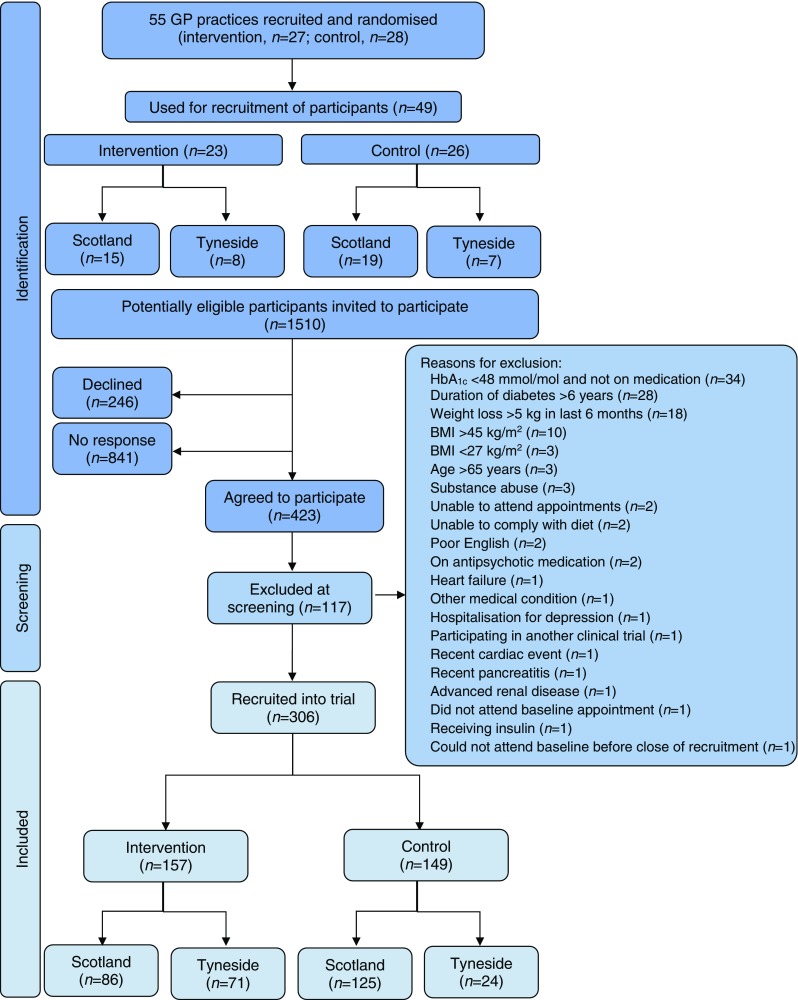
Substantial weight loss in type 2 diabetes can achieve a return to non-diabetic biochemical status, without the need for medication. The Diabetes Remission Clinical Trial (DiRECT), a cluster-randomised controlled trial, is testing a structured intervention designed to achieve and sustain this over 2 years in a primary care setting to determine practicability for routine clinical practice. This paper reports the characteristics of the baseline cohort. People with type 2 diabetes for <6 years with a BMI of 27–45 kg/m2 were recruited in 49 UK primary care practices, randomised to either best-practice diabetes care alone or with an additional evidence-based weight management programme (Counterweight-Plus). The co-primary outcomes, at 12 months, are weight loss ≥15 kg and diabetes remission (HbA1c <48 mmol/mol [6.5%]) without glucose-lowering therapy for at least 2 months. Outcome assessors are blinded to group assignment. Of 1510 people invited, 423 (28%) accepted; of whom, 306 (72%) were eligible at screening and gave informed consent. Seven participants were later found to have been randomised in error and one withdrew consent, leaving 298 (176 men, 122 women) who will form the intention to treat (ITT) population for analysis. Mean (SD) age was 54.4 (7.6) years, duration of diabetes 3.0 (1.7) years, BMI 34.6 (4.4) kg/m2 for all participants (34.2 (4.2) kg/m2 in men and 35.3 (4.6) kg/m2 in women) and baseline HbA1c (on treatment) 59.3 (12.7) mmol/mol (7.6% [1.2%]). The recruitment rate in the intervention and control groups, and comparisons between the subgroups recruited in Scotland and England, showed few differences. DiRECT has recruited a cohort of people with type 2 diabetes with characteristics similar to those seen in routine practice, indicating potential widespread applicability. Over 25% of the eligible population wished to participate in the study, including a high proportion of men, in line with the prevalence distribution of type 2 diabetes. www.controlled-trials.com/ISRCTN03267836 ; date of registration 20 December 2013
Overview
The claims and statistics of this paper haven’t been checked yet.
Free: it reads the open-access text and checks the first 5 claims that cite a source we can check. Create a free account to check every claim.
Integrity signals
Registry
Cites
Statistics
Figures
Verification
Claims the paper makes
The claims and statistics of this paper haven’t been checked yet.
Free: it reads the open-access text and checks the first 5 claims that cite a source we can check. Create a free account to check every claim.
Claims other papers make about this one
Each is checked against this paper’s own text: does it say what the citing paper says it does?
The source backs part of the claim, not all of it — or backs it for a different population, condition or comparison.
In the citing paper
“observational follow-up of larger, longer, trials increasingly suggest benefits from substantial intentional weight loss, likely related to blood pressure control. 40,41”
From 5-year follow-up of the randomised Diabetes Remission Clinical Trial (DiRECT) of continued support for weight loss maintenance in the UK: an extension study (2024) · cites this paper as [40]
Experimental — accuracy not yet measuredThe cited source says what the claim attributes to it.
In the citing paper
“The sample had characteristics very similar to the general population of people with type 2 diabetes, so the results are likely to be widely generalisable. 15”
The cited source says what the claim attributes to it.
In the citing paper
“These considerations, and the fact that DiRECT included a high proportion of participants from more socially deprived backgrounds 15 (unlike many other programs), all imply that the intervention should be widely transferable within routine healthcare.”
The check wasn’t confident either way, so it gives no verdict — never disputed.
In the citing paper
“Baseline characteristics were similar between groups. 15”
From Durability of a primary care-led weight-management intervention for remission of type 2 diabetes: 2-year results of the DiRECT open-label, cluster-randomised trial (2019) · cites this paper as [15]
Experimental — accuracy not yet measured
Self-check
Percentages, sums and reported differences re-computed from the paper’s own numbers.
The self-check needs the paper’s full text.
Citations
Cites
Effects of Intensive Glucose Lowering in Type 2 Diabetes
(2008) · New England Journal of Medicine · doi:10.1056/nejmoa0802743 · Cited by 7,888
Dormandy, J. A., Charbonnel, B., Eckland, D. J., Erdmann, E., Massi-Benedetti, M., Moules, I. K., Skene, A. M., Tan, M. H., Lefèbvre, P. J., Murray, G. D., et al. (2005) · The Lancet · doi:10.1016/s0140-6736(05)67528-9 · Cited by 4,129 · cited 3×
“DiRECT Scottish population of people with type 2 diabetes (2015/2016) [23] LookAHEAD [20] (USA) ACCORD [21] (USA/Canada) PROactive [22] (Europe)”
BackgroundResultLim, E. L., Hollingsworth, K. G., Aribisala, B. S., Chen, M. J., Mathers, J. C., & Taylor, R. (2011) · Diabetologia · doi:10.1007/s00125-011-2204-7 · Cited by 1,164 · cited 2×
“In the early years after diagnosis type 2 diabetes has been shown to be a reversible metabolic condition [1, 2].”
BackgroundResultSelf-citationAssociation of an intensive lifestyle intervention with remission of type 2 diabetes
Gregg, E. W., Chen, H., Wagenknecht, L. E., Clark, J. M., Delahanty, L. M., Bantle, J., Pownall, H. J., Johnson, K. C., Safford, M. M., Kitabchi, A. E., et al. (2012) · JAMA · doi:10.1001/jama.2012.67929 · Cited by 752
Treweek, S., Lockhart, P., Pitkethly, M., Cook, J. A., Kjeldstrøm, M., Johansen, M., Taskila, T. K., Sullivan, F. M., Wilson, S., Jackson, C., et al. (2013) · BMJ Open · doi:10.1136/bmjopen-2012-002360 · Cited by 623 · cited 2×
“reminder letter, telephone contact and incentive) [18].”
Steven, S., Hollingsworth, K. G., Al-Mrabeh, A., Avery, L., Aribisala, B., Caslake, M., & Taylor, R. (2016) · Diabetes Care · doi:10.2337/dc15-1942 · Cited by 418
Self-citationMechanisms of Recovery From Type 2 Diabetes After Malabsorptive Bariatric Surgery
Guidone, C., Manco, M., Valera-Mora, E., Iaconelli, A., Gniuli, D., Mari, A., Nanni, G., Castagneto, M., Calvani, M., & Mingrone, G. (2006) · Diabetes · doi:10.2337/db06-0068 · Cited by 368 · cited 1×
“Bariatric surgery of any kind can reverse metabolic abnormalities in about 70% of people with type 2 diabetes [4], with the likelihood of benefit determined primarily by the extent of weight loss and duration of diabetes [5, 6].”
BackgroundDo men develop type 2 diabetes at lower body mass indices than women?
on behalf of The Scottish Diabetes Research Network Epidemiology Group, Logue, J., Walker, J. J., Colhoun, H. M., Leese, G. P., Lindsay, R. S., McKnight, J. A., Morris, A. D., Pearson, D. W., Petrie, J. R., et al. (2011) · Diabetologia · doi:10.1007/s00125-011-2313-3 · Cited by 313
Self-citationPredicting the Glycemic Response to Gastric Bypass Surgery in Patients With Type 2 Diabetes
Dixon, J. B., Chuang, L.-M., Chong, K., Chen, S.-C., Lambert, G. W., Straznicky, N. E., Lambert, E. A., & Lee, W.-J. (2013) · Diabetes Care · doi:10.2337/dc12-0779 · Cited by 199 · cited 1×
“Bariatric surgery of any kind can reverse metabolic abnormalities in about 70% of people with type 2 diabetes [4], with the likelihood of benefit determined primarily by the extent of weight loss and duration of diabetes [5, 6].”
BackgroundWeight gain as an adverse effect of some commonly prescribed drugs: a systematic review
Leslie, W. S., Hankey, C. R., & Lean, M. E. J. (2007) · QJM · doi:10.1093/qjmed/hcm044 · Cited by 173 · cited 1×
“Almost a quarter of the entire cohort was prescribed antidepressant medications, some of which are associated with weight gain [11].”
BackgroundSelf-citation
Research works printed but not linked: 2
- Brierley L McGurnaghan S Blackbourn L McKeigue PM Colhoun HM The changing landscape of diabetes drug therapy in a national population of people with type 2 diabetes Diabetologia 2017 60 Suppl 1 A849
- National Institute for Health and Care Excellence (2015) Type 2 diabetes in adults: management https://www.nice.org.uk/guidance/ng28 accessed 6 Nov 2017 26741015
Cited by
Lean, M. E., Leslie, W. S., Barnes, A. C., Brosnahan, N., Thom, G., McCombie, L., Peters, C., Zhyzhneuskaya, S., Al-Mrabeh, A., Hollingsworth, K. G., et al. (2018) · The Lancet · doi:10.1016/s0140-6736(17)33102-1 · Cited by 2,095
Self-citationLean, M. E. J., Leslie, W. S., Barnes, A. C., Brosnahan, N., Thom, G., McCombie, L., Peters, C., Zhyzhneuskaya, S., Al-Mrabeh, A., Hollingsworth, K. G., et al. (2019) · The Lancet Diabetes & Endocrinology · doi:10.1016/s2213-8587(19)30068-3 · Cited by 1,017
“Baseline characteristics were similar between groups.(15)”
MethodResultInfluentialSelf-citationTaylor, R., Al-Mrabeh, A., Zhyzhneuskaya, S., Peters, C., Barnes, A. C., Aribisala, B. S., Hollingsworth, K. G., Mathers, J. C., Sattar, N., & Lean, M. E. J. (2018) · Cell Metabolism · doi:10.1016/j.cmet.2018.07.003 · Cited by 450
Self-citationLipotoxicity and Diabetic Nephropathy: Novel Mechanistic Insights and Therapeutic Opportunities
Opazo-Ríos, L., Mas, S., Marín-Royo, G., Mezzano, S., Gómez-Guerrero, C., Moreno, J. A., & Egido, J. (2020) · International Journal of Molecular Sciences · doi:10.3390/ijms21072632 · Cited by 363
Development of type 2 diabetes mellitus in people with intermediate hyperglycaemia
Richter, B., Hemmingsen, B., Metzendorf, M.-I., & Takwoingi, Y. (2018) · Cochrane Database of Systematic Reviews · doi:10.1002/14651858.cd012661.pub2 · Cited by 283
Lean, M. E., Leslie, W. S., Barnes, A. C., Brosnahan, N., Thom, G., McCombie, L., Kelly, T., Irvine, K., Peters, C., Zhyzhneuskaya, S., et al. (2024) · The Lancet Diabetes & Endocrinology · doi:10.1016/s2213-8587(23)00385-6 · Cited by 186
Self-citationHepatic Lipoprotein Export and Remission of Human Type 2 Diabetes after Weight Loss
Al-Mrabeh, A., Zhyzhneuskaya, S. V., Peters, C., Barnes, A. C., Melhem, S., Jesuthasan, A., Aribisala, B., Hollingsworth, K. G., Lietz, G., Mathers, J. C., et al. (2020) · Cell Metabolism · doi:10.1016/j.cmet.2019.11.018 · Cited by 162
Self-citationAl-Mrabeh, A., Hollingsworth, K. G., Shaw, J. A. M., McConnachie, A., Sattar, N., Lean, M. E. J., & Taylor, R. (2020) · The Lancet Diabetes & Endocrinology · doi:10.1016/s2213-8587(20)30303-x · Cited by 122
“Baseline characteristics, inclusion criteria, and major clinical outputs of DiRECT have been published (16, 17).”
BackgroundSelf-citationSaponaro, C., Sabatini, S., Gaggini, M., Carli, F., Rosso, C., Positano, V., Armandi, A., Caviglia, G. P., Faletti, R., Bugianesi, E., et al. (2022) · Liver International · doi:10.1111/liv.15377 · Cited by 116
“Calorie restriction produced a substantial weight-loss, which was associated with a decrease in hepatic and intra-pancreatic fat content [64, 65].”
BackgroundPredictors of type 2 diabetes remission in the Diabetes Remission Clinical Trial (DiRECT)
Thom, G., Messow, C. ‐., Leslie, W. S., Barnes, A. C., Brosnahan, N., McCombie, L., Al‐Mrabeh, A., Zhyzhneuskaya, S., Welsh, P., Sattar, N., et al. (2021) · Diabetic Medicine · doi:10.1111/dme.14395 · Cited by 113
“7) Not prescribed metformin or gliclazide, n (%) 38 (26) 12 (16) 6 (30) 20 (38) Metformin only, n (%) 75 (50) 37 (49) 12 (60) 26 (49) Gliclazide only, n (%) 8 (5) 5 (6) 0 (0) 3 (6) Metformin and gliclazide, n (%) 28 (19) 22 (29) 2 (10) 4 (8) Number of anti-hypertensive medications 1.”
Self-citationGoedeke, L., & Shulman, G. I. (2021) · Molecular Metabolism · doi:10.1016/j.molmet.2021.101178 · Cited by 93
“Short-term caloric restriction, with minimal changes in body weight, has long been known to lower liver triglycerides and effectively reverse MAFLD, hepatic insulin resistance, and T2D in human [26,135] and rodent models of obesity [136], suggesting that uncouplingmediated weight loss may not be necessary to improve m…”
BackgroundPathogenesis of Insulin Resistance and Atherogenic Dyslipidemia in Nonalcoholic Fatty Liver Disease
Akhtar, D. H., Iqbal, U., Vazquez‐Montesino, L. M., Dennis, B. B., & Ahmed, A. (2019) · Journal of Clinical and Translational Hepatology · doi:10.14218/jcth.2019.00028 · Cited by 108
Goedeke, L., Perry, R. J., & Shulman, G. I. (2019) · Annual Review of Pharmacology and Toxicology · doi:10.1146/annurev-pharmtox-010716-104727 · Cited by 77
Taylor, R., Al-Mrabeh, A. H., Zhyzhneuskaya, S. V., Peters, C. A., Barnes, A. C., Aribisala, B. S., Hollingsworth, K. G., Mathers, J. C., Sattar, N. A., & Lean, M. E. J. (2018) · Cell Metabolism · doi:10.1016/j.cmet.2018.08.010 · Cited by 86
Self-citationUmphonsathien, M., Prutanopajai, P., Aiam‐O‐Ran, J., Thararoop, T., Karin, A., Kanjanapha, C., Jiamjarasrangsi, W., & Khovidhunkit, W. (2019) · Food Science & Nutrition · doi:10.1002/fsn3.956 · Cited by 44
Leslie, W. S., Ali, E., Harris, L., Messow, C. M., Brosnahan, N. T., Thom, G., McCombie, E. L., Barnes, A. C., Sattar, N., Taylor, R., et al. (2021) · Diabetologia · doi:10.1007/s00125-021-05471-x · Cited by 37
“DiRECT study design and participants The detailed protocol, methods and baseline clinical characteristics for DiRECT have been published in full [19, 20].”
MethodSelf-citationMacKay, D., Chan, C. B., Dasgupta, K., Dominy, C., Gagner, M., Jin, S., Kim, J., Little, J. P., MacDonald, B., McInnes, N., et al. (2022) · Canadian Journal of Diabetes · doi:10.1016/j.jcjd.2022.10.004 · Cited by 46
“Furthermore, the data imply that some residual beta-cell function is required for an individual to achieve type 2 diabetes remission (42,43), supporting the notion that type 2 diabetes remission is more achievable for individuals who are relatively newly diagnosed or who have sufficient beta-cell function.”
BackgroundSchrauben, S. J., Inamdar, A., Yule, C., Kwiecien, S., Krekel, C., Collins, C., Anderson, C. A. M., Bailey-Davis, L. D., & Chang, A. R. (2021) · Journal of Renal Nutrition · doi:10.1053/j.jrn.2021.08.006 · Cited by 41
Taylor, R., & Barnes, A. C. (2018) · Diabetic Medicine · doi:10.1111/dme.13851 · Cited by 41
Self-citationXin, Y., Davies, A., McCombie, L., Briggs, A., Messow, C.-M., Grieve, E., Leslie, W. S., Taylor, R., & Lean, M. E. J. (2019) · The Lancet Diabetes & Endocrinology · doi:10.1016/s2213-8587(18)30346-2 · Cited by 32
Self-citationCorbin, L. J., Hughes, D. A., Bull, C. J., Vincent, E. E., Smith, M. L., McConnachie, A., Messow, C., Welsh, P. I., Taylor, R., Lean, M. E. J., et al. (2023) · Diabetologia · doi:10.1007/s00125-023-06019-x · Cited by 34
“The protocol has been published elsewhere [15], as have the baseline characteristics of the groups [16].”
MethodSelf-citationThom, G., McIntosh, A., Messow, C., Leslie, W. S., Barnes, A. C., Brosnahan, N., McCombie, L., Malkova, D., Al-Mrabeh, A., Zhyzhneuskaya, S. V., et al. (2020) · Diabetes Obesity and Metabolism · doi:10.1111/dom.14274 · Cited by 37
“Participant characteristics for the DiRECT study have been published previously.(20) In this separate analysis, 253 participants (mean ± SD age 53.”
MethodSelf-citationRehackova, L., Taylor, R., Lean, M. E. J., Barnes, A. C., McCombie, L., Thom, G., Brosnahan, N., Leslie, W. S., & Sniehotta, F. F. (2021) · Diabetic Medicine · doi:10.1111/dme.14752 · Cited by 30
“GP practices reported the potential time commitment and staff needed if allocated to the intervention arm as the main barrier to participation (9).”
BackgroundSelf-citationXin, Y., Davies, A., McCombie, L., Briggs, A. H., Messow, C., Grieve, E., Leslie, W. S., Taylor, R., & Lean, M. E. J. (2019) · Diabetic Medicine · doi:10.1111/dme.13981 · Cited by 27
Self-citationLifestyle medicine: a cultural shift in medicine that can drive integration of care
Fallows, E. (2023) · Future Healthcare Journal · doi:10.7861/fhj.2023-0094 · Cited by 29
“39 Similarly, deprived populations are disproportionately affected by the”
BackgroundBarocrinology: The Endocrinology of Obesity from Bench to Bedside
Kalra, S., Kapoor, N., Bhattacharya, S., Aydin, H., & Coetzee, A. (2020) · Medical Sciences · doi:10.3390/medsci8040051 · Cited by 22
“Since the DiRECT trial included patients with T2DM with characteristics similar to patients in routine practice, the results of the trial can be generalized to a wider population [46].”
Gutierrez-Mariscal, F. M., Alcala-Diaz, J. F., Quintana‐Navarro, G. M., de la Cruz, S., Torres-Peña, J. D., Cardelo, M. P., Larriva, A. P. A.-D., Malagón, M. M., Romero‐Cabrera, J. L., Ordovás, J. M., et al. (2023) · European Journal of Nutrition · doi:10.1007/s00394-022-03080-x · Cited by 20
Dietary recommendations for persons with type 2 diabetes mellitus
Skurk, T., Bosy‐Westphal, A., Grünerbel, A., Kabisch, S., Keuthage, W., Kleinridders, A., Kronsbein, P., Müssig, K., Nussbaumer, H., Pfeiffer, A. F. H., et al. (2022) · Experimental and Clinical Endocrinology & Diabetes · doi:10.1055/a-1624-5095 · Cited by 13
Bull, C. J., Hazelwood, E., Legge, D., Corbin, L. J., Richardson, T. G., Lee, M. A., Yarmolinsky, J. W., Smith-Byrne, K., Hughes, D. A., Johansson, M., et al. (2024) · EBioMedicine · doi:10.1016/j.ebiom.2024.104977 · Cited by 13
Self-citationMortality in relation to diabetes remission in Swedish Obese Subjects – a prospective cohort study
Carlsson, L. M. S., Carlsson, B., Jacobson, P., Karlsson, C., Andersson‐Assarsson, J. C., Kristensson, F. M., Ahlin, S., Svensson, P., Taube, M., Näslund, I., et al. (2024) · International Journal of Surgery · doi:10.1097/js9.0000000000001807 · Cited by 12
“In people with obesity and concomitant T2D, the likelihood of remission [18] depends on the duration of T2D and the degree of weight loss after surgical or dietary interventions [19 – 24] .”
BackgroundQuimby, K. R., Sobers, N., George, C., GREAVES, N. S., Browman-Jones, F., & Samuels, T. A. (2021) · Implementation Science Communications · doi:10.1186/s43058-021-00196-9 · Cited by 12
Alfieri, C., Molinari, P., Cinque, F., Vettoretti, S., Cespiati, A., Bignamini, D., Nardelli, L., Fracanzani, A. L., Castellano, G., & Lombardi, R. (2024) · International Journal of Molecular Sciences · doi:10.3390/ijms25147728 · Cited by 13
“…resolution of the diabetic disease in the arm of treatment with diet, achieving weight loss compared to the arm addressed with standard of care, and the greater the weight loss, the higher the percentage of diabetic resolution, up to 87% in the group with >15% of weight loss from baseline [76].”
BackgroundEmpfehlungen zur Ernährung von Personen mit Typ-2-Diabetes mellitus
Skurk, T., Bosy‐Westphal, A., Grünerbel, A., Kabisch, S., Keuthage, W., Kronsbein, P., Müssig, K., Pfeiffer, A. F. H., Simon, M., Tombek, A., et al. (2021) · Diabetologie und Stoffwechsel · doi:10.1055/a-1543-1293 · Cited by 11
Aetiology of type 2 diabetes: an experimental medicine odyssey
Taylor, R. (2025) · Diabetologia · doi:10.1007/s00125-025-06428-0 · Cited by 10
“In practice, recruitment proved difficult to stop and we overshot the power calculation target (298 people recruited rather than 280) [40].”
Self-citationAstbury, N. M., Tudor, K., Aveyard, P. N., & Jebb, S. A. (2020) · BMC Medicine · doi:10.1186/s12916-020-01547-4 · Cited by 9
Zaghloul, H. B., Chagoury, O. L., Elhadad, S. M., Ahmed, S. H., Suleiman, N., Alnaama, A., Nahas, K. E., Al-Hamaq, A. O. A. A., Charlson, M. E., Wells, M. T., et al. (2020) · BMJ Open · doi:10.1136/bmjopen-2020-041386 · Cited by 10
Empfehlungen zur Ernährung von Personen mit Typ-2-Diabetes mellitus
Skurk, T., Bosy‐Westphal, A., Grünerbel, A., Kabisch, S., Keuthage, W., Kronsbein, P., Müssig, K., Nussbaumer, H., Pfeiffer, A. F. H., Simon, M., et al. (2023) · Die Diabetologie · doi:10.1007/s11428-023-01041-4 · Cited by 7
Iqbal, S., Iqbal, H., & Kagan, C. M. (2023) · Diabetic Medicine · doi:10.1111/dme.15222 · Cited by 8
Galendi, J. S. C., Leite, R. G. O. F., Mendes, A. L., & Nogueira, V. D. S. N. (2019) · BMJ Open · doi:10.1136/bmjopen-2019-030450 · Cited by 9
The Twin Cycle Hypothesis of type 2 diabetes aetiology: From concept to national NHS programme
Taylor, R. (2025) · Experimental Physiology · doi:10.1113/ep092009 · Cited by 7
“…ninety-eight people were randomised equally to have the best management by current guidelines (National Institute for Clinical Excellence and Scocttish Intercollegiate Network) or to have medications stopped and to commence the rapid weight loss programme (Leslie et al., 2016; Taylor et al., 2017).”
Self-citationEmpfehlungen zur Ernährung von Personen mit Diabetes mellitus Typ 2
Skurk, T., Bosy‐Westphal, A., Grünerbel, A., Kabisch, S., Keuthage, W., Kronsbein, P., Müssig, K., Pfeiffer, A. F. H., Simon, M., Tombek, A., et al. (2022) · Die Diabetologie · doi:10.1007/s11428-022-00908-2 · Cited by 6
Dietary Recommendations for Persons with Type 2 Diabetes Mellitus
Skurk, T., Bosy‐Westphal, A., Grünerbel, A., Kabisch, S., Keuthage, W., Kronsbein, P., Müssig, K., Nussbaumer, H., Pfeiffer, A. F. H., Simon, M., et al. (2024) · Experimental and Clinical Endocrinology & Diabetes · doi:10.1055/a-2166-6772 · Cited by 5
The future of diabetes education
Wake, D. J. (2019) · Practical Diabetes · doi:10.1002/pdi.2245 · Cited by 5
Andreoli, B., Mantovani, A., & Andreoli, C. (2020) · Journal of Clinical and Translational Endocrinology Case Reports · doi:10.1016/j.jecr.2020.100061 · Cited by 6
Deshpande, N., Mamata, A. H., Parmaj, R., Agarwal, S., Sarda, A. L., Bhatt, A., Shilpa, J., & Kapoor, N. (2023) · Clinical Epidemiology and Global Health · doi:10.1016/j.cegh.2023.101397 · Cited by 4
Liu, H., Duan, J., Guan, G., Rong, P., & Jin, P. (2025) · Diabetes Metabolic Syndrome and Obesity · doi:10.2147/dmso.s564591 · Cited by 2
Empfehlungen zur Ernährung von Personen mit Typ-2-Diabetes mellitus
Skurk, T., Bosy‐Westphal, A., Grünerbel, A., Kabisch, S., Keuthage, W., Kronsbein, P., Müssig, K., Nussbaumer, H., Pfeiffer, A. F. H., Simon, M., et al. (2022) · Diabetologie und Stoffwechsel · doi:10.1055/a-1886-3959 · Cited by 2
Empfehlungen zur Ernährung von Personen mit Typ-2-Diabetes mellitus
Skurk, T., Bosy‐Westphal, A., Grünerbel, A., Kabisch, S., Keuthage, W., Kronsbein, P., Müssig, K., Nussbaumer, H., Pfeiffer, A. F. H., Simon, M., et al. (2023) · Diabetologie und Stoffwechsel · doi:10.1055/a-1997-7924 · Cited by 3
Rogers, G., Landi, S., Purssell, H., Momoh, T., Yates, S., Street, O., Hanley, K. P., Hanley, N. A., Athwal, V. S., & Payne, K. (2026) · BMJ Public Health · doi:10.1136/bmjph-2025-003480 · Cited by 2
“16 19 In a scenario analysis, we use the effect of behavioural intervention plus BMJ Public Health medication from the same three studies.”
Type 2 diabetes: the problem and the solution
Taylor, R. (2022) · British Journal of Diabetes · doi:10.15277/bjd.2022.366 · Cited by 1
Self-citationWie rückt man dem Zucker ohne Medikamente zu Leibe?
Martin, S. (2018) · Info Diabetologie · doi:10.1007/s15034-018-1311-7 · Cited by 1
Incorporating individualised care into UK diabetes guidelines
Holmes, P. (2019) · Practice Nursing · doi:10.12968/pnur.2019.30.3.130
Empfehlungen zur Ernährung von Personen mit Typ-2-Diabetes mellitus
Skurk, T., Bosy‐Westphal, A., Grünerbel, A., Kabisch, S., Keuthage, W., Kronsbein, P., Müssig, K., Nussbaumer, H., Pfeiffer, A. F. H., Simon, M., et al. (2024) · Die Diabetologie · doi:10.1007/s11428-024-01174-0
“Ältere Menschen erleiden häufig erhebliche Muskelverluste durch Erkrankungen, Glukokortikoidtherapie, Im-mobilität oder Inappetenz, weshalb Geriater ebenfalls eine höhere Eiweißzufuhr empfehlen [100].”
Sunderland, N. P., Smith, M. L., McConnachie, A., Welsh, P. I., Taylor, R., Lean, M. E. J., Rogers, C. A., Blazeby, J. M., Sattar, N. A., Paternoster, L., et al. (2026) · PLoS Medicine · doi:10.1101/2025.11.14.25340254
Self-citationEamchunprathip, S., & Kongsanae, P. (2026) · Research Medical Journal · doi:10.33165/rmj.2027.276975
Kuba, I., Góralczyk, M., Idziński, J., Lubomska, A., Jagodzińska, J., Grześkowiak, M., Janiszewska, M., Sapikowski, J., Juchniewicz, A., & Jętasiewicz, I. (2026) · International Journal of Innovative Technologies in Social Science · doi:10.31435/ijitss.2(50).2026.5981
Metadata
- Authors
- Taylor, R., Leslie, W. S., Barnes, A. C., Brosnahan, N., Thom, G., McCombie, L., Sattar, N., Welsh, P., Peters, C., Zhyzhneuskaya, S., Hollingsworth, K. G., Al-Mrabeh, A., Rodrigues, A. M., Rehackova, L., Adamson, A. J., Sniehotta, F. F., Mathers, J. C., Ross, H. M., McIlvenna, Y., Kean, S., Ford, I., McConnachie, A., & Lean, M. E. J.
- Affiliations
- Newcastle University (GB)
- Glasgow Royal Infirmary (GB)
- University of Glasgow (GB)
- Corresponding author
- Lean, Michael E. J.
- ORCID
- Taylor, Roy
- Leslie, Wilma S.
- Barnes, Alison C
- Brosnahan, Naomi
- Thom, George
- McCombie, Louise
- Sattar, Naveed
- Welsh, Paul
- Zhyzhneuskaya, Sviatlana
- Hollingsworth, Kieren G.
- Al-Mrabeh, Ahmad
- Rodrigues, Angela M.
- Rehackova, Lucia
- Adamson, Ashley J.
- Sniehotta, Falko F.
- Mathers, John C.
- Kean, Sharon
- Ford, Ian
- McConnachie, Alex
- Lean, Michael E. J.
- Venue
- Diabetologia
- Published
- 2017-11-30
- Volume
- 61
- Issue
- 3
- Pages
- 589-598
- ISSN
- 0012-186X (ISSN-L)
- 1432-0428
- PMC
- PMC6448967
- OpenAlex
- W2769315987
- Cited by
- 55
- References
- 23
- Citations by year
- 2026: 2 · 2025: 4 · 2024: 6 · 2023: 7 · 2022: 7 · 2021: 6 · 2020: 8 · 2019: 9 · 2018: 5 · 2017: 1
- FWCI
- 4.98
- Type
- journal article
- Language
- en
- Open access
- hybrid
- doi.org
- Locations
- Diabetologia (publishedVersion, cc-by)
- PubMed Central (publishedVersion, cc-by)
- PubMed (publishedVersion)
- Northumbria Research Link (Northumbria University) (acceptedVersion)
- ENLIGHTEN (Jurnal Bimbingan dan Konseling Islam) (acceptedVersion, cc-by-sa)
- Newcastle University ePrints (Newcastle Univesity) (cc-by)
- Funders
- Diabetes UK (13/0004691)
- Topics
- Health Sciences › Medicine › Endocrinology, Diabetes and Metabolism › Diabetes Treatment and Management
- Health Sciences › Medicine › Endocrinology, Diabetes and Metabolism › Diabetes, Cardiovascular Risks, and Lipoproteins
- Health Sciences › Medicine › Endocrinology, Diabetes and Metabolism › Diabetes Management and Research
- Keywords
- diabetes remission, weight loss, weight management, primary care, HbA1c, obesity, recruitment (clinical trials), DIRECT
- MeSH terms
- Adult, Aged, Blood Glucose, Diabetes Mellitus, Type 2, England, Female, Glycated Hemoglobin, Humans, Hypoglycemic Agents, Male, Middle Aged, Quality of Life, Scotland, Cohort Studies, Weight Loss, Young Adult
About these checks
Registry, retraction, Cites and statistics results are computed, not judged, with one exception: a printed reference that no index lists is read once by a model before it counts as a citation error. Claims are extracted by a model and kept only when their quote appears verbatim in the text; each cited source is then checked, with a model’s help, for whether it says what the claim relies on. Those verdicts can be wrong — read the claim’s quote and the cited source before relying on one.
Statistics and arithmetic are recomputed, not judged.
Confidence bands are shown only for fields calibrated on our annotated test set. None is calibrated yet, so no band is shown.
What counts as a claim ›How we measure confidence ›How we check this ›
Are you an author, or do you see a problem with this page? Request a review
Data sources
Bibliographic data: Semantic Scholar, OpenAlex, Crossref.
Contains information from the Semantic Scholar Academic Graph Datasets, made available under the ODC Attribution License (ODC-BY 1.0).
Semantic Scholar’s data is described in: Kinney, R., et al. (2023). The Semantic Scholar Open Data Platform. arXiv:2301.10140.
