

Management of type 2 diabetes with the dual GIP/GLP-1 receptor agonist tirzepatide: a systematic review and meta-analysis
Open accessThe DOI matches its Crossref record; 32 of the 32 references it cites were found in a registry or an index.
Abstract
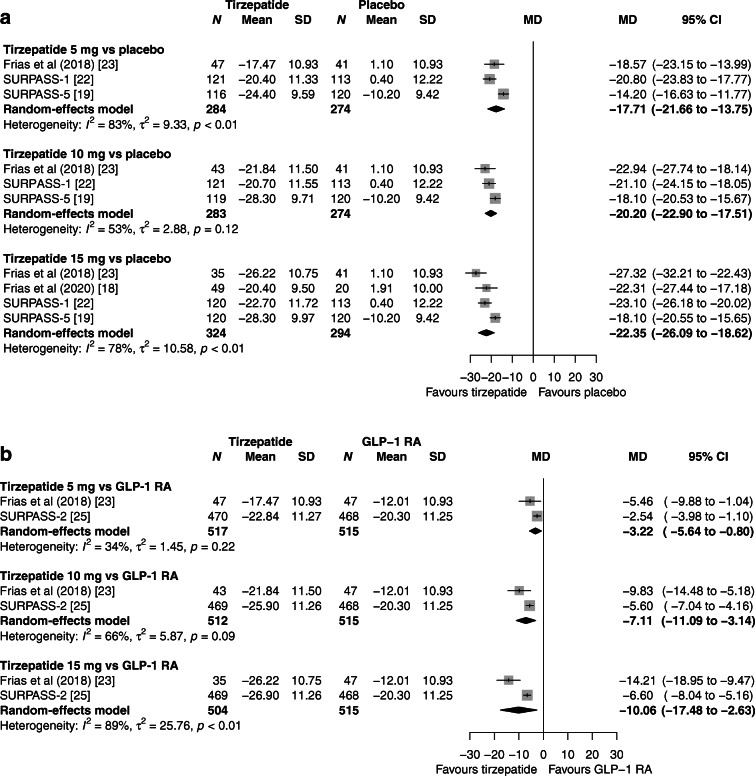
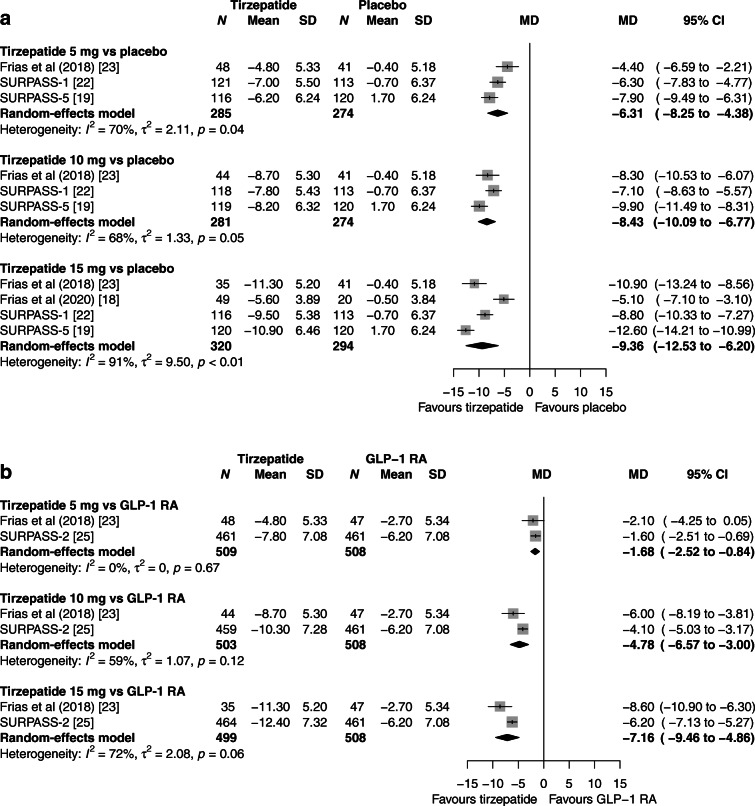
Aims/hypothesis: Tirzepatide is a novel dual glucose-dependent insulinotropic peptide (GIP) and glucagon-like peptide-1 receptor agonist (GLP-1 RA) currently under review for marketing approval. Individual trials have assessed the clinical profile of tirzepatide vs different comparators. We conducted a systematic review and meta-analysis to assess the efficacy and safety of tirzepatide for type 2 diabetes. Methods: We searched PubMed, Embase, Cochrane and ClinicalTrials.gov up until 27 October 2021 for randomised controlled trials with a duration of at least 12 weeks that compared once-weekly tirzepatide 5, 10 or 15 mg with placebo or other glucose-lowering drugs in adults with type 2 diabetes irrespective of their background glucose-lowering treatment. The primary outcome was change in HbA 1c from baseline. Secondary efficacy outcomes included change in body weight, proportion of individuals reaching the HbA 1c target of <53 mmol/mol (<7.0%), ≤48 mmol/mol (≤6.5%) or <39 mmol/mol (<5.7%), and proportion of individuals with body weight loss of at least 5%, 10% or 15%. Safety outcomes included hypoglycaemia, gastrointestinal adverse events, treatment discontinuation due to adverse events, serious adverse events, and mortality. We used version 2 of the Cochrane risk-of-bias tool for randomised trials to assess risk of bias for the primary outcome. Results: Seven trials (6609 participants) were included. A dose-dependent superiority in lowering HbA 1c was evident with all three tirzepatide doses vs all comparators, with mean differences ranging from −17.71 mmol/mol (−1.62%) to −22.35 mmol/mol (−2.06%) vs placebo, −3.22 mmol/mol (−0.29%) to −10.06 mmol/mol (−0.92%) vs GLP-1 RAs, and −7.66 mmol/mol (−0.70%) to −12.02 mmol/mol (−1.09%) vs basal insulin regimens. Tirzepatide was more efficacious in reducing body weight; reductions vs GLP-1 RAs ranged from 1.68 kg with tirzepatide 5 mg to 7.16 kg with tirzepatide 15 mg. Incidence of hypoglycaemia with tirzepatide was similar vs placebo and lower vs basal insulin. Nausea was more frequent with tirzepatide vs placebo, especially with tirzepatide 15 mg (OR 5.60 [95% CI 3.12, 10.06]), associated with higher incidence of vomiting (OR 5.50 [95% CI 2.40, 12.59]) and diarrhoea (OR 3.31 [95% CI 1.40, 7.85]). Odds of gastrointestinal events were similar between tirzepatide and GLP-1 RAs, except for diarrhoea with tirzepatide 10 mg (OR 1.51 [95% CI 1.07, 2.15]). Tirzepatide 15 mg led to higher discontinuation rate of study medication due to adverse events regardless of comparator, while all tirzepatide doses were safe in terms of serious adverse events and mortality. Conclusions/interpretation: A dose-dependent superiority on glycaemic efficacy and body weight reduction was evident with tirzepatide vs placebo, GLP-1 RAs and basal insulin. Tirzepatide did not increase the odds of hypoglycaemia but was associated with increased incidence of gastrointestinal adverse events. Study limitations include presence of statistical heterogeneity in the meta-analyses for change in HbA 1c and body weight, assessment of risk of bias solely for the primary outcome, and generalisation of findings mainly to individuals who are overweight or obese and already on metformin-based background therapy. PROSPERO registration no. CRD42021283449. Graphical abstract:
Overview
The claims and statistics of this paper haven’t been checked yet.
Free: it reads the open-access text and checks the first 5 claims that cite a source we can check. Create a free account to check every claim.
Integrity signals
Registry
Cites
Statistics
Figures
Verification
Claims the paper makes
The claims and statistics of this paper haven’t been checked yet.
Free: it reads the open-access text and checks the first 5 claims that cite a source we can check. Create a free account to check every claim.
Claims other papers make about this one
Each is checked against this paper’s own text: does it say what the citing paper says it does?
The source backs part of the claim, not all of it — or backs it for a different population, condition or comparison.
In the citing paper
“Based on meta-analysis fi ndings, tirzepatide was superior to its comparators, including other long-acting GLP-1 RA, in reducing glucose and body weight, but was associated with increased odds for gastrointestinal adverse events, in particular nausea (189).”
From Management of Hyperglycemia in Type 2 Diabetes, 2022. A Consensus Report by the American Diabetes Association (ADA) and the European Association for the Study of Diabetes (EASD) (2022) · cites this paper as [189]
Experimental — accuracy not yet measuredThe cited source says what the claim attributes to it.
In the citing paper
“The occurrence of such gastrointestinal side effects increases with the dose used. 86 , 87”
From Real‐world evidence on the utilization, clinical and comparative effectiveness, and adverse effects of newer GLP ‐ 1RA ‐based weight‐loss therapies (2025) · cites this paper as [86]
The cited source says what the claim attributes to it.
In the citing paper
“Some studies have demonstrated that tirzepatide achieves greater weight loss compared to existing GLP-1 RAs [20,21,22].”
From The Efficacy and Safety of Tirzepatide in Patients with Diabetes and/or Obesity: Systematic Review and Meta-Analysis of Randomized Clinical Trials (2025) · cites this paper as [20]
The cited source says what the claim attributes to it.
In the citing paper
“Data from RCTs have consistently shown the efficacy of tirzepatide in reducing HbA1c and body weight in people with type 2 diabetes [3].”
In the citing paper
“Karagiannis et al. found that tezepatide had a significant dose-dependent advantage in weight loss compared with placebo, GLP-1R agonists, and basal insulin (130).”
From GLP−1 receptor agonists for the treatment of obesity: Role as a promising approach (2023) · cites this paper as [130]
Self-check
Percentages, sums and reported differences re-computed from the paper’s own numbers.
The self-check needs the paper’s full text.
Citations
Cites
The PRISMA 2020 statement: An updated guideline for reporting systematic reviews
Page, M. J., McKenzie, J. E., Bossuyt, P. M., Boutron, I., Hoffmann, T. C., Mulrow, C. D., Shamseer, L., Tetzlaff, J. M., Akl, E. A., Brennan, S. E., et al. (2021) · BMJ · doi:10.1136/bmj.n71 · Cited by 108,283
RoB 2: a revised tool for assessing risk of bias in randomised trials
Sterne, J. A. C., Savović, J., Page, M. J., Elbers, R. G., Blencowe, N. S., Boutron, I., Cates, C. J., Cheng, H.-Y., Corbett, M. S., Eldridge, S. M., et al. (2019) · BMJ · doi:10.1136/bmj.l4898 · Cited by 34,787 · cited 2×
“As such, we did not consider open-label status as a source of bias, given that measurement of HbA1c is an objective outcome and thus is not affected by blinding status [15].”
BackgroundMethodThe PRISMA 2020 statement: an updated guideline for reporting systematic reviews
Page, M. J., McKenzie, J., Bossuyt, P., Boutron, I., Hoffmann, T., mulrow, C., Shamseer, L., Tetzlaff, J., Akl, E., Brennan, S. E., et al. (2020) · doi:10.31222/osf.io/v7gm2_v1 · Cited by 8,090
The PRISMA 2020 statement: an updated guideline for reporting systematic reviews
Page, M. J., McKenzie, J., Bossuyt, P., Boutron, I., Hoffmann, T., mulrow, C., Shamseer, L., Tetzlaff, J., Akl, E., Brennan, S. E., et al. (2020) · doi:10.31222/osf.io/v7gm2 · Cited by 5,177
Biology of Incretins: GLP-1 and GIP
Baggio, L. L., & Drucker, D. J. (2007) · Gastroenterology · doi:10.1053/j.gastro.2007.03.054 · Cited by 3,639 · cited 1×
“GLP-1 is released from L cells in the distal ileum and colon, while GIP is secreted from K cells in the duodenum and jejunum and is responsible for most of the insulinotropic incretin effect [2].”
BackgroundGerstein, H. C., Colhoun, H. M., Dagenais, G. R., Diaz, R., Lakshmanan, M., Pais, P., Probstfield, J., Riesmeyer, J. S., Riddle, M. C., Rydén, L., et al. (2019) · The Lancet · doi:10.1016/s0140-6736(19)31149-3 · Cited by 3,163 · cited 1×
“NCT04255433) is expected to provide definitive answers on the impact of tirzepatide on cardiovascular disease compared with dulaglutide, a long-acting GLP-1 RA that has been shown to be cardioprotective in individuals with type 2 diabetes at increased cardiovascular risk [31].”
BackgroundTirzepatide versus Semaglutide Once Weekly in Patients with Type 2 Diabetes
Frías, J. P., Davies, M. J., Rosenstock, J., Pérez Manghi, F. C., Fernández Landó, L., Bergman, B. K., Liu, B., Cui, X., & Brown, K. (2021) · New England Journal of Medicine · doi:10.1056/nejmoa2107519 · Cited by 2,096 · cited 7×
“06 Frias et al (2018) [23] SURPASS-2 [25]”
BackgroundMethodInfluentialMethods to estimate the between‐study variance and its uncertainty in meta‐analysis
Veroniki, A. A., Jackson, D., Viechtbauer, W., Bender, R., Bowden, J., Knapp, G., Kuss, O., Higgins, J. P., Langan, D., & Salanti, G. (2016) · Research Synthesis Methods · doi:10.1002/jrsm.1164 · Cited by 1,685 · cited 1×
“In all analyses, we used the Paule–Mandel method to estimate between-study variance [17], and the I(2) statistic to assess statistical heterogeneity.”
MethodReduced incretin effect in Type 2 (non-insulin dependent) diabetes
Nauck, M., Stöckmann, F., Ebert, R., & Creutzfeldt, W. (1986) · Diabetologia · doi:10.1007/bf02427280 · Cited by 1,307 · cited 1×
“In people with type 2 diabetes the incretin effect is considerably diminished [3].”
BackgroundRosenstock, J., Wysham, C., Frías, J. P., Kaneko, S., Lee, C. J., Fernández Landó, L., Mao, H., Cui, X., Karanikas, C. A., & Thieu, V. T. (2021) · The Lancet · doi:10.1016/s0140-6736(21)01324-6 · Cited by 1,080 · cited 8×
“01 Frias et al (2018) [23] SURPASS-1 [22] SURPASS-5 [19]”
BackgroundMethodResultInfluential
Cited by
Items 201–292 of 292
Kamrul-Hasan, A. B. M., Selim, S., Afsana, F., Nagendra, L., Ahmed, R., & Dutta, D. (2024) · Endocrine Practice · doi:10.1016/j.eprac.2024.12.005 · Cited by 2
Effect of tirzepatide on weight and metabolism in a multiethnic cohort with and without diabetes
Ghandour, S. E., Akbarpoor, F., Malik, M., Kalsekar, M., Vidha, S., Bhatia, P., Ghazal, N. A., Jeyaseelan, L., Cherquaoui, R., Abed, F. A., et al. (2025) · Diabetes Obesity and Metabolism · doi:10.1111/dom.16287 · Cited by 2
Cardiovascular effects of semaglutide and tirzepatide and their potential for cardioprevention
Cherkashin, D. V., Салухов, В. В., & Khalimov, Y. S. (2025) · Meditsinskiy sovet = Medical Council · doi:10.21518/ms2025-323 · Cited by 2
Use of GLP-1 analogs in the treatment of obesity: an integrative and systematic review
Furlan, G. B., Storto, M. E. B. M., da Silva, N. A. M., Corrêa, M. M. D. S. A., de Oliveira, B. R., Filho, D. R., & Neto, D. R. (2023) · International Journal of Nutrology · doi:10.54448/ijn23105 · Cited by 2
Santos‐de‐Araújo, A. D., Dibai‐Filho, A. V., Pontes‐Silva, A., Rêgo, A. S., dos Santos, D. L., Júnior, A. A. M., Pereira, F. H. F., Bacelar, S. N. D. A., Oliveira, B. E. C., Tavarez, R. R. D. J., et al. (2024) · Sao Paulo Medical Journal · doi:10.1590/1516-3180.2022.0681.r1.10042023 · Cited by 3
Pharmacotherapy of Obesity and Metabolic Syndrome
Duan, D., & Ahima, R. S. (2023) · Springer eBooks · doi:10.1007/978-3-031-40116-9_44 · Cited by 4
Newer Outpatient Diabetes Therapies and Technologies
Kamal, N., Lee, K., & Aleppo, G. (2024) · Medical Clinics of North America · doi:10.1016/j.mcna.2024.03.002 · Cited by 2
Diabetic Kidney Disease: Increasing Hope with Transformative Therapies
Rosas, S. E., & Nasser, S. (2023) · Springer eBooks · doi:10.1007/978-3-031-42045-0_4 · Cited by 1
Tirzepatide – a new hope for type 2 diabetes mellitus and obesity management. A literature review.
Stawicka, I., Orzołek, I., Jarmołowicz, J., Boczar, A., & Dryja, P. (2024) · Journal of Education Health and Sport · doi:10.12775/jehs.2024.71.55971 · Cited by 1
Kim, Y. Y., Kim, J. H., & Shin, J. (2024) · Precision and Future Medicine · doi:10.23838/pfm.2024.00170 · Cited by 2
“…their duration of action, with short-acting agents including exenatide and lix-isenatide and long-acting agents including liraglutide, albi-glutide, dulaglutide, extended-release exenatide, semaglu-tide, and tirzepatide, a dual GLP-1 and gastric inhibitory polypeptide (GIP) receptor agonist [1,3].”
de Carvalho, G. F., de Sousa, G. M. B., Moraes, G., Dorneles, H. B. F., Ferreira, L. C. L., Cury, G. A. A., Carvalho, M. D. O. P., & Lima, M. C. T. L. (2025) · Contribuciones a las Ciencias Sociales · doi:10.55905/revconv.18n.1-235 · Cited by 1
Enhancing Antidiabetic Drug Selection Using Transformers: Machine-Learning Model Development
Kurasawa, H., Waki, K., Seki, T., Nakahara, E., Fujino, A., Shiomi, N., Nakashima, H., & Ohe, K. (2025) · JMIR Medical Informatics · doi:10.2196/67748 · Cited by 1
“For example, in Japan, sodium–glucose cotransporter 2 [14], imeglimin [15], and tirzepatide [16] were introduced in 2014, 2021, and 2023, respectively.”
Kempf, K., Röhling, M., & Martin, S. (2025) · Frontiers in Endocrinology · doi:10.3389/fendo.2025.1644442 · Cited by 1
Setiawan, D., Tjandrawinata, R. R., Lianawati, Prasuma, G. S., Annisa, A. N., & Soegondo, S. (2025) · INDONESIAN JOURNAL OF PHARMACY · doi:10.22146/ijp.12803 · Cited by 2
“A vast number of therapies have been developed, such as Insulin (Rocha et al., 2022), Sulfonylureas (Hume et al., 2022), Biguanides (Karagiannis et al., 2022; Pratama et al., 2022), Glinides (Lv et al., 2020), Thiazolidinediones (Julie S. Eggleton, 2020), Dipeptidyl Peptidase (DPP-IV) Inhibitors…”
Therapeutic strategy for diabetic patients with cardiovascular-kidney-metabolic syndrome
Huang, J., Zuo, P.-Y., Zhang, C., & Yan, J. (2025) · Postgraduate Medical Journal · doi:10.1093/postmj/qgaf180 · Cited by 1
Aguilar-Pineda, J. A., Pérez-Aguilar, J., & González-Melchor, M. (2025) · ACS Omega · doi:10.1021/acsomega.5c06782 · Cited by 2
DesRochers, P., Kaiser, L., Lee, S., Perchetti, G. A., & Lazarescu, R. (2025) · Cureus · doi:10.7759/cureus.97851 · Cited by 1
“However, these benefits are frequently accompanied by dose-dependent gastrointestinal adverse events, including nausea, vomiting, and diarrhea, which may be severe enough to warrant discontinuation [5].”
Tirzepatide and Obesity: A Narrative Review
Singh, A., Ahmad, R., Chowdhury, K., Narwaria, M., & Haque, M. (2025) · Advances in Human Biology · doi:10.4103/aihb.aihb_244_25 · Cited by 1
Oshakbayev, K., Durmanova, A., Kuttymuratov, G., Bikhanov, N., Nabiyev, A., Suleimenov, T., Idrisov, A., Shakhmarova, T., Mirmanova, Z., Rakhimova, S., et al. (2026) · Journal of Clinical Medicine · doi:10.3390/jcm15020546 · Cited by 1
“Many authors have shown that if a person is overweight, over time, impaired glucose tolerance develops, followed by the manifestation of T2DM [18,19].”
Suga, T., Tabei, Y., Kikuchi, O., Kohno, D., Ikeuchi, Y., Kobayashi, M., Nakagawa, Y., Tojima, H., Yamazaki, Y., Sato, K., et al. (2026) · Molecular Metabolism · doi:10.1016/j.molmet.2026.102324 · Cited by 1
Chan, Z. H., Omar, A. S., Gill, K., Volucke, G., Azhar, M. M., Haleem, S. M., Sia, J. E., Rahman, O. U., Ahmad, M., Shahid, N., et al. (2026) · Cardiology in Review · doi:10.1097/crd.0000000000001209 · Cited by 2
Yang, K., Huang, Y., Gu, L., Li, J., Ma, Y., Gao, P., Qiu, W., Liu, K., Zhang, Y., Guan, L., et al. (2026) · Frontiers in Microbiology · doi:10.3389/fmicb.2026.1768664 · Cited by 2
Hoog, M. M., Minghetti, A., & Valentine, W. J. (2026) · Diabetes Therapy · doi:10.1007/s13300-026-01846-8 · Cited by 1
“These agents were selected for third-line therapy based on their widespread use and superior efficacy relative to other potential third-line agents [19–22].”
Huang, J., Lu, Y.-T., Hsin, C., Lo, T.-S., Lee, C., Yang, S.-F., & Liao, M.-Y. (2026) · International Journal of Medical Sciences · doi:10.7150/ijms.131397 · Cited by 1
“Glucagon-like peptide-1 receptor agonists (GLP-1 RAs) are another class of anti-diabetic medications that have gained popularity, demonstrating better outcomes compared to older anti-diabetic drugs [9, 10].”
Tirzepatide in Egypt: A New Era in Type 2 Diabetes and Obesity Management
Ghazi, H. A. (2026) · doi:10.5005/jodec-11035-0006 · Cited by 1
Abe, T., Maruyama, F., Nishikawa, E., Ito, M., Miyano, Y., Yamagata, H., Sasaki, T., Sakagami, H., Nakamura, A., Nomoto, H., et al. (2026) · Journal of Diabetes Investigation · doi:10.1111/jdi.70355 · Cited by 1
Reitz, J., Rosoff, D. B., Pacher, P., & Lohoff, F. W. (2026) · Biological Psychiatry Global Open Science · doi:10.1016/j.bpsgos.2026.100793 · Cited by 1
“Tirzepatide and GLP1RAs commonly cause gastrointestinal adverse effects, including nausea, vomiting, and diarrhea (122,123), which may be problematic in patients with alcohol-related gastritis, gut dysbiosis, poor oral intake, or cirrhosis-related vulnerability (56,126,127).”
Llerena-Velastegui, J., Delgado-Quijano, F., Trujillo-Delgado, M., Villacis‐Lopez, C., Fernandez-Arcos, A., Santafe-Abril, G., Hurtado-Alzate, C., & Benitez-Acosta, K. (2023) · International Journal of Medical and Surgical Sciences · doi:10.32457/ijmss.v10i3.2263 · Cited by 1
Pharmacotherapy of Obesity and Metabolic Syndrome
Duan, D., & Ahima, R. S. (2023) · Springer eBooks · doi:10.1007/978-3-319-12125-3_44-2 · Cited by 1
Bastos, R. A., Lopes, A. G. B., OLIVIERI, B., Fraguas, J. V. A., & de Oliveira, É. À. (2024) · RECIMA21 - Revista Científica Multidisciplinar · doi:10.47820/recima21.v5i4.5133 · Cited by 2
Thirzepatide. A novelty in the treatment of obesity - literature review
Wiśniewska, K., Gmitrzuk, J., Malinka, Z., Jachymek, A., Opatowska, M., Jakubiec, J., Kucharski, T., & Piotrowska, M. (2024) · Quality in Sport · doi:10.12775/qs.2024.15.52005 · Cited by 1
“Despite some side effects, tirzepatide did not increase the risk of serious adverse events or mortality compared to placebo [35].”
BackgroundNew class of drugs for the treatment of diabetes mellitus
Islamova, A. I., Sabirova, A. R., Batyrshina, E. R., Muzafarova, G. N., Khabibullina, L. H., Kiraeva, A. E., Pyatyshina, A. V., Arslanova, E., Vinnikova, A. A., Pisarev, A. A., et al. (2024) · Clinical Medicine (Russian Journal) · doi:10.30629/0023-2149-2024-102-7-499-509 · Cited by 1
Utilizing Semaglutide for Addressing Type-2 Diabetes and Obesity
Gupta, R., & Sharma, S. (2025) · Current Signal Transduction Therapy · doi:10.2174/0115743624346660250317013032 · Cited by 2
Albasheer, O. (2025) · Current Bioactive Compounds · doi:10.2174/0115734072353980250418211500 · Cited by 1
Tirzepatide: O Início de uma Nova Era na Terapêutica da Diabetes
Raimundo, A. (2023) · Medicina Interna · doi:10.24950/rspmi.1053 · Cited by 1
Cardiovascular efficacy of tirzepatide: what real-world evidence promises
Nasoufidou, A., Stachteas, P., Karakasis, P., Fragakis, N., & Patoulias, D. (2025) · Expert Review of Cardiovascular Therapy · doi:10.1080/14779072.2025.2587294 · Cited by 1
Isseki nichō (one stone, two birds): a dual incretin receptor agonist for type 2 diabetes
Jalleh, R. J., Rayner, C. K., Jones, K. L., & Horowitz, M. (2022) · The Lancet Diabetes & Endocrinology · doi:10.1016/s2213-8587(22)00193-0
Schlienger, J.-L., & Monnier, L. (2022) · Médecine des Maladies Métaboliques · doi:10.1016/j.mmm.2022.12.006 · Cited by 5
New Medications for the Treatment of Diabetes
Garg, S. K., Rodriguez, E., & Hirsch, I. B. (2023) · Diabetes Technology & Therapeutics · doi:10.1089/dia.2023.2514
Update on Medical Management of Diabetes
Katwal, D., JAMES, D. J., & Dagogo-Jack, S. E. (2023) · Orthopedic Clinics of North America · doi:10.1016/j.ocl.2023.02.005
Injektionstherapie (GLP1-Rezeptor Agonisten und Insulin) bei Typ 2 Diabetes mellitus (Update 2023)
Lechleitner, M., Roden, M., Weitgasser, R., Ludvik, B. H., Fasching, P., Hoppichler, F., Kautzky‐Willer, A., Schernthaner, G., Prager, R., Kaser, S., et al. (2023) · Wiener klinische Wochenschrift · doi:10.1007/s00508-023-02171-x
Lautenbach, A., Wiesch, C. S. Z., & Aberle, J. (2023) · Adipositas - Ursachen Folgeerkrankungen Therapie · doi:10.1055/a-2059-9064 · Cited by 1
Advances in GLP-1 receptor agonists for the treatment of type 2 diabetes
Hong, S. (2023) · BIO Web of Conferences · doi:10.1051/bioconf/20236101006
Cutting Edge Developments in Diabetes
Clifton, P. M. (2023) · Diabetology · doi:10.3390/diabetology4030024
“Subsequent meta-analyses of 7–8 trials of terzepatide have demonstrated similar benefits [4,5].”
BackgroundLautenbach, A., Wiesch, C. S. Z., & Aberle, J. (2023) · Aktuelle Ernährungsmedizin · doi:10.1055/a-2185-5427
“Nach dreimonatiger Behandlung wurde ein Plazebo-bereinigter Rück - gang des HbA1c-Wertes um bis zu 1,6 % und eine Plazebo-berei - nigte Körpergewichtsreduktion von -9,0 kg festgestellt [27].”
BackgroundInfluentialHow to Use Type 2 Diabetes Treatments in Clinical Practice
Karagiannis, T., Liakos, A., & Τσάπας, Α. (2024) · Wiley eBooks · doi:10.1002/9781119697473.ch37
Self-citationNEW TREATMENTS FOR OBESITY: DOUBLE AGONIST TWO GIP/ GLP-1 RECEPTORS – TIRZEPATIDE
Pinto, G. M., Gonçalves, M. C., Duarte, P. L. S., Mendes, E. A. B. N., Massariol, L. B., Navarro, M. P. T. B. D. M., Burnier, V. D. L., Rosa, J. D. A. A., Fonseca, L. C., Carbone, M., et al. (2024) · International Journal of Health Science · doi:10.22533/at.ed.1594122423011
Chen, G., Liu, Y., Gao, X., Wu, K., Yang, Y., Chen, Y., Peng, C., Jin, T., Huang, Y., Zhang, Y., et al. (2024) · Diabetes Obesity and Metabolism · doi:10.1111/dom.15441
Zhu, J., Huang, Y., Luo, Y., Wen, Y., Li, H., Li, W., Deng, Y., Shao, J., Huang, H., & Zhu, Z. (2024) · Research Square · doi:10.21203/rs.3.rs-3894429/v1
Tirzepatide cardiovascular benefits and adverse events assessment: a Bayesian network meta-analysisPreprint
gong, X., cheng, P., han, Y., li, Q., Song, C., & Zhao, Y. (2024) · Research Square · doi:10.21203/rs.3.rs-4159026/v1
Abramov, V. V., & Maksimov, M. L. (2024) · Glavvrač (Chief Medical Officer) · doi:10.33920/med-03-2407-03
Tirzepatide: la nuova sfida farmacologica al diabete e all’obesità
Capobianco, E., Pagotto, U., & Garelli, S. (2024) · L Endocrinologo · doi:10.1007/s40619-024-01522-8 · Cited by 1
The Developments of Drugs Based on Non-Alcoholic Fatty Liver
Chen, S., & Chu, M. (2024) · Advances in Social Science, Education and Humanities Research/Advances in social science, education and humanities research · doi:10.2991/978-2-38476-295-8_17
Qiao, X., Hu, J., Wang, Y., Lv, M., Wang, X., Liu, X., Wang, Y., & Wang, F. (2024) · Research Square · doi:10.21203/rs.3.rs-5270140/v1
O impacto da tirzepatida no Diabetes Mellitus: uma revisão de literatura
Abreu, L. T. D. A., Salvador, F., Nunes, M. L., de Moura, A. C., & de Carvalho, R. M. (2024) · Brazilian Journal of Health Review · doi:10.34119/bjhrv7n10-173
Mazur, M., Waz, D., Szarłowicz, J., Goliszek, Z., Sobek, K. Ł., Tabin-Barczak, W., Sokołowska, A., Fikas, K., Chwaliszewski, K., & Samuła, S. (2024) · Quality in Sport · doi:10.12775/qs.2024.36.56722
Role of Incretin Mimetics in the Management of Obesity
Garcha, S. C., & Kalra, S. (2025) · Springer eBooks · doi:10.1007/978-981-96-1651-0_4 · Cited by 1
Lange, K., & Landgraf, R. (2025) · Die Diabetologie · doi:10.1007/s11428-025-01308-y
Liu, X., & Shu, M. (2025) · International Journal of Public Health and Medical Research · doi:10.62051/ijphmr.v3n3.08
“In recent years, many large-scale clinical trials have confirmed that GLP-1 RAs can not only significantly reduce the level of glycosylated hemoglobin (HbA1c), but also reduce the weight of patients by 5%~15%, and reduce the risk of cardiovascular events by 13% ~ 26% [2].”
Pan, Y., Song, F., Liu, X., Zhang, Y., Zhang, J., Chen, S., Song, G., & Ren, L. (2025) · Research Square · doi:10.21203/rs.3.rs-7562588/v1
Role of sitagliptin in diabetes-induced testicular damage via the Fas/FasL signalling pathway
Ersoy, O., & Kızılay, G. (2025) · Biotechnic & Histochemistry · doi:10.1080/10520295.2025.2583963
“It has been shown that DPP4 activity is increased in diabetic individuals and therefore blood glucose levels remain high due to a decreased incretin effect (Karagiannis et al. 2022; Yasuda et al. 2024).”
McGuire, D. K., D’Alessio, D., Nicholls, S. J., Nissen, S. E., Riesmeyer, J. S., Pavo, I., Sethuraman, S., Heilmann, C. R., Kaiser, J. J., & Weerakkody, G. J. (2022) · Figshare · doi:10.6084/m9.figshare.20625103
Zhou, Q., Lei, X., Fu, S., Liu, P., Long, C., Wang, Y., Li, Z., Xie, Q., & Chen, Q. (2024) · Figshare · doi:10.6084/m9.figshare.26633796
Ramsbacher, N., & Neumiller, J. J. (2025) · American Diabetes Association eBooks · doi:10.2337/9781580408486-references
Evans, J., Hall, M., & Baker, L. (2023) · Annals of Pharmacy Practice and Pharmacotherapy · doi:10.51847/ur419h9jop
Panhofer, P., Krzyzanowska-Mittermayer, K., & Rothe, S. (2026) · Deutsche Zeitschrift für Akupunktur · doi:10.1007/s42212-025-00797-8
Anti-obesity drugs: comprehensive review and emerging therapies
Marne, P., Patil, S. D., Vora, A., MohdSiddique, M. U., Gadkari, Y. U., & Kurkute, P. (2026) · Endocrine · doi:10.1007/s12020-025-04528-w · Cited by 1
“It also lowers the generation of glucose in the liver, which helps with overall glycaemic management [83 ].”
Mai, T. (2026) · Medicine · doi:10.1097/md.0000000000047562
“[12,13] The safety profile observed here aligns with recent real-world and clinical-trial experience.”
Gupta, R., Sunner, S. S., & Lam, A. P. (2026) · Current Opinion in Physiology · doi:10.1016/j.cophys.2026.100930 · Cited by 1
Qazi, S., Zahid, M., Atif, E., Ilyas, A. F., Ali, M., Ali, U., Junaid, M., Fatima, E., Bibi, S., Ashraf, R. M. H., et al. (2026) · Healthcare · doi:10.3390/healthcare14070850
“These findings define a clinically important tolerability-persistence trade-off whose relevance varies by patient profile [17,18].”
InfluentialKhawar, M., Baba, A. H., Akhtar, R., Rawat, A., Afzaal, H. B., Haq, A. U., Khalid, M. B., Ghazi, M. A., Awan, J., Kumar, B., et al. (2026) · Nepal Journal of Epidemiology · doi:10.3126/nje.v16i1.92323
“Current reviews have either been limited to indirect comparisons provided by network meta-analyses or have pooled trial data provided by placebo trials or other active comparators [10].”
A rationally designed 18-amino acid peptide with potential as GLP-1 receptor agonist
Singh, A., Shadangi, S., & Rana, S. (2026) · Frontiers in Pharmacology · doi:10.3389/fphar.2026.1789257
Uzyanbaev, I. A., Timoshenko, S., Спирина, Л. В., & Матвеева, М. В. (2026) · Current Drug Targets · doi:10.2174/0113894501398066251211070417
Fąfara, M., Jeczkało, M., Kosiorowska, M., Kowalczyk, A., Lasoń, J., Makulska, M., Płachta, W., Sęk, W., Sieradzka, A., & Wegenko, C. M. (2026) · International Journal of Innovative Technologies in Social Science · doi:10.31435/ijitss.2(50).2026.5796
Pan, Y., Song, F., Liu, X., (8098), Y. Z., Zhang, J., Song, G., & Ren, L. (2026) · BMC Gastroenterology · doi:10.1186/s12876-026-04986-0 · Cited by 1
“Tirzepatide (TZP), a dual GIP/GLP-1 receptor agonist, was found to have a dose-dependent superiority over placebo, mono-receptor agonists and basal insulin in terms of glucose reduction and weight loss in a recent meta-analysis [29].”
Tirzepatida e Semaglutida no tratamento da obesidade: eficácia, segurança e impactos metabólicos
Assis, J. N., de Oliveira, M. E. S., Antonio, T. B. R., & Furtado, R. K. (2026) · Revista JRG de Estudos Acadêmicos · doi:10.55892/jrg.v9i20.3469
Varra, F., Theodosis‐Nobelos, P., Varra, V., & Varras, M. N. (2026) · Medicina · doi:10.3390/medicina62081445
Tirzepatide for refractory post-fundoplication dumping syndrome: A case report
Adeniran, O. F., Almusabeh, H. A., Adekolu, A. A., Diab, K., Hadam-Veverka, J., Bham, N. S., & Sobani, Z. A. (2026) · World Journal of Gastroenterology · doi:10.3748/wjg.122564
Ayub, M., Abbas, Z., Zubair, H. M., Rizvi, M. I. S., Shams, A., & Aijaz, W. (2026) · Genetics and Molecular Research · doi:10.4238/b94h1957
Vanlaer, Y., de Cauter, E. V., Embo, N., & Benhalima, K. (2026) · BMC Medicine · doi:10.1186/s12916-026-05182-3
“Gastrointestinal AEs, most commonly nausea, vomiting, constipation, and diarrhea, were the most frequently reported [56, 57].”
Lin, C.-L., Lin, K.-C., Yu, J.-M., Chang, C., Lin, Y.-Y., Fang, C.-Y., Chen, W., & Wu, S. (2026) · Nature Communications · doi:10.1038/s41467-026-77047-5
Inzucchi, S. E. (2026) · Diabetes Care · doi:10.2337/dci26-0047
Ilie, I. R. P., Ghibu, S., Butucă, A., Dobrea, C. M., Frum, A., Stoicescu, L., Homorodean, C., Gligor, F. G., & Morgovan, C. (2026) · BMJ Open · doi:10.1136/bmjopen-2026-120507
李, 美., Zhou, C., & Zhou, J. (2026) · Therapeutic Advances in Drug Safety · doi:10.1177/20420986261492895
James, R. A., Kothari, M., Almirol, E. A., SINGLETON, C.-M., Verghese, G., & Lowden, E. (2026) · medRxiv · doi:10.64898/2026.10.08.26363772
Zhan, S., Deng, Y., Chen, P., Lv, T., Song, Y., Liu, J., & Kong, C. (2026) · Cells · doi:10.3390/cells15201900
“Although previous studies have demonstrated that metformin can alleviate PAH by activating the AMPK pathway, we selected Tirzepatide as the primary interventional agent in this study due to its superiority in energy metabolic remodeling and potential clinical safety [35,36].”
Matsunaga, K., Honda, K., Ali, M., Hameed, A., Inoue, R., Tsuno, T., Kin, T., Shapiro, A. M. J., Obinata, H., Kondoh, Y., et al. (2026) · Cell chemical biology · doi:10.1016/j.chembiol.2026.09.019
Abolhassan, M. R., Mariam, Z., Prasad, A., Shahsavani, M. B., Niazi, O., Zarei, I., Deganutti, G., Kumar, A., Amanlou, M., Moosavi‐Movahedi, A. A., et al. (2026) · International Journal of Biological Macromolecules · doi:10.1016/j.ijbiomac.2026.155069
Parrotta, M. E., Milani, I., Chinucci, M., Occhipinti, F., Gintoli, E., Franco, F., Sanci, G., Sbraccia, P., Capoccia, D., & Guglielmi, V. (2026) · Diabetes & Metabolism · doi:10.1016/j.diabet.2026.101807
Metadata
- Authors
- Karagiannis, T., Avgerinos, I., Liakos, A., Del Prato, S., Matthews, D. R., Tsapas, A., & Bekiari, E.
- Affiliations
- Aristotle University of Thessaloniki (GR)
- Churchill Hospital (GB)
- Corresponding author
- Karagiannis, Thomas
- ORCID
- Venue
- Diabetologia
- Published
- 2022-05-17
- Volume
- 65
- Issue
- 8
- Pages
- 1251-1261
- ISSN
- 0012-186X (ISSN-L)
- 1432-0428
- PMC
- PMC9112245
- OpenAlex
- W4280579438
- Cited by
- 272
- References
- 30
- Citations by year
- 2026: 32 · 2025: 66 · 2024: 81 · 2023: 72 · 2022: 21
- FWCI
- 8.54
- Type
- journal article
- Language
- en
- Open access
- hybrid
- doi.org
- Licence
- cc-by
- creativecommons.org/licenses/by/4.0 (tdm)
- creativecommons.org/licenses/by/4.0 (vor)
- Locations
- Diabetologia (publishedVersion, cc-by)
- PubMed Central (publishedVersion, cc-by)
- PubMed (publishedVersion)
- Topics
- Health Sciences › Medicine › Endocrinology, Diabetes and Metabolism › Diabetes Treatment and Management
- Health Sciences › Medicine › Endocrinology, Diabetes and Metabolism › Diabetes Management and Research
- Health Sciences › Medicine › Pharmacology (medical) › Pharmacology and Obesity Treatment
- Keywords
- type 2 diabetes, GIP/GLP-1 receptor agonist, glucose-dependent insulinotropic polypeptide, GLP-1 receptor agonists, HbA1c, HbA1c reduction, weight loss, hypoglycemia, gastrointestinal adverse effects, drug safety, dose-response relationship, basal insulin, antidiabetic drugs
- MeSH terms
- Glucagon-Like Peptide-1 Receptor, Glucagon-Like Peptide-1 Receptor Agonists, Tirzepatide, Blood Glucose, Body Weight, Diabetes Mellitus, Type 2, Diarrhea, Gastric Inhibitory Polypeptide, Glycated Hemoglobin, Humans, Hypoglycemia, Hypoglycemic Agents, Treatment Outcome, Glucagon-Like Peptide 1, Insulins
About these checks
Registry, retraction, Cites and statistics results are computed, not judged, with one exception: a printed reference that no index lists is read once by a model before it counts as a citation error. Claims are extracted by a model and kept only when their quote appears verbatim in the text; each cited source is then checked, with a model’s help, for whether it says what the claim relies on. Those verdicts can be wrong — read the claim’s quote and the cited source before relying on one.
Statistics and arithmetic are recomputed, not judged.
Confidence bands are shown only for fields calibrated on our annotated test set. None is calibrated yet, so no band is shown.
What counts as a claim ›How we measure confidence ›How we check this ›
Are you an author, or do you see a problem with this page? Request a review
Data sources
Bibliographic data: Semantic Scholar, OpenAlex, Crossref.
Contains information from the Semantic Scholar Academic Graph Datasets, made available under the ODC Attribution License (ODC-BY 1.0).
Semantic Scholar’s data is described in: Kinney, R., et al. (2023). The Semantic Scholar Open Data Platform. arXiv:2301.10140.
