

Dose-response effects on HbA1c and bodyweight reduction of survodutide, a dual glucagon/GLP-1 receptor agonist, compared with placebo and open-label semaglutide in people with type 2 diabetes: a randomised clinical trial
Open accessThe DOI matches its Crossref record; 42 of the 42 references it cites were found in a registry or an index.
Abstract
Aims/hypothesis: The aim of this study was to assess the dose–response effects of the subcutaneous glucagon receptor/glucagon-like peptide-1 receptor dual agonist survodutide (BI 456906) on HbA 1c levels and bodyweight reduction. Methods: This Phase II, multicentre, randomised, double-blind, parallel-group, placebo-controlled study, conducted in clinical research centres, assessed survodutide in participants aged 18–75 years with type 2 diabetes, an HbA 1c level of 53–86 mmol/mol (7.0–10.0%) and a BMI of 25–50 kg/m 2 on a background of metformin therapy. Participants were randomised via interactive response technology to receive survodutide (up to 0.3, 0.9, 1.8 or 2.7 mg once weekly [qw; dose group (DG) 1–4, respectively] or 1.2 or 1.8 mg twice weekly [DG 5 and 6, respectively]), placebo or semaglutide (up to 1.0 mg qw). Participants and all those involved in the trial conduct/analysis were blinded; the semaglutide arm was open-label. The primary endpoint was absolute change from baseline in HbA 1c after 16 weeks’ treatment. The key secondary endpoint was relative change from baseline in bodyweight after 16 weeks’ treatment. Results: A total of 413 participants were randomised (DG1, n =50; DG2, n =50; DG3, n =52; DG4, n =50; DG5, n =51; DG6, n =50; semaglutide, n =50; placebo, n =60). The full analysis set comprised 411 treated participants (DG6, n =49; placebo, n =59). Adjusted mean (95% CI) HbA 1c decreased from baseline (mean ± SD 64.7±9.2 mmol/mol [8.07±0.84%] after 16 weeks’ treatment: DG1 ( n =41), −9.92 mmol/mol (−12.27, −7.56; −0.91% [−1.12, −0.69]); DG2 ( n =46), −15.95 mmol/mol (−18.27, −13.63; −1.46% [−1.67, −1.25]); DG3 ( n =36), −18.72 mmol/mol (−21.15, −16.29; −1.71% [−1.94, −1.49]); DG4 ( n =33), −17.01 mmol/mol (−19.59, −14.43; −1.56% [−1.79, −1.32]); DG5 ( n =44), −17.84 mmol/mol (−20.18, −15.51; −1.63% [−1.85, −1.42]); DG6 ( n =36), −18.38 mmol/mol (−20.90, −15.87; −1.68% [−1.91, −1.45]). The mean reduction in HbA 1c was similar with low-dose survodutide (DG2: −15.95 mmol/mol [−1.46%]; n =46) and semaglutide (−16.07 mmol/mol [−1.47%]; n =45). Mean (95% CI) bodyweight decreased dose-dependently up to −8.7% (−10.1, −7.3; DG6, n =37); survodutide ≥1.8 mg qw produced greater bodyweight reductions than semaglutide (−5.3% [−6.6, −4.1]; n =45). Adverse events (AEs) were reported for 77.8% of survodutide-treated participants (mainly gastrointestinal), 52.5% receiving placebo and 52.0% receiving semaglutide. Conclusions/interpretation: Survodutide reduced HbA 1c levels and bodyweight after 16 weeks’ treatment in participants with type 2 diabetes. Dose-related gastrointestinal AEs could be mitigated with slower dose escalations. Trial registration: ClinicalTrials.gov NCT04153929 and EudraCT 2019-002390-60. Funding: Boehringer Ingelheim Pharma GmbH & Co. KG, Ingelheim, Germany. Graphical Abstract:
Overview
The claims and statistics of this paper haven’t been checked yet.
Free: it reads the open-access text and checks the first 5 claims that cite a source we can check. Create a free account to check every claim.
Integrity signals
Registry
Cites
Statistics
Figures
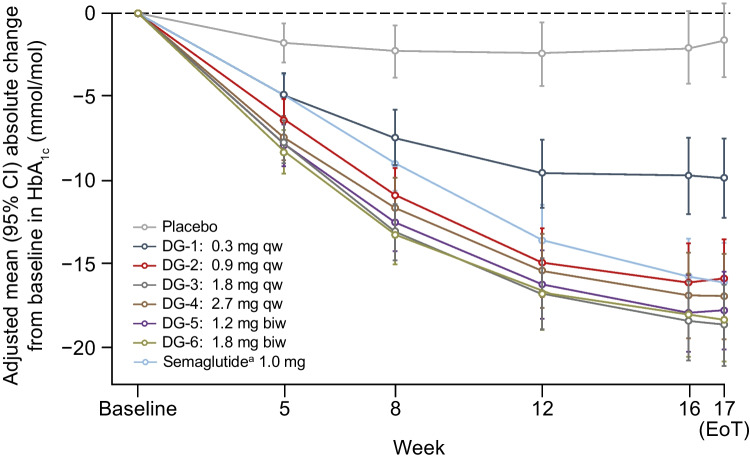
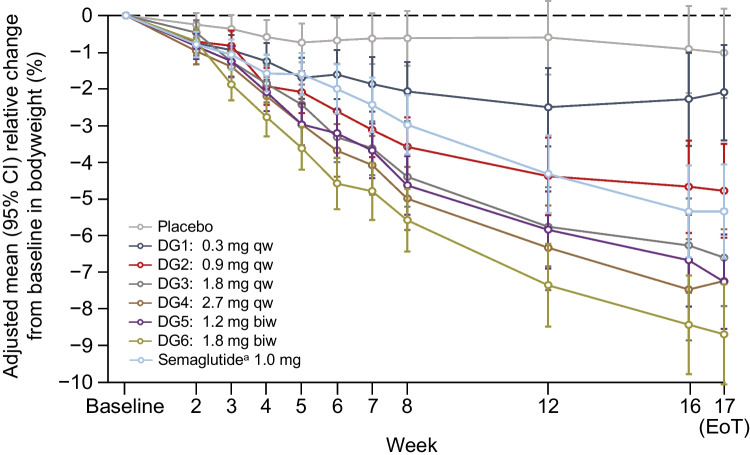
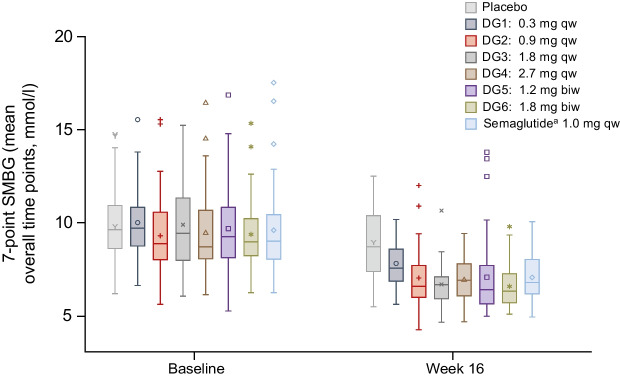
Verification
Claims the paper makes
The claims and statistics of this paper haven’t been checked yet.
Free: it reads the open-access text and checks the first 5 claims that cite a source we can check. Create a free account to check every claim.
Claims other papers make about this one
Each is checked against this paper’s own text: does it say what the citing paper says it does?
The source backs part of the claim, not all of it — or backs it for a different population, condition or comparison.
In the citing paper
“A new weight loss plateau was not reached during the study period.125”
From GLP-1 receptor agonists and next-generation incretin-based medications: metabolic, cardiovascular, and renal benefits (2026) · cites this paper as [125]
Experimental — accuracy not yet measuredThe source backs part of the claim, not all of it — or backs it for a different population, condition or comparison.
In the citing paper
“The risk of experiencing nausea (up to 46%), vomiting (up to 26%), or drug discontinuation (up to 30%) was greater than with semaglutide (nausea 9%, vomiting 2%, and drug discontinuation due to adverse events 5%) or placebo (nausea 12%, vomiting 4%, and drug discontinuation due to adverse events 4%).125”
From GLP-1 receptor agonists and next-generation incretin-based medications: metabolic, cardiovascular, and renal benefits (2026) · cites this paper as [125]
Experimental — accuracy not yet measuredThe source backs part of the claim, not all of it — or backs it for a different population, condition or comparison.
In the citing paper
“Weight loss with survodutide (up to 7•7%) was greater than with semaglutide (5•3%) or placebo (0•9%).”
From GLP-1 receptor agonists and next-generation incretin-based medications: metabolic, cardiovascular, and renal benefits (2026) · cites this paper as [125]
Experimental — accuracy not yet measuredThe source backs part of the claim, not all of it — or backs it for a different population, condition or comparison.
In the citing paper
“In a phase 2 trial in people with T2D, after 16 weeks of treatment, doses of survodutide up to 2•7 mg once weekly reduced HbA 1c by up to 1•6% (95% CI 1•3-1•8) or 17 mmol/mol (14-20) compared with semaglutide (1 mg once weekly; reduction of 1•5% [16 mmol/mol]; table).125”
From GLP-1 receptor agonists and next-generation incretin-based medications: metabolic, cardiovascular, and renal benefits (2026) · cites this paper as [125]
Experimental — accuracy not yet measuredThe source backs part of the claim, not all of it — or backs it for a different population, condition or comparison.
In the citing paper
“Thus, hepatic glucagon receptor stimulation increased hepatic lipid oxidation and reversed diet-induced steatosis in mice [137].”
From Obesity and MASLD: Is weight loss the (only) key to treat metabolic liver disease? (2024) · cites this paper as [137]
Experimental — accuracy not yet measured
5 more claims about this paper
Create a free account to see every claim other papers make about this one.
Self-check
Percentages, sums and reported differences re-computed from the paper’s own numbers.
The self-check needs the paper’s full text.
Citations
Cites
Once-Weekly Semaglutide in Adults with Overweight or Obesity
Wilding, J. P. H., Batterham, R. L., Calanna, S., Davies, M., Van Gaal, L. F., Lingvay, I., McGowan, B. M., Rosenstock, J., Tran, M. T. D., Wadden, T. A., et al. (2021) · New England Journal of Medicine · doi:10.1056/nejmoa2032183 · Cited by 5,205 · cited 1×
“The occurrence of GI disorders is common in people treated with GLP-1R agonists [23, 24] and can be linked to the central effects of GLP-1R agonism and delayed gastric emptying [25, 26].”
BackgroundSelf-citationA Randomized, Controlled Trial of 3.0 mg of Liraglutide in Weight Management
Pi-Sunyer, X., Astrup, A., Fujioka, K., Greenway, F., Halpern, A., Krempf, M., Lau, D. C. W., le Roux, C. W., Violante Ortiz, R., Jensen, C. B., et al. (2015) · New England Journal of Medicine · doi:10.1056/nejmoa1411892 · Cited by 2,724
Tirzepatide versus Semaglutide Once Weekly in Patients with Type 2 Diabetes
Frías, J. P., Davies, M. J., Rosenstock, J., Pérez Manghi, F. C., Fernández Landó, L., Bergman, B. K., Liu, B., Cui, X., & Brown, K. (2021) · New England Journal of Medicine · doi:10.1056/nejmoa2107519 · Cited by 2,096 · cited 2×
“…such as glucose-dependent insuli-notropic polypeptide receptor (GIPR)/GLP-1R and glucagon receptor (GCGR)/GLP-1R dual agonists, have the potential for enhanced therapeutic efficacy and improved tolerability compared with GLP-1R mono-agonists, owing to their multiple mechanisms of action [5, 6].”
BackgroundSelf-citationNauck, M., Frid, A., Hermansen, K., Shah, N. S., Tankova, T., Mitha, I. H., Zdravkovic, M., Düring, M., Matthews, D. R., & for the LEAD-2 Study Group (2009) · Diabetes Care · doi:10.2337/dc08-1355 · Cited by 1,129
Anti-obesity drug discovery: advances and challenges
Müller, T. D., Blüher, M., Tschöp, M. H., & DiMarchi, R. D. (2022) · Nature Reviews Drug Discovery · doi:10.1038/s41573-021-00337-8 · Cited by 1,021
Self-citationon behalf of the NN8022-1807 Investigators, Astrup, A., Carraro, R., Finer, N., Harper, A., Kunesova, M., Lean, M. E. J., Niskanen, L., Rasmussen, M. F., Rissanen, A., et al. (2012) · International Journal of Obesity · doi:10.1038/ijo.2011.158 · Cited by 757 · cited 1×
“The occurrence of GI disorders is common in people treated with GLP-1R agonists [23, 24] and can be linked to the central effects of GLP-1R agonism and delayed gastric emptying [25, 26].”
BackgroundGIP and GLP-1, the two incretin hormones: Similarities and differences
Seino, Y., Fukushima, M., & Yabe, D. (2010) · Journal of Diabetes Investigation · doi:10.1111/j.2040-1124.2010.00022.x · Cited by 746
Ahmann, A. J., Capehorn, M., Charpentier, G., Dotta, F., Henkel, E., Lingvay, I., Holst, A. G., Annett, M. P., & Aroda, V. R. (2018) · Diabetes Care · doi:10.2337/dc17-0417 · Cited by 596
Usdin, T. B., Mezey, E., Button, D. C., Brownstein, M. J., & Bonner, T. I. (1993) · Endocrinology · doi:10.1210/endo.133.6.8243312 · Cited by 534
Subcutaneous Oxyntomodulin Reduces Body Weight in Overweight and Obese Subjects
Wynne, K., Park, A. J., Small, C. J., Patterson, M., Ellis, S. M., Murphy, K. G., Wren, A. M., Frost, G. S., Meeran, K., Ghatei, M. A., et al. (2005) · Diabetes · doi:10.2337/diabetes.54.8.2390 · Cited by 435
Cited by
Items 101–157 of 157
Kukova, L., Munir, K. M., Sayeed, A., & Davis, S. N. (2024) · Expert Opinion on Drug Metabolism & Toxicology · doi:10.1080/17425255.2024.2401589 · Cited by 4
“…[VK2735, also has an oral formulation [103]], GLP-1 and GIP receptor modulators [CT-388 [104], CT-868 [105,106]], GLP-1 and glucagon receptor agonists [survo-dutide{BI456906} [107], SAR425899 [108], cotadutide [109], efinopegdutide [110]], as well as GLP-1 and GLP-2 agonists [dapiglutide [111]].”
InfluentialZhang, J., Xu, H., Dong, Y., Feng, J., & Li, R. (2025) · European Journal of Medicinal Chemistry · doi:10.1016/j.ejmech.2025.118024 · Cited by 2
Yousif, A. B., Mudarres, M. F., Yousef, M. F., Badawi, A., & Hassan, E. A. (2024) · Yemen Journal of Medicine · doi:10.18231/j.yjom.2024.005 · Cited by 2
Xie, S., Ye, L., Yang, A., Li, X., & Yin, Y. (2025) · Hormone and Metabolic Research · doi:10.1055/a-2618-7509 · Cited by 2
Li, W. (2024) · Preprints.org · doi:10.20944/preprints202406.1032.v1 · Cited by 2
de Carvalho, G. F., de Sousa, G. M. B., Moraes, G., Dorneles, H. B. F., Ferreira, L. C. L., Cury, G. A. A., Carvalho, M. D. O. P., & Lima, M. C. T. L. (2025) · Contribuciones a las Ciencias Sociales · doi:10.55905/revconv.18n.1-235 · Cited by 1
Doppi e tripli agonisti recettoriali nel trattamento del diabete mellito tipo 2
Pizzo, A., Paccagnella, M., Luca, F. D., & Candido, R. (2025) · L Endocrinologo · doi:10.1007/s40619-025-01710-0 · Cited by 1
Jia, Q., Wang, Y., Li, J., & Gao, Z. (2025) · International Journal of Biology and Life Sciences · doi:10.54097/9576k069 · Cited by 1
GLP-1 Is Not Enough: Can Glucagon Fill the Energy Expenditure Gap?
Beji, S., & Caron, A. (2026) · Neuroendocrinology · doi:10.1159/000550812 · Cited by 1
Acute Contractile Effects of Glucagon-like-Peptide-1 Receptor Agonists in the Human Heart
Neumann, J., Kirchhefer, U., Hofmann, B., & Gergs, U. (2026) · Pharmaceutics · doi:10.3390/pharmaceutics18040447 · Cited by 1
“Like its competitors, survodutide and mazdutide, cotadutide also reduced body weight in non-diabetic obese patients [138,139].”
Glucagon-Like Peptide-1 Receptor Agonists: Their Therapeutic Potential in Cystic Fibrosis
Panou, T., Gouveri, E., Popovic, D. S., & Παπάνας, Ν. (2026) · Advances in Therapy · doi:10.1007/s12325-026-03599-z · Cited by 1
Impact of incretin analogues on lipid and lipoprotein metabolism in obesity and diabetes
Baragetti, A., & Norata, G. D. (2026) · British Journal of Pharmacology · doi:10.1111/bph.70483 · Cited by 2
Yokote, K., Yamauchi, T., Fukushima, Y., Takatsuka, Y., Kato, M., Yan, S., Inoue, T., Borowska, L., Brueckmann, M., Ogawa, W., et al. (2026) · Diabetes Obesity and Metabolism · doi:10.1111/dom.70862 · Cited by 1
Xie, J., Yang, Y., Chen, W., (45927), L. W., Weng, S., Lyu, Q., & Cao, G. (2026) · Current Obesity Reports · doi:10.1007/s13679-026-00722-7 · Cited by 1
Patil, M., Piccinini, F., Johnstone, E. K. M., Casari, I., & Falasca, M. (2026) · Bioscience Reports · doi:10.1042/bsr20250114 · Cited by 1
Liu, M. R., Cheng, Z. F., Li, L., Cai, H., Liu, J., Liu, J., Zheng, Y., Wang, S., Zhao, J., Yang, W., et al. (2026) · Annals of Internal Medicine · doi:10.7326/annals-25-04623 · Cited by 1
Piguet, C. E. M., Nucci, R., & Beaudry, J. L. (2026) · The Journal of Physiology · doi:10.1113/jp291081 · Cited by 1
Bloomgarden, Z. T. (2024) · Journal of Diabetes · doi:10.1111/1753-0407.13568 · Cited by 1
Eisenberg, L. P., Huada, A. C. P., Gomes, M. E. C. C., GOUVEA, C. S. D. O., de Lima, L. P., Daura, R. J. A., Goulart, B. R. S., & Alves, H. F. D. A. (2025) · Contribuciones a las Ciencias Sociales · doi:10.55905/revconv.18n.2-076 · Cited by 1
A one-dimensional semaglutide-GLP-1R-based mini static GIBACPreprint
Li, W. (2024) · Preprints.org · doi:10.20944/preprints202406.0953.v1 · Cited by 1
Outcomes of Type 2 Diabetes Management: One Center Experience 2015–2023
Chlup, R., Zálešáková, H., Gottwaldová, J., Trefil, M., Zapletalová, J., Kaňa, R., Hanáčková, L., Bretšnajdrová, M., Falt, P., & Polzerová, Z. (2024) · IntechOpen eBooks · doi:10.5772/intechopen.1005206
Dosisabhängige Effekte von Survodutid auf den HbA1c-Wert und das Körpergewicht
Clauss, R. M. (2024) · Diabetologie und Stoffwechsel · doi:10.1055/a-2265-4753
Multi‐target Peptides for the Treatment of Metabolic Diseases
Bossart, M., & Heßler, G. (2024) · Wiley eBooks · doi:10.1002/9781394182862.ch20
Urbańska, K., Popiela, D., Stojak, Ł., Kwiatkowski, F., Grego, K., Grego, M., Baczewski, M., & Czyż, W. (2025) · Quality in Sport · doi:10.12775/qs.2025.37.57002
MacCarthy, T. (2025) · British Journal of Cardiology · doi:10.5837/bjc.2025.005
Pharmacological targets in obesity
Pavli, P., Mastorakos, G. P., & Valsamakis, G. (2025) · Elsevier eBooks · doi:10.1016/b978-0-443-27370-4.00013-5
Exploring the therapeutic landscape of glucagon
Paila, D., Bansal, P., Aggarwal, R., & Prakash, A. (2025) · National Journal of Pharmacology and Therapeutics · doi:10.4103/njpt.njpt_23_25
Cardiovascular Effects of GLP-1 and Glucagon Dual Receptor Agonism in Humans
Goodman, J. (2024) · Apollo (University of Cambridge) · doi:10.17863/cam.117744
New and Interesting Benefits with New Molecules in Obesity and Type 2 Diabetes
Páez, F. G., Barrios, S. Z., Bautista, L. E. C., Chong, L. D. P., & Velazquez, X. G. R. (2026) · IntechOpen eBooks · doi:10.5772/intechopen.1009256
Alsaygh, E. F., Aljarboa, A. M., Alhazmi, A., Alhazmi, A. S., Alraddadi, O. A. A., Althagafi, A. A., & Alhojele, M. F. (2026) · Cureus · doi:10.7759/cureus.102500
“Survodutide, a dual glucagon/GLP-1 RA, reduced HbA1c and produced dose-dependent weight loss up to 8.7% at 16 weeks, with doses ≥1.8 mg once weekly achieving greater weight reduction than open-label semaglutide (up to 1.0 mg once weekly) over the same period [8].”
InfluentialShahriar, M. F., Kabir, J., & Kong, Y. (2026) · Molecular Diversity · doi:10.1007/s11030-025-11455-5
Anti-Obesity Effects of Soy Peptides In Vivo: A Meta-Analysis of Randomized Controlled Trials
Qiu, Z., Wu, Z., Chen, K., Du, Q., Yu, L., Li, M., Fan, Y., Fan, M., Luo, T., Song, B., et al. (2026) · Foods · doi:10.3390/foods15071191
Insights into semaglutide cardiovascular research: Mechanisms, trials, and frontiers
Zhang, J. K., Gao, G., He, M., & Sun, T. (2026) · European Journal of Pharmacology · doi:10.1016/j.ejphar.2026.178921
The effect of GLP-1RAs and co-agonists on body composition across obesity and type 2 diabetes
Sun, L. L., Liu, H. F., Zhang, X., Zuo, F., Kong, Y., Feng, J., & Nian, X. (2026) · European journal of medical research · doi:10.1186/s40001-026-04534-2
Jain, A., Shrivastav, Y., Manocha, N., Baraskar, G., Bisht, R., Bhawsar, D., & Retrekar, N. (2026) · International Journal of Drug Delivery Technology · doi:10.25258/ijddt.16.30s.55
“…Agonists in Obesity Management: Evidence from Glycemic and Non-Glycemic Populations weight loss is a major factor in long term glycemic benefit with GLP-1 RAs, especially with long actuities, patients who lose weight insignificantly might not gain major benefits in glycemic control [60,61].”
Brock, S. B., Hansen, N. L., Jóhönnuson, E. M. S., Kjeldsen, S. A. S., & Albrechtsen, N. J. W. (2026) · Diabetes Obesity and Metabolism · doi:10.1111/dom.70896
Tirzepatide in type 1 diabetes: beyond mere weight loss
Panou, T., Gouveri, E., Popovic, D. S., & Παπάνας, Ν. (2026) · Expert Review of Clinical Pharmacology · doi:10.1080/17512433.2026.2685653
Simental‐Mendía, L. E., Simental-Mendía, M. A., Aguillón-Marín, P., & Sánchez‐García, A. (2026) · Journal of Investigative Medicine · doi:10.1177/10815589261460894
Ekinci, E. I., Maldonado, S. G., Unseld, A., Arrubla, J., Hennige, A. M., & Schoelch, C. (2026) · Diabetes Obesity and Metabolism · doi:10.1111/dom.70861
Self-citationThe systems medicine view of semaglutide: from clinical trials to molecular mechanisms
Vitorino, R. M. P. (2026) · Expert Review of Clinical Pharmacology · doi:10.1080/17512433.2026.2695172
“High-dose weight management trials (NCT03552757) confirmed efficacy at ≥2.4 mg, while NCT03724981 and NCT05533632 focused on device preference and post-marketing safety [21,40,41].”
InfluentialPeptide hormone-based combinational pharmacotherapies for chronic metabolic diseases
Chui, Z. S. W., Xue, Y., Wu, X., & Xu, A. (2026) · Pharmacological Reviews · doi:10.1016/j.pharmr.2026.100150
A Lineup for Next Anti-Obesity Medicines: Beyond Incretin-Based Pharmacotherapy
Lee, S. M., Song, H., & Kwon, Y. O.-S. (2026) · Pharmaceuticals · doi:10.3390/ph19071047
“When the clinical efficacy of the dual agonist mazdu-tide (6 mg/week injection) or survodutide (1.8 mg/2 weeks injection) was compared with semaglutide (1 mg/week injection), they showed greater efficacy in reducing body weight and blood glucose than semaglutide alone [68,69].”
InfluentialHassan, M., Hussain, M., Khan, S., Azam, M. T., Shahid, Z. U. A., Hannan, A., Khuhro, M. M., Bhagia, S., & Aminpoor, H. (2026) · Diabetology & Metabolic Syndrome · doi:10.1186/s13098-026-02248-3
Djatmiko, N. I., Asyhar, M. L., Alridjal, R., Faradila, Z., Sholihah, F. H., Santoso, B. V., Kusuma, M. A. S., & Sanjaya, C. (2026) · The Indonesian Journal of General Medicine · doi:10.70070/bbvjb653
Role of glucagon in metabolic diseases
Kitamura, T., Tabei, Y., & Kobayashi, M. (2026) · Journal of Diabetes Investigation · doi:10.1111/jdi.70416
Ji, L., Chen, L., Cheng, Z., Lu, Y., Yang, Y., Fu, F., Zhu, Y., Jin, L., & Kloer, I. M. (2026) · Diabetes Therapy · doi:10.1007/s13300-026-01908-x
“Another phase 2 clinical trial (NCT04153929) showed that survodu-tide with 16-week treatment dose-dependently decreased glycated hemoglobin (HbA 1c ) in adults with overweight or obesity and T2DM, with a mean HbA 1c reduction of up to 1.7% observed with a once-weekly dose of 1.8 mg survodutide [26].”
InfluentialSynchronizing obesity management with survodutide
Lonardo, A., & Weiskirchen, R. (2026) · Exploration of Drug Science · doi:10.37349/eds.2026.1008175
Chlup, R. (2026) · Directory of Open access Books (OAPEN Foundation)
Lee, C.-M., Kim, J.-Y., Shim, J.-H., & Cho, G.-W. (2026) · Hormone and Metabolic Research · doi:10.1055/a-2928-5204
Effect of GLP‐1 receptor agonist on nutrient intake: A narrative review
Fujioka, K. (2026) · Nutrition in Clinical Practice · doi:10.1002/ncp.70172
Amjad, M. M., Khan, M. M., Sarwar, F., Ali, A., Ali, M., Bakhash, F., Abid, H., Ibrahim, F., Mustafa, K., Ali, D., et al. (2026) · Diabetes Obesity and Metabolism · doi:10.1111/dom.71400
Wang, Y., Liu, Z., Wang, S., Lv, C., El-Seedi, H. R., Khalifa, S. A. M., & Wang, H. (2026) · Endocrinology Diabetes & Metabolism · doi:10.1002/edm2.70351
Progress in Anti-Obesity Drug Development: A Pharmacodynamics Perspective
Ahmad, I., Azmi, S., Albabtain, M. A., Mustafa, M., Kunnathodi, F., Riyasdeen, A., AlWhaiby, B. R., Alharbi, E. M., Arafat, A. A., & Alotaibi, H. F. (2026) · Pharmaceutics · doi:10.3390/pharmaceutics18101281
Ard, J. D., & Almandoz, J. P. (2026) · Obesity Reviews · doi:10.1111/obr.70228
Chen, Z., Zhou, Y., Li, G., MUTHANNA, A., d’Arqom, A., Tham, C. L., Ho, Y.-C., & Lee, M. T. (2026) · Journal of Diabetes & Metabolic Disorders · doi:10.1007/s40200-026-02110-3
Argano, C., Maggio, D., Pollicino, C., Cangialosi, V., Manno, S. B., Orlando, V., Monti, M. L., Grutta, A., Torres, A., & Corrao, S. (2026) · Frontiers in Pharmacology · doi:10.3389/fphar.2026.1784959
Antidiabetic medications in the pipeline
Efstathiadou, Z. A., Gogakos, A. I., Divaris, E., Kostopoulos, G., & Makri, E. (2026) · HORMONES · doi:10.1007/s42000-026-00780-5
Metadata
- Authors
- Blüher, M., Rosenstock, J., Hoefler, J., Manuel, R., & Hennige, A. M.
- Affiliations
- Helmholtz Munich (DE)
- Boehringer Ingelheim (United States) (US)
- Boehringer Ingelheim (Germany) (DE)
- Corresponding author
- Blüher, Matthias
- Hennige, Anita M.
- Venue
- Diabetologia
- Published
- 2023-12-14
- Volume
- 67
- Issue
- 3
- Pages
- 470-482
- ISSN
- 0012-186X (ISSN-L)
- 1432-0428
- PMC
- PMC10844353
- OpenAlex
- W4389739323
- Cited by
- 138
- References
- 28
- Citations by year
- 2026: 50 · 2025: 42 · 2024: 46
- FWCI
- 28.14
- Type
- journal article
- Language
- en
- Update notices
- correction (2024-02-13)
- Open access
- hybrid
- doi.org
- Licence
- cc-by
- creativecommons.org/licenses/by/4.0 (tdm)
- creativecommons.org/licenses/by/4.0 (vor)
- Locations
- Diabetologia (publishedVersion, cc-by)
- PubMed Central (publishedVersion, cc-by)
- PubMed (publishedVersion)
- Qucosa (Saxon State and University Library Dresden) (publishedVersion, other-oa)
- PUBLISSO (German National Library of Medicine) (submittedVersion, cc-by)
- PuSH - Publication Server of Helmholtz Zentrum München (submittedVersion, cc-by)
- Funders
- Boehringer Ingelheim
- Universität Leipzig
- Topics
- Health Sciences › Medicine › Endocrinology, Diabetes and Metabolism › Diabetes Treatment and Management
- Health Sciences › Medicine › Pharmacology (medical) › Pharmacology and Obesity Treatment
- Health Sciences › Medicine › Endocrinology, Diabetes and Metabolism › Diabetes Management and Research
- Keywords
- survodutide, type 2 diabetes, HbA1c, dose-response relationship, semaglutide, metformin, weight loss, glycemic control, GLP-1 receptor agonists, glucagon receptor agonist
- MeSH terms
- Glucagon-Like Peptide-1 Receptor Agonists, Semaglutide, Diabetes Mellitus, Type 2, Double-Blind Method, Glucagon-Like Peptides, Glucagon, Humans, Hypoglycemic Agents, Peptides, Treatment Outcome, Glucagon-Like Peptide 1
About these checks
Registry, retraction, Cites and statistics results are computed, not judged, with one exception: a printed reference that no index lists is read once by a model before it counts as a citation error. Claims are extracted by a model and kept only when their quote appears verbatim in the text; each cited source is then checked, with a model’s help, for whether it says what the claim relies on. Those verdicts can be wrong — read the claim’s quote and the cited source before relying on one.
Statistics and arithmetic are recomputed, not judged.
Confidence bands are shown only for fields calibrated on our annotated test set. None is calibrated yet, so no band is shown.
What counts as a claim ›How we measure confidence ›How we check this ›
Are you an author, or do you see a problem with this page? Request a review
Data sources
Bibliographic data: Semantic Scholar, OpenAlex, Crossref.
Contains information from the Semantic Scholar Academic Graph Datasets, made available under the ODC Attribution License (ODC-BY 1.0).
Semantic Scholar’s data is described in: Kinney, R., et al. (2023). The Semantic Scholar Open Data Platform. arXiv:2301.10140.
