

Honest, Open, Proud to support disclosure decisions and to decrease stigma's impact among people with mental illness: conceptual review and meta-analysis of program efficacy
Open accessThe DOI matches its Crossref record; 68 of the 68 references it cites were found in a registry or an index.
Abstract
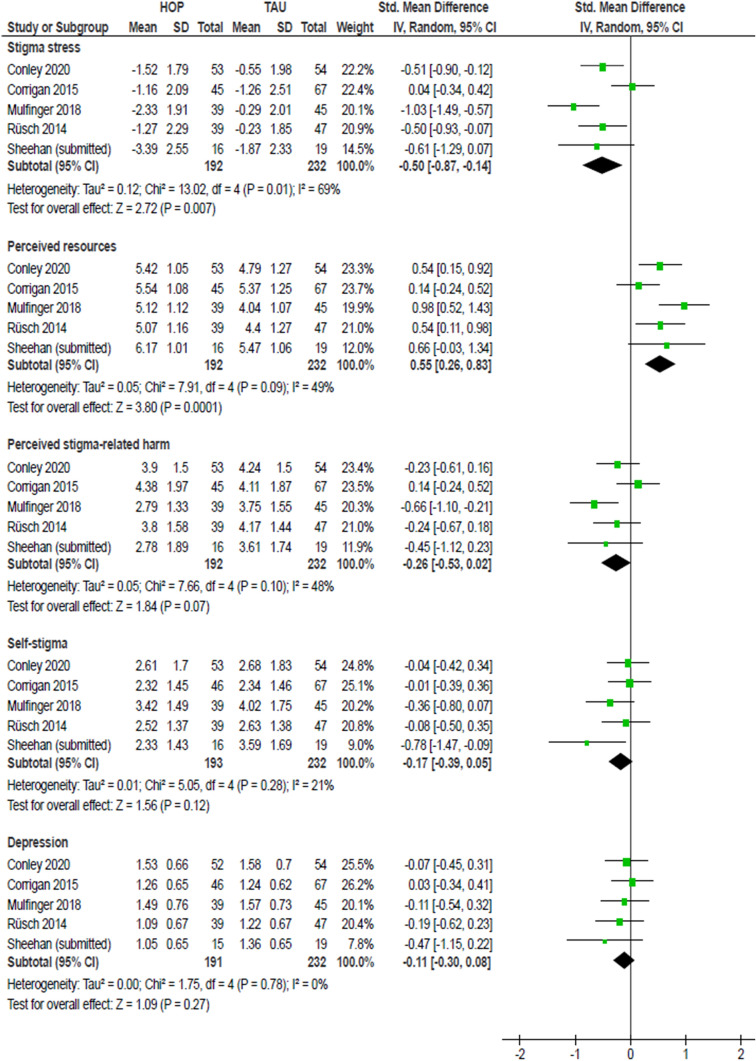
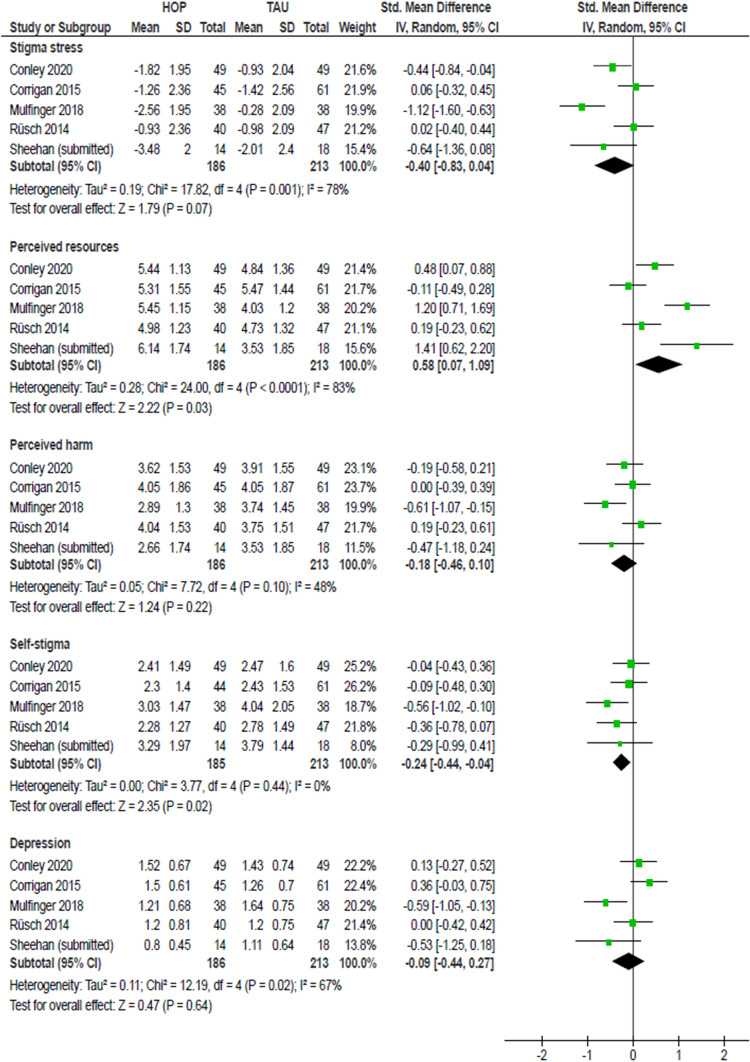
PURPOSE: Honest, Open, Proud (HOP; formerly "Coming Out Proud"/COP) is a peer-led group program to support people with mental illness in their disclosure decisions and in their coping with stigma. The aims of this study were to provide (i) a conceptual review of HOP, including versions for different target groups and issues related to outcome measurement and implementation; and (ii) a meta-analysis of program efficacy. METHODS: Conceptual and empirical literature on disclosure and the HOP program was reviewed. Controlled trials of HOP/COP were searched in literature databases. A meta-analysis of HOP efficacy in terms of key outcomes was conducted. RESULTS: HOP program adaptations for different target groups (e.g. parents of children with mental illness; veterans or active soldiers with mental illness) exist and await evaluation. Recruitment for trials and program implementation may be challenging. A meta-analysis of five HOP RCTs for adults or adolescents with mental illness or adult survivors of suicide attempts found significant positive effects on stigma stress (smd = - 0.50) as well as smaller, statistically non-significant effects on self-stigma (smd = - 0.17) and depression (smd = - 0.11) at the end of the HOP program. At 3- to 4-week follow-up, there was a modest, not statistically significant effect on stigma stress (smd = - 0.40, 95%-CI -0.83 to 0.04), while effects for self-stigma were small and significant (smd = - 0.24). Long-term effects of the HOP program are unknown. CONCLUSION: There is initial evidence that HOP effectively supports people with mental illness in their disclosure decisions and in their coping with stigma. Implementation issues, future developments and public health implications are discussed.
Overview
The claims and statistics of this paper haven’t been checked yet.
Free: it reads the open-access text and checks the first 5 claims that cite a source we can check. Create a free account to check every claim.
Integrity signals
Registry
Cites
Statistics
Figures
Verification
Claims the paper makes
The claims and statistics of this paper haven’t been checked yet.
Free: it reads the open-access text and checks the first 5 claims that cite a source we can check. Create a free account to check every claim.
Claims other papers make about this one
Each is checked against this paper’s own text: does it say what the citing paper says it does?
In the citing paper
“In meta-analyses short-term follow-up showed sustained moderate improvements, 218 but two reviews found that the improvements became non-significant over time.221,224”
From The Lancet Commission on ending stigma and discrimination in mental health (2022) · cites this paper as [218]
Self-check
Percentages, sums and reported differences re-computed from the paper’s own numbers.
The self-check needs the paper’s full text.
Citations
Cites
Eysenck, H. J. (1985) · Behaviour Research and Therapy · doi:10.1016/0005-7967(85)90087-7 · Cited by 31,975
“Stress: appraisal and coping,”
Folkman, S. (2013) · Encyclopedia of Behavioral Medicine · doi:10.1007/978-1-4419-1005-9_215 · Cited by 27,833
Link, B. G., & Phelan, J. C. (2001) · Annual Review of Sociology · doi:10.1146/annurev.soc.27.1.363 · Cited by 8,848
Clement, S., Schauman, O., Graham, T., Maggioni, F., Evans-Lacko, S., Bezborodovs, N., Morgan, C., Rüsch, N., Brown, J. S. L., & Thornicroft, G. (2015) · Psychological Medicine · doi:10.1017/s0033291714000129 · Cited by 3,152
Self-citationTwo Shorter Forms of the CES-D Depression Symptoms Index
Kohout, F. J., Berkman, L. F., Evans, D. A., & Cornoni-Huntley, J. (1993) · Journal of Aging and Health · doi:10.1177/089826439300500202 · Cited by 2,284
Analysing Data and Undertaking Meta‐Analyses
Deeks, J. J., Higgins, J. P., & Altman, D. G. (2008) · Cochrane Handbook for Systematic Reviews of Interventions · doi:10.1002/9780470712184.ch9 · Cited by 1,800
Challenging the public stigma of mental illness: a meta-analysis of outcome studies
Corrigan, P. W., Morris, S. B., Michaels, P. J., Rafacz, J. D., & Rüsch, N. (2012) · Psychiatric Services · doi:10.1176/appi.ps.201100529 · Cited by 1,680 · cited 1×
“Disclosure that works well for discloser and recipient means positive contact—arguably the most potent strategy to reduce the public stigma of mental illness [55, 56].”
BackgroundSelf-citationMental illness stigma: Concepts, consequences, and initiatives to reduce stigma
Rüsch, N., Angermeyer, M. C., & Corrigan, P. W. (2005) · European Psychiatry · doi:10.1016/j.eurpsy.2005.04.004 · Cited by 1,621
Self-citationInternalized stigma of mental illness: psychometric properties of a new measure
Boyd Ritsher, J., Otilingam, P. G., & Grajales, M. (2003) · Psychiatry Research · doi:10.1016/j.psychres.2003.08.008 · Cited by 1,596
The psychological implications of concealing a stigma: A cognitive-affective-behavioral model
Pachankis, J. E. (2007) · Psychological Bulletin · doi:10.1037/0033-2909.133.2.328 · Cited by 1,305 · cited 1×
“HOP’s focus on disclosure decisions is based on models that highlight the role of (non-)disclosure for coping with the stigma associated with a concealable stigmatized identity [31, 32] and on findings that concealment versus disclosure is a dilemma for many people with mental illness [33].”
BackgroundSelf-stigma and the “why try” effect: impact on life goals and evidence-based practices
CORRIGAN, P. W., LARSON, J. E., & RÜSCH, N. (2009) · World Psychiatry · doi:10.1002/j.2051-5545.2009.tb00218.x · Cited by 1,074
Self-citationChaudoir, S. R., & Fisher, J. D. (2010) · Psychological Bulletin · doi:10.1037/a0018193 · Cited by 926
the European KIDSCREEN Group, Ravens-Sieberer, U., Erhart, M., Rajmil, L., Herdman, M., Auquier, P., Bruil, J., Power, M., Duer, W., Abel, T., et al. (2010) · Quality of Life Research · doi:10.1007/s11136-010-9706-5 · Cited by 725
Lysaker, P. H., Roe, D., & Yanos, P. T. (2006) · Schizophrenia Bulletin · doi:10.1093/schbul/sbl016 · Cited by 688
(2005) · Canadian Journal of Counselling and Psychotherapy · Cited by 612
The Oxford Handbook of Stigma, Discrimination, and Health
(2018) · Oxford University Press eBooks · doi:10.1093/oxfordhb/9780190243470.001.0001 · Cited by 508
Examining a progressive model of self-stigma and its impact on people with serious mental illness
Corrigan, P. W., Rafacz, J., & Rüsch, N. (2011) · Psychiatry Research · doi:10.1016/j.psychres.2011.05.024 · Cited by 467
Self-citation(1993) · Beltz eBooks · Cited by 409
Reducing Self-Stigma by Coming Out Proud
Corrigan, P. W., Kosyluk, K. A., & Rüsch, N. (2013) · American Journal of Public Health · doi:10.2105/ajph.2012.301037 · Cited by 360
Self-citationDubreucq, J., Plasse, J., & Franck, N. (2021) · Schizophrenia Bulletin · doi:10.1093/schbul/sbaa181 · Cited by 358 · cited 2×
“In longitudinal studies, self-stigma was a predictor of increased symptoms and of suicidality [7].”
BackgroundInterventions targeting mental health self-stigma: A review and comparison.
Yanos, P. T., Lucksted, A., Drapalski, A. L., Roe, D., & Lysaker, P. (2015) · Psychiatric Rehabilitation Journal · doi:10.1037/prj0000100 · Cited by 351
Luoma, J. B., Kohlenberg, B. S., Hayes, S. C., & Fletcher, L. (2012) · Journal of Consulting and Clinical Psychology · doi:10.1037/a0026070 · Cited by 336 · cited 1×
“Acceptance-based approaches use principles of acceptance and commitment therapy and mindfulness to reduce self-stigma and improve self-esteem [18].”
MethodQuinn, D. M., Williams, M. K., Quintana, F., Gaskins, J. L., Overstreet, N. M., Pishori, A., Earnshaw, V. A., Perez, G., & Chaudoir, S. R. (2014) · PLoS ONE · doi:10.1371/journal.pone.0096977 · Cited by 218
Rüsch, N., Abbruzzese, E., Hagedorn, E., Hartenhauer, D., Kaufmann, I., Curschellas, J., Ventling, S., Zuaboni, G., Bridler, R., Olschewski, M., et al. (2014) · British Journal of Psychiatry · doi:10.1192/bjp.bp.113.135772 · Cited by 215
Self-citationDo clinical outcome measures assess consumer-defined recovery?
Andresen, R., Caputi, P., & Oades, L. G. (2010) · Psychiatry Research · doi:10.1016/j.psychres.2010.02.013 · Cited by 213
Boyd, J. E., Otilingam, P. G., & DeForge, B. R. (2014) · Psychiatric Rehabilitation Journal · doi:10.1037/prj0000035 · Cited by 213
Self-stigma of mental illness scale—short form: Reliability and validity
Corrigan, P. W., Michaels, P. J., Vega, E., Gause, M., Watson, A. C., & Rüsch, N. (2012) · Psychiatry Research · doi:10.1016/j.psychres.2012.04.009 · Cited by 207
Self-citationA stress-coping model of mental illness stigma: I. Predictors of cognitive stress appraisal
Rüsch, N., Corrigan, P. W., Wassel, A., Michaels, P., Olschewski, M., Wilkniss, S., & Batia, K. (2009) · Schizophrenia Research · doi:10.1016/j.schres.2009.01.006 · Cited by 187
Self-citationPerkins, A., Ridler, J., Browes, D., Peryer, G., Notley, C., & Hackmann, C. (2018) · The Lancet Psychiatry · doi:10.1016/s2215-0366(18)30095-6 · Cited by 184
Intergroup contact and mental health stigma: a comparative effectiveness meta-analysis
Maunder, R. D., & White, F. A. (2019) · Clinical Psychology Review · doi:10.1016/j.cpr.2019.101749 · Cited by 152 · cited 1×
“Disclosure that works well for discloser and recipient means positive contact—arguably the most potent strategy to reduce the public stigma of mental illness [55, 56].”
BackgroundDiminishing the self-stigma of mental illness by coming out proud
Corrigan, P. W., Larson, J. E., Michaels, P. J., Buchholz, B. A., Rossi, R. D., Fontecchio, M. J., Castro, D., Gause, M., Krzyżanowski, R., & Rüsch, N. (2015) · Psychiatry Research · doi:10.1016/j.psychres.2015.07.053 · Cited by 149
Self-citationSelf-stigma and suicidality: a longitudinal study
Oexle, N., Rüsch, N., Viering, S., Wyss, C., Seifritz, E., Xu, Z., & Kawohl, W. (2017) · European Archives of Psychiatry and Clinical Neuroscience · doi:10.1007/s00406-016-0698-1 · Cited by 131 · cited 1×
“The consequences for labeled individuals are significant and include status loss [1], disadvantages with respect to housing [2], work [3] or education, social isolation, poor health care and suicidality [4, 5].”
BackgroundSelf-citationHonest, open, proud for adolescents with mental illness: pilot randomized controlled trial
Mulfinger, N., Müller, S., Böge, I., Sakar, V., Corrigan, P. W., Evans‐Lacko, S., Nehf, L., Djamali, J., Samarelli, A., Kempter, M., et al. (2018) · Journal of Child Psychology and Psychiatry · doi:10.1111/jcpp.12853 · Cited by 131
Self-citationTsang, H. W. H., Ching, S. C., Tang, K. H., Lam, H. T., Law, P. Y. Y., & Wan, C. N. (2016) · Schizophrenia Research · doi:10.1016/j.schres.2016.02.013 · Cited by 129
Bril-Barniv, S., Moran, G. S., Naaman, A., Roe, D., & Karnieli‐Miller, O. (2016) · Qualitative Health Research · doi:10.1177/1049732316673581 · Cited by 106
Don't Call Me Nuts : Coping with the Stigma of Mental Illness
Lundin, R. K., & Corrigan, P. W. (2001) · Cited by 102
Yanos, P. T., Lysaker, P. H., Silverstein, S. M., Vayshenker, B., Gonzales, L., West, M. L., & Roe, D. (2019) · Social Psychiatry and Psychiatric Epidemiology · doi:10.1007/s00127-019-01702-0 · Cited by 102
Interventions to Reduce Internalized Stigma in individuals with Mental Illness: A Systematic Review
Alonso, M. B. M., Guillén, A. I., & Muñoz, M. (2019) · The Spanish Journal of Psychology · doi:10.1017/sjp.2019.9 · Cited by 95
Wood, L., Byrne, R., Varese, F., & Morrison, A. P. (2016) · Schizophrenia Research · doi:10.1016/j.schres.2016.05.001 · Cited by 93
Rüsch, N., Heekeren, K., Theodoridou, A., Müller, M., Corrigan, P. W., Mayer, B., Metzler, S., Dvorsky, D., Walitza, S., & Rössler, W. (2015) · Schizophrenia Research · doi:10.1016/j.schres.2015.05.027 · Cited by 87 · cited 1×
“Stigma can also be a stressor if people with mental illness perceive stigma-related harm to be higher than their coping resources; this so-called stigma stress predicts self-stigma [5], poor quality of life, higher symptom levels and worse clinical outcomes [9, 10].”
BackgroundSelf-citationXu, Z., Huang, F., Kösters, M., & Rüsch, N. (2017) · Psychiatry Research · doi:10.1016/j.psychres.2017.05.002 · Cited by 86
Self-citationMejía-Lancheros, C., Lachaud, J., Woodhall‐Melnik, J., O'Campo, P. J., Hwang, S. W., & Stergiopoulos, V. (2020) · Social Science & Medicine · doi:10.1016/j.socscimed.2020.113463 · Cited by 76
Fu, R., & Holmer, H. K. (2016) · Journal of Clinical Epidemiology · doi:10.1016/j.jclinepi.2016.01.034 · Cited by 71
Adapting Disclosure Programs to Reduce the Stigma of Mental Illness
Corrigan, P. W., Rüsch, N., & Scior, K. (2018) · Psychiatric Services · doi:10.1176/appi.ps.201700478 · Cited by 66
Self-citationDon't Call Me Nuts! Coping With the Stigma of Mental Illness
Armstrong, M. (2002) · Psychiatric Services · doi:10.1176/appi.ps.54.1.116 · Cited by 61
Lucksted, A., Drapalski, A. L., Brown, C. H., Wilson, C., Charlotte, M., Mullane, A., & Fang, L. J. (2017) · Psychiatric Services · doi:10.1176/appi.ps.201600037 · Cited by 57
Conley, C. S., Hundert, C. G., Charles, J. L. K., Huguenel, B. M., Al-khouja, M., Qin, S., Paniagua, D., & Corrigan, P. W. (2020) · Stigma and Health · doi:10.1037/sah0000185 · Cited by 56
Rüsch, N., Müller, M., Heekeren, K., Theodoridou, A., Metzler, S., Dvorsky, D. N., Corrigan, P. W., Walitza, S., & Wulf Rössler, A. (2014) · Schizophrenia Research · doi:10.1016/j.schres.2014.07.016 · Cited by 54
Self-citationSelf-Stigma and Consumer Participation in Shared Decision Making in Mental Health Services
Hamann, J., Bühner, M., & Rüsch, N. (2017) · Psychiatric Services · doi:10.1176/appi.ps.201600282 · Cited by 54
Self-citationAttitudes Toward Disclosing a Mental Health Problem and Reemployment: A Longitudinal Study
Rüsch, N., Corrigan, P. W., Waldmann, T., Staiger, T., Bahemann, A., Oexle, N., Wigand, M. E., & Becker, T. M. (2018) · The Journal of Nervous and Mental Disease · doi:10.1097/nmd.0000000000000810 · Cited by 53
Self-citationInvoluntary psychiatric hospitalisation, stigma stress and recovery: a 2-year study
Xu, Z., Lay, B., Oexle, N., Drack, T., Bleiker, M., Lengler, S., Blank, C., Müller, M., Mayer, B., Rössler, W., et al. (2019) · Epidemiology and Psychiatric Sciences · doi:10.1017/s2045796018000021 · Cited by 52
Self-citationMulfinger, N., Rüsch, N., Bayha, P., Müller, S., Böge, I., Sakar, V., & Krumm, S. (2018) · Journal of Mental Health · doi:10.1080/09638237.2018.1487535 · Cited by 48
Self-citationComing-Out Issues for Adult Lesbians: A Group Intervention
Morrow, D. F. (1996) · Social Work · doi:10.1093/sw/41.6.647 · Cited by 44
Involuntary hospitalization, stigma stress and suicidality: a longitudinal study
Xu, Z., Müller, M., Lay, B., Oexle, N., Drack, T., Bleiker, M., Lengler, S., Blank, C., Vetter, S., Rössler, W., et al. (2018) · Social Psychiatry and Psychiatric Epidemiology · doi:10.1007/s00127-018-1489-y · Cited by 42 · cited 2×
“Stigma can also be a stressor if people with mental illness perceive stigma-related harm to be higher than their coping resources; this so-called stigma stress predicts self-stigma [5], poor quality of life, higher symptom levels and worse clinical outcomes [9, 10].”
BackgroundSelf-citationWood, L., Byrne, R., Enache, G., & Morrison, A. P. (2018) · Psychiatry Research · doi:10.1016/j.psychres.2017.12.030 · Cited by 41 · cited 1×
“Cognitive therapies aim to correct self-stigma as a distorted self-concept, but their benefit is unclear [17].”
BackgroundRüsch, N., Malzer, A., Oexle, N., Waldmann, T., Staiger, T., Bahemann, A., Wigand, M. E., Becker, T. M., & Corrigan, P. W. (2019) · The Journal of Nervous and Mental Disease · doi:10.1097/nmd.0000000000000914 · Cited by 38
Self-citationDrapalski, A. L., Lucksted, A. A., Brown, C. H., & Fang, L. (2020) · Psychiatric Services · doi:10.1176/appi.ps.201900296 · Cited by 38
Supporting mental health disclosure decisions: the Honest, Open, Proud programme
Scior, K., Rüsch, N., White, C. M., & Corrigan, P. W. (2019) · The British Journal of Psychiatry · doi:10.1192/bjp.2019.256 · Cited by 37
Self-citationComing-out issues for adult lesbians: a group intervention.
Morrow, D. F. (1996) · PubMed · Cited by 35
When Stigma Is Concealable: The Costs and Benefits for Health
Quinn, D. M. (2017) · Oxford University Press eBooks · doi:10.1093/oxfordhb/9780190243470.013.19 · Cited by 28
Disclosing the diagnosis of schizophrenia: A pilot study of the ‘Coming Out Proud’ intervention
Setti, V. P. C., Loch, A. A., Modelli, A., Rocca, C. C. D. A., Hungerbuehler, I., van de Bilt, M. T., Gattaz, W. F., & Rössler, W. (2019) · International Journal of Social Psychiatry · doi:10.1177/0020764019840057 · Cited by 23
Rüsch, N., Oexle, N., Reichhardt, L., & Ventling, S. (2018) · Psychiatrische Praxis · doi:10.1055/a-0800-3695 · Cited by 20
Self-citationTo share or not to share? Evaluation of a strategic disclosure program for suicide attempt survivors
Sheehan, L. L., Oexle, N., Bushman, M., Glover, L., Lewy, S. A., Armas, S. A., & Qin, S. (2022) · Death Studies · doi:10.1080/07481187.2022.2076266 · Cited by 19
Mulfinger, N., Rüsch, N., Bayha, P., Müller, S., Böge, I., Sakar, V., & Krumm, S. (2019) · Journal of Mental Health · doi:10.1080/09638237.2018.1487537 · Cited by 17
Self-citationBhatt, J., Ruffell, T., Scior, K., & Charlesworth, G. M. (2020) · Clinical Interventions in Aging · doi:10.2147/cia.s257317 · Cited by 15
Banfield, M., Morse, A. R., & Gulliver, A. (2020) · Implementation Science Communications · doi:10.1186/s43058-020-00002-y · Cited by 8
Pellet, J., Suter, C., Nguyen, A., Brana, A., Gavillet, A., Ismailaj, A., Bonsack, C., & Favrod, J. (2020) · Annales Médico-psychologiques revue psychiatrique · doi:10.1016/j.amp.2020.08.007 · Cited by 3
N/A (2019) · International Journal of Social Psychiatry · doi:10.1177/0020764019877018 · Cited by 3
Research works printed but not linked: 3
- Goffman E (1963) Stigma. Notes on the management of spoiled identity, First Touchstone Edition. A Touchstone Book. Simon & Schuster, New York
- Cochrane Collaboration (2020) Review Manager (RevMan). Version 5.4
- Hautzinger M Bailer M Allgemeine Depressionsskala 1993 Weinheim Beltz
Cited by
The Lancet Commission on ending stigma and discrimination in mental health
Thornicroft, G., Sunkel, C., Alikhon Aliev, A., Baker, S., Brohan, E., el Chammay, R., Davies, K., Demissie, M., Duncan, J., Fekadu, W., et al. (2022) · The Lancet · doi:10.1016/s0140-6736(22)01470-2 · Cited by 748
Self-citationStigma and Peer-Led Interventions: A Systematic Review and Meta-Analysis
Sun, J., Yin, X., Li, C., Liu, W., & Sun, H. (2022) · Frontiers in Psychiatry · doi:10.3389/fpsyt.2022.915617 · Cited by 146
Development of stigma-related support for autistic adults: Insights from the autism community
Han, E. K. L., Scior, K., Heath, E., Umagami, K., & Crane, L. (2023) · Autism · doi:10.1177/13623613221143590 · Cited by 52
Attitudes towards disclosing a mental illness: impact on quality of life and recovery
Mayer, L., Corrigan, P. W., Eisheuer, D., Oexle, N., & Rüsch, N. (2021) · Social Psychiatry and Psychiatric Epidemiology · doi:10.1007/s00127-021-02081-1 · Cited by 52
Self-citationDevendorf, A. R., Victor, S. E., Rottenberg, J. A., Miller, R., Lewis, S. P., Muehlenkamp, J. J., & Stage, D. L. (2023) · Clinical Psychological Science · doi:10.1177/21677026221141655 · Cited by 49
Metadata
- Authors
- Rüsch, N., & Kösters, M.
- Affiliations
- Universität Ulm (DE)
- Corresponding author
- Rüsch, Nicolas
- ORCID
- Rüsch, Nicolas
- Venue
- Social Psychiatry and Psychiatric Epidemiology
- Published
- 2021-04-24
- Volume
- 56
- Issue
- 9
- Pages
- 1513-1526
- ISSN
- 0933-7954 (ISSN-L)
- 1433-9285
- PMC
- PMC8429161
- OpenAlex
- W3155485241
- Cited by
- 90
- References
- 67
- Citations by year
- 2026: 16 · 2025: 13 · 2024: 13 · 2023: 13 · 2022: 33 · 2021: 2
- FWCI
- 2.39
- Type
- journal article
- Language
- en
- Open access
- hybrid
- doi.org
- Licence
- cc-by
- creativecommons.org/licenses/by/4.0 (tdm)
- creativecommons.org/licenses/by/4.0 (vor)
- Locations
- Social Psychiatry and Psychiatric Epidemiology (publishedVersion, cc-by)
- Europe PMC (PubMed Central) (publishedVersion, other-oa)
- PubMed Central (publishedVersion, cc-by)
- PubMed (publishedVersion)
- Informationszentrum Lebenswissenschaften (ZB MED) (submittedVersion, cc-by)
- OPen Access Repositorium der Universität Ulm (OPARU) (Ulm University) (submittedVersion, cc-by)
- Universität Ulm, Kommunikations- und Informationszentrum (kiz) (cc-by)
- Funders
- Universität Ulm
- Topics
- Health Sciences › Medicine › Psychiatry and Mental health › Mental Health Treatment and Access
- Health Sciences › Health Professions › General Health Professions › Mental Health and Patient Involvement
- Social Sciences › Psychology › Social Psychology › LGBTQ Health, Identity, and Policy
- Keywords
- mental illness, disclosure decisions, stigma, self-stigma, program efficacy, depression, suicide attempt survivors, adolescents, parents of children with mental illness, veterans, program implementation
- MeSH terms
- Adaptation, Psychological, Adolescent, Adult, Mental Disorders, Child, Humans, Peer Group, Disclosure, Social Stigma
About these checks
Registry, retraction, Cites and statistics results are computed, not judged, with one exception: a printed reference that no index lists is read once by a model before it counts as a citation error. Claims are extracted by a model and kept only when their quote appears verbatim in the text; each cited source is then checked, with a model’s help, for whether it says what the claim relies on. Those verdicts can be wrong — read the claim’s quote and the cited source before relying on one.
Statistics and arithmetic are recomputed, not judged.
Confidence bands are shown only for fields calibrated on our annotated test set. None is calibrated yet, so no band is shown.
What counts as a claim ›How we measure confidence ›How we check this ›
Are you an author, or do you see a problem with this page? Request a review
Data sources
Bibliographic data: Semantic Scholar, OpenAlex, Crossref.
Contains information from the Semantic Scholar Academic Graph Datasets, made available under the ODC Attribution License (ODC-BY 1.0).
Semantic Scholar’s data is described in: Kinney, R., et al. (2023). The Semantic Scholar Open Data Platform. arXiv:2301.10140.
