

The DOI matches its Crossref record; 77 of the 78 references it cites were found in a registry or an index.
A placebo-controlled study of the effects of ayahuasca, set and setting on mental health of participants in ayahuasca group retreats
Open accessAbstract
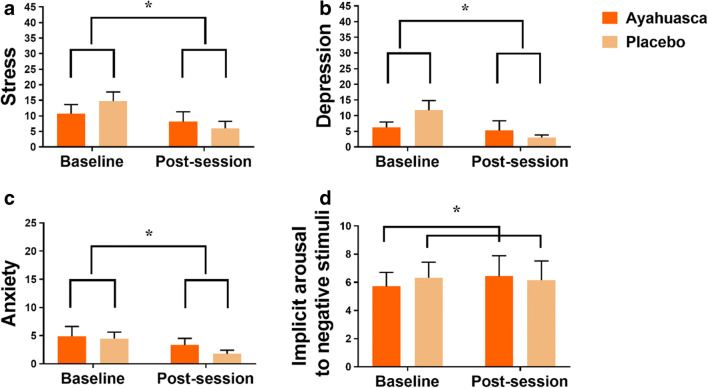
Ayahuasca is a plant concoction containing N,N-dimethyltryptamine (DMT) and certain β-carboline alkaloids from South America. Previous research in naturalistic settings has suggested that ingestion of ayahuasca can improve mental health and well-being; however, these studies were not placebo controlled and did not control for the possibility of expectation bias. This naturalistic observational study was designed to assess whether mental health changes were produced by ayahuasca or by set and setting. Assessments were made pre- and post-ayahuasca sessions in 30 experienced participants of ayahuasca retreats hosted in the Netherlands, Spain, and Germany. Participants consumed ayahuasca (N = 14) or placebo (N = 16). Analysis revealed a main effect of time on symptoms of depression, anxiety, and stress. Compared to baseline, symptoms reduced in both groups after the ceremony, independent of treatment. There was a main treatment × time interaction on implicit emotional empathy, indicating that ayahuasca increased emotional empathy to negative stimuli. The current findings suggest that improvements in mental health of participants of ayahuasca ceremonies can be driven by non-pharmacological factors that constitute a placebo response but also by pharmacological factors that are related to the use of ayahuasca. These findings stress the importance of placebo-controlled designs in psychedelic research and the need to further explore the contribution of non-pharmacological factors to the psychedelic experience.
Overview
The claims and statistics of this paper haven’t been checked yet.
Run the check — free, no account needed. It reads the open-access text and checks the sources it cites.
Integrity signals
Registry
Cites
Statistics
Figures
Verification
Claims the paper makes
The claims and statistics of this paper haven’t been checked yet.
Run the check — free, no account needed. It reads the open-access text and checks the sources it cites.
Claims other papers make about this one
Each is checked against this paper’s own text: does it say what the citing paper says it does?
The source backs part of the claim, not all of it — or backs it for a different population, condition or comparison.
In the citing paper
“Overall, the subjective experience shared phenomenological similarities with ayahuasca and other serotonergic psychedelics such as psilocybin (19, 49), including alterations of consciousness captured by the 11 subscales of the widely used 5D-ASC scale (63, 75).”
From Potential therapeutic effects of an ayahuasca-inspired N,N-DMT and harmine formulation: a controlled trial in healthy subjects (2024) · cites this paper as [75]
Experimental — accuracy not yet measuredThe cited source says what the claim attributes to it.
In the citing paper
“These findings are consistent with results from a blinded, placebo-controlled study (N = 30) demonstrating that participants in group-based ceremonies showed comparable reductions in depression, anxiety, and stress whether they received ayahuasca or placebo, indicating a potential therapeutic effect of the groupbased ceremony in itself.13”
From Innovations in group-based psilocybin-assisted therapy of major depression in patients with cancer (2024) · cites this paper as [13]
The cited source says what the claim attributes to it.
In the citing paper
“indicating a potential therapeutic effect of the groupbased ceremony in itself.13”
From Innovations in group-based psilocybin-assisted therapy of major depression in patients with cancer (2024) · cites this paper as [13]
Self-check
Percentages, sums and reported differences re-computed from the paper’s own numbers.
The self-check needs the paper’s full text.
Citations
Cites
Using Self-Report Assessment Methods to Explore Facets of Mindfulness
Baer, R. A., Smith, G. T., Hopkins, J., Krietemeyer, J., & Toney, L. (2006) · Assessment · doi:10.1177/1073191105283504 · Cited by 7,511 · cited 3×
“…describing internal experiences; (3) acting with awareness, focus on the present activity; (4) nonjudgment, not evaluating or judging the present experience; and (5) non-reaction, allowing thoughts and feelings to come without acting or reacting upon them (Baer et al. 2006) (Gu et al. 2016).”
BackgroundJournal of Consciousness Studies
(2022) · Journal of Consciousness Studies · doi:10.53765/20512201 · Cited by 6,852
Emotion-regulation strategies across psychopathology: A meta-analytic review
Aldao, A., Nolen-Hoeksema, S., & Schweizer, S. (2010) · Clinical Psychology Review · doi:10.1016/j.cpr.2009.11.004 · Cited by 6,686 · cited 1×
“Core features of mood disorders include repetitive and rigid patterns of negative and compulsive thoughts, together with social difficulties and impaired empathic abilities (Aldao et al. 2010; Beck 1967; Dos Santos et al. 2016; Morrison et al. 2016; Nietlisbach and Maercker 2009; Todd et al. 2015).”
BackgroundHenry, J. D., & Crawford, J. R. (2005) · British Journal of Clinical Psychology · doi:10.1348/014466505x29657 · Cited by 5,801 · cited 3×
“The DASS-21 is the shorter version of the original self-report questionnaire Depression, Anxiety, and Stress Scale 42 with a Cronbach’s alpha of 0.93 (Henry and Crawford 2005).”
MethodInfluentialDepression. Clinical, Experimental, and Theoretical Aspects.
(1968) · Annals of Internal Medicine · doi:10.7326/0003-4819-68-2-502 · Cited by 5,233
Response expectancy as a determinant of experience and behavior.
Kirsch, I. (1985) · American Psychologist · doi:10.1037/0003-066x.40.11.1189 · Cited by 1,014
Dziobek, I., Rogers, K., Fleck, S., Bahnemann, M., Heekeren, H. R., Wolf, O. T., & Convit, A. (2008) · Journal of Autism and Developmental Disorders · doi:10.1007/s10803-007-0486-x · Cited by 951
Palhano-Fontes, F., Barreto, D., Onias, H., Andrade, K. C., Novaes, M. M., Pessoa, J. A., Mota-Rolim, S. A., Osório, F. L., Sanches, R., dos Santos, R. G., et al. (2019) · Psychological Medicine · doi:10.1017/s0033291718001356 · Cited by 852
Psychometric evaluation of the altered states of consciousness rating scale (OAV)
Studerus, E., Gamma, A., & Vollenweider, F. X. (2010) · PLoS ONE · doi:10.1371/journal.pone.0012412 · Cited by 683
Motor Inhibition and Cognitive Flexibility in Obsessive-Compulsive Disorder and Trichotillomania
Chamberlain, S. R., Fineberg, N. A., Blackwell, A. D., Robbins, T. W., & Sahakian, B. J. (2006) · American Journal of Psychiatry · doi:10.1176/ajp.2006.163.7.1282 · Cited by 627
Research works printed but not linked: 3
- Adamson S, Metzner R (1988) The nature of the MDMA experience and its role in healing, psychotherapy and spiritual practice. ReVision 10:59–72
- Blewett D (1970) The psychedelics and group therapy. Aaronson, B y H Osmond
- Kuypers KPC, Dolder PC, Ramaekers JG, Liechti ME (2017b) Multifaceted empathy of healthy volunteers after single doses of MDMA: a pooled sample of placebo-controlled studies. J Psychopharmacol 31:589–598 · DOI · Paper page
Cited by
Sorted by citations
Items 101–111 of 111
Zhang, X., Liu, D.-N., Miao, Q.-S., Cai, X., Zong, L.-X., Hou, Y.-K., & Xiong, J. (2025) · Pharmacology Biochemistry and Behavior · doi:10.1016/j.pbb.2025.174099
The Ghosts of Ayahuasca: Conceptual Limits and Spectral Residues
Glazier, J. W., & O'Donnell, S. J. (2025) · Anthropology of Consciousness · doi:10.1111/anoc.70013
Psychedelic-induced behavioral and developmental effects on zebrafish: a systematic review
de Oliveira, A. L., de Oliveira, D. P., SANTOS, R. G. D., & Hallak, J. E. C. (2025) · Progress in Neuro-Psychopharmacology and Biological Psychiatry · doi:10.1016/j.pnpbp.2025.111534
Mian, M. N., Coker, A. R., Kretzer, G., Cavnar, C., Mitchell, J., & Anderson, B. T. (2025) · Current topics in behavioral neurosciences · doi:10.1007/7854_2025_607
Ritual to Relief: Ethical Frontiers in Repurposing Psychoactive Substances
O’Leary, E., Dodd, S., & Stahl, S. M. (2025) · Cambridge University Press eBooks · doi:10.1017/9781009585330.003
Ayahuasca, DMT, and Mental Health: A Current Review of Scientific Studies
Araújo, D. B., Maia, L. O., Sanchez, T. A., Coelho, N. L. G., & Palhano-Fontes, F. (2026) · Current Addiction Reports · doi:10.1007/s40429-026-00721-7
Enchanted consciousness revisited – Ayahuasca visualizations and Sartre's ideas on hallucination
Horváth, L. (2026) · Journal of Psychedelic Studies · doi:10.1556/2054.2026.00484
Teixeira, P. J., Encantado, J., Amaro, H. D., Veiga, D., de Carvalho, L. L., Alcázar‐Córcoles, M. Á., Hallak, J. E. C., SANTOS, R. G. D., Bouso, J. C., & Kohek, M. (2026) · Journal of Psychoactive Drugs · doi:10.1080/02791072.2026.2631378
Xin, Y., Davis, A. K., Yoon, S., & Lee, M. Y. (2026) · Psychedelic Medicine · doi:10.1177/28314425261448756
Reynante, B. M., & Buchanan, J. (2026) · Journal of Psychedelic Studies · doi:10.1556/2054.2026.00523
Mason, N. L., Mallaroni, P., Kuypers, K. P. C., de la Torre, R., Reckweg, J. T., Preller, K. H., & Ramaekers, J. G. (2026) · bioRxiv (Cold Spring Harbor Laboratory) · doi:10.64898/2026.08.04.742704
Self-citation
Metadata
- Authors
- Uthaug, M. V., Mason, N. L., Toennes, S. W., Reckweg, J. T., de Sousa Fernandes Perna, E. B., Kuypers, K. P. C., van Oorsouw, K., Riba, J., & Ramaekers, J. G.
- Affiliations
- Maastricht University (NL)
- Goethe University Frankfurt (DE)
- Corresponding author
- Uthaug, M. V.
- Ramaekers, J. G.
- Venue
- Psychopharmacology
- Published
- 2021-03-10
- Volume
- 238
- Issue
- 7
- Pages
- 1899-1910
- ISSN
- 0033-3158 (ISSN-L)
- 1432-2072
- PMC
- PMC8233273
- OpenAlex
- W3133906491
- Cited by
- 112
- References
- 78
- Citations by year
- 2026: 11 · 2025: 26 · 2024: 23 · 2023: 25 · 2022: 14 · 2021: 13
- FWCI
- 12.79
- Type
- journal article
- Language
- en
- Open access
- hybrid
- doi.org
- Locations
- Psychopharmacology (publishedVersion, cc-by)
- PubMed Central (publishedVersion, cc-by)
- PubMed (publishedVersion)
- Research Publications (Maastricht University) (publishedVersion, cc-by)
- Research Publications (Maastricht University) (submittedVersion, other-oa)
- Topics
- Social Sciences › Psychology › Clinical Psychology › Psychedelics and Drug Studies
- Life Sciences › Neuroscience › Cognitive Neuroscience › Pain Management and Placebo Effect
- Social Sciences › Health › Religion, Spirituality, and Psychology
- Keywords
- ayahuasca, set and setting, placebo response, mental health, depression, anxiety, stress, affective empathy, N,N-dimethyltryptamine
- MeSH terms
- Adult, Alkaloids, Mental Disorders, Ceremonial Behavior, Double-Blind Method, Female, Germany, Hallucinogens, Humans, Male, Mental Health, Middle Aged, Netherlands, Plant Extracts, Spain, Banisteriopsis
About these checks
Registry, retraction, Cites and statistics results are computed, not judged, with one exception: a printed reference that no index lists is read once by a model before it counts as a citation error. Claims are extracted by a model and kept only when their quote appears verbatim in the text; each cited source is then checked, with a model’s help, for whether it says what the claim relies on. Those verdicts can be wrong — read the claim’s quote and the cited source before relying on one.
Statistics and arithmetic are recomputed, not judged.
Confidence bands are shown only for fields calibrated on our annotated test set. None is calibrated yet, so no band is shown.
What counts as a claim ›How we measure confidence ›How we check this ›
Are you an author, or do you see a problem with this page? Request a review
