

The DOI matches its Crossref record; 77 of the 78 references it cites were found in a registry or an index.
A placebo-controlled study of the effects of ayahuasca, set and setting on mental health of participants in ayahuasca group retreats
Open accessAbstract
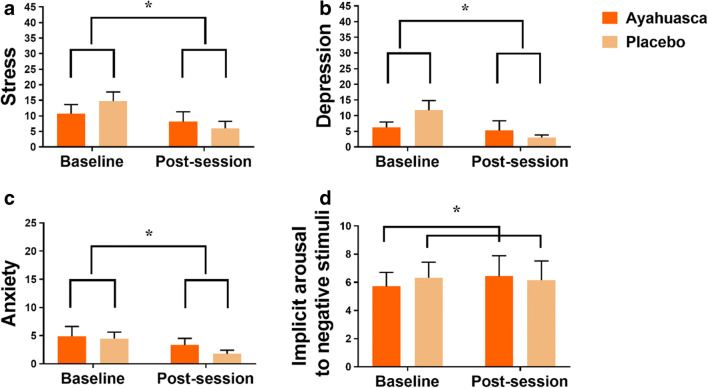
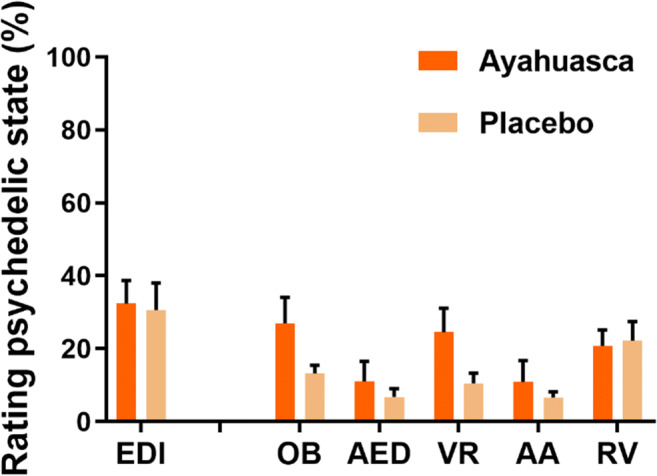
Ayahuasca is a plant concoction containing N,N-dimethyltryptamine (DMT) and certain β-carboline alkaloids from South America. Previous research in naturalistic settings has suggested that ingestion of ayahuasca can improve mental health and well-being; however, these studies were not placebo controlled and did not control for the possibility of expectation bias. This naturalistic observational study was designed to assess whether mental health changes were produced by ayahuasca or by set and setting. Assessments were made pre- and post-ayahuasca sessions in 30 experienced participants of ayahuasca retreats hosted in the Netherlands, Spain, and Germany. Participants consumed ayahuasca (N = 14) or placebo (N = 16). Analysis revealed a main effect of time on symptoms of depression, anxiety, and stress. Compared to baseline, symptoms reduced in both groups after the ceremony, independent of treatment. There was a main treatment × time interaction on implicit emotional empathy, indicating that ayahuasca increased emotional empathy to negative stimuli. The current findings suggest that improvements in mental health of participants of ayahuasca ceremonies can be driven by non-pharmacological factors that constitute a placebo response but also by pharmacological factors that are related to the use of ayahuasca. These findings stress the importance of placebo-controlled designs in psychedelic research and the need to further explore the contribution of non-pharmacological factors to the psychedelic experience.
Overview
The claims and statistics of this paper haven’t been checked yet.
Run the check — free, no account needed. It reads the open-access text and checks the sources it cites.
Integrity signals
Registry
Cites
Statistics
Figures
Verification
Claims the paper makes
The claims and statistics of this paper haven’t been checked yet.
Run the check — free, no account needed. It reads the open-access text and checks the sources it cites.
Claims other papers make about this one
Each is checked against this paper’s own text: does it say what the citing paper says it does?
The source backs part of the claim, not all of it — or backs it for a different population, condition or comparison.
In the citing paper
“Overall, the subjective experience shared phenomenological similarities with ayahuasca and other serotonergic psychedelics such as psilocybin (19, 49), including alterations of consciousness captured by the 11 subscales of the widely used 5D-ASC scale (63, 75).”
From Potential therapeutic effects of an ayahuasca-inspired N,N-DMT and harmine formulation: a controlled trial in healthy subjects (2024) · cites this paper as [75]
Experimental — accuracy not yet measuredThe cited source says what the claim attributes to it.
In the citing paper
“These findings are consistent with results from a blinded, placebo-controlled study (N = 30) demonstrating that participants in group-based ceremonies showed comparable reductions in depression, anxiety, and stress whether they received ayahuasca or placebo, indicating a potential therapeutic effect of the groupbased ceremony in itself.13”
From Innovations in group-based psilocybin-assisted therapy of major depression in patients with cancer (2024) · cites this paper as [13]
The cited source says what the claim attributes to it.
In the citing paper
“indicating a potential therapeutic effect of the groupbased ceremony in itself.13”
From Innovations in group-based psilocybin-assisted therapy of major depression in patients with cancer (2024) · cites this paper as [13]
Self-check
Percentages, sums and reported differences re-computed from the paper’s own numbers.
The self-check needs the paper’s full text.
Citations
Cites
Using Self-Report Assessment Methods to Explore Facets of Mindfulness
Baer, R. A., Smith, G. T., Hopkins, J., Krietemeyer, J., & Toney, L. (2006) · Assessment · doi:10.1177/1073191105283504 · Cited by 7,511 · cited 3×
“…describing internal experiences; (3) acting with awareness, focus on the present activity; (4) nonjudgment, not evaluating or judging the present experience; and (5) non-reaction, allowing thoughts and feelings to come without acting or reacting upon them (Baer et al. 2006) (Gu et al. 2016).”
BackgroundJournal of Consciousness Studies
(2022) · Journal of Consciousness Studies · doi:10.53765/20512201 · Cited by 6,852
Emotion-regulation strategies across psychopathology: A meta-analytic review
Aldao, A., Nolen-Hoeksema, S., & Schweizer, S. (2010) · Clinical Psychology Review · doi:10.1016/j.cpr.2009.11.004 · Cited by 6,686 · cited 1×
“Core features of mood disorders include repetitive and rigid patterns of negative and compulsive thoughts, together with social difficulties and impaired empathic abilities (Aldao et al. 2010; Beck 1967; Dos Santos et al. 2016; Morrison et al. 2016; Nietlisbach and Maercker 2009; Todd et al. 2015).”
BackgroundHenry, J. D., & Crawford, J. R. (2005) · British Journal of Clinical Psychology · doi:10.1348/014466505x29657 · Cited by 5,801 · cited 3×
“The DASS-21 is the shorter version of the original self-report questionnaire Depression, Anxiety, and Stress Scale 42 with a Cronbach’s alpha of 0.93 (Henry and Crawford 2005).”
MethodInfluentialDepression. Clinical, Experimental, and Theoretical Aspects.
(1968) · Annals of Internal Medicine · doi:10.7326/0003-4819-68-2-502 · Cited by 5,233
Response expectancy as a determinant of experience and behavior.
Kirsch, I. (1985) · American Psychologist · doi:10.1037/0003-066x.40.11.1189 · Cited by 1,014
Dziobek, I., Rogers, K., Fleck, S., Bahnemann, M., Heekeren, H. R., Wolf, O. T., & Convit, A. (2008) · Journal of Autism and Developmental Disorders · doi:10.1007/s10803-007-0486-x · Cited by 951
Palhano-Fontes, F., Barreto, D., Onias, H., Andrade, K. C., Novaes, M. M., Pessoa, J. A., Mota-Rolim, S. A., Osório, F. L., Sanches, R., dos Santos, R. G., et al. (2019) · Psychological Medicine · doi:10.1017/s0033291718001356 · Cited by 852
Psychometric evaluation of the altered states of consciousness rating scale (OAV)
Studerus, E., Gamma, A., & Vollenweider, F. X. (2010) · PLoS ONE · doi:10.1371/journal.pone.0012412 · Cited by 683
Motor Inhibition and Cognitive Flexibility in Obsessive-Compulsive Disorder and Trichotillomania
Chamberlain, S. R., Fineberg, N. A., Blackwell, A. D., Robbins, T. W., & Sahakian, B. J. (2006) · American Journal of Psychiatry · doi:10.1176/ajp.2006.163.7.1282 · Cited by 627
The Standardized Psychometric Assessment of Altered States of Consciousness (ASCs) in Humans
Dittrich, A. (1998) · Pharmacopsychiatry · doi:10.1055/s-2007-979351 · Cited by 577
Hartogsohn, I. (2016) · Journal of Psychopharmacology · doi:10.1177/0269881116677852 · Cited by 483
Constructing drug effects: a history of set and setting
Hartogsohn, I. (2017) · Drug Science Policy and Law · doi:10.1177/2050324516683325 · Cited by 472
Ego-dissolution and psychedelics: validation of the ego-dissolution inventory (EDI).
Nour, M. M., Evans, L., Nutt, D., & Carhart-Harris, R. L. (2016) · Frontiers in Human Neuroscience · doi:10.3389/fnhum.2016.00269 · Cited by 470
Sanches, R. F., de Lima Osório, F., dos Santos, R. G., Macedo, L. R. H., Maia-de-Oliveira, J. P., Wichert-Ana, L., de Araujo, D. B., Riba, J., Crippa, J. A. S., & Hallak, J. E. C. (2016) · Journal of Clinical Psychopharmacology · doi:10.1097/jcp.0000000000000436 · Cited by 466
Palhano-Fontes, F., Andrade, K. C., Tofoli, L. F., Santos, A. C., Crippa, J. A. S., Hallak, J. E. C., Ribeiro, S., & de Araujo, D. B. (2015) · PLOS ONE · doi:10.1371/journal.pone.0118143 · Cited by 454
A New Psychosocial Screening Instrument for Use With Cancer Patients
Zabora, J., Brintzenhofeszoc, K., Jacobsen, P., Curbow, B., Piantadosi, S., Hooker, C., Owens, A., & Derogatis, L. (2001) · Psychosomatics · doi:10.1176/appi.psy.42.3.241 · Cited by 440
Gu, J., Strauss, C., Crane, C., Barnhofer, T., Karl, A., Cavanagh, K., & Kuyken, W. (2016) · Psychological Assessment · doi:10.1037/pas0000263 · Cited by 431 · cited 1×
“…describing internal experiences; (3) acting with awareness, focus on the present activity; (4) nonjudgment, not evaluating or judging the present experience; and (5) non-reaction, allowing thoughts and feelings to come without acting or reacting upon them (Baer et al. 2006) (Gu et al. 2016).”
BackgroundPredicting responses to psychedelics: a prospective study
Haijen, E. C. H. M., Kaelen, M., Roseman, L., Timmermann, C., Kettner, H., Russ, S., Nutt, D., Daws, R. E., Hampshire, A. D. G., Lorenz, R., et al. (2018) · Frontiers in Pharmacology · doi:10.3389/fphar.2018.00897 · Cited by 417
Decety, J., Chen, C., Harenski, C., & Kiehl, K. A. (2013) · Frontiers in Human Neuroscience · doi:10.3389/fnhum.2013.00489 · Cited by 386 · cited 1×
“The lack of empathy is particularly evident in psychopathy and has been suggested to modulate an individual’s risk for aggression (Blair 2018; Cusi et al. 2011; Decety et al. 2013; Donges et al. 2005).”
BackgroundMDMA enhances emotional empathy and prosocial behavior
Hysek, C. M., Schmid, Y., Simmler, L. D., Domes, G., Heinrichs, M., Eisenegger, C., Preller, K. H., Quednow, B. B., & Liechti, M. E. (2014) · Social Cognitive and Affective Neuroscience · doi:10.1093/scan/nst161 · Cited by 356
Human psychopharmacology of hoasca, a plant hallucinogen used in ritual context in Brazil.
GROB, C. S., McKENNA, D. J., CALLAWAY, J. C., BRITO, G. S., NEVES, E. S., OBERLAENDER, G., SAIDE, O. L., LABIGALINI, E., TACLA, C., MIRANDA, C. T., et al. (1996) · The Journal of Nervous and Mental Disease · doi:10.1097/00005053-199602000-00004 · Cited by 338
McKenna, D. J. (2004) · Pharmacology & Therapeutics · doi:10.1016/j.pharmthera.2004.03.002 · Cited by 321
LSD enhances suggestibility in healthy volunteers
Carhart-Harris, R. L., Kaelen, M., Whalley, M. G., Bolstridge, M., Feilding, A., & Nutt, D. J. (2015) · Psychopharmacology · doi:10.1007/s00213-014-3714-z · Cited by 320
Riba, J., Rodríguez-Fornells, A., Urbano, G., Morte, A., Antonijoan, R., Montero, M., Callaway, J. C., & Barbanoj, M. J. (2001) · Psychopharmacology · doi:10.1007/s002130000606 · Cited by 303
Self-citationPsychometric analysis of the brief symptom inventory 18 (BSI-18) in a representative German sample
Franke, G. H., Jaeger, S., Glaesmer, H., Barkmann, C., Petrowski, K., & Braehler, E. (2017) · BMC Medical Research Methodology · doi:10.1186/s12874-016-0283-3 · Cited by 294
REACTIONS TO PSILOCYBJN ADMINISTERED IN A SUPPORTIVE ENVIRONMENT
Leary, T., Litwin, G. H., & Metzner, R. (1963) · The Journal of Nervous and Mental Disease · doi:10.1097/00005053-196312000-00007 · Cited by 245
The therapeutic potentials of Ayahuasca: possible effects against various diseases of civilization
Frecska, E., Bokor, P., & Winkelman, M. (2016) · Frontiers in Pharmacology · doi:10.3389/fphar.2016.00035 · Cited by 242
The globalization of ayahuasca: harm reduction or benefit maximization?
Tupper, K. W. (2008) · International Journal of Drug Policy · doi:10.1016/j.drugpo.2006.11.001 · Cited by 212
SANTOS, R. G. D., Landeira-Fernández, J., Strassman, R. J., Motta, V., & Cruz, A. P. D. M. (2007) · Journal of Ethnopharmacology · doi:10.1016/j.jep.2007.04.012 · Cited by 212
Uthaug, M. V., van Oorsouw, K., Kuypers, K. P. C., van Boxtel, M., Broers, N. J., Mason, N. L., Toennes, S. W., Riba, J., & Ramaekers, J. G. (2018) · Psychopharmacology · doi:10.1007/s00213-018-4988-3 · Cited by 212
Self-citationSoler, J., Elices, M., Franquesa, A., Barker, S., Friedlander, P., Feilding, A., Pascual, J. C., & Riba, J. (2016) · Psychopharmacology · doi:10.1007/s00213-015-4162-0 · Cited by 209
Ayahuasca enhances creative divergent thinking while decreasing conventional convergent thinking
Kuypers, K. P. C., Riba, J., de la Fuente Revenga, M., Barker, S., Theunissen, E. L., & Ramaekers, J. G. (2016) · Psychopharmacology · doi:10.1007/s00213-016-4377-8 · Cited by 201
Self-citationAnxious and egocentric: How specific emotions influence perspective taking.
Todd, A. R., Forstmann, M., Burgmer, P., Brooks, A. W., & Galinsky, A. D. (2015) · Journal of Experimental Psychology General · doi:10.1037/xge0000048 · Cited by 200
Effect of Psilocybin on Empathy and Moral Decision-Making
Pokorny, T., Preller, K. H., Kometer, M., Dziobek, I., & Vollenweider, F. X. (2017) · International Journal of Neuropsychopharmacology · doi:10.1093/ijnp/pyx047 · Cited by 197
Uthaug, M. V., Lancelotta, R., van Oorsouw, K., Kuypers, K. P. C., Mason, N., Rak, J., Šuláková, A., Jurok, R., Maryška, M., Kuchař, M., et al. (2019) · Psychopharmacology · doi:10.1007/s00213-019-05236-w · Cited by 197
Self-citationSANTOS, R. G. D., Osório, F. D. L., Crippa, J. A. S., & Hallak, J. E. C. (2016) · Brazilian Journal of Psychiatry · doi:10.1590/1516-4446-2015-1701 · Cited by 175
Valle, M., Maqueda, A. E., Rabella, M., Rodríguez-Pujadas, A., Antonijoan, R. M., Romero, S., Alonso, J. F., Mañanas, M. À., Barker, S., Friedlander, P., et al. (2016) · European Neuropsychopharmacology · doi:10.1016/j.euroneuro.2016.03.012 · Cited by 173
Sub-Acute Effects of Psilocybin on Empathy, Creative Thinking, and Subjective Well-Being
Mason, N. L., Mischler, E., Uthaug, M. V., & Kuypers, K. P. C. (2019) · Journal of Psychoactive Drugs · doi:10.1080/02791072.2019.1580804 · Cited by 172
Self-citationLee, J. K., & Orsillo, S. M. (2014) · Journal of Behavior Therapy and Experimental Psychiatry · doi:10.1016/j.jbtep.2013.10.008 · Cited by 171
Cusi, A. M., MacQUEEN, G. M., Spreng, R. N., & McKinnon, M. C. (2011) · Psychiatry Research · doi:10.1016/j.psychres.2011.04.013 · Cited by 159
Drug Tourism or Spiritual Healing? Ayahuasca Seekers in Amazonia
Winkelman, M. (2005) · Journal of Psychoactive Drugs · doi:10.1080/02791072.2005.10399803 · Cited by 157
Tripping on nothing: placebo psychedelics and contextual factors
Olson, J. A., Suissa-Rocheleau, L., Lifshitz, M., Raz, A., & Veissière, S. P. L. (2020) · Psychopharmacology · doi:10.1007/s00213-020-05464-5 · Cited by 155
Autonomic, Neuroendocrine, and Immunological Effects of Ayahuasca
SANTOS, R. G. D., Valle, M., Bouso, J. C., Nomdedeu, J. F., Rodrı́guez-Espinosa, J., McIlhenny, E. H., Barker, S. A., Barbanoj, M. J., & Riba, J. (2011) · Journal of Clinical Psychopharmacology · doi:10.1097/jcp.0b013e31823607f6 · Cited by 143
Pharmacology of ayahuasca administered in two repeated doses
dos Santos, R. G., Grasa, E., Valle, M., Ballester, M. R., Bouso, J. C., Nomdedéu, J. F., Homs, R., Barbanoj, M. J., & Riba, J. (2012) · Psychopharmacology · doi:10.1007/s00213-011-2434-x · Cited by 141
Lafrance, A., Loizaga-Velder, A. K., Fletcher, J., Renelli, M., Files, N., & Tupper, K. W. (2017) · Journal of Psychoactive Drugs · doi:10.1080/02791072.2017.1361559 · Cited by 134
Role of Conditioning and Verbal Suggestion in Placebo and Nocebo Effects on Itch
Bartels, D. J. P., van Laarhoven, A. I. M., Haverkamp, E. A., Wilder‐Smith, O. H. G., Donders, A. R. T., van Middendorp, H., van de Kerkhof, P. C. M., & Evers, A. W. M. (2014) · PLoS ONE · doi:10.1371/journal.pone.0091727 · Cited by 126
Blair, J. (2018) · Philosophical Transactions of the Royal Society B Biological Sciences · doi:10.1098/rstb.2017.0155 · Cited by 124
Barbosa, P. C. R., Giglio, J. S., & Dalgalarrondo, P. (2005) · Journal of Psychoactive Drugs · doi:10.1080/02791072.2005.10399801 · Cited by 120
Psychedelic-Assisted Group Therapy: A Systematic Review
Trope, A., Anderson, B. T., Hooker, A. R., Glick, G., Stauffer, C. S., & Woolley, J. D. (2019) · Journal of Psychoactive Drugs · doi:10.1080/02791072.2019.1593559 · Cited by 113
Health status of ayahuasca users
Barbosa, P. C. R., Mizumoto, S., Bogenschutz, M. P., & Strassman, R. J. (2012) · Drug Testing and Analysis · doi:10.1002/dta.1383 · Cited by 112
Reed, K. M. P., & Follette, V. M. (2010) · Journal of Psychopathology and Behavioral Assessment · doi:10.1007/s10862-010-9201-x · Cited by 112
Conditioning, Expectancy, and the Placebo Effect: Comment on Stewart-Williams and Podd (2004).
Kirsch, I. (2004) · Psychological Bulletin · doi:10.1037/0033-2909.130.2.341 · Cited by 111
Barbosa, P. C. R., Cazorla, I. M., Giglio, J. S., & Strassman, R. J. (2009) · Journal of Psychoactive Drugs · doi:10.1080/02791072.2009.10400530 · Cited by 108
Are Empathic Abilities Impaired in Posttraumatic Stress Disorder?
Nietlisbach, G., Maercker, A., Rösler, W., & Haker, H. (2010) · Psychological Reports · doi:10.2466/pr0.106.3.832-844 · Cited by 101
Social Cognition and Interpersonal Impairments in Trauma Survivors with PTSD
Nietlisbach, G., & Maercker, A. (2009) · Journal of Aggression, Maltreatment & Trauma · doi:10.1080/10926770902881489 · Cited by 97
Empathy for positive and negative emotions in social anxiety disorder
Morrison, A. S., Mateen, M. A., Brozovich, F. A., Zaki, J., Goldin, P. R., Heimberg, R. G., & Gross, J. J. (2016) · Behaviour Research and Therapy · doi:10.1016/j.brat.2016.10.005 · Cited by 96
Reduced awareness of others’ emotions in unipolar depressed patients
Donges, U.-S., Kersting, A., Dannlowski, U., Lalee-Mentzel, J., Arolt, V., & Suslow, T. (2005) · Journal of Nervous & Mental Disease · doi:10.1097/01.nmd.0000161683.02482.19 · Cited by 89
ANTICIPATION OF ANALGESIA, A PLACEBO EFFECT
LASKA, E. M., & Sunshine, A. N. (1973) · Headache The Journal of Head and Face Pain · doi:10.1111/j.1526-4610.1973.hed1301001.x · Cited by 89
Kuypers, K. P., Dolder, P. C., Ramaekers, J. G., & Liechti, M. E. (2017) · Journal of Psychopharmacology · doi:10.1177/0269881117699617 · Cited by 89 · cited 2×
“This increase in empathic emotion was assessed with theMET that might be less susceptible to the influence of nonpharmacological factors and fluctuates with drug concentration (Kuypers et al. 2017b).”
Self-citationKuypers, K. P. C., de la Torre, R., Farre, M., Yubero-Lahoz, S., Dziobek, I., Van den Bos, W., & Ramaekers, J. G. (2014) · PLoS ONE · doi:10.1371/journal.pone.0100719 · Cited by 88
Self-citationNocebo in clinical trials for depression: A meta-analysis
Mitsikostas, D. D., Mantonakis, L., & Chalarakis, N. (2013) · Psychiatry Research · doi:10.1016/j.psychres.2013.10.019 · Cited by 86
Domínguez‐Clavé, E., Soler, J., Pascual, J. C., Elices, M., Franquesa, A., Valle, M., Álvarez, E., & Riba, J. (2018) · Psychopharmacology · doi:10.1007/s00213-018-5085-3 · Cited by 86
Perceived risk and risk reduction among ecstasy users: the role of drug, set, and setting
Shewan, D., Dalgarno, P., & Reith, G. (2000) · International Journal of Drug Policy · doi:10.1016/s0955-3959(99)00038-9 · Cited by 85
Lawn, W., Hallak, J. E. C., Crippa, J. A. S., SANTOS, R. G. D., Porffy, L., Barratt, M. J., Ferris, J., WINSTOCK, A. R., & Morgan, C. J. A. (2017) · Scientific Reports · doi:10.1038/s41598-017-14700-6 · Cited by 83
Mechanisms of the Placebo Effect and of Conditioning
Haour, F. (2005) · NeuroImmunoModulation · doi:10.1159/000085651 · Cited by 78
Parlar, M. E., Frewen, P., Nazarov, A., Oremus, C., MacQUEEN, G. M., Lanius, R. A., & McKinnon, M. C. (2014) · Brain and Behavior · doi:10.1002/brb3.215 · Cited by 75
Placebo, Nocebo, and Learning Mechanisms
Colloca, L. (2014) · Handbook of experimental pharmacology · doi:10.1007/978-3-662-44519-8_2 · Cited by 67
SANTOS, R. G. D., & Hallak, J. E. C. (2019) · Epilepsy & Behavior · doi:10.1016/j.yebeh.2019.04.053 · Cited by 66
The epistemology and technologies of shamanic states of consciousness.
Krippner, S. (2000) · Journal of Consciousness Studies · Cited by 64
Working with “ L a M edicina”: Elements of Healing in Contemporary Ayahuasca Rituals
Fotiou, E. (2012) · Anthropology of Consciousness · doi:10.1111/j.1556-3537.2012.01054.x · Cited by 46
Nocebo Effects in the Treatment of Major Depression
Dodd, S., Schacht, A., Kelin, K., Dueñas, H., Reed, V. A., Williams, L. J., Quirk, F. H., Malhi, G. S., & Berk, M. (2015) · The Journal of Clinical Psychiatry · doi:10.4088/jcp.13r08858 · Cited by 32
Individualist Religious Movements: Core and Neo‐shamanism
Townsend, J. B. (2004) · Anthropology of Consciousness · doi:10.1525/ac.2004.15.1.1 · Cited by 28
Implicit versus explicit associative learning and experimentally induced placebo hypoalgesia
Martin-Pichora, Mankovsky-Arnold, T., & Katz, J. D. (2011) · Journal of Pain Research · doi:10.2147/jpr.s15966 · Cited by 24
Baker, J. R. (2005) · Journal of Psychoactive Drugs · doi:10.1080/02791072.2005.10399799 · Cited by 24
The Effect of 5-HT2A/1a Agonist Treatment On Social Cognition, Empathy, and Social Decision-making
Preller, K. H., Pokorny, T., Krähenmann, R., Dziobek, I., Stämpfli, P., & Vollenweider, F. X. (2015) · European Psychiatry · doi:10.1016/s0924-9338(15)30017-1 · Cited by 20
Expectancies and Memory for an Emotional Film Fragment: A Placebo Study
van Oorsouw, K. I. M., & Merckelbach, H. L. G. J. (2007) · The American Journal of Psychology · doi:10.2307/20445399 · Cited by 15
Research works printed but not linked: 3
- Adamson S, Metzner R (1988) The nature of the MDMA experience and its role in healing, psychotherapy and spiritual practice. ReVision 10:59–72
- Blewett D (1970) The psychedelics and group therapy. Aaronson, B y H Osmond
- Kuypers KPC, Dolder PC, Ramaekers JG, Liechti ME (2017b) Multifaceted empathy of healthy volunteers after single doses of MDMA: a pooled sample of placebo-controlled studies. J Psychopharmacol 31:589–598 · DOI · Paper page
Cited by
Sorted by citations
Aday, J. S., Heifets, B. D., Pratscher, S. D., Bradley, E., Rosen, R., & Woolley, J. D. (2022) · Psychopharmacology · doi:10.1007/s00213-022-06123-7 · Cited by 237
Yao, Y., Guo, D., Lu, T., Liu, F.-L., Huang, S., Diao, M.-Q., Li, S., Zhang, X.-J., Kosten, T. R., Shi, J., et al. (2024) · Psychiatry Research · doi:10.1016/j.psychres.2024.115886 · Cited by 162
Reckweg, J. T., Uthaug, M. V., Szabó, A., Davis, A. K., Lancelotta, R., Mason, N. L., & Ramaekers, J. G. (2022) · Journal of Neurochemistry · doi:10.1111/jnc.15587 · Cited by 126
Self-citationNayak, S. M., Jackson, H., Sepeda, N. D., Mathai, D. S., So, S., Yaffe, A., Zaki, H., Brasher, T. J., Lowe, M. X., Jolly, D. R. P., et al. (2023) · Frontiers in Psychiatry · doi:10.3389/fpsyt.2023.1199642 · Cited by 97
Psychedelics, Sociality, and Human Evolution
Rodríguez Arce, J. M., & Winkelman, M. J. (2021) · Frontiers in Psychology · doi:10.3389/fpsyg.2021.729425 · Cited by 86
Metadata
- Authors
- Uthaug, M. V., Mason, N. L., Toennes, S. W., Reckweg, J. T., de Sousa Fernandes Perna, E. B., Kuypers, K. P. C., van Oorsouw, K., Riba, J., & Ramaekers, J. G.
- Affiliations
- Maastricht University (NL)
- Goethe University Frankfurt (DE)
- Corresponding author
- Uthaug, M. V.
- Ramaekers, J. G.
- Venue
- Psychopharmacology
- Published
- 2021-03-10
- Volume
- 238
- Issue
- 7
- Pages
- 1899-1910
- ISSN
- 0033-3158 (ISSN-L)
- 1432-2072
- PMC
- PMC8233273
- OpenAlex
- W3133906491
- Cited by
- 112
- References
- 78
- Citations by year
- 2026: 11 · 2025: 26 · 2024: 23 · 2023: 25 · 2022: 14 · 2021: 13
- FWCI
- 12.79
- Type
- journal article
- Language
- en
- Open access
- hybrid
- doi.org
- Locations
- Psychopharmacology (publishedVersion, cc-by)
- PubMed Central (publishedVersion, cc-by)
- PubMed (publishedVersion)
- Research Publications (Maastricht University) (publishedVersion, cc-by)
- Research Publications (Maastricht University) (submittedVersion, other-oa)
- Topics
- Social Sciences › Psychology › Clinical Psychology › Psychedelics and Drug Studies
- Life Sciences › Neuroscience › Cognitive Neuroscience › Pain Management and Placebo Effect
- Social Sciences › Health › Religion, Spirituality, and Psychology
- Keywords
- ayahuasca, set and setting, placebo response, mental health, depression, anxiety, stress, affective empathy, N,N-dimethyltryptamine
- MeSH terms
- Adult, Alkaloids, Mental Disorders, Ceremonial Behavior, Double-Blind Method, Female, Germany, Hallucinogens, Humans, Male, Mental Health, Middle Aged, Netherlands, Plant Extracts, Spain, Banisteriopsis
About these checks
Registry, retraction, Cites and statistics results are computed, not judged, with one exception: a printed reference that no index lists is read once by a model before it counts as a citation error. Claims are extracted by a model and kept only when their quote appears verbatim in the text; each cited source is then checked, with a model’s help, for whether it says what the claim relies on. Those verdicts can be wrong — read the claim’s quote and the cited source before relying on one.
Statistics and arithmetic are recomputed, not judged.
Confidence bands are shown only for fields calibrated on our annotated test set. None is calibrated yet, so no band is shown.
What counts as a claim ›How we measure confidence ›How we check this ›
Are you an author, or do you see a problem with this page? Request a review
