

The DOI matches its Crossref record; 67 of the 67 references it cites were found in a registry or an index.
Dual modification of Alzheimer’s disease PHF-tau protein by lysine methylation and ubiquitylation: a mass spectrometry approach
Open accessAbstract
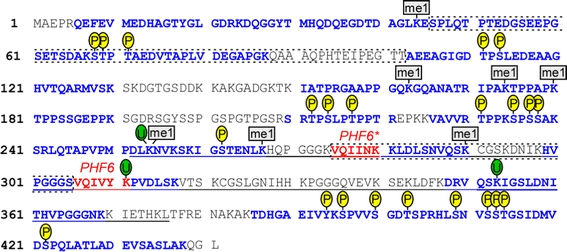
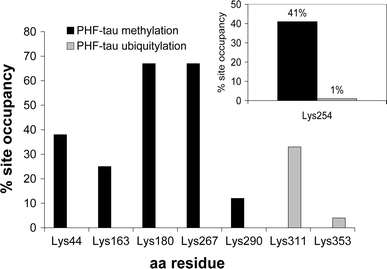
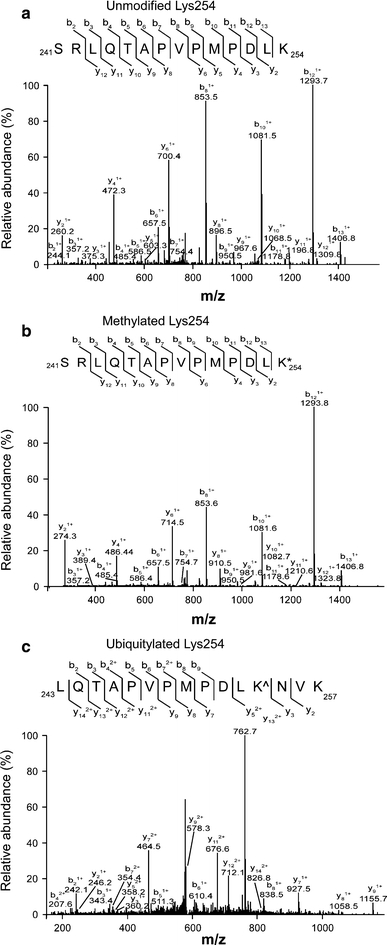
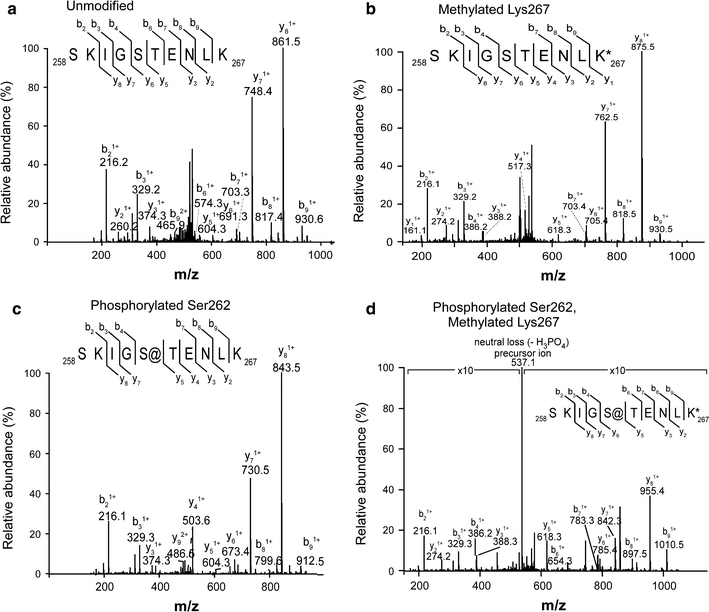
In sporadic Alzheimer's disease (AD), neurofibrillary lesion formation is preceded by extensive post-translational modification of the microtubule associated protein tau. To identify the modification signature associated with tau lesion formation at single amino acid resolution, immunopurified paired helical filaments were isolated from AD brain and subjected to nanoflow liquid chromatography-tandem mass spectrometry analysis. The resulting spectra identified monomethylation of lysine residues as a new tau modification. The methyl-lysine was distributed among seven residues located in the projection and microtubule binding repeat regions of tau protein, with one site, K254, being a substrate for a competing lysine modification, ubiquitylation. To characterize methyl lysine content in intact tissue, hippocampal sections prepared from post mortem late-stage AD cases were subjected to double-label confocal fluorescence microscopy using anti-tau and anti-methyl lysine antibodies. Anti-methyl lysine immunoreactivity colocalized with 78 ± 13% of neurofibrillary tangles in these specimens. Together these data provide the first evidence that tau in neurofibrillary lesions is post-translationally modified by lysine methylation.
Overview
The claims and statistics of this paper haven’t been checked yet.
Run the check — free, no account needed. It reads the open-access text and checks the sources it cites.
Integrity signals
Registry
Cites
Statistics
Figures
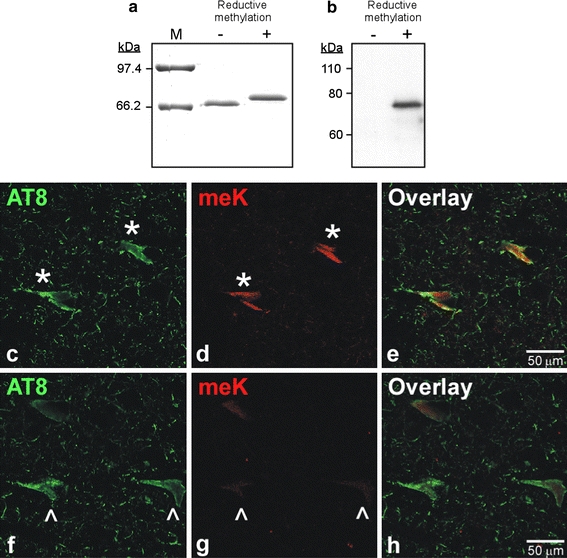
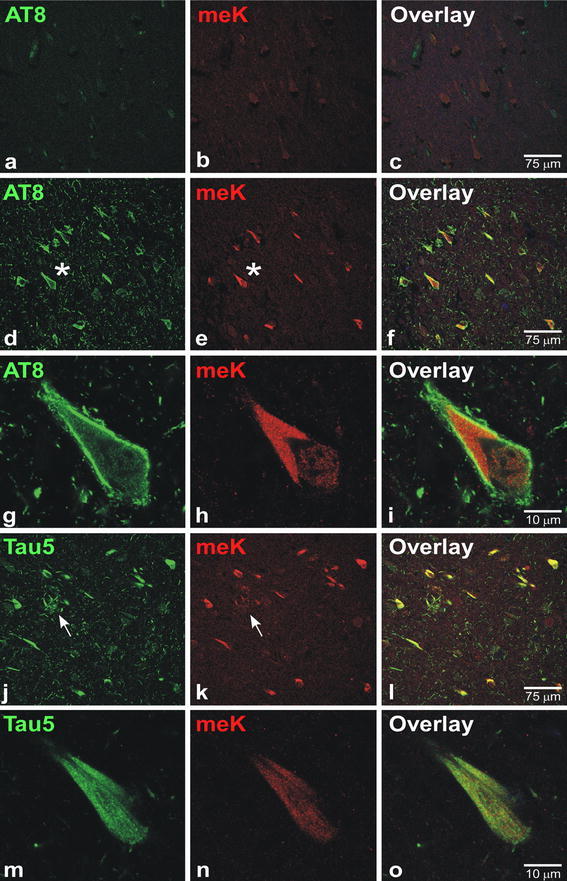
Verification
Claims the paper makes
The claims and statistics of this paper haven’t been checked yet.
Run the check — free, no account needed. It reads the open-access text and checks the sources it cites.
Claims other papers make about this one
Each is checked against this paper’s own text: does it say what the citing paper says it does?
In the citing paper
“a recent study suggests that Lys residues are predominately monomethylated in aging or AD cohorts [174–176].”
From Molecular and cellular mechanisms underlying the pathogenesis of Alzheimer’s disease (2020) · cites this paper as [175]
In the citing paper
“Methylated Lys residues mainly distribute to the projection region and tau microtubule-binding domain [174–176].”
From Molecular and cellular mechanisms underlying the pathogenesis of Alzheimer’s disease (2020) · cites this paper as [175]
Self-check
Percentages, sums and reported differences re-computed from the paper’s own numbers.
The self-check needs the paper’s full text.
Citations
Cites
Neuropathological stageing of Alzheimer-related changes.
Braak, H., & Braak, E. (1991) · Acta Neuropathologica · doi:10.1007/bf00308809 · Cited by 16,123 · cited 1×
“All AD cases satisfied criteria for Braak stages V or VI, whereas none of the control cases met pathological criteria for AD [6].”
Mirra, S. S., Heyman, A., McKeel, D., Sumi, S. M., Crain, B. J., Brownlee, L. M., Vogel, F. S., Hughes, J. P., Belle, G. V., Berg, L., et al. (1991) · Neurology · doi:10.1212/wnl.41.4.479 · Cited by 4,961
Braak, H., Alafuzoff, I., Arzberger, T., Kretzschmar, H., & Del Tredici, K. (2006) · Acta Neuropathologica · doi:10.1007/s00401-006-0127-z · Cited by 3,172
Consortium to Establish a Registry for Alzheimer's Disease (CERAD)
Fillenbaum, G., & Heyman, A. (2002) · doi:10.1002/0470846410.ch42(iii · Cited by 2,859
A Model for Random Sampling and Estimation of Relative Protein Abundance in Shotgun Proteomics
Liu, H., Sadygov, R. G., & Yates, J. R. (2004) · Analytical Chemistry · doi:10.1021/ac0498563 · Cited by 2,533
Buée, L., Bussière, T., Buée‐Scherrer, V., Delacourte, A., & Hof, P. R. (2000) · Brain Research Reviews · doi:10.1016/s0165-0173(00)00019-9 · Cited by 2,142
Profound Loss of Layer II Entorhinal Cortex Neurons Occurs in Very Mild Alzheimer’s Disease
Gómez-Isla, T., Price, J. L., McKeel Jr., D. W., Morris, J. C., Growdon, J. H., & Hyman, B. T. (1996) · The Journal of Neuroscience · doi:10.1523/jneurosci.16-14-04491.1996 · Cited by 1,796 · cited 1×
“Because neurofibrillary lesion density correlates with neurodegeneration [24, 31] and cognitive decline”
BackgroundLarge-scale characterization of HeLa cell nuclear phosphoproteins
Beausoleil, S. A., Jedrychowski, M. P., Schwartz, D., Elias, J. E., Villén, J., Li, J., Cohn, M. A., Cantley, L. C., & Gygi, S. P. (2004) · Proceedings of the National Academy of Sciences · doi:10.1073/pnas.0404720101 · Cited by 1,376
Comparison of Label-free Methods for Quantifying Human Proteins by Shotgun Proteomics
Old, W. M., Meyer-Arendt, K., Aveline-Wolf, L. D., Pierce, K. G., Mendoza, A. M., Sevinsky, J. R., Resing, K. A., & Ahn, N. G. (2005) · Molecular & Cellular Proteomics · doi:10.1074/mcp.m500084-mcp200 · Cited by 1,206
Tangle and neuron numbers, but not amyloid load, predict cognitive status in Alzheimer’s disease
Giannakopoulos, P., Herrmann, F. R., Bussière, T., Bouras, C., Kövari, E., Perl, D. P., Morrison, J. H., Gold, G., & Hof, P. R. (2003) · Neurology · doi:10.1212/01.wnl.0000063311.58879.01 · Cited by 1,118
Goedert, M., Spillantini, M. G., Potier, M. C., Ulrich, J., & Crowther, R. A. (1989) · The EMBO Journal · doi:10.1002/j.1460-2075.1989.tb03390.x · Cited by 1,037
von Bergen, M., Friedhoff, P., Biernat, J., Heberle, J., Mandelkow, E.-M., & Mandelkow, E. (2000) · Proceedings of the National Academy of Sciences · doi:10.1073/pnas.97.10.5129 · Cited by 1,021
Augustinack, J. C., Schneider, A., Mandelkow, E.-M., & Hyman, B. T. (2002) · Acta Neuropathologica · doi:10.1007/s004010100423 · Cited by 998
Tau phosphorylation: the therapeutic challenge for neurodegenerative disease
Hanger, D. P., Anderton, B. H., & Noble, W. (2009) · Trends in Molecular Medicine · doi:10.1016/j.molmed.2009.01.003 · Cited by 965
Acetylation of Tau Inhibits Its Degradation and Contributes to Tauopathy
Min, S.-W., Cho, S.-H., Zhou, Y., Schroeder, S., Haroutunian, V., Seeley, W. W., Huang, E. J., Shen, Y., Masliah, E., Mukherjee, C., et al. (2010) · Neuron · doi:10.1016/j.neuron.2010.08.044 · Cited by 949
Bramblett, G. T., Goedert, M., Jakes, R., Merrick, S. E., Trojanowski, J. Q., & Lee, V. M. Y. (1993) · Neuron · doi:10.1016/0896-6273(93)90057-x · Cited by 903
Alonso, A. D. C., Zaidi, T., Novak, M., Grundke-Iqbal, I., & Iqbal, K. (2001) · Proceedings of the National Academy of Sciences · doi:10.1073/pnas.121119298 · Cited by 827
Biernat, J., Gustke, N., Drewes, G., Mandelkow, E., & Mandelkow, E. (1993) · Neuron · doi:10.1016/0896-6273(93)90279-z · Cited by 796
O-GlcNAcylation regulates phosphorylation of tau: A mechanism involved in Alzheimer's disease
Liu, F., Iqbal, K., Grundke-Iqbal, I., Hart, G. W., & Gong, C.-X. (2004) · Proceedings of the National Academy of Sciences · doi:10.1073/pnas.0400348101 · Cited by 775
The acetylation of tau inhibits its function and promotes pathological tau aggregation
Cohen, T. J., Guo, J. L., Hurtado, D. E., Kwong, L. K., Mills, I. P., Trojanowski, J. Q., & Lee, V. M. Y. (2011) · Nature Communications · doi:10.1038/ncomms1255 · Cited by 724
CHIP and Hsp70 regulate tau ubiquitination, degradation and aggregation
Petrucelli, L. (2004) · Human Molecular Genetics · doi:10.1093/hmg/ddh083 · Cited by 723 · cited 1×
“For example, ubiquitylation of tau at Lys residues modulates intracellular tau levels [53, 61], the magnitude of which affects both nucleation and extension phases of the aggregation reaction [12].”
BackgroundReduction of Lipofuscin-like Autofluorescence in Fluorescently Labeled Tissue
Schnell, S. A., Staines, W. A., & Wessendorf, M. W. (1999) · Journal of Histochemistry & Cytochemistry · doi:10.1177/002215549904700601 · Cited by 699
Post-translational modifications of tau protein: Implications for Alzheimer's disease
Martin, L., Latypova, X., & Terro, F. (2011) · Neurochemistry International · doi:10.1016/j.neuint.2010.12.023 · Cited by 683
Monoclonal antibody AT8 recognises tau protein phosphorylated at both serine 202 and threonine 205
Goedert, M., Jakes, R., & Vanmechelen, E. (1995) · Neuroscience Letters · doi:10.1016/0304-3940(95)11484-e · Cited by 608
Schneider, A., Biernat, J., von Bergen, M., Mandelkow, E., & Mandelkow, E.-M. (1999) · Biochemistry · doi:10.1021/bi981874p · Cited by 564
Tau interacts with src-family non-receptor tyrosine kinases
Lee, G. S., Newman, S. T., Gard, D. L., Band, H., & Panchamoorthy, G. (1998) · Journal of Cell Science · doi:10.1242/jcs.111.21.3167 · Cited by 471
CHIP-Hsc70 Complex Ubiquitinates Phosphorylated Tau and Enhances Cell Survival
Shimura, H., Schwartz, D., Gygi, S. P., & Kosik, K. S. (2004) · Journal of Biological Chemistry · doi:10.1074/jbc.m305838200 · Cited by 469
Cross-regulation of histone modifications
Latham, J. A., & Dent, S. (2007) · Nature Structural & Molecular Biology · doi:10.1038/nsmb1307 · Cited by 439
Novak, M., Kabat, J., & Wischik, C. M. (1993) · The EMBO Journal · doi:10.1002/j.1460-2075.1993.tb05665.x · Cited by 398
Detecting Differential and Correlated Protein Expression in Label-Free Shotgun Proteomics
Zhang, B., VerBerkmoes, N. C., Langston, M. A., Uberbacher, E. C., Hettich, R. L., & Samatova, N. F. (2006) · Journal of Proteome Research · doi:10.1021/pr0600273 · Cited by 395
LoPresti, P., Szuchet, S., Papasozomenos, S. C., Zinkowski, R. P., & Binder, L. I. (1995) · Proceedings of the National Academy of Sciences · doi:10.1073/pnas.92.22.10369 · Cited by 388
Hanger, D. P., Betts, J. C., Loviny, T. L. F., Blackstock, W. P., & Anderton, B. H. (1998) · Journal of Neurochemistry · doi:10.1046/j.1471-4159.1998.71062465.x · Cited by 386
Goedert, M., Jakes, R., Crowther, R. A., Cohen, P., Vanmechelen, E., Vandermeeren, M., & Cras, P. (1994) · Biochemical Journal · doi:10.1042/bj3010871 · Cited by 375
Significance Analysis of Spectral Count Data in Label-free Shotgun Proteomics
Choi, H., Fermin, D., & Nesvizhskii, A. I. (2008) · Molecular & Cellular Proteomics · doi:10.1074/mcp.m800203-mcp200 · Cited by 364
Cripps, D., Thomas, S. N., Jeng, Y., Yang, F., Davies, P., & Yang, A. J. (2006) · Journal of Biological Chemistry · doi:10.1074/jbc.m512786200 · Cited by 312
Self-citationMeta-analysis of multiple outcomes by regression with random effects
Berkey, C. S., Hoaglin, D. C., Antczak‐Bouckoms, A., Mosteller, F. C., & Colditz, G. A. (1998) · Statistics in Medicine · doi:10.1002/(sici)1097-0258(19981130)17:22 · Cited by 274
Park, S.-Y., & Ferreira, A. (2005) · The Journal of Neuroscience · doi:10.1523/jneurosci.1125-05.2005 · Cited by 262
Reynolds, C. H., Garwood, C. J., Wray, S., Price, C., Kellie, S., Perera, T. P. S., Zvelebil, M., Yang, A., Sheppard, P. W., Varndell, I. M., et al. (2008) · Journal of Biological Chemistry · doi:10.1074/jbc.m709715200 · Cited by 256
Self-citationβ‐amyloid burden is not associated with rates of brain atrophy
Josephs, K. A., Whitwell, J. L., Ahmed, Z., Shiung, M. M., Weigand, S. D., Knopman, D. S., Boeve, B. F., Parisi, J. E., Petersen, R. C., Dickson, D. W., et al. (2007) · Annals of Neurology · doi:10.1002/ana.21223 · Cited by 240
Probabilistic assembly of human protein interaction networks from label-free quantitative proteomics
Sardiu, M. E., Cai, Y., Jin, J., Swanson, S. K., Conaway, R. C., Conaway, J. W., Florens, L., & Washburn, M. P. (2008) · Proceedings of the National Academy of Sciences · doi:10.1073/pnas.0706983105 · Cited by 226
Akt and CHIP coregulate tau degradation through coordinated interactions
Dickey, C. A., Koren, J., Zhang, Y.-J., Xu, Y.-F., Jinwal, U. K., Birnbaum, M. J., Monks, B., Sun, M., Cheng, J. Q., Patterson, C., et al. (2008) · Proceedings of the National Academy of Sciences · doi:10.1073/pnas.0709180105 · Cited by 226
Characterization of Two VQIXXK Motifs for Tau Fibrillization in Vitro
Li, W., & Lee, V. M. ‐. (2006) · Biochemistry · doi:10.1021/bi061422+ · Cited by 197
Ghoshal, N. (2002) · Experimental Neurology · doi:10.1006/exnr.2002.8014 · Cited by 192
Derkinderen, P., Scales, T. M. E., Hanger, D. P., Leung, K., Byers, H. L., Ward, M. A., Lenz, C., Price, C., Bird, I. N., Perera, T. P. S., et al. (2005) · Journal of Neuroscience · doi:10.1523/jneurosci.1487-05.2005 · Cited by 186
Influence of Combinatorial Histone Modifications on Antibody and Effector Protein Recognition
Fuchs, S. M., Krajewski, K., Baker, R. W., Miller, V. L., & Strahl, B. D. (2010) · Current Biology · doi:10.1016/j.cub.2010.11.058 · Cited by 182
The proline-rich domain of tau plays a role in interactions with actin
He, H. J., Wang, X. S., Pan, R., Wang, D. L., Liu, M. N., & He, R. Q. (2009) · BMC Cell Biology · doi:10.1186/1471-2121-10-81 · Cited by 142
Necula, M., & Kuret, J. (2004) · Journal of Biological Chemistry · doi:10.1074/jbc.m405527200 · Cited by 140
Self-citationLéger, J. G., Kempf, M., Lee, G. S., & Brandt, R. (1997) · Journal of Biological Chemistry · doi:10.1074/jbc.272.13.8441 · Cited by 131
Funk, K. E., Mrak, R. E., & Kuret, J. (2010) · Neuropathology and Applied Neurobiology · doi:10.1111/j.1365-2990.2010.01135.x · Cited by 126
Self-citationNucleation-dependent Tau Filament Formation
Congdon, E. E., Kim, S., Bonchak, J., Songrug, T., Anastasios Matzavinos, A., & Kuret, J. (2008) · Journal of Biological Chemistry · doi:10.1074/jbc.m800247200 · Cited by 126
Self-citationComparative proteomic and transcriptomic profiling of the fission yeast Schizosaccharomyces pombe
Schmidt, M. W., Houseman, A., Ivanov, A. R., & Wolf, D. A. (2007) · Molecular Systems Biology · doi:10.1038/msb4100117 · Cited by 114 · cited 1×
“counts correlate linearly with protein abundance [41], they have been employed for relative quantification in many label-free proteomic studies [10, 51, 56, 57, 66].”
Tremblay, M. A., Acker, C. M., & Davies, P. (2010) · Journal of Alzheimer s Disease · doi:10.3233/jad-2010-1271 · Cited by 106
Self-citationLarge-scale evaluation of protein reductive methylation for improving protein crystallization
Kim, Y., Quartey, P., Li, H., Volkart, L., Hatzos, C., Chang, C., Nocek, B. P., Cuff, M. E., Osipiuk, J., Tan, K., et al. (2008) · Nature Methods · doi:10.1038/nmeth1008-853 · Cited by 90
Jung, S. Y., Li, Y., Wang, Y., Chen, Y., Zhao, Y., & Qin, J. (2008) · Analytical Chemistry · doi:10.1021/ac7021025 · Cited by 75
Pathological Determinants of the Transition to Clinical Dementia in Alzheimer's Disease
Royall, D. R., Palmer, R. F., Mulroy, A. R., Polk, M. J., Román, G. C., David, J. P., & Delacourte, A. (2002) · Experimental Aging Research · doi:10.1080/03610730252800166 · Cited by 71
Kannanayakal, T. J., Tao, H., Vandré, D. D., & Kuret, J. (2006) · Acta Neuropathologica · doi:10.1007/s00401-006-0049-9 · Cited by 59
Self-citationX‐34 Labeling of Abnormal Protein Aggregates During the Progression of Alzheimer's Disease
Ikonomović, M. D., Abrahamson, E. E., Isanski, B. A., Debnath, M. L., Mathis, C. A., DeKosky, S. T., & Klunk, W. E. (2006) · Methods in enzymology on CD-ROM/Methods in enzymology · doi:10.1016/s0076-6879(06)12009-1 · Cited by 56
Abnormal tau proteins from Alzheimer's disease brains. Purification and amino acid analysis.
Liu, W. K., Ksiȩżak-Reding, H., & Yen, S. H. (1991) · Journal of Biological Chemistry · doi:10.1016/s0021-9258(18)54696-2 · Cited by 52
Pseudophosphorylation of tau protein directly modulates its aggregation kinetics
Chang, E., Kim, S., Schafer, K. N., & Kuret, J. (2010) · Biochimica et Biophysica Acta (BBA) - Proteins and Proteomics · doi:10.1016/j.bbapap.2010.10.005 · Cited by 39
Self-citationO-GlcNAc Modification and the Tauopathies: Insights from Chemical Biology
Yuzwa, S. A., & Vocadlo, D. J. (2009) · Current Alzheimer Research · doi:10.2174/156720509789207967 · Cited by 32
Iliev, A. I., Ganesan, S., Bunt, G., & Wouters, F. S. (2006) · Journal of Biological Chemistry · doi:10.1074/jbc.m604863200 · Cited by 31
Mapping of Lysine Monomethylation of Linker Histones in Human Breast and Its Cancer
Lu, A., Zougman, A., Pudełko, M., Bębenek, M., Ziolkowski, P. P., Mann, M., & Wiśniewski, J. R. (2009) · Journal of Proteome Research · doi:10.1021/pr9000652 · Cited by 28
Sledz, P., Zheng, H., Murzyn, K., Chruszcz, M., Zimmerman, M. D., Chordia, M. D., Joachimiak, A., & Minor, W. (2010) · Protein Science · doi:10.1002/pro.420 · Cited by 27
Geoghegan, K. F. (1996) · Current Protocols in Protein Science · doi:10.1002/0471140864.ps1502s04 · Cited by 12
Detection and Reduction of Neurofibrillary Lesions
Kuret, J. (2007) · Enzyme inhibitors series/CRC enzyme inhibitors series · doi:10.1201/9781420007145.ch6 · Cited by 6
Self-citationCorrelation between tau phosphorylation sites and tangle morphology in Alzheimer's disease
Shimazaki, M., NAKANO, H., & Kobayashi, K. (2005) · Psychogeriatrics · doi:10.1111/j.1479-8301.2005.00087.x · Cited by 2
- Self-citation
Cited by
Sorted by citations
Artificial intelligence to deep learning: machine intelligence approach for drug discovery
Gupta, R., Srivastava, D., Sahu, M., Tiwari, S., Ambasta, R. K., & Kumar, P. (2021) · Molecular Diversity · doi:10.1007/s11030-021-10217-3 · Cited by 1,473
“Further, [463] used a combination of protein–protein interaction networks, autoencoder, and SVM to predict novel target genes associated with PD. Likewise, [464] used ML models like RF, DT, generalized linear model, and rule induction to find out risk genes of HD through gene expression profiling.”
MethodFricker, M., Tolkovsky, A. M., Borutaitė, V., Coleman, M. P., & Brown, G. C. (2018) · Physiological Reviews · doi:10.1152/physrev.00011.2017 · Cited by 1,148
Molecular and cellular mechanisms underlying the pathogenesis of Alzheimer’s disease
Guo, T., Zhang, D., Zeng, Y., Huang, T. Y., Xu, H., & Zhao, Y. (2020) · Molecular Neurodegeneration · doi:10.1186/s13024-020-00391-7 · Cited by 994
Morris, M., Knudsen, G. M., Maeda, S., Trinidad, J. C., Ioanoviciu, A., Burlingame, A. L., & Mucke, L. (2015) · Nature Neuroscience · doi:10.1038/nn.4067 · Cited by 472
Glial contributions to neurodegeneration in tauopathies
Leyns, C. E. G., & Holtzman, D. M. (2017) · Molecular Neurodegeneration · doi:10.1186/s13024-017-0192-x · Cited by 409
Metadata
- Authors
- Thomas, S. N., Funk, K. E., Wan, Y., Liao, Z., Davies, P., Kuret, J., & Yang, A. J.
- Affiliations
- University of Maryland, Baltimore (US)
- The Ohio State University (US)
- Albert Einstein College of Medicine (US)
- Corresponding author
- Kuret, Jeff
- Yang, Austin J.
- ORCID
- Venue
- Acta Neuropathologica
- Published
- 2011-10-28
- Volume
- 123
- Issue
- 1
- Pages
- 105-117
- ISSN
- 0001-6322 (ISSN-L)
- 1432-0533
- PMC
- PMC3249157
- OpenAlex
- W2155022431
- Cited by
- 123
- References
- 67
- Citations by year
- 2026: 7 · 2025: 12 · 2024: 14 · 2023: 8 · 2022: 10 · 2021: 14 · 2020: 7 · 2019: 9 · 2018: 9 · 2017: 14 · 2016: 5 · 2015: 3 · 2014: 7 · 2013: 1 · 2012: 3
- FWCI
- 2.40
- Type
- journal article
- Language
- en
- Open access
- hybrid
- doi.org
- Licence
- cc-by-nc
- Locations
- Acta Neuropathologica (publishedVersion, cc-by-nc)
- Europe PMC (PubMed Central) (publishedVersion, cc-by-nc)
- PubMed Central (publishedVersion, cc-by-nc)
- PubMed (publishedVersion)
- Funders
- Ohio State University (P30-NS045758)
- University of Rochester
- National Institutes of Health (NS045758)
- National Institute on Aging (AG 25323, R01AG014452, AG 14452, R01AG025323)
- National Institute of Mental Health (MH 59786, R01MH059786)
- National Institute of Neurological Disorders and Stroke (P30NS045758)
- Topics
- Life Sciences › Neuroscience › Cellular and Molecular Neuroscience › Alzheimer's disease research and treatments
- Health Sciences › Medicine › Psychiatry and Mental health › Dementia and Cognitive Impairment Research
- Physical Sciences › Chemistry › Spectroscopy › Advanced Proteomics Techniques and Applications
- Keywords
- Alzheimer's disease, tau protein, lysine methylation, ubiquitination, post-translational modification, paired helical filaments, neurofibrillary tangles, microtubule-binding repeats, hippocampus
- MeSH terms
- Aged, Aged, 80 and over, Alzheimer Disease, Amino Acid Sequence, Female, Humans, Lysine, Male, Methylation, Middle Aged, Molecular Sequence Data, Phosphorylation, Protein Processing, Post-Translational, Neurofibrillary Tangles, tau Proteins, Tandem Mass Spectrometry, Ubiquitination
About these checks
Registry, retraction, Cites and statistics results are computed, not judged, with one exception: a printed reference that no index lists is read once by a model before it counts as a citation error. Claims are extracted by a model and kept only when their quote appears verbatim in the text; each cited source is then checked, with a model’s help, for whether it says what the claim relies on. Those verdicts can be wrong — read the claim’s quote and the cited source before relying on one.
Statistics and arithmetic are recomputed, not judged.
Confidence bands are shown only for fields calibrated on our annotated test set. None is calibrated yet, so no band is shown.
What counts as a claim ›How we measure confidence ›How we check this ›
Are you an author, or do you see a problem with this page? Request a review
