

Associations between COVID-19 related media consumption and symptoms of anxiety, depression and COVID-19 related fear in the general population in Germany
Open accessThe DOI matches its Crossref record; 17 of the 17 references it cites were found in a registry or an index.
Abstract
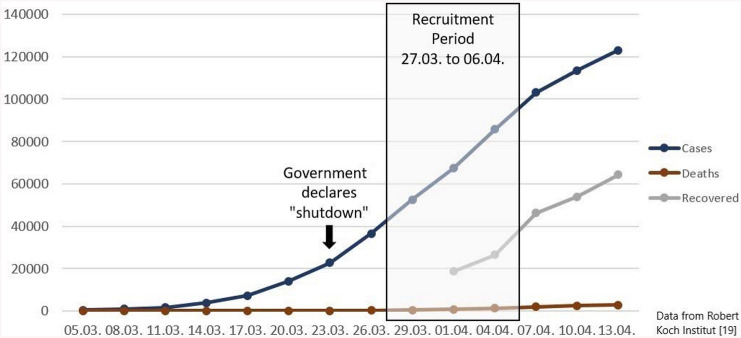
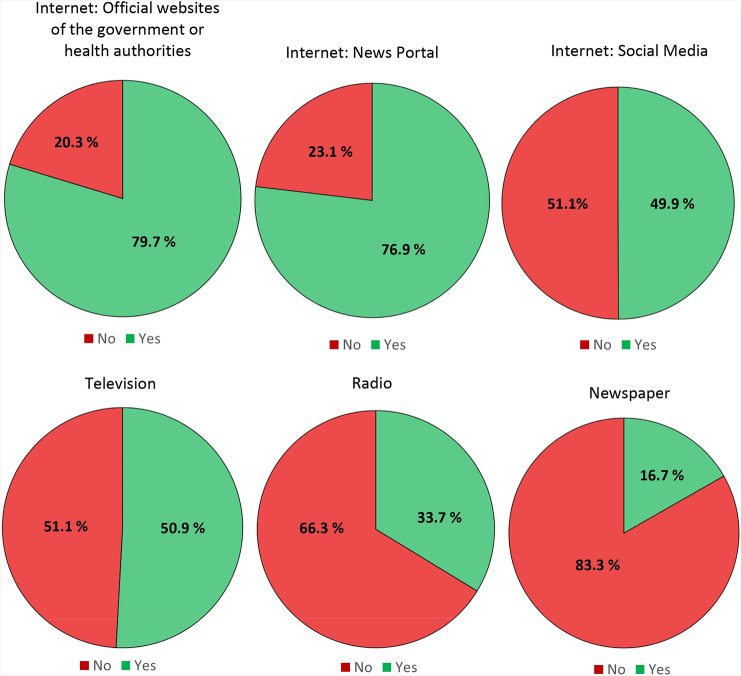
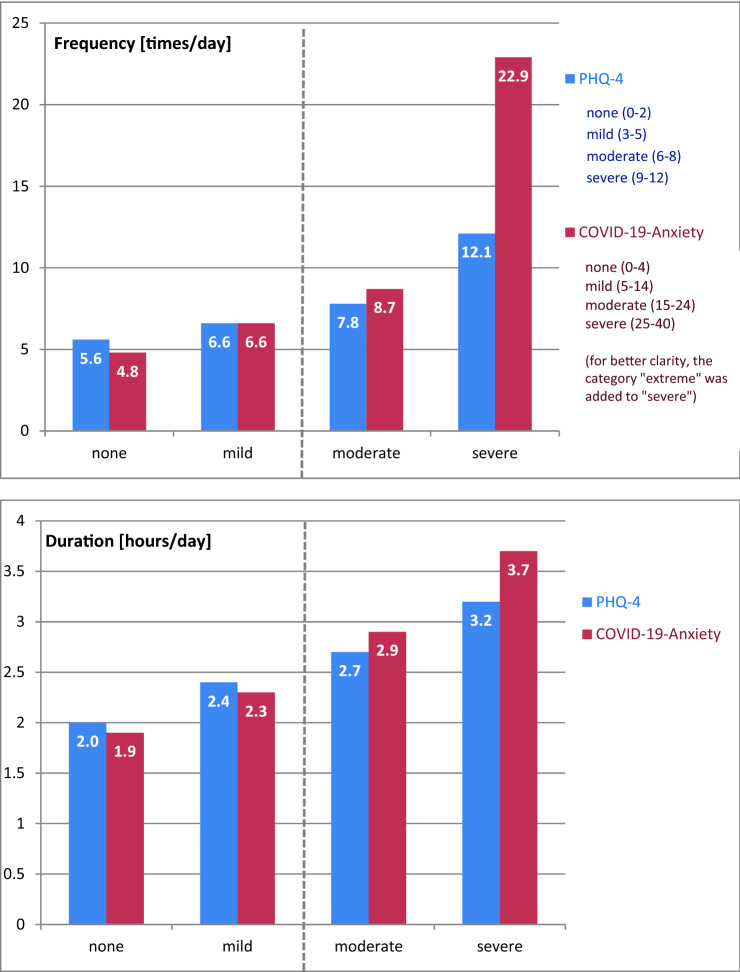
In context of the current COVID-19 pandemic the consumption of pandemic-related media coverage may be an important factor that is associated with anxiety and psychological distress. Aim of the study was to examine those associations in the general population in Germany. 6233 participants took part in an online-survey (March 27th–April 6th, 2020), which included demographic information and media exploitation in terms of duration, frequency and types of media. Symptoms of depression, unspecific anxiety and COVID-19 related anxiety were ascertained with standardized questionnaires. Frequency, duration and diversity of media exposure were positively associated with more symptoms of depression and unspecific and COVID-19 specific anxiety. We obtained the critical threshold of seven times per day and 2.5 h of media exposure to mark the difference between mild and moderate symptoms of (un)specific anxiety and depression. Particularly the usage of social media was associated with more pronounced psychological strain. Participants with pre-existing fears seem to be particularly vulnerable for mental distress related to more immoderate media consumption. Our findings provide some evidence for problematical associations of COVID-19 related media exposure with psychological strain and could serve as an orientation for recommendations—especially with regard to the thresholds of critical media usage.
Overview
The claims and statistics of this paper haven’t been checked yet.
Free: it reads the open-access text and checks the first 5 claims that cite a source we can check. Create a free account to check every claim.
Integrity signals
Registry
Cites
Statistics
Figures
Verification
Claims the paper makes
The claims and statistics of this paper haven’t been checked yet.
Free: it reads the open-access text and checks the first 5 claims that cite a source we can check. Create a free account to check every claim.
Claims other papers make about this one
Each is checked against this paper’s own text: does it say what the citing paper says it does?
The source backs part of the claim, not all of it — or backs it for a different population, condition or comparison.
In the citing paper
“This negative impact on the psychological state has been found to be more pronounced in social media than in traditional media [64,68,71-73].”
From Impact of Media-Induced Uncertainty on Mental Health: Narrative-Based Perspective. (2025) · cites this paper as [64]
Experimental — accuracy not yet measuredThe source backs part of the claim, not all of it — or backs it for a different population, condition or comparison.
In the citing paper
“These effects include heightened levels of anxiety [64], depression [64,65], psychological distress [66,67], posttraumatic stress symptoms [68], schizotypal traits [69], and substance use [70].”
From Impact of Media-Induced Uncertainty on Mental Health: Narrative-Based Perspective. (2025) · cites this paper as [64]
Experimental — accuracy not yet measuredThe source backs part of the claim, not all of it — or backs it for a different population, condition or comparison.
In the citing paper
“As noted earlier, robust evidence has shown a positive association between the frequency and total time spent watching or reading media news and symptoms of mental distress, highlighting the need to limit media exposure [10,64,66,166].”
From Impact of Media-Induced Uncertainty on Mental Health: Narrative-Based Perspective. (2025) · cites this paper as [64]
Experimental — accuracy not yet measuredThe source backs part of the claim, not all of it — or backs it for a different population, condition or comparison.
In the citing paper
“Such media consumption behaviors are linked to increased anxiety, depression, and stress, making interventions that focus on reducing media exposure especially beneficial for this cohort [64,76].”
From Impact of Media-Induced Uncertainty on Mental Health: Narrative-Based Perspective. (2025) · cites this paper as [64]
Experimental — accuracy not yet measuredThe cited source says what the claim attributes to it.
In the citing paper
“Specifically, Bendau et al [64] reported that the critical threshold of 7 times per day and 2.5 hours of media exposure differentiates between mild and moderate symptoms of anxiety and depression.”
From Impact of Media-Induced Uncertainty on Mental Health: Narrative-Based Perspective. (2025) · cites this paper as [64]
Self-check
Percentages, sums and reported differences re-computed from the paper’s own numbers.
The self-check needs the paper’s full text.
Citations
Cites
Wang, C., Pan, R., Wan, X., Tan, Y., Xu, L., Ho, C. S., & Ho, R. C. (2020) · International Journal of Environmental Research and Public Health · doi:10.3390/ijerph17051729 · Cited by 9,923
Qiu, J., Shen, B., Zhao, M., Wang, Z., Xie, B., & Xu, Y. (2020) · General Psychiatry · doi:10.1136/gpsych-2020-100213 · Cited by 4,307
An Ultra-Brief Screening Scale for Anxiety and Depression: The PHQ–4
Kroenke, K., Spitzer, R. L., Williams, J. B. W., & Löwe, B. (2009) · Psychosomatics · doi:10.1016/s0033-3182(09)70864-3 · Cited by 4,261 · cited 1×
“The validated ultra-brief screening scale of the Patient Health Questionnaire-4 PHQ-4; [22, 23] was included to screen for general anxiety and depressive symptoms.”
MethodMental health problems and social media exposure during COVID-19 outbreak
Gao, J., Zheng, P., Jia, Y., Chen, H., Mao, Y., Chen, S., Wang, Y., Fu, H., & Dai, J. (2020) · PLoS ONE · doi:10.1371/journal.pone.0231924 · Cited by 2,830
Mental Health Problems and Social Media Exposure During COVID-19 Outbreak
Gao, J., Zheng, P., Jia, Y., Chen, H., Mao, Y., Chen, S., Wang, Y., Fu, H., & Dai, J. (2020) · SSRN Electronic Journal · doi:10.2139/ssrn.3541120 · Cited by 2,830
Löwe, B., Wahl, I., Rose, M., Spitzer, C., Glaesmer, H., Wingenfeld, K., Schneider, A., & Brähler, E. (2010) · Journal of Affective Disorders · doi:10.1016/j.jad.2009.06.019 · Cited by 2,473
Schlenger, W. E., Caddell, J. M., Ebert, L., Jordan, B. K., Rourke, K. M., Wilson, D., Thalji, L., Dennis, J. M., Fairbank, J. A., & Kulka, R. A. (2002) · JAMA · doi:10.1001/jama.288.5.581 · Cited by 1,133
Media’s role in broadcasting acute stress following the Boston Marathon bombings
Holman, E. A., Garfin, D. R., & Silver, R. C. (2014) · Proceedings of the National Academy of Sciences · doi:10.1073/pnas.1316265110 · Cited by 513
Understanding the mental health effects of indirect exposure to mass trauma through the media
Neria, Y., & Sullivan, G. M. (2011) · JAMA · doi:10.1001/jama.2011.1358 · Cited by 240
Umgang mit psychischer Belastung bei Gesundheitsfachkräften im Rahmen der Covid-19-Pandemie
Petzold, M. B., Plag, J., & Ströhle, A. (2020) · Der Nervenarzt · doi:10.1007/s00115-020-00905-0 · Cited by 212
Self-citation
Research works printed but not linked: 2
- Petzold MB Plag J Ströhle A COVID-19-Pandemie—Psychische Belastungen können reduziert werden Deutsches Ärzteblatt 2020 117 13 648 654
- World Health Organization Mental health and psychosocial considerations during the COVID-19 outbreak, 18 March 2020 2020 Geneva World Health Organization
Cited by
Items 301–376 of 376
Vermeer, A. B. L., Muth, A.-K., Terenzi, D., & Park, S. Q. (2021) · doi:10.31234/osf.io/me254 · Cited by 1
Grover, H. (2022) · SSRN Electronic Journal · doi:10.2139/ssrn.4122786 · Cited by 1
Impact of digital stress on negative emotions and physical complaints in the home officePreprint
Wrede, S. J. S., Claaßen, K., dos Anjos, D. R., Kettschau, J. P., & Broding, H. C. (2022) · Research Square · doi:10.21203/rs.3.rs-2394404/v1 · Cited by 1
Covid-19 in Indonesia: Threat and Fear of Family Instability
Hasan, S., Bachri, S., Ramadhita, R., Fakhruddin, F., & Zuhriah, E. (2021) · Advances in Social Science, Education and Humanities Research/Advances in social science, education and humanities research · doi:10.2991/assehr.k.210421.045 · Cited by 4
“Bendau's research shows that increased anxiety about COVID-19 is influenced by media coverage [4].”
BackgroundScattoni, M. L., Starace, F., de Girolamo, G., & Xia, J. (2021) · Frontiers in Public Health · doi:10.3389/fpubh.2021.640205 · Cited by 1
“All Italian people suddenly experienced confinement at home, physical distancing, while simultaneously receiving dramatic news from all media concerning the pandemic evolution and hospital emergencies, with potential negative impacts on the mental health of the people, as shown in a recent German study (1).”
BackgroundLanders, J. (2021) · Social Work & Christianity · doi:10.34043/swc.v48i4.249 · Cited by 1
No meaningful effects of COVID-19 related social media use on well-beingPreprint
Dienlin, T. (2021) · doi:10.31235/osf.io/wmrfx
Battling Against COVID-19 Infodemic in Indonesia: A Sociocybernetics Perspective
Putri, L., & Rafly, R. F. (2021) · Journal of Asian Social Science Research · doi:10.15575/jassr.v3i2.41
“2020; Bendau et al .”
Illness and Death in the Covid Epoch
Briggs, D., Telford, L., Lloyd, A., Ellis, A., & Kotzé, J. (2021) · Springer eBooks · doi:10.1007/978-3-030-88825-1_3
Determınıng The Psychosocıal Effects Of The Coronavırus (Covıd-19) Pandemıc
Bayageldi, N. K. (2022) · Journal of Psychiatric Nursing · doi:10.14744/phd.2022.45712
Gender, Social media Use, and Fear of COVID-19 among Ghanaian University StudentsPreprint
Malm, E. K., Oti-Boadi, M., Dey, N. E. Y., Adade, A. E., & Ocansey, G. (2022) · Research Square · doi:10.21203/rs.3.rs-1519483/v1
Choudhury, S., Bhuvaneshwari, S., Manohar, B., Dash, P., Goel, S., & Mathur, H. (2022) · International Journal of Health Sciences · doi:10.53730/ijhs.v6ns1.5621
“They already faced a lot of mental pressure due to academic burden, pre-clinicals ,completion of quota in colleges ,lack of confidence, internals and professional exams pressure and Covid-19 added more to it.[5,6]Furthermore, the disruption of most occupations, as well as the negative impact of the lockdown on the eco…”
BackgroundAriyanti, L., & Dinata, F. A. (2022) · JURNAL KREATIVITAS PENGABDIAN KEPADA MASYARAKAT (PKM) · doi:10.33024/jkpm.v5i5.4919
Ahmed, M. S., Abid, R., & Ahmed, N. (2022) · PsyArXiv (OSF Preprints) · doi:10.31234/osf.io/8hvbj
Socjalizacja ekonomiczna dzieci w zdalnym nauczaniu w ramach projektu Oczy Szeroko Otwarte
Bajak, M., & Manczak, I. (2022) · Przegląd Prawno-Ekonomiczny · doi:10.31743/ppe.13470
Asa, G. A., Fauk, N. K., Ratu, M., Dent, E., & Ward, P. (2022) · medRxiv · doi:10.1101/2022.08.22.22278860
Safitri, R. G., & Qonitatin, N. (2021) · Jurnal EMPATI · doi:10.14710/empati.2021.32602
Age-related Eye Tracking Study of Reading COVID-19 Texts with Negative Elements
Popov, A. O., Ivaskevych, D., Тукаєв, С., Havrylets, Y., Petrenko-Lysak, A., Yachnik, Y., & Rizun, V. (2022) · IEEE International Conference on Electronics and Nanotechnology (ELNANO) · doi:10.1109/elnano54667.2022.9927118
“The first cause is lifestyle changes associated with the COVID-19 pandemic [3].”
BackgroundSuicidal Ideation of Healthcare Workers During COVID-19: An Ecological Momentary Assessment
Genest, C., Bergeron, N., Provost-Tremblay, É., Dufour, M., Guay, S., & Geoffrion, S. (2022) · Science of Nursing and Health Practices · doi:10.7202/1095201ar · Cited by 1
“Moreover, the German study by Bendau et al. (2021) in the general population found that the frequent viewing of media content was positively correlated with anxiety (r=0.25, p<0.001) and depression (r=0.21, p<0.001) during the COVID-19 pandemic.”
BackgroundInfluentialWorriers of the Pandemic: How People with Mental Disorders Cope with COVID-19 Restrictions
Zinchuk, M., Pashnin, E., Kustov, G., Popova, S. B., Voinova, N., Gersamia, A., Yakovlev, A. A., & Guekht, A. B. (2022) · Current Psychiatry Research and Reviews · doi:10.2174/2666082219666221226151805
Impact of digital stress on negative emotions and physical complaints in the home officePreprint
Wrede, S. J. S., Claaßen, K., dos Anjos, D. R., Kettschau, J. P., & Broding, H. C. (2023) · Research Square · doi:10.21203/rs.3.rs-2394404/v2 · Cited by 2
Research on Behavior Changes of Chinese College Students on Weibo in the Context of COVID-19
Ma, M., Xie, M., & Yang, E. (2022) · Proceedings of the 2022 International Conference on Science Education and Art Appreciation (SEAA 2022) · doi:10.2991/978-2-494069-05-3_171
Folgen der Pandemie auf die psychische Gesundheit
Probst, G. H., & Flückiger, C. (2023) · PiD - Psychotherapie im Dialog · doi:10.1055/a-1879-0813
“[11] Bendau A, Petzold MB, Pyrkosch L et al.”
Hodalska, M., Lisowska-Magdziarz, M., & Całek, A. (2023) · Zeszyty Prasoznawcze · doi:10.4467/22996362pz.23.004.17196
Watts, Farman, & van Woerden (2023) · Rural and Remote Health · doi:10.22605/rrh7136
Age-related differences in fixation gaze length while reading the news with negative text elements
Ivaskevych, D., Popov, A. O., Rizun, V., Havrylets, Y., Petrenko-Lysak, A., Yachnik, Y., & Тукаєв, С. (2023) · East European Journal of Psycholinguistics · doi:10.29038/eejpl.2023.10.1.iva · Cited by 2
Climate Change, Environmental Pollution and Covid-19 Pandemic: The Triangle Impacts on Mental Health
Haron, N. F., Sapuan, N. M., Kumaran, V. V., Saudi, N. S. M., & Ridzuan, A. R. (2023) · Environmental Management and Sustainable Development · doi:10.5296/emsd.v12i2.21051
Liang, J., Aranda, M., & Jang, Y. (2023) · The Gerontologist · doi:10.1093/geront/gnad122 · Cited by 1
Schmachtenberg, T., Wegener, G., Königs, G., Müller, F., Müllenmeister, C., & Schröder, D. (2023) · Archives of Microbiology & Immunology · doi:10.26502/ami.936500131
Özkan, G. Ö., Canyolu, B. A., Devrim-Lanpir, A., Güzeldere, H. K. B., İlktaç, H. Y., Güler, K. Y., & Güneş, F. E. (2023) · Research Square · doi:10.21203/rs.3.rs-3693376/v1
Bayer, A., White, S. V., & Ehrenreich, S. E. (2023) · Oxford University Press eBooks · doi:10.1093/oso/9780197615133.003.0022
Predictors of News Media Use in the COVID-19 Pandemic. A Brief Research Report
Iwanowska, M., Kondratowicz, B., & Zawadzka, A. M. (2023) · Przegląd Psychologiczny · doi:10.31648/przegldpsychologiczny.9245
Pelin, Y., Cemal, K., Uri, C., Rabia, K., & Ersin, A. (2024) · Archives of Preventive Medicine · doi:10.17352/apm.000034
Ali, R., Qasim, H., & Naqvi, S. (2024) · Journal of Entrepreneurship and Business Venturing · doi:10.56536/jebv.v4i1.77
“…in Germany in which data was collected from 623 participants through an online survey, concluded that the media consumption regarding COVID-19 by people suffering from preexisting fears leads to anxiety among them, especially when the media consumption is more than moderate (Bendau et al., 2021).”
BackgroundDíaz, C. M. C., Alba‐Marrugo, M. A., Tungjitcharoen, W., García, N. B., & Lieberoth, A. (2024) · Observatorio (OBS*) · doi:10.15847/obsobs18120242300
“These findings are supported by Bendau et al. (2021), who found that media consumption and information-seeking behaviour about COVID-19 increased symptoms of depression, unspecific anxiety, and pre-existing fears in the studied population.”
BackgroundResultUntil the shaken snowglobe settles: Feeling unsettled when using social media during COVID-19
Landrum, B., & Garza, G. J. (2024) · Cyberpsychology Journal of Psychosocial Research on Cyberspace · doi:10.5817/cp2024-2-8 · Cited by 1
Lassri, D., Gewirtz‐Meydan, A., & Nolte, T. (2024) · Child Abuse & Neglect · doi:10.1016/j.chiabu.2024.106808
Svestkova, A., Šmahel, D., & Dědková, L. (2024) · SSRN Electronic Journal · doi:10.2139/ssrn.4816909
Anupansupsai, R., Saisavoey, N., Supavekin, S., Ratta‐apha, W., Lortrakul, J., & Hataiyusuk, S. (2024) · Siriraj Medical Journal/San Sirirat · doi:10.33192/smj.v76i5.267324 · Cited by 1
Svestkova, A., Šmahel, D., & Dědková, L. (2024) · SSRN Electronic Journal · doi:10.2139/ssrn.4859492 · Cited by 1
Characteristics of sleep disturbance across two waves of the COVID-19 pandemic among nursing staffs
Wu, P.-J., Wang, W. C., Liu, C.-L., Lin, G., Lo, Y.-Y., & Chou, F. H. (2024) · Sleep Medicine X · doi:10.1016/j.sleepx.2024.100120
“However, the frequency, duration, and variety of media exposure are positively associated with more depressive symptoms, non-specific anxiety, and COVID-19-specific anxiety [55].”
BackgroundGetsova, Z., & Rangelova, V. (2024) · Heliyon · doi:10.1016/j.heliyon.2024.e36575 · Cited by 1
“A study describes a positive correlation between media usage for information on COVID-19 and anxiety symptoms [15].”
BackgroundMastino, A., Pettinau, F., Palla, P., Ozzella, G., Grosso, M., & Pittau, B. (2024) · Journal of Pharmaceutical Policy and Practice · doi:10.1080/20523211.2024.2418366
“Studies have shown that misinformation on social media and unprecedented quarantine measures exacerbate panic (Bendau et al., 2021; Dong & Bouey, 2020).”
BackgroundHanda, S. (2025) · International Journal of Indian Psychology · doi:10.25215/1301.030
Effects of COVID-19 related social media use on well-being
Dienlin, T. (2025) · Scientific Reports · doi:10.1038/s41598-025-91385-2 · Cited by 3
The influence of negative news in regional media on the financial behavior of the population
Pomulev, A. A., & Батаева, Б. С. (2025) · Finance and Credit · doi:10.24891/fc.31.3.105
Online media reporting of global mortality rates and causes: a content analysisPreprint
Treharne, T., & Heneghan, C. (2025) · medRxiv · doi:10.1101/2025.04.22.25326092
Desai, T. (2025) · Preprints.org · doi:10.20944/preprints202505.0537.v1
Epojé digital y juicio crítico: prácticas informativas juveniles en entornos de sobreinformación
Alvarez, A. F. N., & Fierro, C. S. E. (2025) · Religación · doi:10.46652/rgn.v10i46.1485
Psychological and Behavioral Impact of Disasters in the Time of COVID-19
Morganstein, J. C. (2025) · Psychoanalytic Inquiry · doi:10.1080/07351690.2025.2561369
“The media also transmits fear and distress, and research has consistently found that increasing exposure to disaster-related media associated with increased rates of insomnia, alcohol use, depression, post-traumatic stress, and general psychological distress (Bendau et al., 2020).”
Svestkova, A., Šmahel, D., & Dědková, L. (2025) · Journal of Medical Internet Research · doi:10.2196/66129 · Cited by 1
“Alternatively, any possible long-term impact might have been overshadowed by external factors, such as the COVID-19 pandemic, which has significantly influenced both anxiety levels [48] and online engagement with health-related information [49].”
Li, Q., Peng, K., Liu, X., Sun, Z., Guo, Y. Q., & Liu, P. L. (2025) · SAGE Open · doi:10.1177/21582440251386773
“Bendau et al. (2021) found that frequent and prolonged media consumption might raise fear of the pandemic.”
The Influence of Anxiety During The COVID-19 Pandemic on The Selection of Nutritional Supplements
Özkan, G. Ö., Canyolu, B. A., Devrim-Lanpir, A., Güzeldere, H. K. B., İlktaç, H. Y., Yıldız, K., & Güneş, F. E. (2025) · Van Sağlık Bilimleri Dergisi · doi:10.52976/vansaglik.1640106
Jabarali, A. K., Kanimozhi, S., Nilofer, A., & Williams, J. W. (2026) · Communications in Statistics Case Studies Data Analysis and Applications · doi:10.1080/23737484.2026.2613831
“Studies such as Gao et al. (2020) and Bendau et al. (2021) reported that pandemic-related media exposure heightened anxiety and emotional distress.”
Impact of AI and ML in Healthcare, Education, and Mental Health
Srivastava, S., Taneja, S., Dhara, C., & Raheja, S. (2026) · Advanced technologies and societal change · doi:10.1007/978-981-95-0800-6_5
Jiang, M., Liu, L., Huang, X., Yao, Y., Feng, J., & Ma, Z. (2026) · Geriatric Nursing · doi:10.1016/j.gerinurse.2026.103916
Tüfekçi, Ş., Turhan, F. H., İnce, U., TÜFEKÇİ, S., Özkeskin, M., Aygün, Y., Canpolat, B., & Aslan, T. V. (2026) · Research Square · doi:10.21203/rs.3.rs-8899242/v1
Tefertiller, A. C., Cozma, R., Muturi, N., & Groshek, J. (2026) · Electronic News · doi:10.1177/19312431261432638
“Mindlessly and persistently scrolling through social media feeds with a fi xation on distressing news has been associated with negative effects like depression as well as neglect of other healthy activities, such as taking a break or attending to one ’ s family ’ s needs (Bendau et al., 2021).”
The role of meaning violations in distress following COVID-19 pandemic stressors
Seidel-Koulaxis, L. J., Daniels, J. K., & Ostafin, B. D. (2026) · Psychology and Health · doi:10.1080/08870446.2026.2648618
Kittur, M. E., Jones, B. D. M., Imran, S., Wang, W., Chen, S., & Husain, M. I. (2026) · PLoS ONE · doi:10.1371/journal.pone.0346913
Minimierung toxischer Substanzen: Ein unverzichtbarer Bestandteil der Life-Style Psychiatrie
Sugden, S. G., & Betzler, F. (2026) · Nervenheilkunde · doi:10.1055/a-2839-0497
“Einsamkeit, Entfremdung, ein schlechtes Körperbild, Ess-störungen und Suizidalität bei Teenagern.”
Self-citationDevelopment and validation of a short doomscrolling scale
Kazun, A. D. (2026) · Moscow University Journalism Bulletin · doi:10.55959/msu.vestnik.journ.1.2026.335
Pandemie als Herausforderung für die Gesundheitskommunikation
Reifegerste, D., & Wagner, A. (2026) · Springer eBooks · doi:10.1007/978-3-658-47239-9_6-1
Wielgus, B., & Cichocki, Ł. (2026) · Psychiatria i Psychologia Kliniczna · doi:10.15557/pipk.2026.0003
Dopelt, K. (2026) · International Journal of Intercultural Relations · doi:10.1016/j.ijintrel.2026.102445
Sheltering through media: Dispositions and wartime uses-and-gratifications
Ariel, Y., Elishar-Malka, V., & Saks, D. W. (2026) · Atlantic Journal of Communication · doi:10.1080/15456870.2026.2687622
Kaya, F., & Türkkan, T. (2026) · Behavioral Sciences · doi:10.3390/bs16081339 · Cited by 1
“Similar patterns were observed during the COVID-19 pandemic, when excessive exposure to threat-related media content was linked to increased fear and poorer mental health outcomes (Bendau et al., 2021; Sasaki et al., 2020).”
Čirjak, M., Kathirgamalingam, A., Betakova, D., Ali, K. P. S., & Boomgaarden, H. G. (2026) · Mass Communication & Society · doi:10.1080/15205436.2026.2714269
Who Frames Europe? Euroscepticism, Radical Right Parties and Elite Twitter Communication
Kovář, J. (2026) · JCMS Journal of Common Market Studies · doi:10.1111/jcms.70157
Digital media engagement and its relationship with depression severity
Syed, A., Preiss, M., Grygarová, D., Podaná, Z., & Horáček, J. (2026) · Frontiers in Psychology · doi:10.3389/fpsyg.2026.1926446
Metadata
- Authors
- Bendau, A., Petzold, M. B., Pyrkosch, L., Mascarell Maricic, L., Betzler, F., Rogoll, J., Große, J., Ströhle, A., & Plag, J.
- Affiliations
- Humboldt-Universität zu Berlin (DE)
- Corresponding author
- Plag, Jens
- ORCID
- Venue
- European Archives of Psychiatry and Clinical Neuroscience
- Published
- 2020-07-20
- Volume
- 271
- Issue
- 2
- Pages
- 283-291
- ISSN
- 0003-9373 (ISSN-L)
- 0940-1334
- 1433-8491
- PMC
- PMC7371788
- OpenAlex
- W3042228059
- Cited by
- 376
- References
- 16
- Citations by year
- 2026: 21 · 2025: 21 · 2024: 35 · 2023: 64 · 2022: 107 · 2021: 118 · 2020: 10
- FWCI
- 29.92
- Type
- journal article
- Language
- en
- Update notices
- correction (2021-07-17)
- Open access
- hybrid
- doi.org
- Licence
- cc-by
- creativecommons.org/licenses/by/4.0 (tdm)
- creativecommons.org/licenses/by/4.0 (vor)
- Locations
- European Archives of Psychiatry and Clinical Neuroscience (publishedVersion, cc-by)
- PubMed Central (publishedVersion, cc-by)
- PubMed (publishedVersion)
- Refubium (Universitätsbibliothek der Freien Universität Berlin) (submittedVersion, cc-by)
- Universitätsbibliothek der FU Berlin Hochschulschriftenstelle u. Dokumentenserver (cc-by)
- Topics
- Social Sciences › Psychology › Clinical Psychology › COVID-19 and Mental Health
- Social Sciences › Communication › Communication and COVID-19 Impact
- Social Sciences › Sociology and Political Science › Impact of Technology on Adolescents
- Keywords
- COVID-19 pandemic, media use, anxiety, depression, psychological distress, social media use, general population
- MeSH terms
- Psychological Distress, COVID-19, Adolescent, Adult, Aged, Aged, 80 and over, Anxiety, Cross-Sectional Studies, Depression, Fear, Female, Germany, Humans, Male, Mass Media, Middle Aged, Surveys and Questionnaires, Young Adult, Pandemics
About these checks
Registry, retraction, Cites and statistics results are computed, not judged, with one exception: a printed reference that no index lists is read once by a model before it counts as a citation error. Claims are extracted by a model and kept only when their quote appears verbatim in the text; each cited source is then checked, with a model’s help, for whether it says what the claim relies on. Those verdicts can be wrong — read the claim’s quote and the cited source before relying on one.
Statistics and arithmetic are recomputed, not judged.
Confidence bands are shown only for fields calibrated on our annotated test set. None is calibrated yet, so no band is shown.
What counts as a claim ›How we measure confidence ›How we check this ›
Are you an author, or do you see a problem with this page? Request a review
Data sources
Bibliographic data: Semantic Scholar, OpenAlex, Crossref.
Contains information from the Semantic Scholar Academic Graph Datasets, made available under the ODC Attribution License (ODC-BY 1.0).
Semantic Scholar’s data is described in: Kinney, R., et al. (2023). The Semantic Scholar Open Data Platform. arXiv:2301.10140.
