

Associations between COVID-19 related media consumption and symptoms of anxiety, depression and COVID-19 related fear in the general population in Germany
Open accessThe DOI matches its Crossref record; 17 of the 17 references it cites were found in a registry or an index.
Abstract
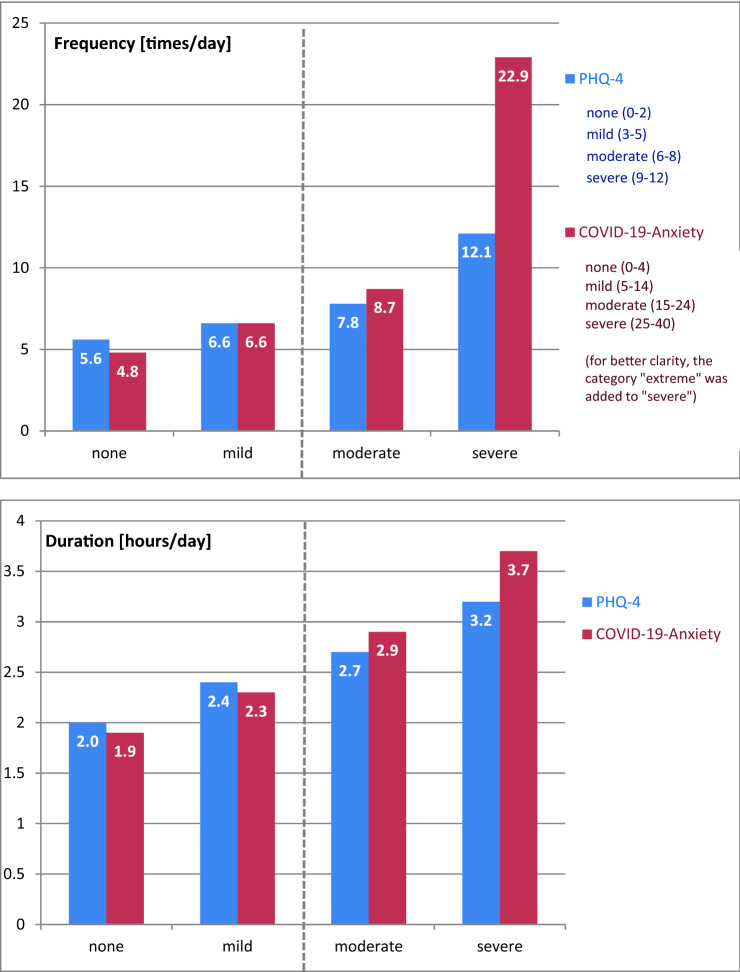
In context of the current COVID-19 pandemic the consumption of pandemic-related media coverage may be an important factor that is associated with anxiety and psychological distress. Aim of the study was to examine those associations in the general population in Germany. 6233 participants took part in an online-survey (March 27th–April 6th, 2020), which included demographic information and media exploitation in terms of duration, frequency and types of media. Symptoms of depression, unspecific anxiety and COVID-19 related anxiety were ascertained with standardized questionnaires. Frequency, duration and diversity of media exposure were positively associated with more symptoms of depression and unspecific and COVID-19 specific anxiety. We obtained the critical threshold of seven times per day and 2.5 h of media exposure to mark the difference between mild and moderate symptoms of (un)specific anxiety and depression. Particularly the usage of social media was associated with more pronounced psychological strain. Participants with pre-existing fears seem to be particularly vulnerable for mental distress related to more immoderate media consumption. Our findings provide some evidence for problematical associations of COVID-19 related media exposure with psychological strain and could serve as an orientation for recommendations—especially with regard to the thresholds of critical media usage.
Overview
The claims and statistics of this paper haven’t been checked yet.
Free: it reads the open-access text and checks the first 5 claims that cite a source we can check. Create a free account to check every claim.
Integrity signals
Registry
Cites
Statistics
Figures
Verification
Claims the paper makes
The claims and statistics of this paper haven’t been checked yet.
Free: it reads the open-access text and checks the first 5 claims that cite a source we can check. Create a free account to check every claim.
Claims other papers make about this one
Each is checked against this paper’s own text: does it say what the citing paper says it does?
The source backs part of the claim, not all of it — or backs it for a different population, condition or comparison.
In the citing paper
“This negative impact on the psychological state has been found to be more pronounced in social media than in traditional media [64,68,71-73].”
From Impact of Media-Induced Uncertainty on Mental Health: Narrative-Based Perspective. (2025) · cites this paper as [64]
Experimental — accuracy not yet measuredThe source backs part of the claim, not all of it — or backs it for a different population, condition or comparison.
In the citing paper
“These effects include heightened levels of anxiety [64], depression [64,65], psychological distress [66,67], posttraumatic stress symptoms [68], schizotypal traits [69], and substance use [70].”
From Impact of Media-Induced Uncertainty on Mental Health: Narrative-Based Perspective. (2025) · cites this paper as [64]
Experimental — accuracy not yet measuredThe source backs part of the claim, not all of it — or backs it for a different population, condition or comparison.
In the citing paper
“As noted earlier, robust evidence has shown a positive association between the frequency and total time spent watching or reading media news and symptoms of mental distress, highlighting the need to limit media exposure [10,64,66,166].”
From Impact of Media-Induced Uncertainty on Mental Health: Narrative-Based Perspective. (2025) · cites this paper as [64]
Experimental — accuracy not yet measuredThe source backs part of the claim, not all of it — or backs it for a different population, condition or comparison.
In the citing paper
“Such media consumption behaviors are linked to increased anxiety, depression, and stress, making interventions that focus on reducing media exposure especially beneficial for this cohort [64,76].”
From Impact of Media-Induced Uncertainty on Mental Health: Narrative-Based Perspective. (2025) · cites this paper as [64]
Experimental — accuracy not yet measuredThe cited source says what the claim attributes to it.
In the citing paper
“Specifically, Bendau et al [64] reported that the critical threshold of 7 times per day and 2.5 hours of media exposure differentiates between mild and moderate symptoms of anxiety and depression.”
From Impact of Media-Induced Uncertainty on Mental Health: Narrative-Based Perspective. (2025) · cites this paper as [64]
Self-check
Percentages, sums and reported differences re-computed from the paper’s own numbers.
The self-check needs the paper’s full text.
Citations
Cites
Wang, C., Pan, R., Wan, X., Tan, Y., Xu, L., Ho, C. S., & Ho, R. C. (2020) · International Journal of Environmental Research and Public Health · doi:10.3390/ijerph17051729 · Cited by 9,923
Qiu, J., Shen, B., Zhao, M., Wang, Z., Xie, B., & Xu, Y. (2020) · General Psychiatry · doi:10.1136/gpsych-2020-100213 · Cited by 4,307
An Ultra-Brief Screening Scale for Anxiety and Depression: The PHQ–4
Kroenke, K., Spitzer, R. L., Williams, J. B. W., & Löwe, B. (2009) · Psychosomatics · doi:10.1016/s0033-3182(09)70864-3 · Cited by 4,261 · cited 1×
“The validated ultra-brief screening scale of the Patient Health Questionnaire-4 PHQ-4; [22, 23] was included to screen for general anxiety and depressive symptoms.”
MethodMental health problems and social media exposure during COVID-19 outbreak
Gao, J., Zheng, P., Jia, Y., Chen, H., Mao, Y., Chen, S., Wang, Y., Fu, H., & Dai, J. (2020) · PLoS ONE · doi:10.1371/journal.pone.0231924 · Cited by 2,830
Mental Health Problems and Social Media Exposure During COVID-19 Outbreak
Gao, J., Zheng, P., Jia, Y., Chen, H., Mao, Y., Chen, S., Wang, Y., Fu, H., & Dai, J. (2020) · SSRN Electronic Journal · doi:10.2139/ssrn.3541120 · Cited by 2,830
Löwe, B., Wahl, I., Rose, M., Spitzer, C., Glaesmer, H., Wingenfeld, K., Schneider, A., & Brähler, E. (2010) · Journal of Affective Disorders · doi:10.1016/j.jad.2009.06.019 · Cited by 2,473
Schlenger, W. E., Caddell, J. M., Ebert, L., Jordan, B. K., Rourke, K. M., Wilson, D., Thalji, L., Dennis, J. M., Fairbank, J. A., & Kulka, R. A. (2002) · JAMA · doi:10.1001/jama.288.5.581 · Cited by 1,133
Media’s role in broadcasting acute stress following the Boston Marathon bombings
Holman, E. A., Garfin, D. R., & Silver, R. C. (2014) · Proceedings of the National Academy of Sciences · doi:10.1073/pnas.1316265110 · Cited by 513
Understanding the mental health effects of indirect exposure to mass trauma through the media
Neria, Y., & Sullivan, G. M. (2011) · JAMA · doi:10.1001/jama.2011.1358 · Cited by 240
Umgang mit psychischer Belastung bei Gesundheitsfachkräften im Rahmen der Covid-19-Pandemie
Petzold, M. B., Plag, J., & Ströhle, A. (2020) · Der Nervenarzt · doi:10.1007/s00115-020-00905-0 · Cited by 212
Self-citation
Research works printed but not linked: 2
- Petzold MB Plag J Ströhle A COVID-19-Pandemie—Psychische Belastungen können reduziert werden Deutsches Ärzteblatt 2020 117 13 648 654
- World Health Organization Mental health and psychosocial considerations during the COVID-19 outbreak, 18 March 2020 2020 Geneva World Health Organization
Cited by
Items 201–300 of 376
Predictors of third-person perceptions about media's influence on vaccination against COVID-19
Buturoiu, R., Vladu, L., Durach, F., & Dumitrache, A. C. (2021) · Kybernetes · doi:10.1108/k-10-2021-0975 · Cited by 7
Letter to the editor: chronic pain tidal wave after COVID-19: are you ready?
Louw, A. (2020) · Physiotherapy Theory and Practice · doi:10.1080/09593985.2020.1840717 · Cited by 8
“…contact, isolation, fear of illness, future uncertainty, media coverage, financial strain, and concerns about “secondwaves” would have the potential to add to increased rates of anxiety and fear (Bendau et al., 2020; Clauw, Hauser, Cohen, and Fitzcharles, 2020; Mahmud, Talukder, and Rahman, 2020).”
BackgroundMejia, C. R., Serna-Alarcón, V., Vilela-Estrada, M. A., Armada, J., Ubillus, M., Beraún-Barrantes, J., Álvarez-Risco, A., Del-Aguila-Arcentales, S., Davies, N. M., & Yáñez, J. A. (2024) · Frontiers in Public Health · doi:10.3389/fpubh.2023.1302694 · Cited by 5
Elers, P., & Dutta, M. J. (2023) · Communication Monographs · doi:10.1080/03637751.2022.2164321 · Cited by 5
“, 2020), but could also increase anxiety in COVID-19 information seeking (Bendau et al., 2021; Ebrahim et al., 2020; Liu, 2020; Price et al., 2022) and raised concerns about the intensification of digital inequalities that could disadvantage low-”
BackgroundLi, J., Fong, D., Ho, M. M., Choi, E. P. H., Lok, K. Y. W., Lee, J. J., Duan, W., Wong, J. Y. H., & Lin, C. (2024) · Journal of Medical Internet Research · doi:10.2196/53321 · Cited by 5
“Finally, infection concerns and COVID-19 exposure negatively impact only the high screen time group, possibly increasing stress and reducing productivity [35].”
BackgroundBreadTube Rising: How Modern Creators Use Cultural Formats to Spread Countercultural Ideology
Sylvia, J., & Moody, K. (2022) · CLCWeb Comparative Literature and Culture · doi:10.7771/1481-4374.4291 · Cited by 5
Lewis, N., & Sznitman, S. R. (2022) · Journal of Psychoactive Drugs · doi:10.1080/02791072.2022.2031355 · Cited by 5
“…associations may be cyclical in nature, that is, cannabis users who check for COVID19 media updates frequently may exacerbate feelings of stress and anxiety, and create a “cycle of distress” that may not be short-lived (Bendau et al. 2020; Garfin, Holman, and Silver 2015; Thompson et al. 2019).”
BackgroundPragitara, C. F., Rahmasena, N., Ramadhani, A. T., Fauzia, S., Erfadila, R., Faraj, D. M. W., Rahmadhanti, D. C. G., & Handayani, S. (2022) · International Journal of Public Health Science (IJPHS) · doi:10.11591/ijphs.v11i2.21187 · Cited by 6
Unethical Practices and Effects of Digital Journalism in the COVID-19 Era: The Case of TRNC
Dolunay, A., Elyeli, K., & Kasap, F. (2022) · SAGE Open · doi:10.1177/21582440221085266 · Cited by 5
Embitterment during the COVID-19 Pandemic in Reaction to Injustice, Humiliation, and Breach of Trust
Linden, M., Arnold, C. P., & Muschalla, B. (2022) · Psychiatry International · doi:10.3390/psychiatryint3030016 · Cited by 6
Zhao, B., Kong, F., & Nam, E. W. (2023) · Health & Social Care in the Community · doi:10.1155/2023/2755354 · Cited by 6
The effects of constructive journalism: Towards a theoretical framework
Mack, M., Jandura, O., & Maurer, M. (2025) · Journalism · doi:10.1177/14648849251395798 · Cited by 9
“Research shows that news negatively affects users ’ mental health (De Hoog and Verboon, 2020), causing a rise in stress responses, anxiety levels, and depression (Bendau et al., 2021).”
Sleeping under attack: Sleep disruption and next-day emotions during active wartime
Nimrodi, S., Roth, R. G., Poches, M., Millgram, Y., & Kahn, M. (2026) · International Journal of Clinical and Health Psychology · doi:10.1016/j.ijchp.2026.100672 · Cited by 4
Gaynor, N., & Fitzgerald, L. M. (2023) · Psychological Reports · doi:10.1177/00332941231203563 · Cited by 6
“…and positive affect, and increased risk and experience of depression, emotional disorder symptomatology, anxiety, stress, and psychological strain (Bendau et al., 2021; Fountoulakis et al., 2021; Gallagher et al., 2020; Patel et al., 2022; Planchuelo-Gomez et al., 2020; Shevlin et al., 2020;…”
Media Use During the COVID-19 Pandemic: Cross-sectional Study
Rivest‐Beauregard, M., Fortin, J., Guo, C., Cipolletta, S., Sapkota, R. P., Lonergan, M. H., & Brunet, A. (2022) · Journal of Medical Internet Research · doi:10.2196/33011 · Cited by 6
Bendau, A., Petzold, M. B., Plag, J., Asselmann, E., & Ströhle, A. (2023) · Stress and Health · doi:10.1002/smi.3255 · Cited by 4
Self-citationMushkbara, F. S., Khan, S., & Sadia, R. (2023) · Psychology in Russia State of Art · doi:10.11621/pir.2023.0205 · Cited by 3
Chan, B. M. C., Schouten, B. C., Boukes, M., Mansueto, A. C., & van Weert, J. C. M. (2024) · Journal of Health Communication · doi:10.1080/10810730.2024.2428973 · Cited by 6
“At the start of the COVID-19 pandemic, online media consumption indeed increased substantially to visit government and public health authorities’ official websites and online news portals (Bendau et al., 2020).”
Wang, Y., Kinsler, J. J., Cumberland, W. G., & Young, S. D. (2022) · Community Mental Health Journal · doi:10.1007/s10597-022-00970-6 · Cited by 4
“This is consistent with findings that the massive media attention to this pandemic, inconsistency of the guidelines, and policy changes lead to higher levels of anxiety and uncertainty at the beginning of the pandemic (Bendau et al., 2020; Sigdel et al., 2020; Zakout et al., 2020).”
ResultΚορνηλάκη, Α. (2022) · Psychology the Journal of the Hellenic Psychological Society · doi:10.12681/psy_hps.28859 · Cited by 7
Covid-19 anksiyete sıklığında sosyal medya bağımlılığının rolü nedir? Kesitsel bir çalışma.
EGREN, A., Başpınar, M. M., & Basat, O. (2022) · Ege Tıp Dergisi · doi:10.19161/etd.1167197 · Cited by 6
“Evli 3,35±3,88 (2) 4,25±5,14 (2,5) 9,98±4,47 (8) *p 0,151 0,004 <0,001”
InfluentialTeschendorf, V. S. (2022) · European Journal of Communication · doi:10.1177/02673231221130926 · Cited by 4
“In this way, the (framing of) mass media exert a strong influence on the formation of citizens’ (political) opinions, particularly in crisis times, such as the COVID-19 pandemic (e.g. Bendau et al., 2020).”
BackgroundSana, S., Merkelbach, I., Magnée, T., Kollmann, J., Peeters, R. P., Kocken, P., & Denktaş, S. (2023) · Vaccine · doi:10.1016/j.vaccine.2023.08.074 · Cited by 4
Ebrahimi, O. V., Bauer, D. J., Hoffart, A., & Johnson, S. U. (2021) · doi:10.31234/osf.io/kqm4j · Cited by 4
Building resilience: the long-term psychological impact of COVID-19 on college students
Zhang, Q., Xiao, M., Liu, L., & Yang, K. (2025) · Current Psychology · doi:10.1007/s12144-025-08460-0 · Cited by 5
Xu, Q., Fan, K., Wei, D., Wang, J., Wang, X., Lou, X., Lin, H., Wang, C., Wu, C., & Mao, Z. (2023) · Journal of Public Health · doi:10.1007/s10389-023-01830-7 · Cited by 4
“Several studies have shown that media communication (especially social media) plays an important role in vaccine attitudes: social media and fear in the context of the COVID-19 pandemic (Bendau et al. 2021), and vaccine hesitancy and related conspiracy theories (Kennedy 2020; Wilson and Wiysonge 2020).”
Asa, G. A., Fauk, N. K., Ratu, M., Dent, E., & Ward, P. (2023) · PLoS ONE · doi:10.1371/journal.pone.0273761 · Cited by 3
Public risk perception of covid-19 transmission and support for compact development
Grover, H. (2023) · Humanities and Social Sciences Communications · doi:10.1057/s41599-023-02431-1 · Cited by 3
Terui, T., Kunii, Y., Kawasaki, Y., Kakamu, T., Hidaka, T., Yabe, H., & Miura, I. (2024) · Disaster Medicine and Public Health Preparedness · doi:10.1017/dmp.2024.255 · Cited by 3
“37 Based on previous research on CBRNE disasters, we suggest that radiation anxiety triggers negative information-seeking behaviors, such as prolonged media exposure or social media usage.”
Unmasking the impact of COVID-19 on the mental health of college students: a cross-sectional study
Gandhi, S., Jordan, A., Glaman, R., & Morrow, B. (2024) · Frontiers in Psychiatry · doi:10.3389/fpsyt.2024.1453323 · Cited by 8
Nohl, A., Abdallah, H. B., Weichert, V., Zeiger, S., Ohmann, T., & Dudda, M. (2021) · Healthcare · doi:10.3390/healthcare9121616 · Cited by 3
“8 million doses of the vaccine were ordered initially [32].”
BackgroundTeaching Journalism in the Era of Doomscrolling
Das, B. S. (2022) · The Radical Teacher · doi:10.5195/rt.2022.1099 · Cited by 3
Celik, S. (2022) · SiSli Etfal Hastanesi Tip Bulteni / The Medical Bulletin of Sisli Hospital · doi:10.14744/semb.2022.06787 · Cited by 4
“[14] In studies conducted with adults in the general population in Canada and the United States, COVID-19-related stress levels were found to be higher in those with the previous depressive disorder and anxiety disorder.”
Psychological Impacts of COVID-19 Pandemic
Lin, C., & Yeh, C. (2023) · Journal of Medical Sciences · doi:10.4103/jmedsci.jmedsci_269_21 · Cited by 4
Posttraumatic stress disorder symptoms among healthcare workers during the Omicron era
Yin, Y., Han, S., Guan, J., Wang, D., Wang, H., Yuan, T., & Yang, Y. (2023) · Frontiers in Psychiatry · doi:10.3389/fpsyt.2023.1140511 · Cited by 4
“Studies have shown that the duration and frequency of exposing to COVID-19-related information were positively associated with levels of anxiety and depression (21).”
BackgroundPsychosocial predictors of distress in East and West Germans during the COVID-19 pandemic
Seidel-Koulaxis, L. J., Daniels, J. K., & Ostafin, B. D. (2023) · Psychology and Health · doi:10.1080/08870446.2023.2265929 · Cited by 4
“Indeed, science attitude coincided with greater media exposure ( r = .10; p = .011), a distress predictor (Bendau et al., 2021), and finding the pandemic personally relevant ( r = .15; p < .001), but not with finding the pandemic harmful ( r = .04; p = .286).”
Zhang, H.-X. (2024) · Psychiatry Investigation · doi:10.30773/pi.2024.0112 · Cited by 5
“The inclusion criteria were: 1) have been infected with COVID-19, 2) use social media daily.”
BackgroundInfluentialEkinci, G. (2021) · International Journal of Research in Business and Social Science (2147-4478) · doi:10.20525/ijrbs.v10i3.1147 · Cited by 5
Factors of Negative Affect in Elderly Patients With Substance Use Disorders During COVID-19 Pandemic
Wang, Q., Wang, Y., Zuo, J., Zhou, Y., Yang, W. F. Z., Liao, Y., Tang, J., Wang, X., Yang, Q., Wu, Q., et al. (2021) · Frontiers in Psychiatry · doi:10.3389/fpsyt.2021.697472 · Cited by 5
The Impacts of Propensity to Worry and Fear of COVID-19 on Mental Health of University Students
Belen, H. (2021) · International Journal of Psychology and Educational Studies · doi:10.52380/ijpes.2021.8.4.591 · Cited by 3
“Further, a growing body of research reported the increase in anxiety symptoms across the world throughout the current pandemic (Bendau et al., 2020; Cameron et al., 2020; Han et al., 2020; Hyland et al., 2020; Kılınçel et al., 2020; Nickell et al., 2004; Roy et al., 2020; Spence, 2020; Tsang et al., 2004).”
BackgroundEmotional State and Social Media Experience: A Pandemic Case Study
Bitkina, O. V., & Park, J. (2021) · Sustainability · doi:10.3390/su132313311 · Cited by 3
“A positive relationship between media consumption (frequency, duration, and diversity) and distress/worry-related factors was found by [60].”
BackgroundIslam, M. A., Alshayban, D., Naqvi, A. A., Maqsood, M. B., Ishaqui, A. A., Kashif, M., Ali, M., & Haseeb, A. (2023) · Frontiers in Public Health · doi:10.3389/fpubh.2023.1078023 · Cited by 4
“Such news reports and emotive information propagated a sense of fear and anxiety among the general masses, and it may be linked to anxiety and psychological distress (5, 6).”
BackgroundInfluentialANXIETY AND AGGRESSION DURING SOCIAL DISTANCING IMPOSED BY THE COVID-19 PANDEMIC
Chiru, A. I., & Răban-Motounu, N. (2020) · CURRENT TRENDS IN NATURAL SCIENCES · doi:10.47068/ctns.2020.v9i18.024 · Cited by 2
Shah, Z., Rahimi, A. W., & Manzoor, F. (2025) · Journal of Information Technology & Politics · doi:10.1080/19331681.2025.2487887 · Cited by 2
Papa, V., Constantinou, E., & Lamprianou, I. (2025) · Communications · doi:10.1515/commun-2024-0137 · Cited by 2
“It is no surprise that increased consumption of Covid-related news on social media platforms has often been associated with heightened anxiety and worry on a global scale (Bendau et al., 2021; Hamidein et al., 2020; Ho et al., 2020; Wheaton et al., 2021).”
Torales, J. C., Barrios, I., Liebrenz, M., Smith, A. J., Caycho-Rodríguez, T., Ventriglio, A., & Castaldelli-Maia, J. M. (2026) · Acta Psychologica · doi:10.1016/j.actpsy.2026.106933 · Cited by 3
Systemic resilience of megacities against respiratory epidemics: A multi-scale coupled framework
Li, W., Cai, M., & Wang, W. (2026) · Reliability Engineering & System Safety · doi:10.1016/j.ress.2026.112941 · Cited by 2
The Cognitive Emotion Regulation Questionnaire-Short Specific to the COVID-19 Pandemic
Frondozo, C. E., Mendoza, N. B., Dizon, J. I. W. T., & Buenconsejo, J. U. (2022) · Measurement and Evaluation in Counseling and Development · doi:10.1080/07481756.2022.2102506 · Cited by 3
“…issues (Nicola et al., 2020), and mental health outcomes (Brooks et al., 2020; Shigemura et al., 2020), such as anxiety and depression (Bendau et al., 2020; Bernado et al., 2020; Bernado and Mendoza, 2021; Li et al., 2020; Mendoza et al., 2022; Mendoza & Dizon, 2022; Salari et al.,…”
Zheng, C., Zhang, J., Qian, L., & Zhang, Y. (2022) · International Journal of Environmental Research and Public Health · doi:10.3390/ijerph191811505 · Cited by 3
Banić, A., Sapunar, D., & Buljan, I. (2023) · Croatian Medical Journal · doi:10.3325/cmj.2023.64.93 · Cited by 2
“While appropriate communication through the media can improve citizens’ knowledge, media literacy, and compliance with epidemiological measures (28-31), frequent exposure to news and social media may result in information overload (32), anxiety or fear (33-35), and depression (36,37).”
Jiang, Q., Mao, Y., & Yuan, Z.-M. (2023) · Pragmatics and Society · doi:10.1075/ps.20078.jia · Cited by 2
Albert, K., & Gray, G. (2023) · Canadian Review of Sociology/Revue canadienne de sociologie · doi:10.1111/cars.12453 · Cited by 2
Universitas Pendidikan Indonesia, B., Rusmana, N., Hidayah, N. E. F., Universitas Negeri Malang, M., Asrowi, A., Universitas Sebelas Maret, S., Riduwan, M., & Universitas Pendidikan Indonesia, B. (2023) · International Journal of Instruction · doi:10.29333/iji.2023.16442a · Cited by 8
“However, there is also a lot of information spread on social media in the form of images and videos that can trigger children to remember traumatic events that have been experienced or shown to them (Bendau et al., 2021; Tsao et al., 2021).”
Walach, H., & Klement, R. J. (2024) · Journal of Scientific Exploration · doi:10.31275/20243249 · Cited by 4
Ruan, Y., Hong, Q., Feng, L., Chien, C., Kai, S., Chuang, Y., & Tang, F. (2024) · Risk Analysis · doi:10.1111/risa.14304 · Cited by 3
“Patients with CKD have weakened immune systems and are at greater risk of infection than the general population (Bendau et al., 2021; Levey et al., 2020), requiring long-term and regular hospitalization for hemodialysis treatment (Sajadi et al., 2017; Schwab, 1999).”
Koet, L. B. M., Velek, P., Bindels, P., Bohnen, A. M., de Schepper, E. I. T., & Gerger, H. (2024) · European Journal of General Practice · doi:10.1080/13814788.2024.2357780 · Cited by 2
Islam, A. F. M. M., Ahmed, K. T., Raihan, M. A., Ahmed, T., Hossain, M. S., Eshad, M. K. A., Mahmud, M. H., Shill, P. K., Islam, S., & Siraj, M. A. (2024) · PLOS mental health. · doi:10.1371/journal.pmen.0000014 · Cited by 2
Effects of the COVID-19 Pandemic on College Students in Brazil
Valesan, L. F., SALVADOR, A. C., Régis, J. R., COAN, M. V., Archer, A. B., Denardin, A. C. S., & de Souza, B. D. M. (2024) · Anais da Academia Brasileira de Ciências · doi:10.1590/0001-3765202420220441 · Cited by 2
Naqvi, A. A., Islam, M. A., Jahangir, A., Rizvi, M., Iffat, W., Aftab, M. T., & Martin, L. R. (2024) · PLoS ONE · doi:10.1371/journal.pone.0312459 · Cited by 2
Media, informacja a szczepienia przeciw COVID-19
Bałandynowicz-Panfil, K. (2021) · Media Biznes Kultura · doi:10.4467/25442554.mbk.21.023.15164 · Cited by 2
Role of Media in Depression to The Viewers Watching Covid 19 Related News
Ullah, A., Khan, A. M., & Siraj, M. (2022) · Journal of Accounting and Finance in Emerging Economies · doi:10.26710/jafee.v8i2.2267 · Cited by 2
“Psychological distress among the population is the outcome of mass lockdown, closing of business activities, and self-isolation (Anand et al., 2020; Bao et al., 2020; Bendau, Petzold, Pyrkosch, Mascarell Maricic, et al., 2021).”
BackgroundЩербак, В. Г., & Arabuli, S. I. (2021) · Management · doi:10.30857/2415-3206.2021.1.10 · Cited by 4
Bourion-Bédès, S., Rousseau, H., Batt, M., Tarquinio, P., Lebreuilly, R., Sorsana, C., Legrand, K., Machane, R., Tarquinio, C., & Baumann, C. (2022) · International Journal of Environmental Research and Public Health · doi:10.3390/ijerph191710999 · Cited by 3
“In addition, several authors have highlighted the need for nuanced and balanced media news with regard to mental health during the pandemic and resilience, as nocebo effects occur as a result of negative and alarming news coverage [51].”
BackgroundZhang, S., Zhang, Y., Xue, D., Zhang, H., Chao, M., & Liu, T. (2023) · Psychiatry Investigation · doi:10.30773/pi.2022.0146 · Cited by 2
Predictors of depression: lifestyle choices during the pandemic
Tesařová, Š., Pekáček, O., & Porrovecchio, A. (2023) · Frontiers in Psychology · doi:10.3389/fpsyg.2023.1194270 · Cited by 3
Miconi, D., Levinsson, A., Kafi, M. A. H., Ngov, C., Santavicca, T., & Rousseau, C. (2024) · Transcultural Psychiatry · doi:10.1177/13634615241296293 · Cited by 2
Sharov, K. S. (2021) · Journal of Global Health · doi:10.7189/jogh.11.03066 · Cited by 2
Taechajinda, V. (2021) · Chula Digiverse · doi:10.58837/chula.the.2021.338 · Cited by 3
Climate Change, Environmental Pollution and Covid-19 Pandemic: The Triangle Impacts on Mental Health
Haron, N. F., Sapuan, N. M., Kumaran, V. V., Saudi, N. S. M., & Ridzuan, A. R. (2022) · Environmental Management and Sustainable Development · doi:10.5296/emsd.v11i4.21051 · Cited by 2
YAZGAN, Ç. Ü. (2023) · İletişim Kuram ve Araştırma Dergisi · doi:10.47998/ikad.1129036 · Cited by 1
Cho, H., Lee, W., Huang, L.-M. C., & Urban, A. C. (2024) · The Library Quarterly · doi:10.1086/730461 · Cited by 2
“Previous studies in media suggest that audiences ’ consumption of event-related materials may predict their traumatic symptoms (Pfefferbaum et al. 2014; Monfort and Afzali 2017), and pandemic-related media consumption is no exception (Bendau et al. 2020).”
BackgroundPiar, C. (2022) · La Revue des Sciences de Gestion · doi:10.3917/rsg.315.0069 · Cited by 1
Wassif, G. O., El-Awady, M. Y., Nagi, M. W., & Mossad, I. M. (2025) · Journal of the Egyptian Public Health Association · doi:10.1186/s42506-025-00191-1 · Cited by 1
“The enforcement of lockdowns and social isolation measures aimed at controlling the virus’s spread further intensified psychological distress [6].”
InfluentialAboargob, M., Ramirez, A. M., & Volpert‐Esmond, H. I. (2025) · Group Processes & Intergroup Relations · doi:10.1177/13684302251355877 · Cited by 3
“Other research has focused on news engagement during public health crises (e.g., the height of the COVID-19 pandemic, other infectious disease outbreaks; Bendau et al., 2021; Hoyt et al., 2022; Nekliudov et al., 2020), showing specific effects on health-related anxiety.”
Sheng, R., Zhang, K., Chang, L., Chu, Y., Lin, H., & Tu, J. (2025) · Applied Acoustics · doi:10.1016/j.apacoust.2025.111084 · Cited by 2
Infodemia en Perú post primera ola del COVID-19: Características y factores asociados
Vilela-Estrada, M. A., Carbajal-Paniora, I., Alcantara-Cuellar, C. B., Ore-Cayllahua, R. D., Chura-Alanoca, R., Chumpitaz-Carrillo, E., Serna-Alarcón, V., Rivera, L. D. J. I., & Mejia, C. R. (2021) · Boletín de Malariología y Salud Ambiental · doi:10.52808/bmsa.7e5.61e2.018 · Cited by 1
Barbosa, G. F., & Picarelli, C. C. (2022) · Revista de Medicina · doi:10.11606/issn.1679-9836.v101i2e-184948 · Cited by 2
MEDIA USE AND LOCKDOWNS: NAVIGATING EMOTIONAL AND MENTAL STATES DURING THE COVID-19 PANDEMIC
Hooi, R., & Çakmak, V. (2022) · Elektronik Sosyal Bilimler Dergisi · doi:10.17755/esosder.1035934 · Cited by 1
BİLGİ KAYNAKLARININ COVID-19 KORKUSUNA ETKİSİ
KARAHAN, G., Duyan, V., & Güre, M. D. P. (2022) · Turkish Journal of Applied Social Work · doi:10.54467/trjasw.1099685 · Cited by 1
Media trust among university students during the COVID-19 pandemic in Ukraine
Rizun, V., Тукаєв, С., Havrylets, Y., Vasheka, T. V., Enzminger, A., Grimm, J., Palamar, B. I., Dolgova, O. M., Pravda, O., & Makarchuk, M. Y. (2022) · Current Issues of Mass Communication · doi:10.17721/cimc.2022.32.35-49 · Cited by 1
Mixed Methods Research to Build Bridges
Landrum, B., & Garza, G. J. (2022) · Springer eBooks · doi:10.1007/978-3-031-13942-0_9 · Cited by 1
Economic and Socio-Cultural Impacts of Recreational Activities by COVID-19
Castillo-Benancio, S., Álvarez-Risco, A., Morales-Ríos, F., Anderson-Seminario, M. D. L. M., & Del-Aguila-Arcentales, S. (2023) · Emerald Group Publishing Limited eBooks · doi:10.1108/s1877-636120230000030028 · Cited by 3
Kulke, J. K., Nacke, B., & Jacobi, C. (2023) · Mental Health Science · doi:10.1002/mhs2.27 · Cited by 1
Madrisotti, F., & Wang, S. (2023) · BRILL eBooks · doi:10.1163/9789004678606_005 · Cited by 1
Probst, G. H., Wolf, M., Vîslă, A., & Flückiger, C. (2023) · Journal of Affective Disorders Reports · doi:10.1016/j.jadr.2023.100701 · Cited by 1
Srem‐Sai, M., Ankomah, F., Agormedah, E. K., Quansah, F., Hagan, J. E., Okan, O., Dadaczynski, K., & Schack, T. (2024) · BMC Digital Health · doi:10.1186/s44247-024-00063-2 · Cited by 1
“The spread of COVID-19 news on social media was dominated by negative epidemic information [17–20], with several studies showing that frequent contact with COVID-19 news in the mainstream media was associated with higher levels of depression among AYAs in schools [17, 19, 21–23].”
BackgroundChoi, J., Kim, M., Kim, M. S., Fond, G. B., Boyer, L., Sánchez, G. F. L., Dragioti, E., Cortese, S., & Koyanagi, A. (2023) · Life Cycle · doi:10.54724/lc.2023.e18 · Cited by 1
“Citizens were warned of the pandemic through massive information via social media which exacerbated the fear[23].”
BackgroundBendau, A., Petzold, M. B., Ströhle, A., & Plag, J. (2024) · International Journal of Behavioral Medicine · doi:10.1007/s12529-024-10293-3 · Cited by 3
“In cross-sectional data from the early pandemic, for example, official websites were the most frequently reported sources of information and showed more adaptive associations with mental strain than social media use [12].”
InfluentialSelf-citationInfodemic: Social Media and the Amplification of the COVID-19 Crisis in Canada
Banyongen, S. (2024) · Open Journal of Social Sciences · doi:10.4236/jss.2024.129015 · Cited by 1
Stjernswärd, S., Ivert, A., & Glasdam, S. (2021) · Journal of Media Research · doi:10.24193/jmr.40.2 · Cited by 3
Ab, N., Mohd, R. H., & Kadir, N. B. A. (2021) · Makara Journal of Health Research · doi:10.7454/msk.v25i2.1265 · Cited by 1
“The means of communication and information are also a critical function for the psychological well-being of individuals to go through this pandemic.(18)”
BackgroundHow to tell the kids? Parental crisis communication during the COVID-19 pandemic
Reifegerste, D., Wilhelm, C., & Riesmeyer, C. (2022) · Studies in Communication Sciences · doi:10.24434/j.scoms.2022.01.3010 · Cited by 1
Pandemiczna piaskownica – netnografia społeczności internetowej matek w czasie kryzysu zdrowotnego
Piłat, A., Prokop‐Dorner, A., & Badawcza, S. G. (2022) · Przegląd Socjologiczny · doi:10.26485/ps/2022/71.2/4 · Cited by 1
Fitzpatrick, K. M., Harris, C. T., Drawve, G. R., & Tidwell, C. (2022) · Medical Research Archives · doi:10.18103/mra.v10i10.3154 · Cited by 2
Rowicka, M. (2021) · Heliyon · doi:10.1016/j.heliyon.2023.e16894 · Cited by 1
“These results indicate relatively high prevalence rates of both anxiety and depression and are similar to other studies investigating mental health issues during the COVID-19 pandemic [15], [16], [27], [66] and within the ranges found by Xiong et al.”
FEAR AND STIGMATIZATION IN THE GENERAL POPULATION DURING THE COVID-19 PANDEMIC
Toska, A. G., Diamantopoulos, V., Mastrogiannis, D., Fradelos, Ε. C., Albani, E. N., Вус, В., & Saridi, M. (2023) · Polski Merkuriusz Lekarski · doi:10.36740/merkur202304102 · Cited by 2
Zougheibe, R., Dewan, A. M., Norman, R., & Gudes, O. (2023) · BMC Public Health · doi:10.1186/s12889-023-16337-9 · Cited by 1
“For example, perceived neighbourhood safety may trigger worry in everyday life while other factors, such as media exposure, may play a more prominent role during abnormal events [17, 34].”
BackgroundPredyktory korzystania z mediów informacyjnych podczas pandemii COVID-19. Krótki raport z badań
Iwanowska, M., Kondratowicz, B., & Zawadzka, A. M. (2023) · Przegląd Psychologiczny · doi:10.31648/przegldpsychologiczny.9649 · Cited by 1
Amundsen, O. M., Hoffart, A., Johnson, S. U., & Ebrahimi, O. V. (2021) · doi:10.31234/osf.io/pwhb9 · Cited by 1
Zhai, W., Bian, J., Zhang, J., & Bai, X. (2021) · medRxiv · doi:10.1101/2021.12.14.21267757 · Cited by 2
Metadata
- Authors
- Bendau, A., Petzold, M. B., Pyrkosch, L., Mascarell Maricic, L., Betzler, F., Rogoll, J., Große, J., Ströhle, A., & Plag, J.
- Affiliations
- Humboldt-Universität zu Berlin (DE)
- Corresponding author
- Plag, Jens
- ORCID
- Venue
- European Archives of Psychiatry and Clinical Neuroscience
- Published
- 2020-07-20
- Volume
- 271
- Issue
- 2
- Pages
- 283-291
- ISSN
- 0003-9373 (ISSN-L)
- 0940-1334
- 1433-8491
- PMC
- PMC7371788
- OpenAlex
- W3042228059
- Cited by
- 376
- References
- 16
- Citations by year
- 2026: 21 · 2025: 21 · 2024: 35 · 2023: 64 · 2022: 107 · 2021: 118 · 2020: 10
- FWCI
- 29.92
- Type
- journal article
- Language
- en
- Update notices
- correction (2021-07-17)
- Open access
- hybrid
- doi.org
- Licence
- cc-by
- creativecommons.org/licenses/by/4.0 (tdm)
- creativecommons.org/licenses/by/4.0 (vor)
- Locations
- European Archives of Psychiatry and Clinical Neuroscience (publishedVersion, cc-by)
- PubMed Central (publishedVersion, cc-by)
- PubMed (publishedVersion)
- Refubium (Universitätsbibliothek der Freien Universität Berlin) (submittedVersion, cc-by)
- Universitätsbibliothek der FU Berlin Hochschulschriftenstelle u. Dokumentenserver (cc-by)
- Topics
- Social Sciences › Psychology › Clinical Psychology › COVID-19 and Mental Health
- Social Sciences › Communication › Communication and COVID-19 Impact
- Social Sciences › Sociology and Political Science › Impact of Technology on Adolescents
- Keywords
- COVID-19 pandemic, media use, anxiety, depression, psychological distress, social media use, general population
- MeSH terms
- Psychological Distress, COVID-19, Adolescent, Adult, Aged, Aged, 80 and over, Anxiety, Cross-Sectional Studies, Depression, Fear, Female, Germany, Humans, Male, Mass Media, Middle Aged, Surveys and Questionnaires, Young Adult, Pandemics
About these checks
Registry, retraction, Cites and statistics results are computed, not judged, with one exception: a printed reference that no index lists is read once by a model before it counts as a citation error. Claims are extracted by a model and kept only when their quote appears verbatim in the text; each cited source is then checked, with a model’s help, for whether it says what the claim relies on. Those verdicts can be wrong — read the claim’s quote and the cited source before relying on one.
Statistics and arithmetic are recomputed, not judged.
Confidence bands are shown only for fields calibrated on our annotated test set. None is calibrated yet, so no band is shown.
What counts as a claim ›How we measure confidence ›How we check this ›
Are you an author, or do you see a problem with this page? Request a review
Data sources
Bibliographic data: Semantic Scholar, OpenAlex, Crossref.
Contains information from the Semantic Scholar Academic Graph Datasets, made available under the ODC Attribution License (ODC-BY 1.0).
Semantic Scholar’s data is described in: Kinney, R., et al. (2023). The Semantic Scholar Open Data Platform. arXiv:2301.10140.
