

Low energy availability: history, definition and evidence of its endocrine, metabolic and physiological effects in prospective studies in females and males
Open accessThe DOI matches its Crossref record; 110 of the 110 references it cites were found in a registry or an index.
Abstract
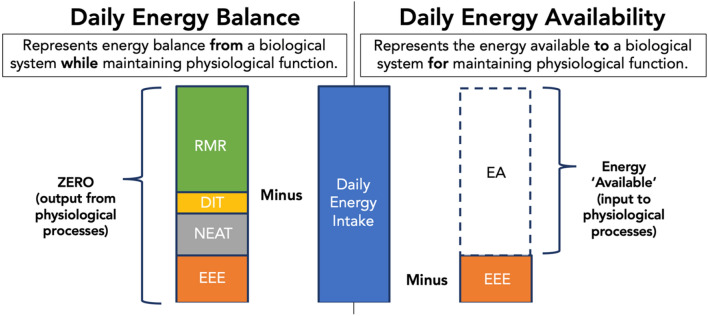
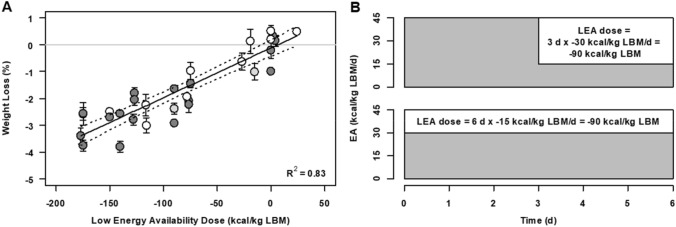
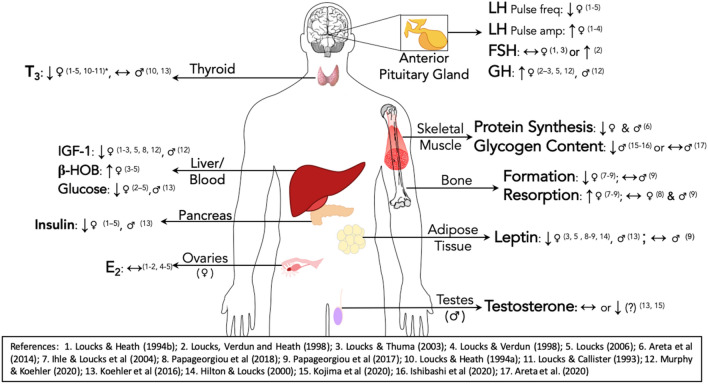
Energy availability (EA) is defined as the amount of dietary energy available to sustain physiological function after subtracting the energetic cost of exercise. Insufficient EA due to increased exercise, reduced energy intake, or a combination of both, is a potent disruptor of the endocrine milieu. As such, EA is conceived as a key etiological factor underlying a plethora of physiological dysregulations described in the female athlete triad, its male counterpart and the Relative Energy Deficiency in Sport models. Originally developed upon female-specific physiological responses, this concept has recently been extended to males, where experimental evidence is limited. The majority of data for all these models are from cross-sectional or observational studies where hypothesized chronic low energy availability (LEA) is linked to physiological maladaptation. However, the body of evidence determining causal effects of LEA on endocrine, and physiological function through prospective studies manipulating EA is comparatively small, with interventions typically lasting ≤ 5 days. Extending laboratory-based findings to the field requires recognition of the strengths and limitations of current knowledge. To aid this, this review will: (1) provide a brief historical overview of the origin of the concept in mammalian ecology through its evolution of algebraic calculations used in humans today, (2) Outline key differences from the ‘energy balance’ concept, (3) summarise and critically evaluate the effects of LEA on tissues/systems for which we now have evidence, namely: hormonal milieu, reproductive system endocrinology, bone metabolism and skeletal muscle; and finally (4) provide perspectives and suggestions for research upon identified knowledge gaps.
Overview
The claims and statistics of this paper haven’t been checked yet.
Free: it reads the open-access text and checks the first 5 claims that cite a source we can check. Create a free account to check every claim.
Integrity signals
Registry
Cites
Statistics
Figures
Verification
Claims the paper makes
The claims and statistics of this paper haven’t been checked yet.
Free: it reads the open-access text and checks the first 5 claims that cite a source we can check. Create a free account to check every claim.
Claims other papers make about this one
Each is checked against this paper’s own text: does it say what the citing paper says it does?
The source backs part of the claim, not all of it — or backs it for a different population, condition or comparison.
In the citing paper
“It is widely accepted that sufficient energy is crucial for training consistency, particularly during intensified periods, as prolonged energy restriction can lead to impaired physiological function, maladaptation to prescribed training, and an increased risk of fatigue, illness, and injury [61,64,114–116].”
From International society of sports nutrition position stand: nutritional concerns of the female athlete (2023) · cites this paper as [115]
Experimental — accuracy not yet measuredThe source backs part of the claim, not all of it — or backs it for a different population, condition or comparison.
In the citing paper
“Briefly, the known consequences of LEA cause a myriad of complications, which include reproductive dysfunction and impairments to skeletal, cardiovascular, gastrointestinal, endocrine, and neurological function [113,115,127,128].”
From International society of sports nutrition position stand: nutritional concerns of the female athlete (2023) · cites this paper as [115]
Experimental — accuracy not yet measuredThe source backs part of the claim, not all of it — or backs it for a different population, condition or comparison.
In the citing paper
“Many forms of performance pressure contribute to scenarios that either, intentionally or unintentionally, alter energy intake (EI) and exercise energy expenditure (EEE), resulting in low energy availability (LEA).”
From 2023 international olympic committee's (IOC) consensus statement on relative energy deficiency in sport (REDs) (2023) · cites this paper as [3]
Experimental — accuracy not yet measuredThe source backs part of the claim, not all of it — or backs it for a different population, condition or comparison.
In the citing paper
“In the real world, athletes experience exposure to LEA (purposefully or inadvertently) in various manners along the continuum from adaptable to problematic.”
From 2023 international olympic committee's (IOC) consensus statement on relative energy deficiency in sport (REDs) (2023) · cites this paper as [3]
Experimental — accuracy not yet measuredIn the citing paper
“Short term studies in exercising females provide direct evidence of disruption of the hypothalamic pituitary ovarian (HPO) axis hormones luteinizing hormone (pulsatility) and follicle stimulating hormone, but not oestrogen with LEA [30, 67].”
From Does relative energy deficiency in sport (REDs) syndrome exist? (2024) · cites this paper as [30]
2 more claims about this paper
Create a free account to see every claim other papers make about this one.
Self-check
Percentages, sums and reported differences re-computed from the paper’s own numbers.
The self-check needs the paper’s full text.
Citations
Cites
(1985) · Europe PMC (PubMed Central) · Cited by 9,143
Serum Immunoreactive-Leptin Concentrations in Normal-Weight and Obese Humans
Considine, R. V., Sinha, M. K., Heiman, M. L., Kriauciunas, A., Stephens, T. W., Nyce, M. R., Ohannesian, J. P., Marco, C. C., McKee, L. J., Bauer, T. L., et al. (1996) · New England Journal of Medicine · doi:10.1056/nejm199602013340503 · Cited by 6,326 · cited 1×
“Despite leptin’s secretion from adipose tissue and its close correlation with fat mass (Considine et al. 1996), a fall in circulating leptin occurs early during food deprivation, well before there are measurable changes in fat mass (Kolaczynski et al.”
BackgroundThyroid Hormone Regulation of Metabolism
Mullur, R., Liu, Y.-Y., & Brent, G. A. (2014) · Physiological Reviews · doi:10.1152/physrev.00030.2013 · Cited by 2,421 · cited 1×
“Thyroid hormones influence key metabolic pathways related to the control of energy balance, and regulate metabolism through acting in the brain, white fat, brown fat, skeletal muscle and pancreas (Mullur et al. 2014) likely through a profound effect on mitochondrial metabolism (Lanni et al.”
BackgroundDiet, muscle glycogen and physical performance.
Bergström, J., Hermansen, L., Hultman, E., & Saltin, B. (1967) · Acta Physiologica Scandinavica · doi:10.1111/j.1748-1716.1967.tb03720.x · Cited by 1,740 · cited 1×
“1 3 high training load and low-carbohydrate availability, rather than energy availability itself (Areta and Hopkins 2018; Bergström et al. 1967; Olsson and Saltin 1970).”
Background(2007) · Medicine & Science in Sports & Exercise · doi:10.1249/mss.0b013e318149f111 · Cited by 1,554
Mountjoy, M., Sundgot-Borgen, J., Burke, L., Carter, S., Constantini, N., Lebrun, C., Meyer, N., Sherman, R., Steffen, K., Budgett, R., et al. (2014) · British Journal of Sports Medicine · doi:10.1136/bjsports-2014-093502 · Cited by 1,469 · cited 1×
“Lying at their core is the concept of energy availability (EA), a concept that provides a single numerical value that is thought as the aetiological factor of a broad range of hormonal, metabolic and physiological dysregulations triggered by energy deficiency (De Souza et al. 2014, 2019b; Mountjoy et al. 2014).”
BackgroundMammalian reproductive biology
(1990) · Choice Reviews Online · doi:10.5860/choice.28-0283 · Cited by 1,044
Leptin: a review of its peripheral actions and interactions
Margetic, S., Gazzola, C., Pegg, G., & Hill, R. (2002) · International Journal of Obesity · doi:10.1038/sj.ijo.0802142 · Cited by 1,005 · cited 1×
“1 3 and intake through hypothalamic control and peripheral tissue metabolism exerting an important top-down regulation of the neuroendocrine axes (Blüher and Mantzoros, 2009; Margetic et al. 2002).”
BackgroundRole of Nonexercise Activity Thermogenesis in Resistance to Fat Gain in Humans
Levine, J. A., Eberhardt, N. L., & Jensen, M. D. (1999) · Science · doi:10.1126/science.283.5399.212 · Cited by 997 · cited 1×
“Second, since NEAT may vary in response to changes in energy balance (Levine et al. 1999; Müller and Bosy-Westphal 2013), it is also likely to be affected by EA.”
BackgroundBiology of RANK, RANKL, and osteoprotegerin
Boyce, B. F., & Xing, L. (2007) · Arthritis Research & Therapy · doi:10.1186/ar2165 · Cited by 957 · cited 2×
“However, bone resorption and formation, are not independent processes—as evidenced by the bone turnover regulation through the receptor activator of nuclear factor-κB ligand/osteoprotegerin pathway (Boyce and Xing, 2007)—, and mechanistic details regarding the modulatory effect of EA should be unravelled by future res…”
Background
Cited by
Items 201–270 of 270
Effects of nutrient and exercise interactions on the components of energy balance
Donoso, I. A. P. (2024) · University of Birmingham Institutional Research Archive (University of Birmingham)
Energitillgänglighet och kolhydratintag hos manliga elitbandyspelare
Bergström, H., & Sundberg, J. (2023) · Uppsala University Publications (Uppsala University)
Visagie, R. (2024) · Open University of Cape Town (University of Cape Town)
Harju, T. (2025) · Jyväskylä University Digital Archive (University of Jyväskylä) · Cited by 2
Platen, P. (2025) · Springer eBooks · doi:10.1007/978-3-662-69524-1_11
Schneider, V. M., Smania, P. J., Carpes, L., & Farias, J. M. D. (2025) · European Journal of Physical Education and Sport Science · doi:10.46827/ejpe.v12i10.6351
“This may reflect age-related physiological adaptations, such as reduced metabolic flexibility and anabolic resistance, which limit fat loss and muscle gain in older populations 21, 22 .”
Gunnoe, A. R. (2025) · ScholarWorks (Walden University)
Energy Expenditure Exceeds Nutritional Intake of ROTC Members During a Field Training Exercise
Frick, K. A., Bordonie, N. C., Clouse, K. G., Roberts, M. D., Frugé, A. D., Wadsworth, D. D., Miller, M. W., & Sefton, J. M. (2025) · Journal of Functional Morphology and Kinesiology · doi:10.3390/jfmk11010003
“If an individual consumes less calories than they burn they fall into a LEA state in which the body lacks adequate energy to sustain optimal health and performance [11,22–24].”
Isaeva, E. P., Okorokov, P. L., Stolyarova, S. A., Zyabkin, I. V., & Isaev, M. R. (2026) · Extreme Medicine · doi:10.47183/mes.2025-405
The Impact of Female Sex Hormones on Concussion
Hardaker, N. J. (2025) · Tuwhera (Auckland University of Technology)
Kabeer, D. A., Wilson, V. W., Safad, A. K., Kottarath, S. K., Aravind, M. K., Pramitha, M., Shanmugasundaram, S. K., & Sudha, S. B. (2026) · Advanced Exercise and Health Science · doi:10.1016/j.aehs.2026.02.004
Experimental evidence of life history trade-offs during ultra-endurance physical activity
Longman, D. P., Murray, A. A., Brown, E. L., Lewis, C. C., Millis, R. M., Nowak, T. J., Udquim, K.-I. T., Muehlenbein, M. P., Wells, J. C. K., & Stock, J. T. (2026) · Evolutionary Human Sciences · doi:10.1017/ehs.2026.10040
“As prolonged exposure to energy deficit increases injury risk, compromises bone health and disrupts reproductive function (Areta et al., 2020; Mountjoy et al., 2018; Nattiv et al., 2007), exercise physiologists seek to better characterise patterns of energy allocation to optimise both performance…”
Nurlaila, S., Sentani, M. R., Syihab, S. F., & Insani, H. M. (2025) · Jurnal Gizi dan Pangan Soedirman · doi:10.20884/1.jgipas.2025.9.2.17304
Dietary Determinants Associated with Low Energy Availability among Athletes: A Scoping Review
Gupta, S., & Lal, P. R. (2026) · The Open Sports Sciences Journal · doi:10.2174/011875399x449583260407061445
Kitts, S. (2026) · Springer eBooks · doi:10.1007/978-3-032-22506-1_5
Buechel, C., Pumpa, K. L., Etxebarria, N., Helms, E. R., Ashton, L., Mitchell, L., & Minehan, M. (2026) · Journal of the International Society of Sports Nutrition · doi:10.1080/15502783.2026.2676190
Relative Energy Deficiency in Sport
Volovyk, N., Підвальна, О. В., & Antonevych, B. (2026) · Scientific Journal of National Pedagogical Dragomanov University Series 15 Scientific and pedagogical problems of physical culture (physical culture and sports) · doi:10.31392/udu-nc.series15.2026.05(205).05
Szulim, J., Petelicki, K., Biełanowicz, E., Tora, A., Barszcz, A., & Pondo, W. (2026) · Quality in Sport · doi:10.12775/qs.2026.56.72575
Robertson, A. P. (2026) · Queensland University of Technology · doi:10.5204/thesis.eprints.266294
Herrera-Amante, C. A., Veitía, W. C., Yáñez-Sepúlveda, R., & López-Gil, J. F. (2026) · Frontiers in Sports and Active Living · doi:10.3389/fspor.2026.1816128
Chung, N. (2026) · Physical Activity and Nutrition · doi:10.20463/pan.2026.0017
Çapar, A. G., Haspolat, D. A., Çağatay, M., & İnanç, N. (2026) · IJPANH · doi:10.71350/ijpanh.38
“Sports dietitians play a critical role in maintaining athletes’ overall health and optimizing their performance through their expertise in areas such as clinical nutrition, medical nutrition therapy, exercise physiology, and physical performance (Areta et.al., 2021).”
Cao, Z., Liu, L., An, G., Park, G., Kim, S., Li, Z., & Jung, J. (2026) · Aquatic Toxicology · doi:10.1016/j.aquatox.2026.107920
Deng, S.-J., Jiang, Y., Shu, M.-Y., Li, G. H., LIU, Y. F., Wang, L., Ma, M., Yushan, G., Li, Y. P., Tan, Y. F., et al. (2026) · Frontiers in Nutrition · doi:10.3389/fnut.2026.1858347
Peculiarities of the bone remodeling cycle in professional sports activities (literature review)
Nikitina, K. I., Vykhodets, I. Т., Абрамова, Т. Ф., & Михайловна, Н. Т. (2026) · Russian Osteopathic Journal · doi:10.32885/2220-0975-2026-2-157-168
Sports Dietitians’ Methods of Assessing Energy Deficiency Among Free-Living Athletes
Barrack, M. T., Visconti, L. M., & Seggern, K. V. (2026) · Journal of the American Nutrition Association · doi:10.1080/27697061.2026.2694020
Muñoz-López, M., Quesada-Fernández, G., Sancho-Haro, E. S., Viúdez, X. R. D. L. P., Baz-Valle, E., López‐Gil, J. F., & Tornero-Aguilera, J. F. (2026) · Metabolites · doi:10.3390/metabo16070483 · Cited by 1
McDonald, C. V., McSorley, E. M., McNeilly, A., & Magee, P. J. (2026) · Nutrients · doi:10.3390/nu18142259
“Furthermore, long term under-fuelling exposes athletes to risks associated with low energy availability (LEA) such as overreaching, compromised immune function, impaired bone health, endocrine and cognitive disturbances [13].”
Lackner, S., Kärkkäinen, O. K., Mörkl, S., Müller, W., Fürhapter-Rieger, A., Hanhineva, K., & Holasek, S. J. (2026) · Experimental Physiology · doi:10.1113/ep092957
Nußer, V., Teubner, J., Buerger, S. A., Frodl, A., Rainsberger, K., Braunsperger, A., Wasserfurth, P., Hackney, A. C., & Koehler, K. (2026) · Journal of Applied Physiology · doi:10.1152/japplphysiol.00207.2026
Self-citationRelative Energy Deficiency in Sport (REDs) and Body Composition
Godley, M., Fink, D., Saupe, T., Edelmers, E., Pļaviņa, L., & Pilmane, M. (2026) · Sports · doi:10.3390/sports14080314
Vegetarian diets in female athletes: performance, health outcomes, and the implementation gap
López‐Moreno, M., Pérez-Díaz-del-Campo, N., Villa, N., Leszczyńska, P. M., Sánchez-Infante, J., & Marrero‐Fernández, P. (2026) · Frontiers in Nutrition · doi:10.3389/fnut.2026.1901139
Khor, J. (2023) · Otago University Research Archive (University of Otago) · Cited by 1
Rasituksen suhde testosteronitasoihin syvillä neuroverkoilla
Peura, S. (2026) · Jyväskylä University Digital Archive (University of Jyväskylä)
Low energy availability in females: Risk, knowledge, and education
Pai, N. N. (2023) · Otago University Research Archive (University of Otago) · Cited by 1
Erdeljac, T., Comyns, T. M., Norton, C., Warrington, G. D., Sweeney, G., Bibby, K. L., Purtill, H., & Kenny, I. C. (2026) · International Journal of Sports Science & Coaching · doi:10.1177/17479541261472281
Minnetti, M., Tarantino, C., D’Amico, M., Filice, E., Graziadio, C., Mocini, E., Tiralongo, G., Gianfrilli, D., Isidori, A. M., Donini, L. M., et al. (2026) · Journal of Neuroendocrinology · doi:10.1111/jne.70242
“5,7 Overall, studies conducted in patients with FEDs suggest that PA is most frequently reported in AN and restrictive clinical subtypes.”
InfluentialŠváb, M. (2026) · Repository of the University of Primorsk (University of Primorska)
Braunsperger, A., Tischer, D., Soriano‐Arroquia, A., Schönfelder, M., Georgiadi, A., & Wackerhage, H. (2026) · Sports Medicine - Open · doi:10.1186/s40798-026-01085-y
Hegarty, S., Ovin, F., Keay, N., Hirsch, C., & Meeten, F. (2026) · Journal of Sports Sciences · doi:10.1080/02640414.2026.2717966
“Low energy availability (LEA) occurs when an athlete’s dietary energy intake is insufficient to support basic physiological functions after accounting for the energy expended during exercise (Areta et al., 2021).”
de Oliveira, M. E. D., da Silva, E. M., & Paixão, M. P. C. P. (2026) · doi:10.65458/978-65-02-29246-4
Methods of Calculating Energy Availability in Current Research: A Standardised Audit
Walker, A. E., McKay, A. K. A., Rogers, M. A., Kuikman, M. A., Ackerman, K. E., Stellingwerff, T., & Burke, L. M. (2026) · Sports Medicine · doi:10.1007/s40279-026-02526-0
López, E., Taylor, H. L., Nishimura, Y., Langan‐Evans, C., Shepherd, S. O., Strauss, J. A., Morton, J. P., Burniston, J. G., & Areta, J. L. (2026) · The FASEB Journal · doi:10.1096/fj.202602531r
Self-citationCano, M. A. M., Monsalve-Girlado, M. F., Cárdenas-Castillo, G., & Orjuela, L. S. G. (2026) · Journal of Sport and Health Research · doi:10.58727/jshr.114758
運動誘発性の鉄欠乏の新たな要因の検討 : ヘプシジン分泌応答に着目して
Hayashi, N. (2023) · Institutional Repositories DataBase (IRDB) · doi:10.34382/00018555
A hidden crisis: the threat of environment to reproductive health
Zhou, W., Xu, C., Wang, C., & Zhang, L. (2026) · Journal of Endocrinology · doi:10.1530/joe-26-0279
Hadi, E. M. A. A., Ouali, E. M. E., Akhittouch, A., Rimy, H., Zehhaf, F., Kassimi, K., Chokri, A., Zahi, B., Elgot, A., & Barkaoui, M. (2026) · Journal of the International Society of Sports Nutrition · doi:10.1080/15502783.2026.2730213 · Cited by 1
“When energy availability is insufficient, the body prioritizes essential physiological functions, while other processes may receive inadequate energetic support [12].”
Võ, K. (2026) · Journal of Scientific training and Sports coaching · doi:10.64024/upes14093
Septianingrum, K., & Hakim, A. L. R. (2026) · COMPETITOR Jurnal Pendidikan Kepelatihan Olahraga · doi:10.67322/cpjok.v18i3.1144
“Klein et al. (2023) (Logue et al., 2020; Areta et al., 2021; Mountjoy et al., 2023; Gallant et al., 2025).”
Low energy availability and female athlete Triad risk in Black collegiate track and field athletes
Taylor, A. L., Moore, C. J., & Barrack, M. T. (2026) · Applied Physiology, Nutrition, and Metabolism · doi:10.1139/apnm-2026-0036
Puchalt-Urbano, X., Esteve, M. J., López-Grueso, R., & Blesa, J. (2026) · Research Square · doi:10.21203/rs.3.rs-10895587/v1
Liu, W., Ai, H., Li, X., Yang, J., Jiang, D., & Chang, C. (2026) · The Innovation Medicine · doi:10.59717/j.xinn-med.2026.100260
Relative energy deficiency in sport (REDs) as a stress-induced disruption of energy flow
Balagué, N., Lizarraga, M. A., & Montull, L. (2026) · Apunts Sports Medicine · doi:10.1016/j.apunsm.2026.100535
Kokelj, A. (2026) · Repository of the University of Ljubljana (University of Ljubljana)
Benson, S. (2026) · HARVEST (University of Saskatchewan)
Formation of Relative Energy Deficiency Syndrome in Young Highly Qualified Athletes
Isaeva, E. P., Okorokov, P. L., Zyabkin, I. V., & Rilova, N. V. (2026) · A I Burnasyan Federal Medical Biophysical Center Clinical Bulletin · doi:10.33266/2782-6430-2026-3-38-46
Chesters, R. L. (2026) · University of Birmingham Institutional Research Archive (University of Birmingham)
Saarinen, M. K. (2023) · UEF eRepo (University of Eastern Finland)
Kahilainen, M. (2026) · UEF eRepo (University of Eastern Finland)
Analisis Status Gizi Pemain Sepak Bola Ps Mataram
Alpandi, A. T., E, B. R. N. L., & Yundarwati, S. (2023) · Gelora Jurnal Pendidikan Olahraga dan Kesehatan IKIP Mataram
Forchino, F., Brade, C. J., Kerr, D. A., & Chapman, D. W. (2026) · Sports · doi:10.3390/sports14100446
“These findings are consistent with previous research indicating the relationship between LEA and exercise performance is not uniform and may depend on the severity, duration, and context of the energy deficit, as well as the specific performance outcome assessed [12,13,22].”
InfluentialMonaco, F., Vignapiano, A., Panarello, E., Landi, S., Spista, F., Bonifacio, R., Falchetta, D., Marenna, A., Mignone, M. L., Steardo, L., et al. (2026) · Brain Sciences · doi:10.3390/brainsci16101114
Kolb, D. E., Cipriano, N. L., Moody, R. A., Stephens, J. A., Caldwell, L. K., Lindley, M. R., Ware, M. E., & Deemer, S. E. (2026) · The Journal of Strength and Conditioning Research · doi:10.1519/jsc.0000000000005644
Muflih, A. S., & Erzeybek, M. S. (2026) · Maǧallaẗ al-rāfidayn li-l-ʻulūm al-riyāḍiyyaẗ · doi:10.33899/rjss.v29i91.62247
Andriani, S. R., Syihab, S. F., Fitrianingsih, A. D. R., & Sentani, M. R. (2026) · Nutri-Sains Jurnal Gizi Pangan dan Aplikasinya · doi:10.21580/ns.2026.10.1.31572
“…inadequate energy intake may adversely influence psychological well-being through alterations in energy availability, appetite-regulating hormones, HPA-axis activity, metabolic function, and brain energy supply, potentially increasing vulnerability to psychological distress (Areta et al., 2021).”
Łożyńska, K., Kałuża, J., & Surała, O. (2026) · Biomedical Human Kinetics · doi:10.2478/bhk-2026-0026
Sadurska, G., Psiuk, M., Prusaczyk-Świerzewska, A., Hunek, O., Gajewska, K., Januszewska, N., Matuszewski, P., Ziółkowska, J., Kleparska, A., & Smędowski, I. (2026) · Quality in Sport · doi:10.12775/qs.2026.78.76475
Carr, A. J., Vallance, B. S., Rothwell, J., Rea, A. E., Burke, L. M., & Guy, J. H. (2022) · doi:10.3389/fphys.2022.836858.s002
Winkert, K., Steinacker, J. M., Koehler, K., & Treff, G. (2022) · doi:10.3389/fphys.2022.829757.s001
Self-citation
Metadata
- Authors
- Areta, J. L., Taylor, H. L., & Koehler, K.
- Affiliations
- Liverpool John Moores University (GB)
- Technical University of Munich (DE)
- Corresponding author
- Areta, José L.
- Venue
- European Journal of Applied Physiology
- Published
- 2020-10-23
- Volume
- 121
- Issue
- 1
- Pages
- 1-21
- ISSN
- 0020-9376 (ISSN-L)
- 1439-6319
- 1439-6327
- PMC
- PMC7815551
- OpenAlex
- W3094522798
- Semantic Scholar
- 2ebe38f409b6b75cd47af9c4207d56cbcd9ed59a
- Cited by
- 214
- References
- 110
- Citations by year
- 2026: 44 · 2025: 39 · 2024: 50 · 2023: 37 · 2022: 24 · 2021: 18 · 2020: 1
- FWCI
- 3.93
- Type
- journal article
- Language
- en
- Open access
- hybrid
- doi.org
- Licence
- cc-by
- creativecommons.org/licenses/by/4.0 (tdm)
- creativecommons.org/licenses/by/4.0 (vor)
- Locations
- European Journal of Applied Physiology (publishedVersion, cc-by)
- PubMed Central (publishedVersion, cc-by)
- PubMed (publishedVersion)
- Liverpool John Moores University (acceptedVersion)
- mediaTUM (Technical University of Munich) (submittedVersion, other-oa)
- mediaTUM – the media and publications repository of the Technical University Munich (Technical University Munich) (submittedVersion, cc-by)
- mediaTUM – the media and publications repository of the Technical University Munich (Technical University Munich) (submittedVersion, other-oa)
- Funders
- Liverpool John Moores University
- Topics
- Health Sciences › Medicine › Orthopedics and Sports Medicine › Sports Performance and Training
- Social Sciences › Psychology › Clinical Psychology › Eating Disorders and Behaviors
- Health Sciences › Medicine › Reproductive Medicine › Hypothalamic control of reproductive hormones
- Keywords
- low energy availability, energy balance, female athlete triad, relative energy deficiency in sport, energy cost of exercise, hormonal milieu, reproductive endocrinology, bone metabolism, skeletal muscle, caloric restriction
- MeSH terms
- Energy Intake, Energy Metabolism, Female, Humans, Hypothalamo-Hypophyseal System, Male, Sports Medicine, Exercise, Gonadal Hormones
About these checks
Registry, retraction, Cites and statistics results are computed, not judged, with one exception: a printed reference that no index lists is read once by a model before it counts as a citation error. Claims are extracted by a model and kept only when their quote appears verbatim in the text; each cited source is then checked, with a model’s help, for whether it says what the claim relies on. Those verdicts can be wrong — read the claim’s quote and the cited source before relying on one.
Statistics and arithmetic are recomputed, not judged.
Confidence bands are shown only for fields calibrated on our annotated test set. None is calibrated yet, so no band is shown.
What counts as a claim ›How we measure confidence ›How we check this ›
Are you an author, or do you see a problem with this page? Request a review
Data sources
Bibliographic data: Semantic Scholar, OpenAlex, Crossref.
Contains information from the Semantic Scholar Academic Graph Datasets, made available under the ODC Attribution License (ODC-BY 1.0).
Semantic Scholar’s data is described in: Kinney, R., et al. (2023). The Semantic Scholar Open Data Platform. arXiv:2301.10140.
