

Translating cancer genomics into precision medicine with artificial intelligence: applications, challenges and future perspectives
Open accessThe DOI matches its Crossref record; 165 of the 165 references it cites were found in a registry or an index.
Abstract
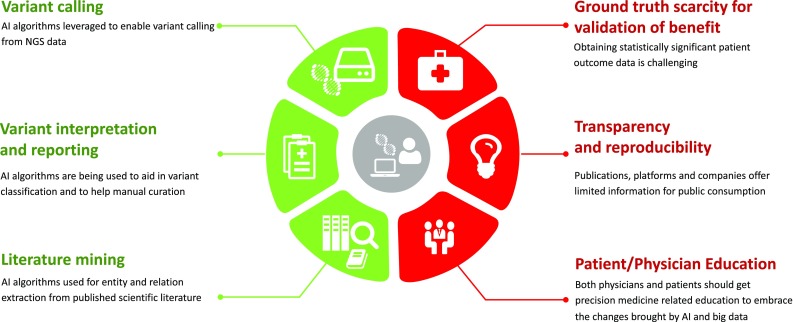
In the field of cancer genomics, the broad availability of genetic information offered by next-generation sequencing technologies and rapid growth in biomedical publication has led to the advent of the big-data era. Integration of artificial intelligence (AI) approaches such as machine learning, deep learning, and natural language processing (NLP) to tackle the challenges of scalability and high dimensionality of data and to transform big data into clinically actionable knowledge is expanding and becoming the foundation of precision medicine. In this paper, we review the current status and future directions of AI application in cancer genomics within the context of workflows to integrate genomic analysis for precision cancer care. The existing solutions of AI and their limitations in cancer genetic testing and diagnostics such as variant calling and interpretation are critically analyzed. Publicly available tools or algorithms for key NLP technologies in the literature mining for evidence-based clinical recommendations are reviewed and compared. In addition, the present paper highlights the challenges to AI adoption in digital healthcare with regard to data requirements, algorithmic transparency, reproducibility, and real-world assessment, and discusses the importance of preparing patients and physicians for modern digitized healthcare. We believe that AI will remain the main driver to healthcare transformation toward precision medicine, yet the unprecedented challenges posed should be addressed to ensure safety and beneficial impact to healthcare.
Overview
The claims and statistics of this paper haven’t been checked yet.
Free: it reads the open-access text and checks the first 5 claims that cite a source we can check. Create a free account to check every claim.
Integrity signals
Registry
Cites
Statistics
Figures
Verification
Claims the paper makes
The claims and statistics of this paper haven’t been checked yet.
Free: it reads the open-access text and checks the first 5 claims that cite a source we can check. Create a free account to check every claim.
Claims other papers make about this one
Each is checked against this paper’s own text: does it say what the citing paper says it does?
In the citing paper
“AI causes challenges to patient-clinician interactions, as clinicians need to learn how to interact with the AI system for healthcare delivery, and patients are required to reduce the fear of technology [32].”
From Use of AI-based tools for healthcare purposes: a survey study from consumers’ perspectives (2020) · cites this paper as [32]
Self-check
Percentages, sums and reported differences re-computed from the paper’s own numbers.
The self-check needs the paper’s full text.
Citations
Cites
Going deeper with convolutions
Szegedy, C., Liu, W., Jia, Y., Sermanet, P., Reed, S., Anguelov, D., Erhan, D., Vanhoucke, V., & Rabinovich, A. (2015) · 2015 IEEE Conference on Computer Vision and Pattern Recognition (CVPR) · doi:10.1109/cvpr.2015.7298594 · Cited by 48,562
Richards, S., Aziz, N., Bale, S., Bick, D., Das, S., Gastier-Foster, J., Grody, W. W., Hegde, M., Lyon, E., Spector, E., et al. (2015) · Genetics in Medicine · doi:10.1038/gim.2015.30 · Cited by 32,594 · cited 2×
“…such as the American College of Medical Genetics and Genomics and the Association for Molecular Pathology (ACMG-AMP), who, in 2015, published a series of guidelines for the interpretation of germline genetic variants for genes causative of hereditary human disorders (Richards et al. 2015).”
BackgroundPD-1 and PD-L1 Immune Checkpoint Blockade to Treat Breast Cancer
Hartkopf, A. D., Taran, F.-A., Wallwiener, M., Walter, C. B., Krämer, B., Grischke, E.-M., & Brucker, S. Y. (2016) · Breast Care · doi:10.1159/000453569 · Cited by 30,845
A method and server for predicting damaging missense mutations.
Adzhubei, I. A., Schmidt, S., Peshkin, L., Ramensky, V. E., Gerasimova, A., Bork, P., Kondrashov, A. S., & Sunyaev, S. R. (2010) · Nature Methods · doi:10.1038/nmeth0410-248 · Cited by 13,194 · cited 1×
“In silico prediction tools like PolyPhen and SIFT are widely used to assist the manual curation but have not established themselves as the determining factors in the clinical setting (Adzhubei et al. 2010; Vaser et al. 2016).”
MethodNishimura, R., Osako, T., Nishiyama, Y., Tashima, R., Nakano, M., Fujisue, M., Toyozumi, Y., & Arima, N. (2013) · Oncology · doi:10.1159/000353099 · Cited by 13,166
Comprehensive molecular portraits of human breast tumours
The Cancer Genome Atlas Network (2012) · Nature · doi:10.1038/nature11412 · Cited by 12,129
The cancer genome atlas pan-cancer analysis project
The Cancer Genome Atlas Research Network, Weinstein, J. N., Collisson, E. A., Mills, G. B., Shaw, K. R. M., Ozenberger, B. A., Ellrott, K., Shmulevich, I., Sander, C., & Stuart, J. M. (2013) · Nature Genetics · doi:10.1038/ng.2764 · Cited by 9,092
The genomic and transcriptomic architecture of 2,000 breast tumours reveals novel subgroups
METABRIC Group, Curtis, C., Shah, S. P., Chin, S.-F., Turashvili, G., Rueda, O. M., Dunning, M. J., Speed, D., Lynch, A. G., Samarajiwa, S., et al. (2012) · Nature · doi:10.1038/nature10983 · Cited by 6,097 · cited 1×
“Molecular sub-types discovered in the pan-cancer studies also help to personalize the treatment and improve patient’s survival outcome (Cancer Genome Atlas Network 2012; Curtis et al. 2012; Vaske et al. 2010).”
BackgroundMachine Learning Applications in Cancer Prognosis and Prediction
Kourou, K., Exarchos, T. P., Exarchos, K. P., Karamouzis, M. V., & Fotiadis, D. I. (2015) · Computational and Structural Biotechnology Journal · doi:10.1016/j.csbj.2014.11.005 · Cited by 3,338 · cited 1×
“Multiple review papers have already covered different ML applications on gene expression data (Molla et al. 2004; Sajda 2006; Kourou et al. 2014; Libbrecht 2015; Bashiri et al. 2017; Noor and Narwal 2017).”
BackgroundEhteshami Bejnordi, B., Veta, M., Johannes van Diest, P., van Ginneken, B., Karssemeijer, N., Litjens, G., van der Laak, J. A. W. M., and the CAMELYON16 Consortium, Hermsen, M., Manson, Q. F., et al. (2017) · JAMA · doi:10.1001/jama.2017.14585 · Cited by 3,293 · cited 1×
“Through application of deep learning on medical imaging data, AI has outperformed expert pathologists and dermatologists in diagnosing metastatic breast cancer, melanoma, and several eye diseases (De Fauw et al. 2018; Ehteshami Bejnordi et al. 2017; Haenssle et al. 2018).”
Research works printed but not linked: 1
- Molla M, Waddell M, Page D, Shavlik J (2004) Using machine learn- ing to design and interpret gene-expression microarrays. AI Mag 25:23-44. https ://doi.org/10.1609/aimag .v25i1 .1745 · doi:10.1609/aimag.v25i1.1745
Cited by
Items 301–359 of 359
Introduction to Machine Learning in Medicine
Buongiorno, R., Caudai, C., Colantonio, S., & Germanese, D. (2023) · Imaging informatics for healthcare professionals · doi:10.1007/978-3-031-25928-9_3
Artificial intelligence in pharmacy an overview
Utkarsha, M., Meghana, M., Diksha, K., & Mhetre, R. (2024) · International Journal of Biological and Pharmaceutical Sciences Archive · doi:10.53771/ijbpsa.2024.7.2.0041
Tansitpong, P. (2024) · International Journal of Healthcare Information Systems and Informatics · doi:10.4018/ijhisi.351244
An Enhanced Few-Shot Learning Method for Genomic Variant Detection
Peng, Q., & Ren, Y. (2024) · IEEE International Conference on Bioinformatics and Biomedicine (BIBM) · doi:10.1109/bibm62325.2024.10822577
Bioinformatic Approaches in Neurodegenerative Diseases
Liu, Z. (2024) · Transactions on Materials Biotechnology and Life Sciences · doi:10.62051/kpfb4b76
“For example, the application of machine learning and artificial intelligence technologies has enabled researchers to extract deeper biological meaning from large-scale genetic data and identify complex genetic patterns associated with diseases [7].”
Advancing Genetic Engineering through AI: Sequencing and Editing Innovations
Sun, S. (2025) · Theoretical and Natural Science · doi:10.54254/2753-8818/2025.gu20450
A Comparative Analysis of Startups Applying AI in Clinical Oncology
Meça, A., & Ali, M. (2024) · International Conference on Computing, Networking, Telecommunications & Engineering Sciences Applications (CoNTESA) · doi:10.1109/contesa64738.2024.10891291
“In relation to cancer genomics, AI-based technologies can be used for analysis of genomic data from cancer patients and the clinical interpretation of genetic variants, which can be important in early detection and treatment of different cancerous variants [12-13].”
(2025) · Journal of Clinical Oncology and Therapeutics · doi:10.47275/2690-5663-140
Future role of AI in genomic literacy
Mohamad, M. S., Manzoor, A., & Al-Jasmi, F. A. (2025) · Elsevier eBooks · doi:10.1016/b978-0-443-22384-6.00011-1
Gangappa, M., Chandra, N. S., Kalpana, P., Kodati, S., & Dhasaratham, M. (2025) · Sustainable civil infrastructures · doi:10.1007/978-3-031-84335-8_8
Traditional machine learning techniques for explainable AI in lung and colon cancer classification
Amer, M., & Sultani, Z. N. (2025) · Engineering and Technology Journal · doi:10.30684/etj.2025.158895.1935
Role of AI in Cancer Screening and Its Detection
Muskan, Sharma, S., Sharma, P., Malik, M., & Kaur, J. (2025) · Wiley eBooks · doi:10.1002/9781394270613.ch14
Applications of Artificial Intelligence in Cancer Precision and Personalized Medicine
Sun, S. (2025) · Transactions on Materials Biotechnology and Life Sciences · doi:10.62051/6zv3ry94
AI in targeted drug discovery for TNBC
Kothawade, S. N., Bhosale, S., Jedhe, R., Mhaske, P., & Makhare, S. (2025) · Elsevier eBooks · doi:10.1016/b978-0-443-33565-5.00020-7
AI in Diagnostics and Treatment Planning
Panigrahy, U. P., Verma, A., SHARMA, A. K., Sharma, S., & Sagapola, R. (2025) · BENTHAM SCIENCE PUBLISHERS eBooks · doi:10.2174/9798898811563125010009
Munukutla, M. K., Karthikeyan, P., & Vishnu, M. (2025) · International Conference on New Frontiers in Communication, Automation, Management and Security (ICCAMS) · doi:10.1109/iccams65118.2025.11234626
“[24] For disease susceptibility, diagnosing, and treatment response, precision medicine allows medical interventions to be allocated to the group of patients.”
Shekiri, M. A., Ghoneim, I. A., Alharbi, M. H., Alamri, M. M., AlAhmadi, N. O., Almutairi, H. H., Alraddadi, A. A., & Haroun, M. S. (2025) · Journal of Medical and Life Science · doi:10.21608/jmals.2025.466701
Sasaki, S., Karako, K., Ito, K., Mihara, Y., Takayama, M., Oikawa, R., Takamoto, T., Akamatsu, N., Kawaguchi, Y., & Hasegawa, K. (2025) · Journal of Hepato-Biliary-Pancreatic Sciences · doi:10.1002/jhbp.70052
Διερεύνηση και ταξινόμηση σταδίων καρκίνου του μαστού ϐάσει γονιδιακών δεδομένων
Syrri, A. E. (2025) · DSpace - NTUA (National Technical University of Athens) · doi:10.26240/heal.ntua.28566
Digitalna tehnologija in informacijski sistemi kot podpora zdravljenju onkoloških bolnikov
Đošan, D. (2024) · Repository of the University of Ljubljana (University of Ljubljana)
Intel·ligència artificial en biomedicina: Aplicacions i reptes
Belda, I. (2025) · Mètode: Revista de difusió de la investigació de la Universitat de Valencia · doi:10.7203/metode.15.30448
**Requested PDF/A** A legal and technical assessment of the rights to information and an explanation
Bringas Colmenarejo, A. (2025) · ePrints Soton (University of Southampton)
Role of Artificial Intelligence and Machine Learning in the Diagnosis and Treatment of NSCLC
Singh, N., Sharma, V., Thakur, A., Bhalla, S., Verma, N., & Srivastava, R. (2025) · IGI Global eBooks · doi:10.4018/979-8-3373-2096-0.ch009
Next-Generation Sequencing Analysis
Velayutham, D., Nisamudheen, N. A., Mohammed, F., Al-Yafei, R. S., & Jithesh, P. V. (2025) · Springer handbooks · doi:10.1007/978-3-031-81728-1_36
The Intersection of AI and genomics in health and disease: Advancements and applications
Kaushik, L., Vivek, A., Arora, S., Hamid, F., Mukherjee, K., Bisht, N., Chaudhary, S., Shukla, J., Nawani, S., & Kumar, S. (2026) · Progress in molecular biology and translational science · doi:10.1016/bs.pmbts.2026.01.013
Tayebi, L., Shetty, S. P., & Imani, S. (2026) · Springer eBooks · doi:10.1007/978-3-032-15977-9_2
Role of AI in molecular cancer pharmacology
Chawla, G., Gupta, O., & Pradhan, T. (2026) · Elsevier eBooks · doi:10.1016/b978-0-443-31592-3.00017-0
Hsu, W.-H., Chang, K., Chang, C.-H., Lin, H.-R., Wu, C.-J., Ko, C.-C., Wu, C., Ho, Y., Lin, C.-C., Yuan, C.-H., et al. (2026) · Oncology Research Featuring Preclinical and Clinical Cancer Therapeutics · doi:10.32604/or.2026.070445
Sapa, H., Ayana, K., Prajitha, P. G., Shona, S. S., Althaf Umar, K. P., Kaladhar, K., Praveen, V. P., Vivek, N., K, P., Venugopal, B. S., et al. (2026) · Elsevier eBooks · doi:10.1016/b978-0-443-40441-2.00001-9
Médecine prédictive et oncogènes : un paradigme en question
Racine, J. (2024) · theses.fr (ABES) · doi:10.70675/d0d7230ez8d50z4c9czaaf4z30dfc015ba65 · Cited by 1
Singh, D., Ghosh, A., Pandey, B., & Pandey, J. K. (2026) · PharmaNutrition · doi:10.1016/j.phanu.2026.100494
Artificial Intelligence in Genomic Research and Advanced Healthcare Applications
Channarayappa, & R, S. K. R. (2026) · Advances in computational intelligence and robotics book series · doi:10.4018/406754
Karic, A., Duraković, D., & Kozarić-Kurtović, A. (2026) · World Congress on Medical Physics and Biomedical Engineering, September 7 - 12, 2009, Munich, Germany · doi:10.1007/978-3-032-06531-5_20
Artificial intelligence in cancer risk assessment
Siddique, K. R., Tiwari, S., Akash, A., Singh, N., Yadav, P., & Gupta, S. K. (2026) · Elsevier eBooks · doi:10.1016/b978-0-443-45004-4.00013-x
Artificial intelligence in oncology: An introduction
Khan, N. A., Mahajan, A. A., Tendulkar, D., Das, N. R., Mondal, S., Dey, A., Ghosh, S., & Rashid, G. (2026) · Elsevier eBooks · doi:10.1016/b978-0-443-45004-4.00008-6
Chaos theory in AI-driven healthcare systems: Unraveling complex data patterns
Baghdadi, G., & Jafari, S. (2026) · Elsevier eBooks · doi:10.1016/b978-0-443-36554-6.00014-3
Chen, J., Ting, N., & Lu, F. (2026) · Wiley eBooks · doi:10.1002/9781394369683.biblio
Haddiya, I., & Ramdani, S. (2026) · Green energy and technology · doi:10.1007/978-3-031-99001-4_32
Corvi, J. (2025) · Tesis Doctorals en Xarxa (Consorci de Serveis Universitaris de Catalunya)
Gandhi, C. R., Reshmma, V., Priyadarshini, B., Darshana, B., Tarani, V., & Jayanthy, A. K. (2026) · Wiley eBooks · doi:10.1002/9781394358212.ch35
Gillan, C., Liszewski, B., Hsu, A., Rahman, F. H., Ebady, M., Nielsen, M. K., Aloysious, C., Lai, Y., Brown, E. M., Donaldson, H., et al. (2026) · Journal of medical imaging and radiation sciences · doi:10.1016/j.jmir.2026.102436
Chy, K. S. (2022) · Journal of Medical and Health Studies · doi:10.32996/jmhs.2022.3.4.29
“The translation of cancer genomics into clinical precision medicine through artificial intelligence is now an active field with a documented catalogue of applications and an equally documented list of open challenges (Xu et al., 2019).”
Nusrat, S., Uddin, B., & Hossain, F. (2022) · Journal of Computer Science and Technology Studies · doi:10.32996/jcsts.2022.4.2.26
1Chapter 1 Bridging Biotechnology and Artificial Intelligence
Bansal, P., Duhan, P., Verma, K., Sharma, A., Sharma, A. K., & Verma, P. (2026) · De Gruyter eBooks · doi:10.1515/9783112214275-001
Big Data in Cancer Genomics: Computational Foundations and Emerging Pathways for Precision Oncology
Vanu, N., Mohammad, N., Ahmed, F., Alam, T., Saha, K., Shahi, D., Hossain, A., Manik, M. M. T. G., & Parvin, M. R. (2026) · Computational and Systems Oncology · doi:10.1002/cso2.70020
Gillan, C., Liszewski, B., Hsu, A., Rahman, F. H., Ebady, M., Nielsen, M. K., Aloysious, C., Lai, Y., Brown, E. M., Donaldson, H., et al. (2026) · Journal of Applied Clinical Medical Physics · doi:10.1002/acm2.70658
“Patient-Specific QA 64 Focused consideration Luk et al. 45 ;Jones et al. 47 ;Simon et al. 85 ;Ono et al. 86 ;Chan et al. 87 Applied research Xu et al. 88 ;Deng et al. 89 ;Kehayias et al. 90 ;Looe et al. 91 ;Miao et al. 92 ; Lambri et al. 93 ;Wang et al. 94 ;Kalendralis et al. 95 Patient positioning…”
Alam, T., Saha, K., Rony, M. K. K., Shahi, D., Utsho, M. R., Hossain, A., Ahmed, F., Manik, M. M. T. G., Sabeena, A. A., & Erdei, T. I. (2026) · Journal of Multidisciplinary Healthcare · doi:10.2147/jmdh.s623353
“2,13,117 Studies have emphasized the need for robust data governance frameworks that ensure the protection of sensitive information while enabling meaningful research.”
Bhinder, K. (2026) · Osong Public Health and Research Perspectives · doi:10.24171/j.phrp.2026.0441
Sangida, & Uddin, N. (2026) · American Journal of Technology Advancement · doi:10.31149/ajta.v3i4.4331
İlgen, B., Tolias, Y. S., Kühnert, D., Papadopoulou, P., Westerlund, M., Heider, D., Ladewig, K., & Hattab, G. (2026) · arXiv (Cornell University) · doi:10.48550/arxiv.2608.30912
“Applications now span literature mining, automated variant interpretation, clinical decision support, clinical trial matching, knowledge graph construction, biomarker discovery, multimodal data integration, and the extraction of gene–variant–disease relationships [5, 7, 8].”
Artificial intelligence powered precision oncology
Pandey, B., Sonkusale, L., Singh, N., & Singh, T. R. (2026) · Elsevier eBooks · doi:10.1016/b978-0-443-40338-5.00008-1
Wang, Z., Qin, Y., Zeng, Y., Liao, S., Tao, X., & Liu, X. (2026) · Veterinary Sciences · doi:10.3390/vetsci13090984
“Genomics and precision medicine have made remarkable strides in advancing human cancer treatment, yet their applicability across species remains to be fully defined [35].”
InfluentialCurrent challenges and future prospects for microbiome research in cancer treatment
Jain, P., & Verma, P. K. (2026) · Elsevier eBooks · doi:10.1016/b978-0-443-33206-7.00002-9
Integration of Artificial Intelligence and Omics Technologies for Precision Oncology
Mungkalarungsi, S., Subsiripaibool, A., Duang-Ngern, W., Phonporton, P., Siriwitpreecha, I., Ovatnupat, C., Ruktaengam, K., & Chawanasunthorn, T. (2024) · Academic Journal of Science and Technology, Dhonburi Rajabhat University
Applications Of Artificial Intelligence In Public Health
Khan, W. A., khan, W. A., Rehman, A. U., Khan, W. A., Anwar, A., Haider, M. S., Rizwan, M., & Awais, M. (2025) · Pakistan Journal of Medical & Cardiological Review · doi:10.64105/6srsea18
Transforming Healthcare with Artificial Intelligence and Machine Learning
Muthukumaran, C., Jayashree, J., Vijayashree, J., & Haleema, P. K. (2026) · Wiley eBooks · doi:10.1002/9781394302574.ch1
Robertson, C., Woods, A., Bergstrand, K., Findley, J., Balser, C., & Slepian, M. J. (2023) · doi:10.1371/journal.pdig.0000237.r005
Metadata
- Authors
- Xu, J., Yang, P., Xue, S., Sharma, B., Sanchez-Martin, M., Wang, F., Beaty, K. A., Dehan, E., & Parikh, B.
- Affiliations
- IBM (United States) (US)
- Corresponding author
- Xu, Jia
- Venue
- Human Genetics
- Published
- 2019-01-22
- Volume
- 138
- Issue
- 2
- Pages
- 109-124
- ISSN
- 0018-7348 (ISSN-L)
- 0340-6717
- 1432-1203
- PMC
- PMC6373233
- OpenAlex
- W2911526543
- Cited by
- 305
- References
- 163
- Citations by year
- 2026: 33 · 2025: 64 · 2024: 47 · 2023: 38 · 2022: 35 · 2021: 35 · 2020: 40 · 2019: 13
- FWCI
- 1.49
- Type
- journal article
- Language
- en
- Open access
- hybrid
- doi.org
- Licence
- cc-by
- creativecommons.org/licenses/by/4.0 (tdm)
- Locations
- Human Genetics (publishedVersion, cc-by)
- Europe PMC (PubMed Central) (publishedVersion, other-oa)
- PubMed Central (publishedVersion, cc-by)
- PubMed (publishedVersion)
- Topics
- Health Sciences › Medicine › Health Informatics › Artificial Intelligence in Healthcare and Education
- Life Sciences › Biochemistry, Genetics and Molecular Biology › Cancer Research › Cancer Genomics and Diagnostics
- Physical Sciences › Computer Science › Artificial Intelligence › AI in cancer detection
- Keywords
- cancer genomics, artificial intelligence, precision medicine, variant calling, variant interpretation, cancer genetic testing, natural language processing, literature mining, clinical guidelines, machine learning, deep learning, algorithmic transparency, reproducibility, digital healthcare, next-generation sequencing, big data
- MeSH terms
- Animals, Electronic Data Processing, Diagnosis, Computer-Assisted, Humans, Natural Language Processing, Neoplasms, Genomics, Data Mining, Precision Medicine
About these checks
Registry, retraction, Cites and statistics results are computed, not judged, with one exception: a printed reference that no index lists is read once by a model before it counts as a citation error. Claims are extracted by a model and kept only when their quote appears verbatim in the text; each cited source is then checked, with a model’s help, for whether it says what the claim relies on. Those verdicts can be wrong — read the claim’s quote and the cited source before relying on one.
Statistics and arithmetic are recomputed, not judged.
Confidence bands are shown only for fields calibrated on our annotated test set. None is calibrated yet, so no band is shown.
What counts as a claim ›How we measure confidence ›How we check this ›
Are you an author, or do you see a problem with this page? Request a review
Data sources
Bibliographic data: Semantic Scholar, OpenAlex, Crossref.
Contains information from the Semantic Scholar Academic Graph Datasets, made available under the ODC Attribution License (ODC-BY 1.0).
Semantic Scholar’s data is described in: Kinney, R., et al. (2023). The Semantic Scholar Open Data Platform. arXiv:2301.10140.
