

Estimating red fox density using non-invasive genetic sampling and spatial capture–recapture modelling
Open accessThe DOI matches its Crossref record; 75 of the 75 references it cites were found in a registry or an index.
Abstract
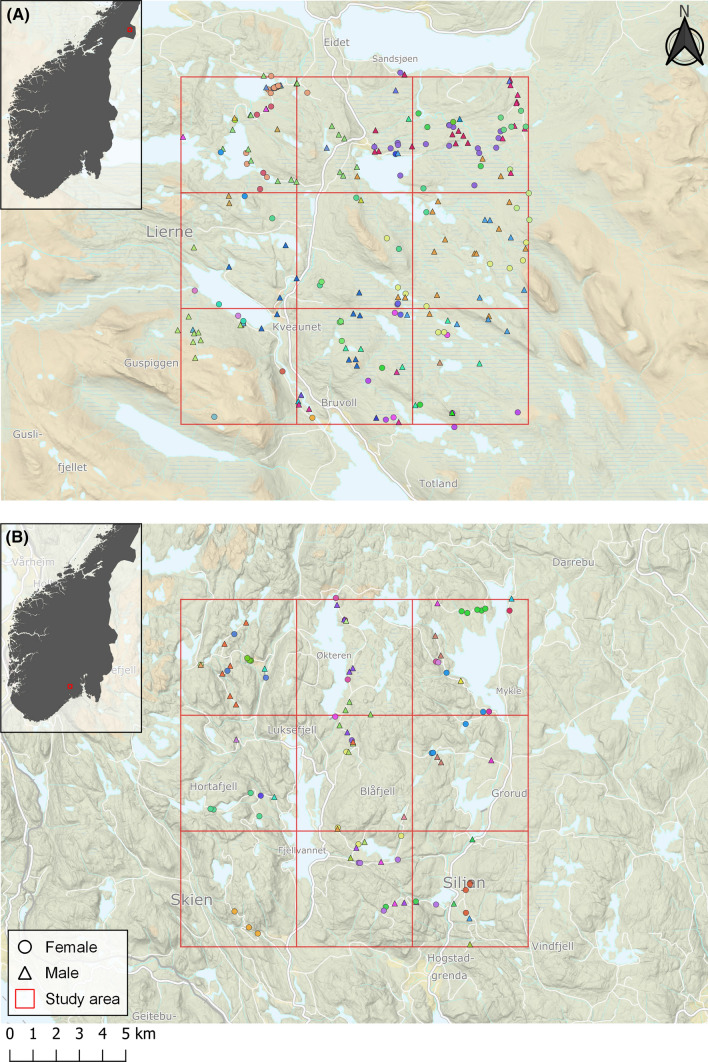
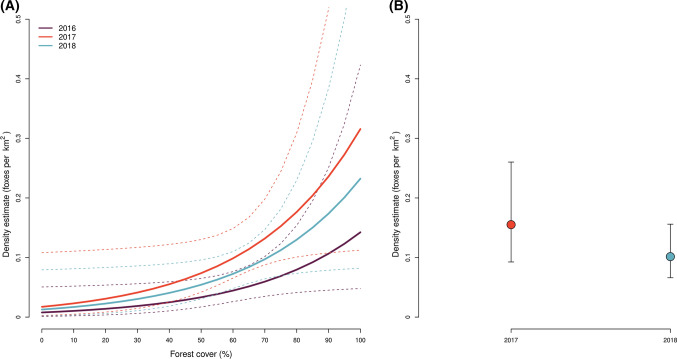
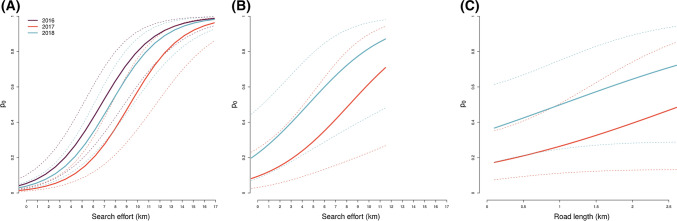
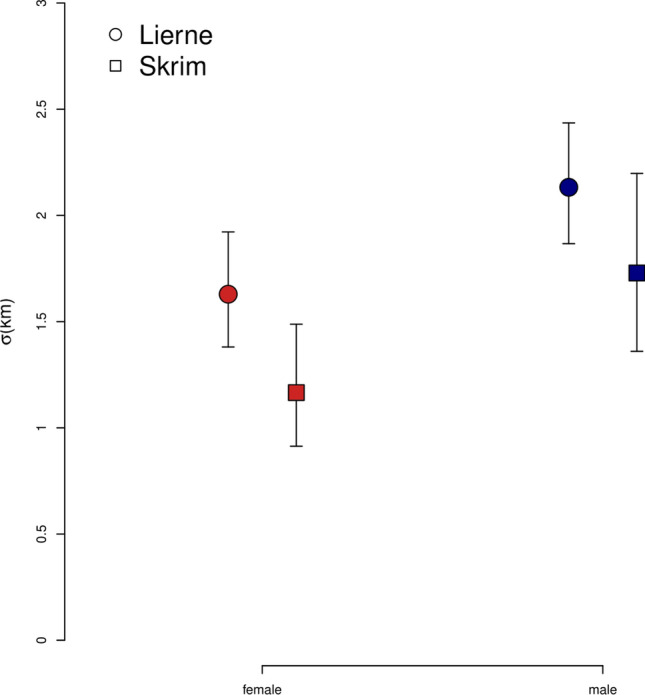
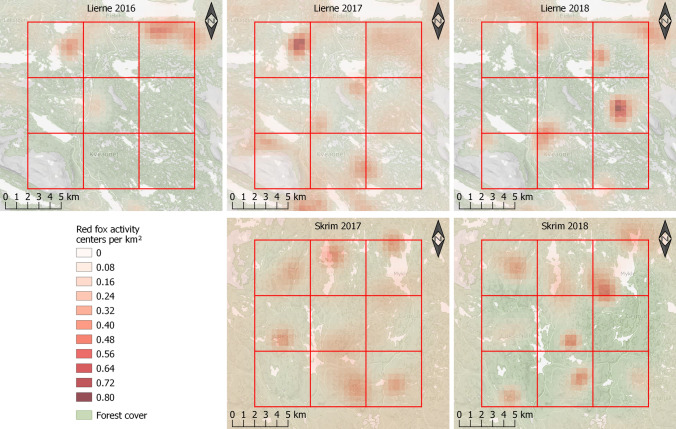
Spatial capture–recapture modelling (SCR) is a powerful tool for estimating density, population size, and space use of elusive animals. Here, we applied SCR modelling to non-invasive genetic sampling (NGS) data to estimate red fox (Vulpes vulpes) densities in two areas of boreal forest in central (2016–2018) and southern Norway (2017–2018). Estimated densities were overall lower in the central study area (mean = 0.04 foxes per km 2 in 2016, 0.10 in 2017, and 0.06 in 2018) compared to the southern study area (0.16 in 2017 and 0.09 in 2018). We found a positive effect of forest cover on density in the central, but not the southern study area. The absence of an effect in the southern area may reflect a paucity of evidence caused by low variation in forest cover. Estimated mean home-range size in the central study area was 45 km 2 [95%CI 34–60] for females and 88 km 2 [69–113] for males. Mean home-range sizes were smaller in the southern study area (26 km 2 [16–42] for females and 56 km 2 [35–91] for males). In both study areas, detection probability was session-dependent and affected by sampling effort. This study highlights how SCR modelling in combination with NGS can be used to efficiently monitor red fox populations, and simultaneously incorporate ecological factors and estimate their effects on population density and space use.
Overview
The claims and statistics of this paper haven’t been checked yet.
Free: it reads the open-access text and checks the first 5 claims that cite a source we can check. Create a free account to check every claim.
Integrity signals
Registry
Cites
Statistics
Figures
Verification
Claims the paper makes
The claims and statistics of this paper haven’t been checked yet.
Free: it reads the open-access text and checks the first 5 claims that cite a source we can check. Create a free account to check every claim.
Claims other papers make about this one
Each is checked against this paper’s own text: does it say what the citing paper says it does?
The source backs part of the claim, not all of it — or backs it for a different population, condition or comparison.
In the citing paper
“Average genotyping success (52.8%) was consistent with previous studies based on faecal DNA (e.g., 48%44, 58%45).”
From Nutritional ecology of a prototypical generalist predator, the red fox (Vulpes vulpes) (2024) · cites this paper as [44]
Experimental — accuracy not yet measuredIn the citing paper
“The red fox ( Vulpes vulpes ) is the most widespread and adaptable wild carnivore in the world (Linds ø et al., 2022; Kobryn et al., 2023), and can be found all over Europe (Delcourt et al., 2022), including Slovenia (Rataj et al., 2010), having adapted its activity level and behaviour to many different habitats (Gil-Fern ´ andez et al., 2020).”
From Exposure assessment of anticoagulant rodenticides in the liver of red foxes (Vulpes vulpes) in Slovenia (2024) · cites this paper as Linds ø et al., 2022
Self-check
Percentages, sums and reported differences re-computed from the paper’s own numbers.
The self-check needs the paper’s full text.
Citations
Cites
R: A Language and Environment for Statistical Computing
R Core Team (2025) · doi:10.32614/r.manuals · Cited by 352,181
Uninformative Parameters and Model Selection Using Akaike's Information Criterion
ARNOLD, T. W. (2010) · The Journal of Wildlife Management · doi:10.1111/j.1937-2817.2010.tb01236.x · Cited by 3,417
Reliable genotyping of samples with very low DNA quantities using PCR
Taberlet, P. (1996) · Nucleic Acids Research · doi:10.1093/nar/24.16.3189 · Cited by 1,491 · cited 1×
“This procedure minimizes the risk of genotyping errors caused by allelic dropout and false alleles (Taberlet et al. 1996).”
Invasive predators and global biodiversity loss
Doherty, T. S., Glen, A. S., Nimmo, D. G., Ritchie, E. G., & Dickman, C. R. (2016) · Proceedings of the National Academy of Sciences · doi:10.1073/pnas.1602480113 · Cited by 1,270 · cited 1×
“2017), and game species like forest birds (Doherty et al. 2016; Jahren 2017; Skrede 2016; Smedshaug et al. 1999).”
BackgroundSpatially Explicit Maximum Likelihood Methods for Capture–Recapture Studies
Borchers, D. L., & Efford, M. G. (2008) · Biometrics · doi:10.1111/j.1541-0420.2007.00927.x · Cited by 881 · cited 1×
“Density may be modelled as a function of spatially explicit covariates (Borchers and Efford 2008).”
BackgroundAbsent or undetected? Effects of non-detection of species occurrence on wildlife–habitat models
Gu, W., & Swihart, R. K. (2004) · Biological Conservation · doi:10.1016/s0006-3207(03)00190-3 · Cited by 788 · cited 1×
“When not accounted for, imperfect detection can lead to erroneous inferences about density and its drivers (Gu and Swihart 2004).”
BackgroundDensity estimation in live‐trapping studies
Efford, M. (2004) · Oikos · doi:10.1111/j.0030-1299.2004.13043.x · Cited by 760 · cited 2×
“The buffer width was calculated by multiplying by 4 the largest estimated σ in a preliminary analysis (Efford 2004).”
MethodCamera traps in animal ecology : methods and analyses
O’Connell, A. F., Nichols, J. D., & Kāranta, K. U. (2011) · Cited by 600
(2014) · Elsevier eBooks · doi:10.1016/c2012-0-01222-7 · Cited by 501
A HIERARCHICAL MODEL FOR SPATIAL CAPTURE–RECAPTURE DATA
Royle, J. A., & Young, K. V. (2008) · Ecology · doi:10.1890/07-0601.1 · Cited by 414 · cited 4×
“2010; Royle and Young 2008).”
BackgroundMethodInfluential
Research works printed but not linked: 6
- Burnham KP, Anderson DR (2002) A practical information-theoretic approach. Model selection and multimodel inference, 2nd edn. Springer, New York, pp 70–71
- Jahren T (2017) The role of nest predation and nest predators in population declines of capercaillie and black grouse. PhD dissertation, Faculty of applied ecology and agricultural sciences, Inland Norway University of Applied Sciences, Evenstad, Norway
- Østbye E, Steen H, Framstad E, Tvete B (1989) Do connections exist between climatic variations and cyclicity in small rodents? Fauna 42:147–153
- Silvy NJ (Eds.) (2012) The Wildlife Techniques Manual: Volume 1: Research. Volume 2: Management 2-vol. Set (Vol. 1). JHU Press, Baltimore.
- Skrede A (2016) Nest-predation in willow ptarmigan – Red fox in the mountains (Original title: Reirpredasjon hjå lirype–Raudrev inntar fjellet). Bachelor's thesis, Faculty of Applied Ecology and Agricultural Sciences, Inland Norway University of Applied Sciences, Evenstad, Norway
- Svendsen K (2016) Movement and habitat use of red foxes in a boreal conifer forest (Original title: Rødrevens bevegelsesmønster og habitatbruk i en boreal barskog). Bachelor's thesis, Faculty of Applied Ecology and Agricultural Sciences, Inland Norway University of Applied Sciences, Evenstad
Cited by
Red fox (Vulpes vulpes) play an important role in the propagation of tick-borne pathogens
Lesiczka, P. M., Rudenko, N., Golovchenko, M., Juránková, J., Daněk, O., Modrý, D., & Hrazdilová, K. (2022) · Ticks and Tick-borne Diseases · doi:10.1016/j.ttbdis.2022.102076 · Cited by 27
Cerkvenik-Flajs, V., Schenke, D., Žele-Vengušt, D., Korenjak-Černe, S., Perpar, A., & Vengušt, G. (2024) · Science of The Total Environment · doi:10.1016/j.scitotenv.2024.170400 · Cited by 10
Lesiczka, P. M., Myśliwy, I., Buńkowska‐Gawlik, K., Modrý, D., Hrazdilová, K., Hildebrand, J., & Perec‐Matysiak, A. (2023) · Parasites & Vectors · doi:10.1186/s13071-023-05996-7 · Cited by 10
“The red fox is the most widespread free-living predator in the world [44], and its role as a host for A. phago-cytophilum is well documented [45, 46].”
BackgroundCelva, R., Crestanello, B., Obber, F., Dellamaria, D., Trevisiol, K., Bregoli, M., Cenni, L., Agreiter, A., Danesi, P., Hauffe, H. C., et al. (2022) · Pathogens · doi:10.3390/pathogens12010060 · Cited by 8
Antimicrobial Resistance in Enterococcus spp. Isolates from Red Foxes (Vulpes vulpes) in Latvia
Terentjeva, M., Ķibilds, J., Avsejenko, J., Cīrulis, A., Labecka, L., & Bērziņš, A. (2024) · Antibiotics · doi:10.3390/antibiotics13020114 · Cited by 10
Nutritional ecology of a prototypical generalist predator, the red fox (Vulpes vulpes)
Balestrieri, A., Gigliotti, S., Caniglia, R., Velli, E., Zambuto, F., De Giorgi, E., Mucci, N., Tremolada, P., & Gazzola, A. (2024) · Scientific Reports · doi:10.1038/s41598-024-58711-6 · Cited by 8
“%) was consistent with previous studies based on faecal DNA (e.g., 48% 44 , 58% 45 ).”
ResultFukui, M., Uraguchi, K., Numa, H., Suzuki, T., Karasawa, M., Maita, K., Yokozawa, T., Hayama, Y., & Makita, K. (2024) · Frontiers in Veterinary Science · doi:10.3389/fvets.2024.1387352 · Cited by 6
Density‐habitat relationships of white‐tailed deer (Odocoileus virginianus) in Finland
Poutanen, J., Fuller, A. K., Pusenius, J., Royle, J. A., Wikström, M., & Brommer, J. E. (2023) · Ecology and Evolution · doi:10.1002/ece3.9711 · Cited by 4
Non-zoonotic tick-borne pathogens in Western Balkan
Kapo, N., Bogdanović, I. Z., Gagović, E., Jurković, D., Sukara, R., Adžić, B., Kadriaj, P., Naletilić, Š., Vodica, A., Cvetkovikj, A., et al. (2025) · Parasites & Vectors · doi:10.1186/s13071-025-06740-z · Cited by 4
“…epidemiology of TBDs is currently escalating due to increases in the density of these species in some European regions over the past decades, notably red deer ( Cervus elaphus ), roe deer ( Capreolus capreolus ), wild boars ( Sus scrofa ), foxes ( Vulpes vulpes ) and wolves ( Canis lupus ) [9–11].”
Carbonara, M., Alves, M. H., Dantas‐Torres, F., Camarda, A., Prioletti, M., Giordano, V., Mendoza-Roldan, J. A., Giudice, A. L., Šlapeta, J. R., Baneth, G., et al. (2026) · International Journal for Parasitology Parasites and Wildlife · doi:10.1016/j.ijppaw.2026.101193 · Cited by 2
Martin‐Garcia, S., Cortázar‐Chinarro, M., Rodríguez‐Recio, M., Jímenez, J., Höglund, J., & Virgós, E. (2023) · Biodiversity and Conservation · doi:10.1007/s10531-023-02586-y · Cited by 5
“Including more faeces could help identify a potential relationship between the minimum number of individuals identified by DNA faeces sampling, NI photo-identified, and abundance (Wegge et al. 2019; Lindsø et al. 2022).”
BackgroundEnvironmental effects on faecal genotyping success in mesocarnivores
Scholz, L. G., Tripke, H., Ebert, C., Alef, T., Kämmerle, J., Storch, I., & Bhardwaj, M. (2024) · Conservation Genetics Resources · doi:10.1007/s12686-024-01363-5 · Cited by 4
The Role of Foxes in Transmitting Zoonotic Bacteria to Humans: A Scoping Review
Hobbs, E. C., McNamara, B. J., Hayman, S., Blasdell, K. R., Athan, E., O'Brien, D. P., & Muleme, M. (2025) · Zoonoses and Public Health · doi:10.1111/zph.13230 · Cited by 3
“…Triggs et al. 1984) and also roam large distances, with reported home ranges from 100 to over 10,000 ha (Carter et al. 2012; Kobryn et al. 2023; Lindsø et al. 2022), making them potentially capable of introducing novel pathogens into new geographical areas via direct and indirect pathways,…”
Lindhorst, Z. T. L., Frangl, M. T., Eigner, B., Shahi‐Barogh, B., Duscher, G. G., Schliephake, A., Gaede, W., Fuehrer, H., & Heddergott, M. (2025) · International Journal for Parasitology Parasites and Wildlife · doi:10.1016/j.ijppaw.2025.101162 · Cited by 1
Integrating noninvasive genetics and SECR to estimate snow leopard population in Pakistan
Ahmad, S., Solari, K. A., Durbach, I. N., Ali, H., Hameed, S., Din, J. U., Asif, M., Petrov, D. A., & Nawaz, M. A. (2026) · Biological Conservation · doi:10.1016/j.biocon.2026.111709 · Cited by 1
An integrated population modeling workflow for supporting mesopredator management
Nater, C. R., Hofhuis, S. P., Grainger, M., Flagstad, Ø., Ims, R. A., Killengreen, S. T., & Ehrich, D. (2026) · Ecological Applications · doi:10.1002/eap.70153 · Cited by 2
Self-citationNorth American red fox rabies immunity gene drive for safer (sub)urban rewilding
Douglas, V. (2024) · Research Ideas and Outcomes · doi:10.3897/rio.10.e134189
Kureljušić, B., Milićević, V., Glišić, D., Vasić, A., Savić, B., Jezdimirović, N., Erünlü, N. G. O., Blasi, B., & Weissenbacher‐Lang, C. (2026) · BMC Veterinary Research · doi:10.1186/s12917-026-05315-z · Cited by 1
“The red fox is the most widespread wild carnivore globally, with a natural range covering much of the Northern Hemi-sphere [3].”
Eggersmann, A., Schenk, T., Schulze, C., Peters, M. C., von Samson‐Himmelstjerna, G., & Krücken, J. (2026) · Ticks and Tick-borne Diseases · doi:10.1016/j.ttbdis.2026.102708
Metadata
- Authors
- Lindsø, L. K., Dupont, P., Rød-Eriksen, L., Andersskog, I. P. Ø., Ulvund, K. R., Flagstad, Ø., Bischof, R., & Eide, N. E.
- Affiliations
- University of Oslo (NO)
- Norwegian University of Life Sciences (NO)
- Norwegian Institute for Nature Research (NO)
- Corresponding author
- Lindsø, Lars K.
- ORCID
- Venue
- Oecologia
- Published
- 2021-12-02
- Volume
- 198
- Issue
- 1
- Pages
- 139-151
- ISSN
- 0029-8549 (ISSN-L)
- 1432-1939
- PMC
- PMC8803778
- OpenAlex
- W3153442753
- Cited by
- 19
- References
- 75
- Citations by year
- 2026: 5 · 2025: 3 · 2024: 6 · 2023: 3 · 2022: 2
- FWCI
- 1.48
- Type
- journal article
- Language
- en
- Open access
- hybrid
- doi.org
- Licence
- cc-by
- creativecommons.org/licenses/by/4.0 (tdm)
- creativecommons.org/licenses/by/4.0 (vor)
- Locations
- Oecologia (publishedVersion, cc-by)
- PubMed Central (publishedVersion, cc-by)
- PubMed (publishedVersion)
- NORA - Norwegian Open Research Archives (submittedVersion, other-oa)
- Zenodo (CERN European Organization for Nuclear Research) (submittedVersion, cc-by)
- Funders
- Miljødirektoratet (18S247E2)
- Norges Forskningsråd (Project ECOFUNC, grant 244557/E50, Project WildMap, NFR 286886)
- University of Oslo
- Topics
- Physical Sciences › Environmental Science › Ecology › Wildlife Ecology and Conservation
- Physical Sciences › Mathematics › Statistics and Probability › Census and Population Estimation
- Physical Sciences › Environmental Science › Ecology › Animal Ecology and Behavior Studies
- Keywords
- red fox, population density estimation, non-invasive genetic sampling, spatial capture-recapture, home range size, space use, forest cover, detection probability, boreal forest, population monitoring, sex differences in home range
- MeSH terms
- Animals, Female, Foxes, Male, Norway, Population Density, Probability
About these checks
Registry, retraction, Cites and statistics results are computed, not judged, with one exception: a printed reference that no index lists is read once by a model before it counts as a citation error. Claims are extracted by a model and kept only when their quote appears verbatim in the text; each cited source is then checked, with a model’s help, for whether it says what the claim relies on. Those verdicts can be wrong — read the claim’s quote and the cited source before relying on one.
Statistics and arithmetic are recomputed, not judged.
Confidence bands are shown only for fields calibrated on our annotated test set. None is calibrated yet, so no band is shown.
What counts as a claim ›How we measure confidence ›How we check this ›
Are you an author, or do you see a problem with this page? Request a review
Data sources
Bibliographic data: Semantic Scholar, OpenAlex, Crossref.
Contains information from the Semantic Scholar Academic Graph Datasets, made available under the ODC Attribution License (ODC-BY 1.0).
Semantic Scholar’s data is described in: Kinney, R., et al. (2023). The Semantic Scholar Open Data Platform. arXiv:2301.10140.
