

Associations between attention-deficit/hyperactivity disorder and autoimmune diseases are modified by sex: a population-based cross-sectional study
Open accessThe DOI matches its Crossref record; 77 of the 77 references it cites were found in a registry or an index.
Abstract
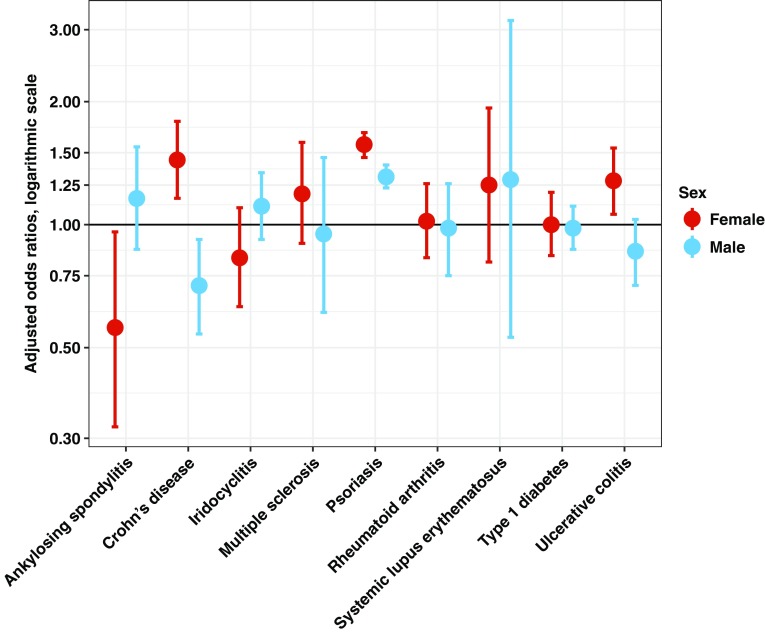
Several studies have demonstrated associations between neuropsychiatric disorders, such as attention-deficit/hyperactivity disorder (ADHD), and the immune system, including autoimmune diseases. Since ADHD and many autoimmune diseases show sex-specific properties, such associations may also differ by sex. Using Norwegian national registries, we performed a cross-sectional study based on a cohort of 2,500,118 individuals to investigate whether ADHD is associated with common autoimmune diseases. Associations between ADHD and autoimmune diseases in females and males were investigated with logistic regression and effect modification by sex was evaluated. Several subanalyses were performed. The strongest association was found between ADHD and psoriasis in females, adjusted odds ratio (adjOR) = 1.57 (95% confidence interval: 1.46-1.68) and males, adjOR = 1.31 (1.23-1.40); p value for interaction < 0.0001. Furthermore, among females, ADHD was associated with Crohn's disease, adjOR = 1.44 (1.16-1.79) and ulcerative colitis, adjOR = 1.28 (1.06-1.54). In contrast, males with ADHD had lower odds of Crohn's disease, adjOR = 0.71 (0.54-0.92), in addition to a trend for lower odds of ulcerative colitis, adjOR = 0.86 (0.71-1.03); p values for interaction < 0.0001 and 0.0023, respectively. In a group of females where information on smoking and body mass index was available, adjustment for these potential mediators did not substantially alter the associations. Our findings support previously reported associations between ADHD and diseases of the immune system. The associations differ by sex, suggesting that sex-specific immune-mediated neurodevelopmental processes may be involved in the etiology of ADHD.
Overview
The claims and statistics of this paper haven’t been checked yet.
Free: it reads the open-access text and checks the first 5 claims that cite a source we can check. Create a free account to check every claim.
Integrity signals
Registry
Cites
Statistics
Figures
Verification
Claims the paper makes
The claims and statistics of this paper haven’t been checked yet.
Free: it reads the open-access text and checks the first 5 claims that cite a source we can check. Create a free account to check every claim.
Claims other papers make about this one
Each is checked against this paper’s own text: does it say what the citing paper says it does?
The cited source says what the claim attributes to it.
In the citing paper
“In a Norwegian national registry study of over 1.2 million males and over 1.2 million females, males with ADHD were 30% more likely to be diagnosed with psoriasis, and women with ADHD more than 50% more likely to be diagnosed with psoriasis, than normally developing controls (Hegvik et al., 2018).”
From The World Federation of ADHD International Consensus Statement: 208 Evidence-based conclusions about the disorder (2021) · cites this paper as Hegvik et al., 2018
In the citing paper
“A Norwegian registry study found higher rates of psoriasis, ulcerative colitis and Crohn’s disease in females than in males diagnosed with ADHD287.”
From Sex and gender in neurodevelopmental conditions (2023) · cites this paper as [287]
Self-check
Percentages, sums and reported differences re-computed from the paper’s own numbers.
The self-check needs the paper’s full text.
Citations
Cites
R: A Language and Environment for Statistical Computing
R Core Team (2025) · doi:10.32614/r.manuals · Cited by 352,181
Glutamate neurotoxicity and diseases of the nervous system
CHOI, D. (1988) · Neuron · doi:10.1016/0896-6273(88)90162-6 · Cited by 7,972
Host–microbe interactions have shaped the genetic architecture of inflammatory bowel disease
The International IBD Genetics Consortium (IIBDGC), Jostins, L., Ripke, S., Weersma, R. K., Duerr, R. H., McGovern, D. P., Hui, K. Y., Lee, J. C., Philip Schumm, L., Sharma, Y., et al. (2012) · Nature · doi:10.1038/nature11582 · Cited by 4,722 · cited 1×
“More than 150 genetic risk variants have been identified for both, many of which are shared, and environmental factors are highly implicated in the etiology [51, 66, 67].”
BackgroundThe Classical Complement Cascade Mediates CNS Synapse Elimination
Stevens, B., Allen, N. J., Vazquez, L. E., Howell, G. R., Christopherson, K. S., Nouri, N., Micheva, K. D., Mehalow, A. K., Huberman, A. D., Stafford, B., et al. (2007) · Cell · doi:10.1016/j.cell.2007.10.036 · Cited by 3,313
Global Epidemiology of Psoriasis: A Systematic Review of Incidence and Prevalence
Parisi, R., Symmons, D. P. M., Griffiths, C. E. M., & Ashcroft, D. M. (2013) · Journal of Investigative Dermatology · doi:10.1038/jid.2012.339 · Cited by 2,592 · cited 2×
“The etiology behind psoriasis is complex, including environmental and lifestyle factors [50, 53, 59] and several genetic risk variants have been identified, mainly in and around genes involved in the immune response and skin barrier regulation [60].”
BackgroundDiscovery of the first genome-wide significant risk loci for ADHD
(2017) · doi:10.1101/145581 · Cited by 2,203 · cited 2×
“Knockout of the ST3GAL3 gene affects both eosinophilic immune responses [28] and brain development [29].”
BackgroundADHD Working Group of the Psychiatric Genomics Consortium (PGC), Demontis, D., Early Lifecourse & Genetic Epidemiology (EAGLE) Consortium, 23andMe Research Team, Walters, R. K., Martin, J., Mattheisen, M., Als, T. D., Agerbo, E., Baldursson, G., et al. (2019) · Nature Genetics · doi:10.1038/s41588-018-0269-7 · Cited by 2,203
Self-citationThe Prevalence of DSM-IV Attention-Deficit/Hyperactivity Disorder: A Meta-Analytic Review
Willcutt, E. G. (2012) · Neurotherapeutics · doi:10.1007/s13311-012-0135-8 · Cited by 2,160 · cited 2×
“Sex, including both hormonal and non-hormonal influences, is a key determinant of immune system functioning [33, 34], brain development, neural functioning and psychiatric disease [30, 31, 38, 39, 68, 69].”
BackgroundOveradjustment bias and unnecessary adjustment in epidemiologic studies.
Schisterman, E. F., Cole, S. R., & Platt, R. W. (2009) · Epidemiology · doi:10.1097/ede.0b013e3181a819a1 · Cited by 2,096 · cited 3×
“Substantial attenuation of the estimated associations between ADHD and autoimmune diseases when adjusting for smoking and BMI, would indicate that much of the effect of ADHD on these diseases might be mediated through these mediators [57, 58].”
BackgroundOcrelizumab versus Placebo in Primary Progressive Multiple Sclerosis
Montalban, X., Hauser, S. L., Kappos, L., Arnold, D. L., Bar-Or, A., Comi, G., de Seze, J., Giovannoni, G., Hartung, H.-P., Hemmer, B., et al. (2017) · New England Journal of Medicine · doi:10.1056/nejmoa1606468 · Cited by 1,905 · cited 1×
“For example, patients with primary-progressive multiple sclerosis, which constitute 10–15% of multiple sclerosis patients, will often not be identified by our approach as until recently there have been limited pharmacological treatment options for this group [72].”
Background
Cited by
Faraone, S. V., Banaschewski, T., Coghill, D., Zheng, Y., Biederman, J., Bellgrove, M. A., Newcorn, J. H., Gignac, M., Al Saud, N. M., Manor, I., et al. (2021) · Neuroscience & Biobehavioral Reviews · doi:10.1016/j.neubiorev.2021.01.022 · Cited by 1,545
“likely to be diagnosed with psoriasis, and women with ADHD more than 50 % more likely to be diagnosed with psoriasis, than normally developing controls (Hegvik et al., 2018).”
InfluentialSelf-citationUpdated European Consensus Statement on diagnosis and treatment of adult ADHD
Kooij, J. J. S., Bijlenga, D., Salerno, L., Jaeschke, R., Bitter, I., Balázs, J., Thome, J., Dom, G., Kasper, S., Nunes Filipe, C., et al. (2019) · European Psychiatry · doi:10.1016/j.eurpsy.2018.11.001 · Cited by 686
“ADHD has further been associated with auto-immune diseases [148], obesity [149], and physical multi-morbidity.”
BackgroundSex and gender in neurodevelopmental conditions
Bölte, S., Neufeld, J., Marschik, P. B., Williams, Z. J., Gallagher, L., & Lai, M.-C. (2023) · Nature Reviews Neurology · doi:10.1038/s41582-023-00774-6 · Cited by 249
Tylee, D. S., Sun, J., Hess, J. L., Tahir, M. A., Sharma, E., Malik, R., Worrall, B. B., Levine, A. J., Martinson, J. J., Nejentsev, S., et al. (2018) · American Journal of Medical Genetics Part B: Neuropsychiatric Genetics · doi:10.1002/ajmg.b.32652 · Cited by 219
Sex differences in neurodevelopmental disorders
May, T., Adesina, I., McGillivray, J., & Rinehart, N. J. (2019) · Current Opinion in Neurology · doi:10.1097/wco.0000000000000714 · Cited by 235
Iskandar, I. Y. K., Parisi, R., Griffiths, C. E. M., Ashcroft, D. M., & Atlas, T. G. P. (2021) · British Journal of Dermatology · doi:10.1111/bjd.19169 · Cited by 181
A Review on the Role of Inflammation in Attention-Deficit/Hyperactivity Disorder
Leffa, D. T., Torres, I. L. S., & Rohde, L. A. (2018) · Neuroimmunomodulation · doi:10.1159/000489635 · Cited by 168
Chang, J. P.-C., Mondelli, V., Satyanarayanan, S. K., Chiang, Y.-J., Chen, H.-T., Su, K.-P., & Pariante, C. M. (2020) · Brain, Behavior, and Immunity · doi:10.1016/j.bbi.2020.05.017 · Cited by 104
Physical health in children with neurodevelopmental disorders
Alabaf, S., Gillberg, C., Lundström, S., Lichtenstein, P., Kerekes, N., Råstam, M., & Anckarsäter, H. (2019) · Journal of Autism and Developmental Disorders · doi:10.1007/s10803-018-3697-4 · Cited by 97
Chang, J. P., Su, K., Mondelli, V., & Pariante, C. M. (2021) · Translational Psychiatry · doi:10.1038/s41398-021-01550-0 · Cited by 111
“For example, ADHD is more likely to have allergy associated disorders including asthma, rhinitis, atopic dermatitis and allergic conjunctivitis [9], and psoriasis [10].”
BackgroundMisiak, B., Wójta-Kempa, M., Samochowiec, J., Schiweck, C., Aichholzer, M., Reif, A., Samochowiec, A., & Stańczykiewicz, B. (2022) · Progress in Neuro-Psychopharmacology and Biological Psychiatry · doi:10.1016/j.pnpbp.2022.110581 · Cited by 107
“Finally, the role of immune activation in the etiology of ADHD is supported by studies showing that individuals with ADHD and their mothers have higher risk of developing chronic diseases with immune component (Hegvik et al., 2018; Instanes et al., 2017; Miyazaki et al., 2017).”
The Role of the Gut-Brain Axis in Attention-Deficit/Hyperactivity Disorder
Dam, S. A., Mostert, J. C., Szopinska-Tokov, J. W., Bloemendaal, M., Amato, M., & Arias-Vasquez, A. (2019) · Gastroenterology Clinics of North America · doi:10.1016/j.gtc.2019.05.001 · Cited by 64
Martino, D., Johnson, I. N. S., & Leckman, J. F. (2020) · Frontiers in Neurology · doi:10.3389/fneur.2020.567407 · Cited by 66
“(163) conducted a cross-sectional study of a cohort of more than 2.”
BackgroundKittel-Schneider, S., Arteaga-Henriquez, G., Vasquez, A. A., Asherson, P., Banaschewski, T., Brikell, I., Buitelaar, J., Cormand, B., Faraone, S. V., Freitag, C. M., et al. (2022) · Neuroscience & Biobehavioral Reviews · doi:10.1016/j.neubiorev.2021.10.035 · Cited by 54
Self-citationSong, Y., Lu, M., Yuan, H., Chen, T., & Han, X. (2020) · Experimental and Therapeutic Medicine · doi:10.3892/etm.2020.8789 · Cited by 59
“A cross‐sectional study involving 2,500,118 individuals in Norway indicated that ADHD was associated with psoriasis and Crohn's disease among females (136).”
BackgroundZhao, L., Li, X., Liu, G., Han, B., Wang, J., & Jiang, X. (2019) · Neuropsychiatric Disease and Treatment · doi:10.2147/ndt.s189200 · Cited by 49
“with ADHD, particularly in females.(14) Considering that ADHD has an approximate sex ratio of 3:1 during childhood and displays sex-specific manifestations,(23) a sex-specific mechanism may underlie the relationship between ADHD and maternal immune disease, such as diabetes.”
BackgroundPetruso, F., Giff, A., Milano, B. A., Rossi, M. M. D., & Saccaro, L. F. (2023) · Neuronal Signaling · doi:10.1042/ns20220077 · Cited by 60
“…ADHD and autoimmune and inflammatory comorbidities, including eczema [323], atopic dermatitis [324], allergic rhinitis, asthma [324], and psoriasis [325] (see also [323] for a meta-analysis) has raised the possibility of a neuropathological role of the immune system and inflammation in ADHD…”
BackgroundHegvik, T.-A., Waløen, K., Pandey, S. K., Faraone, S. V., Haavik, J., & Zayats, T. (2021) · Molecular Psychiatry · doi:10.1038/s41380-019-0540-z · Cited by 39
Self-citationInsights into attention-deficit/hyperactivity disorder from recent genetic studies
Brikell, I., Burton, C. L., Mota, N. R., & Martin, J. (2021) · Psychological Medicine · doi:10.1017/s0033291721000982 · Cited by 42
“…hypertension, certain autoimmune and inflammatory disorders, infections, migraine, and epilepsy in children, adolescents and adults with ADHD (Akmatov et al., 2019; Bertelsen et al., 2016; Chen et al., 2018; Cortese et al., 2018; Hegvik et al., 2018; Nielsen et al., 2017; Salem et al., 2018).”
BackgroundArteaga-Henríquez, G., Rosales-Ortiz, S. K., Vásquez, A. A., Bitter, I., Ginsberg, Y., Ibañez-Jiménez, P., Kilencz, T., Lavebratt, C., Matura, S., Reif, A., et al. (2020) · Trials · doi:10.1186/s13063-019-4040-x · Cited by 40
Chan, A. Y. L., Gao, L., Hsieh, M. H., Kjerpeseth, L. J., Avelar, R., Banaschewski, T., Chan, A. H. Y., Coghill, D., Cohen, J. M., Gissler, M., et al. (2024) · Nature Medicine · doi:10.1038/s41591-024-02917-8 · Cited by 33
“However, some of the included studies used self-reported data 19–21 , had limited statistical power 20,22 or had limited adjustment for confounders 19,20,23,24 , especially familial factors, and were predominantly conducted in White populations 7,19–23, 25,”
Attention-deficit/hyperactivity disorder: is there a connection with the immune system?
Hoekstra, P. J. (2019) · European Child & Adolescent Psychiatry · doi:10.1007/s00787-019-01344-2 · Cited by 29
Akıncı, M. A., & Necati, U. (2021) · Bratislavské lekárske listy/Bratislava medical journal · doi:10.4149/bll_2021_042 · Cited by 27
“Additionally, it has been noted that there is a positive relationship between ADHD and immune-related diseases in females while gender-specifi c immune-mediated neurodevelopmental processes may be involved in the ADHD etiology (41).”
Hegvik, T., Chen, Q., Kuja‐Halkola, R., Klungsøyr, K., Butwicka, A., Lichtenstein, P., Almqvist, C., Faraone, S. V., Haavik, J., & Larsson, H. (2021) · International Journal of Epidemiology · doi:10.1093/ije/dyab151 · Cited by 28
“Some of this study’s findings are replications of previous findings in independent materials.(12,17,18,20) Still, the magnitude of the associations differs between the studies, and some previous findings were not replicated.”
ResultSelf-citationSears, C. G., Sears, L. L., & Zierold, K. M. (2020) · Neurotoxicology and Teratology · doi:10.1016/j.ntt.2020.106855 · Cited by 25
Chang, J. P. (2021) · Brain Behavior & Immunity - Health · doi:10.1016/j.bbih.2021.100310 · Cited by 27
“N-3 PUFAs have been reported to be important for several brain disorders (Hibbeln et al., 2007; Su et al., 2008, 2014).”
BackgroundYang, X., Yang, L., Zhang, T., Zhang, H., Chen, H., & Zuo, X. (2023) · Frontiers in Immunology · doi:10.3389/fimmu.2023.1267834 · Cited by 19
Evaluation of causality between ADHD and Parkinson's disease: Mendelian randomization study
Li, G. H., Ge, G. M., Cheung, C., Ip, P., Coghill, D., & Wong, I. C. K. (2020) · European Neuropsychopharmacology · doi:10.1016/j.euroneuro.2020.06.001 · Cited by 17
“, 2018), and inflammatory bowel disease(Hegvik et al., 2018; Villumsen et al., 2019)) were checked at PhenoScanner, a database of publicly available genotype-phenotype association results from GWAS(Staley et al.”
BackgroundKelly, C. A., Kelly, C., & Taylor, R. (2024) · European Journal of Medical and Health Sciences · doi:10.24018/ejmed.2024.6.1.2033 · Cited by 22
“Skin rashes such as eczema, psoriasis, urticaria or hives are common [88], but MCA may also contribute to a wide range of internal organ dysfunction.”
BackgroundSodium hydrogen exchanger 9 NHE9 ( SLC9A9 ) and its emerging roles in neuropsychiatric comorbidity
Patak, J., Faraone, S. V., & Zhang‐James, Y. (2020) · American Journal of Medical Genetics Part B Neuropsychiatric Genetics · doi:10.1002/ajmg.b.32787 · Cited by 15
Brikell, I., Wimberley, T., Albiñana, C., Vilhjálmsson, B. J., Agerbo, E., Børglum, A. D., Demontis, D., Schork, A. J., LaBianca, S., Werge, T. M., et al. (2022) · American Journal of Psychiatry · doi:10.1176/appi.ajp.21111105 · Cited by 18
Ho, H.-Y., Wong, C., Wu, S., Hsiao, R. C.-J., Chen, Y., & Yen, C. (2021) · International Journal of Environmental Research and Public Health · doi:10.3390/ijerph18031286 · Cited by 12
“In addition to AA, the comorbid association of ADHD with other autoimmune diseases including psoriasis, ankylosing spondylitis, autoimmune thyroid diseases, and inflammatory bowel disease has been reported [31,32].”
BackgroundFai, K. N., Simo, L. P., Ntani, L. L., Forchin, A. N., Chirsir, P., Tianyi, F.-L., Nsah, B., & Agbor, V. N. (2020) · BMJ Open · doi:10.1136/bmjopen-2020-037297 · Cited by 20
Solberg, B. S., Kvalvik, L. G., Instanes, J. T., Hartman, C. A., Klungsøyr, K., Li, L., Larsson, H., Magnus, P. M., Njølstad, P. R., Johansson, S., et al. (2023) · Biological Psychiatry · doi:10.1016/j.biopsych.2023.12.017 · Cited by 12
Self-citationEarly estradiol exposure masculinizes disease‐relevant behaviors in female mice
Seiffe, A., Ramirez, M. F., Barrios, C. D., Albarrán, M. M., & Depino, A. M. (2021) · European Journal of Neuroscience · doi:10.1111/ejn.15130 · Cited by 11
“Indeed, mutations or transcriptional alterations in genes located in sex chromosomes (Nguyen et al., 2020; Schaafsma & Pfaff, 2014), abnormal perinatal exposure to sex steroids (Baron- Cohen et al., 2019; Geier et al., 2012), perinatal exposure to immunological factors (Depino, 2013, 2018; Estes & McAllister, 2016; He…”
BackgroundNg, R. W. Y., Chen, Z., Yang, L., Wong, O. W. H., Leung, A. S. Y., Tsui, K. W., Kwok, N. M. W., Tang, L. H. Y., Cheung, P. M. H., Chan, P. K. S., et al. (2025) · Scientific Reports · doi:10.1038/s41598-025-04303-x · Cited by 13
Gagliano, A., Cucinotta, F., Giunta, I., Modica, I. D., Domenico, C. D., Costanza, C., Germanò, E., & Frankovich, J. (2025) · International Journal of Molecular Sciences · doi:10.3390/ijms26167767 · Cited by 15
“A potential role for neuroinflammation in ADHD has been primarily postulated based on the frequent association between ADHD and various immune disorders, such as eczema, asthma, rheumatoid arthritis, type 1 diabetes, psoriasis, and inflammatory bowel disease [52–57].”
Hu, J., Lee, C., Lin, T.-C., Chung, C., Chen, C., Chang, P.-K., Hsiao, C.-W., Sun, C., Tzeng, N., & Chien, W. (2021) · Frontiers in Psychiatry · doi:10.3389/fpsyt.2021.537137 · Cited by 12
“Studies also identified a higher prevalence of autoimmune diseases, such as thyrotoxicosis, type 1 diabetes, autoimmune hepatitis, psoriasis, and ankylosing spondylitis in ADHD patients (72).”
BackgroundAro, T. I., Neittaanmäki, R., Korhonen, E., Riihimäki, H., & Torppa, M. (2023) · Journal of Learning Disabilities · doi:10.1177/00222194221150230 · Cited by 17
“ADHD, for instance, has been reported to co-occur with migraines (Fasmer et al., 2011a, 2011b; Kutuk et al., 2018), asthma (Fasmer et al., 2011b), and psoriasis (Hegvik et al., 2018).”
BackgroundVillén, R. G., Fernández-López, M. L., Checa-Ros, A., Tortosa-Pinto, P., Aguado-Rivas, R., Garre-Morata, L., Acuña-Castroviejo, D., & Molina‐Carballo, A. (2024) · Biomedicines · doi:10.3390/biomedicines12081818 · Cited by 8
“…HI. (or more) for 4 out of the 8 behaviors on questions 19–26 (total score sum ≥ 8 points considered pathological) and have a The oppositional defiant disorder screening (items 19 to 28 of the Vanderbilt Scales) was completed by the parents. score 1 or 2 on any of the performance questions 36–43.”
BackgroundNovel Genetic Variant Predicts Surgical Recurrence Risk in Crohn’s Disease Patients
Wang, M., Friton, J. J., Raffals, L. E., Leighton, J. A., Pasha, S. F., Picco, M. F., Monroe, K. M., Nix, B. D., Newberry, R. D., & Faubion, W. A. (2021) · Inflammatory Bowel Diseases · doi:10.1093/ibd/izaa362 · Cited by 9
Attention Deficit Hyperactivity Disorder
Katzinger, J. J., Murray, M. T., & Lyon, M. R. (2020) · Elsevier eBooks · doi:10.1016/b978-0-323-43044-9.00151-5 · Cited by 7
Acute exposure of microwave impairs attention process by activating microglial inflammation
Jiang, S., Ma, Y., Shi, Y., Zou, Y., Yang, Z., Zhi, W., Zhao, Z., Shen, W., Chen, L., Wu, Y., et al. (2024) · Cell & Bioscience · doi:10.1186/s13578-023-01162-9 · Cited by 8
“…that microglial activation and neuroinflammation might be druggable targets upstream of cell apoptosis [44, 45], and epidemiology, genetic studies, and systematic review of literature largely suggest that attention-deficit/hyper-activity disorder presents with increased neuroinflammation [46, 47].”
BackgroundBehavioral disorders in multiple sclerosis: a comprehensive review
Jellinger, K. A. (2024) · Journal of Neural Transmission · doi:10.1007/s00702-024-02816-9 · Cited by 6
“Autoimmune encephalitis and systemic or brain autoimmne diseases, such as MS, have been reported to sometimes present with obsessive-compulsive symptoms (Endres et al. 2022; Hegvik et al. 2018; Nielsen et al. 2017 ).”
Shero, N., & Pandeya, D. R. (2022) · Annals of Medicine and Surgery · doi:10.1016/j.amsu.2022.103369 · Cited by 5
“Recent studies on this relationship show that the prevalence of ADHD is higher in females with CD than males with CD [17].”
BackgroundInfluentialPetruso, F., Giff, A. E., Milano, B. A., Rossi, M. M. D., & Saccaro, L. F. (2023) · doi:10.31234/osf.io/2rnk8 · Cited by 4
Tarafdar, N., Varambally, M., Pope, E., Lam, J. M., & Liu, C. (2025) · Pediatric Dermatology · doi:10.1111/pde.70066 · Cited by 4
“Both AD and psoriasis are linked to depression, anxiety, and ADHD, while conduct symptoms are more common in AD [22, 23].”
Gasanov, R. F., Makarov, I. V., Emelina, D. A., & Avtenuk, A. S. (2023) · V M BEKHTEREV REVIEW OF PSYCHIATRY AND MEDICAL PSYCHOLOGY · doi:10.31363/2313-7053-2023-699 · Cited by 4
Merzon, E., Farag, R., Ashkenazi, S., Magen, E., Manor, I., Weizman, A., Green, I., Golan‐Cohen, A., Genshin, A., Vinker, S., et al. (2024) · Journal of Clinical Medicine · doi:10.3390/jcm13206075 · Cited by 3
“In addition, alterations in neural development resulting from immune dysfunction may increase the susceptibility to ADHD, a hypothesis supported by emerging evidence of immune system involvement in neurodevelopmental disorders [11,25,26].”
BackgroundDickinson, K., Parmar, P., Reyes, A. B., & Hale, E. W. (2024) · Obesity Surgery · doi:10.1007/s11695-024-07211-7 · Cited by 4
“Conversely, obesity can exacerbate ADHD symptoms, such as reduced energy levels, decreased motivation, and heightened stress levels [41].”
Ram, S., Corbin, M., Mannetje, A. ’., Eng, A., Kvalsvig, A., Baker, M. G., & Douwes, J. E. (2025) · JMIR Research Protocols · doi:10.2196/66184 · Cited by 2
“The etiology of these diseases is not well understood, but environmental factors, genetics, immune-regulatory pathways, and microbial exposures are considered important [13,14].”
Luo, Y., Blakey, R., Gkatzionis, A., Stergiakouli, E., & Dardani, C. (2025) · Psychological Medicine · doi:10.1017/s0033291725000480 · Cited by 3
“Individuals with ADHD appear to be at higher risk of a number of adverse physical and mental health outcomes throughout life, particularly cardiovascular conditions, autoimmune conditions, and depression (Dardani et al., 2021; Hegvik et al., 2018; Leppert et al., 2021; Riglin et al., 2021).”
Ma, L., Li, X., & Zhang, Y. (2025) · Medicine · doi:10.1097/md.0000000000042423 · Cited by 2
Autoimmune Diseases and Infections as Risk Factors for Mental Disorders
Orlovska‐Waast, S., & Benros, M. E. (2021) · Springer eBooks · doi:10.1007/978-3-030-71229-7_1 · Cited by 2
Saliba, M., Wilton, A., Hagen, K., & Romanowicz, M. (2023) · Brain Behavior & Immunity - Health · doi:10.1016/j.bbih.2023.100692 · Cited by 2
“…cases of chorea, dystonic reactions, and orofacial and extremity dyskinesia exacerbated by stimulant treatment have been reported in the literature (Heinrich, 2002; Mattson and Calverley, 1968; Melvin and Heiraty, 2013; Pagliaro et al., 2022; Senecky et al., 2002; Tekin et al., 2015; Waugh, 2013;…”
BackgroundPeripheral Inflammation In Adult ADHD: Sex Differences And Hematological Markers
Çankaya, P. K. (2025) · Psychiatric Quarterly · doi:10.1007/s11126-025-10185-z · Cited by 2
“Future studies should incorporate hormonal profiling and sex-specific immunopheno-typing to clarify the biological underpinnings of these divergent patterns [31, 32, 53].”
Peltier, R., Miller, E., Berne-Anderson, T., & Langlais, M. R. (2026) · American Journal of Qualitative Research · doi:10.29333/ajqr/17386 · Cited by 1
Fu, Q., Li, L., Zhuoma, N., Ma, R., Zhao, Z., Quzuo, Z., Wang, Z., Yangzong, D., & Di, J. (2024) · Scientific Reports · doi:10.1038/s41598-024-66535-7 · Cited by 2
Kuśmierczyk-Kozieł, H., Michalak, A., Chrzanowski, J., Błaziak, K., Mianowska, B., Szadkowska, A., Chobot, A. P., Jarosz-Chobot, P. A., Myśliwiec, M., Makowska, I., et al. (2025) · Nordic Journal of Psychiatry · doi:10.1080/08039488.2025.2455555 · Cited by 1
“Additionally, ADHD tends to coincide with other chronic conditions, particularly autoimmune disorders [5].”
Hermann, I., Matthies, S., & van Elst, L. T. (2019) · Nervenheilkunde · doi:10.1055/a-0976-9207
“Auch wurde eine hohe Komorbidität von ADHS und Autoimmunerkrankungen beschrieben [36].”
BackgroundAandachtsdeficiëntie-/hyperactiviteitsstoornis (ADHD)
Bijlenga, D., & Kooij, J. J. S. (2020) · Bohn Stafleu van Loghum eBooks · doi:10.1007/978-90-368-2524-5_14
Prenatal Enflamasyon ve Dikkat Eksikliği Hiperaktivite Bozukluğu İlişkisi
Karcı, C. K. (2021) · Psikiyatride Guncel Yaklasimlar - Current Approaches in Psychiatry · doi:10.18863/pgy.811846 · Cited by 1
محمد, ت. م. ف. (2023) · Mağallaẗ Al-Qirā'aẗ wa Al-Maʿrifaẗ/Mağallaẗ Al-Qirā'aẗ wa Al-Maʿrifaẗ · doi:10.21608/mrk.2023.317222
Kustow, J. (2024) · Elsevier eBooks · doi:10.1016/b978-0-323-95082-4.00004-9 · Cited by 1
Villén, R. G., Fernández-López, L., Checa-Ros, A., Tortosa-Pinto, P., Aguado-Rivas, R., Garre-Morata, L., Acuña-Castroviejo, D., & Molina‐Carballo, A. (2024) · Research Square · doi:10.21203/rs.3.rs-3902568/v1
Ram, S., Corbin, M., Douwes, J. E., Kvalsvig, A., Baker, M. G., & Mannetje, A. ’. (2024) · Research Square · doi:10.21203/rs.3.rs-4357022/v1
Alameri, M. A., Abu-Shaikh, H., Mansour, M., Al-Habahbeh, S., Weshah, F., Ennab, W., Binsaleh, A. Y., Shilbayeh, S. A. R., & Gammoh, O. (2024) · Journal of Clinical Medicine · doi:10.3390/jcm13133844
Zhou, Y., Jin, B., & Qiao, K. (2025) · Medicine · doi:10.1097/md.0000000000041157 · Cited by 1
“[11] Although these observational studies have tried to control the available confounding factors, the residual confounding effects and reverse causation might still bias the associations, [12] leaving the causal relationships between ADHD and autoimmune diseases that remained unclear.”
Jiang, S., Ma, Y., Shi, Y., Zou, Y., Yang, Z., Zhi, W., Zhao, Z., Shen, W., Chen, L., Wu, Y., et al. (2024) · Figshare · doi:10.6084/m9.figshare.26661119
Jiang, S., Ma, Y., Shi, Y., Zou, Y., Yang, Z., Zhi, W., Zhao, Z., Shen, W., Chen, L., Wu, Y., et al. (2024) · Figshare · doi:10.6084/m9.figshare.26661140
Jiang, S., Ma, Y., Shi, Y., Zou, Y., Yang, Z., Zhi, W., Zhao, Z., Shen, W., Chen, L., Wu, Y., et al. (2024) · Figshare · doi:10.6084/m9.figshare.26661128
Jiang, S., Ma, Y., Shi, Y., Zou, Y., Yang, Z., Zhi, W., Zhao, Z., Shen, W., Chen, L., Wu, Y., et al. (2024) · Figshare · doi:10.6084/m9.figshare.26661137
Jiang, S., Ma, Y., Shi, Y., Zou, Y., Yang, Z., Zhi, W., Zhao, Z., Shen, W., Chen, L., Wu, Y., et al. (2024) · Figshare · doi:10.6084/m9.figshare.26661131
Jiang, S., Ma, Y., Shi, Y., Zou, Y., Yang, Z., Zhi, W., Zhao, Z., Shen, W., Chen, L., Wu, Y., et al. (2024) · Figshare · doi:10.6084/m9.figshare.26661125
Jiang, S., Ma, Y., Shi, Y., Zou, Y., Yang, Z., Zhi, W., Zhao, Z., Shen, W., Chen, L., Wu, Y., et al. (2024) · Figshare · doi:10.6084/m9.figshare.26661122
Jiang, S., Ma, Y., Shi, Y., Zou, Y., Yang, Z., Zhi, W., Zhao, Z., Shen, W., Chen, L., Wu, Y., et al. (2024) · Figshare · doi:10.6084/m9.figshare.26661143
Jiang, S., Ma, Y., Shi, Y., Zou, Y., Yang, Z., Zhi, W., Zhao, Z., Shen, W., Chen, L., Wu, Y., et al. (2024) · Figshare · doi:10.6084/m9.figshare.26661134
Urbina, F. (2025) · Journal of Clinical Medicine · doi:10.3390/jcm15010084
“…disorder—a childhood-onset neurodevelopmental disorder characterized by inattention, hyperactivity, and impulsivity—has been strongly linked with psoriasis in females, despite being a male-predominant disorder with a ratio of 3:1 during childhood and adolescence [59].”
Neurodevelopmental comorbidities in juvenile systemic autoimmune and autoinflammatory diseases
Ellul, P., & Melki, I. (2026) · Nature Reviews Rheumatology · doi:10.1038/s41584-026-01356-8 · Cited by 3
Metadata
- Authors
- Hegvik, T.-A., Instanes, J. T., Haavik, J., Klungsøyr, K., & Engeland, A.
- Affiliations
- University of Bergen (NO)
- Haukeland University Hospital (NO)
- Norwegian Institute of Public Health (NO)
- Corresponding author
- Hegvik, Tor-Arne
- Venue
- European Child & Adolescent Psychiatry
- Published
- 2017-10-05
- Volume
- 27
- Issue
- 5
- Pages
- 663-675
- ISSN
- 1018-8827 (ISSN-L)
- 1435-165X
- PMC
- PMC5945751
- OpenAlex
- W2762084917
- Cited by
- 79
- References
- 76
- Citations by year
- 2026: 2 · 2025: 10 · 2024: 21 · 2023: 9 · 2022: 3 · 2021: 13 · 2020: 11 · 2019: 6 · 2018: 4
- FWCI
- 4.72
- Type
- journal article
- Language
- en
- Update notices
- correction (2017-12-01)
- Open access
- hybrid
- doi.org
- Locations
- European Child & Adolescent Psychiatry (publishedVersion, cc-by)
- Europe PMC (PubMed Central) (publishedVersion, cc-by)
- PubMed Central (publishedVersion, cc-by)
- PubMed (publishedVersion)
- NORA - Norwegian Open Research Archives (submittedVersion, cc-by)
- NORA - Norwegian Open Research Archives (submittedVersion, other-oa)
- Funders
- Horizon 2020 (667302)
- Helse Vest
- Universitetet i Bergen
- Stiftelsen Kristian Gerhard Jebsen
- The Norwegian national research network for ADHD
- Topics
- Health Sciences › Medicine › Psychiatry and Mental health › Attention Deficit Hyperactivity Disorder
- Life Sciences › Neuroscience › Cognitive Neuroscience › Autism Spectrum Disorder Research
- Health Sciences › Medicine › Gastroenterology › Inflammatory Bowel Disease
- Keywords
- attention deficit hyperactivity disorder, autoimmune disease, sex differences, psoriasis, Crohn's disease, ulcerative colitis, effect modification, smoking, body mass index
- MeSH terms
- Adolescent, Adult, Attention Deficit Disorder with Hyperactivity, Autoimmune Diseases, Child, Cross-Sectional Studies, Female, Humans, Male, Registries, Sex Factors, Cohort Studies
About these checks
Registry, retraction, Cites and statistics results are computed, not judged, with one exception: a printed reference that no index lists is read once by a model before it counts as a citation error. Claims are extracted by a model and kept only when their quote appears verbatim in the text; each cited source is then checked, with a model’s help, for whether it says what the claim relies on. Those verdicts can be wrong — read the claim’s quote and the cited source before relying on one.
Statistics and arithmetic are recomputed, not judged.
Confidence bands are shown only for fields calibrated on our annotated test set. None is calibrated yet, so no band is shown.
What counts as a claim ›How we measure confidence ›How we check this ›
Are you an author, or do you see a problem with this page? Request a review
Data sources
Bibliographic data: Semantic Scholar, OpenAlex, Crossref.
Contains information from the Semantic Scholar Academic Graph Datasets, made available under the ODC Attribution License (ODC-BY 1.0).
Semantic Scholar’s data is described in: Kinney, R., et al. (2023). The Semantic Scholar Open Data Platform. arXiv:2301.10140.
