

The DOI matches its Crossref record; 61 of the 61 references it cites were found in a registry or an index; 20 of the 37 sources its claims cite were checked for support.
Association between attention-deficit/hyperactivity disorders and intestinal disorders: A systematic review and Meta-analysis
Open accessAbstract
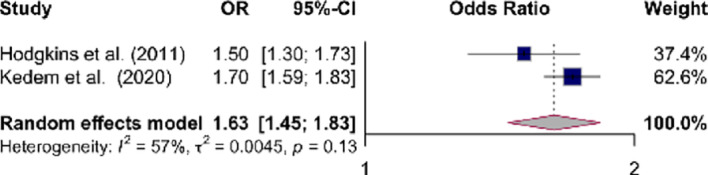
Patients with attention-deficit hyperactivity disorder (ADHD) reported significantly more constipation and flatulence than healthy controls. An altered gut microbiome can be associated with gastrointestinal symptoms. However, comprehensive information about associated risk of intestinal disorders and ADHD remains limited. A systematic review of the literature was therefore conducted to investigate the association between ADHD and different types of intestinal disorders. A total of 11 studies with 3,851,163 unique individuals, including 175 806 individuals with ADHD and 3 675 357 individuals without ADHD were included. The pooled OR of intestinal disorders for individuals with ADHD was 1.25 (95%CI, 0.75–2.07). A significant positive association was found between ADHD and irritable bowel syndrome (IBS) (OR 1.63 [95% CI 1.45–1.83]). Studies conducted in Eastern Mediterranean Region yielded a summary OR estimate that was higher than summary OR estimates in studies conducted in Region of the Americas, European Region and Western Pacific Region (3.03 [1.53–5.99] vs. 2.20 [1.05–4.63], 1.04 [0.44–2.41], 0.68 [0.25–1.87]), with p value 0.053, indicating a trend towards significance. High heterogeneity was observed. Our study supports association between ADHD and increased risk of IBS. Our study suggests an altered gut microbiome is the potential link that bridges gap between ADHD and intestinal disorder.
Overview
CoChat Summary
TL;DR
This systematic review and meta-analysis of 11 studies (3,851,163 individuals) found no significant pooled association between ADHD and all intestinal disorders (OR 1.25, 95% CI 0.75–2.07), but a significant positive association with IBS (OR 1.63, 95% CI 1.45–1.83). The authors suggest an altered gut microbiome may link ADHD and intestinal disorders, though heterogeneity was high.
Key findings
- Across 11 studies including 175,806 individuals with ADHD and 3,675,357 without ADHD, the pooled OR for all intestinal disorders was 1.25 (95% CI 0.75–2.07), with heterogeneity I² = 99% (P < 0.01).
- A significant positive association was found between ADHD and irritable bowel syndrome (IBS): OR 1.63 (95% CI 1.45–1.83) (I² = 57%, Tau² = 0.0045, p = 0.13). No association was found for IBD subtype (Crohn’s disease and ulcerative colitis), celiac disease, or constipation.
- In WHO-region subgroup analysis, Eastern Mediterranean Region had a higher summary OR (3.03 [1.53–5.99]) than the Americas (2.20 [1.05–4.63]), European Region (1.04 [0.44–2.41]), and Western Pacific Region (0.68 [0.25–1.87]), with p = 0.053, indicating a trend toward significance.
- Leave-one-out sensitivity analysis excluding Van den Heuvel et al. yielded a statistically significant positive association between ADHD and intestinal disorders (OR 1.47 [95% CI 1.00–2.16]). Egger’s test did not indicate strong publication bias (p = 0.38); 10 studies were rated good quality and 1 moderate quality.
Methods
- Systematic review and meta-analysis reported per PRISMA and registered in PROSPERO (CRD42023486812); databases EMBASE, Medline, Web of Science, and APA PsycINFO were searched from inception to 16 November 2023, with grey literature via Google Scholar and reference lists.
- Included control, nested case-control, cohort, and cross-sectional studies with professionally diagnosed ADHD, reported intestinal disorder counts, and OR/RR/HR with 95% CIs or computable count data; excluded reviews, commentaries, editorials, conference abstracts/theses, and studies lacking clear clinical definitions.
- Random-effects meta-analysis was used; primary outcome was OR of intestinal disorders in ADHD versus non-ADHD, secondary outcome was OR for specific intestinal disorders. Heterogeneity was assessed with I² and Cochran Q, with univariate meta-regression and subgroup analyses by age group, study type, study design, WHO region, number of subjects, and ADHD diagnostic criteria; leave-one-out sensitivity analysis and Egger’s test were also performed using R packages ‘meta’ and ‘metafor’.
Limitations
- The paper states: nearly half of studies were from Asia, limiting generalizability; heterogeneity was high due to differences in study design, population, and diagnostic criteria; only 11 studies were included; some subgroup analyses had small numbers; the WHO regional difference may reflect small sample size; and 9 of 11 studies were retrospective, prone to recall bias and incomplete data collection.
- Evident from the text: the overall pooled estimate had very high heterogeneity (I² = 99%), and the included observational designs cannot establish causality between ADHD and intestinal disorders.
Model-written summary. Check it against the paper before relying on it.
Integrity signals
Registry
Cites
Statistics
Figures



Verification
Claims the paper makes
19 Valid · 0 Not valid · 10 Not checked · 34 Own results and interpretations
Every source the paper cites for this claim was checked and supports it.
In the paper
“Microorganisms influence the brain through their ability to produce and modify metabolic, immunological and neurochemical factors in the gut that ultimately impact on the central nervous system59.”
§ Association between attention-deficit/hyperactivity disorders and intestinal disorders: A systematic review and Meta-analysis > Discussion
What the sources say
- Supportedcites [59] Erny, D. et al. Host microbiota constantly control maturation and function of microglia in the CNS. Nat. Neurosci. 18 (7), 965–977 (2015). source
The Discussion describes gut bacterial metabolites that may affect CNS function and microbiota-driven changes in cytokines that affect microglia. The Introduction also links intestinal microbiota to endocrine development and brain neurochemical mediators. These passages support the claim’s broad description of metabolic, immunological and neurochemical gut-to-brain influences. (LLM, conf=0.86)
plainstates a cause- Asserted: passes — The authors put it forward as true.
- Checkable: passes — It can be checked against evidence.
- Load-bearing: unclear — It is unclear whether the paper’s conclusions depend on it.
- Based: passes — The paper gives a reason why it holds.
- Supported
Every source the paper cites for this claim was checked and supports it.
In the paper
“ADHD has been associated with increased risk for intestinal disorders21.”
§ Association between attention-deficit/hyperactivity disorders and intestinal disorders: A systematic review and Meta-analysis > Discussion
What the sources say
- Supportedcites [21] Ming, X. et al. A gut feeling: a hypothesis of the role of the Microbiome in attention-deficit/hyperactivity disorders. Child. Neurol. Open. 5, 2329048X18786799 (2018). source
The Discussion reports increased rates of serious stomach or bowel problems in people with ADHD and cites studies finding constipation and fecal incontinence more likely in children with ADHD. The paper’s own findings, summarized in the Conclusion, also show a modest increase in gastrointestinal symptoms among children with ADHD. These support the claimed association, without establishing causation. (LLM, conf=0.90)
plainstates an association- Asserted: passes — The authors put it forward as true.
- Checkable: passes — It can be checked against evidence.
- Load-bearing: passes — The paper’s conclusions depend on it.
- Based: passes — The paper gives a reason why it holds.
- Supported
Every source the paper cites for this claim was checked and supports it.
In the paper
“Patients with attention-deficit hyperactivity disorder (ADHD) reported significantly more constipation and flatulence than healthy controls.”
- Also stated in: § Introduction · plain
“Children with ADHD reported significantly more constipation and flatulence symptoms than the healthy controls21.”
§ Association between attention-deficit/hyperactivity disorders and intestinal disorders: A systematic review and Meta-analysis > Abstract
What the sources say
- Supportedcites [21] Ming, X. et al. A gut feeling: a hypothesis of the role of the Microbiome in attention-deficit/hyperactivity disorders. Child. Neurol. Open. 5, 2329048X18786799 (2018). source
The ‘Prevalence of Gastrointestinal Symptoms in ADHD’ section states that children with ADHD had significantly higher constipation and flatulence scores than healthy controls. Table 3 reports P = .024 for constipation and P = .019 for flatulence. (LLM, conf=0.95)
plainstates an association- Asserted: passes — The authors put it forward as true.
- Checkable: passes — It can be checked against evidence.
- Load-bearing: unclear — It is unclear whether the paper’s conclusions depend on it.
- Based: passes — The paper gives a reason why it holds.
- Also stated in: § Introduction · plain
Every source the paper cites for this claim was checked and supports it.
In the paper
“In turn, brain activity also impacts the gut microbiota composition60.”
§ Association between attention-deficit/hyperactivity disorders and intestinal disorders: A systematic review and Meta-analysis > Discussion
What the sources say
- Supportedcites [60] Kuwahara, A. et al. Microbiota-gut-brain axis: enteroendocrine cells and the enteric nervous system form an interface between the microbiota and the central nervous system. Biomed. Res. 41 (5), 199–216 (2020). source
The section “Microbiota-gut-brain axis: Communication between the CNS and ENS” (p. 13) states that the CNS modulates intestinal motility patterns, which can change gut microbiota composition. It explicitly concludes that the brain can influence the gut microbiota through changes in motility, secretion and intestinal permeability. (LLM, conf=0.93)
plainstates a cause- Asserted: passes — The authors put it forward as true.
- Checkable: passes — It can be checked against evidence.
- Load-bearing: unclear — It is unclear whether the paper’s conclusions depend on it.
- Based: passes — The paper gives a reason why it holds.
- Supported
The cited sources support only part of this claim — read each source’s verdict below.
In the paper
“Differences in ADHD prevalence in different geographical regions40 may be due to differences in study methodologies, including sample size, response rate, information sources from parents or teachers, cultural factors and clinical diagnosis criteria of ADHD.”
§ Association between attention-deficit/hyperactivity disorders and intestinal disorders: A systematic review and Meta-analysis > Discussion
What the sources say
- Partly supportedcites [40] Salari, N. et al. The global prevalence of ADHD in children and adolescents: a systematic review and meta-analysis. Ital. J. Pediatr. 49 (1), 48 (2023). sourceExperimental — accuracy not yet measured
The Background and Discussion (page unavailable) support variation in ADHD prevalence across studies and identify diagnostic criteria as one reason estimates differ. The paper also reports prevalence estimates from different regions, but the cited passages do not attribute those differences to response rates, parent-versus-teacher information sources, or cultural factors; sample sizes are reported without being identified as a cause. (LLM, conf=0.86)
hedgedstates a possible cause- Asserted: passes — The authors put it forward as true.
- Checkable: passes — It can be checked against evidence.
- Load-bearing: unclear — It is unclear whether the paper’s conclusions depend on it.
- Based: passes — The paper gives a reason why it holds.
- Partly supported
19 more claims · 2 with their cited sources checked
Create a free account to see all 63 claims and to verify the 1 reference still open.
- Probably not a substantial claim. 27
- It may state two separate claims as one. 20
Citations
Cites
Host microbiota constantly control maturation and function of microglia in the CNS
Erny, D., Hrabě de Angelis, A. L., Jaitin, D., Wieghofer, P., Staszewski, O., David, E., Keren-Shaul, H., Mahlakoiv, T., Jakobshagen, K., Buch, T., et al. (2015) · Nature Neuroscience · doi:10.1038/nn.4030 · Cited by 3,569 · cited 1×
“Microorganisms influence the brain through their ability to produce and modify metabolic, immunological and neurochemical factors in the gut that ultimately impact on the central nervous system 59 .”
The role of short-chain fatty acids in microbiota–gut–brain communication
Dalile, B., Van Oudenhove, L., Vervliet, B., & Verbeke, K. (2019) · Nature Reviews Gastroenterology & Hepatology · doi:10.1038/s41575-019-0157-3 · Cited by 3,357 · cited 1×
“The gut microbiota influences gut barrier and produce neurotransmitters, amino acids and microbial metabolites 61 .”
Microbiota in health and diseases
Hou, K., Wu, Z.-X., Chen, X.-Y., Wang, J.-Q., Zhang, D., Xiao, C., Zhu, D., Koya, J. B., Wei, L., Li, J., et al. (2022) · Signal Transduction and Targeted Therapy · doi:10.1038/s41392-022-00974-4 · Cited by 3,171 · cited 1×
“Dysbiosis, in contrast, is the imbalanced state of gut microbial communities that can lead to dysregulation of bodily functions and various diseases 19 .”
Self-citationADHD Working Group of the Psychiatric Genomics Consortium (PGC), Demontis, D., Early Lifecourse & Genetic Epidemiology (EAGLE) Consortium, 23andMe Research Team, Walters, R. K., Martin, J., Mattheisen, M., Als, T. D., Agerbo, E., Baldursson, G., et al. (2019) · Nature Genetics · doi:10.1038/s41588-018-0269-7 · Cited by 2,203 · cited 1×
“There is evidence of strong genetic component of common variants in the polygenic architecture of ADHD with 22% of Single Nucleotide Polymorphism (SNP)-based heritability 47 .”
The gut microbiota–brain axis in behaviour and brain disorders
Morais, L. H., Schreiber, H. L., & Mazmanian, S. K. (2021) · Nature Reviews Microbiology · doi:10.1038/s41579-020-00460-0 · Cited by 2,149 · cited 1×
“Gut-brain axis 17 refers to the network of connections involving multiple biological systems that allows bidirectional communication between gut bacteria and the brain.”
Inflammatory bowel disease: Etiology and pathogenesis
Fiocchi, C. (1998) · Gastroenterology · doi:10.1016/s0016-5085(98)70381-6 · Cited by 2,059 · cited 3×
“Figure 2 showed the overall risk estimates of association between ADHD and all types of intestinal disorders reported in the included studies, including IBS, IBD subtype, celiac disease, constipation, dyspepsia, recurrent abdominal pain, Shigellosis, peptic ulcer, and fecal incontinence.”
The gut microbiome in neurological disorders
Cryan, J. F., O'Riordan, K. J., Sandhu, K., Peterson, V., & Dinan, T. G. (2020) · The Lancet Neurology · doi:10.1016/s1474-4422(19)30356-4 · Cited by 1,336
Song, P., Zha, M., Yang, Q., Zhang, Y., Li, X., & Rudan, I. (2021) · Journal of Global Health · doi:10.7189/jogh.11.04009 · Cited by 896
Attention-deficit hyperactivity disorder
Posner, J., Polanczyk, G. V., & Sonuga-Barke, E. (2020) · The Lancet · doi:10.1016/s0140-6736(19)33004-1 · Cited by 835
The global prevalence of ADHD in children and adolescents: a systematic review and meta-analysis
Salari, N., Ghasemi, H., Abdoli, N., Rahmani, A., Shiri, M. H., Hashemian, A. H., Akbari, H., & Mohammadi, M. (2023) · Italian Journal of Pediatrics · doi:10.1186/s13052-023-01456-1 · Cited by 670
Research works printed but not linked: 1
- Lacy, B. E. et al. Bowel Disorders Gastroenterol. ;150(6):1393–1407. (2016). e5.
Cited by
Rodrigues, B., Miranda, I. M., & de Oliveira, S. C. (2026) · Microorganisms · doi:10.3390/microorganisms14061301 · Cited by 5
“However, findings have been inconsistent across studies, and recent systematic reviews highlight several limitations, including the poor control of confounding factors (e.g., diet, medication, or age) [17], small sample sizes [18,19], and heterogeneous methodologies [17].”
Öksüzoğlu, M. E., & Okumuş, H. G. (2025) · BMC Psychiatry · doi:10.1186/s12888-025-07638-x · Cited by 1
Orell, G., Barazanji, N., Fernell, E., Gillberg, C., Lindberg, G., & Walter, S. (2026) · Scandinavian Journal of Gastroenterology · doi:10.1080/00365521.2026.2661968 · Cited by 1
WITHDRAWNPreprint
(2025) · PsyArXiv (OSF Preprints) · doi:10.31234/osf.io/dyxuf_v2
MCAS and Histamine H₃ Receptors in Treatment-Resistant ADHD and Anxiety: A Patient-Led HypothesisPreprint
Zlotnikov, A. (2025) · PsyArXiv (OSF Preprints) · doi:10.31234/osf.io/dyxuf_v3
Metadata
- Authors
- Ng, R. W. Y., Chen, Z., Yang, L., Wong, O. W. H., Leung, A. S. Y., Tsui, K. W., Kwok, N. M. W., Tang, L. H. Y., Cheung, P. M. H., Chan, P. K. S., & Ip, M.
- Affiliations
- Chinese University of Hong Kong (HK)
- Hospital Authority (HK)
- Corresponding author
- Ip, Margaret
- ORCID
- Venue
- Scientific Reports
- Published
- 2025-06-02
- Volume
- 15
- Issue
- 1
- Pages
- 19278-19278
- ISSN
- 2045-2322 (ISSN-L)
- PMC
- PMC12130308
- OpenAlex
- W4410964441
- Cited by
- 13
- References
- 60
- Citations by year
- 2026: 9 · 2025: 4
- FWCI
- 1.96
- Type
- journal article
- Language
- en
- Open access
- gold
- doi.org
- Licence
- cc-by
- creativecommons.org/licenses/by/4.0 (tdm)
- creativecommons.org/licenses/by/4.0 (vor)
- Locations
- Scientific Reports (publishedVersion, cc-by)
- PubMed Central (publishedVersion, cc-by)
- PubMed (publishedVersion)
- DOAJ (DOAJ: Directory of Open Access Journals) (submittedVersion, cc-by-sa)
- Funders
- Hong Kong Special Administrative Region, China (CUHK 24115121)
- Topics
- Health Sciences › Medicine › Gastroenterology › Gastrointestinal motility and disorders
- Health Sciences › Medicine › Psychiatry and Mental health › Attention Deficit Hyperactivity Disorder
- Life Sciences › Biochemistry, Genetics and Molecular Biology › Molecular Biology › Gut microbiota and health
- Keywords
- attention deficit hyperactivity disorder, irritable bowel syndrome, intestinal disorders, constipation, flatulence, gut microbiota, gastrointestinal symptoms, Eastern Mediterranean Region
- MeSH terms
- Gastrointestinal Microbiome, Attention Deficit Disorder with Hyperactivity, Humans, Intestinal Diseases, Risk Factors, Irritable Bowel Syndrome
About these checks
Registry, retraction, Cites and statistics results are computed, not judged, with one exception: a printed reference that no index lists is read once by a model before it counts as a citation error. Claims are extracted by a model and kept only when their quote appears verbatim in the text; each cited source is then checked, with a model’s help, for whether it says what the claim relies on. Those verdicts can be wrong — read the claim’s quote and the cited source before relying on one.
The claim verdicts this report counts are experimental: their accuracy is not yet measured.
A language model drew the claims from the paper on 2026-10-04, under version 3 of the claim definition (model deepseek-v4.1-flash, prompt extract-v3).
A second model labelled each claim on 2026-10-04 (model jev-1.13-20260917, definition revision gold-guideline-v0.2).
Cited sources are checked with a language model’s help (gpt-6-sol).
Statistics and arithmetic are recomputed, not judged.
Confidence bands are shown only for fields calibrated on our annotated test set. None is calibrated yet, so no band is shown.
What counts as a claim ›How we measure confidence ›How we check this ›
Are you an author, or do you see a problem with this page? Request a review
How to cite
Cite CoChat for the checks on this page, and the paper for its own findings.
- This page
- CoChat. (2026). Citation check: Association between attention-deficit/hyperactivity disorders and intestinal disorders: A systematic review and Meta-analysis. https://app.cochat.ai/papers/10.1038/s41598-025-04303-x
- The paper
- Ng, R. W. Y., Chen, Z., Yang, L., Wong, O. W. H., Leung, A. S. Y., Tsui, K. W., Kwok, N. M. W., Tang, L. H. Y., Cheung, P. M. H., Chan, P. K. S., & Ip, M. (2025). Association between attention-deficit/hyperactivity disorders and intestinal disorders: A systematic review and Meta-analysis. Scientific Reports. https://doi.org/10.1038/s41598-025-04303-x
Data sources
Bibliographic data: Semantic Scholar, OpenAlex, Crossref.
Contains information from the Semantic Scholar Academic Graph Datasets, made available under the ODC Attribution License (ODC-BY 1.0).
Semantic Scholar’s data is described in: Kinney, R., et al. (2023). The Semantic Scholar Open Data Platform. arXiv:2301.10140.
