

Through the looking glass: how do marked dolphins use mirrors and what does it mean?
Open accessThe DOI matches its Crossref record; 50 of the 50 references it cites were found in a registry or an index.
Abstract
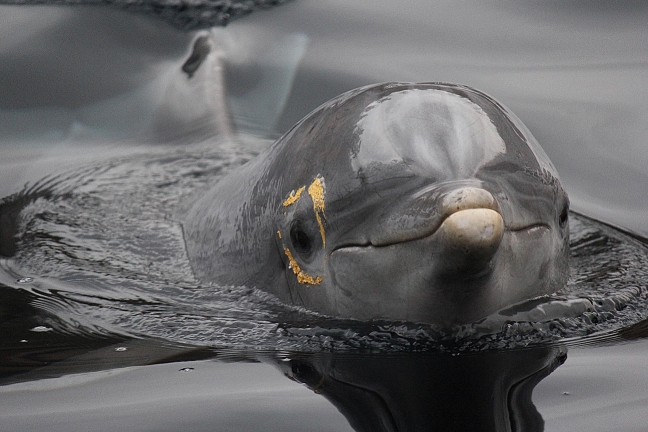
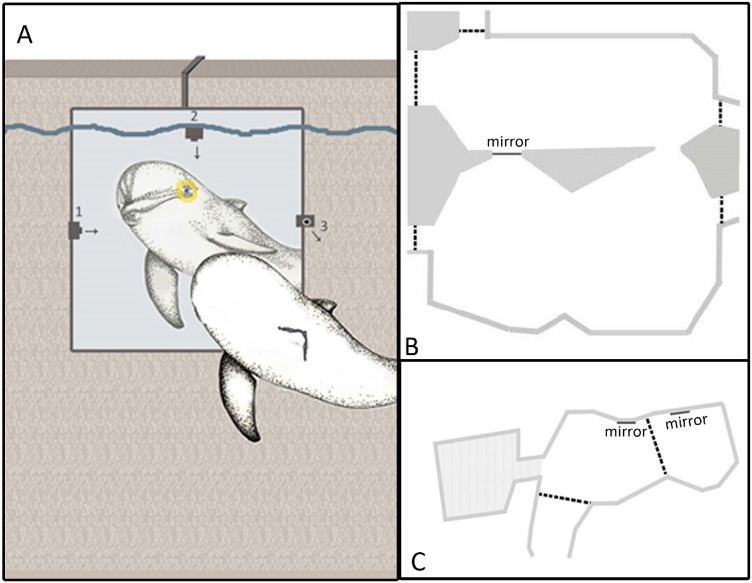
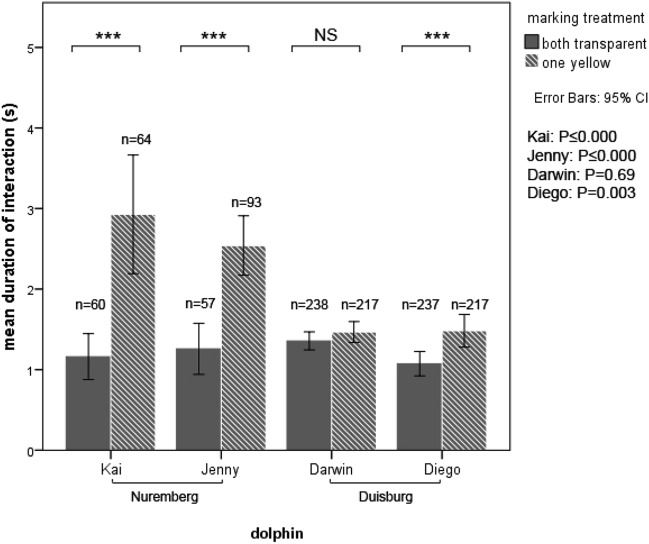
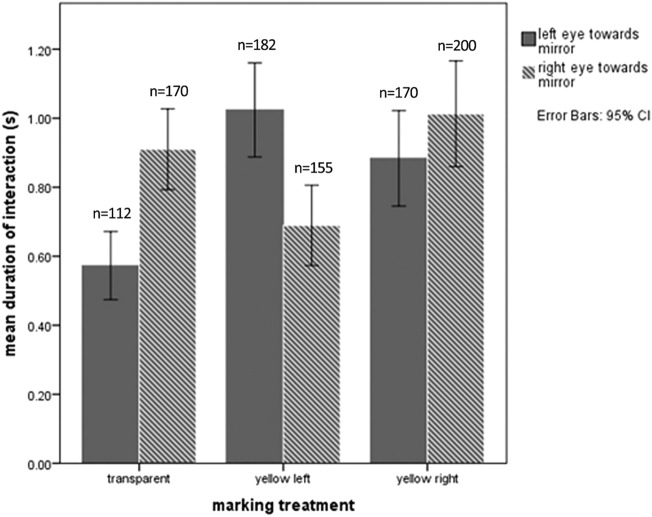
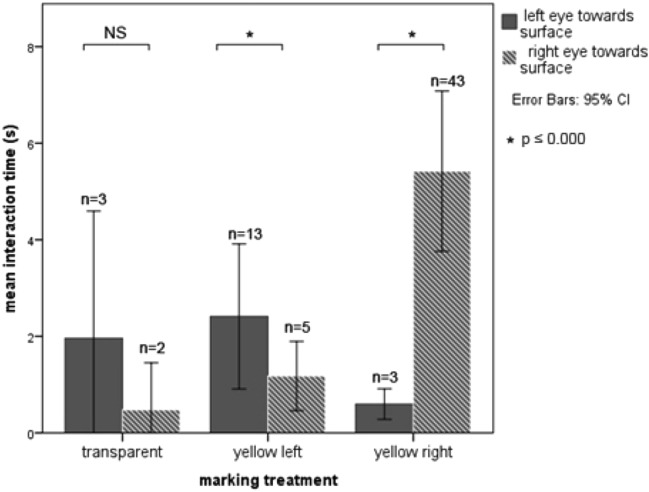
Mirror-guided self-inspection is seen as a cognitive hallmark purportedly indicating the existence of self-recognition. Only a few species of great apes have been reported to pass a standard mark test for mirror self-recognition in which animals attempt to touch a mark. In addition, evidence for passing the mark test was also reported for Asian elephants, two species of corvids, and a species of cleaner fish. Mirror self-recognition has also been claimed for bottlenose dolphins, using exposure of marked areas to a mirror as evidence. However, what counts as self-directed behaviour to see the mark and what does not has been debated. To avoid this problem, we marked the areas around both eyes of the animals at the same time, one with visible and the other with transparent dye to control for haptic cues. This allowed the animal to see the mark easily and us to investigate what side was exposed to the mirror as an indicator for mark observation. We found that the animals actively chose to inspect their visibly marked side while they did not show an increased interest in a marked conspecific in the pool. These results demonstrate that dolphins use the mirror to inspect their marks and, therefore, likely recognise a distinction between self and others.
Overview
The claims and statistics of this paper haven’t been checked yet.
Free: it reads the open-access text and checks the first 5 claims that cite a source we can check. Create a free account to check every claim.
Integrity signals
Registry
Cites
Statistics
Figures
Verification
Claims the paper makes
The claims and statistics of this paper haven’t been checked yet.
Free: it reads the open-access text and checks the first 5 claims that cite a source we can check. Create a free account to check every claim.
Claims other papers make about this one
Each is checked against this paper’s own text: does it say what the citing paper says it does?
The source backs part of the claim, not all of it — or backs it for a different population, condition or comparison.
In the citing paper
“Tests of mirror self-recognition (MSR) have provided behavioral evidence of a high level of self-awareness in humans, chimpanzees, bonobos, orangutans, gorillas, bottlenose dolphins, Asian elephants, magpies, and to some extent in the cleaner wrasse.”
From Evidence for mirror self-recognition in beluga whales (Delphinapterus leucas) (2026) · cites this paper as [9]
Experimental — accuracy not yet measuredThe cited source says what the claim attributes to it.
In the citing paper
“We used the same criteria for passing the mark test as used in prior cetacean studies that required the whales to orient the marked area of their body to the mirror [7–9].”
From Evidence for mirror self-recognition in beluga whales (Delphinapterus leucas) (2026) · cites this paper as [9]
Self-check
Percentages, sums and reported differences re-computed from the paper’s own numbers.
The self-check needs the paper’s full text.
Citations
Cites
Conscious Processing and the Global Neuronal Workspace Hypothesis
Mashour, G. A., Roelfsema, P., Changeux, J.-P., & Dehaene, S. (2020) · Neuron · doi:10.1016/j.neuron.2020.01.026 · Cited by 1,164
What is consciousness, and could machines have it?
Dehaene, S., Lau, H., & Kouider, S. (2017) · Science · doi:10.1126/science.aan8871 · Cited by 855
Santos Vázquez, M. B. (2000) · Journal of Experimental Marine Biology and Ecology · doi:10.1016/s0022-0981(00)00175-1 · Cited by 733
Mirror self-recognition in the bottlenose dolphin: a case of cognitive convergence
Reiss, D., & Marino, L. (2001) · Proceedings of the National Academy of Sciences · doi:10.1073/pnas.101086398 · Cited by 711
Self-recognition in an Asian elephant
Plotnik, J. M., de Waal, F. B. M., & Reiss, D. (2006) · Proceedings of the National Academy of Sciences · doi:10.1073/pnas.0608062103 · Cited by 709 · cited 1×
“2008), while initially successful individuals do not necessarily pass during test repetitions (Plotnik et al. 2006).”
BackgroundCetacean Behavior: Mechanisms and Functions
Herman, L. M. (1988) · Medical Entomology and Zoology · Cited by 624
Mirror-Induced Behavior in the Magpie (Pica pica): Evidence of Self-Recognition
Prior, H., Schwarz, A., & Güntürkün, O. (2008) · PLoS Biology · doi:10.1371/journal.pbio.0060202 · Cited by 586 · cited 1×
“In all mark test studies with different animal species, only a (small) subset of individuals passes the test (Povinelli et al. 1993, 1997; Prior et al. 2008), while initially successful individuals do not necessarily pass during test repetitions (Plotnik et al.”
BackgroundSelf-citationFive levels of self-awareness as they unfold early in life.
Rochat, P. (2003) · Consciousness and Cognition · doi:10.1016/s1053-8100(03)00081-3 · Cited by 560 · cited 1×
“2005; Feinberg and Keenan 2005; Kakrada and Colombo 2022; Rochat 2003; * V. M. Janik vj@st-andrews.ac.uk 1 Scottish Oceans Institute, School of Biology, University of St. Andrews, Fife KY16 8LB, UK 2 Biopsychology, Institute of Cognitive Neuroscience, Faculty of Psychology, Ruhr-University Bochum,…”
BackgroundThe threshold for conscious report: Signal loss and response bias in visual and frontal cortex
van Vugt, B., Dagnino, B., Vartak, D., Safaai, H., Panzeri, S., Dehaene, S., & Roelfsema, P. R. (2018) · Science · doi:10.1126/science.aar7186 · Cited by 394
Mental models of mirror-self-recognition: Two theories
Mitchell, R. W. (1993) · New Ideas in Psychology · doi:10.1016/0732-118x(93)90002-u · Cited by 365 · cited 2×
“1993), whereas others argued it might just demonstrate kinaesthetic matching (Mitchell 1993).”
BackgroundPovinelli, D. J., Rulf, A. B., Landau, K. R., & Bierschwale, D. T. (1993) · Journal of Comparative Psychology · doi:10.1037/0735-7036.107.4.347 · Cited by 309
Connor, R. C. (2007) · Philosophical Transactions of the Royal Society B: Biological Sciences · doi:10.1098/rstb.2006.1997 · Cited by 289 · cited 1×
“Bottlenose dolphins have highly evolved social and cognitive skills (Connor 2007; Güntürkün 2014; Herman 2006; Janik 2013; Norris and Dohl 1980; Pack 2018; Tyack 1999), and mirror self-recognition has been claimed here as well (Reiss and Marino 2001).”
Background"Self-Awareness" in the Pigeon
Epstei, R., Lanza, R. P., & Skinner, B. F. (1981) · Science · doi:10.1126/science.212.4495.695 · Cited by 269
Kohda, M., Hotta, T., Takeyama, T., Awata, S., Tanaka, H., Asai, J.-Y., & Jordan, A. L. (2019) · PLOS Biology · doi:10.1371/journal.pbio.3000021 · Cited by 249 · cited 1×
“Furthermore, the recognition of oneself in a mirror does not necessarily imply full self-awareness or consciousness (Kohda et al. 2019).”
BackgroundDo minds exist in species other than our own?
Gallup, G. G. (1985) · Neuroscience & Biobehavioral Reviews · doi:10.1016/0149-7634(85)90010-7 · Cited by 248
A neural correlate of sensory consciousness in a corvid bird
Nieder, A., Wagener, L., & Rinnert, P. (2020) · Science · doi:10.1126/science.abb1447 · Cited by 218 · cited 1×
“Recently, the same behavioural and electrophysiological markers were also demonstrated in carrion crows (Nieder et al. 2020; Güntürkün 2021).”
BackgroundThe nature of visual self-recognition
Suddendorf, T., & Butler, D. L. (2013) · Trends in Cognitive Sciences · doi:10.1016/j.tics.2013.01.004 · Cited by 186 · cited 2×
“…suggesting that self-exploration in front of a mirror as tested in mark tests serves as evidence for selfrecognition (de Veer and van den Bos 1999; de Waal 2019) while a more conservative view is that it only demonstrates a general ability to collate representations (Suddendorf and Butler 2013).”
BackgroundWhere in the brain is the self?
Feinberg, T. E., & Keenan, J. P. (2005) · Consciousness and Cognition · doi:10.1016/j.concog.2005.01.002 · Cited by 170
Burge, T. (2013) · Oxford University Press eBooks · doi:10.1093/acprof:oso/9780199672028.001.0001 · Cited by 155
Chimpanzees recognize themselves in mirrors
Povinelli, D. J., Gallup, G. G., Eddy, T. J., Bierschwale, D. T., ENGSTROM, M. C., Perilloux, H. K., & Toxopeus, I. B. (1997) · Animal Behaviour · doi:10.1006/anbe.1996.0303 · Cited by 145
Evolution of consciousness: Phylogeny, ontogeny, and emergence from general anesthesia
Mashour, G. A., & Alkire, M. T. (2013) · Proceedings of the National Academy of Sciences · doi:10.1073/pnas.1301188110 · Cited by 144
Mirror-Induced Self-Directed Behaviors in Rhesus Monkeys after Visual-Somatosensory Training
Chang, L., Fang, Q., Zhang, S., Poo, M., & Gong, N. (2015) · Current Biology · doi:10.1016/j.cub.2014.11.016 · Cited by 143
Fish, mirrors, and a gradualist perspective on self-awareness
de Waal, F. B. M. (2019) · PLOS Biology · doi:10.1371/journal.pbio.3000112 · Cited by 136
de Veer, M. W., & van den Bos, R. (1999) · Animal Behaviour · doi:10.1006/anbe.1999.1166 · Cited by 136
The monkey in the mirror: Hardly a stranger
de Waal, F. B. M., Dindo, M., Freeman, C. A., & Hall, M. J. (2005) · Proceedings of the National Academy of Sciences · doi:10.1073/pnas.0503935102 · Cited by 128
Geometry and dynamics in refracting systems
Wolf, K. B., & Krötzsch, G. (1995) · European Journal of Physics · doi:10.1088/0143-0807/16/1/003 · Cited by 120
Cultural Variations in Children’s Mirror Self-Recognition
Broesch, T., Callaghan, T., Henrich, J., Murphy, C., & Rochat, P. (2011) · Journal of Cross-Cultural Psychology · doi:10.1177/0022022110381114 · Cited by 100
Kohda, M., Sogawa, S., Jordan, A. L., Kubo, N., Awata, S., Satoh, S., Kobayashi, T., Fujita, A., & Bshary, R. (2022) · PLOS Biology · doi:10.1371/journal.pbio.3001529 · Cited by 99 · cited 1×
“These results indicate that the binary fail-or-pass outcomes of the mark test do not necessarily capture the evolutionary much more likely graded result pattern which would ascribe different levels of mirror-understandings to different species that live in different ecological contexts (Clary and Kelly 2016; Kohda et…”
ResultGallup, G. G., & Anderson, J. R. (2017) · Behavioural Processes · doi:10.1016/j.beproc.2017.12.010 · Cited by 94
Intelligence and rational behaviour in the bottlenosed dolphin
Herman, L. M. (2006) · Rational Animals? · doi:10.1093/acprof:oso/9780198528272.003.0020 · Cited by 90
Precocious development of self-awareness in dolphins
Morrison, R., & Reiss, D. (2018) · PLOS ONE · doi:10.1371/journal.pone.0189813 · Cited by 86
Which Primates Recognize Themselves in Mirrors?
Anderson, J. R., & Gallup, G. G. (2011) · PLoS Biology · doi:10.1371/journal.pbio.1001024 · Cited by 79
Graded Mirror Self-Recognition by Clark’s Nutcrackers
Clary, D., & Kelly, D. M. (2016) · Scientific Reports · doi:10.1038/srep36459 · Cited by 75
Soler, M., Pérez-Contreras, T., & Peralta-Sánchez, J. M. (2014) · PLoS ONE · doi:10.1371/journal.pone.0086193 · Cited by 74
Cognitive skills in bottlenose dolphin communication
Janik, V. M. (2013) · Trends in Cognitive Sciences · doi:10.1016/j.tics.2013.02.005 · Cited by 64
Self-citationManger, P. R. (2013) · Neuroscience · doi:10.1016/j.neuroscience.2013.07.041 · Cited by 64
Buniyaadi, A., Taufique, S. K. T., & Kumar, V. (2019) · Journal für Ornithologie · doi:10.1007/s10336-019-01730-2 · Cited by 59
Carrion crows (Corvus corone corone) fail the mirror mark test yet again.
Brecht, K. F., Müller, J., & Nieder, A. (2020) · Journal of comparative psychology · doi:10.1037/com0000231 · Cited by 34
Consciousness in dolphins? A review of recent evidence
Harley, H. E. (2013) · Journal of Comparative Physiology A · doi:10.1007/s00359-013-0816-8 · Cited by 27
Discrimination of moving video images of self by pigeons (Columba livia)
Toda, K., & Watanabe, S. (2008) · Animal Cognition · doi:10.1007/s10071-008-0161-4 · Cited by 25
Mirror mirror on the wall, it’s not the mark I care about at all
Kakrada, E., & Colombo, M. (2022) · Learning and Motivation · doi:10.1016/j.lmot.2022.101785 · Cited by 21 · cited 3×
“Not every animal is necessarily motivated to remove marks on itself (Kakrada and Colombo 2022) in which case looking times might be more informative than other actions even in animals that can reach the mark.”
BackgroundGüntürkün, O. (2014) · Brain Behavior and Evolution · doi:10.1159/000357551 · Cited by 21
Self-citationMirror Self-Recognition in Pigeons: Beyond the Pass-or-Fail Criterion
Wittek, N., Matsui, H., Kessel, N., Oeksuez, F., Güntürkün, O., & Anselme, P. (2021) · Frontiers in Psychology · doi:10.3389/fpsyg.2021.669039 · Cited by 19
Self-citationMurray, L., Anderson, J. R., & Gallup, G. G. (2022) · Animal Cognition · doi:10.1007/s10071-021-01592-3 · Cited by 18
The question of animal awareness: Evolutionary continuity of mental experience
Gallup, G. G. (1983) · Ethology and Sociobiology · doi:10.1016/0162-3095(83)90017-1 · Cited by 15
There is no other monkey in the mirror for spider monkeys (Ateles geoffroyi).
Murray, L., Schaffner, C. M., Aureli, F., & Amici, F. (2020) · Journal of comparative psychology · doi:10.1037/com0000243 · Cited by 10
It's done with mirrors: Chimps and self-concept
Gallup, G. G. (1971) · PsycEXTRA Dataset · doi:10.1037/e400342009-002 · Cited by 6
The Dolphin in the Mirror – A Familiar Face?
Dibble, D. S., Alstyne, K. R. V., Rohr, J. J., & Ridgway, S. H. (2016) · The Physics Teacher · doi:10.1119/1.4972489 · Cited by 4
Güntürkün, O. (2021) · Learning & Behavior · doi:10.3758/s13420-021-00466-5 · Cited by 4
Self-citationPack, A. A. (2017) · Springer eBooks · doi:10.1007/978-3-319-47829-6_987-1 · Cited by 1
Research works printed but not linked: 2
- Gallup GG Anderson JJ Self-recognition in animals: where do we stand 50 years later? Lessons from cleaner wrasse and other species Psychol Conscious Theory Res Pract 2020 7 46 58
- Hanke FD Mooney TA Janik VM Fahlman A Hooker SK Sensory physiology The physiology of dolphins 2022 Amsterdam Elsevier
Cited by
Roosters do not warn the bird in the mirror: The cognitive ecology of mirror self-recognition
Hillemacher, S., Ocklenburg, S., Güntürkün, O., & Tiemann, I. (2023) · PLoS ONE · doi:10.1371/journal.pone.0291416 · Cited by 40
Self-citationKobayashi, T., Kohda, M., Awata, S., Bshary, R., & Sogawa, S. (2024) · Scientific Reports · doi:10.1038/s41598-024-70138-7 · Cited by 21
Szabo, B., & Ringler, E. (2023) · Animal Cognition · doi:10.1007/s10071-023-01751-8 · Cited by 20
Mirror self-recognition in ghost crab (Ocypode quadrata)
Robinson, T. (2023) · Animal Cognition · doi:10.1007/s10071-023-01800-2 · Cited by 14
Gerussi, T., Graïc, J., Peruffo, A., Behroozi, M., Schlaffke, L., Huggenberger, S., Güntürkün, O., & Cozzi, B. (2023) · Brain Structure and Function · doi:10.1007/s00429-023-02699-8 · Cited by 13
Self-citation
Metadata
- Authors
- Loth, A., Güntürkün, O., von Fersen, L., & Janik, V. M.
- Affiliations
- University of St Andrews (GB)
- Ruhr University Bochum (DE)
- Corresponding author
- Janik, V. M.
- Venue
- Animal Cognition
- Published
- 2022-09-20
- Volume
- 25
- Issue
- 5
- Pages
- 1151-1160
- ISSN
- 1435-9448 (ISSN-L)
- 1435-9456
- PMC
- PMC9617816
- OpenAlex
- W4297069123
- Cited by
- 23
- References
- 50
- Citations by year
- 2026: 4 · 2025: 2 · 2024: 4 · 2023: 12 · 2022: 1
- FWCI
- 2.53
- Type
- journal article
- Language
- en
- Open access
- hybrid
- doi.org
- Licence
- cc-by
- creativecommons.org/licenses/by/4.0 (tdm)
- creativecommons.org/licenses/by/4.0 (vor)
- Locations
- Animal Cognition (publishedVersion, cc-by)
- PubMed Central (publishedVersion, cc-by)
- PubMed (publishedVersion)
- St Andrews Research Repository (St Andrews Research Repository) (acceptedVersion, cc-by)
- Funders
- Studienstiftung des Deutschen Volkes
- Deutsche Forschungsgemeinschaft (Gu227/16-1)
- Topics
- Physical Sciences › Environmental Science › Ecology › Marine animal studies overview
- Life Sciences › Agricultural and Biological Sciences › Ecology, Evolution, Behavior and Systematics › Primate Behavior and Ecology
- Life Sciences › Neuroscience › Cognitive Neuroscience › Face Recognition and Perception
- Keywords
- mirror self-recognition, Tursiops truncatus, self-other distinction, mark test, haptic cues, self-directed behavior, dolphin cognition
- MeSH terms
- Facial Recognition, Animals, Behavior, Animal, Elephants, Fishes, Pattern Recognition, Visual, Crows, Bottle-Nosed Dolphin
About these checks
Registry, retraction, Cites and statistics results are computed, not judged, with one exception: a printed reference that no index lists is read once by a model before it counts as a citation error. Claims are extracted by a model and kept only when their quote appears verbatim in the text; each cited source is then checked, with a model’s help, for whether it says what the claim relies on. Those verdicts can be wrong — read the claim’s quote and the cited source before relying on one.
Statistics and arithmetic are recomputed, not judged.
Confidence bands are shown only for fields calibrated on our annotated test set. None is calibrated yet, so no band is shown.
What counts as a claim ›How we measure confidence ›How we check this ›
Are you an author, or do you see a problem with this page? Request a review
Data sources
Bibliographic data: Semantic Scholar, OpenAlex, Crossref.
Contains information from the Semantic Scholar Academic Graph Datasets, made available under the ODC Attribution License (ODC-BY 1.0).
Semantic Scholar’s data is described in: Kinney, R., et al. (2023). The Semantic Scholar Open Data Platform. arXiv:2301.10140.
