

The DOI matches its Crossref record; 72 of the 72 references it cites were found in a registry or an index.
Dysfunction of NMDA receptors in Alzheimer’s disease
Open accessAbstract
N-methyl-D-aspartate receptors (NMDARs) play a pivotal role in the synaptic transmission and synaptic plasticity thought to underlie learning and memory. NMDARs activation has been recently implicated in Alzheimer's disease (AD) related to synaptic dysfunction. Synaptic NMDARs are neuroprotective, whereas overactivation of NMDARs located outside of the synapse cause loss of mitochondrial membrane potential and cell death. NMDARs dysfunction in the glutamatergic tripartite synapse, comprising presynaptic and postsynaptic neurons and glial cells, is directly involved in AD. This review discusses that both beta-amyloid (Aβ) and tau perturb synaptic functioning of the tripartite synapse, including alterations in glutamate release, astrocytic uptake, and receptor signaling. Particular emphasis is given to the role of NMDARs as a possible convergence point for Aβ and tau toxicity and possible reversible stages of the AD through preventive and/or disease-modifying therapeutic strategies.
Overview
The claims and statistics of this paper haven’t been checked yet.
Run the check — free, no account needed. It reads the open-access text and checks the sources it cites.
Integrity signals
Registry
Cites
Statistics
Figures
Verification
Claims the paper makes
The claims and statistics of this paper haven’t been checked yet.
Run the check — free, no account needed. It reads the open-access text and checks the sources it cites.
Claims other papers make about this one
Each is checked against this paper’s own text: does it say what the citing paper says it does?
In the citing paper
“The relevance of NMDAR in AD lends support from studies showing that partial blockade of NMDAR overstimulation with NMDAR antagonists rescues Aβ-induced LTP impairment and cognitive function in various animal models [69].”
From Molecular and cellular mechanisms underlying the pathogenesis of Alzheimer’s disease (2020) · cites this paper as [69]
Self-check
Percentages, sums and reported differences re-computed from the paper’s own numbers.
The self-check needs the paper’s full text.
Citations
Cites
1 retracted
Disturbed Neurotransmitter Transporter Expression in Alzheimer’s Disease Brain
Chen, K. H., Reese, E. A., Kim, H., Rapoport, S. I., & Rao, J. S. (2011) · Journal of Alzheimer s Disease · doi:10.3233/jad-2011-110002 · Cited by 122 · cited 1×
“The expression of glutamate transporters is reduced significantly both in human tissue from AD patients [54] and animal models of AD [55].”
BackgroundRetractedAmyloid oligomers exacerbate tau pathology in a mouse model of tauopathy
Selenica, M.-L. B., Brownlow, M., Jimenez, J. P., Lee, D. C., Pena, G., Dickey, C. A., Gordon, M. N., & Morgan, D. (2013) · Neurodegenerative Diseases · doi:10.1159/000337230 · Cited by 10,359
Shrestha, S., & Offer, S. M. (2016) · Medical Epigenetics · doi:10.1159/000444713 · Cited by 8,951
Südhof, T. C. (2004) · Annual Review of Neuroscience · doi:10.1146/annurev.neuro.26.041002.131412 · Cited by 2,491 · cited 1×
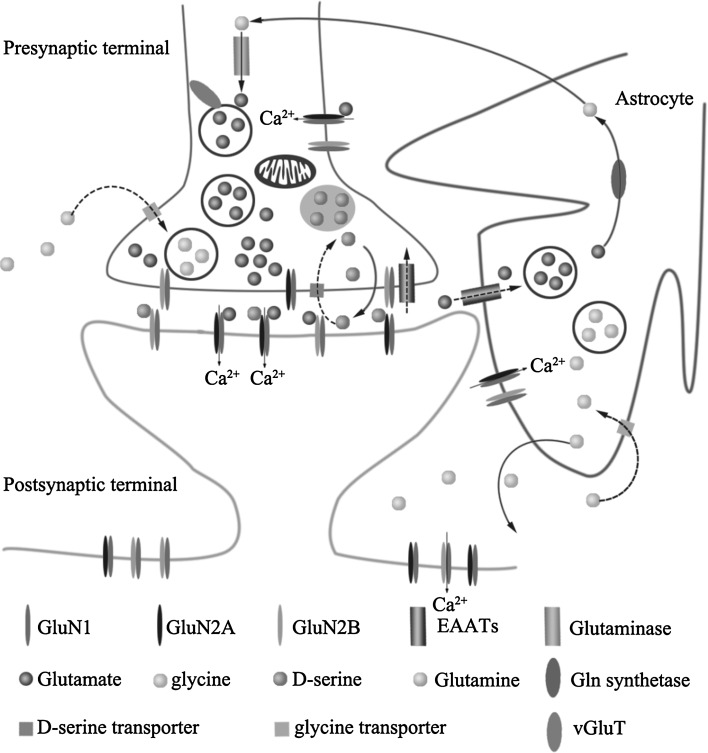
“Following presynaptic neuronal depolarization, calcium channels open, permitting the influx of calcium and triggering the fusion of vesicles with the membrane, resulting in the exocytosis of glutamate into the synapse [15].”
BackgroundDendritic Function of Tau Mediates Amyloid-β Toxicity in Alzheimer's Disease Mouse Models
Ittner, L. M., Ke, Y. D., Delerue, F., Bi, M., Gladbach, A., van Eersel, J., Wölfing, H., Chieng, B. C., Christie, M. J., Napier, I. A., et al. (2010) · Cell · doi:10.1016/j.cell.2010.06.036 · Cited by 1,821 · cited 1×
“Tau reductions cannot transport Fyn to dendritic spines, prevent the memory deficits and excitability caused by A b [58].”
BackgroundSynaptic versus extrasynaptic NMDA receptor signalling: implications for neurodegenerative disorders
Hardingham, G. E., & Bading, H. (2010) · Nature Reviews Neuroscience · doi:10.1038/nrn2911 · Cited by 1,644 · cited 1×
“…can also be taken up by the presynaptic terminal or astrocytes by their respective transporters Activation of synaptic NMDARs mediates synaptic plasticity and is thought to be beneficial for neurons, whereas prolonged activation of NMDARs with subsequent overload of Ca 2 ? entry is deleterious [32].”
BackgroundShankar, G. M., Bloodgood, B. L., Townsend, M., Walsh, D. M., Selkoe, D. J., & Sabatini, B. L. (2007) · The Journal of Neuroscience · doi:10.1523/jneurosci.4970-06.2007 · Cited by 1,592 · cited 2×
“More-over, treatment of rat organotypic slices containing pyramidal neurons with A b oligomers decrease dendritic spine density and reduce NMDAR-mediated calcium influx into active spines [50].”
BackgroundRegulation of NMDA receptor trafficking by amyloid-β
Snyder, E. M., Nong, Y., Almeida, C. G., Paul, S., Moran, T., Choi, E. Y., Nairn, A. C., Salter, M. W., Lombroso, P. J., Gouras, G. K., et al. (2005) · Nature Neuroscience · doi:10.1038/nn1503 · Cited by 1,561 · cited 1×
“When applied to cultured cortical neurons, Ab enhances endocytosis of NMDARs and decreases expression of NMDARs [53].”
Long-term potentiation depends on release of d-serine from astrocytes
Henneberger, C., Papouin, T., Oliet, S. H. R., & Rusakov, D. A. (2010) · Nature · doi:10.1038/nature08673 · Cited by 1,389 · cited 1×
“The increased influx of calcium transform into chemical signals which in turn, leading to the establishment of LTP, a process believed to underlie learning and memory [18].”
BackgroundHoover, B. R., Reed, M. N., Su, J., Penrod, R. D., Kotilinek, L. A., Grant, M. K., Pitstick, R., Carlson, G. A., Lanier, L. M., Yuan, L.-L., et al. (2010) · Neuron · doi:10.1016/j.neuron.2010.11.030 · Cited by 1,118 · cited 1×
“Tau phosphorylation results in mislocalization of tau from axons to dendritic spines and decreased expression of AMPA receptors and LTP deficits, and subsequently synaptic impairment [56].”
Background
Cited by
Sorted by citations
Molecular and cellular mechanisms underlying the pathogenesis of Alzheimer’s disease
Guo, T., Zhang, D., Zeng, Y., Huang, T. Y., Xu, H., & Zhao, Y. (2020) · Molecular Neurodegeneration · doi:10.1186/s13024-020-00391-7 · Cited by 994
“The relevance of NMDAR in AD lends support from studies showing that partial blockade of NMDAR overstimulation with NMDAR antagonists rescues Aβinduced LTP impairment and cognitive function in various animal models [69].”
BackgroundAlzheimer’s disease: Recent treatment strategies
Vaz, M., & Silvestre, S. (2020) · European Journal of Pharmacology · doi:10.1016/j.ejphar.2020.173554 · Cited by 547
Costa, L. G., Cole, T. B., Dao, K., Chang, Y. C., Coburn, J. L., & Garrick, J. M. (2020) · Pharmacology & Therapeutics · doi:10.1016/j.pharmthera.2020.107523 · Cited by 511
Calcium signaling and molecular mechanisms underlying neurodegenerative diseases
Pchitskaya, E. I., Александровна, П. Е., & Борисович, Б. И. (2017) · Cell Calcium · doi:10.1016/j.ceca.2017.06.008 · Cited by 355
“In case of hippocampus, TRPC6 and Orai2 were recently identified as SOCE-forming channels in hippocampal neurons (Zhang et al., 2016a).”
BackgroundInfluentialSharma, P., Srivastava, P., Seth, A., Tripathi, P. N., Banerjee, A. G., & Shrivastava, S. K. (2019) · Progress in Neurobiology · doi:10.1016/j.pneurobio.2018.12.006 · Cited by 331
Metadata
- Authors
- Zhang, Y., Li, P., Feng, J., & Wu, M.
- Affiliations
- Central South University (CN)
- Corresponding author
- Wu, Minghua
- Venue
- Neurological Sciences
- Published
- 2016-03-12
- Volume
- 37
- Issue
- 7
- Pages
- 1039-1047
- ISSN
- 1590-1874 (ISSN-L)
- 1590-3478
- PMC
- PMC4917574
- OpenAlex
- W2293608890
- Cited by
- 282
- References
- 72
- Citations by year
- 2026: 15 · 2025: 30 · 2024: 36 · 2023: 29 · 2022: 29 · 2021: 27 · 2020: 39 · 2019: 23 · 2018: 35 · 2017: 15 · 2016: 3
- FWCI
- 2.97
- Type
- journal article
- Language
- en
- Open access
- hybrid
- doi.org
- Locations
- Neurological Sciences (publishedVersion, cc-by)
- PubMed Central (publishedVersion, cc-by)
- PubMed (publishedVersion)
- Topics
- Life Sciences › Neuroscience › Cellular and Molecular Neuroscience › Alzheimer's disease research and treatments
- Life Sciences › Neuroscience › Cellular and Molecular Neuroscience › Neuroscience and Neuropharmacology Research
- Life Sciences › Neuroscience › Neurology › Neuroinflammation and Neurodegeneration Mechanisms
- Keywords
- NMDA receptor, Alzheimer's disease, synaptic dysfunction, tripartite synapse, amyloid-beta, tau protein, glutamate release, astrocytes, synaptic plasticity, mitochondrial membrane potential, neuroprotection, disease-modifying therapy
- MeSH terms
- Alzheimer Disease, Humans, Synapses, Receptors, N-Methyl-D-Aspartate, Amyloid beta-Peptides, tau Proteins
About these checks
Registry, retraction, Cites and statistics results are computed, not judged, with one exception: a printed reference that no index lists is read once by a model before it counts as a citation error. Claims are extracted by a model and kept only when their quote appears verbatim in the text; each cited source is then checked, with a model’s help, for whether it says what the claim relies on. Those verdicts can be wrong — read the claim’s quote and the cited source before relying on one.
Statistics and arithmetic are recomputed, not judged.
Confidence bands are shown only for fields calibrated on our annotated test set. None is calibrated yet, so no band is shown.
What counts as a claim ›How we measure confidence ›How we check this ›
Are you an author, or do you see a problem with this page? Request a review
