

Environmental Impacts of Large-Scale Spirulina (Arthrospira platensis) Production in Hellisheidi Geothermal Park Iceland: Life Cycle Assessment
Open accessThe DOI matches its Crossref record; 52 of the 52 references it cites were found in a registry or an index.
Abstract
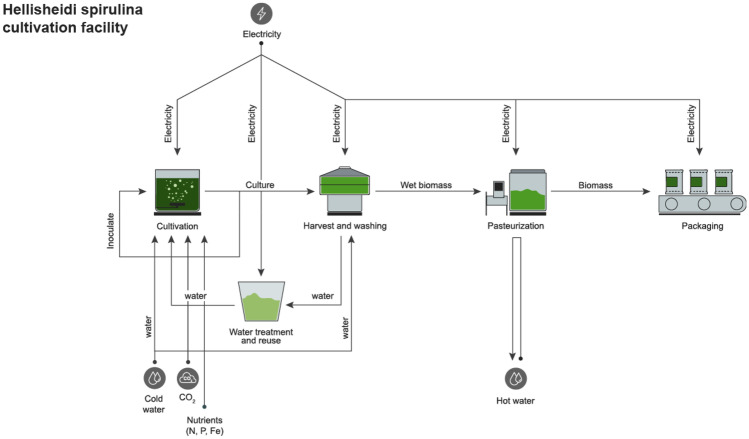
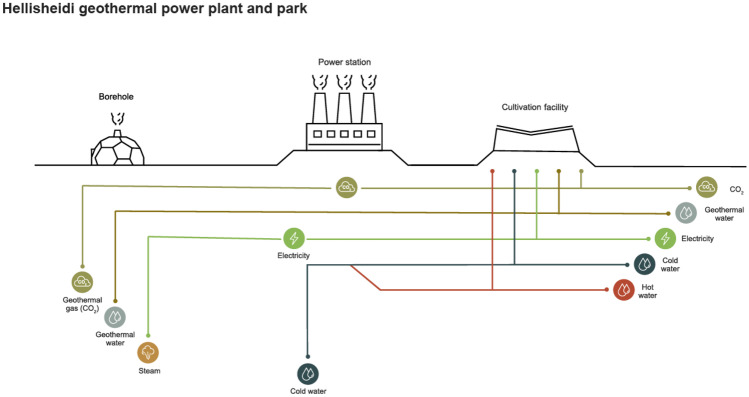
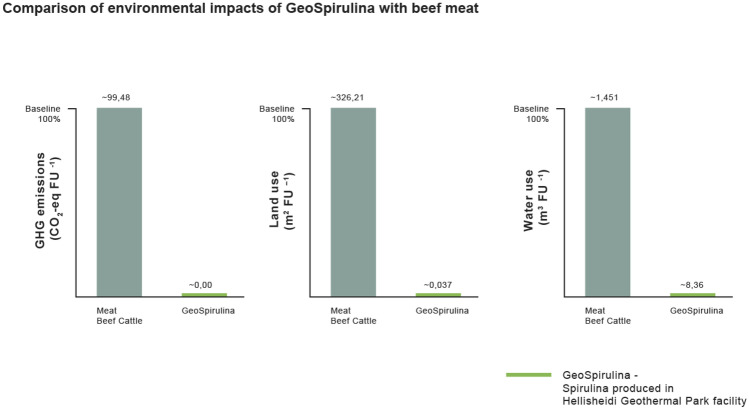
Abstract Spirulina algae (Spirulina platensis) cultivated in geothermally powered photobioreactors is here proposed as a potentially resource efficient, zero-carbon, and nutritious alternative to conventional beef meat. Employing a standard life cycle assessment, environmental impacts of large-scale Spirulina production in this facility are calculated. The production facility is sited in Orka náttúrunnar (ON Power) Geothermal Park, Iceland, and benefits from resource streams accessible through Hellisheiði (Hellisheidi) power station, including renewable electricity for illumination and power usage, hot and cold water streams for thermal management, freshwater for cultivation, and CO2 for biofixation. During cultivation, GHG-intensive ammonia-based fertilizers are replaced with macronutrients sourced from natural open mines. LCA results show that production of 1 kg of wet edible biomass in this facility requires 0.0378 m2 non-arable land, 8.36 m3 fresh water and is carbon neutral with − 0.008 CO2-eq GHG emissions (net zero). Compared with conventionally produced meat from beef cattle, Spirulina algae cultured in the ON Power Geothermal Park, referred to in this study as GeoSpirulina, requires less than 1% land and water and emits less than 1% GHGs. Considering food and nutritional security concerns, cultivation in a controlled environment agriculture system assures consistent nutritional profile year-round. Moreover, GeoSpirulina biomass assessed in this study contains all essential amino acids as well as essential vitamins and minerals. While keeping a balanced nutrition, for every kg beef meat replaced with one kg GeoSpirulina, the average consumer can save ~ 100 kg CO2-eq GHGs. It is concluded that environmental impacts of GeoSpirulina production in the Hellisheidi facility are considerably lower than those of conventionally produced ruminants. Graphical abstract
Overview
The claims and statistics of this paper haven’t been checked yet.
Free: it reads the open-access text and checks the first 5 claims that cite a source we can check. Create a free account to check every claim.
Integrity signals
Registry
Cites
Statistics
Figures
Verification
Claims the paper makes
The claims and statistics of this paper haven’t been checked yet.
Free: it reads the open-access text and checks the first 5 claims that cite a source we can check. Create a free account to check every claim.
Claims other papers make about this one
Each is checked against this paper’s own text: does it say what the citing paper says it does?
The source backs part of the claim, not all of it — or backs it for a different population, condition or comparison.
In the citing paper
“The advantages of large-scale microalgae production of Spirulina compared to meat production are well-documented in terms of land and water needs and greenhouse gases emitted (less than 1%) [126].”
From Overview and Challenges of Large-Scale Cultivation of Photosynthetic Microalgae and Cyanobacteria (2023) · cites this paper as [126]
Experimental — accuracy not yet measured
Self-check
Percentages, sums and reported differences re-computed from the paper’s own numbers.
The self-check needs the paper’s full text.
Citations
Cites
Ultrastructural Characterization of the Lower Motor System in a Mouse Model of Krabbe Disease
Cappello, V., Marchetti, L., Parlanti, P., Landi, S., Tonazzini, I., Cecchini, M., Piazza, V., & Gemmi, M. (2016) · Scientific Reports · doi:10.1038/s41598-016-0001-8 · Cited by 13,097
Reducing food's environmental impacts through producers and consumers
Poore, J., & Nemecek, T. (2018) · Science · doi:10.1126/science.aaq0216 · Cited by 6,085 · cited 2×
“Specifically, it draws on a landmark study (Poore and Nemecek 2018) for the three comparisons: GHG intensity, land use, and freshwater use.”
BackgroundSlowing Amazon deforestation through public policy and interventions in beef and soy supply chains
Nepstad, D., McGrath, D., Stickler, C., Alencar, A., Azevedo, A., Swette, B., Bezerra, T., DiGiano, M., Shimada, J., Seroa da Motta, R., et al. (2014) · Science · doi:10.1126/science.1248525 · Cited by 1,202 · cited 1×
“2016) and production of feedstocks (Nepstad et al. 2014).”
Frieri, M., Kumar, K., & Boutin, A. (2017) · Journal of Infection and Public Health · doi:10.1016/j.jiph.2016.08.007 · Cited by 1,100
Photobioreactors: Production systems for phototrophic microorganisms
O., P. (2001) · Applied Microbiology and Biotechnology · doi:10.1007/s002530100702 · Cited by 987
Handbook of Microalgal Culture. Biotechnology and Applied Phycology
Siew Moi, P. (2004) · Journal of Applied Phycology · doi:10.1023/b:japh.0000044943.45511.5e · Cited by 921
Environmental impacts of cultured meat production
Tuomisto, H. L., & Teixeira de Mattos, M. J. (2011) · Environmental Science & Technology · doi:10.1021/es200130u · Cited by 891 · cited 2×
“2014; Mathijs 2015), an increasing number of studies suggest a dietary transition to meat alternatives with similar or improved functional properties and substantially decreased environmental impacts (Tuomisto and Teixeira de Mattos 2011; Moomaw et al.”
BackgroundMeat nutritional composition and nutritive role in the human diet
Pereira, P. M. D. C. C., & Vicente, A. F. D. R. B. (2013) · Meat Science · doi:10.1016/j.meatsci.2012.09.018 · Cited by 884
Handbook of microalgal culture: biotechnology and applied phycology.
RICHMOND, A. E. (2004) · Cited by 864
Nijdam, D., Rood, T., & Westhoek, H. (2012) · Food Policy · doi:10.1016/j.foodpol.2012.08.002 · Cited by 734 · cited 5×
“In LCAs, co-production processes require allocation of environmental impacts between different by-products (Nijdam et al. 2012).”
BackgroundInfluential
Research works printed but not linked: 2
- Marques A, Teixeira R, Lorena A, del Pino V, del Valle-Inclan Y, Navalho J, Domingos T (2009) Sustainability assessment of traditional solar salt. In 2nd International Conference on the Ecological Importance of Solar Saltworks (CEISSA 2009), Merida, Yucatan, Mexico 26–29
- Rajasekaran C Ajeesh CM Balaji S Shalini M Ramamoorthy SIVA Ranjan DAS Kalaivani T Effect of modified Zarrouk’s medium on growth of different Spirulina strains Walailak Journal of Science and Technology (WJST) 2016 13 67 75
Cited by
Overview and Challenges of Large-Scale Cultivation of Photosynthetic Microalgae and Cyanobacteria
Novoveská, L., Nielsen, S. L., Eroldoğan, O. T., Haznedaroglu, B. Z., Rinkevich, B., Fazi, S., Robbens, J., Vasquez, M., & Einarsson, H. (2023) · Marine Drugs · doi:10.3390/md21080445 · Cited by 368
Eilam, Y., Khattib, H., Pintel, N., & Avni, D. (2023) · Global Challenges · doi:10.1002/gch2.202200177 · Cited by 101
Podgórska-Kryszczuk, I. (2024) · Molecules · doi:10.3390/molecules29225387 · Cited by 88
Nutritional Quality, Safety and Environmental Benefits of Alternative Protein Sources—An Overview
Choręziak, A., Rosiejka, D., Michałowska, J., & Bogdański, P. (2025) · Nutrients · doi:10.3390/nu17071148 · Cited by 76
Marjanović, B., Benković, M., Jurina, T., Sokač Cvetnić, T., Valinger, D., Gajdoš Kljusurić, J., & Jurinjak Tušek, A. (2024) · Separations · doi:10.3390/separations11090257 · Cited by 69
Techno-economic assessment of co-production of edible bioplastic and food supplements from Spirulina
Chalermthai, B., Charoensuppanimit, P., Nootong, K., Olsen, B. D., & Assabumrungrat, S. (2023) · Scientific Reports · doi:10.1038/s41598-023-37156-3 · Cited by 65
Fabricating Strong and Stiff Bioplastics from Whole Spirulina Cells
Iyer, H., Grandgeorge, P., Jimenez, A. M., Campbell, I. R., Parker, M., Holden, M., Venkatesh, M., Nelsen, M., Nguyen, B. H., & Roumeli, E. (2023) · Advanced Functional Materials · doi:10.1002/adfm.202302067 · Cited by 58
Musa, M. N., Jirgi, G. M., Zango, Z. U., Isah, M., Abdurrazak, M., Adamu, A. N. D. U. A. L. E. M. T. S. E. H. A. Y. E., Wadi, I. A., Adeleke, A. A., Garba, Z. N., Bello, U., et al. (2025) · Bioresources and Bioprocessing · doi:10.1186/s40643-025-00888-3 · Cited by 53
Environmental Impact of Meat Protein Substitutes: A Mini-Review
Lee, D. Y., Mariano, E., Choi, Y., Park, J., Han, D., Kim, J. S., Park, J. W., Namkung, S., Li, Q., Li, X., et al. (2025) · Food Science of Animal Resources · doi:10.5851/kosfa.2024.e109 · Cited by 46
Liao, K., Grandgeorge, P., Jimenez, A. M., Nguyen, B. H., & Roumeli, E. (2023) · Sustainable materials and technologies · doi:10.1016/j.susmat.2023.e00591 · Cited by 35
Spirulina as a Key Ingredient in the Evolution of Eco-Friendly Cosmetics
Ramos, S. D. P., Bürck, M., da Costa, S. F. F., Assis, M., & Braga, A. R. C. (2025) · BioTech · doi:10.3390/biotech14020041 · Cited by 30
Principles of green microbiology: The microbial blueprint for sustainable development
Akinsemolu, A. A. (2023) · Environmental Advances · doi:10.1016/j.envadv.2023.100440 · Cited by 31
Lin, M.-Y., Grandgeorge, P., Jimenez, A. M., Nguyen, B. H., & Roumeli, E. (2023) · ACS Sustainable Chemistry & Engineering · doi:10.1021/acssuschemeng.2c07539 · Cited by 24
Braud, L., McDonnell, K. P., & Murphy, F. (2025) · Bioresource Technology Reports · doi:10.1016/j.biteb.2025.102027 · Cited by 22
Martínez, J. B. G., Behr, J., & Denkenberger, D. (2024) · Trends in Food Science & Technology · doi:10.1016/j.tifs.2024.104609 · Cited by 19
Fernández‐Ríos, A., Butnar, I., Margallo, M., Laso, J., Borrion, A. L., & García, R. A. (2023) · The Science of The Total Environment · doi:10.1016/j.scitotenv.2023.164362 · Cited by 17
The Impact of Abrupt Sunlight Reduction Scenarios on Renewable Energy Production
Varne, A. R., Blouin, S., Williams, B., & Denkenberger, D. (2024) · Energies · doi:10.3390/en17205147 · Cited by 18
Zampiga, M., Laghi, L., Soglia, F., Piscitelli, R., Dayan, J., Petracci, M., Bonaldo, A., & Sirri, F. (2024) · Poultry Science · doi:10.1016/j.psj.2024.103856 · Cited by 15
Fernández‐Ríos, A., Laso, J., García, R. A., & Margallo, M. (2024) · Environmental Impact Assessment Review · doi:10.1016/j.eiar.2024.107579 · Cited by 13
Tzachor, A., van den Oever, S. P., Mayer, H. K., Asfur, M., Smidt-Jensen, A., Geirsdóttir, M., Jensen, S., & Smárason, B. Ö. (2024) · Discover Food · doi:10.1007/s44187-024-00152-1 · Cited by 13
Self-citationSoma, K., Kals, J., Opiyo, M. A., Ndambi, A., García-Cubero, R., Barbosa, M. J., Rurangwa, E., & Vernooij, A. G. (2024) · Frontiers in Sustainable Food Systems · doi:10.3389/fsufs.2024.1283150 · Cited by 13
Lin, M.-Y., Severson, K., Grandgeorge, P., & Roumeli, E. (2025) · Matter · doi:10.1016/j.matt.2025.102267 · Cited by 12
Scenario analysis of the socioeconomic impacts of achieving zero-carbon energy by 2030
Chen, N. (2024) · Heliyon · doi:10.1016/j.heliyon.2024.e26602 · Cited by 10
Comparative life cycle assessment of industrial and artisanal spirulina production systems
Vannini, V., & Achten, W. M. J. (2025) · Science of The Total Environment · doi:10.1016/j.scitotenv.2025.180184 · Cited by 9
Thevarajah, B., Nimarshana, P. H. V., Sandeepa, G. D. S., Vivekanand, V., & Ariyadasa, T. U. (2025) · Journal of environmental chemical engineering · doi:10.1016/j.jece.2025.117551 · Cited by 9
Karthick Srinivas, M., Alengaram, U. J., Ibrahim, S. B., Vello, V., & Phang, S. M. (2024) · Environmental Science and Pollution Research · doi:10.1007/s11356-024-32784-2 · Cited by 9
Microalgae functional feed additives strengthen immunity and increase longevity in honey bees
Ewert, A. M., McMenamin, A. J., Adjaye, D., Rainey, V. P., & Ricigliano, V. A. (2025) · Journal of Invertebrate Pathology · doi:10.1016/j.jip.2025.108352 · Cited by 7
Zielińska, E., Podgórska-Kryszczuk, I., Ramotowski, D., & Pankiewicz, U. (2025) · Nutrients · doi:10.3390/nu17182931 · Cited by 6
Tzachor, A., Richards, C. E., Smidt-Jensen, A., Skúlason, A. Þ., Ramel, A., & Geirsdóttir, M. (2022) · Foods · doi:10.3390/foods12010038 · Cited by 6
Self-citationEnvironmental impacts of alternatives to animal-source foods: a scoping review
Sokourenko, K. V., Beal, T., McAuliffe, G. A., Young, O., Gould, Z., Quint, B., Nordhagen, S., DiGiovine, E., Lambertini, E., Xipsiti, M., et al. (2026) · The Lancet Planetary Health · doi:10.1016/j.lanplh.2026.101461 · Cited by 6
Circular economy approaches in the production of alternative proteins
Karp, S. G., Penha, R. D. O., Soccol, V. T., Weber, M. Z., Fusaro, T., Aguiar, A. B., Thuma, S. S., Biagini, G., Guieseler, B. S., Manzoki, M. C., et al. (2026) · Systems Microbiology and Biomanufacturing · doi:10.1007/s43393-026-00434-y · Cited by 6
Gavilan‐Figari, I. M., Peña-Urdániga, G. V., Naka, A., & Castro-Rosas, M. A. (2024) · CABI Reviews · doi:10.1079/cabireviews.2024.0061 · Cited by 5
Bertoldi, M. C., da Silva, M. E. T., Grigório, J. K. A., & Santana, H. C. (2025) · Algal Research · doi:10.1016/j.algal.2025.104029 · Cited by 4
Al-Saily, H. M. N., Hassan, W. S., & Chabuk, H. A.-H. (2024) · Journal of Applied and Natural Science · doi:10.31018/jans.v16i1.5280 · Cited by 4
Spirulina as a food supplement in the 3D printing of meat analogs
Lopes, L. C., da Rosa, G. M., & Costa, J. A. V. (2025) · International Journal of Gastronomy and Food Science · doi:10.1016/j.ijgfs.2025.101176 · Cited by 4
Smidt-Jensen, A., Røgild, T. B., Cohen, T., Meshoulam, S., Iuclea, L., Sigurjónsson, H. Æ., Tzachor, A., Geirsdóttir, M., & Moomaw, W. R. (2026) · Foods · doi:10.3390/foods15040610 · Cited by 4
Self-citationSpirulina: Morphology, Cultivation, Harvesting as a Supplement and Its Therapeutic Properties
Khushala, A., Bobby, M. N., & Balasubramaniyan, M. (2025) · Springer eBooks · doi:10.1007/978-981-96-1844-6_9 · Cited by 3
Radomirović, M., Gligorijević, N., Stanić-Vučinić, D., Nikolic, M. R., & Veličković, T. Ć. (2024) · Journal of the Science of Food and Agriculture · doi:10.1002/jsfa.13649 · Cited by 3
Geremia, E., Buonocore, E., Venditti, P., Adamos, I., Paolacci, S., Agnisola, C., & Napolitano, G. (2026) · Frontiers in Physiology · doi:10.3389/fphys.2026.1766656 · Cited by 3
van Duinen, R., Rivière, C., Strosser, P., Dijkstra, J. W., Rios, S. D., Luzzi, S., Bruhn, A., Nielsen, M. O., Göke, C., Samarasinghe, M. B., et al. (2023) · TNO Repository · Cited by 3
Zhao, N., Chu, Y., Huang, Q., Qin, S., Cui, H., & Zhang, W. (2026) · Algal Research · doi:10.1016/j.algal.2026.104629 · Cited by 2
Wu, B. F., Li, T., & Ding, A. (2025) · Journal of environmental chemical engineering · doi:10.1016/j.jece.2025.117499 · Cited by 2
Noufeu, T., Ming, T., Zeng, X., Xu, J., Ngaba, M. J. Y., François, T., Pandong, A. N., Mpondo, S., Keyeya, T., & Gouife, M. (2025) · Foods · doi:10.3390/foods14173009 · Cited by 2
Hefferon, K. L. (2023) · Elsevier eBooks · doi:10.1016/b978-0-12-823960-5.00092-5 · Cited by 2
Effect of Spirulina platensis enrichment on the physicochemical and sensory properties of pasta
Shirmohammadi, P., Fazeli, F., Zoghi, A., Khorshidian, N., & Mohammadi, M. (2026) · Scientific Reports · doi:10.1038/s41598-026-42668-9 · Cited by 2
EASAC – the European Academies' Science Advisory Council (2025) · doi:10.1553/easac_report_meat-alternatives_2025 · Cited by 2
From Pond to Plate: Tailored Functional Proteins for Next-Gen Microalgal Food
Zoehrer, J., Wang, X., Stopfer, A., Tarlabasi, P., Castells, C. B., Fernández, C. C., de Juan, P. R., Garbe, D., Brück, T., & Awad, D. (2026) · Foods · doi:10.3390/foods15142428 · Cited by 1
Borah, U., Duarah, P., & Purkait, M. K. (2026) · Bioresource Technology Reports · doi:10.1016/j.biteb.2026.102919 · Cited by 1
Ali, S., Ali, B., Ahmad, K., Zhang, L., & Jamal, Q. M. S. (2026) · Frontiers in Nutrition · doi:10.3389/fnut.2026.1913634 · Cited by 1
Mollo, L., Norici, A., Raffaelli, L., & Amato, A. (2026) · Bioengineering · doi:10.3390/bioengineering13040373 · Cited by 1
Microalgal Cultivation in Temperate Regions: State of the Art, Challenges, and Future Perspectives
Braud, L., Pajot, A., Rizzo, A., Ripari, J. A., & Verdelho, V. (2026) · Developments in applied phycology. · doi:10.1007/978-3-032-02955-3_7 · Cited by 1
Sustainability metrics and indicators in microalgae-based processes and products
Deprá, M. C., Dias, R. R., & Lopes, E. J. (2025) · Elsevier eBooks · doi:10.1016/b978-0-443-22080-7.00010-7 · Cited by 1
Power-to-food: energy use, costs, and applications across industrial CO₂-to-food pathwaysPreprint
Martínez, J. B. G., Lazouski, N., Chintapalli, M., & Denkenberger, D. (2025) · OSF Preprints (OSF Preprints) · doi:10.31219/osf.io/ukfx3_v1 · Cited by 1
Masisi, K., Mokoba, M., Lebogang, L., & Gessesse, A. (2026) · Bioprocess and Biosystems Engineering · doi:10.1007/s00449-026-03354-2
Qie, F., Li, X., Zhu, J., Zong, B., & Rong, J. (2026) · Biomass and Bioenergy · doi:10.1016/j.biombioe.2026.109866
Algae industry and the farm to fork strategy
Fernández‐Ríos, A., Laso, J., García, R. A., & Margallo, M. (2025) · Elsevier eBooks · doi:10.1016/b978-0-443-22080-7.00026-0
Smidt-Jensen, A., Asfur, M., Cohen, T., Tzachor, A., & Moomaw, W. R. (2026) · Sustainability · doi:10.3390/su18157838
Self-citationNavalho, S., Bradley, T., Lima, A. R., Cardoso, H., Barbosa, M. J., Varela, J., & Speranza, L. G. (2026) · Resources Environment and Sustainability · doi:10.1016/j.resenv.2026.100396
Climate-neutral microalgae-based products?
Reijnders, L. (2026) · Elsevier eBooks · doi:10.1016/b978-0-443-34082-6.00046-5
Smidt-Jensen, A., Røgild, T. B., Tzachor, A., Sigurjónsson, H. Æ., Das, G., & Moomaw, W. R. (2026) · Sustainable Production and Consumption · doi:10.1016/j.spc.2026.09.033
Self-citationRadomirović, M. (2025) · Cherry (Univesrity of Belgrade, Faculty of Chemistry)
A life cycle assessment of land-based macroalgae production in Iceland : A scenario-based LCA
Gerdbo, S. (2025) · KTH Publication Database DiVA (KTH Royal Institute of Technology)
Designing resilient foods: The role of food technology in a changing ingredient landscape
Oliviero, T., & Fogliano, V. (2026) · International Journal of Food Design · doi:10.1386/ijfd_00107_1
Cheng, Y., Tan, H. R., & Tan, J. (2026) · Future Foods · doi:10.1016/j.fufo.2026.101260
Metadata
- Authors
- Tzachor, A., Smidt-Jensen, A., Ramel, A., & Geirsdóttir, M.
- Affiliations
- Reichman University (IL)
- Danish Technological Institute (DK)
- Matís (Iceland) (IS)
- Corresponding author
- Tzachor, Asaf
- Venue
- Marine Biotechnology
- Published
- 2022-09-07
- Volume
- 24
- Issue
- 5
- Pages
- 991-1001
- ISSN
- 1436-2228 (ISSN-L)
- 1436-2236
- PMC
- PMC9560931
- OpenAlex
- W4294912291
- Cited by
- 52
- References
- 52
- Citations by year
- 2026: 14 · 2025: 15 · 2024: 13 · 2023: 9 · 2022: 1
- FWCI
- 1.71
- Type
- journal article
- Language
- en
- Update notices
- correction (2022-10-12)
- Open access
- hybrid
- doi.org
- Licence
- cc-by
- creativecommons.org/licenses/by/4.0 (tdm)
- creativecommons.org/licenses/by/4.0 (vor)
- Locations
- Marine Biotechnology (publishedVersion, cc-by)
- PubMed Central (publishedVersion, cc-by)
- PubMed (publishedVersion)
- Opin vísindi (Opin vísindi) (submittedVersion, cc-by-nc-sa)
- Opin vísindi (Opin vísindi) (submittedVersion, other-oa)
- Funders
- Horizon 2020 (862704)
- Topics
- Physical Sciences › Energy › Renewable Energy, Sustainability and the Environment › Algal biology and biofuel production
- Physical Sciences › Environmental Science › Ecology › Agriculture Sustainability and Environmental Impact
- Physical Sciences › Environmental Science › Environmental Engineering › Environmental Impact and Sustainability
- Keywords
- Spirulina platensis, greenhouse gas emissions, carbon neutrality, land use, water consumption, nutritional composition, controlled environment agriculture
- MeSH terms
- Amino Acids, Essential, Ammonia, Animals, Carbon, Carbon Dioxide, Cattle, Environment, Fertilizers, Iceland, Life Cycle Stages, Vitamins, Water, Biomass, Spirulina
About these checks
Registry, retraction, Cites and statistics results are computed, not judged, with one exception: a printed reference that no index lists is read once by a model before it counts as a citation error. Claims are extracted by a model and kept only when their quote appears verbatim in the text; each cited source is then checked, with a model’s help, for whether it says what the claim relies on. Those verdicts can be wrong — read the claim’s quote and the cited source before relying on one.
Statistics and arithmetic are recomputed, not judged.
Confidence bands are shown only for fields calibrated on our annotated test set. None is calibrated yet, so no band is shown.
What counts as a claim ›How we measure confidence ›How we check this ›
Are you an author, or do you see a problem with this page? Request a review
Data sources
Bibliographic data: Semantic Scholar, OpenAlex, Crossref.
Contains information from the Semantic Scholar Academic Graph Datasets, made available under the ODC Attribution License (ODC-BY 1.0).
Semantic Scholar’s data is described in: Kinney, R., et al. (2023). The Semantic Scholar Open Data Platform. arXiv:2301.10140.
