

The DOI matches its Crossref record; 209 of the 209 references it cites were found in a registry or an index.
Artificial intelligence for waste management in smart cities: a review
Open accessAbstract
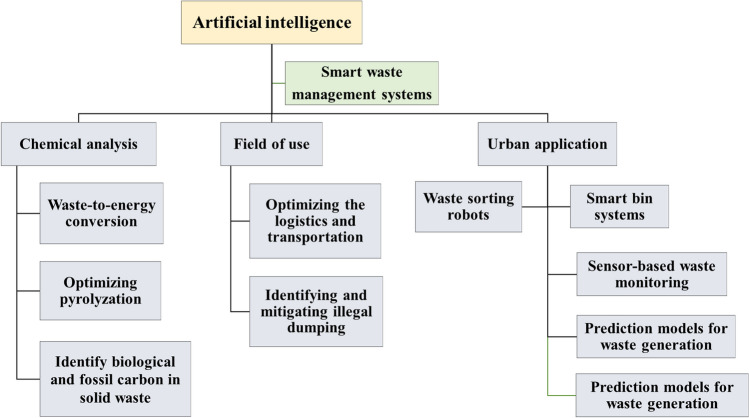
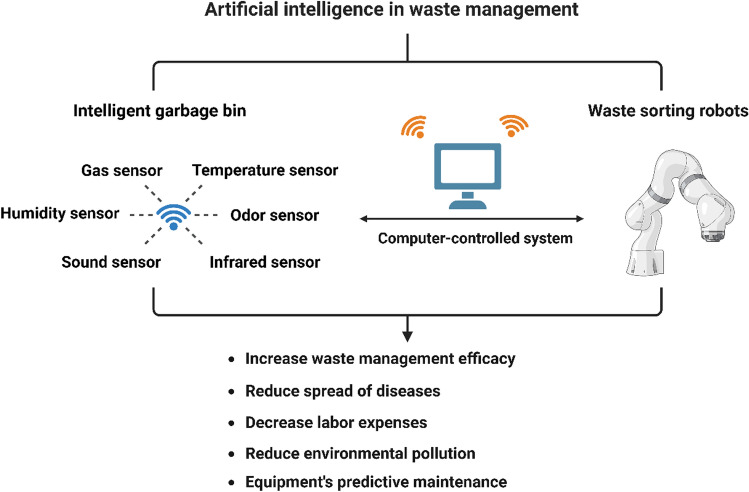
The rising amount of waste generated worldwide is inducing issues of pollution, waste management, and recycling, calling for new strategies to improve the waste ecosystem, such as the use of artificial intelligence. Here, we review the application of artificial intelligence in waste-to-energy, smart bins, waste-sorting robots, waste generation models, waste monitoring and tracking, plastic pyrolysis, distinguishing fossil and modern materials, logistics, disposal, illegal dumping, resource recovery, smart cities, process efficiency, cost savings, and improving public health. Using artificial intelligence in waste logistics can reduce transportation distance by up to 36.8%, cost savings by up to 13.35%, and time savings by up to 28.22%. Artificial intelligence allows for identifying and sorting waste with an accuracy ranging from 72.8 to 99.95%. Artificial intelligence combined with chemical analysis improves waste pyrolysis, carbon emission estimation, and energy conversion. We also explain how efficiency can be increased and costs can be reduced by artificial intelligence in waste management systems for smart cities.
Overview
The claims and statistics of this paper haven’t been checked yet.
Run the check — free, no account needed. It reads the open-access text and checks the sources it cites.
Integrity signals
Registry
Cites
Statistics
Figures
Verification
Claims the paper makes
The claims and statistics of this paper haven’t been checked yet.
Run the check — free, no account needed. It reads the open-access text and checks the sources it cites.
Claims other papers make about this one
Each is checked against this paper’s own text: does it say what the citing paper says it does?
The cited source says what the claim attributes to it.
In the citing paper
“Organizations can transform traditional practices of waste management into more efficient, automated, and data-driven processes that not only reduce waste but also optimize resource recovery and minimize environmental impacts by incorporating AI and IoT technologies.”
From A decision-support framework for evaluating AI-enabled ESG strategies in the context of sustainable manufacturing systems (2025) · cites this paper as [47]
In the citing paper
“The integration of AI enables this information to be analyzed for better planning by optimizing the work of waste management systems in predicting waste generation and performing resource planning.”
From A decision-support framework for evaluating AI-enabled ESG strategies in the context of sustainable manufacturing systems (2025) · cites this paper as [47]
In the citing paper
“For instance, AI can interpret and analyze the data gathered from the collections to determine when and at which point collection should be done so that it decreases fuel consumption and the discharges of carbon are minimal46,47.”
From A decision-support framework for evaluating AI-enabled ESG strategies in the context of sustainable manufacturing systems (2025) · cites this paper as [47]
In the citing paper
“These IoT devices may be designed to track the level of waste accumulation, monitor the types of waste collected, and generate real-time data regarding waste collection patterns.”
From A decision-support framework for evaluating AI-enabled ESG strategies in the context of sustainable manufacturing systems (2025) · cites this paper as [47]
Self-check
Percentages, sums and reported differences re-computed from the paper’s own numbers.
The self-check needs the paper’s full text.
Citations
Cites
2 retracted
RETRACTED: Organic wastes bioremediation and its changing prospects
Patel, A. K., Singhania, R. R., Albarico, F. P. J. B., Pandey, A., Chen, C., & Dong, C. (2022) · The Science of The Total Environment · doi:10.1016/j.scitotenv.2022.153889 · Cited by 253
RetractedOptimization of Sorting Robot Control System Based on Deep Learning and Machine Vision
Chang-yong, F., Nie, G., Naveed, Q. N., Potrich, E., Sankaran, K. S., Kaur, A., & Sammy, F. (2022) · Mathematical Problems in Engineering · doi:10.1155/2022/5458703 · Cited by 14
RetractedGrad-CAM: Visual Explanations from Deep Networks via Gradient-Based Localization
Selvaraju, R. R., Cogswell, M., Das, A., Vedantam, R., Parikh, D., & Batra, D. (2020) · International Journal of Computer Vision · doi:10.1007/s11263-019-01228-7 · Cited by 6,909
What a Waste 2.0: A Global Snapshot of Solid Waste Management to 2050
Kaza, S., Yao, L. C., Bhada-Tata, P., Van Woerden, F., & Levine, D. (2018) · doi:10.1596/978-1-4648-1329-0 · Cited by 6,126
Waste Mismanagement in Developing Countries: A Review of Global Issues
Ferronato, N., & Torretta, V. (2019) · International Journal of Environmental Research and Public Health · doi:10.3390/ijerph16061060 · Cited by 2,293
Evaluating scenarios toward zero plastic pollution
Lau, W. W. Y., Shiran, Y., Bailey, R. M., Cook, E., Stuchtey, M. R., Koskella, J., Velis, C. A., Godfrey, L., Boucher, J., Murphy, M. B., et al. (2020) · Science · doi:10.1126/science.aba9475 · Cited by 1,766
Artificial Intelligence and the Public Sector—Applications and Challenges
Wirtz, B. W., Weyerer, J. C., & Geyer, C. (2019) · International Journal of Public Administration · doi:10.1080/01900692.2018.1498103 · Cited by 1,341 · cited 1×
“These machines are powered by artificial intelligence, can distinguish between different types of solid waste, and exhibit a high degree of autonomy in computer vision programs (Wirtz et al. 2019).”
BackgroundTong, T., & Elimelech, M. (2016) · Environmental Science & Technology · doi:10.1021/acs.est.6b01000 · Cited by 1,126
Cost, environmental impact, and resilience of renewable energy under a changing climate: a review
Osman, A. I., Chen, L., Yang, M., Msigwa, G., Farghali, M., Fawzy, S., Rooney, D. W., & Yap, P.-S. (2023) · Environmental Chemistry Letters · doi:10.1007/s10311-022-01532-8 · Cited by 1,048
Self-citationBouktif, S., Fiaz, A., Ouni, A., & Serhani, M. A. (2018) · Energies · doi:10.3390/en11071636 · Cited by 941
Research works printed but not linked: 6
- Brynjolfsson E, Mcafee A (2017) Artificial intelligence, for real. Harvard business review 1: 1–31. Available at:https://starlab-alliance.com/wp-content/uploads/2017/09/AI-Article.pdf
- Mekonnen FH (2012) Liquid waste management: the case of Bahir Dar, Ethiopia. Ethiopian J Health Develop 26:49–53. https://www.ajol.info/index.php/ejhd/article/view/83828
- Oralhan Z, Oralhan B, Yiğit Y (2017) Smart city application: internet of things technologies based smart waste collection using data mining approach and ant colony optimization. Internet Things 14:5. Available at: https://iajit.org/PDF/%20Vol%2014,%20No.%204/14969.pdf
- Praveen A, Radhika R, Rammohan MU, Sidharth D, Ambat S, Anjali T (2020a) IoT based Smart Bin: a Swachh-Bharat Initiative. In: 2020a International Conference on Electronics and Sustainable Communication Systems (ICESC). https://doi.org/10.1109/ICESC48915.2020.9155626 · DOI
- Takahashi Y, Fujii J, Amakata M (2022) Training a robust uav river patrol ai for different river and an analysis of the training dataset. In: Proceedings of the National Congress of the Society for Artificial Knowledge. JSAI2022: 3S3IS2e01–3S3IS2e01. https://doi.org/10.11517/pjsai.JSAI2022.0_3S3IS2e01 · DOI
- Williams M-A (2019) The artificial intelligence race: will Australia lead or lose? J Proc Royal Soc New South Wales 152:105–114. https://doi.org/10.3316/informit.639079353030330 · DOI
Cited by
Sorted by citations
Items 101–200 of 630
Artificial Intelligence in Bioremediation and Environmental Management
Singh, K., Sarkar, S., & Sharma, S. (2025) · Environmental Quality Management · doi:10.1002/tqem.70192 · Cited by 16
Patil, D. (2025) · SSRN Electronic Journal · doi:10.2139/ssrn.5057414 · Cited by 18
Emmanouil, C., Roumeliotis, D., Kostas, A., & Vagiona, D. G. (2025) · Sustainability · doi:10.3390/su17052265 · Cited by 13
Strzelecka, C. (2025) · Environmental Science & Policy · doi:10.1016/j.envsci.2025.104037 · Cited by 14
Harnessing artificial intelligence for sustainable environmental remediation a review
Balakumar, S., Narayanan, M., Kamaraj, M., & Aravind, J. (2025) · International Journal of Environmental Science and Technology · doi:10.1007/s13762-025-06528-9 · Cited by 17
Shen, N., Zhang, L., Wang, Q., & Wu, L. (2025) · Energy Policy · doi:10.1016/j.enpol.2025.114721 · Cited by 13
Ebrahimi, S., Chen, J., Bridgelall, R., Szmerekovsky, J. G., & Motwani, J. G. (2025) · Sustainability · doi:10.3390/su17167325 · Cited by 14
Garcés, G. (2025) · Journal of Information Technology in Construction · doi:10.36680/j.itcon.2025.050 · Cited by 15
Modernized Management of Biomedical Waste Assisted with Artificial Intelligence
Sarkar, O., Dey, A., & Malik, T. (2023) · International Journal of Biomedical and Clinical Analysis · doi:10.61797/ijbca.v3i2.265 · Cited by 13
Solid Waste Management for Environmental Sustainability and Human Health
Kanade, J. J. D. T. M., & Varghese, T. S. M. A. M. (2024) · Journal of Informatics Education and Research · doi:10.52783/jier.v4i1.599 · Cited by 13
Use of AI in conservation and for understanding climate change
Khaleel, M., Murtaza, N., Mueen, Q. H., Ahmad, S. A., & Qadri, S. F. I. (2024) · Elsevier eBooks · doi:10.1016/b978-0-443-24001-0.00013-0 · Cited by 14
Use of AI in assembly line design and worker and equipment management: review and future directions
Elyasi, M., Thevenin, S., & Cerqueus, A. (2024) · Flexible Services and Manufacturing Journal · doi:10.1007/s10696-024-09576-4 · Cited by 13
Zyoud, S. H., & Zyoud, A. H. (2024) · International Journal of Environmental Science and Technology · doi:10.1007/s13762-024-06146-x · Cited by 16
Fabolude, G., Knoble, C., Vu, A., & Yu, D. (2024) · Geography and sustainability · doi:10.1016/j.geosus.2024.10.002 · Cited by 14
Reza, S. A., Chowdhury, M. S. R., Hossain, S., Hasanuzzaman, M., Shawon, R. E. R., Chowdhury, B. R., & Rana, M. S. (2024) · Journal of Environmental and Agricultural Studies · doi:10.32996/jeas.2024.5.3.5 · Cited by 13
Li, Y., Duan, Y., Wang, Z., Maurice, N. J., Claire, M. J., Ali, N. A., & Giwa, A. S. (2025) · Processes · doi:10.3390/pr13020321 · Cited by 13
Artificial Intelligence and Environmental Social Governance: An Exploratory Landscape of AI ToolkitPreprint
Cucari, N., Nevi, G., Laviola, F., & Barbagli, L. (2023) · SSRN Electronic Journal · doi:10.2139/ssrn.4629933 · Cited by 13
Solar-Powered Smart Bin: Revolutionizing Waste Classification for a Sustainable Future
Hesham, H., Alahmed, Y., Wael, B., & Saleh, M. (2023) · International Arab Conference on Information Technology (ACIT) · doi:10.1109/acit58888.2023.10453850 · Cited by 12
Deberdt, R., Billon, P. L., Makinde, O., Dauvergne, P., Solwati, T., Razmi, S., Kumar, G., & Belhabib, D. (2025) · The Extractive Industries and Society · doi:10.1016/j.exis.2025.101690 · Cited by 16
Rane, N. L., Choudhary, S., & Rane, J. (2024) · SSRN Electronic Journal · doi:10.2139/ssrn.4681733 · Cited by 15
Artificial intelligence in sustainable organic waste treatment: a review
Sugumaran, D., Dananjaya, U. M., Kodippili, S. P., Alwis, M. M. D., Attigala, D. L., Ranasinghe, N. N., Manatunga, D. C., Dassanayake, R. S., Zhou, Y., & Liu, Y. (2025) · Waste Disposal & Sustainable Energy · doi:10.1007/s42768-025-00246-1 · Cited by 15
Ibitoye, S. E., Ball, A. K., Rodriguez, R. V., Olayemi, O. A., Esteva, P., Omoniyi, P. O., Adegun, I. K., Mahamood, R. M., & Akinlabi, E. T. (2025) · Sustainable Development · doi:10.1002/sd.70345 · Cited by 11
Hassan, O. M. (2025) · Discover Applied Sciences · doi:10.1007/s42452-025-07904-3 · Cited by 17
Automated sorting technology for plastic waste
Lubongo, C., Daej, M. A. A. B., & Alexandridis, P. (2024) · Elsevier eBooks · doi:10.1016/b978-0-443-13798-3.00017-6 · Cited by 13
Belsare, K., Singh, M., Gandam, A., Samudrala, V., Singh, R., Soliman, N. F., Das, S., & Algarni, A. D. (2024) · Heliyon · doi:10.1016/j.heliyon.2024.e36271 · Cited by 11
RetractedHamzah, R., Ang, L., Roslan, R., Teo, N. H. I., Samad, K. A., & Samah, K. A. F. A. (2024) · IEEE International Conference on Automatic Control and Intelligent Systems (I2CACIS) · doi:10.1109/i2cacis61270.2024.10649835 · Cited by 11
Wang, L., Wang, H., Bai, M., Wu, Y., Guo, T., Cai, D., Sun, P., Xiao, N., Li, A., & Ming, W. (2024) · IEEE Access · doi:10.1109/access.2024.3494549 · Cited by 11
Souza, E., Pinheiro, P., Coutinho, F., Dias, J. V. F., Pilar, R., Pontes, M. J., & Junior, A. G. L. (2024) · Sensors · doi:10.3390/s24247998 · Cited by 11
Enhancing door-to-door waste collection forecasting through ML
Pasa, L., Angelini, G., Ballarin, M., Fedrizzi, P. L., & Sperduti, A. (2025) · Waste Management · doi:10.1016/j.wasman.2024.12.044 · Cited by 14
Role of Machine Learning and Artificial Intelligence in Smart Waste Management
Nirmala, N., Arun, J., Kumar, S. S., & Dawn, S. S. (2025) · Interdisciplinary biotechnological advances · doi:10.1007/978-981-97-8673-2_3 · Cited by 11
Si, Q., & Han, S. I. (2025) · IEEE Access · doi:10.1109/access.2025.3544631 · Cited by 11
Garcés, G. (2025) · Discover Civil Engineering · doi:10.1007/s44290-025-00297-7 · Cited by 14
Patil, D. (2025) · SSRN Electronic Journal · doi:10.2139/ssrn.5057408 · Cited by 18
Destek, G., Aydın, S., Okumuş, N., & Destek, M. A. (2025) · Business Strategy and the Environment · doi:10.1002/bse.70172 · Cited by 10
Research on Service Design of Garbage Classification Driven by Artificial Intelligence
Zhang, J., Yang, H., & Xu, X. (2023) · Sustainability · doi:10.3390/su152316454 · Cited by 14
Devi, R., Singh, A. K., Kumar, A., Kumar, R., Rani, S., & Chandra, R. (2024) · Springer eBooks · doi:10.1007/978-981-97-0823-9_3 · Cited by 10
Olivieri, F., Caputo, A., Leonetti, D., Castaldo, R., Avolio, R., Cocca, M., Errico, M. E., Iannotta, L., Avella, M., Carfagna, C., et al. (2024) · Polymers · doi:10.3390/polym16202898 · Cited by 9
A Time Series Approach to Smart City Transformation: The Problem of Air Pollution in Brescia
Pagano, E., & Barbierato, E. (2023) · AI · doi:10.3390/ai5010002 · Cited by 9
Chen, Z., Kurniawan, T. A., & Yap, P. (2024) · Journal of Water Process Engineering · doi:10.1016/j.jwpe.2024.106524 · Cited by 11
Self-citationOlazo, D. B., & Evaristo, J. A. (2025) · SEISENSE Business Review · doi:10.33215/2hddey70 · Cited by 9
HaitherAli, H., Jamal Mohamed Shakeel, S. J., Sivagami, M., & Anjali, G. (2025) · Results in Engineering · doi:10.1016/j.rineng.2025.105688 · Cited by 9
Wu, G., He, Y., Cao, X., & Yuen, C. (2025) · IEEE Internet of Things Journal · doi:10.1109/jiot.2025.3579940 · Cited by 10
Fang, X., & Yang, L. (2025) · Journal of Cleaner Production · doi:10.1016/j.jclepro.2025.146474 · Cited by 9
Mougari, N. E., Ghersi, D. E., Iachachene, F., Largeau, J.-F., & Arıcı, M. (2025) · Bioprocess and Biosystems Engineering · doi:10.1007/s00449-025-03255-w · Cited by 10
Artificial intelligence in waste management systems: Applications, challenges, and prospects
Belyamani, I. (2025) · Waste Management Bulletin · doi:10.1016/j.wmb.2025.100269 · Cited by 9
Abourida, M., Short, M., Victorovich, K. O., Khamis, N. M., Mahammedi, C., Al-Mhdawi, M. K. S., & Sakr, A.-H. (2025) · Waste Management Bulletin · doi:10.1016/j.wmb.2025.100271 · Cited by 11
Li, S., Razi, U., Almugren, H., Zhang, L., & Galgotia, A. (2025) · Technological Forecasting and Social Change · doi:10.1016/j.techfore.2025.124468 · Cited by 9
Patil, D. (2025) · SSRN Electronic Journal · doi:10.2139/ssrn.5057410 · Cited by 13
Calcium oxide waste-based catalysts for biodiesel production and depollution: a review
Teo, C. K., Chia, P. W., Nordin, N., Kan, S., Ismail, N. M., Zakaria, Z., Liew, R. K., Wu, L., & Yong, F. S. J. (2024) · Environmental Chemistry Letters · doi:10.1007/s10311-024-01740-4 · Cited by 8
Bulatov, N. K., Uvaliyeva, A., Kassymzhanova, K., Izteleuova, M., & Saukenova, I. (2024) · Evergreen · doi:10.5109/7183376 · Cited by 8
Tackling food waste in nursing homes: A measurement method using smart bins
Liu, Z., Satyanarayana, K. C., Koppisetty, A. K. C., Rousta, K., & Brancoli, P. (2025) · Waste Management · doi:10.1016/j.wasman.2025.114858 · Cited by 8
Integrating V2X solutions in intelligent green cities: an AI-driven point exchange system approach
Talaat, F. M., Shaban, W. M., ZainEldin, H. Y., Badawy, M., & Elhosseini, M. A. (2025) · Neural Computing and Applications · doi:10.1007/s00521-025-11187-5 · Cited by 8
Hao, M., Xu, S.-C., Meng, X.-N., & Xue, X.-F. (2024) · Environmental Science and Pollution Research · doi:10.1007/s11356-024-32304-2 · Cited by 8
Dınçer, H., Yüksel, S., Eti, S., Gökalp, Y., Mikhaylov, A. Y., & Karpyn, Z. T. (2024) · Waste Management & Research The Journal for a Sustainable Circular Economy · doi:10.1177/0734242x241242682 · Cited by 8
Veselá, L., Vršanská, M., Baláková, I., Voběrková, S., Kubíčková, L., & Vaverková, M. D. (2025) · Sustainable Development · doi:10.1002/sd.3434 · Cited by 7
Alam, M. J., Molla, C., Misbauddin, S., Hossen, M. A., & Golder, U. (2025) · Cleaner Waste Systems · doi:10.1016/j.clwas.2025.100282 · Cited by 9
Alzahrani, A., Kostkova, P., Alshammari, H. H., Habibullah, S., & Alzahrani, A. (2025) · Alexandria Engineering Journal · doi:10.1016/j.aej.2025.05.046 · Cited by 14
Ahmad, I. A., Hasan, A. M., & Humaidi, A. J. (2025) · Journal of Engineering Research · doi:10.1016/j.jer.2025.08.014 · Cited by 7
Anitha, R., & Parthiban, A. (2025) · Results in Engineering · doi:10.1016/j.rineng.2025.107988 · Cited by 13
Rohde, F., Nasruddin, Z., Kotova, E., & Ammon, S. (2026) · AI and Ethics · doi:10.1007/s43681-026-01008-3 · Cited by 9
Balakrishnan, P., & Arya, R. K. (2026) · Biomass Conversion and Biorefinery · doi:10.1007/s13399-026-07079-w · Cited by 7
Sharma, N., Ingole, S. B., Pokhariya, H. S., Parmar, A., Shilpa, K., Reddy, U., & Hussny, H. A. (2023) · E3S Web of Conferences · doi:10.1051/e3sconf/202345301029 · Cited by 16
Sengupta, P. (2024) · ACS symposium series · doi:10.1021/bk-2024-1472.ch012 · Cited by 7
Strzelecka, C. (2024) · Convergence The International Journal of Research into New Media Technologies · doi:10.1177/13548565241288452 · Cited by 7
Zhao, X., Li, S., Lu, K., & Zhong, Y. (2024) · Journal of Environmental Management · doi:10.1016/j.jenvman.2024.123107 · Cited by 7
Employing Technological Innovation for Eco-Friendly Waste Disposal at a Global Scale
Ganguly, A., Chattaraj, M., Chattaraj, S., Mitra, D., Ganguly, M., Kirtania, D. K., & Konar, R. (2025) · Advances in environmental engineering and green technologies book series · doi:10.4018/979-8-3693-7282-1.ch008 · Cited by 7
AI-Driven Smart Cities in France
-, R. E. (2024) · International Journal For Multidisciplinary Research · doi:10.36948/ijfmr.2024.v06i03.21920 · Cited by 7
Patil, D. (2025) · SSRN Electronic Journal · doi:10.2139/ssrn.5057424 · Cited by 12
Greenhouse gas mitigation potential via a large-scale compulsory circular waste management system
Li, R. (2024) · Journal of Environmental Management · doi:10.1016/j.jenvman.2024.122425 · Cited by 6
Application of the Clark–Wright Method to Improve the Sustainability of the Logistic Chain
Mašek, J., Pálková, A., & Bulková, Z. (2024) · Applied Sciences · doi:10.3390/app14219908 · Cited by 6
Spatiotemporal analysis and GIS-based dashboard development for urban household waste
Shi-xiong, X., Shirowzhan, S., & Sepasgozar, S. M. E. (2025) · Smart and Sustainable Built Environment · doi:10.1108/sasbe-08-2023-0229 · Cited by 6
From Construction 4.0 to Construction 5.0: Principles and Enabling Technologies
Chen, X., Liu, F., Ghaffarianhoseini, A., GhaffarianHoseini, A., & Guo, B. H. W. (2025) · Lecture notes in civil engineering · doi:10.1007/978-981-96-4051-5_88 · Cited by 6
AI-Driven Innovations in Waste Management: Catalyzing the Circular Economy
Snoun, A., Mufida, M. K., El-Cadi, A. A., & Delot, T. (2025) · doi:10.3390/engproc2025097012 · Cited by 6
Hao, F., Shao, Y., Guan, H., & Wang, S. (2025) · Cities · doi:10.1016/j.cities.2025.106463 · Cited by 6
Marefat, A., Golzary, A., Takahashi, F., & Huisingh, D. (2025) · Cleaner Environmental Systems · doi:10.1016/j.cesys.2025.100339 · Cited by 8
Jayabal, R., & Prabhakar, P. (2025) · Journal of the Science of Food and Agriculture · doi:10.1002/jsfa.70311 · Cited by 10
Ali, S. S., Xiong, M., Jiao, H., Al-Tohamy, R., & Sun, J. (2026) · Journal of Environmental Management · doi:10.1016/j.jenvman.2026.129282 · Cited by 9
Lin, Y.-H., Yuan, W., & Wang, T. (2026) · Buildings · doi:10.3390/buildings16071437 · Cited by 7
Mawthoh, A. B. T., Seram, D., Haobijam, J. W., Ayrılmış, N., Subramani, T., Naveen Kumar, P., Patil, H., & Aruljothi, J. (2026) · Environment Development and Sustainability · doi:10.1007/s10668-026-07853-w · Cited by 6
Towards an Intelligent Tomorrow
Kalinaki, K., Acaru, S. F., Kugonza, J., & Nsubuga, R. (2024) · Advances in computational intelligence and robotics book series · doi:10.4018/979-8-3693-1062-5.ch004 · Cited by 6
Garbage Collection and Segregation using Computer Vision
Kumar, R. L., Ramya, R., Balaji, M. J., Hari, V., & Malarvizhi, M. (2024) · International Conference on Inventive Computation Technologies (ICICT) · doi:10.1109/icict60155.2024.10544861 · Cited by 6
MIPs-Based Sensors and Biosensors for Environmental Monitoring
Yang, L., Ge, K., Qadir, M. F., Wang, X., Gu, Y., & Yang, Y. (2024) · Springer eBooks · doi:10.1007/978-3-031-58995-9_7 · Cited by 6
Eco-Friendly Solutions for Sustainable Waste Management
Rajpoot, S. (2024) · Advances in logistics, operations, and management science book series · doi:10.4018/979-8-3693-2595-7.ch003 · Cited by 6
Vadivel, T., Barathi, K., Arulkumaran, G., Anand, M. B., & Cherubini, C. (2024) · Water · doi:10.3390/w16233450 · Cited by 6
Harnessing Artificial Intelligence for Circular Economy in Agriculture
Sen, M., Garai, S., Dutta, S., Rakshit, D., Roy, A., Das, R., & Das, S. (2024) · Advances in marketing, customer relationship management, and e-services book series · doi:10.4018/979-8-3693-6468-0.ch011 · Cited by 7
Utilizing Artificial Intelligence and Machine Learning for Enhanced Recycling Efforts
Kandpal, N., Singhal, N., Lavaniya, H. V., Jain, R., Singh, R. K., & Gaur, A. (2025) · Advances in environmental engineering and green technologies book series · doi:10.4018/979-8-3693-7282-1.ch004 · Cited by 6
Advancing Environmental Monitoring through AI: Applications of R and Python
Hackenberger, B. K., Djerdj, T., & Hackenberger, D. K. (2025) · Environmental sciences · doi:10.5772/intechopen.1007683 · Cited by 8
Nasir, N. A. N. M., Zakarya, I. A., Anuar, N., Kamaruddin, S. A., & Helmi, N. A. M. (2025) · International Journal of Environmental Science and Technology · doi:10.1007/s13762-025-06489-z · Cited by 6
RTDRNet-lite: A lightweight real-time detection framework for robotic waste sorting
Karim, M. J., Munir, S., Khandakar, A. A., Ahsan, M., & Haider, J. (2025) · Waste Management · doi:10.1016/j.wasman.2025.115164 · Cited by 6
Patil, D. (2025) · SSRN Electronic Journal · doi:10.2139/ssrn.5057438 · Cited by 8
The Role of Artificial Intelligence in Circular Economy Strategies: Predictive Analysis for SMEs
Klimecka-Tatar, D., & Kapustka, K. (2025) · Management Systems in Production Engineering · doi:10.2478/mspe-2025-0020 · Cited by 9
Advancing microplastic pollution management in aquatic environments through artificial intelligence
Nagpal, M., Gupta, K., Gupta, T., Mittal, A., & Sharma, N. (2025) · Journal of Environmental Health Science and Engineering · doi:10.1007/s40201-025-00958-w · Cited by 7
How to track the dumped waste? From data collection to advanced source identification
Liang, W., Fan, L., Yang, Z., Yang, J., Zou, Q., Huang, C., Huang, Q., Duan, H., & Yang, J. (2025) · Journal of Hazardous Materials · doi:10.1016/j.jhazmat.2025.140052 · Cited by 5
Ye, S., & Zhang, W. (2025) · Technology Analysis and Strategic Management · doi:10.1080/09537325.2025.2572043 · Cited by 5
Kumpf, K., Cajic, M., Zeljkovic, V., Mravik, M., Zivkovic, M. Z., Mani, J. P., Šimić, V., & Bačanin, N. (2025) · International Journal of Information Security · doi:10.1007/s10207-025-01137-6 · Cited by 5
Myhrer, K. S., Gaarder, M. Ø., Bøhn, S. K., Reynolds, C. J., & Almli, V. L. (2025) · Cleaner Food Systems · doi:10.1016/j.clfs.2025.100008 · Cited by 5
Bibi, S., & Yang, L. (2025) · Discover Artificial Intelligence · doi:10.1007/s44163-025-00647-5 · Cited by 5
Bari, A., Arshi, O., & Mondal, S. (2026) · Smart Construction and Sustainable Cities · doi:10.1007/s44268-026-00088-8 · Cited by 9
Kafestidis, S., Chasiotou, A., Konstantinidis, C., & Lazos, G. (2024) · Risk Governance and Control Financial Markets & Institutions · doi:10.22495/rgcv14i4p9 · Cited by 5
Singh, P., Azad, M. L., & Mishra, V. (2024) · International Conference on Contemporary Computing and Informatics (IC3I) · doi:10.1109/ic3i61595.2024.10829161 · Cited by 5
Metadata
- Authors
- Fang, B., Yu, J., Chen, Z., Osman, A. I., Farghali, M., Ihara, I., Hamza, E. H., Rooney, D. W., & Yap, P.-S.
- Affiliations
- Xi’an Jiaotong-Liverpool University (CN)
- Queen's University Belfast (GB)
- Kobe University (JP)
- Military Technical College (EG)
- Corresponding author
- Osman, Ahmed I.
- Farghali, Mohamed
- Yap, Pow-Seng
- ORCID
- Venue
- Environmental Chemistry Letters
- Published
- 2023-05-09
- Volume
- 21
- Issue
- 4
- Pages
- 1959-1989
- ISSN
- 1610-3653 (ISSN-L)
- 1610-3661
- PMC
- PMC10169138
- OpenAlex
- W4382182093
- Cited by
- 629
- References
- 209
- Citations by year
- 2026: 195 · 2025: 272 · 2024: 141 · 2023: 21
- FWCI
- 11.90
- Type
- journal article
- Language
- en
- Open access
- hybrid
- doi.org
- Locations
- Environmental Chemistry Letters (publishedVersion, cc-by)
- PubMed Central (publishedVersion, cc-by)
- PubMed (publishedVersion)
- Research Portal (Queen's University Belfast) (submittedVersion, cc-by)
- Funders
- SEUPB (Bryden Centre project (Project ID VA5048))
- Topics
- Physical Sciences › Environmental Science › Waste Management and Disposal › Municipal Solid Waste Management
- Physical Sciences › Environmental Science › Waste Management and Disposal › Waste Management and Recycling
- Health Sciences › Medicine › Public Health, Environmental and Occupational Health › Healthcare and Environmental Waste Management
- Keywords
- artificial intelligence, waste management, smart cities, waste-to-energy, smart bins, plastic waste pyrolysis, waste logistics, illegal dumping, resource recovery, carbon emission estimation
About these checks
Registry, retraction, Cites and statistics results are computed, not judged, with one exception: a printed reference that no index lists is read once by a model before it counts as a citation error. Claims are extracted by a model and kept only when their quote appears verbatim in the text; each cited source is then checked, with a model’s help, for whether it says what the claim relies on. Those verdicts can be wrong — read the claim’s quote and the cited source before relying on one.
Statistics and arithmetic are recomputed, not judged.
Confidence bands are shown only for fields calibrated on our annotated test set. None is calibrated yet, so no band is shown.
What counts as a claim ›How we measure confidence ›How we check this ›
Are you an author, or do you see a problem with this page? Request a review
