

The DOI matches its Crossref record; 266 of the 266 references it cites were found in a registry or an index.
Obesity and cancer—extracellular matrix, angiogenesis, and adrenergic signaling as unusual suspects linking the two diseases
Open accessAbstract
Obesity is an established risk factor for several human cancers. Given the association between excess body weight and cancer, the increasing rates of obesity worldwide are worrisome. A variety of obesity-related factors has been implicated in cancer initiation, progression, and response to therapy. These factors include circulating nutritional factors, hormones, and cytokines, causing hyperinsulinemia, inflammation, and adipose tissue dysfunction. The impact of these conditions on cancer development and progression has been the focus of extensive literature. In this review, we concentrate on processes that can link obesity and cancer, and which provide a novel perspective: extracellular matrix remodeling, angiogenesis, and adrenergic signaling. We describe molecular mechanisms involved in these processes, which represent putative targets for intervention. Liver, pancreas, and breast cancers were chosen as exemplary disease models. In view of the expanding epidemic of obesity, a better understanding of the tumorigenic process in obese individuals might lead to more effective treatments and preventive measures.
Overview
The claims and statistics of this paper haven’t been checked yet.
Run the check — free, no account needed. It reads the open-access text and checks the sources it cites.
Integrity signals
Registry
Cites
Statistics
Figures
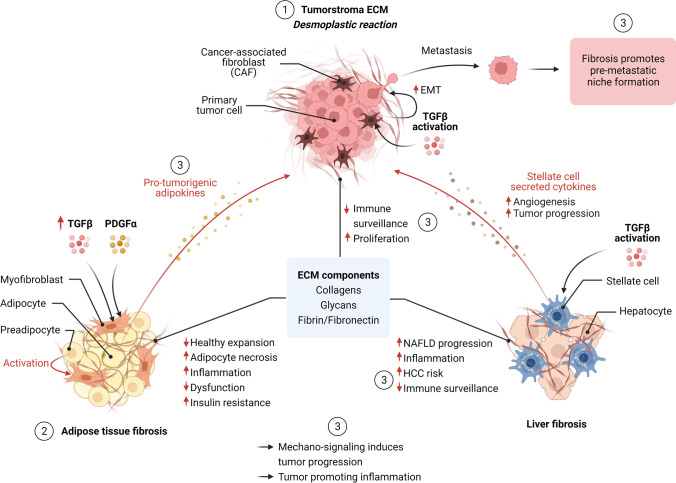
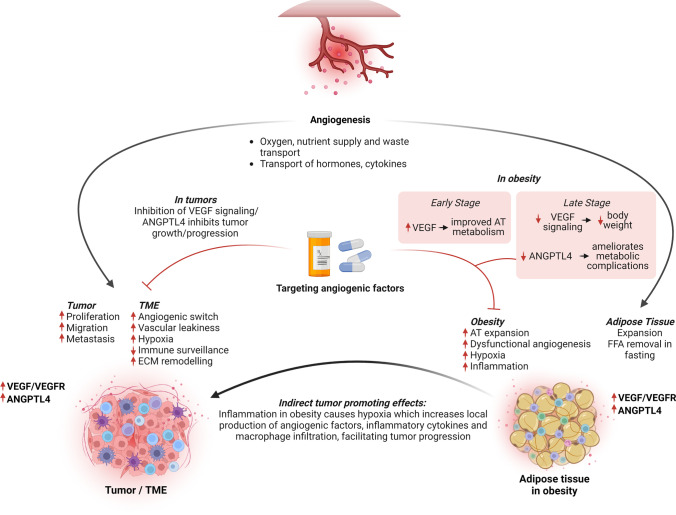
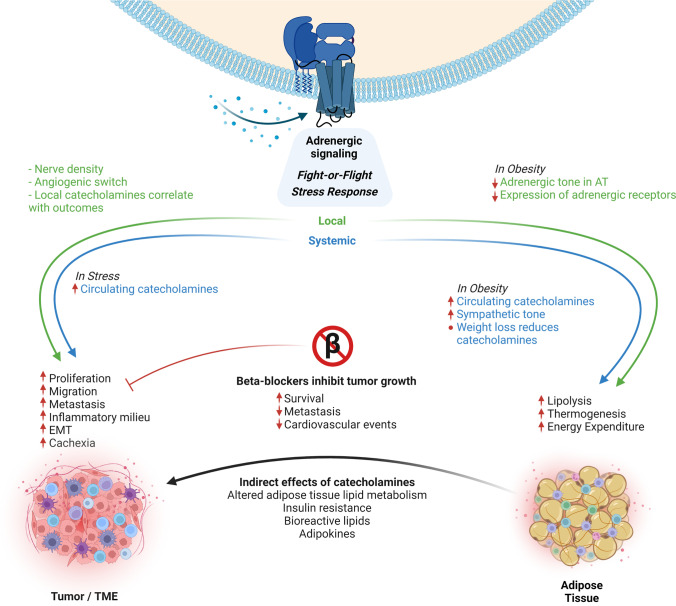
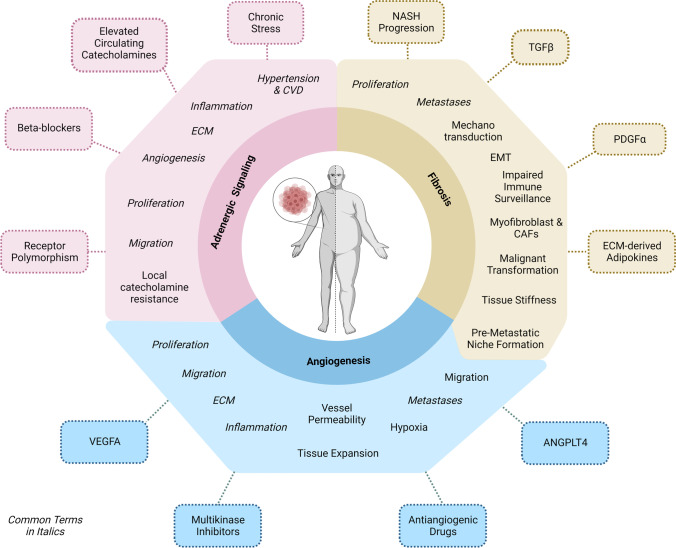
Verification
Claims the paper makes
The claims and statistics of this paper haven’t been checked yet.
Run the check — free, no account needed. It reads the open-access text and checks the sources it cites.
Claims other papers make about this one
Each is checked against this paper’s own text: does it say what the citing paper says it does?
In the citing paper
“Obesity is associated with chronic low-grade inflammation and a plethora of metabolic dysfunctions such as insulin resistance, impaired glucose tolerance and hypertension.”
From A deep-learning framework reveals whole-body perturbations at cell level (2026) · cites this paper as [13]
In the citing paper
“Obesity increases the risk of developing secondary comorbidities, including type 2 diabetes, peripheral neuropathies, cardiovascular diseases, stroke and numerous cancer types12,13, underscoring the systemic effects of excess body fat and the need for holistic characterizations of the underlying structural and cellular changes.”
From A deep-learning framework reveals whole-body perturbations at cell level (2026) · cites this paper as [13]
Self-check
Percentages, sums and reported differences re-computed from the paper’s own numbers.
The self-check needs the paper’s full text.
Citations
Cites
1 retracted
Items 201–266 of 266
Daly, C. J., & McGrath, J. C. (2011) · Trends in Pharmacological Sciences · doi:10.1016/j.tips.2011.02.008 · Cited by 84
Epigenetics and the overhealing wound: the role of DNA methylation in fibrosis
Neary, R., Watson, C. J., & Baugh, J. A. (2015) · Fibrogenesis & Tissue Repair · doi:10.1186/s13069-015-0035-8 · Cited by 83
Tamoxifen inhibits angiogenesis in estrogen receptor-negative animal models.
Blackwell, K. L., Haroon, Z. A., Shan, S., Saito, W., Broadwater, G., Greenberg, C. S., & Dewhirst, M. W. (2000) · PubMed · Cited by 81
Etiology and management of hypertension in patients with cancer
Mohammed, T. J., Singh, M., Tiu, J. G., & Kim, A. S. (2021) · Cardio-Oncology · doi:10.1186/s40959-021-00101-2 · Cited by 77
Mazzarella, L., Disalvatore, D., Bagnardi, V., Rotmensz, N., Galbiati, D., Caputo, S., Curigliano, G., & Pelicci, P. G. (2013) · European Journal of Cancer · doi:10.1016/j.ejca.2013.07.016 · Cited by 76
Vascular targeting of adipose tissue as an anti-obesity approach
Daquinag, A. C., Zhang, Y., & Kolonin, M. G. (2011) · Trends in Pharmacological Sciences · doi:10.1016/j.tips.2011.01.004 · Cited by 74
Shan, T., Cui, X., Li, W., Lin, W., Li, Y., Chen, X., & Wu, T. (2014) · Cancer Science · doi:10.1111/cas.12438 · Cited by 74
Olson, P., Chu, G. C., Perry, S. R., Nolan-Stevaux, O., & Hanahan, D. (2011) · Proceedings of the National Academy of Sciences · doi:10.1073/pnas.1111079108 · Cited by 73
Collins, S., Daniel, K. W., & Rohlfs, E. M. (1999) · International Journal of Obesity · doi:10.1038/sj.ijo.0800894 · Cited by 72
Lotta, L. A., Stewart, I. D., Sharp, S. J., Day, F. R., Burgess, S., Luan, J., Bowker, N., Cai, L., Li, C., Wittemans, L. B. L., et al. (2018) · JAMA Cardiology · doi:10.1001/jamacardio.2018.2866 · Cited by 72
Role of angiogenesis in pancreatic cancer biology and therapy
Zhang, Z., Ji, S., Zhang, B., Liu, J., Qin, Y., Xu, J., & Yu, X. (2018) · Biomedicine & Pharmacotherapy · doi:10.1016/j.biopha.2018.09.136 · Cited by 72
Human endotrophin as a driver of malignant tumor growth
Bu, D., Crewe, C., Kusminski, C. M., Gordillo, R., Ghaben, A. L., Kim, M., Park, J., Deng, H., Xiong, W., Liu, X., et al. (2019) · JCI Insight · doi:10.1172/jci.insight.125094 · Cited by 71
Identification of genomic signatures in circulating tumor cells from breast cancer
Kanwar, N., Hu, P., Bedard, P. L., Clemons, M. J., McCready, D. R., & Done, S. J. (2014) · International Journal of Cancer · doi:10.1002/ijc.29399 · Cited by 69
O'Reilly, E. M., Niedzwiecki, D., Hall, M., Hollis, D. R., Bekaii‐Saab, T., Pluard, T., Douglas, K., Abou‐Alfa, G. K., Kindler, H. L., Schilsky, R. L., et al. (2010) · The Oncologist · doi:10.1634/theoncologist.2010-0152 · Cited by 67
beta-Adrenoreceptor antagonists reduce cancer cell proliferation, invasion, and migration
İşeri, Ö. D., Şahin, F. İ., Terzi, Y. K., Yurtçu, E., Erdem, R., & Sarıalioğlu, F. (2014) · Pharmaceutical Biology · doi:10.3109/13880209.2014.892513 · Cited by 67
ANGPTL4 overexpression is associated with progression and poor prognosis in breast cancer
Zhao, J., Liu, J., Wu, N., Zhang, H., Zhang, S., Li, L., & Wang, M. (2020) · Oncology Letters · doi:10.3892/ol.2020.11768 · Cited by 65
Zhong, S., Yu, D., Zhang, X., Chen, X., Yang, S., Tang, J., Zhao, J., & Wang, S. (2015) · European Journal of Cancer Prevention · doi:10.1097/cej.0000000000000192 · Cited by 65
Löfling, L., Støer, N. C., Sloan, E. K., Chang, A., Gandini, S., Ursin, G., & Botteri, E. (2022) · British Journal of Cancer · doi:10.1038/s41416-022-01891-7 · Cited by 64
Huang, X., Hamajima, N., Saito, T., Matsuo, K., Mizutani, M., Iwata, H., Iwase, T., Miura, S., Mizuno, T., Tokudome, S., et al. (2001) · Breast Cancer Research · doi:10.1186/bcr304 · Cited by 64
Bergmann, L., Maute, L., Heil, G., Rüssel, J., Weidmann, E., Köberle, D., Fuxius, S., Weigang-Köhler, K., Aulitzky, W. E., Wormann, B. J., et al. (2014) · European Journal of Cancer · doi:10.1016/j.ejca.2014.10.010 · Cited by 64
Effect of Chronic Restraint Stress on Human Colorectal Carcinoma Growth in Mice
Lin, Q., Wang, F., Yang, R., Zheng, X., Gao, H.-B., & Zhang, P. (2013) · PLoS ONE · doi:10.1371/journal.pone.0061435 · Cited by 62
Ng, T., Xu, A., Cheng, Q., Guo, D. Y., Lim, Z. X. H., Sun, C. K.-W., Fung, J. H.-S., Poon, R. T. P., Fan, S. T., Lo, C. M., et al. (2014) · Molecular Cancer · doi:10.1186/1476-4598-13-196 · Cited by 62
Transcriptional Cofactor TBLR1 Controls Lipid Mobilization in White Adipose Tissue
Rohm, M., Sommerfeld, A., Strzoda, D., Jones, A., Sijmonsma, T., Rudofsky, G., Wolfrum, C., Sticht, C., Gretz, N., Zeyda, M., et al. (2013) · Cell Metabolism · doi:10.1016/j.cmet.2013.02.010 · Cited by 61
Self-citationScriba, D., Aprath-Husmann, I., Blum, W., & Hauner, H. (2000) · European Journal of Endocrinology · doi:10.1530/eje.0.1430439 · Cited by 60
Adipocyte lipolysis drives acute stress-induced insulin resistance
Raje, V., Ahern, K. W., Martínez, B. A., Howell, N. L., Oenarto, V., Granade, M. E., Kim, J. W., Tundup, S., Bottermann, K., Gödecke, A., et al. (2020) · Scientific Reports · doi:10.1038/s41598-020-75321-0 · Cited by 59
Lima, J. D. C. C., Simoes, E., de Castro, G. S., Morais, M., de Matos‐Neto, E. M., Alves, M. J., Neto, N. I. P., Figuerêdo, R. G., Zorn, T. M. T., Felipe-Silva, A., et al. (2019) · Journal of Cachexia Sarcopenia and Muscle · doi:10.1002/jcsm.12441 · Cited by 59
High levels of modified ceramides are a defining feature of murine and human cancer cachexia
Morigny, P., Zuber, J., Haid, M., Kaltenecker, D., Riols, F., Lima, J. D. C. C., Simoes, E., Otoch, J. P., Schmidt, S. F., Herzig, S., et al. (2020) · Journal of Cachexia Sarcopenia and Muscle · doi:10.1002/jcsm.12626 · Cited by 58
Self-citationMcQueen, A. E., Kanamaluru, D., Yan, K., Gray, N. E., Wu, L., Li, M.-L., Chang, A., Hasan, A., Stifler, D., Koliwad, S. K., et al. (2017) · Journal of Biological Chemistry · doi:10.1074/jbc.m117.803973 · Cited by 56
Gujral, D. M., Lloyd, G., & Bhattacharyya, S. (2017) · The Breast · doi:10.1016/j.breast.2017.10.010 · Cited by 56
Endotrophin - Linking Obesity with Aggressive Tumor Growth
Park, J., & Scherer, P. E. (2012) · Oncotarget · doi:10.18632/oncotarget.796 · Cited by 53
Role of β1‐adrenoceptor in increased lipolysis in cancer cachexia
Cao, D., Wu, G., Yang, Z., Zhang, B., Jiang, Y., Han, Y., He, G., Zhuang, Q., Wang, Y., Huang, Z., et al. (2010) · Cancer Science · doi:10.1111/j.1349-7006.2010.01582.x · Cited by 52
Angiopoietin-like protein 3 and 4 expression 4 and their serum levels in hepatocellular carcinoma
El‐Shal, A. S., Zidan, H. E., Rashad, N. M., & Wadea, F. M. (2017) · Cytokine · doi:10.1016/j.cyto.2017.03.006 · Cited by 52
Nault, J., Pigneur, F., Charles‐Nelson, A., Costentin, C. E., Tselikas, L., Katsahian, S., Diao, G., Laurent, A., Mallat, A., Duvoux, C., et al. (2015) · Digestive and Liver Disease · doi:10.1016/j.dld.2015.07.001 · Cited by 51
Beta-adrenoceptor action on pancreatic cancer cell proliferation and tumor growth in mice.
Lin, X., Luo, K., Lv, Z., & Huang, J. J. (2012) · PubMed · doi:10.5754/hge11271 · Cited by 49
Gene expression in “young adult type” breast cancer: a retrospective analysis
Johnson, R. H., Hu, P., Fan, C., & Anders, C. K. (2015) · Oncotarget · doi:10.18632/oncotarget.4051 · Cited by 48
Control of Adipose Tissue Inflammation Through TRB1
Ostertag, A., Jones, A., Rose, A. J., Liebert, M., Kleinsorg, S., Reimann, A., Vegiopoulos, A., Díaz, M. B., Strzoda, D., Yamamoto, M., et al. (2010) · Diabetes · doi:10.2337/db09-1537 · Cited by 48
Self-citationYotsumoto, F., Tokunaga, E., Oki, E., Maehara, Y., Yamada, H., Nakajima, K., Nam, S. O., Miyata, K., Koyanagi, M., Doi, K., et al. (2013) · Molecular Cancer Research · doi:10.1158/1541-7786.mcr-12-0428 · Cited by 47
Biophysical Properties of Extracellular Matrix: Linking Obesity and Cancer
Druso, J. E., & Fischbach, C. (2018) · Trends in cancer · doi:10.1016/j.trecan.2018.02.001 · Cited by 40
Can a fibrotic liver afford epithelial-mesenchymal transition?
Munker, S., Wu, Y., Ding, H.-G., Liebe, R., & Weng, H. (2017) · World Journal of Gastroenterology · doi:10.3748/wjg.v23.i26.4661 · Cited by 38
Chang, M. (2022) · Biomedicines · doi:10.3390/biomedicines10030692 · Cited by 38
Blücher, C., Iberl, S., Schwagarus, N., Müller, S., Liebisch, G., Höring, M., Hidrobo, M. S., Ecker, J., Spindler, N., Dietrich, A., et al. (2020) · Molecular Cancer Research · doi:10.1158/1541-7786.mcr-19-1223 · Cited by 37
Adrenergic Signaling in Immunotherapy of Cancer: Friend or Foe?
Jensen, A. W. P., Simões, A. M. C., Straten, P. T., & Olofsson, G. H. (2021) · Cancers · doi:10.3390/cancers13030394 · Cited by 37
Lazzati, A., Epaud, S., Ortala, M., Katsahian, S., & Lanoy, É. (2022) · British journal of surgery · doi:10.1093/bjs/znac003 · Cited by 36
Udumyan, R., Montgomery, S., Duberg, A., Fang, F., Valdimarsdóttir, U. A., Ekbom, A., Smedby, K. E. E., & Fall, K. (2020) · Scandinavian Journal of Gastroenterology · doi:10.1080/00365521.2020.1762919 · Cited by 36
Heparanase Accelerates Obesity-Associated Breast Cancer Progression
Hermano, E., Goldberg, R., Rubinstein, A. M., Sonnenblick, A., Maly, B., Nahmias, D., Li, J., Bakker, M. A. H., van der Vlag, J., Vlodavsky, I., et al. (2019) · Cancer Research · doi:10.1158/0008-5472.can-18-4058 · Cited by 35
Is Beta-Blocker Use Beneficial in Breast Cancer? A Meta-Analysis
Kim, H. Y., Jung, Y. J., Lee, S. H., Jung, H. J., & Pak, K. (2017) · Oncology · doi:10.1159/000455143 · Cited by 34
ANGPTL4 accelerates KRASG12D-Induced acinar to ductal metaplasia and pancreatic carcinogenesis
YAN, H. H., Jung, K. H., Lee, J. E., Son, M. K., Fang, Z., Park, J. H., Kim, S., Kim, J., Lim, J. H., & Hong, S. (2021) · Cancer Letters · doi:10.1016/j.canlet.2021.07.036 · Cited by 34
Chang, P., Chung, C., Chang, W., Lin, C., Lin, H., Dai, M., Ho, C., & Chien, W. (2019) · PLoS ONE · doi:10.1371/journal.pone.0216828 · Cited by 30
Obesity and Microvascular Invasion in Hepatocellular Carcinoma
Siegel, A. B., Wang, S., Jacobson, J. S., Hershman, D. L., Lim, E. A., Yu, J. C., Ferrante, L. E., Devaraj, K. M., Remotti, H. E., Scrudato, S., et al. (2010) · Cancer Investigation · doi:10.3109/07357907.2010.483500 · Cited by 28
Shafik, N. M., Mohamed, D. A., Bedeer, A. E., & El-Gendy, A. M. (2016) · Asian Pacific Journal of Cancer Prevention · doi:10.7314/apjcp.2015.16.18.8579 · Cited by 26
High-Fat Diet Drives an Aggressive Pancreatic Cancer Phenotype
Garcia, D. I., Hurst, K. E., Bradshaw, A., Janakiraman, H., Wang, C., & Camp, E. R. (2021) · Journal of Surgical Research · doi:10.1016/j.jss.2020.10.007 · Cited by 26
Yang, L., Yu, C., Wang, X., Yuan, S., Zhang, L., Lang, J., Zhao, D., & Feng, Y. (2017) · Journal of the American Heart Association · doi:10.1161/jaha.117.005973 · Cited by 24
Corica, F. (2001) · American Journal of Hypertension · doi:10.1016/s0895-7061(01)01288-2 · Cited by 22
Aucejo, F., Kim, R. D., Zein, N. N., Quintini, C., Uso, T. D., López, R., Eghtesad, B., Fung, J. J., Miller, C. M., & Yerian, L. M. (2009) · Liver Transplantation · doi:10.1002/lt.21678 · Cited by 20
Babol, K., Przybyłowska, K., Lukaszek, M., Pertyński, T., & Błasiak, J. (2004) · PubMed · Cited by 20
Hillers‐Ziemer, L. E., Williams, A. E., Janquart, A., Grogan, C., Thompson, V., Sánchez, A., & Arendt, L. M. (2021) · Cancers · doi:10.3390/cancers13051005 · Cited by 19
Bailey, T., Simeon, J., & Thrush, J. (2021) · Journal of Carcinogenesis · doi:10.4103/jcar.jcar_20_20 · Cited by 18
SALM4 regulates angiogenic functions in endothelial cells through VEGFR2 phosphorylation at Tyr1175
Kim, D. Y., Park, J. A., Kim, Y., Noh, M., Park, S., Lie, E., Kim, E., Kim, Y., & Kwon, Y. (2019) · The FASEB Journal · doi:10.1096/fj.201802516rr · Cited by 17
Niemann, B., Li, L., Simm, A., Molenda, N., Kockskämper, J., Boening, A., & Rohrbach, S. (2021) · Scientific Reports · doi:10.1038/s41598-021-81438-7 · Cited by 16
Jin, J., Miao, C., Wang, Z., Zhang, W., Zhang, X., Xie, X., & Lu, W. P. (2018) · European Journal of Medicinal Chemistry · doi:10.1016/j.ejmech.2018.03.032 · Cited by 15
Wnorowski, A., Dudzik, D., Bernier, M., Wójcik, J., Keijzers, G., Díaz‐Ruiz, A., Mazur, K., Zhang, Y., Han, H., Scheibye‐Knudsen, M., et al. (2022) · Scientific Reports · doi:10.1038/s41598-022-07600-x · Cited by 14
Schinzari, F., Vizioli, G., Campia, U., Tesauro, M., & Cardillo, C. (2021) · Biomedicines · doi:10.3390/biomedicines9081037 · Cited by 13
Biological Mechanisms for the Effect of Obesity on Cancer Risk: Experimental Evidence
Díaz, M. B., Herzig, S., & Schafmeier, T. (2016) · Recent results in cancer research/Recent Results in Cancer Research · doi:10.1007/978-3-319-42542-9_12 · Cited by 11
Self-citationβ‐Adrenergic signaling in skin cancer
Batalla‐Covello, J., Ali, S. R., Xie, T., & Amit, M. (2021) · FASEB BioAdvances · doi:10.1096/fba.2021-00097 · Cited by 11
Labenz, C., Prenosil, V., Koch, S., Huber, Y., Marquardt, J. U., Schattenberg, J. M., Galle, P. R., Weinmann, A., & Wörns, M. (2017) · Digestive Diseases · doi:10.1159/000477578 · Cited by 9
Prystupa, A., Kiciński, P., Luchowska-Kocot, D., Nowicki, G., Dzida, G. J., Myśliński, W., Zakrzewski, M., Mosiewicz, J., & Panasiuk, L. (2020) · Annals of Agricultural and Environmental Medicine · doi:10.26444/aaem/127621 · Cited by 8
Cited by
Sorted by citations
Update on Adipose Tissue and Cancer
Brown, K. A., & Scherer, P. E. (2023) · Endocrine Reviews · doi:10.1210/endrev/bnad015 · Cited by 147
Ziqubu, K., Dludla, P. V., Mthembu, S. X. H., Nkambule, B. B., Mabhida, S. E., Jack, B. U., Nyambuya, T. M., & Mazibuko-Mbeje, S. E. (2023) · Frontiers in Endocrinology · doi:10.3389/fendo.2023.1114767 · Cited by 107
Obesity: pathophysiology and therapeutic interventions
Kong, Y., Yang, H., Nie, R., Zhang, X., Zuo, F., Zhang, H., & Nian, X. (2025) · Molecular Biomedicine · doi:10.1186/s43556-025-00264-9 · Cited by 89
Lee‐Rueckert, M., Canyelles, M., Tondo, M., Rotllán, N., Kovanen, P. T., Llorente‐Cortés, V., & Escolá‐Gil, J. C. (2023) · Seminars in Cancer Biology · doi:10.1016/j.semcancer.2023.05.002 · Cited by 68
Lathigara, D., Kaushal, D., & Wilson, R. B. (2023) · Metabolites · doi:10.3390/metabo13050675 · Cited by 64
Metadata
- Authors
- Pellegata, N. S., Berriel Diaz, M., Rohm, M., & Herzig, S.
- Affiliations
- University Hospital Heidelberg (DE)
- Corresponding author
- Herzig, Stephan
- Venue
- Cancer and Metastasis Reviews
- Published
- 2022-09
- Volume
- 41
- Issue
- 3
- Pages
- 517-547
- ISSN
- 0167-7659 (ISSN-L)
- 1573-7233
- PMC
- PMC9470659
- OpenAlex
- W4294992477
- Cited by
- 33
- References
- 266
- Citations by year
- 2026: 6 · 2025: 9 · 2024: 6 · 2023: 12
- FWCI
- 0.82
- Type
- journal article
- Language
- en
- Open access
- hybrid
- doi.org
- Locations
- Cancer and Metastasis Reviews (publishedVersion, cc-by)
- PubMed Central (publishedVersion, cc-by)
- PubMed (publishedVersion)
- mediaTUM – the media and publications repository of the Technical University Munich (Technical University Munich) (submittedVersion, other-oa)
- Site cant be reached (submittedVersion, cc-by)
- PuSH - Publication Server of Helmholtz Zentrum München (submittedVersion)
- Funders
- Deutsche Krebshilfe (70115158)
- H2020 European Research Council (949017)
- Helmholtz Association (Initiative, Networking Fund)
- European Foundation for the Study of Diabetes
- Helmholtz Future Topic Aging and Metabolic Programming (AMPro, ZT-0026)
- Else-Kröner-Fresenius-Stiftung (2020 EKSE.23)
- Edith-Haberland-Wagner Stiftung
- DFG (CRC/Transregio 205/2 314061271)
- Helmholtz Zentrum München - Deutsches Forschungszentrum für Gesundheit und Umwelt (GmbH)
- Topics
- Health Sciences › Medicine › Oncology › Cancer Risks and Factors
- Life Sciences › Biochemistry, Genetics and Molecular Biology › Cancer Research › Cancer, Lipids, and Metabolism
- Health Sciences › Medicine › Endocrinology, Diabetes and Metabolism › Adipokines, Inflammation, and Metabolic Diseases
- Keywords
- obesity, cancer, extracellular matrix remodeling, angiogenesis, adrenergic signaling, obesity-related cancer risk, liver cancer, pancreatic cancer, breast cancer, inflammation, hyperinsulinemia, adipose tissue dysfunction, tumor progression
- MeSH terms
- Adipose Tissue, Extracellular Matrix, Humans, Neoplasms, Obesity, Adrenergic Agents
About these checks
Registry, retraction, Cites and statistics results are computed, not judged, with one exception: a printed reference that no index lists is read once by a model before it counts as a citation error. Claims are extracted by a model and kept only when their quote appears verbatim in the text; each cited source is then checked, with a model’s help, for whether it says what the claim relies on. Those verdicts can be wrong — read the claim’s quote and the cited source before relying on one.
Statistics and arithmetic are recomputed, not judged.
Confidence bands are shown only for fields calibrated on our annotated test set. None is calibrated yet, so no band is shown.
What counts as a claim ›How we measure confidence ›How we check this ›
Are you an author, or do you see a problem with this page? Request a review
