

Energy efficiency in cloud computing data centers: a survey on software technologies
Open accessThe DOI matches its Crossref record; 133 of the 134 references it cites were found in a registry or an index; 14 of the 109 sources its claims cite were checked for support.
Abstract
Cloud computing is a commercial and economic paradigm that has gained traction since 2006 and is presently the most significant technology in IT sector. From the notion of cloud computing to its energy efficiency, cloud has been the subject of much discussion. The energy consumption of data centres alone will rise from 200 TWh in 2016 to 2967 TWh in 2030. The data centres require a lot of power to provide services, which increases CO2 emissions. In this survey paper, software-based technologies that can be used for building green data centers and include power management at individual software level has been discussed. The paper discusses the energy efficiency in containers and problem-solving approaches used for reducing power consumption in data centers. Further, the paper also gives details about the impact of data centers on environment that includes the e-waste and the various standards opted by different countries for giving rating to the data centers. This article goes beyond just demonstrating new green cloud computing possibilities. Instead, it focuses the attention and resources of academia and society on a critical issue: long-term technological advancement. The article covers the new technologies that can be applied at the individual software level that includes techniques applied at virtualization level, operating system level and application level. It clearly defines different measures at each level to reduce the energy consumption that clearly adds value to the current environmental problem of pollution reduction. This article also addresses the difficulties, concerns, and needs that cloud data centres and cloud organisations must grasp, as well as some of the factors and case studies that influence green cloud usage.
Overview
CoChat Summary
TL;DR
This survey reviews software-level technologies for improving energy efficiency in cloud data centers, covering operating system, virtualization, application, container, and data-center-level approaches. It also discusses environmental impact, policies/standards, case studies, and open research challenges for green data centers.
Key findings
- Data center energy consumption is projected to rise from 200 TWh in 2016 to 2967 TWh in 2030; average annual data center PUE was 1.57 in 2021 versus 1.59 in 2020, with an ideal PUE of 1.0.
- Containerization can reduce energy use: Docker configured to a maximum latency of 3000 ms can operate up to 21% more services than KVM while consuming 11.33% less energy than KVM; a container placement method (MLSM) cut energy usage by an average of 12.8% compared with First Fit.
- Other reported software-level gains include VIP reducing power usage and improving CPU-intensive application completion time by up to 27% and 32%, respectively, without breaching latency-sensitive SLAs; a MapReduce configurator improved energy efficiency by up to 50% in two structurally distinct clusters.
- Data centers emitted 3.15 × 10^7 tons CO2-eq in 2018, about 0.5% of total U.S. GHG emissions; many corporate servers are utilized only 10–15%, and 30% are described as “zombies” that are inactive yet still consume electricity.
Methods
- Design: a survey of software-based energy-efficiency techniques in cloud data centers, organized by OS level, virtualization level, application level, operating-system virtualization/containers, data-center-level dynamic power management, problem-solving approaches, environment, and research challenges.
- Data sources: articles collected from IEEE, Springer, and Elsevier, using Web of Science and Scopus; included publications were peer reviewed, mostly published between 2015 and 2020, and focused on software-based methods for data center energy efficiency.
- Analysis: narrative synthesis and taxonomy; excluded non-peer-reviewed papers, pre-2015 publications, non-English studies, and studies without details on software innovations for data center energy savings. No datasets were generated or analyzed.
Limitations
- The paper does not state its own limitations explicitly; it states that prior survey articles are “either incomplete or having limitations,” especially regarding application, virtualization, and OS layers, data-center-level solutions, containers, environmental factors, and case studies.
- Evident from the text: this is a secondary literature survey with no primary experiments or datasets, and its scope is limited to software technologies, excluding hardware technologies covered in the authors’ earlier work.
- Evident from the text: the literature search is mostly limited to 2015–2020 and excludes non-English and non-peer-reviewed sources, so newer or non-indexed work may be missed.
Model-written summary. Check it against the paper before relying on it.
Integrity signals
Registry
Cites
Statistics
Figures



Verification
Claims the paper makes
13 Valid · 18 Not valid · 71 Not checked · 54 Own results and interpretations
Every source the paper cites for this claim was checked and supports it.
In the paper
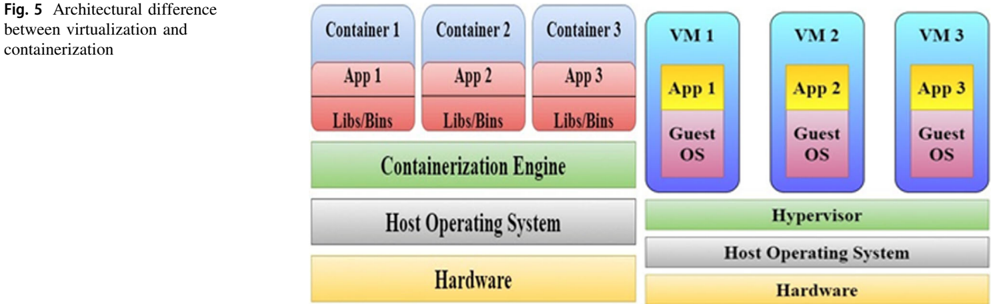
“Container-based systems returned unused memory to the host, resulting in more efficient memory utilisation.”
What the sources say
- Supportedcites [41] 41. Ramchandra Desai, P.A. Survey of Performance Comparison between Virtual Machines and Containers. Int. J. Comput. Sci. Eng. (2016) source
The Memory Performance section (p. of our copy, §B) states directly that 'Container based systems have the ability to return unused memory to the host resulting in better usage,' which is exactly what the citing sentence attributes. The Discussion (§G) reinforces it, crediting container-based virtualization's better CPU and I/O performance to its ability to release unused resources. (LLM, conf=0.90)
plainstates a cause- Asserted: passes — The authors put it forward as true.
- Checkable: passes — It can be checked against evidence.
- Load-bearing: unclear — It is unclear whether the paper’s conclusions depend on it.
- Based: passes — The paper gives a reason why it holds.
- Supported
The cited sources support only part of this claim — read each source’s verdict below.
In the paper
“Virtualization systems suffered from double cache since the host and virtual computer used the same memory blocks.”
What the sources say
- Partly supportedcites [41] 41. Ramchandra Desai, P.A. Survey of Performance Comparison between Virtual Machines and Containers. Int. J. Comput. Sci. Eng. (2016) sourceExperimental — accuracy not yet measured
The Memory Performance section (B) of our copy states the double-cache problem almost verbatim: 'Para virtualization systems suffer from double cache since the same memory blocks are used by the host and the virtual machine.' However, the source restricts this to para-virtualization specifically (the Introduction distinguishes full, partial and para virtualization, and KVM is described as full virtualization), whereas the citing sentence attributes the double-cache drawback to 'virtualization systems' generally. That generalization to all virtualization is the part the source does not support; the mechanism (host and VM sharing the same memory blocks) is confirmed. (LLM, conf=0.72)
plainstates a cause- Asserted: passes — The authors put it forward as true.
- Checkable: passes — It can be checked against evidence.
- Load-bearing: unclear — It is unclear whether the paper’s conclusions depend on it.
- Based: passes — The paper gives a reason why it holds.
- Partly supported
The cited sources support only part of this claim — read each source’s verdict below.
In the paper
“The energy consumption of data centres alone will rise from 200 TWh in 2016 to 2967 TWh in 2030.”
- Also stated in: § 1 Introduction · p. 2 · plain
“The energy consumption of data centres alone will rise from 200 TWh in 2016 to 2967 TWh in 2030 [2].”
What the sources say
- Partly supportedcites [2] 2. Koot, M., Wijnhoven, F.: Usage impact on data center electricity needs: A system dynamic forecasting model. Appl. Energy. 291 , 116798 (2021) sourceExperimental — accuracy not yet measured
The Literature review (section 2) reports the exact 200 TWh-to-2,967 TWh projection, but attributes it to Andrae and Edler and says it was highly uncertain and later revised. The paper’s own conclusion (section 7) instead projects 286 TWh in 2016 rising to 321 TWh in 2030 under unchanged trends, so the unqualified sentence should not be read as this paper’s forecast. (LLM, conf=0.88)
plainstates a cause- Asserted: passes — The authors put it forward as true.
- Checkable: passes — It can be checked against evidence.
- Load-bearing: unclear — It is unclear whether the paper’s conclusions depend on it.
- Based: passes — The paper gives a reason why it holds.
- Also stated in: § 1 Introduction · p. 2 · plain
Every source the paper cites for this claim was checked and supports it.
In the paper
“For achieving energy efficiency especially at the application level, Ho et al. [26] concentrated on batch applications executing on VMs in data centres.”
What the sources say
- Supportedcites [26] 26. Ho, T.T.N., Gribaudo, M., Pernici, B.: Characterizing Energy per Job in Cloud Applications. Electron. 2016. 5 , 90 (2016) source
The Abstract states that the paper focuses on batch applications running on virtual machines in data centers and analyzes their energy consumption and efficiency at the application level. Section 4, “Modeling Application Energy Efficiency,” confirms that focus. The source supports the citing sentence as a description of its research focus, rather than a claim that it achieved a measured efficiency improvement. (LLM, conf=0.94)
plain- Asserted: passes — The authors put it forward as true.
- Checkable: passes — It can be checked against evidence.
- Load-bearing: unclear — It is unclear whether the paper’s conclusions depend on it.
- Based: passes — The paper gives a reason why it holds.
- Supported
In the paper
“Docker, when configured to a maximum latency of 3000ms, can operate up to 21% more services than KVM.”
What the sources say
- Not checked — no full text of the sourcecites [39] 39. Cuadrado-Cordero, I., Orgerie, A.C., Menaud, J.M. Comparative experimental analysis of the quality-of-service and energy-efficiency of VMs and containers' consolidation for cloud applications. 25th International Conference on Software, Telecommunications and Computer Networks, SoftCOM 2017 (2017) https://doi.org/10.23919/SOFTCOM.2017.8115516 source
plainstates a cause- Asserted: passes — The authors put it forward as true.
- Checkable: passes — It can be checked against evidence.
- Load-bearing: unclear — It is unclear whether the paper’s conclusions depend on it.
- Based: passes — The paper gives a reason why it holds.
16 more claims
Create a free account to see all 156 claims and to verify the 9 references still open.
- Probably not a substantial claim. 118
- It may state two separate claims as one. 54
Claims other papers make about this one
Each is checked against this paper’s own text: does it say what the citing paper says it does?
The source backs part of the claim, not all of it — or backs it for a different population, condition or comparison.
In the citing paper
“Studies have shown that green computing initiatives can result in substantial cost savings for organizations through reduced energy bills, lower maintenance costs, and increased operational efficiency (Liu et al ., 2022; Katal et al ., 2023).”
From Advancing green computing: Practices, strategies, and impact in modern software development for environmental sustainability (2024) · cites this paper as Katal et al ., 2023
Experimental — accuracy not yet measuredThe cited source says what the claim attributes to it.
In the citing paper
“In addition to environmental benefits, adopting green computing practices can yield significant economic and societal benefits for organizations and society as a whole.”
From Advancing green computing: Practices, strategies, and impact in modern software development for environmental sustainability (2024) · cites this paper as Katal et al ., 2023
Self-check
Percentages, sums and reported differences re-computed from the paper’s own numbers.
Each contradiction between two passages listed here was confirmed by an independent check.
Rated minor: it would not touch a result — a value no result rests on, a p-value that stays on the same side of the significance level, or a conflict that is clerical, resolved elsewhere in the paper, or outside its own findings.
In the paper
§ Declarations · p. 26
“Ethical approval This paper does not contain any studies with human participants or animals performed by any of the authors.”
§ Declarations · p. 26
“Informed consent Informed consent was obtained from all individual participants included in the study.”
Citations
Cites
Beloglazov, A., & Buyya, R. (2012) · Concurrency and Computation: Practice and Experience · doi:10.1002/cpe.1867 · Cited by 1,864 · cited 1×
“The metric for SLA is calculated as the fraction of the difference among the allocated and the requested CPU for each VM [43].”
Power provisioning for a warehouse-sized computer
Fan, X., Weber, W.-D., & Barroso, L. A. (2007) · Proceedings of the 34th annual international symposium on Computer architecture · doi:10.1145/1250662.1250665 · Cited by 1,797 · cited 1×
“Fan’s [48] energy model of a PM (Eq.”
BackgroundData Center Energy Consumption Modeling: A Survey
Dayarathna, M., Wen, Y., & Fan, R. (2016) · IEEE Communications Surveys & Tutorials · doi:10.1109/comst.2015.2481183 · Cited by 1,165 · cited 1×
“The authors in [14] discussed the different mechanism and architectures for the design of energy efficient data centers.”
Background(2010) · doi:10.5555/1855711.1855728 · Cited by 970
Green Cloud Computing: Balancing Energy in Processing, Storage, and Transport
Baliga, J., Ayre, R. W. A., Hinton, K., & Tucker, R. S. (2011) · Proceedings of the IEEE · doi:10.1109/jproc.2010.2060451 · Cited by 840 · cited 1×
“The authors of [11] presented an analysis on cloud computing energy usage.”
BackgroundA Taxonomy and Survey of Energy-Efficient Data Centers and Cloud Computing Systems
Beloglazov, A., Buyya, R., Lee, Y. C., & Zomaya, A. (2011) · Advances in Computers · doi:10.1016/b978-0-12-385512-1.00003-7 · Cited by 777
Sustainable Computing: Informatics and Systems
Li, K. (2012) · Cited by 486
Post-copy based live virtual machine migration using adaptive pre-paging and dynamic self-ballooning
Hines, M. R., & Gopalan, K. (2009) · Proceedings of the 2009 ACM SIGPLAN/SIGOPS international conference on Virtual execution environments · doi:10.1145/1508293.1508301 · Cited by 409
Usage impact on data center electricity needs: A system dynamic forecasting model
Koot, M., & Wijnhoven, F. (2021) · Applied Energy · doi:10.1016/j.apenergy.2021.116798 · Cited by 403 · cited 1×
“The energy consumption of data centres alone will rise from 200 TWh in 2016 to 2967 TWh in 2030 [2].”
BackgroundUser-priority guided Min-Min scheduling algorithm for load balancing in cloud computing
Chen, H., Wang, F., Helian, N., & Akanmu, G. (2013) · 2013 National Conference on Parallel Computing Technologies (PARCOMPTECH) · doi:10.1109/parcomptech.2013.6621389 · Cited by 287 · cited 9×
“To address the issue of energy usage, the authors of [56] proposed the Energy and Performance-Efficient Task Scheduling Algorithm (EPETTS) in a heterogeneous virtualized cloud.”
MethodInfluential
Research works printed but not linked: 8
- 1. Fiona, B., Ballarat, C.: International Review of Energy Efficiency in Data Centres Acknowledgements. (2021)
- 10. SRCMap: Energy Proportional Storage Using Dynamic Consolidation. https://www.researchgate.net/publication/ 221353706\_SRCMap\_Energy\_Proportional\_Storage\_Using\_ Dynamic\_Consolidation
- 80. Falisha, I.N., Purboyo, T.W., Latuconsina, R.: Experimental model for load balancing in cloud computing using equally spread current execution load algorithm. Int. J. Appl. Eng. Res. 13 , 1134-1138 (2018)
- 81. Patel, D., Rajawat, A. Efficient Throttled Load Balancing Algorithm in Cloud Environment.International Journal of Modern Trends in Engineering and Research (2015)
- 96. Crow Search based Scheduling Algorithm for Load Balancing in Cloud Environment: Int. J. Innovative Technol. Exploring Eng. 8 , 1058-1064 (2019)
- 100. Derdus, K.M., Omwenga, V., Ogao, P. Statistical Techniques for Characterizing Cloud Workloads: A Survey.International Journal of Computer and Information Technology2279-0764(2019)
- 101. Ismaeel, S., Al-Khazraji, A., Miri, A. An efficient workload clustering framework for large-scale data centers. 8th International Conference on Modeling Simulation and Applied
- 102. Yousif, S.A., Al-Dulaimy, A. Clustering Cloud Workload Traces to Improve the Performance of Cloud Data Centers. Proceedings of the World Congress on Engineering (2017)
Cited by
Items 301–400 of 500
Design of Automatic Greener Healthy System For Data Center using Deep Learning
Dhanalakshmi, M., P, V. R. K., Harish, L., Raj, A., & Rath, S. (2024) · International Conference on Computing, Communication and Networking Technologies (ICCCNT) · doi:10.1109/icccnt61001.2024.10724153 · Cited by 2
“Katal et. al in [11] [12] surveys regarding the possibilities of green computing so that the environmental threat can be addressed to some extent.”
BackgroundOptimization of datacenter selection through a genetic algorithm-driven service broker policy
Chowdhury, S., Katangur, A. K., & Sheta, A. F. (2024) · Journal of Cloud Computing Advances Systems and Applications · doi:10.1186/s13677-024-00719-4 · Cited by 1
Integration of Building Information Model and Engineering Cost Calculation Based on Cloud Computing
Liu, X. (2025) · Sustainable civil infrastructures · doi:10.1007/978-3-031-72509-8_30 · Cited by 1
Arivoli, A., Kalaavathi, B., & Chen, J. I. (2025) · Elsevier eBooks · doi:10.1016/b978-0-443-23724-9.00013-x · Cited by 2
Huang, P.-H., Raval, V., Garza-Arias, E., et al. (2024) · IEEE Energy Conversion Congress and Exposition (ECCE) · doi:10.1109/ecce55643.2024.10860797 · Cited by 1
Role of Green IT in Software Development Life Cycle
Ramzan, H. A., Kalsum, T., Ramzan, S., et al. (2025) · International Conference on Emerging Technologies in Electronics, Computing and Communication (ICETECC) · doi:10.1109/icetecc65365.2025.11070248 · Cited by 1
“However now-a-days software has become so powerful that there is a growing need to consider the software influence on hardware regarding energy consumption [4].”
Routing optimization strategies in data center networks: A survey
Xu, B., Liu, Y., Meng, Q., & Wang, B. (2025) · Computer Science Review · doi:10.1016/j.cosrev.2025.100808 · Cited by 2
Costa, G. D., Deutsch-Filippi, A., de Nardin, I. F., et al. (2025) · Cluster Computing · doi:10.1007/s10586-025-05300-5 · Cited by 1
Wang, C., Wen, Z., Zhang, R., et al. (2025) · International Conference on Artificial Intelligence, Virtual Reality and Visualization (AIVRV) · doi:10.1109/aivrv67401.2025.11350369 · Cited by 1
“The multi head mechanism allows the model to learn information in parallel from different representation subspaces [9].”
Quality of Service Aware Task Replanning Algorithm for Web-Service Provisioning in Cloud Environment
(2023) · International journal of intelligent engineering and systems · doi:10.22266/ijies2024.0229.12 · Cited by 1
Energy Optimized Workflow Scheduling in IaaS Cloud: A Flower Pollination based ApproachPreprint
Jaiprakash, S. P., Arya, H. K., Gupta, I., & Badal, T. (2023) · doi:10.22541/au.168594506.69867134/v1
Christogianni, A. (2023) · Advances in healthcare information systems and administration book series · doi:10.4018/978-1-6684-5422-0.ch011 · Cited by 1
Empirical Comparison of Energy Efficiency Between 3-Tier and High-Speed 3-Tier Network Topologies
Alkoshman, M., & Atiewi, S. (2023) · International Journal of Cloud Applications and Computing · doi:10.4018/ijcac.332766
Wadisman, C., Putra, Y. M., & Aldi, F. (2023) · Dedikasi Sains dan Teknologi · doi:10.47709/dst.v3i2.3209 · Cited by 1
“Perangkat lunak termasuk sistem operasi, aplikasi bisnis, perangkat lunak pengembangan, dan lainnya (Katal et al., 2022).”
BackgroundImpacts of energy efficiency in cloud-based database systems
Singh, H. (2022) · International Journal of Cloud Computing and Database Management · doi:10.33545/27075907.2022.v3.i2a.47
Pelatihan Strategi Migrasi Ke Arsitektur PaaS Menggunakan Dewacloud
Darwin, D., Marpaung, S. H., & Riche, R. (2023) · INTEGRITAS Jurnal Pengabdian · doi:10.36841/integritas.v7i2.3208
Safety Performance Evaluation of Data Center Electromechanical Systems with Deep Learning
Yu, G. (2023) · International Conference on Power Communication Computing and Networking Technologies (PCCNT) · doi:10.1145/3630138.3630474
Evaluation of cloud simulators for energy-related applications
Martone, V. E., Mastroianni, M., & Palmieri, F. (2023) · International Conference on Innovation and Intelligence for Informatics, Computing, and Technologies (3ICT) · doi:10.1109/3ict60104.2023.10391467
“So, in this context, data center modeling and forecasting are crucial [3] [4].”
BackgroundCloud Computing Applications in Biomedicine
Namdev, A., Veeraiah, V., Dhamodaran, S., et al. (2024) · Advances in computer and electrical engineering book series · doi:10.4018/979-8-3693-0900-1.ch015
Designing a Cloud Computing System to Improve Energy Consumption in University Buildings
Abdul-Rahaim, L. A., Rasheed, I. M., & Talib, S. H. (2022) · International Conference on Advances in Engineering Science and Technology (AEST) · doi:10.1109/aest55805.2022.10412983
“The developers store the callable images of the related power system research company in the loading systems of the cloud platform[21],[22].”
BackgroundA Novel Approach to Minimize the Energy Consumption Using Task Scheduling in Cloud Data Centers
Praveenchandar, J., Jaganraja, V., Prabhu, V., et al. (2024) · Lecture notes in electrical engineering · doi:10.1007/978-981-99-8661-3_9
Efficient Resource Allocation in Cloud Computing using Adaptive Harris Hawks Approach
Rahman, F., Haval, A. M., & Goyal, A. (2024) · International Conference on Advances in Electrical, Computing, Communication and Sustainable Technologies (ICAECT) · doi:10.1109/icaect60202.2024.10469196
“Using cloud data centres is the most effective approach to deploy virtual machines (VMs) [29].”
BackgroundJin, H.-Z. (2023) · Proceedings of the 2023 4th International Conference on Computer Science and Management Technology · doi:10.1145/3644523.3644532
Olatunde, T. M., Okwandu, A. C., Akande, D. O., & Sikhakhane, Z. Q. (2024) · Open Access Research Journal of Engineering and Technology · doi:10.53022/oarjet.2024.6.2.0019
Server Operational Status Recognition Based on Non-intrusive Energy Monitoring
Zhou, Q., Wang, X., Huang, R., Zhao, S., Luo, M., Zhang, L., & Fan, S. (2023) · Global Reliability and Prognostics and Health Management Conference (PHM) · doi:10.1109/phm-hangzhou58797.2023.10482609
Wang, X., & Yancheng, W. (2023) · International Signal Processing, Communications and Engineering Management Conference (ISPCEM) · doi:10.1109/ispcem60569.2023.00060
“. f x t , Among them, The basic procedure of the PSO algorithm is as follows: Firstly, a set of random solution vectors (called particles) is created, each particle representing a feasible cloud computing task allocation solution [3].”
MethodPitria, N. G. A., Haliah, H., & Nirwana, N. (2024) · Jurnal Teknik Industri Jurnal Hasil Penelitian dan Karya Ilmiah dalam Bidang Teknik Industri · doi:10.24014/jti.v10i1.29307 · Cited by 3
“After supporting the spread of the internet on a large scale, cloud computing has become a paradigm of commercial and economic development since 2006[7].”
BackgroundA machine learningbased framework to Classify Xrays anomality
Saranya, V. S., Kanagajothi, D., Begam, S. R., et al. (2023) · International Conference on Information Management & Machine Intelligence (ICIMMI) · doi:10.1145/3647444.3647862
“Robotics and gaming are only two examples of applications where reinforcement learning has been successful [4-5].”
BackgroundAn overview Scientific Cloud computing Web-based cloud services issues and challenges
Majumder, S., Raju, K. M., Arya, N., et al. (2023) · International Conference on Information Management & Machine Intelligence (ICIMMI) · doi:10.1145/3647444.3652468
“Traditional web hosting models often struggled with the challenges of handling unpredictable web traffic, resulting in server crashes, slow response times, and limited scalability [4].”
BackgroundPandimurugan, V., Balakiruthiga, B., Rajaram, V., et al. (2024) · doi:10.1109/incos59338.2024.10527762
“When we investigate the difficulties faced by data center functions [5] and the quantity of available data that is being monitored, machine learning ways like Q-learning and Deep Q-Networks are well suited for a miscellaneous pall data center terrain.”
MethodEnergy-Efficient Task Scheduling Using a Novel Metaheuristics Approach in Cloud Data Centers
Udatha, C., & Lakshmeeswari, G. (2024) · doi:10.1109/ic-cgu58078.2024.10530794
“The expected surge in energy consumption for data centers is projected to increase significantly, from 200TWh [1] in 2016 to a remarkable 2967 TWh by 2030, representing a staggering 1483.5% increase.”
BackgroundInfluentialA Metaheuristic-Based Scientific Workflow Scheduling in IaaS Cloud
Jaiprakash, S. P., Badal, T., Gupta, I., & Kumar, N. (2024) · International Conference on Cognitive, Green and Ubiquitous Computing (IC-CGU) · doi:10.1109/ic-cgu58078.2024.10530677
“Therefore, makespan can be represented mathematically as: Energy Calculation: The energy calculation in this study employs the MaxUtil model [18].”
MethodCloud Computing and Its Security in Real applications
alfalahi, M., Khodayer, A., Khodayer, O. M., & Alexandra, M. O. (2024) · Al Rafidain Journal of Engineering Sciences · doi:10.61268/gmqmnm28
Enhancement of Data Center Transmission Control Protocol Performance in Network Cloud Environments
Kadhim, Q. K., Al-Tameemi, A., Abdulkader, R. M., & Ahmed, S. T. (2024) · Ingénierie des systèmes d information · doi:10.18280/isi.290329
“…mandate the establishment of geographically distributed data backup and replication sites to ensure integrity, availability and reliability of data; the development of mobile and cloud computing for storing or processing date necessitates efficient data scaling and distribution mechanisms [4].”
BackgroundFuture Changes in Computing Infrastructures as a Result of Advancements in Intelligent Systems
Rasch, F. A. (2024) · Lecture notes in networks and systems · doi:10.1007/978-981-97-3305-7_40 · Cited by 1
EgiCool - IoT Solution for Datacenter Environmental Control and Energy Consumption Monitoring
Gonçalves, V., Daniel, J., Gonçalves, C., Caetano, F., & Silveira, C. (2024) · Advances in intelligent systems and computing · doi:10.1007/978-3-031-66635-3_17
Crypto Deep Ring Topology Firewall in Sensitive Data Transmission and Retrieval in Cloud
Soman, V. K., & Natarajan, V. (2024) · IET Information Security · doi:10.1049/2024/8821086
Green Cloud Computing and Energy Efficiency
Singh, P. K., Misra, S., Mittal, S., et al. (2024) · Advances in business strategy and competitive advantage book series · doi:10.4018/979-8-3693-7658-4.ch011
Adaptive Scheduling Architecture for IoT Environment
Alhameed, M. H. (2024) · International Conference on Machine Learning Technologies (ICMLT) · doi:10.1145/3674029.3674075 · Cited by 1
“Since 2006, cloud computing has gained traction as a commercial and economic paradigm, resulting in becoming the most significant IT technology [25].”
A Systematic Review on Energy-Efficient Techniques for Sustainable Cloud Computing
Radhika, S., Swain, S. K., & Adinarayana, S. (2024) · Lecture notes in networks and systems · doi:10.1007/978-981-97-4895-2_28 · Cited by 1
Cloud Data Centre Optimisation for Various Client Classes
Sameer, S., Dash, B. B., Vijayeeta, P., De, U. C., Mishra, M. R., & Patra, S. S. (2024) · Lecture notes in networks and systems · doi:10.1007/978-3-031-66410-6_37
Analysis of Language Recognition System Based on Cloud Computing Web Platform
Yang, X., Cui, Q., & Jia, Y. (2024) · IEEE World Conference on Applied Intelligence and Computing (AIC) · doi:10.1109/aic61668.2024.10730857
“Katal A [7] studied the energy efficiency of cloud computing data centers: a software technology survey.”
BackgroundMetaverse and ESG Governance: Addressing Social and Environmental Challenges in the Virtual World
Sahdev, S. L., Hassan, A., Krishnan, C., et al. (2024) · Emerald Group Publishing Limited eBooks · doi:10.1108/978-1-83797-524-220241009
Cloud Computing Task Scheduling based on Improved Particle Swarm Algorithm
Liu, X., Yu, P., & Liu, X. (2024) · International Conference on Cyber Security and Information Engineering (ICCSIE) · doi:10.1145/3689236.3691495
“The study simulates CC task scheduling based on Cloudsim simulation platform, which is capable of simulating complex cloud environments on small computing resources, and provides a virtualization engine to complete the creation and management of virtual machine services[7-8] .”
Bajrami, E., Trajkovik, V., Zdravevski, E., et al. (2024) · SSRN Electronic Journal · doi:10.2139/ssrn.5044871
A Two-Phase Fault Tolerant System to Reduce the Service Level Agreement Violations
Pandita, A., Upadhyay, P. K., Mishra, S. K., & Ojha, N. K. (2024) · Journal of Scientific & Industrial Research · doi:10.56042/jsir.v83i12.7568 · Cited by 2
PLC failure program analysis and countermeasure research
Wang, P. (2024) · International Conference on Testing Technology and Automation Engineering (TTAE) · doi:10.1117/12.3055464
“The function meets the requirements, can be executed normally, and the programming is cumbersome, resulting in a waste of CPU resources and slow operation efficiency [14,15].”
Priyadi, P., Migunani, M., & Sasmoko, D. (2024) · Journal of Technology Informatics and Engineering · doi:10.51903/tvkk3t66 · Cited by 15
A Stochastic Hill Climbing Approach for Power Efficiency in Cloud-Based Systems
Singh, R., Suyal, H., Shivhare, A., & Malviya, L. (2024) · International Conference on Cybernation and Computation (CYBERCOM) · doi:10.1109/cybercom63683.2024.10803216 · Cited by 3
“Energy usage is influenced by both hardware efficiency and the resource management system in place, as well as the effectiveness of the applications being used [8].”
McLeod, G., & Reid, H. (2024) · IEEE International Conference on Collaboration and Internet Computing (CIC) · doi:10.1109/cic62241.2024.00024
“Furthermore, the carbon footprint of these data centers is substantial [37]; in 2023, they were estimated to run 24/7 and, unsurprisingly, derive their energy from fossil fuels [38].”
InfluentialLoad Balancing Issues and Challenges in Cloud Environment
Rao, P. H., Rajakumar, P. S., & Geetha, S. (2024) · International Conference on Electronic Systems and Intelligent Computing (ICESIC) · doi:10.1109/icesic61777.2024.10846533
“These are the sorts of questions we should be asking during this migration [8]: 6.”
A Hybrid Peer-to-Peer Data Center Resource Management System
Kaundinya, S. S., Shreyas, S., Dsouza, J. M., Prashanth, K. G., & Auradkar, P. K. (2025) · Lecture notes in networks and systems · doi:10.1007/978-981-97-8336-6_29
ENeRgy SustaInability COding, a Practical Use Case
Lange, B. (2024) · Asia-Pacific Software Engineering Conference (APSEC) · doi:10.1109/apsec65559.2024.00050 · Cited by 1
Optimal CPU Frequency Selection to Minimize the Runtime of Tasks Under Power Capping
Dufossé, F., & Sakellariou, R. (2025) · Lecture notes in computer science · doi:10.1007/978-3-031-81226-2_15
“Both mechanisms have the potential to lead to energy savings, however, there are various aspects and trade-offs that have to be considered for this to happen, also to avoid any adverse effects on performance and system Quality of Service [10,12,20].”
SAT-GAV: A Electricity-Costs Aware Resources Placement Strategy for Data Centers
Feng, H., Xu, X., Chen, L., & Li, J. (2024) · IEEE International Symposium on Parallel and Distributed Processing with Applications (ISPA) · doi:10.1109/ispa63168.2024.00195 · Cited by 1
“This study differs from prior work [11], [12] by focusing on minimizing global electricity costs through task scheduling and virtual machine placement (VMP).”
Integration of Cloud Computing and Traditional Enterprise Management Models
Cao, Z., & Li, W. (2025) · Lecture notes on data engineering and communications technologies · doi:10.1007/978-981-96-0211-7_4
Swarm Intelligence-Based Dynamic Virtual Machine Placement Optimization in Cloud Data Centers
Mishra, S. K., & Awasthi, M. (2024) · doi:10.1109/icac2n63387.2024.10894835
“Comparative analysis of various optimization methods for VM deployment: Different techniques such as linear programming, genetic algorithms, and machine learning have been proposed for VM placement [9].”
Towards the Establishment of a Green Computing Culture in Small and Medium Enterprises
Mohabuth, A. Q. (2025) · Lecture notes in networks and systems · doi:10.1007/978-3-031-84457-7_38
Al-Hayani, A. F., & Al-Zubaidy, L. M. (2025) · AIP conference proceedings · doi:10.1063/5.0258891
Autonomous Network Defense in Cloud Data Center Environments Based on Reinforcement Learning
Zhao, J., Wang, Y., Wang, H., Li, H., & Tang, Y. (2023) · International Conference on Networking Systems of AI (INSAI) · doi:10.1109/insai60116.2023.00027
A Sustainable Storage Compensation Method for Consortium Blockchain-based Computing Power Trading
Zhu, G., Wang, Q., & Gong, B. (2024) · IEEE International Conference on Trust, Security and Privacy in Computing and Communications (TrustCom) · doi:10.1109/trustcom63139.2024.00107
“With the deployment of large-scale computing power centers and continuous improvements in network infrastructure between them, the isolated nature of these centers has been broken [1].”
Cao, Y., Yan, Y., Ma, J., et al. (2025) · SSRN Electronic Journal · doi:10.2139/ssrn.5217712
Energy Aware Heterogeneous Server Consolidation in a Cloud Datacenter
Mault, S. D., & Viswanathan, K. K. (2024) · doi:10.1109/aicecs63354.2024.10957609
“Today, there is an exponential rise in cloud datacenters [1].”
Sila, D. C., Gunawan, A. A. S., Tjong, A. W., et al. (2024) · International Conference on Informatics, Multimedia, Cyber and Information System (ICIMCIS) · doi:10.1109/icimcis63449.2024.10957413
“Additionally, by reducing excess and simplifying support[9], this approach tends to streamline information administration and increase overall efficiency[8].”
Mass Spectrometry in Medical Diagnostics: Principles and Applications
Fiai, K. A., Kadhim, M. M., Abdul-Hussein, L. S., & Ali, M. A. (2025) · Bright Sky Publications eBooks · doi:10.62906/bs.book.339
The Role of Environmental Impact of Mainframe Technology: Sustainability and Green IT Initiatives
Vippala, C. R. (2025) · European Journal of Computer Science and Information Technology · doi:10.37745/ejcsit.2013/vol13n9112
Energy-Efficient Big Data Processing Using Adaptive Resource Scheduling in Cloud Environment
Ponon, N. K. (2025) · International Journal of Science and Research (IJSR) · doi:10.21275/sr25503191344
A Trustworthy Computing Transaction Service System
Li, K., Mu, X., Yu, S., et al. (2025) · Lecture notes in electrical engineering · doi:10.1007/978-981-96-4967-9_128
Han, X. (2025) · doi:10.1109/iscait64916.2025.11010786
“The incorporation of nonlinear activation functions, such as ReLU, enables the network to capture and express nonlinear relationships [8].”
Power-Aware Resource Utilization at Google Cluster Data Centers
Choudhary, A. (2025) · Lecture notes in networks and systems · doi:10.1007/978-981-96-2697-7_9
Energy Efficiency Through Architectural Tactics for Self-Adaptive Cloud Systems
Medeiros, H. (2025) · IEEE/ACM International Conference on Software Engineering: Companion Proceedings (ICSE-Companion) · doi:10.1109/icse-companion66252.2025.00058
“Energy consumption is increasing in cloud computing with the requirement for more powerful hardware [4].”
Artificial Intelligence and Climate Change: A Review of Causes and Opportunities
Watts, M. J., & Bayrak, A. (2025) · Communications in computer and information science · doi:10.1007/978-981-96-7033-8_13 · Cited by 1
A Secure and Trustworthy Cross-Domain Data Aggregation Platform
Li, K., Mu, X., Jia, X., Wei, J., Zhang, R., & Ma, R. Q. (2024) · International Conference on Ubiquitous Computing and Communications (IUCC) · doi:10.1109/iucc65928.2024.00075
“However, despite notable progress in areas like data centers [20], [21] and cloud computing platforms [22], [23], there remain many challenges in data transmission networks [24], [25] and privacy protection mechanisms [26], [27].”
Application of Artificial Intelligence in Power Data Governance and Quality Control
Li, B., Song, J., & Li, H. (2025) · International Conference on Electrical Drives, Power Electronics & Engineering (EDPEE) · doi:10.1109/edpee65754.2025.00028
Zhou, G., Wang, G., Chen, Z., Shi, Z., & Guan, Y. L. (2024) · IEEE International Conference on High Performance Computing and Communications; IEEE International Conference on Smart City; IEEE International Conference on Data Science and Systems (HPCC/SmartCity/DSS) · doi:10.1109/hpcc64274.2024.00041 · Cited by 1
“Large-scale storage systems must handle requests from millions of users worldwide while ensuring efficient and low-latency data services [1], [2].”
BAAM: An Inferential Multi-agent Modeling for Energy-Optimized Job Scheduling in Green Data Centers
Gao, M., Zhao, Y., & Lin, J. (2025) · Communications in computer and information science · doi:10.1007/978-981-96-9986-5_42
Smuts, H. (2025) · Communications in computer and information science · doi:10.1007/978-3-031-95901-1_6
Ahmed, M. H., Alkhazaleh, S., & Elbelkasy, M. S. A. (2025) · Studies in systems, decision and control · doi:10.1007/978-3-031-87550-2_57
Miranda, E. J., & Pereira, M. R. (2025) · doi:10.5753/eradsp.2025.9713
“Segundo [Katal 2023], as principais formas de reduzir o consumo de energia s˜ao: virtualizac¸˜ao de software, virtualizac¸˜ao de sistema operacional, uso de contˆeineres e estrat´egias de gerˆencia de energia.”
Enhanced Osprey Optimization Algorithm for task scheduling in cloud computing environment
Yuan, Y., & Ruan, P. (2025) · Journal of Engineering and Applied Science · doi:10.1186/s44147-025-00715-8
“Both are essential for ensuring reliable performance and optimizing resource utilization [8].”
Greener by Design: Leveraging Knowledge Management Strategies for Organizational Sustainability
Smuts, H. (2025) · Lecture notes in computer science · doi:10.1007/978-3-032-06164-5_23
An optimized hybrid FFOA–DTL framework for energy consumption prediction in cloud computing
Atiyah, H. N., Barzegar, B., Soltanaghaei, M., et al. (2025) · The Journal of Supercomputing · doi:10.1007/s11227-025-07867-7
Amaral, C., Yandri, E., Ludji, O., Sidharta, R., Timba, A., & Ariati, R. (2025) · Heca Journal of Applied Sciences · doi:10.60084/hjas.v3i2.309
Holistic Green Computing: Energy Conservation and Resource Streamlining for Sustainable Data CentersPreprint
Ravi, S., Hemanth, M., Srikanth, K., & Tata, R. K. (2025) · SSRN Electronic Journal · doi:10.2139/ssrn.5574005
GreenK8s: Green-aware Scheduling for Sustainable Kubernetes Cluster Management
Sun, Y., Xu, M., & Toosi, A. N. (2025) · IEEE International Conference on Cluster Computing (CLUSTER) · doi:10.1109/cluster59342.2025.11186459 · Cited by 4
“Data centers, as the core of cloud computing, are major electricity consumers with demand expected to grow from 286 TWh (2016) to 321 TWh by 2030 [1] [2] [3].”
Game Theory-Based Approach for Optimizing Resource Allocation in Cloud Computing *
Chen, Y. (2025) · International Conference on Computer Vision, Application, and Algorithm (CVAA) · doi:10.1109/cvaa66438.2025.11193316
Wang, J., Zhang, J., Liu, H., & Fu, Y. (2025) · Journal of Environmental Management · doi:10.1016/j.jenvman.2025.127686
Reservoir Computing Models for Slow Electronics
Tanaka, G. (2025) · Springer eBooks · doi:10.1007/978-981-96-8383-3_2
Holistic Lookahead Scheduling for Real-time Workflow Applications in Heterogeneous Clouds
Zhu, P., Gao, S., Tang, J., et al. (2025) · doi:10.1109/qrs-c65679.2025.00088
“The power demand of data centers is projected to grow from 200 TWh in 2016 to 2967 TWh by 2030 [8].”
An extended container placement mechanism to enhance the efficiency of cloud systems
Alwabel, A. (2025) · PeerJ Computer Science · doi:10.7717/peerj-cs.3348
Various Automated Collection Technologies of State Grid Cloud Based on High Reliability Environment
Chu, F., Gao, J., & Lu, Y. (2025) · IEEE World Conference on Applied Intelligence and Computing (AIC) · doi:10.1109/aic66080.2025.11212111
“They are suitable for communication between widely distributed and difficult-to-wire terminal devices and master stations [18].”
Compliance and Regulation in Green Software Projects
Evangeline, S. I. (2025) · IGI Global eBooks · doi:10.4018/979-8-3373-4652-6.ch010
Jadon, R., Gollapalli, V. S. T., Srinivasan, K., Budda, R., Chauhan, G. S., & Awotunde, J. B. (2025) · Cluster Computing · doi:10.1007/s10586-025-05809-9 · Cited by 1
Green Energy-Aware Hybrid Service Scheduling Strategy
Xiang, X., & Zhou, J. (2025) · Lecture notes in networks and systems · doi:10.1007/978-981-96-5006-4_109
Alhadid, I. H., Abu-Taieh, E. M. O., Rawajbeh, M. A., Afaneh, S., Daghbosheh, M. E., Alkhawaldeh, R. S., Khwaldeh, S. M., & Alrowwad, A. (2025) · Future Internet · doi:10.3390/fi17110526
“Execution time encompasses time needed for resource allocation, data transfer, computation, and result retrieval, which directly impacts the user experience and application performance [32–35].”
Learning Process Energy Profiles from Node-Level Power Data
Bader, J., Irion, J., Kappel, J., Witzke, J., Fomin, N., Sherifi, D., & Kao, O. (2025) · BigData Congress [Services Society] · doi:10.1109/bigdata66926.2025.11401461 · Cited by 2
“With growing concerns about carbon emissions and rising energy costs [3], improving energy efficiency can relieve the need for expensive infrastructure overhauls or increased energy supply [7], [8].”
Fault Monitoring of Key Business Continuity in Data Centers
Han, L., Zhang, J., Qi, X., et al. (2025) · doi:10.1109/icicnct66124.2025.11232952
“Katal et al. [6] systematically analyzed the application of various software technologies in improving data center energy efficiency, including virtualization technology, load balancing, energy consumption monitoring and management, and discussed the advantages and disadvantages of these…”
Metadata
- Authors
- Katal, A., Dahiya, S., & Choudhury, T.
- Affiliations
- University of Petroleum and Energy Studies (IN)
- Corresponding author
- Katal, Avita
- Choudhury, Tanupriya
- Venue
- Cluster Computing
- Published
- 2022-08-30
- Volume
- 26
- Issue
- 3
- Pages
- 1845-1875
- ISSN
- 1386-7857 (ISSN-L)
- 1573-7543
- PMC
- PMC9424070
- OpenAlex
- W4293770403
- Cited by
- 516
- References
- 126
- Citations by year
- 2026: 110 · 2025: 171 · 2024: 172 · 2023: 55 · 2022: 8
- FWCI
- 100.30
- Type
- journal article
- Language
- en
- Open access
- hybrid
- doi.org
- Licence
- cc-by
- www.springernature.com/gp/researchers/text-and-data-mining (tdm)
- www.springernature.com/gp/researchers/text-and-data-mining (vor)
- Locations
- Cluster Computing (publishedVersion, cc-by)
- PubMed Central (publishedVersion)
- PubMed (publishedVersion)
- Topics
- Physical Sciences › Computer Science › Information Systems › Cloud Computing and Resource Management
- Physical Sciences › Computer Science › Hardware and Architecture › Energy Efficiency in Computing
- Physical Sciences › Engineering › Electrical and Electronic Engineering › Green IT and Sustainability
- Keywords
- energy efficiency, cloud computing, data centers, green data centers, power management, containers, virtualization, operating systems, CO2 emissions, electronic waste, energy consumption
About these checks
Registry, retraction, Cites and statistics results are computed, not judged, with one exception: a printed reference that no index lists is read once by a model before it counts as a citation error. Claims are extracted by a model and kept only when their quote appears verbatim in the text; each cited source is then checked, with a model’s help, for whether it says what the claim relies on. Those verdicts can be wrong — read the claim’s quote and the cited source before relying on one.
The claim verdicts this report counts are experimental: their accuracy is not yet measured.
A language model drew the claims from the paper on 2026-10-10, under version 3 of the claim definition (model deepseek-v4.1-flash, prompt extract-v3).
A second model labelled each claim on 2026-10-10 (model jev-1.13-20260917, definition revision gold-guideline-v0.2).
Cited sources are checked with a language model’s help (qwen3.8-omni-flash and gpt-6-sol).
Statistics and arithmetic are recomputed, not judged.
Confidence bands are shown only for fields calibrated on our annotated test set. None is calibrated yet, so no band is shown.
What counts as a claim ›How we measure confidence ›How we check this ›
Are you an author, or do you see a problem with this page? Request a review
Data sources
Bibliographic data: Semantic Scholar, OpenAlex, Crossref.
Contains information from the Semantic Scholar Academic Graph Datasets, made available under the ODC Attribution License (ODC-BY 1.0).
Semantic Scholar’s data is described in: Kinney, R., et al. (2023). The Semantic Scholar Open Data Platform. arXiv:2301.10140.
