

Energy efficiency in cloud computing data centers: a survey on software technologies
Open accessThe DOI matches its Crossref record; 133 of the 134 references it cites were found in a registry or an index; 14 of the 109 sources its claims cite were checked for support.
Abstract
Cloud computing is a commercial and economic paradigm that has gained traction since 2006 and is presently the most significant technology in IT sector. From the notion of cloud computing to its energy efficiency, cloud has been the subject of much discussion. The energy consumption of data centres alone will rise from 200 TWh in 2016 to 2967 TWh in 2030. The data centres require a lot of power to provide services, which increases CO2 emissions. In this survey paper, software-based technologies that can be used for building green data centers and include power management at individual software level has been discussed. The paper discusses the energy efficiency in containers and problem-solving approaches used for reducing power consumption in data centers. Further, the paper also gives details about the impact of data centers on environment that includes the e-waste and the various standards opted by different countries for giving rating to the data centers. This article goes beyond just demonstrating new green cloud computing possibilities. Instead, it focuses the attention and resources of academia and society on a critical issue: long-term technological advancement. The article covers the new technologies that can be applied at the individual software level that includes techniques applied at virtualization level, operating system level and application level. It clearly defines different measures at each level to reduce the energy consumption that clearly adds value to the current environmental problem of pollution reduction. This article also addresses the difficulties, concerns, and needs that cloud data centres and cloud organisations must grasp, as well as some of the factors and case studies that influence green cloud usage.
Overview
CoChat Summary
TL;DR
This survey reviews software-level technologies for improving energy efficiency in cloud data centers, covering operating system, virtualization, application, container, and data-center-level approaches. It also discusses environmental impact, policies/standards, case studies, and open research challenges for green data centers.
Key findings
- Data center energy consumption is projected to rise from 200 TWh in 2016 to 2967 TWh in 2030; average annual data center PUE was 1.57 in 2021 versus 1.59 in 2020, with an ideal PUE of 1.0.
- Containerization can reduce energy use: Docker configured to a maximum latency of 3000 ms can operate up to 21% more services than KVM while consuming 11.33% less energy than KVM; a container placement method (MLSM) cut energy usage by an average of 12.8% compared with First Fit.
- Other reported software-level gains include VIP reducing power usage and improving CPU-intensive application completion time by up to 27% and 32%, respectively, without breaching latency-sensitive SLAs; a MapReduce configurator improved energy efficiency by up to 50% in two structurally distinct clusters.
- Data centers emitted 3.15 × 10^7 tons CO2-eq in 2018, about 0.5% of total U.S. GHG emissions; many corporate servers are utilized only 10–15%, and 30% are described as “zombies” that are inactive yet still consume electricity.
Methods
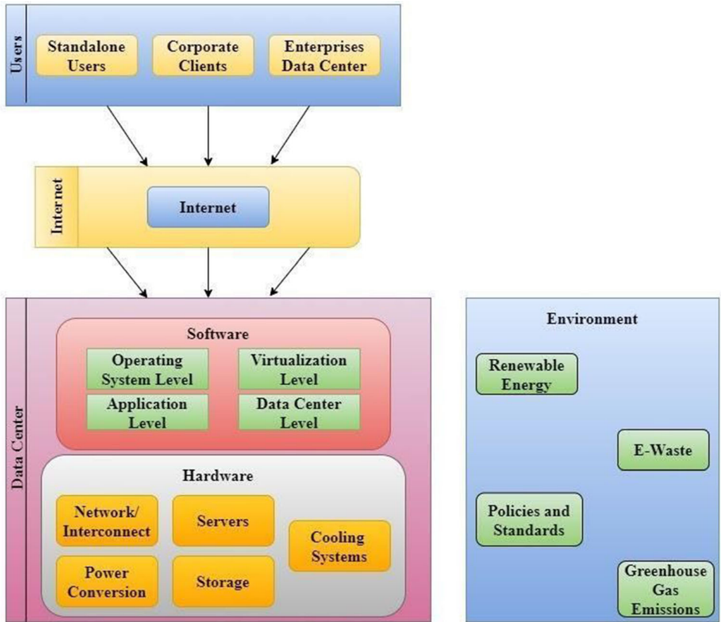
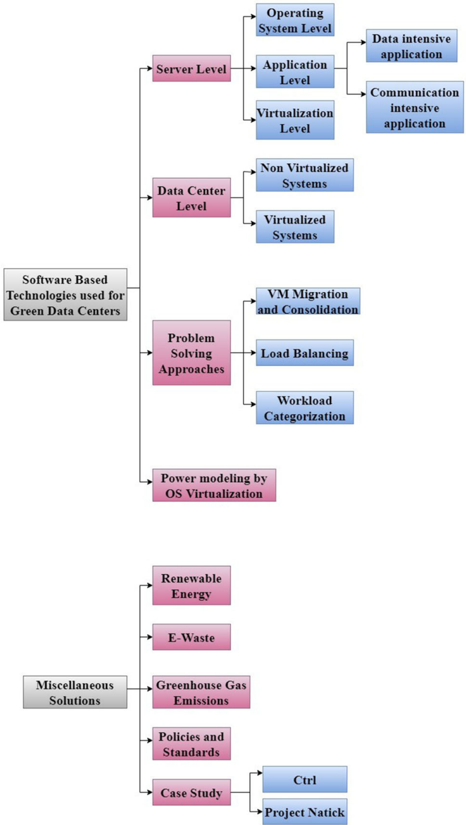
- Design: a survey of software-based energy-efficiency techniques in cloud data centers, organized by OS level, virtualization level, application level, operating-system virtualization/containers, data-center-level dynamic power management, problem-solving approaches, environment, and research challenges.
- Data sources: articles collected from IEEE, Springer, and Elsevier, using Web of Science and Scopus; included publications were peer reviewed, mostly published between 2015 and 2020, and focused on software-based methods for data center energy efficiency.
- Analysis: narrative synthesis and taxonomy; excluded non-peer-reviewed papers, pre-2015 publications, non-English studies, and studies without details on software innovations for data center energy savings. No datasets were generated or analyzed.
Limitations
- The paper does not state its own limitations explicitly; it states that prior survey articles are “either incomplete or having limitations,” especially regarding application, virtualization, and OS layers, data-center-level solutions, containers, environmental factors, and case studies.
- Evident from the text: this is a secondary literature survey with no primary experiments or datasets, and its scope is limited to software technologies, excluding hardware technologies covered in the authors’ earlier work.
- Evident from the text: the literature search is mostly limited to 2015–2020 and excludes non-English and non-peer-reviewed sources, so newer or non-indexed work may be missed.
Model-written summary. Check it against the paper before relying on it.
Integrity signals
Registry
Cites
Statistics
Figures



Verification
Claims the paper makes
13 Valid · 18 Not valid · 71 Not checked · 54 Own results and interpretations
Every source the paper cites for this claim was checked and supports it.
In the paper
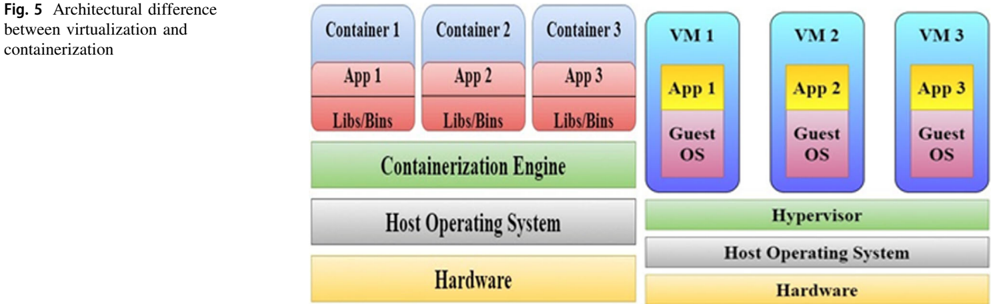
“Container-based systems returned unused memory to the host, resulting in more efficient memory utilisation.”
What the sources say
- Supportedcites [41] 41. Ramchandra Desai, P.A. Survey of Performance Comparison between Virtual Machines and Containers. Int. J. Comput. Sci. Eng. (2016) source
The Memory Performance section (p. of our copy, §B) states directly that 'Container based systems have the ability to return unused memory to the host resulting in better usage,' which is exactly what the citing sentence attributes. The Discussion (§G) reinforces it, crediting container-based virtualization's better CPU and I/O performance to its ability to release unused resources. (LLM, conf=0.90)
plainstates a cause- Asserted: passes — The authors put it forward as true.
- Checkable: passes — It can be checked against evidence.
- Load-bearing: unclear — It is unclear whether the paper’s conclusions depend on it.
- Based: passes — The paper gives a reason why it holds.
- Supported
The cited sources support only part of this claim — read each source’s verdict below.
In the paper
“Virtualization systems suffered from double cache since the host and virtual computer used the same memory blocks.”
What the sources say
- Partly supportedcites [41] 41. Ramchandra Desai, P.A. Survey of Performance Comparison between Virtual Machines and Containers. Int. J. Comput. Sci. Eng. (2016) sourceExperimental — accuracy not yet measured
The Memory Performance section (B) of our copy states the double-cache problem almost verbatim: 'Para virtualization systems suffer from double cache since the same memory blocks are used by the host and the virtual machine.' However, the source restricts this to para-virtualization specifically (the Introduction distinguishes full, partial and para virtualization, and KVM is described as full virtualization), whereas the citing sentence attributes the double-cache drawback to 'virtualization systems' generally. That generalization to all virtualization is the part the source does not support; the mechanism (host and VM sharing the same memory blocks) is confirmed. (LLM, conf=0.72)
plainstates a cause- Asserted: passes — The authors put it forward as true.
- Checkable: passes — It can be checked against evidence.
- Load-bearing: unclear — It is unclear whether the paper’s conclusions depend on it.
- Based: passes — The paper gives a reason why it holds.
- Partly supported
The cited sources support only part of this claim — read each source’s verdict below.
In the paper
“The energy consumption of data centres alone will rise from 200 TWh in 2016 to 2967 TWh in 2030.”
- Also stated in: § 1 Introduction · p. 2 · plain
“The energy consumption of data centres alone will rise from 200 TWh in 2016 to 2967 TWh in 2030 [2].”
What the sources say
- Partly supportedcites [2] 2. Koot, M., Wijnhoven, F.: Usage impact on data center electricity needs: A system dynamic forecasting model. Appl. Energy. 291 , 116798 (2021) sourceExperimental — accuracy not yet measured
The Literature review (section 2) reports the exact 200 TWh-to-2,967 TWh projection, but attributes it to Andrae and Edler and says it was highly uncertain and later revised. The paper’s own conclusion (section 7) instead projects 286 TWh in 2016 rising to 321 TWh in 2030 under unchanged trends, so the unqualified sentence should not be read as this paper’s forecast. (LLM, conf=0.88)
plainstates a cause- Asserted: passes — The authors put it forward as true.
- Checkable: passes — It can be checked against evidence.
- Load-bearing: unclear — It is unclear whether the paper’s conclusions depend on it.
- Based: passes — The paper gives a reason why it holds.
- Also stated in: § 1 Introduction · p. 2 · plain
Every source the paper cites for this claim was checked and supports it.
In the paper
“For achieving energy efficiency especially at the application level, Ho et al. [26] concentrated on batch applications executing on VMs in data centres.”
What the sources say
- Supportedcites [26] 26. Ho, T.T.N., Gribaudo, M., Pernici, B.: Characterizing Energy per Job in Cloud Applications. Electron. 2016. 5 , 90 (2016) source
The Abstract states that the paper focuses on batch applications running on virtual machines in data centers and analyzes their energy consumption and efficiency at the application level. Section 4, “Modeling Application Energy Efficiency,” confirms that focus. The source supports the citing sentence as a description of its research focus, rather than a claim that it achieved a measured efficiency improvement. (LLM, conf=0.94)
plain- Asserted: passes — The authors put it forward as true.
- Checkable: passes — It can be checked against evidence.
- Load-bearing: unclear — It is unclear whether the paper’s conclusions depend on it.
- Based: passes — The paper gives a reason why it holds.
- Supported
In the paper
“Docker, when configured to a maximum latency of 3000ms, can operate up to 21% more services than KVM.”
What the sources say
- Not checked — no full text of the sourcecites [39] 39. Cuadrado-Cordero, I., Orgerie, A.C., Menaud, J.M. Comparative experimental analysis of the quality-of-service and energy-efficiency of VMs and containers' consolidation for cloud applications. 25th International Conference on Software, Telecommunications and Computer Networks, SoftCOM 2017 (2017) https://doi.org/10.23919/SOFTCOM.2017.8115516 source
plainstates a cause- Asserted: passes — The authors put it forward as true.
- Checkable: passes — It can be checked against evidence.
- Load-bearing: unclear — It is unclear whether the paper’s conclusions depend on it.
- Based: passes — The paper gives a reason why it holds.
16 more claims
Create a free account to see all 156 claims and to verify the 9 references still open.
- Probably not a substantial claim. 118
- It may state two separate claims as one. 54
Claims other papers make about this one
Each is checked against this paper’s own text: does it say what the citing paper says it does?
The source backs part of the claim, not all of it — or backs it for a different population, condition or comparison.
In the citing paper
“Studies have shown that green computing initiatives can result in substantial cost savings for organizations through reduced energy bills, lower maintenance costs, and increased operational efficiency (Liu et al ., 2022; Katal et al ., 2023).”
From Advancing green computing: Practices, strategies, and impact in modern software development for environmental sustainability (2024) · cites this paper as Katal et al ., 2023
Experimental — accuracy not yet measuredThe cited source says what the claim attributes to it.
In the citing paper
“In addition to environmental benefits, adopting green computing practices can yield significant economic and societal benefits for organizations and society as a whole.”
From Advancing green computing: Practices, strategies, and impact in modern software development for environmental sustainability (2024) · cites this paper as Katal et al ., 2023
Self-check
Percentages, sums and reported differences re-computed from the paper’s own numbers.
Each contradiction between two passages listed here was confirmed by an independent check.
Rated minor: it would not touch a result — a value no result rests on, a p-value that stays on the same side of the significance level, or a conflict that is clerical, resolved elsewhere in the paper, or outside its own findings.
In the paper
§ Declarations · p. 26
“Ethical approval This paper does not contain any studies with human participants or animals performed by any of the authors.”
§ Declarations · p. 26
“Informed consent Informed consent was obtained from all individual participants included in the study.”
Citations
Cites
Beloglazov, A., & Buyya, R. (2012) · Concurrency and Computation: Practice and Experience · doi:10.1002/cpe.1867 · Cited by 1,864 · cited 1×
“The metric for SLA is calculated as the fraction of the difference among the allocated and the requested CPU for each VM [43].”
Power provisioning for a warehouse-sized computer
Fan, X., Weber, W.-D., & Barroso, L. A. (2007) · Proceedings of the 34th annual international symposium on Computer architecture · doi:10.1145/1250662.1250665 · Cited by 1,797 · cited 1×
“Fan’s [48] energy model of a PM (Eq.”
BackgroundData Center Energy Consumption Modeling: A Survey
Dayarathna, M., Wen, Y., & Fan, R. (2016) · IEEE Communications Surveys & Tutorials · doi:10.1109/comst.2015.2481183 · Cited by 1,165 · cited 1×
“The authors in [14] discussed the different mechanism and architectures for the design of energy efficient data centers.”
Background(2010) · doi:10.5555/1855711.1855728 · Cited by 970
Green Cloud Computing: Balancing Energy in Processing, Storage, and Transport
Baliga, J., Ayre, R. W. A., Hinton, K., & Tucker, R. S. (2011) · Proceedings of the IEEE · doi:10.1109/jproc.2010.2060451 · Cited by 840 · cited 1×
“The authors of [11] presented an analysis on cloud computing energy usage.”
BackgroundA Taxonomy and Survey of Energy-Efficient Data Centers and Cloud Computing Systems
Beloglazov, A., Buyya, R., Lee, Y. C., & Zomaya, A. (2011) · Advances in Computers · doi:10.1016/b978-0-12-385512-1.00003-7 · Cited by 777
Sustainable Computing: Informatics and Systems
Li, K. (2012) · Cited by 486
Post-copy based live virtual machine migration using adaptive pre-paging and dynamic self-ballooning
Hines, M. R., & Gopalan, K. (2009) · Proceedings of the 2009 ACM SIGPLAN/SIGOPS international conference on Virtual execution environments · doi:10.1145/1508293.1508301 · Cited by 409
Usage impact on data center electricity needs: A system dynamic forecasting model
Koot, M., & Wijnhoven, F. (2021) · Applied Energy · doi:10.1016/j.apenergy.2021.116798 · Cited by 403 · cited 1×
“The energy consumption of data centres alone will rise from 200 TWh in 2016 to 2967 TWh in 2030 [2].”
BackgroundUser-priority guided Min-Min scheduling algorithm for load balancing in cloud computing
Chen, H., Wang, F., Helian, N., & Akanmu, G. (2013) · 2013 National Conference on Parallel Computing Technologies (PARCOMPTECH) · doi:10.1109/parcomptech.2013.6621389 · Cited by 287 · cited 9×
“To address the issue of energy usage, the authors of [56] proposed the Energy and Performance-Efficient Task Scheduling Algorithm (EPETTS) in a heterogeneous virtualized cloud.”
MethodInfluential
Research works printed but not linked: 8
- 1. Fiona, B., Ballarat, C.: International Review of Energy Efficiency in Data Centres Acknowledgements. (2021)
- 10. SRCMap: Energy Proportional Storage Using Dynamic Consolidation. https://www.researchgate.net/publication/ 221353706\_SRCMap\_Energy\_Proportional\_Storage\_Using\_ Dynamic\_Consolidation
- 80. Falisha, I.N., Purboyo, T.W., Latuconsina, R.: Experimental model for load balancing in cloud computing using equally spread current execution load algorithm. Int. J. Appl. Eng. Res. 13 , 1134-1138 (2018)
- 81. Patel, D., Rajawat, A. Efficient Throttled Load Balancing Algorithm in Cloud Environment.International Journal of Modern Trends in Engineering and Research (2015)
- 96. Crow Search based Scheduling Algorithm for Load Balancing in Cloud Environment: Int. J. Innovative Technol. Exploring Eng. 8 , 1058-1064 (2019)
- 100. Derdus, K.M., Omwenga, V., Ogao, P. Statistical Techniques for Characterizing Cloud Workloads: A Survey.International Journal of Computer and Information Technology2279-0764(2019)
- 101. Ismaeel, S., Al-Khazraji, A., Miri, A. An efficient workload clustering framework for large-scale data centers. 8th International Conference on Modeling Simulation and Applied
- 102. Yousif, S.A., Al-Dulaimy, A. Clustering Cloud Workload Traces to Improve the Performance of Cloud Data Centers. Proceedings of the World Congress on Engineering (2017)
Cited by
Items 401–500 of 500
Dynamic Load Balancing in Cloud Computing Using Memetic Algorithm for Better Response Time
Krishna Sowjanya, K., Madavi, K. P. B., Khater, G., et al. (2025) · IEEE International Conference on Contemporary Computing and Communications (InC4) · doi:10.1109/inc465408.2025.11256447
“• Data Center Servicing Time: Data center servicing time refers to the time taken by a data center or server to process and fulfill incoming requests or tasks [11].”
Kim, S. H., Kim, D., Yoon, I., Lee, S., Jang, Y., Jeong, L. H., Lee, S., Woo, J., & Lee, J. W. (2025) · Applied Surface Science Advances · doi:10.1016/j.apsadv.2025.100914
Ms Kumudha, M., Suganthi, A., Sinha, A., et al. (2025) · doi:10.1109/icicnis66685.2025.11315798
“The major services provided by cloud computing are as follows: Infrastructure as a Service (IaaS), Platform as a Service (PaaS), Software as a Service (SaaS) [1].”
Software Methods for Energy Consumption Evaluation
Chekushkin, A., Egunov, V. A., Kravets, A. G., et al. (2026) · Studies in systems, decision and control · doi:10.1007/978-3-032-02717-7_8
Tapia, F., Vivas, N., & Iza, C. (2026) · Smart innovation, systems and technologies · doi:10.1007/978-3-032-10947-7_7
DMV-DAB: a multivariate model for cloud resource forecasting
Garg, R., Arora, I., & Gupta, A. (2026) · International Journal of Computers and Applications · doi:10.1080/1206212x.2025.2610313 · Cited by 1
“This ever-expanding ecosystem shows no signs of slowing down, promising even more innovation and trans-formative possibilities for the future [2].”
Scalable Power Management of Data Centers via Proximal Gradient Optimization
Zeger, E., Bambos, N., & Pilancı, M. (2025) · Proceedings of the IEEE Conference on Decision & Control, including the Symposium on Adaptive Processes · doi:10.1109/cdc57313.2025.11312523
“An approach for sustainable computing in data centers [3] is presented.”
InfluentialIncorporating Green Software and Waste Elements for Environmental Sustainability
Ibrahim, S. R. A., Sallehudin, H., & Yahaya, J. B. (2025) · IEEE International Conference on Computing (ICOCO) · doi:10.1109/icoco67189.2025.11334108
“Based on previous studies, green is mostly focused on hardware for energy consumption control, analysis, and monitoring involving important hardware components in the IT aspect [19][20].”
Resilient CloudOps: Smart Scheduling, Secure Scaling, and Self-Healing Systems
Singh, R., & Gilakattula, S. (2025) · IEEE International Conference on Computing, Engineering and Design (ICCED) · doi:10.1109/icced68324.2025.11324689
“It involves installation, administration and upgrading of systems and services in cloud-based environments [1-3].”
Cloudbezogenes IT-Service-Management als Gestaltungshebel für die Twin Transformation
de Souza, L. R. R., Stuber, K., Petrik, D., et al. (2026) · HMD Praxis der Wirtschaftsinformatik · doi:10.1365/s40702-025-01240-1
You, H., Lou, C., Zhou, Y., et al. (2026) · SSRN Electronic Journal · doi:10.2139/ssrn.6106227
Teaching Towards Sustainable Massive IoT: A Review of Energy-Efficient Computing Approaches
Dione, B., & Ikenna, G. T. (2025) · Management Sustainability and Life Span · doi:10.64780/msl.v1i2.180
“…Learning Technologies: These stages utilize AI calculations to personalize learning encounters based on person students qualities [2], shortcomings [3], and learning styles [4], guaranteeing that different learners get custom-made substance and pacing [5], Multimodal Substance Delivery [6],…”
Optimizing Power Efficiency in Cloud Environments for Carrier-Grade Applications
Nakamura, T., Noguchi, H., & KANEKO, M. (2026) · Lecture notes in electrical engineering · doi:10.1007/978-981-95-2820-2_15
Cross-Datacenter RDMA Load Balancing with Dual Control Loop and Probabilistic Rerouting
Yang, S., Wang, N., Liang, G., et al. (2025) · doi:10.1109/wcsp68525.2025.1010479
“As model parameter scales continue to surpass the trillion level, a single data center is increasingly constrained by physical limitations such as power supply, cooling capacity, and space, making it difficult to accommodate the required compute and storage resources [4].”
Mehta, V., & Gupta, A. (2026) · Discover Applied Sciences · doi:10.1007/s42452-026-08395-6
Pan, X., Peng, J., & Wang, J. (2026) · Biomedical Materials & Devices · doi:10.1007/s44174-025-00609-6
Energy efficiency in digital infrastructures: a framework towards a sustainable cloud manufacturing
Simeone, A., Caggiano, A., Melone, M., Muraro, S., Priarone, P. C., & Settineri, L. (2026) · Procedia CIRP · doi:10.1016/j.procir.2026.01.159
Design of Error-Tolerant VLSI Adders and Multipliers for High-Performance Approximate Computing
Velpuri, S., Boddepalli, E., Khan, S. A., et al. (2025) · IEEE Pune Section International Conference (PuneCon) · doi:10.1109/punecon67554.2025.11378650
“The surging development of computing applications in image processing, machine learning, multimedia, and digital signal processing has presented new opportunities to hardware designers who must balance performance, energy efficiency, and accuracy of computation [1].”
A Game Theory-Based Energy-Efficient Resource Allocation Model for Distributed Systems
Mishra, N., Ugli, A. D. A., Thangarasu, N., et al. (2025) · doi:10.1109/ietacs68750.2025.11385739
“Katal et al. developed an RA method that leverages virtualisation techniques, efficiently preventing overload on cloud platforms while minimising the number of required computers [7][16][20].”
A Smart DVFS-Driven Adaptive VLSI Framework for Real-Time IoT Communication Systems
Kumar, C. R., Madeshwaran, S., Sakthivel, N., et al. (2026) · International Conference on Mobile Computing and Sustainable Informatics (ICMCSI) · doi:10.1109/icmcsi67283.2026.11412421
“To meet the growing computing needs of IoT back-end services, researchers have looked at software-level ways to make cloud data centers more energy-efficient, such as resource scheduling and power-aware management [10].”
Kokate, R., Aryal, B., & Park, C. (2026) · SSRN Electronic Journal · doi:10.2139/ssrn.6385901
Hayibo, K. S., & Pearce, J. M. (2026) · SSRN Electronic Journal · doi:10.2139/ssrn.6403959 · Cited by 1
DIGITAL TRANSFORMATION, ECONOMIC PERFORMANCE, AND SUSTAINABILITY WITHIN THE EU
Fildor, D. (2026) · Ekonomska misao i praksa · doi:10.17818/emip/2026/10
Benchmarking AI Inference Efficiency in Public and Private Clouds: An MLPerf-Based Comparative Study
Beitsayadeh, C., & Darbyshire, P. E. (2026) · IEEE Transactions on Cloud Computing · doi:10.1109/tcc.2026.3674888
“This gap is partly due to the absence of accessible, standardized energy telemetry across diverse systems [15].”
Hu, B., & Ji, X. (2025) · doi:10.1109/icdsec67721.2025.11439843
“T t D β The DDQN structure consists of an online network and a target network, and uses independent parameter updates to suppress overestimation bias [12]. is the effective throughput at time ; is the end-to-end delay; is the weighting factor.”
Zhu, D. (2025) · International Conference on Clean Energy Storage and Power Engineering (CESPE) · doi:10.1109/cespe68033.2025.00065
“BMO is inspired by the mating behavior of birds during the breeding season, and simulates the processes of male position updates, female selection, offspring generation, and population evolution to continuously explore the search space and iteratively improve the solution [15].”
A Cloud-Fog Digital Twin Framework for Intelligent and Scalable Structural Health Monitoring
B., V. K., Umamageswaran, J., & Prabu, M. (2026) · International Conference on Intelligent Systems for Communication, IoT and Security (ICISCoIS) · doi:10.1109/iciscois62701.2026.11448025
“Choudhury et al. [15] emphasized energy-2026”
Hagras, T., & El-Sayed, G. A. (2026) · The Journal of Supercomputing · doi:10.1007/s11227-026-08406-8
The optimization and load forecasting of power distribution units in data halls
Abaddi, S. (2026) · Applied Operations and Analytics · doi:10.1080/29966892.2026.2649444 · Cited by 4
Bai, R., & Lin, Z. (2025) · International Conference on Smart Electronics and Communication (ICOSEC) · doi:10.1109/icosec67334.2025.11459628
Exploring thermal management approaches in cloud computing environments
Amahrouch, A., Kafhali, S. E., & Saadi, Y. (2026) · Next Energy · doi:10.1016/j.nxener.2026.100605 · Cited by 1
Physics-Grounded Neuromorphic Computing : From Spiking Neurons to Learning Algorithms
Drouhin, M. (2023) · theses.fr (ABES) · doi:10.70675/f8687efbz8f22z4022zb65czb59d11e98482 · Cited by 1
Yadari, M. E. (2025) · theses.fr (ABES) · doi:10.70675/3354343ez4624z4c15zba3dz2279f99d60d0
Optimisation multi-objectifs du déploiement d'un réseau de capteurs visuels au sein d'un bâtiment
Faga, Y. (2024) · theses.fr (ABES) · doi:10.70675/8ee7c692z29c9z4d90z9698zebb6c203bd96
Reyes, P. E., Fuentes, C. L., & Calderón, J. F. (2025) · IEEE CHILEAN Conference on Electrical, Electronics Engineering, Information and Communication Technologies (CHILECON) · doi:10.1109/chilecon66915.2025.11476529
“As the adoption of cloud services continues to grow exponentially, it is essential to critically examine their environmental impact, specifically their carbon footprint [1].”
A workload-driven and SLA-aware model for relational to document store schema transformation
Soni, K., & Sachdeva, S. (2026) · Knowledge and Information Systems · doi:10.1007/s10115-026-02759-5
Energy-Efficient Task Offloading in Multi-Tenant Edge Clouds
Yalamati, S. (2026) · International Conference on Electronic Systems and Intelligent Computing (ICESIC) · doi:10.1109/icesic67389.2026.11496473
Toward Green Cloud Security: Data-Driven Threat Detection with Computation-Aware Scheduling
Al-Haija, Q. A., & Maleh, Y. (2026) · Springer proceedings in physics · doi:10.1007/978-3-032-19038-3_28
Multi-Objective Carbon-Aware Genetic Scheduling for Green University Data Centers
Chansaeng, T., & Jarupunphol, P. (2026) · IEEE International Conference on Cybernetics and Innovations (ICCI) · doi:10.1109/icci68752.2026.11506465
“VM placement and workload consolidation are the highest-impact energy levers in cloud data centers [13]; ICT emissions are projected to reach 14% of global totals by 2040 [14]; and linear server power models 𝑃 = 𝛼 + 𝛽 · 𝑢 achieve ≤5% RMSE for u > 10% [15].”
Carbon Aware Container Scheduler
Subramanian, A., Shukla, R. M., Krishna, R., Gireesh, N., & Beena, B. M. (2026) · IEEE International Conference for Convergence in Computing Technology (I3CTCON) · doi:10.1109/i3ctcon68242.2026.11508034
Wang, J., & Zhao, K. (2025) · International Conference on Big Data Economy and Information Management (BDEIM) · doi:10.1145/3800000.3800122
“At the same time, it balances the exploration and utilization capabilities of particles through inertia weights, individual learning factors, and social learning factors [8].”
Earth-Based Data Centres vs. Space-Based Data Centres: A holistic review
Bloch, O., Nair, M. H., Rai, M., Schaefer, D., & Reid, S. (2026) · Progress in Aerospace Sciences · doi:10.1016/j.paerosci.2026.101228 · Cited by 6
Liu, Y. W., & Miao, X. (2026) · doi:10.1109/aetcse69203.2026.11503986
“As a key infrastructure in the data age, data centers have become a hot research focus in the management community [4], [5].”
Energy-efficient task management in Apache Spark through data segregation and time-aware scheduling
Basani, M. A. R., & Kaushal, R. K. (2026) · AIP conference proceedings · doi:10.1063/5.0329355
Zhang, J., Guo, C., Zhang, J., Li, Z., Mei, X., Xue, S., Yue, H., & Dai, W. (2026) · Research Square · doi:10.21203/rs.3.rs-9478636/v1
Scalable Assembler System: Optimizing Performance through Unified Data Structures and Procedure
Pan, X., Li, X. C., Zhang, J., et al. (2026) · IEEE International Symposium on Performance Analysis of Systems and Software (ISPASS) · doi:10.1109/ispass69572.2026.00034
“While x86-64 and ARM64 are widely utilized, there is a surge in research focusing on RISC-V and various Domain-Specific Accelerators (DSAs) [1]–[4].”
Alex, M., & Ojo, S. O. (2026) · Computers · doi:10.3390/computers15060339 · Cited by 1
“Methods like dynamic voltage and frequency scaling, virtual machine (VM) consolidation, and workload migration have been extensively researched to diminish energy consumption in distributed systems [24–26].”
GreenCode: A Hybrid Model for Accurate and Efficient Carbon and Cost Prediction
Bhosale, P. R., Gupta, S. S., Ahmad, A. Z., et al. (2026) · International Conference on Computing for Sustainable Global Development · doi:10.23919/indiacom70271.2026.11525639
“This formulation is aligned with cost and performance modeling approaches discussed in sustainable cloud computing research efficiency [15].”
Marwan, M., Temghart, A. A., & Lazaar, M. (2026) · Array · doi:10.1016/j.array.2026.100948
FLoE: Fuzzy-Logic Based Algorithm for Optimizing Energy Utilization in Cloud Datacenters
Tarey, K., Shrivastava, M., Shrivastava, V., & Sheetlani, J. (2025) · International Conference on Emerging Engineering Technologies and Applications (IC-EETA) · doi:10.1109/ic-eeta66496.2025.11548379
Marwan, M., Temghart, A. A., & Lazaar, M. (2026) · Cluster Computing · doi:10.1007/s10586-026-06215-5
“Mbarek Marwan 1 · Abdelkarim Ait Temghart 2 · Mohamed Lazaar 1 operational, and energy costs [3].”
Optimization Model for Home Energy Management Using Demand Response Strategy
Omeje, O. U., Orakwe, G., & Idoko, L. (2026) · International Journal of Energy and Power Engineering · doi:10.11648/j.ijepe.20261503.11
Sulistyo, G. B., Purwati, N., Wahyudi, T., et al. (2026) · Jurnal Riset Informatika · doi:10.34288/jri.v8i3.525
Idle Virtual Machine Management in Cloud Computing: A Bibliometric Survey
Sawant, A., Agarkar, D. P., & Mahalle, P. (2026) · doi:10.1109/icsft67370.2026.11566641
“One, there is no single and clear definition of idle virtual machines, and inactivity is indirectly determined by a trigger of consolidation, utilization levels, or optimization goals (Helali and Omri, 2021; Katal et al., 2023).”
Dynamic Microservice Applications Deployment in Clouds Based on Multi-Tasking Genetic Programming
Fang, Z., Ma, H., Chen, G., & Hartmann, S. (2026) · IEEE Transactions on Cloud Computing · doi:10.1109/tcc.2026.3706413
“Research in [27] shows that the energy consumption of cloud data centers will rise from 200 TWh in 2016 to 2967 TWh in 2030.”
You, H., Lou, C., Zhou, Y., Flynn, D., & Yang, J. S. (2026) · Applied Energy · doi:10.1016/j.apenergy.2026.128298
Green Digital Infrastructure: Insights and Future Pathways
Joseph, D., & James, B. V. (2026) · Springer eBooks · doi:10.1007/978-981-96-1800-2_92-1
Billah, W., Suarez, J., & Wolters, E. A. (2026) · Journal of Science Policy & Governance · doi:10.38126/jspg280101
“PUE is the ratio of a data center's total facility power to the power consumed directly by its IT equipment (Usman et al. 2019; Katal, Dahiya, and Choudhury 2022; Ferreira et al. 2020; Patel et al. 2024).”
Lightweight Energy Consumption Models for High Performance Computing
Muraña, J., & Nesmachnow, S. (2026) · Springer proceedings in energy · doi:10.1007/978-981-95-7302-8_2
Bhati, N., Dhupper, R., Jain, H., Shrivastava, A., & Bhatia, M. (2026) · Circular economy and sustainability · doi:10.1007/978-3-032-22687-7_11 · Cited by 2
Park, E., Yoo, T.-A., Kim, M., & Chung, J. (2026) · SSRN Electronic Journal · doi:10.2139/ssrn.7070558
Park, E., Yoo, T.-A., Kim, M., & Chung, J. (2026) · SSRN Electronic Journal · doi:10.2139/ssrn.7070497
Digital Waste in Fashion: The Overlooked Circularity Challenge
Choudhry, N. A., Badhwar, A., Islam, S., Rodriguez, C. Q., & Panwar, T. (2026) · Circular Economy and Sustainability · doi:10.1007/s43615-026-01059-y
“This includes the energy demand of data centres and cloud computing [ 16], the carbon intensity of blockchain verification systems [ 17 ], the rapid obsolescence of digital platforms [ 18], the proliferation of unused digital assets [ 19], and the growing burden of electronic waste generated by the…”
Green Building Energy-Saving Optimization Algorithm Based on BIM and Machine Learning
Yin, M. (2026) · Procedia Computer Science · doi:10.1016/j.procs.2026.05.208
Evaluation of Microservices Deployments for AI-Driven IoT and Robotic Systems
Branco, D., Martino, B. D., Espósito, A., Venticinque, S., Fernández, A. L., & Porta, V. (2026) · Lecture notes on data engineering and communications technologies · doi:10.1007/978-3-032-30573-2_15
Overview of Digital Architectures to Foster Sustainability
Gaie, C., & Denis, L. (2026) · Advances in sustainability science and technology · doi:10.1007/978-981-92-0458-8_5
A High-Level Conceptual Model for Green Data Centre Development: A Design Science Study
Jäntti, M., Koponen, J., van der Woude, J., & Sipilä, A. (2026) · Lecture notes in business information processing · doi:10.1007/978-3-032-31564-9_4
Fault tolerance optimization using game theory approach in cloud computing
Katyal, A., & Sajwan, M. (2026) · Cluster Computing · doi:10.1007/s10586-026-06280-w
Alanazi, S. (2026) · Journal of Advances in Information Technology · doi:10.12720/jait.17.7.1278-1302
“These facilities, with their continual use of cooling systems, energy to run the equipment, and twenty-four-hour operations, are great consumers of energy all around the world [116].”
Singh, A., Patel, Y. S., Townend, P., & Östberg, P.-O. (2026) · Renewable and Sustainable Energy Reviews · doi:10.1016/j.rser.2026.117261 · Cited by 3
Durgaprasad, S., & Abdul, A. M. (2026) · Science & Technology Asia · doi:10.70730/sta.v31i2.261794
Gupta, S., & Bhushan, K. (2026) · International Conference on Secure Cyber Computing and Communications (ICSCCC) · doi:10.1109/icsccc69031.2026.11600349
“As there is a rapid expansion of cloud computing technology that has made large scale data centers among the most energy consuming facilities in the global ICT ecosystem [6].”
Power-Aware Uncore Frequency Scaling Based on Throughput Saturation
FUJITA, K., Noguchi, H., & KANEKO, M. (2026) · IEEE Transactions on Network and Service Management · doi:10.1109/tnsm.2026.3716735
“Since IT equipment (e.g., servers and switches) and air conditioning account for a large proportion of the power consumed in a data center [2], there have been many studies on server power reduction [3], [4].”
Energie, Nachhaltigkeit und Green Design für Rechenzentren
Katzemich, F., & Aldenhoff, D. (2026) · Springer eBooks · doi:10.1007/978-3-658-51314-6_9
Energiemanagement im Betrieb von Rechenzentren
Katzemich, F., & Aldenhoff, D. (2026) · Springer eBooks · doi:10.1007/978-3-658-51314-6_13
Jain, A. M., Telaprolu, B. S., & Augustine, A. F. (2026) · doi:10.1109/gseact68539.2026.11620583
“Sustainable data engineering techniques are taking on more and more significance as companies move their data and apps into the cloud with the aim of reducing cloud environments’ energy use [1].”
Umbreen, J., Siddiqui, S., Khan, M. M., & Umar, M. (2024) · International Journal of Innovations in Science and Technology · doi:10.33411/ijist/1094
(2026) · Emerald Group Publishing Limited eBooks · doi:10.1108/978-1-80592-054-020261020
A Machine Learning Approach to Estimating Energy Use in Language Model Inference
Sharan, B., & Ghosh, S. (2026) · International Conference on Sustainable Computing and Smart Systems (ICSCSS) · doi:10.1109/icscss69635.2026.11645985
“Research on sustainable and energy-aware cloud computing has grown significantly, establishing the critical need to reduce the environmental footprint of AI workloads [4], [15].”
Sustainable Operation of Data Centers: Energy Consumption Modeling and Reduction Approaches
Korkortsi, W. E., Ofori, C., Addo, P. A., Boateng, M., Darkoh, G. O., & Arkorful, I. P. K. (2026) · International Conference on Cybersecurity, Digital Forensics, and AI Applications (ICCSDFAI) · doi:10.1109/iccsdfai70505.2026.11647900
“Under Storage and Network Power Modeling, this goes beyond the processor, storage models account for the transition states of HDDs and the lower-latency but complex wear-leveling energy of SSDs [22].”
Cognitive IoT architecture for real time spectrum management in 6G networks
Srujana, C., Suresh, R., Mithun, M., et al. (2026) · International Conference on Sustainable Computing and Integrated Communication in Changing Landscape of AI (ICSCAI) · doi:10.1109/icscai68849.2026.11648687
E-HPC: A Unified Model for Carbon Emission Assessment and Reduction in High-Performance Computing
Yang, J., Zhang, J., Li, J., & Kong, C. (2026) · IEEE International Conference on Electronics, Energy Systems and Power Engineering (EESPE) · doi:10.1109/eespe68405.2026.11649401
“According to recent studies, data centers globally account for approximately 1% of the world's electricity usage, with HPC servers contributing significantly to this figure [8].”
Communicative English Skill Development for Enhancing Graduate Employability
Dugaje, M. D., Mitra, R., Zabeen, S. F., et al. (2026) · International Conference on Sustainable Computing and Integrated Communication in Changing Landscape of AI (ICSCAI) · doi:10.1109/icscai68849.2026.11649097
Dynamic Resources Optimization in Cloud Data Centres Using Artificial Intelligence
Hange, J. R., & Bhaladhare, P. R. (2026) · Lecture notes in networks and systems · doi:10.1007/978-3-032-35173-9_17
Navalgund, D. I., Roy, A., Amirovna, A. Z., et al. (2026) · International Conference on Sustainable Computing and Integrated Communication in Changing Landscape of AI (ICSCAI) · doi:10.1109/icscai68849.2026.11649050
Nohong, M., Bakar, N. A., Razak, S. R. A., et al. (2026) · International Journal of Interactive Mobile Technologies (iJIM) · doi:10.3991/ijim.v20i15.62597
Lakhouari, W., Ghmary, M. E., & Echoukairi, H. (2026) · International Journal of Interactive Mobile Technologies (iJIM) · doi:10.3991/ijim.v20i15.61457
dos Santos, I. T. F., Almeida, F. P. D., Rodriguez, L. C., et al. (2026) · doi:10.5753/sbcup.2026.23632
“This leads to a paradigm where, according to [Katal et al. 2023], as the cost is often time-based, the energy cost is frequently neglected.”
Task-Aware Offloading for Heterogeneous DC-HAP Systems
Lu, J., Alkouz, B., Amin, O., et al. (2026) · IEEE ... International Conference on Cloud Computing · doi:10.1109/cloud72782.2026.00051
“We then introduce heterogeneity by setting the servers in the TDCs to [100, 200, 500, 1000] and in the HAPs to [40, 40, 30, 30, 20, 20].”
Tan, B., Ma, H., Mei, Y., et al. (2026) · IEEE International Conference on Web Services (ICWS) · doi:10.1109/icws72778.2026.00103
Sustainable Data Centers and Cloud Computing
Singh, K. R., & Marwaha, L. (2026) · IGI Global eBooks · doi:10.4018/979-8-3373-7431-4.ch010
Performance evaluation of an ORC-based combined cooling system for data center waste heat recovery
Zhang, N., Pan, Y., Tan, S., et al. (2026) · International Journal of Thermal Sciences · doi:10.1016/j.ijthermalsci.2026.111309
Kang, H. S., Yu, H.-J., Kang, H., Jeong, H., Cho, K., & Noh, S.-Y. (2026) · Journal of Cloud Computing Advances Systems and Applications · doi:10.1186/s13677-026-00929-y
“However, the explosive growth of cloud services has led to a surge in data center work-loads and power consumption, driving up operational costs and environmental burdens [1, 2].”
The Intersection of Clean Technology and Information and Communication Technology: A Review
Moletsane, R. I., & Mposula, F. (2026) · Studies in big data · doi:10.1007/978-3-032-20412-7_51
Juibary, M. M., Barzegar, B., Sori, A. A., et al. (2026) · The Journal of Supercomputing · doi:10.1007/s11227-026-08851-5
Goh, K. C., Kurniawan, T. A., Kong, J. W., Casila, E. B., Masrom, M. A. N., Mohamed, S., Sarpin, N., Chong, W. S., Gui, H. C., Toh, T.-C., et al. (2026) · Journal of the Knowledge Economy · doi:10.1007/s13132-026-03461-1
Ahmed, H., Elnairab, N., Amairi, J., et al. (2026) · doi:10.1109/smirc70459.2026.11706668
Ma, Y., Zhang, J., & Zhang, M. (2026) · Environment Development and Sustainability · doi:10.1007/s10668-026-08119-1
REVIEW OF METHODS AND APPROACHES TO THE ANALYSIS OF RADIO FREQUENCY CHANNELS OF FPV DRONES
Vlakh-Vyhrynovska, H., & Vanyuk, V. (2026) · Measuring Equipment and Metrology · doi:10.23939/istcmtm2026.03.158
Metadata
- Authors
- Katal, A., Dahiya, S., & Choudhury, T.
- Affiliations
- University of Petroleum and Energy Studies (IN)
- Corresponding author
- Katal, Avita
- Choudhury, Tanupriya
- Venue
- Cluster Computing
- Published
- 2022-08-30
- Volume
- 26
- Issue
- 3
- Pages
- 1845-1875
- ISSN
- 1386-7857 (ISSN-L)
- 1573-7543
- PMC
- PMC9424070
- OpenAlex
- W4293770403
- Cited by
- 516
- References
- 126
- Citations by year
- 2026: 110 · 2025: 171 · 2024: 172 · 2023: 55 · 2022: 8
- FWCI
- 100.30
- Type
- journal article
- Language
- en
- Open access
- hybrid
- doi.org
- Licence
- cc-by
- www.springernature.com/gp/researchers/text-and-data-mining (tdm)
- www.springernature.com/gp/researchers/text-and-data-mining (vor)
- Locations
- Cluster Computing (publishedVersion, cc-by)
- PubMed Central (publishedVersion)
- PubMed (publishedVersion)
- Topics
- Physical Sciences › Computer Science › Information Systems › Cloud Computing and Resource Management
- Physical Sciences › Computer Science › Hardware and Architecture › Energy Efficiency in Computing
- Physical Sciences › Engineering › Electrical and Electronic Engineering › Green IT and Sustainability
- Keywords
- energy efficiency, cloud computing, data centers, green data centers, power management, containers, virtualization, operating systems, CO2 emissions, electronic waste, energy consumption
About these checks
Registry, retraction, Cites and statistics results are computed, not judged, with one exception: a printed reference that no index lists is read once by a model before it counts as a citation error. Claims are extracted by a model and kept only when their quote appears verbatim in the text; each cited source is then checked, with a model’s help, for whether it says what the claim relies on. Those verdicts can be wrong — read the claim’s quote and the cited source before relying on one.
The claim verdicts this report counts are experimental: their accuracy is not yet measured.
A language model drew the claims from the paper on 2026-10-10, under version 3 of the claim definition (model deepseek-v4.1-flash, prompt extract-v3).
A second model labelled each claim on 2026-10-10 (model jev-1.13-20260917, definition revision gold-guideline-v0.2).
Cited sources are checked with a language model’s help (qwen3.8-omni-flash and gpt-6-sol).
Statistics and arithmetic are recomputed, not judged.
Confidence bands are shown only for fields calibrated on our annotated test set. None is calibrated yet, so no band is shown.
What counts as a claim ›How we measure confidence ›How we check this ›
Are you an author, or do you see a problem with this page? Request a review
Data sources
Bibliographic data: Semantic Scholar, OpenAlex, Crossref.
Contains information from the Semantic Scholar Academic Graph Datasets, made available under the ODC Attribution License (ODC-BY 1.0).
Semantic Scholar’s data is described in: Kinney, R., et al. (2023). The Semantic Scholar Open Data Platform. arXiv:2301.10140.
