

Mainstreaming the Blackpill: Understanding the Incel Community on TikTok
Open accessThe DOI matches its Crossref record; 97 of the 101 references it cites were found in a registry or an index, and 4 are not checked yet; 10 of the 64 sources its claims cite were checked for support.
Abstract
Abstract Incels (involuntary celibates), a subgroup of the so called ‘manosphere,’ have become an increasing security concern for policymakers, researchers, and practitioners following their association with several violent attacks. Once mostly contained on niche men’s forums, redpilled and blackpilled communities and theories are gaining prominence on mainstream social media platforms. However, whilst previous research considerably enhanced our understanding of the incel phenomenon and their presence on Reddit and secluded incel forums, incel’s presence on mainstream social media platforms is understudied and their presence on TikTok is yet to be addressed. The present paper examines the incel subculture on TikTok, through an analysis of incel accounts, videos and their respective comments, to understand the role mainstream social media platforms play in the ‘normiefication’ and normalisation of incel ideology and discourse. The findings suggest that on TikTok the expression of incel ideology takes a covert form, employing emotional appeals and pseudo-science to disseminate common incelosphere tropes. Further, we demonstrate how the process of mainstreaming incel beliefs is facilitated by their interconnectedness with wider sexism and structural misogyny. The harms generating from this association are conducive to the normalisation of blackpill beliefs and the reinforcement of misogyny, sexism and justification of rape culture.
Verified 2026-11-25 · 4 references not checked yet
Overview
CoChat Summary
TL;DR
This qualitative multimodal thematic analysis of two TikTok blackpill accounts, 52 videos, and 1,657 comments finds incel ideology on TikTok is expressed covertly through emotional and pseudo-scientific appeals, adapting blackpill tropes to evade moderation. The authors argue this content is mainstreamed via normiefication and normalisation, converging with wider sexism and rape culture to produce generative harms.
Key findings
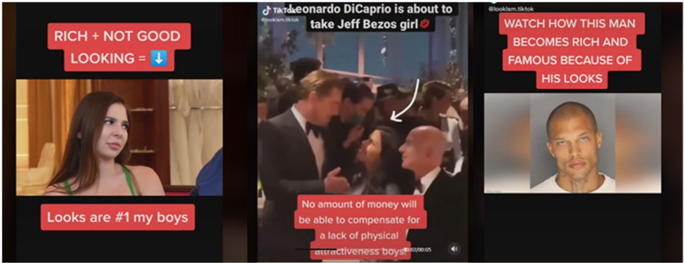
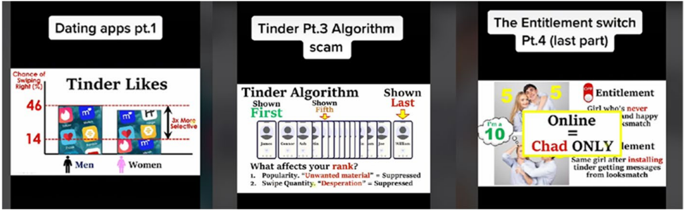
- The two accounts were lookism.tiktok (4,625 followers; 217.6k likes; 45 videos) and redblack_pills (4,330 followers; 51.3k likes; 7 videos). Account1 used repurposed viral clips and emotional appeals; Account2 used an educational/pseudo-scientific format with graphs, surveys, and reposted Wheat Waffles clips.
- Video themes for Account1 (N = 45) included Lookism 38, Women cruel 9, Hybristophilia 7, Women promiscuous 7, Beta bucks 6, Anti-redpill 6, Men’s suffering 6, Sexual assault claims subjective 3, and Advice for unattractive men 3. Account2 (N = 7) included Lookism 5, Exposing dating misconceptions 4, and Beta bucks 1.
- In the comment analysis of six most popular videos, blackpill/incel ideology sub-themes included Lookism 176 and Nihilism 22; redpill sub-themes included attractiveness-confidence/pick-up/improvement 38 and attractiveness-money 52; intersection-with-sexism sub-themes included consent is optional 115, sexual assault claims subjective 49, praising perpetrator/SA endorsement 20, male victimhood injustice/difficulty for unattractive men 102, women hypocritical 110, and women promiscuous 22. Counter-comments included importance of consent 53, disagreement with video content 82, and dismissive comments 44.
- The paper concludes incel content on TikTok is “borderline” (GIFCT, 2022): implicit enough to escape content moderation yet apparent enough to be harmful, normalising blackpill beliefs and reinforcing misogyny, sexism, and justification of rape culture.
Methods
- Qualitative multimodal thematic analysis of two active public TikTok accounts disseminating blackpill content, 52 videos, and 1,657 comments. Accounts were identified by searching incel-adjacent key terms; “incel” and “blackpill” were banned, but “lookism” revealed results. Videos were posted May–September 2022 and collected October 2022; comments were scraped using pyktok.
- Analysis was conducted at account, video, and comment levels, examining visual (pictures, videos, titles, overlay text) and audio (narrations, dialogues, music) content. Thematic analysis (Braun & Clarke, 2021) coded videos and comments into themes and sub-themes; for comments, the three most popular videos from each account (six videos) were selected.
- Ethics approval was received from the institutional faculty ethics committee. Commenter usernames were anonymised and quotations were not presented verbatim; account names were included because creators were treated akin to authors.
Limitations
- Stated: findings are not generalisable to all incel/blackpill expression on TikTok; the qualitative analysis explores blackpill and incel ideology only in the context of the two accounts and their comments. The paper also states only inferences can be made about demographics, with commenters’ profile names and pictures used to assume many were primarily young men.
- Stated: counter-comments were beyond the scope of the article and left for future study; no data were deposited.
- Evident: the sample is very small (two accounts, 52 videos, and six videos for comment analysis) and selected by relevance rather than random sampling, limiting generalisability. Comment counts may also be affected by deleted or removed comments, as the paper notes TikTok displayed higher totals than the visible comments and the reason is unclear.
Model-written summary. Check it against the paper before relying on it.
Integrity signals
Registry
Cites
Statistics
Figures
Verification
Claims the paper makes
8 Valid · 5 Not valid · 40 Not checked · 89 Own results and interpretations
The cited sources support only part of this claim — read each source’s verdict below.
In the paper
“The normalisation of incel misogyny should therefore not be considered in a vacuum but as a reflection of the upsurge in societal misogyny and harmful speech directed towards women (Chadha et al., 2020; Lewis et al., 2017), which goes beyond online men's communities.”
What the sources say
- Partly supportedcites Chadha et al., 2020Experimental — accuracy not yet measured
The feminist-lens section (p. 241) says online harassment reflects systemic sex discrimination and arises from the same misogyny that fuels offline harassment, supporting the point that it extends beyond online men’s communities. The paper does not establish an upsurge in societal misogyny or specifically examine the normalisation of incel misogyny. (LLM, conf=0.84)
- Partly supportedcites Lewis et al., 2017 matched to “Online Abuse of Feminists as An Emerging form of Violence Against Women and Girls” (2016) sourceExperimental — accuracy not yet measured
The Discussion (page not specified) describes online abuse as an extension of offline gendered realities and reports a backlash against women seeking a public voice. It also says online and offline violence against women are normalized in wider discourse. The paper does not establish an upsurge in societal misogyny or specifically examine incel communities, so those parts of the claim are not supported by this source. (LLM, conf=0.84)
plainstates an association- Asserted: passes — The authors put it forward as true.
- Checkable: passes — It can be checked against evidence.
- Load-bearing: passes — The paper’s conclusions depend on it.
- Based: passes — The paper gives a reason why it holds.
- Partly supported
The cited sources support only part of this claim — read each source’s verdict below.
In the paper
“Research examining the language employed on dedicated manosphere and incel forums and subreddits established an increase in violent extremist expressions, including dehumanisation and words depicting violence towards women (Baele et al., 2023; Ribeiro et al., 2020).”
What the sources say
- Not matchedcites Baele et al., 2023
An author–year citation the paper’s reference list doesn’t settle. We don’t search these by name.
- Partly supportedcites Ribeiro et al., 2020 matched to “Do Platform Migrations Compromise Content Moderation? Evidence from r/The_Donald and r/Incels” (2020) sourceExperimental — accuracy not yet measured
The Summary of findings (p. 3) reports increased toxicity, hostility, and othering language after migration for r/The_Donald, while changes for the Incel community tended to be statistically non-significant. The user-level analysis (p. 17) does find increased hostility among matched Incel users, but the paper does not establish an increase in dehumanisation or words depicting violence towards women. (LLM, conf=0.86)
boostedstates a cause- Asserted: passes — The authors put it forward as true.
- Checkable: passes — It can be checked against evidence.
- Load-bearing: unclear — It is unclear whether the paper’s conclusions depend on it.
- Based: passes — The paper gives a reason why it holds.
- Not matched
The cited sources support only part of this claim — read each source’s verdict below.
In the paper
“Instances of routine low-level misogynistic abuse play a significant role in the desensitisation to and normalisation of abuse and harmful speech directed at women (Lewis et al., 2017).”
What the sources say
- Partly supportedcites Lewis et al., 2017 matched to “Online Abuse of Feminists as An Emerging form of Violence Against Women and Girls” (2016) sourceExperimental — accuracy not yet measured
In ‘Impacts of online abuse’ (page unavailable), respondents describe getting used to routine abuse and treating even serious threats as normal, supporting the normalisation part of the claim. But the paper does not establish general desensitisation: its survey data indicate that more frequent abuse generally increased its impact. The Discussion (page unavailable) likewise says frequency exacerbates rather than dilutes harm. (LLM, conf=0.84)
plainstates a cause- Asserted: passes — The authors put it forward as true.
- Checkable: passes — It can be checked against evidence.
- Load-bearing: passes — The paper’s conclusions depend on it.
- Based: passes — The paper gives a reason why it holds.
- Partly supported
A result the paper reports from its own data — it cites no other source for it, so there is none to check. The quote shows it is in the paper.
In the paper
“The findings suggest that on TikTok the expression of incel ideology takes a covert form, employing emotional appeals and pseudo-science to disseminate common incelosphere tropes.”
hedgedstates a cause- Asserted: passes — The authors put it forward as true.
- Checkable: passes — It can be checked against evidence.
- Load-bearing: passes — The paper’s conclusions depend on it.
- Based: passes — The paper gives a reason why it holds.
A result the paper reports from its own data — it cites no other source for it, so there is none to check. The quote shows it is in the paper.
In the paper
“Further, we demonstrate how the process of mainstreaming incel beliefs is facilitated by their interconnectedness with wider sexism and structural misogyny.”
boostedstates a cause- Asserted: passes — The authors put it forward as true.
- Checkable: passes — It can be checked against evidence.
- Load-bearing: passes — The paper’s conclusions depend on it.
- Based: passes — The paper gives a reason why it holds.
50 more claims
Create a free account to see all 142 claims and to verify the 11 references still open.
- Probably not a substantial claim. 36
- It may state two separate claims as one. 69
Claims other papers make about this one
Each is checked against this paper’s own text: does it say what the citing paper says it does?
The source backs part of the claim, not all of it — or backs it for a different population, condition or comparison.
In the citing paper
“In addition to a “red pill” ideology, incels endorse a “black pill” ideology (e.g., Halpin, 2022; Solea & Sugiura, 2023), which asserts that women's mating preferences are biologically fixed, that women pursue the most physically attractive men, and that average-looking and unattractive men have no hope of establishing a heterosexual relationship.”
From Stochastic Gender-Based Violence: How Incels Justify and Encourage Sexualized Violence Against Women (2025) · cites this paper as Solea & Sugiura, 2023
Experimental — accuracy not yet measured
Citations
Cites
Hegemonic Masculinity: Rethinking the Concept
Connell, R. W., & Messerschmidt, J. W. (2005) · Gender & Society · doi:10.1177/0891243205278639 · Cited by 9,367
Thematic Analysis: A Practical Guide
Braun, V., & Clarke, V. (2022) · QMiP Bulletin · doi:10.53841/bpsqmip.2022.1.33.46 · Cited by 5,438
Network Propaganda: Manipulation, Disinformation, and Radicalization in American Politics
Benkler, Y., Faris, R., & Roberts, H. (2018) · doi:10.1093/oso/9780190923624.001.0001 · Cited by 1,504
Sexism and racism: Old-fashioned and modern prejudices
Swim, J. K., Aikin, K. J., Hall, W. S., & Hunter, B. A. (1995) · Journal of Personality and Social Psychology · doi:10.1037/0022-3514.68.2.199 · Cited by 1,486
Massanari, A. (2017) · New Media & Society · doi:10.1177/1461444815608807 · Cited by 1,264
Alphas, Betas, and Incels: Theorizing the Masculinities of the Manosphere
Ging, D. (2019) · Men and Masculinities · doi:10.1177/1097184x17706401 · Cited by 1,245 · cited 9×
“Men’s subordination claim emboldens incel’s victimhood status and serves as a tool to reassert their hegemony in online spaces (Ging, 2017), demonstrating the role hybrid masculine practices play in justifying and enacting their misogyny.”
BackgroundMethodResultInfluentialThe Network Society: A Cross-Cultural Perspective
(2004) · Edward Elgar Publishing eBooks · doi:10.4337/9781845421663 · Cited by 1,144
Hybrid Masculinities: New Directions in the Sociology of Men and Masculinities
Bridges, T., & Pascoe, C. J. (2014) · Sociology Compass · doi:10.1111/soc4.12134 · Cited by 964 · cited 1×
“These dual identities, as oppressed and oppressor, stand in opposition to one another and simultaneously distance incels from and align them with representations of traditional patriarchal masculinity (Bridges & Pascoe, 2014).”
Background#MeToo and the promise and pitfalls of challenging rape culture through digital feminist activism
Mendes, K., Ringrose, J., & Keller, J. (2018) · European Journal of Women's Studies · doi:10.1177/1350506818765318 · Cited by 772
Technology-facilitated sexual violence: A literature review of empirical research
Henry, N., & Powell, A. (2018) · Trauma, Violence, & Abuse · doi:10.1177/1524838016650189 · Cited by 675
Research works printed but not linked: 1
- Chomsky, N. (1997). What makes mainstream media mainstream . Z Magazine, 10 (10), 17-23 https:// choms ky. info/ 199710
Cited by
Haslop, C., Ringrose, J., Cambazoglu, I., & Milne, B. (2024) · Social Media + Society · doi:10.1177/20563051241228811 · Cited by 222
“Following widespread condemnation of his content, in August 2022, Tate’s content on YouTube, TikTok, Facebook, and Instagram was banned (Wilson, 2022).”
BackgroundInfluentialMapping the Neo-Manosphere(s): New Directions for Research
Gerrand, V., Ging, D., Roose, J. M., & Flood, M. (2025) · Men and Masculinities · doi:10.1177/1097184x251350277 · Cited by 82
“Recent studies have found that the incel community has grown in size and reach, and that incel ideologies have become more mainstream, having migrated beyond incel-speci fi c servers and reddit fora to large social media platforms such as Tik Tok (Solea and Sugiura 2023).”
Beyond the Clickbait: Analysing the Masculinist Ideology in Andrew Tate’s Online Written Discourses
Roberts, S., Jones, C. D., Nicholas, L., Wescott, S., & Maloney, M. (2025) · Cultural Sociology · doi:10.1177/17499755241307414 · Cited by 62
“…manosphere-related research, Tate is often referenced in passing when listing examples of ‘manfluencers’ (e.g. Ging et al., 2024; Horeck et al., 2024; Solea and Sugiura, 2023; Thorburn, 2023), and he has been foregrounded (but not the central concern) in important and useful critical scholarly…”
When Help Is Harm: Health, Lookism and Self‐Improvement in the Manosphere
Halpin, M., Gosse, M., Yeo, K., Handlovsky, I., & Maguire, F. (2025) · Sociology of Health & Illness · doi:10.1111/1467-9566.70015 · Cited by 52
Slippages in the Application of Hegemonic Masculinity: A Case Study of Incels
Lucy, S. (2024) · Men and Masculinities · doi:10.1177/1097184x241240415 · Cited by 38
“While most rhetoric is contained in these homosocial spaces, incel community members and ideology also permeate heterosocial mainstream social media platforms and digital spaces, engaging in a variety of deviant behaviors (Brooks, Russo-Batterham, and Blake 2022; Ging 2017; Solea and Sugiura 2023).”
Stochastic Gender-Based Violence: How Incels Justify and Encourage Sexualized Violence Against Women
Gosse, M., Halpin, M., & Maguire, F. (2025) · Violence Against Women · doi:10.1177/10778012241279816 · Cited by 22
“As demonstrated in previous research, online communities can amplify, support, and encourage violence, misogyny, and other forms of hostility (Banet-Weiser & Miltner, 2016; Halpin et al., 2023; Helm et al., 2022; Kim et al., 2023; Marwick & Caplan, 2018; Snaychuk & O ’ Neill, 2020; Tranchese & Sugiura, 2021).”
InfluentialAesthetics of misogyny and the repulsive gaze: Worldview, affect, and ideology in incel imagery
Ging, D., Baele, S. J., Brace, L., Long, S., & Murphy, S. (2025) · New Media & Society · doi:10.1177/14614448251348251 · Cited by 22
“…expand on existing attempts to examine incel (and male supremacist more broadly) visuality (e.g. Anastasi et al., 2024; Baele et al., 2025; Solea and Sugiura, 2023), which either consider very small samples or offer primarily methodological argument, to update and widen the scope of the…”
The Incel Subculture: Drifting In and Out
Andersen, J. C. (2024) · Young · doi:10.1177/11033088241296626 · Cited by 20
“The incel subculture has gained traction on social media platforms by main-streaming incel ideology and discourse (Solea & Sugiura, 2023).”
Toxic Communication on TikTok: Sigma Masculinities and Gendered Disinformation
Tanner, S., & Gillardin, F. (2025) · Social Media + Society · doi:10.1177/20563051251313844 · Cited by 38
“Toxic communication amplifies anxieties and inequalities while banalizing gender-based violence (Banet-Weiser & Miltner, 2016; Solea & Sugiura, 2023).”
The misogynist incel in the news: Analysing representations of gender-based violence in Britain
Meuller, E. B. (2024) · The British Journal of Politics and International Relations · doi:10.1177/13691481231224275 · Cited by 22
“…did not directly self-identify as an incel, the analysis of the videos leaves us with two possible conclusions: first, the ideology of MIs is not necessarily distinct from general misogyny, and/or finally, MI’s ideology is in the process of mainstreaming (Czerwinsky, 2023; Solea and Sugiura, 2023).”
Solea, A. I., & Sugiura, L. (2025) · Crime Media Culture An International Journal · doi:10.1177/17416590251387245 · Cited by 24
Self-citationTo Alleviate Stigma: How Incels Negotiate Masculinity Online
Andersen, J. C. (2024) · Men and Masculinities · doi:10.1177/1097184x241285447 · Cited by 17
“” Additionally, the incel subculture is not con fi ned to obscure online forums but extend to mainstream social media platforms, which is conducive to normalizing and popularizing harmful incel ideology (Solea and Sugiura 2023).”
Rituals of resentment: How dark emotional energy fuels incel identity and solidarity
Kallio, P., & Törnberg, A. (2025) · Acta Sociologica · doi:10.1177/00016993251317963 · Cited by 17
“Solea and Sugiura (2023) highlight a “ normi fi cation ” process where niche incel discourses spread to mainstream platforms like TikTok.”
“RIP TOP G:” Rhetoric, Responses, and Realities Surrounding the Social Media Ban of Andrew Tate
Smith, C. R., Brammer, S. E., Cloudy, J., Essary, C., & Pérez, C. (2025) · Violence Against Women · doi:10.1177/10778012251319308 · Cited by 11
“…the media is still somewhat limited, a surge in popular media coverage and scholarly literature demonstrates a steady increase in understanding the connections and in fl uences between the incel movement and media use (Byerly, 2020; Helm et al., 2024; O ’ Malley & Helm, 2023; Solea & Sugiura, 2023).”
Gender knowledge production and epistemology in the incelosphere
Wilén, E. J., Wemrell, M., & Gunnarsson, L. (2024) · Journal of Gender Studies · doi:10.1080/09589236.2024.2427192 · Cited by 14
Navigating the Manosphere: A Scoping Review of Research on Masculinist and Misogynist Online Spaces
Iñigo, A. (2025) · The Journal of Men s Studies · doi:10.1177/10608265251357869 · Cited by 18
“…terrorist attacks (Baele et al., 2023), academic research has also become interested in the normalization of this ideology through social media (Solea & Sugiura, 2023), policy measures against these communities (Tomkinson et al., 2020), and the de-radicalization processes of incel…”
InfluentialFrom Privilege to Threat: Unraveling Psychological Pathways to the Manosphere
Franklin-Paddock, B., Platow, M. J., & Ryan, M. K. (2025) · Archives of Sexual Behavior · doi:10.1007/s10508-025-03114-5 · Cited by 18
“2 In recent years, the dissemination of manosphere attitudes has extended far beyond dedicated online forums, facilitated by the emergence of online platforms such as YouTube (Reset Australia, 2022) and TikTok (Solea & Sugiura, 2023).”
Exploring incel group dynamics: a computational study of hierarchy and group-boundary policing
Solopova, V., Popa-Wyatt, M., & Berškytė, J. (2025) · Journal of Computational Social Science · doi:10.1007/s42001-024-00357-5 · Cited by 6
“See appendix (Tables 6, 7, and 8).”
The Anti-social Network: The Role of the Social Media Manosphere in Young Men’s Lives
Wilson, M. J., Fisher, K., & Seidler, Z. E. (2024) · Springer eBooks · doi:10.1007/978-3-031-64053-7_6 · Cited by 15
A Lexicon for Studying Radicalization in Incel Communities
Klein, E., & Golbeck, J. (2024) · ACM Web Science Conference (WebSci) · doi:10.1145/3614419.3644005 · Cited by 13
“An incel lexicon is an important resource for scholars and policymakers studying the community, as well as for the broader public as incel terminology and ideology enter mainstream discourse and change over time [21].”
BackgroundReactionary sensemaking: Mapping the micropolitics of online oppositional subcultures
Tuters, M., Devries, M., Venturini, T., de Zeeuw, D., & Willaert, T. (2024) · Big Data & Society · doi:10.1177/20539517241235879 · Cited by 7
“…with the COVID-19 pandemic, the intersection of fi elds that collectively compose ‘ Internet research ’ has become increasingly concerned with the mainstreaming of ‘ fringe ’ online subcultures, who are typically but not always politically aligned with the far-right (e.g., Solea and Sugiura, 2023).”
Deciphering the incels: A scoping review on empirical research
Rodríguez, R., Maldonado, M. Á., & Moyano, M. (2025) · Aggression and Violent Behavior · doi:10.1016/j.avb.2025.102093 · Cited by 10
Hannah, M. (2025) · Journal of Information Technology & Politics · doi:10.1080/19331681.2025.2459808 · Cited by 8
Mainstreaming the manosphere: discourses of contemporary masculinity among Estonian manfluencers
Lott, K., Murumaa-Mengel, M., & Marling, R. (2025) · Humanities and Social Sciences Communications · doi:10.1057/s41599-025-04903-y · Cited by 14
“This is similar to the incel subculture ’ s lookism theory, which claims that men whose looks do not fi t traditional masculine standards fail to fi nd partners (Solea and Sugiura, 2023).”
Addressing Antisocial Behaviour and Toxic Communication Online
Lavorgna, A., & Powell, A. (2023) · European Journal on Criminal Policy and Research · doi:10.1007/s10610-023-09554-w · Cited by 6
“…The Incel Community On TikTok’, Anda Solea and Lisa Sugiura argue that the increasing presence of ‘incel’ (involuntary celibates) discourse in mainstream social media platforms represents a harmful extension of misogyny, sexism and rape culture within broader society (Solea & Sugiura, 2023).”
BackgroundNetflix Dizisi Adolescence (2025) Bağlamında Incel ve Red Pill Akımlarının Kurgusal Temsili
SEVİNDİ, M. İ., & Akalın, A. (2025) · SELÇUK ÜNİVERSİTESİ İLETİŞİM FAKÜLTESİ AKADEMİK DERGİSİ · doi:10.18094/josc.1699644 · Cited by 3
Gram, E. G., Mintzes, B. J., Copp, T., Moynihan, R. N., Brown, A. S., Shih, P., & Nickel, B. (2025) · Social Science & Medicine · doi:10.1016/j.socscimed.2025.118903 · Cited by 12
Techno Music and Luxury Yachts: The Misogynesque Audiovisual Affective Codes of TikTok Manfluencers
Lott, K. (2026) · Social Media + Society · doi:10.1177/20563051261430708 · Cited by 4
“There seems to be a shift in general of the manosphere’s segments moving to mainstream platforms, for example, incels mainstreamed on TikTok (Solea & Sugiura, 2023).”
Resistance through Revision: Reclamation and Ideological Roles for Incels
Berškytė, J., & Popa‐Wyatt, M. (2025) · Topoi · doi:10.1007/s11245-024-10103-1 · Cited by 5
“ArecentstudyintoTikTok,forexample,hassuggestedthatblackpillideasaregettingtractioninmainstream onlinespaces(SoleaandSugiura2023).”
Mainstreaming wanghong in the international press discourse
Abidin, C. (2025) · Celebrity Studies · doi:10.1080/19392397.2025.2521929 · Cited by 5
“Contemporary studies have similarly examined how various discourses – especially those previously perceived to be marginalised or alternative – have been mainstreamed via other media practices like the press and social media (Askanius and Gustafsson 2010, Solea and Sugiura 2023).”
Examining membership across multiple online communities in the “manosphere”
Bocheva, D., Hinds, J. M., Brown, O., & Mayer, L. W. (2025) · New Media & Society · doi:10.1177/14614448251388648 · Cited by 3
“…platforms, with their affordances of anonymity and community building, can foster the development and spread of harmful ideologies that influence individuals’ views and behaviors, potentially increasing the risks of harm (Farrell et al., 2019; Marwick and Caplan, 2018; Solea and Sugiura, 2023).”
Exploring incel discourse through topic modeling: insights from Spanish-speaking contexts on X
Rodríguez, R., Gorostiza-Cerviño, A., Tenorio, E. H., Moyano, M., & Maldonado, M. Á. (2025) · Humanities and Social Sciences Communications · doi:10.1057/s41599-025-06389-0 · Cited by 2
“Atnational level, Spain has established a working group with major tech companies such as Meta, X and TikTok to enhance the detection and removal of online hate speech, coordinated by the Ministry of Inclusion, Social Security, and Migration (2025).”
InfluentialThe straight paradox: gender-wars, morphology, and symbolic self-castration in the manosphere
Sousbois, O. F. (2026) · Journal of Gender Studies · doi:10.1080/09589236.2026.2651828 · Cited by 3
Obreja, D. M. (2026) · Computers in Human Behavior Reports · doi:10.1016/j.chbr.2026.101084 · Cited by 2
Comparing policy responses to incels in Sweden and the UK
Meuller, E. B., & Evans, E. (2024) · Policy & Politics · doi:10.1332/03055736y2024d000000045 · Cited by 6
Hall, M., Lewis, R., & Hearn, J. (2024) · Violence Against Women · doi:10.1177/10778012241292293 · Cited by 7
“Perpetrators 53 DeKeseredy & Schwartz, 2016; Salter, 2018; Solea & Sugiura, 2023; Sugiura, 2021; Zuboff, 2019.”
Button, M., Shepherd, D., & Jung, J. (2025) · Security Journal · doi:10.1057/s41284-025-00476-2 · Cited by 2
“There are also niche areas, such as romance frauds (Cross & Holt 2021), incels (Solea & Sugiura 2023) and selling counterfeit products (Shep-herd et al. 2023).”
Language, ethnicity, race, and racism
Heritage, F. (2023) · Palgrave studies in language, gender and sexuality · doi:10.1007/978-3-031-40184-8_5 · Cited by 1
Taboos as Drivers for Counterculture: Normalizing Misogyny in Incel Communities and Beyond
Popa‐Wyatt, M., & Berškytė, J. (2025) · Journal of Social Philosophy · doi:10.1111/josp.12610 · Cited by 2
Fowler, J. (2025) · Journal of Right-Wing Studies · doi:10.5070/rw3.19457 · Cited by 4
O’Hanlon, R. (2025) · Men and Masculinities · doi:10.1177/1097184x251386553 · Cited by 1
“Furthermore, research that explores the “ generative harms ” resulting from the promotion, ampli fi - cation, and normalization of online misogyny is also needed (Solea and Sugiura 2023).”
Solea, A. I. (2025) · Palgrave hate studies · doi:10.1007/978-3-031-92670-9_3 · Cited by 1
Self-citationRed Pill Leadership Behaviours and Discourse Ethics
Erbil, C., Özbilgin, M. F., & Mergen, A. (2025) · Journal of Business Ethics · doi:10.1007/s10551-025-06194-4 · Cited by 8
“Certain leadership behaviours within the manosphere reinforce the core tenets of Red Pill ideology, providing a sense of purpose and directing followers’ frustrations towards external targets, particularly women and modern societal norms (Solea & Sugiura, 2023; Utterback, 2024).”
Why Incels Capture Attention: A Cultural Attraction Theory Perspective
Costello, W., & Acerbi, A. (2026) · Evolutionary Psychological Science · doi:10.1007/s40806-026-00466-6 · Cited by 1
Neutralization without Drift: The Aesthetics of Cruelty in Hateful Meme Sharing
Moretti, A., & Demant, J. (2026) · The British Journal of Criminology · doi:10.1093/bjc/azaf092 · Cited by 2
A threatened masculinity? The role of status threats and anger in misogynistic engagement
Renström, E. A., & Bäck, H. (2026) · Group Processes & Intergroup Relations · doi:10.1177/13684302261426263 · Cited by 1
“Around the early 2000s, the so-called manosphere, a misogynistic and anti-feminist online milieu said to promote masculinity and men’s rights, moved from the fringes of the internet into the mainstream (Czerwinsky, 2023; Solea & Sugiura, 2023).”
Development and application of the Masculinity Content Classification Framework
Fisher, K., Benakovic, R., O’Gorman, K. M., Rice, S. M., Tierney, K., Miller‐Idriss, C., Dashtgard, P., & Seidler, Z. E. (2026) · Telematics and Informatics · doi:10.1016/j.tele.2026.102402 · Cited by 4
Mobilization of Sexual Violence within the Manosphere: A Mixed Methods Systematic Review
PettyJohn, M. E., Nason, J. A., Cary, K. M., & Graves, C. (2026) · The Journal of Sex Research · doi:10.1080/00224499.2026.2670470 · Cited by 2
Into the void: validating a LIWC-based index of linguistic expressions of nihilism
Champion, A. R. (2026) · Behavioral Sciences of Terrorism and Political Aggression · doi:10.1080/19434472.2026.2713487 · Cited by 1
Language, gender, and (hetero)normativity
Heritage, F. (2023) · Palgrave studies in language, gender and sexuality · doi:10.1007/978-3-031-40184-8_4 · Cited by 1
‘I’d Say That Being Here Has Helped Me’: Attracting New Members to Online Incel Communities
Heritage, F. (2025) · Cambridge University Press eBooks · doi:10.1017/9781009105194.012 · Cited by 1
Exploring Incel Motivations and the Relationship to Gender-Based Violence: A Scoping Review
Fostier, A., Hallett, N., Jordan, G., & Bradbury-Jones, C. (2026) · Trauma, Violence, & Abuse · doi:10.1177/15248380261460442
Sintonizando la manosfera en TikTok España: contenido y discurso de Red Pill Podcast
Navarro-Guinea, A. (2026) · RELIES: Revista del Laboratorio Iberoamericano para el Estudio Sociohistórico de las Sexualidades · doi:10.46661/relies.12943
“…masculinidad y contenidos de tendencia conservadora (Dhoest, 2025); y la rápida difusión de sus discursos antifeministas, diseñada estratégicamente para captar la atención masculina y maximizar la visibilidad mediante el sistema de “Para Ti” (Solea y Sugiura, 2023; Ging et al., 2024; Garzón, 2025).”
Button, M., Shepherd, D., & Jung, J. (2023) · SSRN Electronic Journal · doi:10.2139/ssrn.4581208
Heritage, F. (2023) · Palgrave studies in language, gender and sexuality · doi:10.1007/978-3-031-40184-8_2 · Cited by 1
Conclusions, limitations, and future research
Heritage, F. (2023) · Palgrave studies in language, gender and sexuality · doi:10.1007/978-3-031-40184-8_6 · Cited by 6
Digital Gender-Sexual Violations and Social Marketing Campaigns
Lewis, R., Hearn, J., & Hall, M. (2024) · Springer eBooks · doi:10.1007/978-3-030-95352-2_133-1
Wattis, L. (2024) · Emerald Group Publishing Limited eBooks · doi:10.1108/978-1-80455-360-220241009
Digital Gender-Sexual Violations and Social Marketing Campaigns
Lewis, R., Hearn, J., & Hall, M. (2024) · Springer eBooks · doi:10.1007/978-3-031-56681-3_133
Standing, K., & Porter, J. (2025) · International Conference on Gender Research · doi:10.34190/icgr.8.1.3532 · Cited by 1
Rüdiger, S., & Dayter, D. (2025) · Cambridge University Press eBooks · doi:10.1017/9781009105194.010
Saha, P., Das, M., & Mukherjee, A. (2025) · Synthesis lectures on human language technologies · doi:10.1007/978-3-031-86595-4_2
(2025) · Journal of Right-Wing Studies · doi:10.5070/rw3.48648
Speight, A. (2025) · Open Access Victoria University of Wellington | Te Herenga Waka (Figshare) · doi:10.26686/wgtn.29370641 · Cited by 3
421The negotiation of pronominal address on talk pages of the German, French, and Italian Wikipedia
Flinz, C., Gredel, E., & Herzberg, L. (2025) · De Gruyter eBooks · doi:10.1515/9783111434018-018
4. Kunnskapens kraft og nettets makt. Hvordan forstå gutters holdningsendring til likestilling?
Storstad, O., & Bungum, B. (2025) · Universitetsforlaget eBooks · doi:10.18261/9788215073934-25-04
Walker, R., & Sidebottom, K. (2025) · Gender and Education · doi:10.1080/09540253.2025.2568406 · Cited by 1
Biddlestone, M., Azevedo, F., Chalmers, J., Gronfeldt, B., & Zibell, H. (2025) · Research Square · doi:10.21203/rs.3.rs-7010338/v1
The Current Position of Masculinity for Young Men and Boys
King–Hill, S. (2025) · Palgrave Studies in Risk, Crime and Society · doi:10.1007/978-3-032-03910-1_3
Examining Incel Ideology in Online Spaces with NLP Techniques
Saxena, T., & Shetty, N. P. (2025) · International Conference on Recent Advances in Information Technology for Sustainable Development (ICRAIS) · doi:10.1109/icrais66073.2025.11234701 · Cited by 1
“Solea and Sugiura (2023) [26] analyzed how the incel sub-culture is disseminated on TikTok—examining 52 videos from incel-aligned accounts and over 1,600 comments—and found these communities use emotional appeals and pseudo-scientific framing to communicate the blackpill ideology.”
Being a “Rucel”: How Russian Incels Differ from Their Western Counterparts
Осколков, П., & Kennedy‐Kollar, D. (2025) · Deviant Behavior · doi:10.1080/01639625.2025.2595170
Reconfiguring stoicism: convergence of self-Improvement and masculinity on TikTok
Ağaoğlu, E. (2025) · New Review of Hypermedia and Multimedia · doi:10.1080/13614568.2025.2595322
Framing misogyny in the metaverse: Theorising incel communities in virtual reality (VR) environments
Sugiura, L., & Lakhani, S. (2025) · Crime Media Culture An International Journal · doi:10.1177/17416590251406448
“For them, an attractive man, the “Chad,” cannot rape, as women are presumed to always desire sex with such men (Solea and Sugiura, 2023).”
Self-citationFace to Face with Sex Robots and the Cultures Surrounding Them
Cassar, J. (2026) · Sexuality & Culture · doi:10.1007/s12119-025-10525-y
“The incel subculture revolves around the control of women (Solea & Sugiura, 2023).”
The traditionalist illusion: How conventional gender role items obscure egalitarian views
Steckermeier, L. C., & Hess, S. (2026) · Sociology · doi:10.1177/00380385261432890
Sugiura, L. (2026) · Springer eBooks · doi:10.1007/978-3-031-52643-5_144-1
Self-citationLucy, S., Heritage, F., & Sugiura, L. (2026) · Emerald Group Publishing Limited eBooks · doi:10.1108/978-1-80686-647-220261009
When Single Meets Digital – Comparison of Self-Identified Incels and Other Single Men in PolandPreprint
Walczak, A., & Śmieja, M. (2026) · Research Square · doi:10.21203/rs.3.rs-9622875/v1
Domingues, M., & Magalhães, S. I. (2026) · The Journal of Men s Studies · doi:10.1177/10608265261455489 · Cited by 1
Dordoni, A. (2026) · Emerald Group Publishing Limited eBooks · doi:10.1108/978-1-80592-845-420261010
Incel Identity Development: A Scoping Review of Biopsychosocial Markers
McGilvery, K., & Wiley, K. K. (2026) · Deviant Behavior · doi:10.1080/01639625.2026.2682351
Fluent in Misogyny: Developing a Domain-Specific Dictionary for Dehumanization in Incel Communities
Ochodničanová, E. V., Willkomm, L., Böhmová, E., & de Roos, M. S. (2026) · Deviant Behavior · doi:10.1080/01639625.2026.2699916
Misogynist Incels as a [Digital] Form of Violence Against Women and Girls (VAWG)
Sugiura, L., & Solea, A. I. (2026) · Springer eBooks · doi:10.1007/978-3-031-84546-8_1-1 · Cited by 1
Self-citationHith (2026) · Behavioral Sciences of Terrorism and Political Aggression · doi:10.1080/19434472.2026.2724850
Iterative Netnography and Occurrence for Rapid Research: A Case Study of TikTok
Lutz, N., Hannuksela, K., Hynes, E., Le, C., Lopez, A., & Tomson, D. L. (2026) · Proceedings of the ACM on Human-Computer Interaction · doi:10.1145/3816957
Lucy, S. (2026) · Emerald Group Publishing Limited eBooks · doi:10.1108/978-1-83742-892-220261009
“Your voice says a lot about you”: engendering masculinities in incel communities through voice
Dawson, K., & March, L. (2026) · Feminist Media Studies · doi:10.1080/14680777.2026.2739623
What is the Wall? Negotiating boundaries of women’s desirability in and around the manosphere
Krendel, A., Koller, V., Aiston, J., & McGlashan, M. (2026) · Journal of Gender Studies · doi:10.1080/09589236.2026.2736780
Alphasphere’s Promise: The Construction of Alpha Masculinity on Turkish TikTok
Demir, Y. (2026) · The Journal of Men s Studies · doi:10.1177/10608265261496532
Metadata
- Authors
- Solea, A. I., & Sugiura, L.
- Affiliations
- University of Portsmouth (GB)
- Corresponding author
- Solea, Anda Iulia
- Venue
- European Journal on Criminal Policy and Research
- Published
- 2023-08-12
- Volume
- 29
- Issue
- 3
- Pages
- 311-336
- ISSN
- 0928-1371 (ISSN-L)
- 1572-9869
- OpenAlex
- W4385782608
- Semantic Scholar
- 26c154ac98b220fc1e4530c3f12fe46c80b585f3
- Cited by
- 105
- References
- 87
- Citations by year
- 2026: 42 · 2025: 42 · 2024: 16 · 2023: 5
- FWCI
- 43.81
- Type
- journal article
- Language
- en
- Open access
- hybrid
- doi.org
- Licence
- cc-by
- creativecommons.org/licenses/by/4.0 (tdm)
- creativecommons.org/licenses/by/4.0 (vor)
- Locations
- European Journal on Criminal Policy and Research (publishedVersion, cc-by)
- Topics
- Social Sciences › Gender Studies › Gender, Feminism, and Media
- Social Sciences › Political Science and International Relations › Populism, Right-Wing Movements
- Social Sciences › Sociology and Political Science › Crime, Deviance, and Social Control
- Keywords
- incels, manosphere, TikTok, mainstreaming, incel ideology, misogyny, sexism, rape culture, pseudoscience, emotional appeal, online communities, violent extremism
About these checks
Registry, retraction, Cites and statistics results are computed, not judged, with one exception: a printed reference that no index lists is read once by a model before it counts as a citation error. Claims are extracted by a model and kept only when their quote appears verbatim in the text; each cited source is then checked, with a model’s help, for whether it says what the claim relies on. Those verdicts can be wrong — read the claim’s quote and the cited source before relying on one.
The claim verdicts this report counts are experimental: their accuracy is not yet measured.
A language model drew the claims from the paper on 2026-10-10, under version 3 of the claim definition (model deepseek-v4.1-flash, prompt extract-v3).
A second model labelled each claim on 2026-10-10 (model jev-1.13-20260917, definition revision gold-guideline-v0.2).
Cited sources are checked with a language model’s help (gpt-6-sol).
Statistics and arithmetic are recomputed, not judged.
Confidence bands are shown only for fields calibrated on our annotated test set. None is calibrated yet, so no band is shown.
What counts as a claim ›How we measure confidence ›How we check this ›
Are you an author, or do you see a problem with this page? Request a review
Data sources
Bibliographic data: Semantic Scholar, OpenAlex, Crossref.
Contains information from the Semantic Scholar Academic Graph Datasets, made available under the ODC Attribution License (ODC-BY 1.0).
Semantic Scholar’s data is described in: Kinney, R., et al. (2023). The Semantic Scholar Open Data Platform. arXiv:2301.10140.
