

Mainstreaming the Blackpill: Understanding the Incel Community on TikTok
Open accessThe DOI matches its Crossref record; 97 of the 101 references it cites were found in a registry or an index, and 4 are not checked yet; 10 of the 64 sources its claims cite were checked for support.
Abstract
Abstract Incels (involuntary celibates), a subgroup of the so called ‘manosphere,’ have become an increasing security concern for policymakers, researchers, and practitioners following their association with several violent attacks. Once mostly contained on niche men’s forums, redpilled and blackpilled communities and theories are gaining prominence on mainstream social media platforms. However, whilst previous research considerably enhanced our understanding of the incel phenomenon and their presence on Reddit and secluded incel forums, incel’s presence on mainstream social media platforms is understudied and their presence on TikTok is yet to be addressed. The present paper examines the incel subculture on TikTok, through an analysis of incel accounts, videos and their respective comments, to understand the role mainstream social media platforms play in the ‘normiefication’ and normalisation of incel ideology and discourse. The findings suggest that on TikTok the expression of incel ideology takes a covert form, employing emotional appeals and pseudo-science to disseminate common incelosphere tropes. Further, we demonstrate how the process of mainstreaming incel beliefs is facilitated by their interconnectedness with wider sexism and structural misogyny. The harms generating from this association are conducive to the normalisation of blackpill beliefs and the reinforcement of misogyny, sexism and justification of rape culture.
Verified 2026-11-25 · 4 references not checked yet
Overview
CoChat Summary
TL;DR
This qualitative multimodal thematic analysis of two TikTok blackpill accounts, 52 videos, and 1,657 comments finds incel ideology on TikTok is expressed covertly through emotional and pseudo-scientific appeals, adapting blackpill tropes to evade moderation. The authors argue this content is mainstreamed via normiefication and normalisation, converging with wider sexism and rape culture to produce generative harms.
Key findings
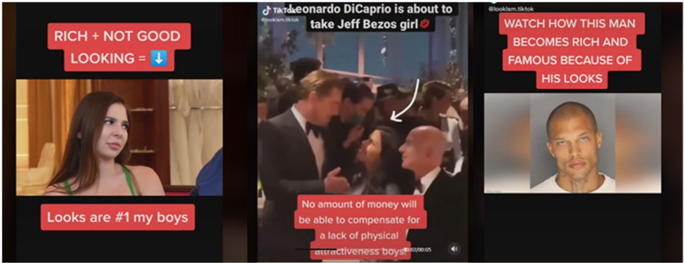
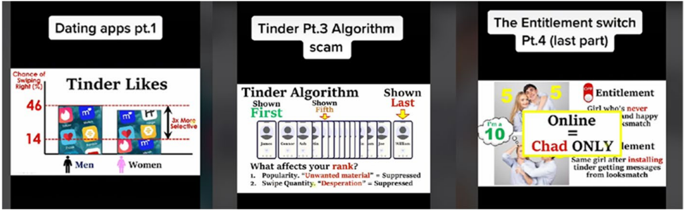
- The two accounts were lookism.tiktok (4,625 followers; 217.6k likes; 45 videos) and redblack_pills (4,330 followers; 51.3k likes; 7 videos). Account1 used repurposed viral clips and emotional appeals; Account2 used an educational/pseudo-scientific format with graphs, surveys, and reposted Wheat Waffles clips.
- Video themes for Account1 (N = 45) included Lookism 38, Women cruel 9, Hybristophilia 7, Women promiscuous 7, Beta bucks 6, Anti-redpill 6, Men’s suffering 6, Sexual assault claims subjective 3, and Advice for unattractive men 3. Account2 (N = 7) included Lookism 5, Exposing dating misconceptions 4, and Beta bucks 1.
- In the comment analysis of six most popular videos, blackpill/incel ideology sub-themes included Lookism 176 and Nihilism 22; redpill sub-themes included attractiveness-confidence/pick-up/improvement 38 and attractiveness-money 52; intersection-with-sexism sub-themes included consent is optional 115, sexual assault claims subjective 49, praising perpetrator/SA endorsement 20, male victimhood injustice/difficulty for unattractive men 102, women hypocritical 110, and women promiscuous 22. Counter-comments included importance of consent 53, disagreement with video content 82, and dismissive comments 44.
- The paper concludes incel content on TikTok is “borderline” (GIFCT, 2022): implicit enough to escape content moderation yet apparent enough to be harmful, normalising blackpill beliefs and reinforcing misogyny, sexism, and justification of rape culture.
Methods
- Qualitative multimodal thematic analysis of two active public TikTok accounts disseminating blackpill content, 52 videos, and 1,657 comments. Accounts were identified by searching incel-adjacent key terms; “incel” and “blackpill” were banned, but “lookism” revealed results. Videos were posted May–September 2022 and collected October 2022; comments were scraped using pyktok.
- Analysis was conducted at account, video, and comment levels, examining visual (pictures, videos, titles, overlay text) and audio (narrations, dialogues, music) content. Thematic analysis (Braun & Clarke, 2021) coded videos and comments into themes and sub-themes; for comments, the three most popular videos from each account (six videos) were selected.
- Ethics approval was received from the institutional faculty ethics committee. Commenter usernames were anonymised and quotations were not presented verbatim; account names were included because creators were treated akin to authors.
Limitations
- Stated: findings are not generalisable to all incel/blackpill expression on TikTok; the qualitative analysis explores blackpill and incel ideology only in the context of the two accounts and their comments. The paper also states only inferences can be made about demographics, with commenters’ profile names and pictures used to assume many were primarily young men.
- Stated: counter-comments were beyond the scope of the article and left for future study; no data were deposited.
- Evident: the sample is very small (two accounts, 52 videos, and six videos for comment analysis) and selected by relevance rather than random sampling, limiting generalisability. Comment counts may also be affected by deleted or removed comments, as the paper notes TikTok displayed higher totals than the visible comments and the reason is unclear.
Model-written summary. Check it against the paper before relying on it.
Integrity signals
Registry
Cites
Statistics
Figures
Verification
Claims the paper makes
8 Valid · 5 Not valid · 40 Not checked · 89 Own results and interpretations
The cited sources support only part of this claim — read each source’s verdict below.
In the paper
“The normalisation of incel misogyny should therefore not be considered in a vacuum but as a reflection of the upsurge in societal misogyny and harmful speech directed towards women (Chadha et al., 2020; Lewis et al., 2017), which goes beyond online men's communities.”
What the sources say
- Partly supportedcites Chadha et al., 2020Experimental — accuracy not yet measured
The feminist-lens section (p. 241) says online harassment reflects systemic sex discrimination and arises from the same misogyny that fuels offline harassment, supporting the point that it extends beyond online men’s communities. The paper does not establish an upsurge in societal misogyny or specifically examine the normalisation of incel misogyny. (LLM, conf=0.84)
- Partly supportedcites Lewis et al., 2017 matched to “Online Abuse of Feminists as An Emerging form of Violence Against Women and Girls” (2016) sourceExperimental — accuracy not yet measured
The Discussion (page not specified) describes online abuse as an extension of offline gendered realities and reports a backlash against women seeking a public voice. It also says online and offline violence against women are normalized in wider discourse. The paper does not establish an upsurge in societal misogyny or specifically examine incel communities, so those parts of the claim are not supported by this source. (LLM, conf=0.84)
plainstates an association- Asserted: passes — The authors put it forward as true.
- Checkable: passes — It can be checked against evidence.
- Load-bearing: passes — The paper’s conclusions depend on it.
- Based: passes — The paper gives a reason why it holds.
- Partly supported
The cited sources support only part of this claim — read each source’s verdict below.
In the paper
“Research examining the language employed on dedicated manosphere and incel forums and subreddits established an increase in violent extremist expressions, including dehumanisation and words depicting violence towards women (Baele et al., 2023; Ribeiro et al., 2020).”
What the sources say
- Not matchedcites Baele et al., 2023
An author–year citation the paper’s reference list doesn’t settle. We don’t search these by name.
- Partly supportedcites Ribeiro et al., 2020 matched to “Do Platform Migrations Compromise Content Moderation? Evidence from r/The_Donald and r/Incels” (2020) sourceExperimental — accuracy not yet measured
The Summary of findings (p. 3) reports increased toxicity, hostility, and othering language after migration for r/The_Donald, while changes for the Incel community tended to be statistically non-significant. The user-level analysis (p. 17) does find increased hostility among matched Incel users, but the paper does not establish an increase in dehumanisation or words depicting violence towards women. (LLM, conf=0.86)
boostedstates a cause- Asserted: passes — The authors put it forward as true.
- Checkable: passes — It can be checked against evidence.
- Load-bearing: unclear — It is unclear whether the paper’s conclusions depend on it.
- Based: passes — The paper gives a reason why it holds.
- Not matched
The cited sources support only part of this claim — read each source’s verdict below.
In the paper
“Instances of routine low-level misogynistic abuse play a significant role in the desensitisation to and normalisation of abuse and harmful speech directed at women (Lewis et al., 2017).”
What the sources say
- Partly supportedcites Lewis et al., 2017 matched to “Online Abuse of Feminists as An Emerging form of Violence Against Women and Girls” (2016) sourceExperimental — accuracy not yet measured
In ‘Impacts of online abuse’ (page unavailable), respondents describe getting used to routine abuse and treating even serious threats as normal, supporting the normalisation part of the claim. But the paper does not establish general desensitisation: its survey data indicate that more frequent abuse generally increased its impact. The Discussion (page unavailable) likewise says frequency exacerbates rather than dilutes harm. (LLM, conf=0.84)
plainstates a cause- Asserted: passes — The authors put it forward as true.
- Checkable: passes — It can be checked against evidence.
- Load-bearing: passes — The paper’s conclusions depend on it.
- Based: passes — The paper gives a reason why it holds.
- Partly supported
A result the paper reports from its own data — it cites no other source for it, so there is none to check. The quote shows it is in the paper.
In the paper
“The findings suggest that on TikTok the expression of incel ideology takes a covert form, employing emotional appeals and pseudo-science to disseminate common incelosphere tropes.”
hedgedstates a cause- Asserted: passes — The authors put it forward as true.
- Checkable: passes — It can be checked against evidence.
- Load-bearing: passes — The paper’s conclusions depend on it.
- Based: passes — The paper gives a reason why it holds.
A result the paper reports from its own data — it cites no other source for it, so there is none to check. The quote shows it is in the paper.
In the paper
“Further, we demonstrate how the process of mainstreaming incel beliefs is facilitated by their interconnectedness with wider sexism and structural misogyny.”
boostedstates a cause- Asserted: passes — The authors put it forward as true.
- Checkable: passes — It can be checked against evidence.
- Load-bearing: passes — The paper’s conclusions depend on it.
- Based: passes — The paper gives a reason why it holds.
50 more claims
Create a free account to see all 142 claims and to verify the 10 references still open.
- Probably not a substantial claim. 36
- It may state two separate claims as one. 69
Claims other papers make about this one
Each is checked against this paper’s own text: does it say what the citing paper says it does?
The source backs part of the claim, not all of it — or backs it for a different population, condition or comparison.
In the citing paper
“In addition to a “red pill” ideology, incels endorse a “black pill” ideology (e.g., Halpin, 2022; Solea & Sugiura, 2023), which asserts that women's mating preferences are biologically fixed, that women pursue the most physically attractive men, and that average-looking and unattractive men have no hope of establishing a heterosexual relationship.”
From Stochastic Gender-Based Violence: How Incels Justify and Encourage Sexualized Violence Against Women (2025) · cites this paper as Solea & Sugiura, 2023
Experimental — accuracy not yet measured
Citations
Cites
Hegemonic Masculinity: Rethinking the Concept
Connell, R. W., & Messerschmidt, J. W. (2005) · Gender & Society · doi:10.1177/0891243205278639 · Cited by 9,367
Thematic Analysis: A Practical Guide
Braun, V., & Clarke, V. (2022) · QMiP Bulletin · doi:10.53841/bpsqmip.2022.1.33.46 · Cited by 5,438
Network Propaganda: Manipulation, Disinformation, and Radicalization in American Politics
Benkler, Y., Faris, R., & Roberts, H. (2018) · doi:10.1093/oso/9780190923624.001.0001 · Cited by 1,504
Sexism and racism: Old-fashioned and modern prejudices
Swim, J. K., Aikin, K. J., Hall, W. S., & Hunter, B. A. (1995) · Journal of Personality and Social Psychology · doi:10.1037/0022-3514.68.2.199 · Cited by 1,486
Massanari, A. (2017) · New Media & Society · doi:10.1177/1461444815608807 · Cited by 1,264
Alphas, Betas, and Incels: Theorizing the Masculinities of the Manosphere
Ging, D. (2019) · Men and Masculinities · doi:10.1177/1097184x17706401 · Cited by 1,245 · cited 9×
“Men’s subordination claim emboldens incel’s victimhood status and serves as a tool to reassert their hegemony in online spaces (Ging, 2017), demonstrating the role hybrid masculine practices play in justifying and enacting their misogyny.”
BackgroundMethodResultInfluentialThe Network Society: A Cross-Cultural Perspective
(2004) · Edward Elgar Publishing eBooks · doi:10.4337/9781845421663 · Cited by 1,144
Hybrid Masculinities: New Directions in the Sociology of Men and Masculinities
Bridges, T., & Pascoe, C. J. (2014) · Sociology Compass · doi:10.1111/soc4.12134 · Cited by 964 · cited 1×
“These dual identities, as oppressed and oppressor, stand in opposition to one another and simultaneously distance incels from and align them with representations of traditional patriarchal masculinity (Bridges & Pascoe, 2014).”
Background#MeToo and the promise and pitfalls of challenging rape culture through digital feminist activism
Mendes, K., Ringrose, J., & Keller, J. (2018) · European Journal of Women's Studies · doi:10.1177/1350506818765318 · Cited by 772
Technology-facilitated sexual violence: A literature review of empirical research
Henry, N., & Powell, A. (2018) · Trauma, Violence, & Abuse · doi:10.1177/1524838016650189 · Cited by 675
Kill All Normies: Online Culture Wars from 4chan and Tumblr to Trump and the Alt-Right
Fish, G. (2018) · Socialism and Democracy · doi:10.1080/08854300.2018.1509625 · Cited by 659 · cited 1×
“Nagle (2017) describes incels as both too subordinate to be hegemonic and too misogynistic to be subordinate.”
BackgroundThe Continuum of Sexual Violence
Kelly, L. (1987) · Women, Violence and Social Control · doi:10.1007/978-1-349-18592-4_4 · Cited by 633
Media manipulation and disinformation online
Marwick, A. E., & Lewis, R. A. (n.d.) · Cited by 563
#MasculinitySoFragile: culture, structure, and networked misogyny
Banet-Weiser, S., & Miltner, K. M. (2016) · Feminist Media Studies · doi:10.1080/14680777.2016.1120490 · Cited by 507
Drinking male tears: language, the manosphere, and networked harassment
Marwick, A. E., & Caplan, R. (2018) · Feminist Media Studies · doi:10.1080/14680777.2018.1450568 · Cited by 495 · cited 1×
“Online antifeminist men’s groups enabled by technologisation have risen in response to and against contemporary feminist advancements, contributing to the growth in online hate and activities promoting gender-based violence (GBV) against women (Marwick & Caplan, 2018).”
BackgroundAssessing the Threat of Incel Violence
Hoffman, B., Ware, J., & Shapiro, E. (2020) · Studies in Conflict & Terrorism · doi:10.1080/1057610x.2020.1751459 · Cited by 408 · cited 2×
“There is research which purports incels as extremists engaging in unique and spectacular forms of misogynistic violence, focusing on instances of domestic terrorism and mass shootings (Chan, 2022; Hoffman et al., 2020).”
Background“Your a Ugly, Whorish, Slut”: Understanding E-bile
Jane, E. A. (2014) · Feminist Media Studies · doi:10.1080/14680777.2012.741073 · Cited by 363
Sexual Violence in a Digital Age
Powell, A., & Henry, N. (2017) · doi:10.1057/978-1-137-58047-4 · Cited by 342
Contesting epistemic authority: Conspiracy theories on the boundaries of science
Harambam, J., & Aupers, S. (2015) · Public Understanding of Science · doi:10.1177/0963662514559891 · Cited by 328
Bratich, J. Z., & Banet‐Weiser, S. (2019) · International journal of communication · Cited by 306
Kill All Normies: Online Culture Wars from 4chan and Tumblr to Trump and the Alt-Right
Nagle, A. (2017) · Cited by 304
Misogyny Online: A Short (and Brutish) History
Jane, E. (2017) · SAGE Publications Ltd eBooks · doi:10.4135/9781473916029 · Cited by 298
Online incivility or sexual harassment? Conceptualising women's experiences in the digital age
Megarry, J. (2014) · Women's Studies International Forum · doi:10.1016/j.wsif.2014.07.012 · Cited by 295
Embodied Harms: Gender, Shame, and Technology-Facilitated Sexual Violence
Henry, N., & Powell, A. (2015) · Violence Against Women · doi:10.1177/1077801215576581 · Cited by 270
Gender and Power in On‐line Communication
Herring, S. C. (2003) · The Handbook of Language and Gender · doi:10.1002/9780470756942.ch9 · Cited by 246
From “Incel” to “Saint”: Analyzing the violent worldview behind the 2018 Toronto attack
Baele, S. J., Brace, L., & Coan, T. G. (2021) · Terrorism and Political Violence · doi:10.1080/09546553.2019.1638256 · Cited by 244
Online hatred of women in the Incels.me forum: Linguistic analysis and automatic detection
Jaki, S., De Smedt, T., Gwóźdź, M., Panchal, R., Rossa, A., & De Pauw, G. (2019) · Journal of Language Aggression and Conflict · doi:10.1075/jlac.00026.jak · Cited by 226 · cited 2×
“…to assert their identification as men.2 These demographics align with the presumed demographics of incels, which are often described as young men (Jaki et al., 2019; O’Malley et al., 2022) and are consistent with Carian’s (2022) findings which suggest inversive sexism is more concentrated…”
BackgroundResultMESSNER, M. A. (1998) · Gender & Society · doi:10.1177/0891243298012003002 · Cited by 217 · cited 2×
“Thus, feminist advances in gender equality, and progressive social movements are blamed for the unjust sexual market, women’s privilege and men’s supposed oppression and diminished status (Ging, 2017; Messner, 1998).”
BackgroundKeating, B. R., & Freeman, J. (1990) · Teaching Sociology · doi:10.2307/1318517 · Cited by 215
#MeToo and the Politics of Social Change
(2019) · Springer eBooks · doi:10.1007/978-3-030-15213-0 · Cited by 213
Research in Delinquent Subcultures1
Cohen, A. K., & Short, J. F. (1958) · Journal of Social Issues · doi:10.1111/j.1540-4560.1958.tb01414.x · Cited by 212
Ethical challenges in online research: Public/private perceptions
Sugiura, L., Wiles, R., & Pope, C. (2017) · Research Ethics · doi:10.1177/1747016116650720 · Cited by 201 · cited 1×
“To prevent individuals from being identified usernames of the commenters are anonymised and quotations are not presented verbatim (Sugiura et al., 2017).”
BackgroundSelf-citationOnline Abuse of Feminists as An Emerging form of Violence Against Women and Girls
Lewis, R., Rowe, M., & Wiper, C. (2016) · British Journal of Criminology · doi:10.1093/bjc/azw073 · Cited by 195 · cited 5×
“Instances of routine low-level misogynistic abuse play a significant role in the desensitisation to and normalisation of abuse and harmful speech directed at women (Lewis et al., 2017).”
BackgroundInfluential#MeToo, Weinstein and Feminism
Boyle, K. (2019) · Springer eBooks · doi:10.1007/978-3-030-28243-1 · Cited by 182
Negative versus Positive Television Advertising in U.S. Presidential Campaigns, 1960–1988
Kaid, L. L., & Johnston, A. (1991) · Journal of Communication · doi:10.1111/j.1460-2466.1991.tb02323.x · Cited by 172 · cited 1×
“Emotional appeals represent a manipulative communication method designed to evoke strong responses such as anger and resentment (Kaid & Johnston, 1991).”
MethodAn Exploration of the Involuntary Celibate (Incel) Subculture Online
O’Malley, R. L., Holt, K., & Holt, T. J. (2022) · Journal of Interpersonal Violence · doi:10.1177/0886260520959625 · Cited by 170
Angry white men : American masculinity at the end of an era
Kimmel, M. (2017) · Cited by 166
Media Manipulation and Disinformation Online
Marwick, A. (2017) · doi:10.69985/qpaf6919 · Cited by 160
The Victim Ideology of White Supremacists and White Separatists in the United States
Berbrier, M. (2000) · Sociological Focus · doi:10.1080/00380237.2000.10571164 · Cited by 157
Zhang, Y., Wells, C., Wang, S., & Rohe, K. (2018) · New Media & Society · doi:10.1177/1461444817744390 · Cited by 155
Chang, W. (2022) · Feminist Media Studies · doi:10.1080/14680777.2020.1804976 · Cited by 142 · cited 3×
“Confirming previous literature (Baele et al., 2019; Chang, 2020; Ging, 2017), the accounts aimed to expose women’s privilege, unattractive men’s victimisation at the hand of women and the immutability of the incel condition.”
BackgroundMethod“I Think Most of Society Hates Us”: A Qualitative Thematic Analysis of Interviews with Incels
Daly, S. E., & Reed, S. M. (2022) · Sex Roles · doi:10.1007/s11199-021-01250-5 · Cited by 136
Intermediaries and Hate Speech: Fostering Digital Citizenship for our Information Age
Citron, D. K., & Norton, H. (2011) · Digital Commons at University of Maryland Carey Law (University of Maryland Francis King Carey School of Law) · Cited by 127
Do Platform Migrations Compromise Content Moderation? Evidence from r/The_Donald and r/Incels
Horta Ribeiro, M., Jhaver, S., Zannettou, S., Blackburn, J., Stringhini, G., De Cristofaro, E., & West, R. (2021) · Proceedings of the ACM on Human-Computer Interaction · doi:10.1145/3476057 · Cited by 124
Pennycook, G., & Rand, D. G. (2021) · Harvard Kennedy School Misinformation Review · doi:10.37016/mr-2020-51 · Cited by 123
“Victims of feminism”: exploring networked misogyny and #MeToo in the manosphere
Dickel, V., & Evolvi, G. (2023) · Feminist Media Studies · doi:10.1080/14680777.2022.2029925 · Cited by 122
Menzie, L. (2022) · Psychology & Sexuality · doi:10.1080/19419899.2020.1806915 · Cited by 111
Heritage, F., & Koller, V. (2020) · Journal of Language and Sexuality · doi:10.1075/jls.19014.her · Cited by 110
Weaponized Subordination: How Incels Discredit Themselves to Degrade Women
Halpin, M. (2022) · Gender & Society · doi:10.1177/08912432221128545 · Cited by 110 · cited 2×
“This sense of feminism-induced victimhood amplifies and enables men’s absorption into blackpill beliefs and hateful communities and strengthens the male victimhood trope (Boyle, 2019; Dickel & Evolvi, 2022; Halpin, 2022).”
BackgroundTranchese, A., & Sugiura, L. (2021) · Violence Against Women · doi:10.1177/1077801221996453 · Cited by 107
Self-citationMoral panics and the transgressive other
Young, J. (2011) · Crime Media Culture An International Journal · doi:10.1177/1741659011417604 · Cited by 106
The Incel Rebellion: The Rise of the Manosphere and the Virtual War Against Women
Sugiura, L. (2021) · doi:10.1108/9781839822544 · Cited by 106
Self-citationDo Platform Migrations Compromise Content Moderation? Evidence from r/The_Donald and r/Incels
Ribeiro, M. H., Jhaver, S., Zannettou, S., Blackburn, J., De Cristofaro, E., Stringhini, G., & West, R. (2020) · arXiv · doi:10.48550/arxiv.2010.10397 · Cited by 102 · cited 6×
“Communities within the manosphere include Men’s Rights Activists (MRAs), Incels (involuntary celibates), Men Going Their Own Way (MGTOW) and Pick-Up Artists (PUAs) (Ribeiro et al., 2020).”
BackgroundResultInfluentialCredible Threat: Attacks Against Women Online and the Future of Democracy
Sobieraj, S. (2020) · doi:10.1093/oso/9780190089283.001.0001 · Cited by 100
Jane, E. A. (2018) · International Journal of Cultural Studies · doi:10.1177/1367877917734042 · Cited by 99
‘The pussy ain’t worth it, bro’: assessing the discourse and structure of MGTOW
Wright, S., Trott, V., & Jones, C. (2020) · Information, Communication & Society · doi:10.1080/1369118x.2020.1751867 · Cited by 98
Interrogating the “incel menace”: assessing the threat of male supremacy in terrorism studies
DeCook, J. R., & Kelly, M. (2022) · Critical Studies on Terrorism · doi:10.1080/17539153.2021.2005099 · Cited by 89
de Zeeuw, D., Hagen, S., Peeters, S., & Jokubauskaitė, E. (2020) · First Monday · doi:10.5210/fm.v25i11.10643 · Cited by 83
"How over is it?" Understanding the Incel Community on YouTube
Papadamou, K., Zannettou, S., Blackburn, J., De Cristofaro, E., Stringhini, G., & Sirivianos, M. (2021) · Proceedings of the ACM on Human-Computer Interaction · doi:10.1145/3479556 · Cited by 80
The Black Pill: New Technology and the Male Supremacy of Involuntarily Celibate Men
Preston, K., Halpin, M., & Maguire, F. (2021) · Men and Masculinities · doi:10.1177/1097184x211017954 · Cited by 77 · cited 1×
“When incels are unable to achieve the goals and characteristics of traditional masculinity, their failures are attributed to the state of society and modern feminism, rather than on patriarchal structures reinforcing strict gender norms and structural inequality (Baele et al., 2019; Chang, 2020; Preston et al., 2021).”
BackgroundMapping the manosphere. Categorization of reactionary masculinity discourses in digital environment
Han, X., & Yin, C. (2023) · Feminist Media Studies · doi:10.1080/14680777.2021.1998185 · Cited by 76
Are Anti-Feminist Communities Gateways to the Far Right? Evidence from Reddit and YouTube
Mamié, R., Horta Ribeiro, M., & West, R. (2021) · 13th ACM Web Science Conference 2021 · doi:10.1145/3447535.3462504 · Cited by 75 · cited 2×
“The ideological interconnectedness between right-wing politics and manosphere groups has been established (Mamié et al., 2021; Rothermel, 2023).”
BackgroundOnline Anti-Rape Activism: Exploring the Politics of the Personal in the Age of Digital Media
Loney-Howes, R. (2020) · Emerald Group Publishing Limited eBooks · doi:10.1108/9781838674397 · Cited by 74 · cited 1×
“…male supremacist groups share the belief that progressive social advances aimed at stifling gender inequality such as inclusive employment practices, movements tackling sexual violence e.g. #MeToo (Fileborn & Loney-Howes, 2019), and anti-rape activism (Loney-Howes, 2020) are subjugating men.”
BackgroundFantasy, Online Misogyny and the Manosphere: Male Bodies of Dis/Inhibition
Johanssen, J. (2021) · doi:10.4324/9781003031581 · Cited by 71
Misogynist Incels and Male Supremacist Violence
Kelly, M., DiBranco, A., & DeCook, J. R. (2022) · Male Supremacism in the United States · doi:10.4324/9781003164722-11 · Cited by 71
A Diachronic Cross-Platforms Analysis of Violent Extremist Language in the Incel Online Ecosystem
Baele, S., Brace, L., & Ging, D. (2024) · Terrorism and Political Violence · doi:10.1080/09546553.2022.2161373 · Cited by 69
#MeToo, Weinstein and Feminism
Boyle, K. (2019) · Springer eBooks · doi:10.1007/978-3-030-28243-1_1 · Cited by 69
Competing or aiming to be average?: normification as a means of engaging digital volunteers
Preist, C., Massung, E., & Coyle, D. (2014) · Proceedings of the 17th ACM conference on Computer supported cooperative work & social computing · doi:10.1145/2531602.2531615 · Cited by 65
Examining Incel Subculture on Reddit
Helm, B., Scrivens, R., Holt, T. J., Chermak, S., & Frank, R. (2024) · Journal of Crime and Justice · doi:10.1080/0735648x.2022.2074867 · Cited by 65 · cited 6×
“, 2020) and Reddit (Helm et al., 2022; Hintz & Baker, 2021), whilst others examined incel hosted forums such as incel.”
BackgroundResultInfluentialRethinking how Technologies Harm
Wood, M. A. (2021) · The British Journal of Criminology · doi:10.1093/bjc/azaa074 · Cited by 60 · cited 2×
“We contend that this convergence facilitates the production of ‘generative harms’ (Wood, 2021), which considers what technologies do to actors and how technologies amplify and facilitate societal harms that go beyond the use of technology.”
BackgroundThe role of evidence-based misogyny in antifeminist online communities of the ‘manosphere’
Rothermel, A.-K. (2023) · Big Data & Society · doi:10.1177/20539517221145671 · Cited by 58
Teh Internet Is Serious Business
de Zeeuw, D., & Tuters, M. (2020) · Cultural Politics · doi:10.1215/17432197-8233406 · Cited by 55
Neologising misogyny: Urban Dictionary’s folksonomies of sexual abuse
Ging, D., Lynn, T., & Rosati, P. (2020) · New Media & Society · doi:10.1177/1461444819870306 · Cited by 52
Incels online reframing sexual violence
Byerly, C. M. (2020) · The Communication Review · doi:10.1080/10714421.2020.1829305 · Cited by 50
Understanding the Incel Community on YouTube
Papadamou, K., Zannettou, S., Blackburn, J., Cristofaro, E. D., Stringhini, G., & Sirivianos, M. (2020) · arXiv.org · doi:10.48550/arxiv.2001.08293 · Cited by 49
Internet-Based Radicalization as Enculturation to Violent Deviant Subcultures
Holt, T. J., Freilich, J. D., & Chermak, S. M. (2017) · Deviant Behavior · doi:10.1080/01639625.2016.1197704 · Cited by 48
A Performative Face Theory Analysis of Online Facework by the Formerly Involuntarily Celibate
Hintz, E. A., & Baker, J. (2021) · International journal of communication · Cited by 46
Snee, H. (2013) · Methodological Innovations Online · doi:10.4256/mio.2013.013 · Cited by 44 · cited 1×
“The names and profiles of the two TikTok accounts are included because as creators they can be treated akin to authors, in terms of being credited for their online contributions and do not require anonymisation (Snee, 2013).”
BackgroundEddington, S. M. (2020) · Journal of Applied Communication Research · doi:10.1080/00909882.2019.1706099 · Cited by 43
(2020) · International journal of communication · Cited by 39
Carian, E. K., DiBranco, A., & Ebin, C. (2022) · doi:10.4324/9781003164722 · Cited by 38
Examining false beliefs about voter fraud in the wake of the 2020 Presidential Election
Pennycook, G., & Rand, D. G. (2021) · doi:10.31234/osf.io/szdgb · Cited by 37
Chan, E. (2023) · Violence Against Women · doi:10.1177/10778012221125495 · Cited by 36 · cited 3×
“There is research which purports incels as extremists engaging in unique and spectacular forms of misogynistic violence, focusing on instances of domestic terrorism and mass shootings (Chan, 2022; Hoffman et al., 2020).”
BackgroundWomen and Dictionary-Making: Gender, Genre, and English Language Lexicography
Russell, L. R. (2018) · doi:10.1017/9781316941553 · Cited by 31
The Emotional Politics of Making America Great Again: Trump’s Working Class Appeals
Schrock, D., Dowd-Arrow, B., Erichsen, K., Gentile, H., & Dignam, P. (2017) · Journal of Working-Class Studies · doi:10.13001/jwcs.v2i1.6039 · Cited by 28
Like, Share, Comment, and Repeat: Far-right Messages, Emotions, and Amplification in Social Media
Doroshenko, L., & Tu, F. (2023) · Journal of Information Technology & Politics · doi:10.1080/19331681.2022.2097358 · Cited by 25
Interrogating the “incel menace”: assessing the threat of male supremacy in terrorism studies
DeCook, J. R., & Kelly, M. (2023) · Routledge eBooks · doi:10.4324/9781003381266-10 · Cited by 24
Phillips, W. (n.d.) · Cited by 24
Knowledge, Counter-Knowledge, Pseudo-Science in Populism
Eslen-Ziya, H. (2022) · Populism and Science in Europe · doi:10.1007/978-3-030-97535-7_2 · Cited by 23
The Agency Myth: Persistence in Individual Explanations for Gender Inequality
Carian, E. K., & Johnson, A. L. (2020) · Social Problems · doi:10.1093/socpro/spaa072 · Cited by 22
A Revolt Against Expertise: Pseudoscience, Right-Wing Populism, and Post-Truth Politicst
Edis, T. (2020) · Disputatio · doi:10.63413/disputatio.438 · Cited by 20
Toward Stopping Incel Rebellion: Detecting Incels in Social Media Using Sentiment Analysis
Hajarian, M., & Khanbabaloo, Z. (2021) · International Conference on Web Research (ICWR) · doi:10.1109/icwr51868.2021.9443027 · Cited by 16 · cited 2×
“…rhetoric are not only found on dark corners of the internet and hard-to-reach forums but also are present on Facebook, Twitter, YouTube, and TikTok (Hajarian & Khanbabaloo, 2021; Papadamou et al., 2020; Smith Galer, 2021), yet the presence of incel communities on mainstream social media has…”
BackgroundResisting rape culture in digital society
Powell, A., & Sugiura, L. (2018) · The Routledge International Handbook of Violence Studies · doi:10.4324/9781315270265-42 · Cited by 8 · cited 1×
“…trivialised sexual violence by claiming that women incite and deserve to be subjected to such acts, demonstrating the pervasiveness of a ‘non-consent’ rhetoric and the embracement of rape culture (Powell & Sugiura, 2018), linking blackpilled beliefs with normalised sexual violence (Kelly, 1987).”
BackgroundSelf-citationThe Edges of a Pandemic: Pseudoscience, Alternative Medicine, and Belief in the Age of COVID
Boutros, A. (2020) · TOPIA · doi:10.3138/topia-006 · Cited by 3
Sugiura, L. (2023) · doi:10.64628/ab.49y9rprqd · Cited by 3
Self-citationPhillips, W. (2018) · doi:10.69985/wgti7516 · Cited by 3 · cited 1×
“Whilst normiefication does not necessarily lead to these ideas being accepted by more people, the repeated exposure and popularisation of these ideas to the ‘general’ population might potentially lead to their normalisation and adoption into mainstream discourse (Phillips, 2018).”
The Incel Rebellion: The Rise of the Manosphere and the Virtual War Against Women: Conclusion
Sugiura, L. (2021) · The Incel Rebellion: The Rise of the Manosphere and the Virtual War Against Women · doi:10.1108/978-1-83982-254-420211009
Self-citationIntroduction: Mapping the Emergence of #MeToo
Fileborn, B., & Loney-Howes, R. (2019) · #MeToo and the Politics of Social Change · doi:10.1007/978-3-030-15213-0_1
Erratum to: Rethinking how Technologies Harm
Wood, M. A. (2021) · The British Journal of Criminology · doi:10.1093/bjc/azaa098
Daly, S. E., & Reed, S. M. (2022) · Sex Roles · doi:10.1007/s11199-022-01288-z
Research works printed but not linked: 1
- Chomsky, N. (1997). What makes mainstream media mainstream . Z Magazine, 10 (10), 17-23 https:// choms ky. info/ 199710
Cited by
Haslop, C., Ringrose, J., Cambazoglu, I., & Milne, B. (2024) · Social Media + Society · doi:10.1177/20563051241228811 · Cited by 222
“Following widespread condemnation of his content, in August 2022, Tate’s content on YouTube, TikTok, Facebook, and Instagram was banned (Wilson, 2022).”
BackgroundInfluentialMapping the Neo-Manosphere(s): New Directions for Research
Gerrand, V., Ging, D., Roose, J. M., & Flood, M. (2025) · Men and Masculinities · doi:10.1177/1097184x251350277 · Cited by 82
“Recent studies have found that the incel community has grown in size and reach, and that incel ideologies have become more mainstream, having migrated beyond incel-speci fi c servers and reddit fora to large social media platforms such as Tik Tok (Solea and Sugiura 2023).”
Beyond the Clickbait: Analysing the Masculinist Ideology in Andrew Tate’s Online Written Discourses
Roberts, S., Jones, C. D., Nicholas, L., Wescott, S., & Maloney, M. (2025) · Cultural Sociology · doi:10.1177/17499755241307414 · Cited by 62
“…manosphere-related research, Tate is often referenced in passing when listing examples of ‘manfluencers’ (e.g. Ging et al., 2024; Horeck et al., 2024; Solea and Sugiura, 2023; Thorburn, 2023), and he has been foregrounded (but not the central concern) in important and useful critical scholarly…”
When Help Is Harm: Health, Lookism and Self‐Improvement in the Manosphere
Halpin, M., Gosse, M., Yeo, K., Handlovsky, I., & Maguire, F. (2025) · Sociology of Health & Illness · doi:10.1111/1467-9566.70015 · Cited by 52
Slippages in the Application of Hegemonic Masculinity: A Case Study of Incels
Lucy, S. (2024) · Men and Masculinities · doi:10.1177/1097184x241240415 · Cited by 38
“While most rhetoric is contained in these homosocial spaces, incel community members and ideology also permeate heterosocial mainstream social media platforms and digital spaces, engaging in a variety of deviant behaviors (Brooks, Russo-Batterham, and Blake 2022; Ging 2017; Solea and Sugiura 2023).”
Metadata
- Authors
- Solea, A. I., & Sugiura, L.
- Affiliations
- University of Portsmouth (GB)
- Corresponding author
- Solea, Anda Iulia
- Venue
- European Journal on Criminal Policy and Research
- Published
- 2023-08-12
- Volume
- 29
- Issue
- 3
- Pages
- 311-336
- ISSN
- 0928-1371 (ISSN-L)
- 1572-9869
- OpenAlex
- W4385782608
- Semantic Scholar
- 26c154ac98b220fc1e4530c3f12fe46c80b585f3
- Cited by
- 105
- References
- 87
- Citations by year
- 2026: 42 · 2025: 42 · 2024: 16 · 2023: 5
- FWCI
- 43.81
- Type
- journal article
- Language
- en
- Open access
- hybrid
- doi.org
- Licence
- cc-by
- creativecommons.org/licenses/by/4.0 (tdm)
- creativecommons.org/licenses/by/4.0 (vor)
- Locations
- European Journal on Criminal Policy and Research (publishedVersion, cc-by)
- Topics
- Social Sciences › Gender Studies › Gender, Feminism, and Media
- Social Sciences › Political Science and International Relations › Populism, Right-Wing Movements
- Social Sciences › Sociology and Political Science › Crime, Deviance, and Social Control
- Keywords
- incels, manosphere, TikTok, mainstreaming, incel ideology, misogyny, sexism, rape culture, pseudoscience, emotional appeal, online communities, violent extremism
About these checks
Registry, retraction, Cites and statistics results are computed, not judged, with one exception: a printed reference that no index lists is read once by a model before it counts as a citation error. Claims are extracted by a model and kept only when their quote appears verbatim in the text; each cited source is then checked, with a model’s help, for whether it says what the claim relies on. Those verdicts can be wrong — read the claim’s quote and the cited source before relying on one.
The claim verdicts this report counts are experimental: their accuracy is not yet measured.
A language model drew the claims from the paper on 2026-10-10, under version 3 of the claim definition (model deepseek-v4.1-flash, prompt extract-v3).
A second model labelled each claim on 2026-10-10 (model jev-1.13-20260917, definition revision gold-guideline-v0.2).
Cited sources are checked with a language model’s help (gpt-6-sol).
Statistics and arithmetic are recomputed, not judged.
Confidence bands are shown only for fields calibrated on our annotated test set. None is calibrated yet, so no band is shown.
What counts as a claim ›How we measure confidence ›How we check this ›
Are you an author, or do you see a problem with this page? Request a review
Data sources
Bibliographic data: Semantic Scholar, OpenAlex, Crossref.
Contains information from the Semantic Scholar Academic Graph Datasets, made available under the ODC Attribution License (ODC-BY 1.0).
Semantic Scholar’s data is described in: Kinney, R., et al. (2023). The Semantic Scholar Open Data Platform. arXiv:2301.10140.
