

The DOI matches its Crossref record; 99 of the 103 references it cites were found in a registry or an index.
Artificial intelligence moving serious gaming: Presenting reusable game AI components
Open accessAbstract
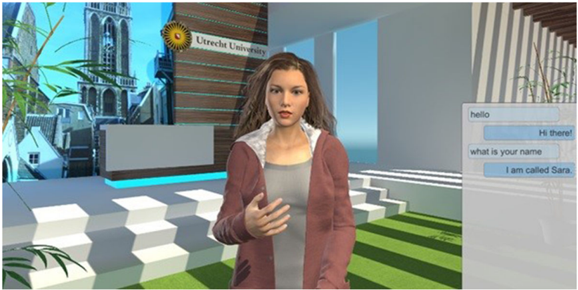
This article provides a comprehensive overview of artificial intelligence (AI) for serious games. Reporting about the work of a European flagship project on serious game technologies, it presents a set of advanced game AI components that enable pedagogical affordances and that can be easily reused across a wide diversity of game engines and game platforms. Serious game AI functionalities include player modelling (real-time facial emotion recognition, automated difficulty adaptation, stealth assessment), natural language processing (sentiment analysis and essay scoring on free texts), and believable non-playing characters (emotional and socio-cultural, non-verbal bodily motion, and lip-synchronised speech), respectively. The reuse of these components enables game developers to develop high quality serious games at reduced costs and in shorter periods of time. All these components are open source software and can be freely downloaded from the newly launched portal at gamecomponents.eu. The components come with detailed installation manuals and tutorial videos. All components have been applied and validated in serious games that were tested with real end-users.
Overview
The claims and statistics of this paper haven’t been checked yet.
Free: it reads the open-access text and checks the first 5 claims that cite a source we can check. Create a free account to check every claim.
Integrity signals
Registry
Cites
Statistics
Figures



Verification
Claims the paper makes
The claims and statistics of this paper haven’t been checked yet.
Free: it reads the open-access text and checks the first 5 claims that cite a source we can check. Create a free account to check every claim.
Claims other papers make about this one
Each is checked against this paper’s own text: does it say what the citing paper says it does?
The source backs part of the claim, not all of it — or backs it for a different population, condition or comparison.
In the citing paper
“Among digital technologies, the use of AIED technology for online learning has become more popular than before to help educators to address teaching challenges such as social isolation, heavy workload and students' lack of motivation (Westera et al., 2020;Zhu et al., 2020).”
From Teachers’ AI digital competencies and twenty-first century skills in the post-pandemic world (2023) · doi:10.1007/s11423-023-10203-6 · cites this paper as Westera et al., 2020
Experimental — accuracy not yet measured
Self-check
Percentages, sums and reported differences re-computed from the paper’s own numbers.
The self-check needs the paper’s full text.
Citations
Cites
(2003) · Journal of Machine Learning Research · doi:10.5555/944919.944937 · Cited by 32,337
Efficient Estimation of Word Representations in Vector Space
Mikolov, T., Chen, K., Corrado, G., & Dean, J. (2013) · arXiv · doi:10.48550/arxiv.1301.3781 · Cited by 26,568
(1994) · Cited by 21,711
Convolutional Neural Networks for Sentence Classification
Kim, Y. (2014) · Proceedings of the 2014 Conference on Empirical Methods in Natural Language Processing (EMNLP) · doi:10.3115/v1/d14-1181 · Cited by 14,831
Statistical Theories of Mental Test Scores
Rozeboom, W. W., Lord, F. M., Novick, M. R., & Birnbaum, A. (1969) · American Educational Research Journal · doi:10.2307/1162101 · Cited by 8,022
Recursive Deep Models for Semantic Compositionality Over a Sentiment Treebank
Socher, R., Perelygin, A., Wu, J., Chuang, J., Manning, C. D., Ng, A., & Potts, C. (2013) · Proceedings of the 2013 Conference on Empirical Methods in Natural Language Processing · doi:10.18653/v1/d13-1170 · Cited by 6,878
What Video Games Have to Teach Us about Learning and Literacy
(2004) · Education + Training · doi:10.1108/et.2004.00446dae.002 · Cited by 6,674
Landauer, T. K., & Dumais, S. T. (1997) · Psychological Review · doi:10.1037/0033-295x.104.2.211 · Cited by 6,282
Framewise phoneme classification with bidirectional LSTM and other neural network architectures
Graves, A., & Schmidhuber, J. (2005) · Neural Networks · doi:10.1016/j.neunet.2005.06.042 · Cited by 5,839
(1997) · Choice Reviews Online · doi:10.5860/choice.34-3702 · Cited by 4,887
Sentiment Analysis and Opinion Mining
Liu, B. (2012) · Synthesis Lectures on Human Language Technologies · doi:10.1007/978-3-031-02145-9 · Cited by 3,281
Sentiment Analysis and Opinion Mining
Zhang, L., & Liu, B. (2017) · Encyclopedia of Machine Learning and Data Mining · doi:10.1007/978-1-4899-7687-1_907 · Cited by 3,260
Improved Semantic Representations From Tree-Structured Long Short-Term Memory Networks
Tai, K. S., Socher, R., & Manning, C. D. (2015) · Proceedings of the 53rd Annual Meeting of the Association for Computational Linguistics and the 7th International Joint Conference on Natural Language Processing (Volume 1: Long Papers) · doi:10.3115/v1/p15-1150 · Cited by 3,081
Interaction between learning and development
(1980) · Mind in Society · doi:10.2307/j.ctvjf9vz4.11 · Cited by 2,150
Reciprocal n-Body Collision Avoidance
van den Berg, J., Guy, S. J., Lin, M., & Manocha, D. (2011) · Springer Tracts in Advanced Robotics · doi:10.1007/978-3-642-19457-3_1 · Cited by 1,858
Evaluating WordNet-based Measures of Lexical Semantic Relatedness
Budanitsky, A., & Hirst, G. (2006) · Computational Linguistics · doi:10.1162/089120106776173093 · Cited by 1,448
Cer, D., Yang, Y., Kong, S.-Y., Hua, N., Limtiaco, N., John, R. S., Constant, N., Guajardo-Cespedes, M., Yuan, S., Tar, C., et al. (2018) · arXiv · doi:10.48550/arxiv.1803.11175 · Cited by 1,267 · cited 3×
“In a comparative study using data from a corpus of 201,552 games reviews crawled from Metacritic (http://www. metacritic.com/game), the BiLSTM network achieved an overall accuracy of 74%, thereby outperforming various Dependency Tree Networks, Support Vector Machine approaches, Universal Sentence Encoder (USE; Cer et…”
MethodInfluential(1978) · Medical Entomology and Zoology · Cited by 1,199
Programming a computer for playing chess
Shannon (1950) · The Philosophical Magazine A Journal of Theoretical Experimental and Applied Physics · Cited by 770
Pekrun, R. (1992) · Applied Psychology · doi:10.1111/j.1464-0597.1992.tb00712.x · Cited by 691
TrueSkill™: A Bayesian Skill Rating System
Herbrich, R., Minka, T., & Graepel, T. (2007) · Advances in Neural Information Processing Systems 19 · doi:10.7551/mitpress/7503.003.0076 · Cited by 639
XXII. Programming a computer for playing chess
Shannon, C. E. (1950) · The London, Edinburgh, and Dublin Philosophical Magazine and Journal of Science · doi:10.1080/14786445008521796 · Cited by 615
Exploiting virtual synchrony in distributed systems
Birman, K., & Joseph, T. (1987) · ACM SIGOPS Operating Systems Review · doi:10.1145/37499.37515 · Cited by 601
Artificial Intelligence and Games
Yannakakis, G. N., & Togelius, J. (2018) · doi:10.1007/978-3-319-63519-4 · Cited by 511
Computer Games and Instruction.
Tobias, S., & Fletcher, J. D. (2011) · Cited by 492
FURIA: an algorithm for unordered fuzzy rule induction
Hühn, J., & Hüllermeier, E. (2009) · Data Mining and Knowledge Discovery · doi:10.1007/s10618-009-0131-8 · Cited by 441
Towards a common framework for multimodal generation: the behavior markup language,
Kopp, S., Krenn, B., Marsella, S., Marshall, A. N., Pelachaud, C., Pirker, H., Thórisson, K. R., & Vilhjálmsson, H. (2006) · Lecture Notes in Computer Science · doi:10.1007/11821830_17 · Cited by 417
ECHOES: An intelligent serious game for fostering social communication in children with autism
Bernardini, S., Porayska-Pomsta, K., & Smith, T. J. (2014) · Information Sciences · doi:10.1016/j.ins.2013.10.027 · Cited by 320
Serious games for higher education: a framework for reducing design complexity
Westera, W., Nadolski, R. J., Hummel, H. G. K., & Wopereis, I. G. J. H. (2008) · Journal of Computer Assisted Learning · doi:10.1111/j.1365-2729.2008.00279.x · Cited by 317
Self-citationA deep learning approach for generalized speech animation
Taylor, S., Kim, T., Yue, Y., Mahler, M., Krahe, J., Rodriguez, A. G., Hodgins, J., & Matthews, I. (2017) · ACM Transactions on Graphics · doi:10.1145/3072959.3073699 · Cited by 303
Measuring problem solving skills via stealth assessment in an engaging video game
Shute, V. J., Wang, L., Greiff, S., Zhao, W., & Moore, G. (2016) · Computers in Human Behavior · doi:10.1016/j.chb.2016.05.047 · Cited by 271
Exploiting virtual synchrony in distributed systems
Birman, K., & Joseph, T. (1987) · Proceedings of the eleventh ACM Symposium on Operating systems principles - SOSP '87 · doi:10.1145/41457.37515 · Cited by 265
Klinkenberg, S., Straatemeier, M., & van der Maas, H. L. J. (2011) · Computers & Education · doi:10.1016/j.compedu.2011.02.003 · Cited by 257
Convolutional Neural Networks for Distant Speech Recognition
Swietojanski, P., Ghoshal, A., & Renals, S. (2014) · IEEE Signal Processing Letters · doi:10.1109/lsp.2014.2325781 · Cited by 253
SmartBody: behavior realization for embodied conversational agents
Thiébaux, M., Marsella, S., Marshall, A. N., & Kallmann, M. E. (2008) · doi:10.5555/1402383.1402409 · Cited by 249
Affective multimodal human-computer interaction
Pantic, M., Sebe, N., Cohn, J. F., & Huang, T. (2005) · Proceedings of the 13th annual ACM international conference on Multimedia · doi:10.1145/1101149.1101299 · Cited by 234
FAtiMA Modular: Towards an Agent Architecture with a Generic Appraisal Framework
Dias, J., Mascarenhas, S., & Paiva, A. (2014) · Lecture Notes in Computer Science · doi:10.1007/978-3-319-12973-0_3 · Cited by 210 · cited 5×
“The FAtiMA Toolkit is an emotion engine for AI Characters (Dias et al. 2014; Mascarenhas et al. 2018).”
BackgroundInfluentialSelf-citationJALI: an animator-centric viseme model for expressive lip synchronization
Edwards, P., Landreth, C., Fiume, E., & Singh, K. (2016) · ACM Transactions on Graphics · doi:10.1145/2897824.2925984 · Cited by 184
Volume II: Technical Concepts of Component-Based Software Engineering
Bachmann, F., Bass, L., Buhman, C., Comella-Dorda, S., Long, F., Robert, J., Seacord, R. C., & Wallnau, K. (2000) · Cited by 182
Yannakakis, G. N. (2012) · Proceedings of the 9th conference on Computing Frontiers · doi:10.1145/2212908.2212954 · Cited by 179
A Panorama of Artificial and Computational Intelligence in Games
Yannakakis, G. N., & Togelius, J. (2015) · IEEE Transactions on Computational Intelligence and AI in Games · doi:10.1109/tciaig.2014.2339221 · Cited by 166
The Age of Artificial Emotional Intelligence
Schuller, D., & Schuller, B. W. (2018) · Computer · doi:10.1109/mc.2018.3620963 · Cited by 164
Assessment and Learning of Qualitative Physics in Newton's Playground
Shute, V. J., Ventura, M., & Kim, Y. J. (2013) · The Journal of Educational Research · doi:10.1080/00220671.2013.832970 · Cited by 162
Evidence-Centered Design for Simulation-Based Assessment
Mislevy, R. J. (2013) · Military Medicine · doi:10.7205/milmed-d-13-00213 · Cited by 122
Assessment and Learning of Qualitative Physics in Newton’s Playground
Ventura, M., Shute, V. J., & Kim, Y. J. (2013) · Lecture notes in computer science · doi:10.1007/978-3-642-39112-5_63 · Cited by 110
Constructing elastic distinguishability metrics for location privacy
Konstantinos Chatzikokolakis, A., Catuscia Palamidessi, A., & Stronati, M. (2015) · Proceedings on Privacy Enhancing Technologies · doi:10.1515/popets-2015-0023 · Cited by 100
Sabourin, J. L., Shores, L. R., Mott, B., & Lester, J. C. (2013) · International Journal of Artificial Intelligence in Education · doi:10.1007/s40593-013-0004-6 · Cited by 98
Can a video game company tame toxic behaviour?
Maher, B. (2016) · Nature · doi:10.1038/531568a · Cited by 86
Technical Concepts of Component-Based Software Engineering, Volume 2
Bachmann, F., Bass, L., Buhman, C., Comella-Dorda, S., & Long, F. (2000) · Defense Technical Information Center (DTIC) · doi:10.21236/ada379930 · Cited by 82
James, S., Bleumers, L., LOOY, J. V., Mariën, I., All, A., Schurmans, D., Willaert, K., Grove, F. D., Jacobs, A., & Misuraca, G. C. (2013) · RePEc: Research Papers in Economics · doi:10.2791/88148 · Cited by 79
ReaderBench, an Environment for Analyzing Text Complexity and Reading Strategies
Dascălu, M., Dessus, P., Trăușan-Matu, Ș., Bianco, M., & Nardy, A. (2013) · Lecture notes in computer science · doi:10.1007/978-3-642-39112-5_39 · Cited by 66
Games and Agents: Designing Intelligent Gameplay
Dignum, F. P. M., Westra, J., van Doesburg, W. A., & Harbers, M. (2009) · International Journal of Computer Games Technology · doi:10.1155/2009/837095 · Cited by 62
A fuzzy logic approach to reliable real-time recognition of facial emotions
Bahreini, K., van der Vegt, W., & Westera, W. (2019) · Multimedia Tools and Applications · doi:10.1007/s11042-019-7250-z · Cited by 58
Self-citationMultimodal interfaces: Challenges and perspectives
Sebe, N. (2009) · Journal of Ambient Intelligence and Smart Environments · doi:10.3233/ais-2009-0003 · Cited by 57
RAGE Architecture for Reusable Serious Gaming Technology Components
van der Vegt, W., Westera, W., Nyamsuren, E., Georgiev, A., & Martínez‐Ortiz, I. (2016) · International Journal of Computer Games Technology · doi:10.1155/2016/5680526 · Cited by 52
Self-citationSerious Gaming Analytics: What Students´ Log Files Tell Us about Gaming and Learning
Westera, W., Nadolski, R. J., & Hummel, H. G. K. (2014) · International Journal of Serious Games · doi:10.17083/ijsg.v1i2.9 · Cited by 50
Self-citationBahreini, K., Nadolski, R. J., & Westera, W. (2016) · International Journal of Human-Computer Interaction · doi:10.1080/10447318.2016.1159799 · Cited by 50
Self-citationEvidence-Centered Design for Simulation-Based Assessment. CRESST Report 800.
Mislevy, R. J. (2011) · National Center for Research on Evaluation, Standards, and Student Testing · Cited by 43
Handbook on Digital Learning for K-12 Schools
Hourigan, T., & Marcus-Quinn, A. (2016) · Springer eBooks · doi:10.1007/978-3-319-33808-8 · Cited by 41
Champandard, A. J. (2003) · Cited by 37
Modeling culture in intelligent virtual agents: From theory to implementation
Mascarenhas, S. F., Degens, N., Paiva, A., Prada, R., Hofstede, G. J., Beulens, A., & Aylett, R. S. (2015) · Autonomous Agents and Multi-Agent Systems · doi:10.1007/s10458-015-9312-6 · Cited by 36
Self-citationVolume II: Technical Concepts of Component-Based Software Engineering, 2nd Edition
Bachmann, F., Bass, L., Buhman, C., Comella-Dorda, S., Long, F., Robert, J., & Seacord, R. C. (2000) · Cited by 35
Min, W., Frankosky, M. H., Mott, B., Rowe, J., Wiebe, E., Boyer, K. E., & Lester, J. C. (2015) · Lecture notes in computer science · doi:10.1007/978-3-319-19773-9_28 · Cited by 33
(2014) · Continuum eBooks · doi:10.5040/9781628927924.ch-013 · Cited by 33
Tutoring and Intelligent Tutoring Systems
Craig, S. D. (2018) · Cited by 31
Automated essay scoring in applied games: Reducing the teacher bandwidth problem in online training
Westera, W., Dascalu, M., Kurvers, H., Ruseti, S., & Trausan-Matu, S. (2018) · Comput. Educ. · doi:10.1016/j.compedu.2018.05.010 · Cited by 26
Self-citationContext Aware Human-Robot and Human-Agent Interaction
Magnenat‐Thalmann, N., Yuan, J., Thalmann, D., & You, B.-J. (2015) · Human-computer interaction series · doi:10.1007/978-3-319-19947-4 · Cited by 22
CiF-CK: An architecture for social NPCS in commercial games
Guimarães, M., Santos, P. A., & Jhala, A. H. (2017) · IEEE Conference on Computational Intelligence and Games (CIG) · doi:10.1109/cig.2017.8080425 · Cited by 22
Self-citationSurrender at 20? Matchmaking in league of legends
Claypool, M. K., Decelle, J. M., Hall, G., & O’Donnell, L. (2015) · IEEE Games, Entertainment, Media Conference (GEM) · doi:10.1109/gem.2015.7377234 · Cited by 21
Cognitive Analysis of Educational Games: The Number Game
van der Maas, H. L. J., & Nyamsuren, E. (2016) · Topics in Cognitive Science · doi:10.1111/tops.12231 · Cited by 19
Self-citationCommunication skills training exploiting multimodal emotion recognition
Bahreini, K., Nadolski, R. J., & Westera, W. (2016) · Interactive Learning Environments · doi:10.1080/10494820.2016.1247286 · Cited by 18
Self-citationA Solution to the Measurement Problem in the Idiographic Approach Using Computer Adaptive Practicing
Hofman, A. D., Jansen, B. R. J., de Mooij, S. M. M., Stevenson, C. E., & van der Maas, H. L. J. (2018) · Journal of Intelligence · doi:10.3390/jintelligence6010014 · Cited by 17
RAGE Reusable Game Software Components and Their Integration into Serious Game Engines
van der Vegt, W., Nyamsuren, E., & Westera, W. (2016) · Lecture notes in computer science · doi:10.1007/978-3-319-35122-3_12 · Cited by 16
Self-citationPlease ReaderBench This Text: A Multi-Dimensional Textual Complexity Assessment Framework
Dascălu, M., Crossley, S. A., McNamara, D. S., Dessus, P., Trăușan-Matu, Ș., & Craig, S. D. (2018) · HAL · Cited by 14
Rabin, S. (2017) · A K Peters/CRC Press eBooks · doi:10.4324/9781315151700-1 · Cited by 13
Exploring HTN Planners through Example
Humphreys, T. (2019) · CRC Press eBooks · doi:10.1201/9780429055058-9 · Cited by 13
Automated Adaptation and Assessment in Serious Games: A Portable Tool for Supporting Learning
Nyamsuren, E., van der Vegt, W., & Westera, W. (2017) · Lecture notes in computer science · doi:10.1007/978-3-319-71649-7_17 · Cited by 12
Self-citationReflecting Comprehension through French Textual Complexity Factors
Dascălu, M., Stavarache, L. L., Trăușan-Matu, Ș., Dessus, P., & Bianco, M. (2014) · IEEE International Conference on Tools with Artificial Intelligence (ICTAI) · doi:10.1109/ictai.2014.97 · Cited by 11
Improving Learning Through Stealth Assessment of Conscientiousness
Moore, G. R., & Shute, V. J. (2016) · Springer eBooks · doi:10.1007/978-3-319-33808-8_21 · Cited by 11
Multimodal and Multi-party Social Interactions
Yumak, Z., & Magnenat‐Thalmann, N. (2015) · Human-computer interaction series · doi:10.1007/978-3-319-19947-4_13 · Cited by 11
Self-citationA special issue on artificial intelligence in computer games: AICG
Fujita, H., & Wu, I. (2012) · Knowledge-Based Systems · doi:10.1016/j.knosys.2012.05.014 · Cited by 10
Guide to Anticipatory Collision Avoidance
Guy, S. J., & Karamouzas, I. (2019) · CRC Press eBooks · doi:10.1201/9780429055096-15 · Cited by 10
Autonomous social gaze model for an interactive virtual character in real‐life settings
Yumak, Z., van den Brink, B., & Egges, A. (2017) · Computer Animation and Virtual Worlds · doi:10.1002/cav.1757 · Cited by 9
Self-citationGame AI Appreciation, Revisited
Lewis, M., & Dill, K. (2015) · A K Peters/CRC Press eBooks · doi:10.1201/b18373-3 · Cited by 8
Accommodating Stealth Assessment in Serious Games: Towards Developing a Generic Tool
Georgiadis, K., van Lankveld, G., Bahreini, K., & Westera, W. (2018) · International Conference on Virtual Worlds and Games for Serious Applications (VS-Games) · doi:10.1109/vs-games.2018.8493409 · Cited by 8
Self-citationThe RAGE Software Asset Model and Metadata Model
Georgiev, A., Grigorov, A., Bontchev, B., Boytchev, P., Stefanov, K., Bahreini, K., Nyamsuren, E., van der Vegt, W., Westera, W., Prada, R., et al. (2016) · Lecture notes in computer science · doi:10.1007/978-3-319-45841-0_18 · Cited by 7
Self-citationContext Steering : Behavior-Driven Steering at the Macro Scale
Rabin, S. (2015) · A K Peters/CRC Press eBooks · doi:10.1201/b18373-24 · Cited by 7
Body Movements Generation for Virtual Characters and Social Robots
Beck, A., Yumak, Z., & Magnenat‐Thalmann, N. (2017) · Cambridge University Press eBooks · doi:10.1017/9781316676202.020 · Cited by 6
Self-citationTurn-Based War Chess Model and Its Search Algorithm per Turn
Nan, H., Fang, B., Wang, G., Yang, W., Carruthers, E. S., & Liu, Y. (2016) · International Journal of Computer Games Technology · doi:10.1155/2016/5216861 · Cited by 5
Set-theoretical and Combinatorial Instruments for Problem Space Analysis in Adaptive Serious Games
Nyamsuren, E., van der Maas, H. L. J., & Maurer, M. (2018) · International Journal of Serious Games · doi:10.17083/ijsg.v5i1.219 · Cited by 5
Self-citationUsing Neural Networks to Control Agent Threat Response
Robbins, M. (2019) · CRC Press eBooks · doi:10.1201/9780429054969-5 · Cited by 5
Fray, A. (2019) · CRC Press eBooks · doi:10.1201/9780429055096-14 · Cited by 4
Efficient Crowd Simulation for Mobile Games
Pentheny, G. (2019) · CRC Press eBooks · doi:10.1201/9780429055096-8 · Cited by 3
Analytics-Based AI Techniques for a Better Gaming Experience
Rabin, S. (2015) · A K Peters/CRC Press eBooks · doi:10.1201/b18373-45 · Cited by 3
Advanced Techniques for Robust, Efficient Crowds
Pentheny, G. (2019) · CRC Press eBooks · doi:10.1201/9780429055096-13 · Cited by 2
Analyzing and Providing Comprehensive Feedback for French CVS with Readerbench
Guțu-Robu, G., Paraschiv, I. C., Dascălu, M., Cristian, G., Trăușan-Matu, Ș., & Lepoivre, O. (2018) · DSpace (Open University in the Netherlands) · Cited by 2
Choosing Effective Utility-Based Considerations
Lewis, M. (2019) · CRC Press eBooks · doi:10.1201/9780429055058-26 · Cited by 2
Choosing Effective Utility-Based Considerations
Lewis, M. (2017) · A K Peters/CRC Press eBooks · doi:10.4324/9781315151700-13 · Cited by 2
(2014) · IEEE International Conference on Tools with Artificial Intelligence (ICTAI) · doi:10.1109/ictai.2014.3 · Cited by 1
Research works printed but not linked: 4
- Dede, C. (2010). Comparing frameworks for 21st century skills. In J. Bellanca & R. Brandt (Eds.), 21st century skills: Rethinking how students learn (pp. 51–75). Bloomington, IN: Solution Tree Press Retrieved from http://sttechnology.pbworks.com/f/Dede_(2010)_Comparing%20Frameworks%20for%2021st%20Century%20Skills.pdf . Accessed 12 July 2019.
- Mascarenhas, S., Prada, R., Dias, J., Santos, P. A., Star, K., Hirsh, B., Spice, E., & Kommeren, R. (2018). A virtual agent toolkit for applied game developers. In C. Browne, M. Winands, J. Liu, & M. Preuss (Eds.), Proceedings of the IEEE Conference on Computational Intelligence and Games, CIG 2018, Maastricht (pp. 1–7). New York: IEEE.
- Nyamsuren, E., van der Vegt, W. & Westera, W. (2018b). A fuzzy rule for adaptive gaming to reduce problem-selection Bias and improve automated difficulty rating. IEEE Transactions on Learning Technologies (accepted for publication).
- Ventura, M., Shute, V., & Small, M. (2014). Assessing persistence in educational games. Design recommendations for adaptive intelligent tutoring systems. Learner Modeling, 2, 93–101.
Cited by
A Review of Artificial Intelligence (AI) in Education from 2010 to 2020
Zhai, X., Chu, X., Chai, C. S., Jong, M. S. Y., Istenic, A., Spector, M., Liu, J.-B., Yuan, J., & Li, Y. (2021) · Complexity · doi:10.1155/2021/8812542 · Cited by 1,364
Chiu, T. K. F., Xia, Q., Zhou, X., Chai, C. S., & Cheng, M. (2023) · Computers and Education: Artificial Intelligence · doi:10.1016/j.caeai.2022.100118 · Cited by 1,181
Revolutionizing education with AI: Exploring the transformative potential of ChatGPT
Adiguzel, T., Kaya, M. H., & Cansu, F. K. (2023) · Contemporary Educational Technology · doi:10.30935/cedtech/13152 · Cited by 975
“Additionally, AI allows to monitor students ’ learning process (Chiu et al., 2023b) and capture data on student learning (Westera et al., 2020).”
BackgroundTeachers’ AI digital competencies and twenty-first century skills in the post-pandemic world
(2023) · doi:10.1007/s11423-023-10203-6 · Cited by 734
Future research recommendations for transforming higher education with generative AI
Chiu, T. K. F. (2024) · Computers and Education: Artificial Intelligence · doi:10.1016/j.caeai.2023.100197 · Cited by 511
Metadata
- Authors
- Westera, W., Prada, R., Mascarenhas, S., Santos, P. A., Dias, J., Guimarães, M., Georgiadis, K., Nyamsuren, E., Bahreini, K., Yumak, Z., Christyowidiasmoro, C., Dascalu, M., Gutu-Robu, G., & Ruseti, S.
- Affiliations
- Open University of the Netherlands (NL)
- Instituto de Engenharia de Sistemas e Computadores Investigação e Desenvolvimento (PT)
- Utrecht University (NL)
- Corresponding author
- Westera, Wim
- ORCID
- Venue
- Education and Information Technologies
- Published
- 2019-07-30
- Volume
- 25
- Issue
- 1
- Pages
- 351-380
- ISSN
- 1360-2357 (ISSN-L)
- 1573-7608
- OpenAlex
- W2965435177
- Cited by
- 136
- References
- 103
- Citations by year
- 2026: 12 · 2025: 30 · 2024: 34 · 2023: 26 · 2022: 18 · 2021: 13 · 2020: 2
- FWCI
- 15.02
- Type
- journal article
- Language
- en
- Open access
- hybrid
- doi.org
- Licence
- cc-by
- creativecommons.org/licenses/by/4.0 (tdm)
- creativecommons.org/licenses/by/4.0 (vor)
- Locations
- Education and Information Technologies (publishedVersion, cc-by)
- DSpace (Open University in the Netherlands) (submittedVersion, cc-by)
- Funders
- Horizon Foundation for New Jersey (644187)
- Fundação para a Ciência e a Tecnologia (FCT-UID/CEC/500 21/2013)
- Topics
- Social Sciences › Psychology › Developmental and Educational Psychology › Educational Games and Gamification
- Physical Sciences › Computer Science › Artificial Intelligence › Artificial Intelligence in Games
- Physical Sciences › Computer Science › Artificial Intelligence › Intelligent Tutoring Systems and Adaptive Learning
- Keywords
- serious games, reusable components, facial emotion recognition, stealth assessment, natural language processing, sentiment analysis, essay scoring, open source software, game engines
About these checks
Registry, retraction, Cites and statistics results are computed, not judged, with one exception: a printed reference that no index lists is read once by a model before it counts as a citation error. Claims are extracted by a model and kept only when their quote appears verbatim in the text; each cited source is then checked, with a model’s help, for whether it says what the claim relies on. Those verdicts can be wrong — read the claim’s quote and the cited source before relying on one.
Statistics and arithmetic are recomputed, not judged.
Confidence bands are shown only for fields calibrated on our annotated test set. None is calibrated yet, so no band is shown.
What counts as a claim ›How we measure confidence ›How we check this ›
Are you an author, or do you see a problem with this page? Request a review
Data sources
Bibliographic data: Semantic Scholar, OpenAlex, Crossref.
Contains information from the Semantic Scholar Academic Graph Datasets, made available under the ODC Attribution License (ODC-BY 1.0).
Semantic Scholar’s data is described in: Kinney, R., et al. (2023). The Semantic Scholar Open Data Platform. arXiv:2301.10140.
