

Ethical principles for artificial intelligence in education
Open accessThe DOI matches its Crossref record; 75 of the 76 references it cites were found in a registry or an index; 13 of the 67 sources its claims cite were checked for support.
Abstract
The advancement of artificial intelligence in education (AIED) has the potential to transform the educational landscape and influence the role of all involved stakeholders. In recent years, the applications of AIED have been gradually adopted to progress our understanding of students' learning and enhance learning performance and experience. However, the adoption of AIED has led to increasing ethical risks and concerns regarding several aspects such as personal data and learner autonomy. Despite the recent announcement of guidelines for ethical and trustworthy AIED, the debate revolves around the key principles underpinning ethical AIED. This paper aims to explore whether there is a global consensus on ethical AIED by mapping and analyzing international organizations' current policies and guidelines. In this paper, we first introduce the opportunities offered by AI in education and potential ethical issues. Then, thematic analysis was conducted to conceptualize and establish a set of ethical principles by examining and synthesizing relevant ethical policies and guidelines for AIED. We discuss each principle and associated implications for relevant educational stakeholders, including students, teachers, technology developers, policymakers, and institutional decision-makers. The proposed set of ethical principles is expected to serve as a framework to inform and guide educational stakeholders in the development and deployment of ethical and trustworthy AIED as well as catalyze future development of related impact studies in the field.
Overview
CoChat Summary
## TL;DR
This paper maps international ethical guidelines for artificial intelligence in education and, through thematic analysis, proposes a set of principles for ethical and trustworthy AIED. It argues that AIED should be governed by a human-centered framework that addresses transparency, privacy, inclusiveness, safety, sustainability, and accountability.
## Key findings
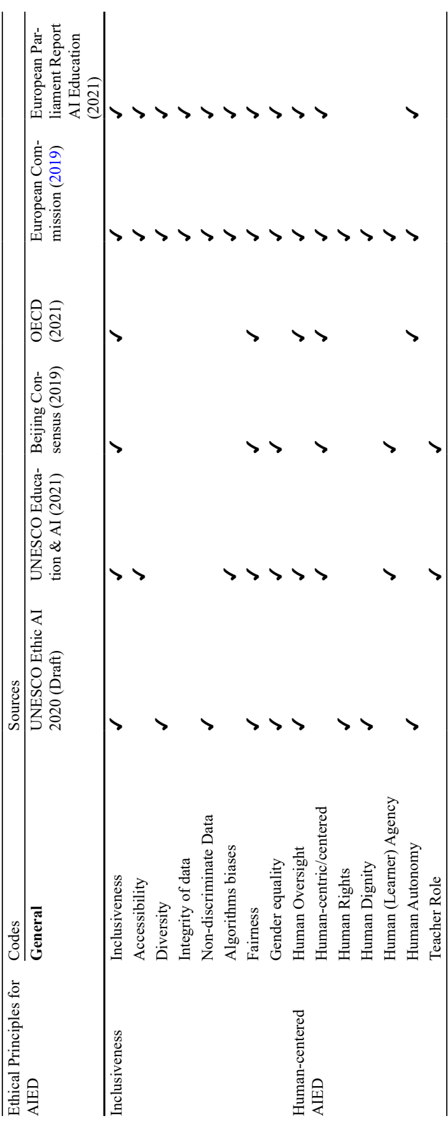
- The authors analyzed ethical guidelines and reports from 6 international sources: UNESCO Ethics AI (AHEG, 2020), UNESCO Education & AI (Miao et al., 2021), Beijing Consensus (UNESCO, 2019), OECD (2021), European Commission (2019), and European Parliament Report AI Education (2021).
- Their thematic analysis produced 39 codes that were collated into 7 themes (principles) for AIED.
- The proposed principles are: governance and stewardship, transparency and accountability, sustainability and proportionality, privacy, security and safety, inclusiveness, and human-centered AIED.
- The paper states that AIED raises concerns about personal data, learner autonomy, privacy, bias, fairness, accountability, inclusiveness, and human rights, while also offering benefits such as personalization and improved learning performance.
## Methods
- The study used thematic analysis based on Braun & Clarke (2012) to examine ethical guidelines and reports related to AIED.
- The sample consisted of policy/guideline documents from international organizations: UNESCO, OECD, European Commission, and European Parliament.
- Analysis involved familiarization, open coding, iterative theme generation, and researcher-researcher corroboration to support reliability and validity.
## Limitations
- The paper says the proposed principles are a starting point and that a precise mechanism for ethical principles in AIED “remains to be elucidated.”
- It explicitly notes that there is no universal consensus on the best ethical theory or standards for AIED, and that the issue is still evolving.
- Evident from the text: the study analyzes published policies and guidelines only, so it does not test the principles in classrooms or evaluate their effectiveness in practice.
Model-written summary. Check it against the paper before relying on it.
Integrity signals
Registry
Cites
Statistics
Figures
Verification
Claims the paper makes
12 Valid · 0 Not valid · 38 Not checked · 11 Own results and interpretations
The cited sources support only part of this claim — read each source’s verdict below.
In the paper
“Hence, there are growing evidence for the roles of AIED to “foster a transformation of knowledge, cognition, and culture” (Hwang et al., 2020, p.1).”
§ Ethical principles for artificial intelligence in education > Opportunities of artificial intelligence in education
What the sources say
- Partly supportedcites Hwang et al., 2020 matched to “Vision, challenges, roles and research issues of Artificial Intelligence in Education” (2020) sourceExperimental — accuracy not yet measured
The Conclusions (page not specified in our copy) say that integrating AI and education is a transformation of human knowledge, cognition, and cultures, supporting the central idea. The passage does not describe growing evidence for AIED’s role in that transformation, and the cited wording is not an exact quotation. (LLM, conf=0.86)
plainstates a cause- Asserted: passes — The authors put it forward as true.
- Checkable: passes — It can be checked against evidence.
- Load-bearing: unclear — It is unclear whether the paper’s conclusions depend on it.
- Based: passes — The paper gives a reason why it holds.
- Partly supported
The cited sources support only part of this claim — read each source’s verdict below.
In the paper
“However, the adoption of AIED has led to increasing ethical risks and concerns regarding several aspects such as personal data and learner autonomy.”
§ Ethical principles for artificial intelligence in education > Abstract The advancement of artificial intelligence in education (AIED) has the potential to transform the educational landscape and influence the role of all involved stakeholders. In recent years, the applications of AIED have been gradually adopted to progress our understanding of students’ learning and enhance learning performance and experience. However, the adoption of AIED has led to increasing ethical risks and concerns regarding several aspects such as personal data and learner autonomy. Despite the recent announcement of guidelines for ethical and trustworthy AIED, the debate revolves around the key principles underpinning ethical AIED. This paper aims to explore whether there is a global consensus on ethical AIED by mapping and analyzing international organizations’ current policies and guidelines. In this paper, we first introduce the opportunities offered by AI in education and potential ethical issues. Then, thematic analysis was conducted to conceptualize and establish a set of ethical principles by examining and synthesizing relevant ethical policies and guidelines for AIED. We discuss each principle and associated implications for relevant educational stakeholders, including students, teachers, technology developers, policymakers, and institutional decision-makers. The proposed set of ethical principles is expected to serve as a framework to inform and guide educational stakeholders in the development and deployment of ethical and trustworthy AIED as well as catalyze future development of related impact studies in the field.
What the sources say
- Partly supportedcites Holmes et al., 2021 matched to “Ethics of AI in Education: Towards a Community-Wide Framework” (2022) sourceExperimental — accuracy not yet measured
“The Ethics of AIED in Particular” identifies privacy concerns about the data collected by AIED, and “Most Ignored Yet Critical Ethical Issues for AIED” identifies lack of human agency as a concern. These passages support the cited concerns, but do not establish that adoption has caused risks concerning personal data and learner autonomy to increase over time. Page numbers are unavailable in our copy. (LLM, conf=0.84)
- Not matchedcites Akgun & Greenhow, 2021
An author–year citation the paper’s reference list doesn’t settle. We don’t search these by name.
- Not matchedcites Miao et al., 2021
An author–year citation the paper’s reference list doesn’t settle. We don’t search these by name.
plainstates a cause- Asserted: passes — The authors put it forward as true.
- Checkable: passes — It can be checked against evidence.
- Load-bearing: passes — The paper’s conclusions depend on it.
- Based: passes — The paper gives a reason why it holds.
- Partly supported
The cited sources support only part of this claim — read each source’s verdict below.
In the paper
“Indeed, a proliferation of studies has revealed the emergence of contrasting ethical themes relating to general AI and AIED, most of which are associated with the liability of data across settings, such as in higher education (Zawacki-Richter et al., 2019), K-12 (Holstein et al., 2019), schools (Luckin, 2017), and subjects (Hwang & Tu, 2021).”
§ Ethical principles for artificial intelligence in education > Ethical issues of AI in education Despite its capability to revolutionize education, numerous challenges also linger for researchers and practitioners who are involved in associated activities or systems (Kay & Kummerfeld, 2019) as AIED is, by nature, a “highly technology-dependent and cross-disciplinary field” (Hwang et al., 2020, p.2). At a global level, UNESCO (2019) pinpointed six challenges in achieving sustainable development of AIED: comprehensive public policy, inclusion and equity in AIED, preparing teachers for AI-powered education,preparing AI to understand education, developing quality and inclusive data systems, making research on AIED significant, ensuring ethics and transparency in data collection, use, and dissemination. At the individual level, challenges range from critical societal drawbacks such as systemic bias, discrimination, inequality for marginalized groups of students, and xenophobia (Hwang et al., 2020) to thorny ethical issues relating to privacy and bias in data collection and processing (Holmes et al., 2021). In fact, the widespread ramifications of AIED have also led to emerging concerns over the negative realities that it brings, such as the widening gaps of inequalities among learners’ commercialization of education, or the home-school divide in education (Reiss, 2021). AI may become pervasive in every sense where those involved may be exposed to risks without being aware of them, and the situation can be even intensified under the ongoing impacts of the COVID-19 pandemic (Borenstein & Howard, 2021). Such obstacles essentialize an urgent demand to induct and acquaint teachers and students with the ethical concerns surrounding AIED and how to navigate them. Furthermore, AIED also carries ethical implications and privacy risks which call for critical attention to differentiate between doing ethical things and doing things ethically (Holmes et al., 2021), or as in the words of Russell and Norvig (2002) “all AI researchers should be concerned with the ethical implications of their work” (p. 1020). Indeed, a proliferation of studies has revealed the emergence of contrasting ethical themes relating to general AI and AIED, most of which are associated with the liability of data across settings, such as in higher education (Zawacki-Richter et al., 2019), K-12 (Holstein et al., 2019), schools (Luckin, 2017), and subjects (Hwang & Tu, 2021). These covered the issues of informed consent, privacy breach, biased data assumption, fairness, accountability, and statistical apophenia. Others also question the impacts of AI-related fields such as surveillance and consent, learner privacy (Sacharidis et al., 2020), identity configuration, user confidentiality, integrity, and inclusiveness (Deshpande et al., 2017). Another stream of discussion has been drawn upon the ethics of data designated for educational use and analytics learning (e.g., Kay & Kummerfeld 2019; Kitto & Knight, 2019; Slade & Prinsloo, 2013). These incorporate the spheres of data interpretation and management, different perspective on the data usage, and the power relation among involved stakeholders such as students, teachers, and the educational objectives (Slade & Prinsloo, 2013). Other ethical issues for AIED include the problems with data collection, restricted availability of data sources, bias and representation, data ownership and control, data autonomy, AIED systems, and human agency (Akgun & Greenhow, 2021; Miao et al., 2021). That said, it is crucial to fully comprehend these values and principals before making ethically and accountability-driven decisions, and being aware of possible, even unexpected outcomes in education. Although recent work has attempted to establish different ethical frameworks for general AI use (e.g., Ashok et al., 2022), ethical and privacy issues are suggested to be contextualized (Ifenthaler & Schumacher, 2016), hence the prior guidelines established in other disciplines might not be appropriate for education. The contextual approach to the ethical design and use of AIED could play an essential role in addressing the issues of ethical and privacy concerns in education context. Prior research has emphasised the importance of the sociotechnical context configured by educational technology and educations practices in ethical considerations (Kitto & Knight, 2019). The understanding of ethics and privacy from various perspectives could promote the design of ethical and trustworthy AIED and the adoption of such systems. Furthermore, we extended the ethical view from published studies reviewed by Ashok et al., (2022) to the policies and guidelines proposed by the international organizations such as UNESCO, OECD, and European Union. The consensus assessment of policies and guidelines would inform a comprehensive and integrated instructions for different stakeholders in adopting AIED. This contributes to establishing a common ground and solid foundation for further development and implementation of AIED.
What the sources say
- Partly supportedcites Zawacki-Richter et al., 2019 matched to “Systematic review of research on artificial intelligence applications in higher education – where are the educators?” (2019) sourceExperimental — accuracy not yet measured
The Introduction identifies privacy and data protection as ethical risks of AI applications in higher education, supporting that part of the claim. But the section ‘Understanding of AI and critical reflection of challenges and risks’ reports that only two of 146 reviewed articles critically reflected on ethical implications; it does not support the claim that a proliferation of studies revealed ethical themes, most concerning data liability. (LLM, conf=0.88)
- Not checked — no full text of the sourcecites Holstein et al., 2019 matched to “Designing for Complementarity: Teacher and Student Needs for Orchestration Support in AI-Enhanced Classrooms” (2019) source
- Not checked — no full text of the sourcecites Luckin, 2017 matched to “Towards artificial intelligence-based assessment systems” (2017) source
boostedstates an association- Asserted: passes — The authors put it forward as true.
- Checkable: passes — It can be checked against evidence.
- Load-bearing: passes — The paper’s conclusions depend on it.
- Based: passes — The paper gives a reason why it holds.
- Partly supported
Every source the paper cites for this claim was checked and supports it.
In the paper
“Bostrom & Yudkowsky (2014) pointed out that AI systems must be “robust against human adversaries deliberately searching for exploitable flaws in the algorithm” (p. 317).”
§ Ethical principles for artificial intelligence in education > Ethical principles for artificial intelligence in education (AIED) > Principle of Security and Safety
What the sources say
- Supportedcites Bostrom & Yudkowsky (2014) matched to “The ethics of artificial intelligence” (2014) source
Section 1 (cited as p. 317) says AI algorithms should be robust against manipulation. It then gives a machine-vision system as an example that must withstand human adversaries searching for exploitable flaws. The quoted wording matches that example. (LLM, conf=0.94)
plain- Asserted: passes — The authors put it forward as true.
- Checkable: passes — It can be checked against evidence.
- Load-bearing: passes — The paper’s conclusions depend on it.
- Based: passes — The paper gives a reason why it holds.
- Supported
The cited sources support only part of this claim — read each source’s verdict below.
In the paper
“Data ethics emphasized the need for transparency in data usage in AIED (Larsson & Heintz, 2020).”
§ Ethical principles for artificial intelligence in education > Ethical principles for artificial intelligence in education (AIED) > Principle of transparency and accountability
What the sources say
- Partly supportedcites Larsson & Heintz, 2020 matched to “Transparency in artificial intelligence” (2020) sourceExperimental — accuracy not yet measured
The Introduction (listed under Abstract; no page given) identifies transparency as a key principle in AI ethics guidelines. Section 2, “A multidisciplinary notion of transparency” (no page given), links AI transparency to the origins of data and how personal data travels. The paper does not address data usage specifically in artificial intelligence in education (AIED), so the educational setting is unsupported. (LLM, conf=0.86)
plainstates a cause- Asserted: passes — The authors put it forward as true.
- Checkable: passes — It can be checked against evidence.
- Load-bearing: passes — The paper’s conclusions depend on it.
- Based: passes — The paper gives a reason why it holds.
- Partly supported
19 more claims
Create a free account to see all 61 claims and to verify the 8 references still open.
- It may state two separate claims as one. 19
- Probably not a substantial claim. 28
Claims other papers make about this one
Each is checked against this paper’s own text: does it say what the citing paper says it does?
The source backs part of the claim, not all of it — or backs it for a different population, condition or comparison.
In the citing paper
“The rise of AI-generated content necessitates a shift towards authentic assessment strategies emphasising higher-order thinking, creativity, and ethical responsibility [ 26 ].”
From Redefining student assessment in AI-infused learning environments: a systematic review of challenges and strategies for academic integrity (2026) · cites this paper as [26]
Experimental — accuracy not yet measuredThe cited source says what the claim attributes to it.
In the citing paper
“There is a real danger of AI becoming pervasive in every sense where those involved may be exposed to risks without being aware of them [32,90].”
From New Era of Artificial Intelligence in Education: Towards a Sustainable Multifaceted Revolution (2023) · cites this paper as [32]
The check wasn’t confident either way, so it gives no verdict — never disputed.
In the citing paper
“This aligns with the sociocultural view that ethical reasoning is dialogic and socially constructed (Nguyen et al., 2023).”
From Generative AI in Design Thinking Pedagogy: Enhancing Creativity, Critical Thinking, and Ethical Reasoning in Higher Education (2025) · cites this paper as Nguyen et al., 2023
Experimental — accuracy not yet measuredThe check wasn’t confident either way, so it gives no verdict — never disputed.
In the citing paper
“Research suggests that assessments should prioritise critical thinking, problemsolving, and creativity over rote memorisation [ 26, 34].”
From Redefining student assessment in AI-infused learning environments: a systematic review of challenges and strategies for academic integrity (2026) · cites this paper as [26]
Experimental — accuracy not yet measuredIn the citing paper
“Although many AI-related guidelines were published before the release of ChatGPT, most are generic and do not specifically address issues and challenges caused by GenAI in higher education”
From Investigating the higher education institutions’ guidelines and policies regarding the use of generative AI in teaching, learning, research, and administration (2025) · cites this paper as Nguyen et al., 2023
1 more claim about this paper
Create a free account to see every claim other papers make about this one.
Citations
Cites
The "what" and "why" of goal pursuits: Human needs and the self-determination of behavior
Deci, E. L., & Ryan, R. M. (2000) · Psychological Inquiry · doi:10.1207/s15327965pli1104_01 · Cited by 34,210
Braun, V., & Clarke, V. (2012) · APA handbook of research methods in psychology, Vol 2: Research designs: Quantitative, qualitative, neuropsychological, and biological. · doi:10.1037/13620-004 · Cited by 10,299
Zawacki-Richter, O., Marín, V. I., Bond, M., & Gouverneur, F. (2019) · International Journal of Educational Technology in Higher Education · doi:10.1186/s41239-019-0171-0 · Cited by 7,242 · cited 2×
“…the emergence of contrasting ethical themes relating to general AI and AIED, most of which are associated with the liability of data across settings, such as in higher education (Zawacki-Richter et al., 2019), K-12 (Holstein et al., 2019), schools (Luckin, 2017 ), and subjects (Hwang & Tu, 2021 ).”
Background(2014) · Medical Entomology and Zoology · Cited by 6,828
The global landscape of AI ethics guidelines
Jobin, A., Ienca, M., & Vayena, E. (2019) · Nature Machine Intelligence · doi:10.1038/s42256-019-0088-2 · Cited by 6,220 · cited 2×
“The objective is to cultivate trust among learners and provide them with insights to leverage their skills across contexts while maintaining control of their respective data and digital identities (Jobin et al., 2019).”
BackgroundThe Ethics of AI Ethics: An Evaluation of Guidelines
Hagendorff, T. (2020) · Minds and Machines · doi:10.1007/s11023-020-09517-8 · Cited by 1,911 · cited 1×
“…and open communica - tions with beneficiaries: educators, students, parents, AI developers, and policymak - ers (Berendt et al., 2020 ; Nigam et al., 2021 ; Hagendorff, 2020 ) stated that more emphasis is necessary to enforce ethical guidelines for AI systems to better align with societal values.”
BackgroundThe Ethics of AI Ethics -- An Evaluation of Guidelines
Hagendorff, T. (2019) · arXiv · doi:10.48550/arxiv.1903.03425 · Cited by 1,907 · cited 1×
“…and open communica - tions with beneficiaries: educators, students, parents, AI developers, and policymak - ers (Berendt et al., 2020 ; Nigam et al., 2021 ; Hagendorff, 2020 ) stated that more emphasis is necessary to enforce ethical guidelines for AI systems to better align with societal values.”
BackgroundArtificial Intelligence in Human Resources Management: Challenges and a Path Forward
Tambe, P., Cappelli, P., & Yakubovich, V. (2019) · California Management Review · doi:10.1177/0008125619867910 · Cited by 1,609
Artificial intelligence in education: Addressing ethical challenges in K-12 settings
Akgun, S., & Greenhow, C. (2022) · AI and Ethics · doi:10.1007/s43681-021-00096-7 · Cited by 1,473 · cited 2×
“…collaborative learning or asynchronous discussion groups, allows cost-wise personalized learning through a navigation system underpinned by algorithms (Nye, 2015 ), promoted by the use of automated assessment,facial recognition systems, and predictive analytics (Akgun & Greenhow, 2021 ).”
BackgroundMethodEthics of AI in Education: Towards a Community-Wide Framework
Holmes, W., Porayska-Pomsta, K., Holstein, K., Sutherland, E., Baker, T., Shum, S. B., Santos, O. C., Rodrigo, M. T., Cukurova, M., Bittencourt, I. I., et al. (2022) · International Journal of Artificial Intelligence in Education · doi:10.1007/s40593-021-00239-1 · Cited by 1,437 · cited 8×
“…ethical implications and privacy risks which call for critical attention to differentiate between doing ethical things and doing things ethically (Holmes et al., 2021 ), or as in the words of Russell and Norvig ( 2002 ) “all AI researchers should be concerned with the ethical implications of…”
BackgroundInfluential
Research works printed but not linked: 1
- Russel, S. J., & Norvig, P. R. (2002). Artificial Intelligence: A modern approach (2nd Ed.) Prentice Hall Upper Saddle River, NJ, USA
Cited by
Items 501–600 of 1,202
Kılıç, E., Almasri, F., & Çelik, H. E. (2025) · Computers and Education Artificial Intelligence · doi:10.1016/j.caeai.2025.100486 · Cited by 7
Beyond the hype: evidence-based approaches to responsible AI integration in workplace learning
Sposato, M. (2025) · Education + Training · doi:10.1108/et-01-2025-0034 · Cited by 3
Tian, J., Hu, W., Li, R., & Li, Y. (2025) · Distance Education · doi:10.1080/01587919.2025.2578773 · Cited by 3
“Investigating how individual differences, such as prior knowledge, impact the process and outcomes of GAI-supported learning could inform the future design of more personalized AI systems that align better with human cognitive processes (Järvelä et al., 2025; Nguyen et al., 2023).”
Big data analytics in e-learning: ethical challenges and opportunities for engineering education
Dritsas, E., & Τρίγκα, Μ. (2025) · AI and Ethics · doi:10.1007/s43681-025-00866-7 · Cited by 8
“Transparency should also extend beyond the algorithm itself to include all data pipelines, including feature selection, preprocessing steps, and decision thresholds [ 39 ].”
Understanding higher education students’ reluctance to adopt GenAI in learning in Latvia and Ukraine
Prohorovs, A., Užule, K., & Tsaryk, O. (2026) · Frontiers in Education · doi:10.3389/feduc.2025.1676900 · Cited by 6
The psychology of teaching preparedness: Linking TPACK to self-efficacy in pre-service EFL teachers
Ke, Q., Gong, Y., & Ke, C. (2026) · Acta Psychologica · doi:10.1016/j.actpsy.2026.106223 · Cited by 5
Rethinking Learning in Higher Education Through AI-Driven Gamification: A Meta-Synthesis
Saldivar, J. M. (2026) · Journal of interdisciplinary perspectives · doi:10.69569/jip.2025.816 · Cited by 3
Yuan, P., Chen, X., & Song, H. (2026) · Behavioral Sciences · doi:10.3390/bs16020165 · Cited by 14
“Accordingly, principals must navigate heightened uncertainty and make high‑ stakes decisions about adoption, governance, and risk mitigation in the face of unprece‑ dented, and sometimes competing, demands (Nguyen et al., 2023; Singh et al., 2024).”
Bali, B. (2026) · Next research. · doi:10.1016/j.nexres.2026.101570 · Cited by 12
Joshi, A., McGoldrick, B., Mittal, N., Roy, S., Zeba, Z., Ofori, M. A., Dockery, S., Jha, N., Auerbach, J. M., Cadet, J. A., et al. (2026) · Frontiers in Public Health · doi:10.3389/fpubh.2026.1796810 · Cited by 4
“Ethical frameworks for AI in education highlight concerns related to algorithmic bias, privacy protection, data security, and the potential impact of automated systems on educational equity (8).”
Ormancı, Ü. (2026) · European Early Childhood Education Research Journal · doi:10.1080/1350293x.2026.2651904 · Cited by 4
Examining the use of artificial intelligence in pre-service teacher education
Ponomarenko, E. B., Sergeeva, O. V., ZHELTUKHINA, M. R., Baranova, K. M., Budkevich, R. L., & Melnik, M. V. (2026) · Contemporary Educational Technology · doi:10.30935/cedtech/18458 · Cited by 7
Making AI in education responsible: classroom-ready ethical guidelines for teachers and students
Go, B., Min, S., & Jeon, M. (2026) · AI and Ethics · doi:10.1007/s43681-026-01176-2 · Cited by 13
“Nguyen et al. [ 36 ] contributed statements about protecting students from cybercrime and data breaches, avoiding misleading information, and ensuring that AI does not negatively affect students’ emotional and social well-being.”
Yang, C., Xu, Z., Lin, Y., & Zhang, Y. (2026) · Computers & Education · doi:10.1016/j.compedu.2026.105720 · Cited by 3
Exploring AI Ethics through Educational Scenarios with AI Generative Arts Apps
Keune, A., Hurtado, S., & Simšič, Ž. (2024) · Proceedings. · doi:10.22318/icls2024.651304 · Cited by 6
“The learning sciences have had a long-standing relationship with artificial intelligence (Schank, 1980; Doroudi, 2022), with the field pivoting toward conceptualizing AI literacy, including ethics related to AI (Morales-Navarro et al., 2023; Ng et al., 2021; Nguyen et al., 2022).”
Empowering Lifelong Learning: Embracing the Impact of Artificial Intelligence
Kumar, J., Jieyao, Z., & Soeiro, J. D. (2024) · Advances in educational marketing, administration, and leadership book series · doi:10.4018/979-8-3693-6955-5.ch003 · Cited by 4
Generative AI and Its Impact on Creative Thinking Abilities in Higher Education Institutions
Kaitharath, M. F., Shifna, K. N., & Anuradha, P. S. (2024) · Advances in educational technologies and instructional design book series · doi:10.4018/979-8-3693-2418-9.ch006 · Cited by 4
Harnessing Computational Intelligence for Educational Transformation
Reddy, C. K. K., Chintalapalli, A., & Nag, A. (2024) · Advances in educational technologies and instructional design book series · doi:10.4018/979-8-3693-8151-9.ch006 · Cited by 3
Understanding the Digital Epistemologies of Chat GPT: Towards a Decolonial Language Pedagogy
Asmawi, A., & Alam, M. S. (2024) · International Conference on Digital Technology in Education (ICDTE) · doi:10.1145/3696230.3696248 · Cited by 4
The Influence of Artificial Intelligence and Language in the International Economic Landscape
Murshed, A. A., Alrahamneh, A., Al-Tarawneh, A., Al-Badawi, M. A., & Alhalalmeh, A. (2024) · Studies in systems, decision and control · doi:10.1007/978-3-031-73545-5_89 · Cited by 5
Harnessing Industry 4.0: A Framework for Integrating AI and Emerging Technologies
Baroud, S. Y., & Qureshi, M. N. (2024) · International Workshop on Artificial Intelligence and Education (WAIE) · doi:10.1109/waie63876.2024.00044 · Cited by 3
“Clear ethical guidelines and engagement of stakeholders in discussions about these issues are essential [38].”
Teacher Leadership and AI Literacy: An Analysis of Teachers' AI Literacy Levels
Çoban, Ö., & Durnalı, M. (2025) · IGI Global eBooks · doi:10.4018/979-8-3373-0472-4.ch001 · Cited by 6
Navigating Ethical Dilemmas in the Implementation of AI-Driven Educational Technologies
Ismail, M., Madathil, N. T., Alalawi, M., Alalawi, S., & Alrabaee, S. (2025) · IEEE Global Engineering Education Conference (EDUCON) · doi:10.1109/educon62633.2025.11016612 · Cited by 5
“Institutions must enforce strict guidelines on data handling and ensure inclusivity to prevent the exclusion of underserved communities [31], [40].”
Navigating the Landscape of Hint Generation Research: From the Past to the Future
Jangra, A., Mozafari, J., Jatowt, A., & Muresan, S. (2025) · Transactions of the Association for Computational Linguistics · doi:10.1162/tacl_a_00751 · Cited by 20
Chen, J. (2025) · Lecture Notes in Education Psychology and Public Media · doi:10.54254/2753-7048/2025.bo24154 · Cited by 3
Zhou, J., & Zhang, H. (2025) · Education and Information Technologies · doi:10.1007/s10639-025-13679-2 · Cited by 8
“…transformations brought about by artificial intelligence technologies in the field of education, particularly with the increasing computational power and increasingly accurate data models, and their potential impact on the very essence of education (Labadze et al., 2023; Nguyen et al., 2023).”
Jayatilake, T. (2025) · Communications in computer and information science · doi:10.1007/978-3-031-99261-2_33 · Cited by 5
The future of anesthesia education: incorporating technology for safer practices
Yu, S., Bettini, L. M., & Harbell, M. W. (2025) · Current Opinion in Anaesthesiology · doi:10.1097/aco.0000000000001559 · Cited by 5
Tjano, R. N., & Mphahlele, R. S. (2025) · Future education and learning spaces · doi:10.1007/978-981-96-7937-9_3 · Cited by 3
Stracke, C. M., Nahar, N., Punzo, V., Massaro, S., Pappa, D., Grassi, A. D., Bećirović, S., Hollins, P. A., Ziouvelou, X., Skënduli, M. P., et al. (2025) · MAP Education and Humanities · doi:10.53880/2744-2373.2025.6.61 · Cited by 8
Eğitimde Yapay Zekâ Etiği ve Politikaları: Finlandiya, Güney Kore ve Türkiye Örneği
Özenç, Y. Y. (2025) · Siirt Eğitim Dergisi · doi:10.58667/sedder.1777959 · Cited by 5
- Retracted
Ani-Rus, A., Catalano, C., Mestic, G., & Catalano, H. (2023) · Educatia 21 · doi:10.24193/ed21.2023.25.38 · Cited by 5
“Simultaneously, artificial intelligence can be considered as a potent instrument for developing novel teaching strategies, promoting group learning, synchronous and asynchronous learning, and individualised instruction depending on the requirements and interests of the students (Nguyen, 2023).”
BackgroundBansal, A., Dasarathy, A. K., Gangadharan, S., Rajeshwari, R. R., Ismail, M. M., & Halaf, N. K. A. (2023) · International Conference on Innovative Computing, Intelligent Communication and Smart Electrical Systems (ICSES) · doi:10.1109/icses60034.2023.10465461 · Cited by 4
RetractedVocê decide quem POD: empoderando a/o estudante de computação quanto à propriedade de seus dados
Silva, O. E. B. M., Souza, T. F. B., Duda, J. M. S., Barros, B. S. R., & da Nóbrega, G. M. (2024) · doi:10.5753/educomp.2024.237559 · Cited by 3
Saari, M., Rantanen, P., Nurminen, M., Kilamo, T., Systä, K., & Abrahamsson, P. (2024) · Springer eBooks · doi:10.1007/978-3-031-55642-5_16 · Cited by 6
STUDENTS' PERCEPTIONS OF ARTIFICIAL INTELLIGENCE TECHNOLOGY TO DEVELOP 21ST CENTURY LEARNING SKILLS
Fadli, F., & Iskarim, M. (2024) · Lentera Pendidikan Jurnal Ilmu Tarbiyah dan Keguruan · doi:10.24252/lp.2024v27n1i11 · Cited by 8
“That makes learning more exciting and motivates students to engage more deeply in learning (Doroudi, 2023; Nguyen, Ngo, Hong, & Dang, 2023).”
BackgroundLeveraging the Human Classroom with AI-Powered Resources
Adib, N., Sommer, N. M., & Waksmanski-Krynski, N. (2024) · IEEE Digital Education and MOOCS Conference (DEMOcon) · doi:10.1109/democon63027.2024.10747892 · Cited by 5
Levenberg, A., Harari, L., & Pollak, D. (2024) · Education and Information Technologies · doi:10.1007/s10639-024-13140-w · Cited by 4
“Frameworks provided by UNESCO (2021) and Nguyen et al. (2023) emphasize transparency, fairness, and responsible governance principles.”
Гришко, В., & Zinchenko, I. (2023) · ЕКОНОМІКА І РЕГІОН Науковий вісник · doi:10.26906/eir.2023.4(91).3216 · Cited by 14
Gutiérrez, E. J. D., & Jarquín-Ramírez, M.-R. (2025) · Edutec Revista Electrónica de Tecnología Educativa · doi:10.21556/edutec.2025.91.3665 · Cited by 10
AI and the Future of Education
Oleet, J. B., & Yu, C. (2025) · Advances in computational intelligence and robotics book series · doi:10.4018/979-8-3693-7873-1.ch015 · Cited by 5
A Scoping Review of AI Literacy for Teachers
Tang, W. K.-W., & Zhang, A. (2025) · Lecture notes in educational technology · doi:10.1007/978-981-96-8931-6_26 · Cited by 5
Ethics and Sustainability in Education That Makes Use of Artificial Intelligence and Robots
Monte-Serrat, D. M., Cabella, D. M. S., & Cattani, C. F. (2025) · Digital education and learning · doi:10.1007/978-3-032-03977-4_6 · Cited by 3
Trustworthy AI for Educational MetaversesPreprint
Abdullakutty, F. C., Qayyum, A., Lampropoulos, G., & Qadir, J. (2024) · doi:10.36227/techrxiv.170775108.81506629/v1 · Cited by 5
Balart, T. S., & Shryock, K. J. (2024) · doi:10.36227/techrxiv.171778881.15802086/v1 · Cited by 3
Leveraging AI in Education: Benefits, Responsibilities, and TrendsPreprint
Fitas, R., Ghosh, K., & Maity, S. (2025) · SSRN Electronic Journal · doi:10.2139/ssrn.5366287 · Cited by 3
Flipped design thinking with generative AI for digital literacy in ODL
Suwardika, G., Sopandi, A. T., Indrawan, I. P. O., & Masakazu, K. (2026) · Asian Association of Open Universities Journal · doi:10.1108/aaouj-11-2025-0206 · Cited by 3
Han, B., Ma, Y., Coghlan, S., McKay, D., Buchanan, G., & Smith, W. (2026) · Proceedings of the 2026 CHI Conference on Human Factors in Computing Systems · doi:10.1145/3772318.3790360 · Cited by 3
Orogun, O., Ogungbe, L., Ajani, A. A., Adegboye, N., & Ogunsola, O. (2024) · European Journal of Contemporary Education and E-Learning · doi:10.59324/ejceel.2024.2(5).03 · Cited by 9
AI Literacy in Learning and Educational Technology
Nguyen, A., Shalpegin, T., Lämsä, J., & Whitehead, R. (2024) · Emerald Group Publishing Limited eBooks · doi:10.1108/978-1-83608-852-320241007 · Cited by 3
Self-citationEnhancing Medical Education with AI-Generated Visual Art: Benefits and Challenges.
Negahdaripour, M., Keshavarzi, M. H., & Amini, M. (2025) · PubMed Central · doi:10.30476/ijms.2024.104198.3777 · Cited by 3
Revolutionizing CTE: AI-Driven Andragogical Practices for Social Justice in Urban Education
Maharjan, S., Espinoza, M., Robles, T., & Strayer, L. P. (2025) · Advances in computational intelligence and robotics book series · doi:10.4018/979-8-3373-0502-8.ch011 · Cited by 4
Ethical Horizons in AI-Driven Educational Research: Transformative Learning and Innovation
Aboudahr, S. M. F. M., Benlahcene, A., & Govindarajoo, M. V. (2025) · Advances in computational intelligence and robotics book series · doi:10.4018/979-8-3693-7332-3.ch018 · Cited by 4
Human-Technology Interaction: Enhancing Education Through AI-Powered Adaptive Learning
Thakur, S., Singh, H., Mishra, N., Tripathy, R., Nayak, R. K., & Thakur, A. (2025) · Advances in educational technologies and instructional design book series · doi:10.4018/979-8-3373-2262-9.ch013 · Cited by 2
Innovations in ESP teaching and learning practices
Дубовик, О. М. (2024) · Humanitarian studios pedagogics psychology philosophy · doi:10.31548/hspedagog/4.2024.23 · Cited by 9
“A. Nguyen et al. (2023) propose a set of ethical principles (Fig.”
Wang, S. B., Wang, S. I. C., & Liu, E. Z. F. (2025) · International Journal of Online Pedagogy and Course Design · doi:10.4018/ijopcd.375626 · Cited by 13
Romero, S. O., León, M. R. R., Francisco, B. N., & Cortés, M. C. (2025) · LATAM Revista Latinoamericana de Ciencias Sociales y Humanidades · doi:10.56712/latam.v6i2.3907 · Cited by 3
A study on the readiness of English teachers in Macao universities in the era of AI
Cao, L. (2025) · Asian Education and Development Studies · doi:10.1108/aeds-12-2024-0314 · Cited by 8
Tulang, A. B. (2025) · European Journal of Educational Research · doi:10.12973/eu-jer.14.3.829 · Cited by 4
Perceptions of the ethicality of using artificial intelligence (AI) in the workplace
Zhang, T., & Soderberg, A. T. (2025) · International journal of organizational analysis · doi:10.1108/ijoa-08-2024-4753 · Cited by 3
Leveraging AI for Nurturing Learners With Empathy, Ethics, and Social Responsibility
Wahi, R. B., Chuah, K.-M., & Junaini, S. N. (2025) · IGI Global eBooks · doi:10.4018/979-8-3373-5077-6.ch008 · Cited by 5
Sofianos, K. C., Stefanidakis, M., Μaragoudakis, M., Kaponis, A., Georgaki, A., & Linas, B. (2025) · IFIP advances in information and communication technology · doi:10.1007/978-3-031-96231-8_13 · Cited by 7
Stracke, C. M., Havinga, B., Holmes, W., Salaj, R., Burgos, D., & Mason, J. (2025) · Communications in computer and information science · doi:10.1007/978-3-031-99267-4_37 · Cited by 2
Higher education readiness to implement artifi cial intelligence: a bibliometric analysis
Tunkevichus, O. (2025) · Lomonosov Economics Journal · doi:10.55959/msu0130-0105-6-60-3-14 · Cited by 7
Han, P.-C. (2025) · Advances in computational intelligence and robotics book series · doi:10.4018/979-8-3373-5102-5.ch014 · Cited by 4
Thompson, K. N., Chandler, K. L., Morgan, C., Khashabi, D., Delinski, E. A., & Durme, B. V. (2025) · Journal of Advanced Academics · doi:10.1177/1932202x251356323 · Cited by 5
Enhancing Healthcare in Africa using Statistical Learning: Applications and Opportunities
Muchapa, P. T., Kasereka, S. K., Pinto, J. K., Mandiya, R. E., Christian, M. M., Ngoie, R.-B. M., Slavov, V., Tashev, T., & Kyamakya, K. (2025) · Procedia Computer Science · doi:10.1016/j.procs.2025.07.181 · Cited by 2
Framework for Ethical AI integration in K-12 Education: Risks, Responsibilities and Roadmap
Azhar, A. (2025) · Technix International Journal for Engineering Research · doi:10.56975/tijer.v12i7.159226 · Cited by 2
Mah, C., Adisa, I. O., & Walker, H. (2025) · Journal of Adolescent & Adult Literacy · doi:10.1002/jaal.70021 · Cited by 4
Empowering marketing students via ethical reflection: a genai-driven assignment design
Farache, F., Boulocher‐Passet, V., & Aydın, G. (2025) · Marketing Education Review · doi:10.1080/10528008.2025.2554189 · Cited by 2
“Students’ unguided use of GenAI poses threats to academic integrity, raising questions about how these tools can be effectively integrated into the assessment process, prompting calls for the development of unified ethical principles for AI in education (Dwivedi et al., 2023; Nguyen et al., 2023).”
Revolutionizing Education with AI: Ethical Considerations in K-12 Settings
Gökçe, A. T. (2025) · Education and human development · doi:10.5772/intechopen.1012230 · Cited by 6
The Role of AI in Shaping the Discharge of Duties of University Administrators: A Systematic Review
Tiika, B. J., Lotsu, S. A., & Buame, J. A. (2025) · Pan-African journal of education and social sciences · doi:10.56893/pajes2025v06i02.02 · Cited by 6
Bali, B. (2025) · Journal of Social and Scientific Education · doi:10.58230/josse.v2i3.351 · Cited by 8
Sun, Y., & Liu, F. (2025) · Education and Information Technologies · doi:10.1007/s10639-025-13779-z · Cited by 7
“Ongoing discussion and development of ethical guidelines are essential to ensure responsible implementation, covering issues like transpar - ency, accountability, and preventing over-reliance on technology (Mouta et al., 2024; Nguyen et al., 2023; Satapathy et al., 2023).”
Kwok, L., Chuang, N., & Huang, Y.-K. (2025) · Journal of Hospitality & Tourism Research · doi:10.1177/10963480251391278 · Cited by 4
“…values: that AI should (1) promote social well-being and sustainability growth; (2) respect human rights, fairness, and privacy; (3) be understandable and transparent; (4) function reliably and safely; and (5) hold developers and users accountable for outcomes (Nguyen et al., 2023; OECD, 2025).”
Trends, Themes, and Innovations in Technology-Enhanced Learning: A Comprehensive Bibliometric Study
Wu, X.-Y., & Chen, J. (2025) · SAGE Open · doi:10.1177/21582440251385845 · Cited by 16
“Educators and policymakers should also collaborate to establish clear guidelines and frameworks that govern the ethical use of AI and AR in education (Nguyen et al., 2023).”
Hua, Y., & Sun, H. L. (2025) · Library & Information Science Research · doi:10.1016/j.lisr.2025.101381 · Cited by 4
Ethical principles for artificial intelligence in education: a meta-review approach
Wickramasinghe, M., Gunawardena, L., & Padukkage, A. (2025) · AI and Ethics · doi:10.1007/s43681-025-00878-3 · Cited by 16
“Responsibility and stewardship were highlighted as essential for integrating AI tools with enduring educational and social goals (Nguyen et al. 2023).”
InfluentialSu, Z., Tan, T. G., Chen, L., Su, H., & Alfayad, S. (2026) · Biomimetics · doi:10.3390/biomimetics11010034 · Cited by 10
“Future developments must move toward more transparent, explainable [82,83], and ethically grounded AI systems [41] that not only personalize instruction but also justify their pedagogical choices.”
Preservice English teachers' attitudes toward GenAI: A qualitative study based on UTAUT2 model
Li, H., & Peng, X. (2026) · Acta Psychologica · doi:10.1016/j.actpsy.2026.106254 · Cited by 5
Integrating AI Education Strategies for Future-Proofing Curriculum Design in Omani Universities
Awashreh, R. A. (2026) · Advances in computational intelligence and robotics book series · doi:10.4018/979-8-3373-2752-5.ch008 · Cited by 2
Karpovich, I., Krepkaia, T. N., Medvedeva, O. D., Voronova, L. S., & Ivanova, T. (2025) · Pedagogy Theory & Practice · doi:10.30853/ped20250112 · Cited by 3
Al-Shamaileh, O., Hammady, R., Abdelrahman, M., & Mubin, O. (2026) · Computers in Human Behavior Reports · doi:10.1016/j.chbr.2026.100980 · Cited by 10
“The integration of AI in education requires careful consideration of these ethical issues and proper training for educators and students (Nguyen et al., 2023).”
Shen, W., Chai, C. S., Chiu, T. K. F., Yau, K. W., Meng, H. M. L., King, I., Wong, S., & Yeung, Y. A. M. (2026) · Computers and Education Artificial Intelligence · doi:10.1016/j.caeai.2026.100564 · Cited by 8
Lam, D. (2026) · Cogent Education · doi:10.1080/2331186x.2026.2636441 · Cited by 6
Candel, E. C., Pérez, A. L., Berd-Gómez, R., & González-Martín, A. M. (2026) · Cogent Education · doi:10.1080/2331186x.2026.2641323 · Cited by 8
Agal, S. (2026) · Scientific Reports · doi:10.1038/s41598-026-44990-8 · Cited by 9
Guan, L., & Gu, M. M. (2026) · European Journal of Education · doi:10.1111/ejed.70598 · Cited by 4
Jin, Y., Martínez‐Maldonado, R., Shi, W., Huang, S., Zheng, M., Han, X., Gašević, D., & Yan, L. (2026) · British Journal of Educational Technology · doi:10.1111/bjet.70067 · Cited by 10
Evaluation of LLMs for mathematical problem solving
Wang, R., Wang, R., Shen, Y., Wu, C., Zhou, Q., & Chandra, R. (2026) · Next research. · doi:10.1016/j.nexres.2026.101705 · Cited by 22
Reshaping Educational Leadership in ASEAN
Subrahmanyam, S., & Azoury, N. (2026) · IGI Global eBooks · doi:10.4018/979-8-2600-1142-3.ch006 · Cited by 2
Mąkosa, P. M., & Chrostowski, M. (2026) · British Journal of Religious Education · doi:10.1080/01416200.2026.2655253 · Cited by 5
Popa, M. (2026) · The International Journal of Management Education · doi:10.1016/j.ijme.2026.101423 · Cited by 3
Tzouramani, E., Manousou, C., & Tzanidis, T. (2026) · Information Systems Frontiers · doi:10.1007/s10796-026-10744-0 · Cited by 3
Lyeonov, S., Аrtyukhov, А., Bilan, S., & Bács, Z. (2026) · Human Technology · doi:10.14254/1795-6889.2026.22-1.4 · Cited by 5
Garcia, M. B. (2026) · Evaluation Review · doi:10.1177/0193841x261451124 · Cited by 5
The Impact of AI on School Leadership Practices and Policy Enactment: A Scoping Literature Review
Mifsud, D., Campbell, P., & Niesche, R. (2026) · Leadership and Policy in Schools · doi:10.1080/15700763.2026.2679510 · Cited by 10
Creely, E. (2026) · AI in Education · doi:10.3390/aieduc2020020 · Cited by 6
“Institutional-level issues concern the governance, procurement, and policy decisions through which education systems mediate AI adoption (Nguyen et al., 2023).”
Żammit, J. (2026) · Technology Pedagogy and Education · doi:10.1080/1475939x.2026.2715526 · Cited by 2
Metadata
- Authors
- Nguyen, A., Ngo, H. N., Hong, Y., Dang, B., & Nguyen, B.-P. T.
- Affiliations
- University of Oulu (FI)
- Victoria University of Wellington (NZ)
- University of Languages and International Studies (VN)
- Corresponding author
- Nguyen, Andy
- Venue
- Education and Information Technologies
- Published
- 2022-10-13
- Volume
- 28
- Issue
- 4
- Pages
- 4221-4241
- ISSN
- 1360-2357 (ISSN-L)
- 1573-7608
- PMC
- PMC9558020
- OpenAlex
- W4304943299
- Semantic Scholar
- ec13995de8797a4e977024942d79fc0d27e20b7b
- Cited by
- 1,228
- References
- 71
- Citations by year
- 2026: 367 · 2025: 479 · 2024: 303 · 2023: 78
- FWCI
- 249.31
- Type
- journal article
- Language
- en
- Open access
- hybrid
- doi.org
- Licence
- cc-by
- creativecommons.org/licenses/by/4.0 (tdm)
- creativecommons.org/licenses/by/4.0 (vor)
- Locations
- Education and Information Technologies (publishedVersion, cc-by)
- PubMed Central (publishedVersion, cc-by)
- PubMed (publishedVersion)
- Open Access Victoria University of Wellington | Te Herenga Waka (Figshare) (submittedVersion, cc-by-nc-nd)
- Victoria University of Wellington
- Funders
- University of Oulu including Oulu University Hospital
- Topics
- Physical Sciences › Computer Science › Artificial Intelligence › Ethics and Social Impacts of AI
- Social Sciences › Education › Artificial Intelligence in Education
- Physical Sciences › Computer Science › Artificial Intelligence › Intelligent Tutoring Systems and Adaptive Learning
- Keywords
- artificial intelligence in education, ethical principles, AI ethics, trustworthy AI, moral norms, personal data, learner autonomy, educational stakeholders, ethical frameworks
About these checks
Registry, retraction, Cites and statistics results are computed, not judged, with one exception: a printed reference that no index lists is read once by a model before it counts as a citation error. Claims are extracted by a model and kept only when their quote appears verbatim in the text; each cited source is then checked, with a model’s help, for whether it says what the claim relies on. Those verdicts can be wrong — read the claim’s quote and the cited source before relying on one.
The claim verdicts this report counts are experimental: their accuracy is not yet measured.
A language model drew the claims from the paper on 2026-10-10, under version 3 of the claim definition (model deepseek-v4.1-flash, prompt extract-v3).
A second model labelled each claim on 2026-10-10 (model jev-1.13-20260917, definition revision gold-guideline-v0.2).
Cited sources are checked with a language model’s help (gpt-6-sol).
Statistics and arithmetic are recomputed, not judged.
Confidence bands are shown only for fields calibrated on our annotated test set. None is calibrated yet, so no band is shown.
What counts as a claim ›How we measure confidence ›How we check this ›
Are you an author, or do you see a problem with this page? Request a review
Data sources
Bibliographic data: Semantic Scholar, OpenAlex, Crossref.
Contains information from the Semantic Scholar Academic Graph Datasets, made available under the ODC Attribution License (ODC-BY 1.0).
Semantic Scholar’s data is described in: Kinney, R., et al. (2023). The Semantic Scholar Open Data Platform. arXiv:2301.10140.
