

Ethical principles for artificial intelligence in education
Open accessThe DOI matches its Crossref record; 75 of the 76 references it cites were found in a registry or an index; 13 of the 67 sources its claims cite were checked for support.
Abstract
The advancement of artificial intelligence in education (AIED) has the potential to transform the educational landscape and influence the role of all involved stakeholders. In recent years, the applications of AIED have been gradually adopted to progress our understanding of students' learning and enhance learning performance and experience. However, the adoption of AIED has led to increasing ethical risks and concerns regarding several aspects such as personal data and learner autonomy. Despite the recent announcement of guidelines for ethical and trustworthy AIED, the debate revolves around the key principles underpinning ethical AIED. This paper aims to explore whether there is a global consensus on ethical AIED by mapping and analyzing international organizations' current policies and guidelines. In this paper, we first introduce the opportunities offered by AI in education and potential ethical issues. Then, thematic analysis was conducted to conceptualize and establish a set of ethical principles by examining and synthesizing relevant ethical policies and guidelines for AIED. We discuss each principle and associated implications for relevant educational stakeholders, including students, teachers, technology developers, policymakers, and institutional decision-makers. The proposed set of ethical principles is expected to serve as a framework to inform and guide educational stakeholders in the development and deployment of ethical and trustworthy AIED as well as catalyze future development of related impact studies in the field.
Overview
CoChat Summary
## TL;DR
This paper maps international ethical guidelines for artificial intelligence in education and, through thematic analysis, proposes a set of principles for ethical and trustworthy AIED. It argues that AIED should be governed by a human-centered framework that addresses transparency, privacy, inclusiveness, safety, sustainability, and accountability.
## Key findings
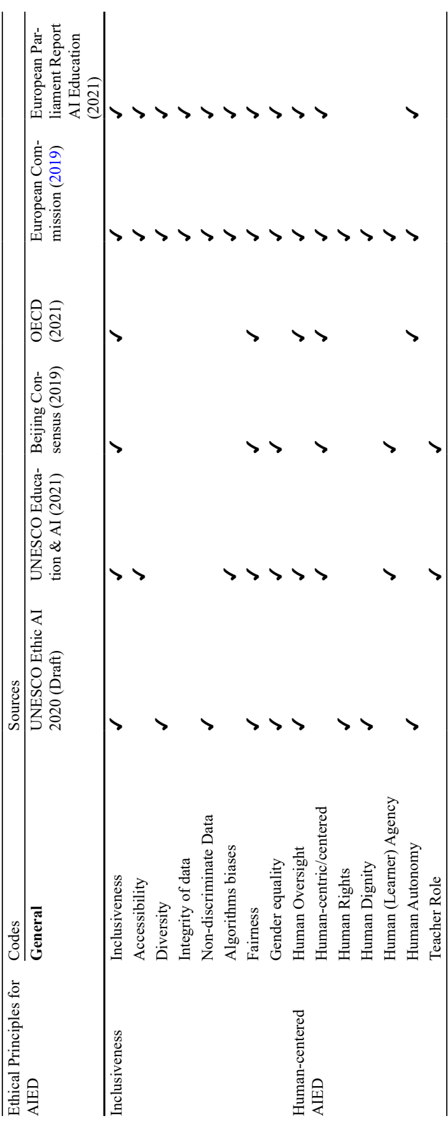
- The authors analyzed ethical guidelines and reports from 6 international sources: UNESCO Ethics AI (AHEG, 2020), UNESCO Education & AI (Miao et al., 2021), Beijing Consensus (UNESCO, 2019), OECD (2021), European Commission (2019), and European Parliament Report AI Education (2021).
- Their thematic analysis produced 39 codes that were collated into 7 themes (principles) for AIED.
- The proposed principles are: governance and stewardship, transparency and accountability, sustainability and proportionality, privacy, security and safety, inclusiveness, and human-centered AIED.
- The paper states that AIED raises concerns about personal data, learner autonomy, privacy, bias, fairness, accountability, inclusiveness, and human rights, while also offering benefits such as personalization and improved learning performance.
## Methods
- The study used thematic analysis based on Braun & Clarke (2012) to examine ethical guidelines and reports related to AIED.
- The sample consisted of policy/guideline documents from international organizations: UNESCO, OECD, European Commission, and European Parliament.
- Analysis involved familiarization, open coding, iterative theme generation, and researcher-researcher corroboration to support reliability and validity.
## Limitations
- The paper says the proposed principles are a starting point and that a precise mechanism for ethical principles in AIED “remains to be elucidated.”
- It explicitly notes that there is no universal consensus on the best ethical theory or standards for AIED, and that the issue is still evolving.
- Evident from the text: the study analyzes published policies and guidelines only, so it does not test the principles in classrooms or evaluate their effectiveness in practice.
Model-written summary. Check it against the paper before relying on it.
Integrity signals
Registry
Cites
Statistics
Figures
Verification
Claims the paper makes
12 Valid · 0 Not valid · 38 Not checked · 11 Own results and interpretations
The cited sources support only part of this claim — read each source’s verdict below.
In the paper
“Hence, there are growing evidence for the roles of AIED to “foster a transformation of knowledge, cognition, and culture” (Hwang et al., 2020, p.1).”
§ Ethical principles for artificial intelligence in education > Opportunities of artificial intelligence in education
What the sources say
- Partly supportedcites Hwang et al., 2020 matched to “Vision, challenges, roles and research issues of Artificial Intelligence in Education” (2020) sourceExperimental — accuracy not yet measured
The Conclusions (page not specified in our copy) say that integrating AI and education is a transformation of human knowledge, cognition, and cultures, supporting the central idea. The passage does not describe growing evidence for AIED’s role in that transformation, and the cited wording is not an exact quotation. (LLM, conf=0.86)
plainstates a cause- Asserted: passes — The authors put it forward as true.
- Checkable: passes — It can be checked against evidence.
- Load-bearing: unclear — It is unclear whether the paper’s conclusions depend on it.
- Based: passes — The paper gives a reason why it holds.
- Partly supported
The cited sources support only part of this claim — read each source’s verdict below.
In the paper
“However, the adoption of AIED has led to increasing ethical risks and concerns regarding several aspects such as personal data and learner autonomy.”
§ Ethical principles for artificial intelligence in education > Abstract The advancement of artificial intelligence in education (AIED) has the potential to transform the educational landscape and influence the role of all involved stakeholders. In recent years, the applications of AIED have been gradually adopted to progress our understanding of students’ learning and enhance learning performance and experience. However, the adoption of AIED has led to increasing ethical risks and concerns regarding several aspects such as personal data and learner autonomy. Despite the recent announcement of guidelines for ethical and trustworthy AIED, the debate revolves around the key principles underpinning ethical AIED. This paper aims to explore whether there is a global consensus on ethical AIED by mapping and analyzing international organizations’ current policies and guidelines. In this paper, we first introduce the opportunities offered by AI in education and potential ethical issues. Then, thematic analysis was conducted to conceptualize and establish a set of ethical principles by examining and synthesizing relevant ethical policies and guidelines for AIED. We discuss each principle and associated implications for relevant educational stakeholders, including students, teachers, technology developers, policymakers, and institutional decision-makers. The proposed set of ethical principles is expected to serve as a framework to inform and guide educational stakeholders in the development and deployment of ethical and trustworthy AIED as well as catalyze future development of related impact studies in the field.
What the sources say
- Partly supportedcites Holmes et al., 2021 matched to “Ethics of AI in Education: Towards a Community-Wide Framework” (2022) sourceExperimental — accuracy not yet measured
“The Ethics of AIED in Particular” identifies privacy concerns about the data collected by AIED, and “Most Ignored Yet Critical Ethical Issues for AIED” identifies lack of human agency as a concern. These passages support the cited concerns, but do not establish that adoption has caused risks concerning personal data and learner autonomy to increase over time. Page numbers are unavailable in our copy. (LLM, conf=0.84)
- Not matchedcites Akgun & Greenhow, 2021
An author–year citation the paper’s reference list doesn’t settle. We don’t search these by name.
- Not matchedcites Miao et al., 2021
An author–year citation the paper’s reference list doesn’t settle. We don’t search these by name.
plainstates a cause- Asserted: passes — The authors put it forward as true.
- Checkable: passes — It can be checked against evidence.
- Load-bearing: passes — The paper’s conclusions depend on it.
- Based: passes — The paper gives a reason why it holds.
- Partly supported
The cited sources support only part of this claim — read each source’s verdict below.
In the paper
“Indeed, a proliferation of studies has revealed the emergence of contrasting ethical themes relating to general AI and AIED, most of which are associated with the liability of data across settings, such as in higher education (Zawacki-Richter et al., 2019), K-12 (Holstein et al., 2019), schools (Luckin, 2017), and subjects (Hwang & Tu, 2021).”
§ Ethical principles for artificial intelligence in education > Ethical issues of AI in education Despite its capability to revolutionize education, numerous challenges also linger for researchers and practitioners who are involved in associated activities or systems (Kay & Kummerfeld, 2019) as AIED is, by nature, a “highly technology-dependent and cross-disciplinary field” (Hwang et al., 2020, p.2). At a global level, UNESCO (2019) pinpointed six challenges in achieving sustainable development of AIED: comprehensive public policy, inclusion and equity in AIED, preparing teachers for AI-powered education,preparing AI to understand education, developing quality and inclusive data systems, making research on AIED significant, ensuring ethics and transparency in data collection, use, and dissemination. At the individual level, challenges range from critical societal drawbacks such as systemic bias, discrimination, inequality for marginalized groups of students, and xenophobia (Hwang et al., 2020) to thorny ethical issues relating to privacy and bias in data collection and processing (Holmes et al., 2021). In fact, the widespread ramifications of AIED have also led to emerging concerns over the negative realities that it brings, such as the widening gaps of inequalities among learners’ commercialization of education, or the home-school divide in education (Reiss, 2021). AI may become pervasive in every sense where those involved may be exposed to risks without being aware of them, and the situation can be even intensified under the ongoing impacts of the COVID-19 pandemic (Borenstein & Howard, 2021). Such obstacles essentialize an urgent demand to induct and acquaint teachers and students with the ethical concerns surrounding AIED and how to navigate them. Furthermore, AIED also carries ethical implications and privacy risks which call for critical attention to differentiate between doing ethical things and doing things ethically (Holmes et al., 2021), or as in the words of Russell and Norvig (2002) “all AI researchers should be concerned with the ethical implications of their work” (p. 1020). Indeed, a proliferation of studies has revealed the emergence of contrasting ethical themes relating to general AI and AIED, most of which are associated with the liability of data across settings, such as in higher education (Zawacki-Richter et al., 2019), K-12 (Holstein et al., 2019), schools (Luckin, 2017), and subjects (Hwang & Tu, 2021). These covered the issues of informed consent, privacy breach, biased data assumption, fairness, accountability, and statistical apophenia. Others also question the impacts of AI-related fields such as surveillance and consent, learner privacy (Sacharidis et al., 2020), identity configuration, user confidentiality, integrity, and inclusiveness (Deshpande et al., 2017). Another stream of discussion has been drawn upon the ethics of data designated for educational use and analytics learning (e.g., Kay & Kummerfeld 2019; Kitto & Knight, 2019; Slade & Prinsloo, 2013). These incorporate the spheres of data interpretation and management, different perspective on the data usage, and the power relation among involved stakeholders such as students, teachers, and the educational objectives (Slade & Prinsloo, 2013). Other ethical issues for AIED include the problems with data collection, restricted availability of data sources, bias and representation, data ownership and control, data autonomy, AIED systems, and human agency (Akgun & Greenhow, 2021; Miao et al., 2021). That said, it is crucial to fully comprehend these values and principals before making ethically and accountability-driven decisions, and being aware of possible, even unexpected outcomes in education. Although recent work has attempted to establish different ethical frameworks for general AI use (e.g., Ashok et al., 2022), ethical and privacy issues are suggested to be contextualized (Ifenthaler & Schumacher, 2016), hence the prior guidelines established in other disciplines might not be appropriate for education. The contextual approach to the ethical design and use of AIED could play an essential role in addressing the issues of ethical and privacy concerns in education context. Prior research has emphasised the importance of the sociotechnical context configured by educational technology and educations practices in ethical considerations (Kitto & Knight, 2019). The understanding of ethics and privacy from various perspectives could promote the design of ethical and trustworthy AIED and the adoption of such systems. Furthermore, we extended the ethical view from published studies reviewed by Ashok et al., (2022) to the policies and guidelines proposed by the international organizations such as UNESCO, OECD, and European Union. The consensus assessment of policies and guidelines would inform a comprehensive and integrated instructions for different stakeholders in adopting AIED. This contributes to establishing a common ground and solid foundation for further development and implementation of AIED.
What the sources say
- Partly supportedcites Zawacki-Richter et al., 2019 matched to “Systematic review of research on artificial intelligence applications in higher education – where are the educators?” (2019) sourceExperimental — accuracy not yet measured
The Introduction identifies privacy and data protection as ethical risks of AI applications in higher education, supporting that part of the claim. But the section ‘Understanding of AI and critical reflection of challenges and risks’ reports that only two of 146 reviewed articles critically reflected on ethical implications; it does not support the claim that a proliferation of studies revealed ethical themes, most concerning data liability. (LLM, conf=0.88)
- Not checked — no full text of the sourcecites Holstein et al., 2019 matched to “Designing for Complementarity: Teacher and Student Needs for Orchestration Support in AI-Enhanced Classrooms” (2019) source
- Not checked — no full text of the sourcecites Luckin, 2017 matched to “Towards artificial intelligence-based assessment systems” (2017) source
boostedstates an association- Asserted: passes — The authors put it forward as true.
- Checkable: passes — It can be checked against evidence.
- Load-bearing: passes — The paper’s conclusions depend on it.
- Based: passes — The paper gives a reason why it holds.
- Partly supported
Every source the paper cites for this claim was checked and supports it.
In the paper
“Bostrom & Yudkowsky (2014) pointed out that AI systems must be “robust against human adversaries deliberately searching for exploitable flaws in the algorithm” (p. 317).”
§ Ethical principles for artificial intelligence in education > Ethical principles for artificial intelligence in education (AIED) > Principle of Security and Safety
What the sources say
- Supportedcites Bostrom & Yudkowsky (2014) matched to “The ethics of artificial intelligence” (2014) source
Section 1 (cited as p. 317) says AI algorithms should be robust against manipulation. It then gives a machine-vision system as an example that must withstand human adversaries searching for exploitable flaws. The quoted wording matches that example. (LLM, conf=0.94)
plain- Asserted: passes — The authors put it forward as true.
- Checkable: passes — It can be checked against evidence.
- Load-bearing: passes — The paper’s conclusions depend on it.
- Based: passes — The paper gives a reason why it holds.
- Supported
The cited sources support only part of this claim — read each source’s verdict below.
In the paper
“Data ethics emphasized the need for transparency in data usage in AIED (Larsson & Heintz, 2020).”
§ Ethical principles for artificial intelligence in education > Ethical principles for artificial intelligence in education (AIED) > Principle of transparency and accountability
What the sources say
- Partly supportedcites Larsson & Heintz, 2020 matched to “Transparency in artificial intelligence” (2020) sourceExperimental — accuracy not yet measured
The Introduction (listed under Abstract; no page given) identifies transparency as a key principle in AI ethics guidelines. Section 2, “A multidisciplinary notion of transparency” (no page given), links AI transparency to the origins of data and how personal data travels. The paper does not address data usage specifically in artificial intelligence in education (AIED), so the educational setting is unsupported. (LLM, conf=0.86)
plainstates a cause- Asserted: passes — The authors put it forward as true.
- Checkable: passes — It can be checked against evidence.
- Load-bearing: passes — The paper’s conclusions depend on it.
- Based: passes — The paper gives a reason why it holds.
- Partly supported
19 more claims
Create a free account to see all 61 claims and to verify the 8 references still open.
- It may state two separate claims as one. 19
- Probably not a substantial claim. 28
Claims other papers make about this one
Each is checked against this paper’s own text: does it say what the citing paper says it does?
The source backs part of the claim, not all of it — or backs it for a different population, condition or comparison.
In the citing paper
“The rise of AI-generated content necessitates a shift towards authentic assessment strategies emphasising higher-order thinking, creativity, and ethical responsibility [ 26 ].”
From Redefining student assessment in AI-infused learning environments: a systematic review of challenges and strategies for academic integrity (2026) · cites this paper as [26]
Experimental — accuracy not yet measuredThe cited source says what the claim attributes to it.
In the citing paper
“There is a real danger of AI becoming pervasive in every sense where those involved may be exposed to risks without being aware of them [32,90].”
From New Era of Artificial Intelligence in Education: Towards a Sustainable Multifaceted Revolution (2023) · cites this paper as [32]
The check wasn’t confident either way, so it gives no verdict — never disputed.
In the citing paper
“This aligns with the sociocultural view that ethical reasoning is dialogic and socially constructed (Nguyen et al., 2023).”
From Generative AI in Design Thinking Pedagogy: Enhancing Creativity, Critical Thinking, and Ethical Reasoning in Higher Education (2025) · cites this paper as Nguyen et al., 2023
Experimental — accuracy not yet measuredThe check wasn’t confident either way, so it gives no verdict — never disputed.
In the citing paper
“Research suggests that assessments should prioritise critical thinking, problemsolving, and creativity over rote memorisation [ 26, 34].”
From Redefining student assessment in AI-infused learning environments: a systematic review of challenges and strategies for academic integrity (2026) · cites this paper as [26]
Experimental — accuracy not yet measuredIn the citing paper
“Although many AI-related guidelines were published before the release of ChatGPT, most are generic and do not specifically address issues and challenges caused by GenAI in higher education”
From Investigating the higher education institutions’ guidelines and policies regarding the use of generative AI in teaching, learning, research, and administration (2025) · cites this paper as Nguyen et al., 2023
1 more claim about this paper
Create a free account to see every claim other papers make about this one.
Citations
Cites
The "what" and "why" of goal pursuits: Human needs and the self-determination of behavior
Deci, E. L., & Ryan, R. M. (2000) · Psychological Inquiry · doi:10.1207/s15327965pli1104_01 · Cited by 34,210
Braun, V., & Clarke, V. (2012) · APA handbook of research methods in psychology, Vol 2: Research designs: Quantitative, qualitative, neuropsychological, and biological. · doi:10.1037/13620-004 · Cited by 10,299
Zawacki-Richter, O., Marín, V. I., Bond, M., & Gouverneur, F. (2019) · International Journal of Educational Technology in Higher Education · doi:10.1186/s41239-019-0171-0 · Cited by 7,242 · cited 2×
“…the emergence of contrasting ethical themes relating to general AI and AIED, most of which are associated with the liability of data across settings, such as in higher education (Zawacki-Richter et al., 2019), K-12 (Holstein et al., 2019), schools (Luckin, 2017 ), and subjects (Hwang & Tu, 2021 ).”
Background(2014) · Medical Entomology and Zoology · Cited by 6,828
The global landscape of AI ethics guidelines
Jobin, A., Ienca, M., & Vayena, E. (2019) · Nature Machine Intelligence · doi:10.1038/s42256-019-0088-2 · Cited by 6,220 · cited 2×
“The objective is to cultivate trust among learners and provide them with insights to leverage their skills across contexts while maintaining control of their respective data and digital identities (Jobin et al., 2019).”
BackgroundThe Ethics of AI Ethics: An Evaluation of Guidelines
Hagendorff, T. (2020) · Minds and Machines · doi:10.1007/s11023-020-09517-8 · Cited by 1,911 · cited 1×
“…and open communica - tions with beneficiaries: educators, students, parents, AI developers, and policymak - ers (Berendt et al., 2020 ; Nigam et al., 2021 ; Hagendorff, 2020 ) stated that more emphasis is necessary to enforce ethical guidelines for AI systems to better align with societal values.”
BackgroundThe Ethics of AI Ethics -- An Evaluation of Guidelines
Hagendorff, T. (2019) · arXiv · doi:10.48550/arxiv.1903.03425 · Cited by 1,907 · cited 1×
“…and open communica - tions with beneficiaries: educators, students, parents, AI developers, and policymak - ers (Berendt et al., 2020 ; Nigam et al., 2021 ; Hagendorff, 2020 ) stated that more emphasis is necessary to enforce ethical guidelines for AI systems to better align with societal values.”
BackgroundArtificial Intelligence in Human Resources Management: Challenges and a Path Forward
Tambe, P., Cappelli, P., & Yakubovich, V. (2019) · California Management Review · doi:10.1177/0008125619867910 · Cited by 1,609
Artificial intelligence in education: Addressing ethical challenges in K-12 settings
Akgun, S., & Greenhow, C. (2022) · AI and Ethics · doi:10.1007/s43681-021-00096-7 · Cited by 1,473 · cited 2×
“…collaborative learning or asynchronous discussion groups, allows cost-wise personalized learning through a navigation system underpinned by algorithms (Nye, 2015 ), promoted by the use of automated assessment,facial recognition systems, and predictive analytics (Akgun & Greenhow, 2021 ).”
BackgroundMethodEthics of AI in Education: Towards a Community-Wide Framework
Holmes, W., Porayska-Pomsta, K., Holstein, K., Sutherland, E., Baker, T., Shum, S. B., Santos, O. C., Rodrigo, M. T., Cukurova, M., Bittencourt, I. I., et al. (2022) · International Journal of Artificial Intelligence in Education · doi:10.1007/s40593-021-00239-1 · Cited by 1,437 · cited 8×
“…ethical implications and privacy risks which call for critical attention to differentiate between doing ethical things and doing things ethically (Holmes et al., 2021 ), or as in the words of Russell and Norvig ( 2002 ) “all AI researchers should be concerned with the ethical implications of…”
BackgroundInfluential
Research works printed but not linked: 1
- Russel, S. J., & Norvig, P. R. (2002). Artificial Intelligence: A modern approach (2nd Ed.) Prentice Hall Upper Saddle River, NJ, USA
Cited by
Items 101–200 of 1,202
Ethical Considerations in AI Development
Singh, B. P., & Joshi, A. (2024) · Advances in computational intelligence and robotics book series · doi:10.4018/979-8-3693-2964-1.ch010 · Cited by 47
Imjai, N., Yordudom, T., Yaacob, Z., Saad, N. H. M., & Aujirapongpan, S. (2024) · Technological Forecasting and Social Change · doi:10.1016/j.techfore.2024.123889 · Cited by 69
A Review of Artificial Intelligence Interventions for Students with Autism Spectrum Disorder
Κώτση, Σ., Χανδρινού, Σ., Iatraki, G., & Soulis, S. (2025) · Disabilities · doi:10.3390/disabilities5010007 · Cited by 70
Amin, M. R. M., Ismail, I., & Sivakumaran, V. M. (2025) · Social Sciences & Humanities Open · doi:10.1016/j.ssaho.2025.101308 · Cited by 114
La inteligencia artificial generativa y la educación universitaria: ¿Salió el genio de la lámpara?
Mendiola, M. S., & Carbajal-Degante, E. (2023) · Perfiles Educativos · doi:10.22201/iisue.24486167e.2023.especial.61692 · Cited by 141
“• Cuidar los aspectos éticos, de derechos de autor, privacía de datos y confidencialidad (Mhlanga et al ., 2023 ; Nguyen et al. , 2023 ; The White House-Office of Science and Technology Policy, 2023 ).”
BackgroundKarakaş, A. (2023) · Advances in educational technologies and instructional design book series · doi:10.4018/978-1-6684-9893-4.ch012 · Cited by 52
Implicit bias in large language models: Experimental proof and implications for education
Warr, M., Oster, N. J., & Isaac, R. (2025) · Journal of Research on Technology in Education · doi:10.1080/15391523.2024.2395295 · Cited by 61
“AI has been described as a technology that can be useful across several aspects of education, including for student tracking, personalizing teaching and learning, automated assessment, and more (Nguyen et al., 2023).”
Abubakar, S., Jeilani, A., & Yusuf, M. (2025) · Cogent Education · doi:10.1080/2331186x.2025.2591503 · Cited by 109
“As noted by Nguyen et al., the establishment of ethical principles in AI education is imperative to guide stakeholders in addressing these concerns effectively (Nguyen et al., 2023).”
Development and validation of the Artificial Intelligence Literacy Scale for Teachers (AILST)
Ning, Y., Zhang, W., Yao, D., Fang, B., Xu, B., & Wijaya, T. T. (2025) · Education and Information Technologies · doi:10.1007/s10639-025-13347-5 · Cited by 80
“Teachers’ adherence to the ethics can maximize AI in education while ensuring fairness and safety (Nguyen et al., 2023).”
Explainable Artificial Intelligence in Education: A Comprehensive Review
Chaushi, B. A., Selimi, B., Chaushi, A., & Apostolova, M. (2023) · Communications in computer and information science · doi:10.1007/978-3-031-44067-0_3 · Cited by 58
The Role of Artificial Intelligence in Shaping the Future of Education: Opportunities and Challenges
Іванашко, О., Козак, А., Knysh, T., & Honchar, K. (2024) · Futurity Education · doi:10.57125/fed.2024.03.25.08 · Cited by 60
“They include data privacy and security, bias and fairness, lack explainability (Nguyen et al., 2023).”
BackgroundGuo, S., Shi, L., & Zhai, X. (2025) · Education and Information Technologies · doi:10.1007/s10639-025-13338-6 · Cited by 35
“One of the concerns is that the decision process of AI is not transparent and can potentially be biased, which makes it possible to lead to unfair treat-ment of students (Nguyen et al., 2023).”
Ichikawa, T., Olsen, E., Vinod, A., Glenn, N., Hanna, K., Lund, G. C., & Pierce-Talsma, S. (2025) · JMIR Medical Education · doi:10.2196/58766 · Cited by 34
Converging perspectives: Assessing AI readiness and utilization in Philippine higher education
Asirit, L. B. L., & Hua, J. H. (2023) · Polaris Global Journal of Scholarly Research and Trends · doi:10.58429/pgjsrt.v2n3a152 · Cited by 59
“Additionally, the results underscore the need to acknowledge that AI is not universally applicable but fulfills distinct objectives for individual students (Nguyen et al., 2022).”
BackgroundAI-Driven Learning Analytics in STEM Education
Nuangchalerm, P. (2023) · International Journal on Research in STEM Education · doi:10.33830/ijrse.v5i2.1596 · Cited by 56
“An excessive dependence on AI may restrict the choices that students are able to make on their own education, which may stifle both creative thinking and critical analysis (Nguyen et al., 2023).”
BackgroundDesign and Evaluation of Trustworthy Knowledge Tracing Model for Intelligent Tutoring System
Lu, Y., Wang, D., Chen, P., & Zhang, Z. (2024) · IEEE Transactions on Learning Technologies · doi:10.1109/tlt.2024.3403135 · Cited by 52
The Future of AI in Education: Predictions and Emerging Trends
Kayyali, M. (2024) · Advances in educational technologies and instructional design book series · doi:10.4018/979-8-3693-7220-3.ch013 · Cited by 38
Multi-stakeholder perspective on responsible artificial intelligence and acceptability in education
Karran, A. J., Charland, P., Martineau, J. T., de Guinea, A. O., Lesage, A., Sénécal, S., & Léger, P. (2025) · npj Science of Learning · doi:10.1038/s41539-025-00333-2 · Cited by 91
“Forthethirdstakeholdergroup,teachers,themediationanalysis showedthattheintentiontousewasin fl uenced by their perceptions of global utility and perceived usefulness, particularly in the context of explainability.”
Decoding AI ethics from Users' lens in education: A systematic review
An, Q., Yang, J., Xu, X., Zhang, Y., & Zhang, H. (2024) · Heliyon · doi:10.1016/j.heliyon.2024.e39357 · Cited by 85
Technology in education: Addressing legal and governance challenges in the digital era
Li, Z., & Zhang, W. (2024) · Education and Information Technologies · doi:10.1007/s10639-024-13036-9 · Cited by 79
“Nguyen et al. ( 2023 ) explore the intricate relationship between AI and education, emphasizing the pressing need for tailored ethical principles to mitigate concerns surrounding data privacy and human rights advocacy.”
Sahar, R., & Munawaroh, M. (2025) · Discover Sustainability · doi:10.1007/s43621-025-01086-z · Cited by 97
Yi, M., & Chen, M. (2025) · Frontiers in Psychology · doi:10.3389/fpsyg.2025.1568239 · Cited by 79
Anderson, J. E., Nguyen, C. A., & Moreira, G. (2025) · The International Journal of Information and Learning Technology · doi:10.1108/ijilt-10-2024-0240 · Cited by 33
The AI-driven classroom: A review of 21st century curriculum trends
Jaramillo, J. J., & Chiappe, A. (2024) · Prospects · doi:10.1007/s11125-024-09704-w · Cited by 70
“Ethical AI implementation in education requires careful attention to issues of fairness, transparency, and accountability to avoid reinforcing existing educational inequities (Nguyen et al., 2023).”
Kalbande, D., Yuvaraj, M., Verma, M. K., Subaveerapandiyan, A., Suradkar, P., & Chavan, S. (2024) · Open Information Science · doi:10.1515/opis-2024-0006 · Cited by 79
Comprehensive AI assessment framework: Enhancing educational evaluation with ethical AI integration
Kılınç, S. (2024) · Journal of Educational Technology and Online Learning · doi:10.31681/jetol.1492695 · Cited by 69
Undergraduate students’ perspectives of generative AI ethics
Yang, T., Cheon, J., Cho, M., Huang, M., & Cusson, N. (2025) · International Journal of Educational Technology in Higher Education · doi:10.1186/s41239-025-00533-1 · Cited by 58
“Educational experts build up AI ethics and assume that they are equally important from a theoretical perspective (Florid & Cowls, 2022; Nguyen et al., 2022; Schiff et al., 2021).”
Generative AI in Education: Mapping the Research Landscape Through Bibliometric Analysis
Ng, S. L., & Ho, C. (2025) · Information · doi:10.3390/info16080657 · Cited by 81
Hacia un marco ético de la inteligencia artificial en la educación
Rodríguez, A. M. A. (2024) · Teoría de la Educación Revista Interuniversitaria · doi:10.14201/teri.31821 · Cited by 92
Zuo, Z., Luo, Y., Yan, S., & Jiang, L. (2025) · Systems · doi:10.3390/systems13080664 · Cited by 29
ChatGPT, the perfect virtual teaching assistant? Ideological bias in learner-chatbot interactions
Poucke, M. V. (2024) · Computers & composition/Computers and composition · doi:10.1016/j.compcom.2024.102871 · Cited by 50
Klímová, B., & Campos, V. (2024) · Cogent Education · doi:10.1080/2331186x.2024.2373512 · Cited by 54
“These studies emphasize the importance of addressing ethical concerns, such as bias and discrimination, while also exploring the impact of AI on student outcomes, teacher development, and educational quality (Gouvea, 2024; Nguyen et al., 2023).”
Future of Textile: Sustainable Manufacturing & Prediction via ChatGPT
Rathore, B. (2023) · Eduzone International peer reviewed/refereed academic multidisciplinary journal · doi:10.56614/eiprmj.v12i1y23.253 · Cited by 88
Factors influencing educators' AI adoption: A grounded meta-analysis review
Taheri, R., Nazemi, N., Pennington, S. E., Clark, J. A., & Dadgostari, F. (2025) · Computers and Education Artificial Intelligence · doi:10.1016/j.caeai.2025.100464 · Cited by 89
Guo, Q., Zhen, J., Wu, F., He, Y., & Qiao, C. (2025) · Journal of Educational Computing Research · doi:10.1177/07356331241312365 · Cited by 28
Impact of Artificial Intelligence in Students’ Learning Life
Raja, S., Jebadurai, D. J., Ivan, L., Rudenko, M., Ruslan, K., & Reznik, N. P. (2024) · Studies in systems, decision and control · doi:10.1007/978-3-031-49544-1_1 · Cited by 53
UNESCO's AI Ethics Principles: Challenges and Opportunities
AllahRakha, N. (2024) · International Journal of Law and Policy · doi:10.59022/ijlp.225 · Cited by 64
Exploring the impact of AI threats on originality and critical thinking in academic writing
Octaberlina, L. R., Muslimin, A. I., Chamidah, D., Surur, M., & Mustikawan, A. (2024) · Edelweiss Applied Science and Technology · doi:10.55214/25768484.v8i6.3878 · Cited by 68
“However, with the advent of AI technology, there are concerns that this critical thinking ability could be eroded (Nguyen et al., 2023).”
AI adoption in Chinese universities: Insights, challenges, and opportunities from academic leaders
Wang, X., Zhao, S., Xu, X., Zhang, H., & Lei, V. N.-L. (2025) · Acta Psychologica · doi:10.1016/j.actpsy.2025.105160 · Cited by 53
Polat, M., Karataş, İ. H., & Varol, N. (2025) · Leadership and Policy in Schools · doi:10.1080/15700763.2024.2412204 · Cited by 28
“Consequently, the advancement of AI in education appears to have the potential to transform the educational environment and influence the role of all relevant stakeholders (Nguyen et al., 2023).”
Altınay, Z., Altınay, F., Sharma, R. C., Dağlı, G., Shadiev, R., Yıkıcı, B., & Altınay, M. (2024) · Societies · doi:10.3390/soc14080148 · Cited by 69
Villagrán, I., Hernández, R., Schuit, G., Neyem, A., Fuentes‐Cimma, J., Miranda, C., Hilliger, I., Espinoza, V. D., Escalona, G., & Varas, J. (2024) · IEEE Transactions on Learning Technologies · doi:10.1109/tlt.2024.3450210 · Cited by 41
Exploring emergent AI-TPACK competencies in a two-week AI literacy module for preservice teachers
Aldemir, T., Bicer, A., Kilinc, S., Moon, J., & Kwok, M. (2025) · Teaching and Teacher Education · doi:10.1016/j.tate.2025.105231 · Cited by 27
“…possess the practical skills to use AI tools, critically evaluate their educational and societal impacts, and recognize ethical and social implications, such as bias, fairness, privacy, and transparency, associated with AI adoption (Abdulayeva et al., 2025; Ng et al., 2021; Nguyen et al., 2023).”
Chanda, R. C., Zadeh, A. V., Hanifah, H. M., & Ramayah, T. (2025) · Education and Information Technologies · doi:10.1007/s10639-025-13360-8 · Cited by 44
“It has the potential to provide sustainable, high-quality education with personalized support for all, without incurring significant expenses (Chiu et al., 2023; Nguyen et al., 2023).”
K-12 teachers’ ethical competencies for AI literacy: Insights from a systematic literature review
Tagare, D., Karki, T., & Yu, W. (2025) · Computers & Education · doi:10.1016/j.compedu.2025.105435 · Cited by 67
Yang, S., Yang, S., & Tong, C. (2023) · Adult and Higher Education · doi:10.23977/aduhe.2023.051902 · Cited by 41
“As a virtual teaching assistant or writing guidance tool, AICG can provide guidance and advice on academic writing [18-19].”
BackgroundOliveira, J., Murphy, T. H., Vaughn, G., Elfahim, S., & Carpenter, R. E. (2024) · New Horizons in Adult Education and Human Resource Development · doi:10.1177/19394225241287032 · Cited by 44
“Ensuring that AI applications respect the privacy rights of students and faculty, provide equitable outcomes, and maintain transparency in their operations is crucial (Nguyen et al., 2023).”
Agyare, B. O., Asare, J., Kraishan, A., Nkrumah, I., & Adjekum, D. K. (2025) · Computers and Education Artificial Intelligence · doi:10.1016/j.caeai.2025.100365 · Cited by 55
Using AI to Improve Accessibility and Inclusivity in Higher Education for Students with Disabilities
Mitre, X., & Zeneli, M. (2024) · International Conference on Information Technology Based Higher Education and Training (ITHET) · doi:10.1109/ithet61869.2024.10837607 · Cited by 32
Generative AI on professional development: a narrative inquiry using TPACK framework
Shrestha, B. L. L., Dahal, N., Hasan, M. K., Paudel, S., & Kapar, H. (2025) · Frontiers in Education · doi:10.3389/feduc.2025.1550773 · Cited by 67
Ncube, P. D. N., Dzvapatsva, G. P., Matobobo, C., & Ranga, M. M. (2026) · AI and Ethics · doi:10.1007/s43681-025-00871-w · Cited by 31
Testolin, A. (2024) · Applied Sciences · doi:10.3390/app14020744 · Cited by 24
Marrone, R., Fowler, S., Bathakur, A., Dawson, S., Siemens, G., & Singh, C. (2025) · School Leadership & Management · doi:10.1080/13632434.2024.2425019 · Cited by 27
“This is similar with emerging research on these topics (Fullan et al. 2023; Khosravi et al. 2023; Nguyen et al. 2023).”
Zhai, S., Zhang, S., Rong, Y., & Rong, G. (2025) · Education and Information Technologies · doi:10.1007/s10639-025-13352-8 · Cited by 47
“Despite the ethical considerations raised by studies like Nguyen et al. (2023 ), the literature does not sufficiently address how institutional policies could mandate and normalize MH education as a core part of higher education curricula.”
Nguyen, A., Duong, A. T., Nguyen, D. T. B., Lai, V. T. T., & Dang, B. (2025) · Information and Learning Sciences · doi:10.1108/ils-11-2024-0148 · Cited by 24
Self-citationTeacher Training on Artificial Intelligence in Education
Fissore, C., Floris, F., Marchisio, M., & Sacchet, M. (2024) · Cognition and exploratory learning in the digital age · doi:10.1007/978-3-031-54207-7_13 · Cited by 38
Yeşilyurt, S., Dündar, R., & Aydın, M. (2024) · ASYA STUDIES · doi:10.31455/asya.1406649 · Cited by 46
Hernández, D. C. V., Pérez, M. L. R., & Salazar-Garcés, L. F. (2023) · Salud Ciencia y Tecnología - Serie de Conferencias · doi:10.56294/sctconf2023582 · Cited by 53
Empowering Student Learning Through Artificial Intelligence: A Bibliometric Analysis
Yun, G., Lee, K. M., & Choi, H. H. (2024) · Journal of Educational Computing Research · doi:10.1177/07356331241278636 · Cited by 37
AI Policies, Equity, and Morality and the Implications for Faculty in Higher Education
Azevedo, L., Mallinson, D. J., Wang, J., Robles, P., & Best, E. (2024) · Public Integrity · doi:10.1080/10999922.2024.2414957 · Cited by 53
“…morality through accountability, and the protection of data privacy in AI-driven education, while also highlighting inclusiveness, human-centered approaches, and a focus on human rights and dignity in shaping the future of higher education through AI (Daly et al., 2019; Nguyen et al., 2023).”
InfluentialYang, H. (2025) · Scientific Reports · doi:10.1038/s41598-025-92327-8 · Cited by 49
AI in Education: Shaping the Future of Teaching and Learning
Takona, J. (2024) · International Journal of Current Educational Studies · doi:10.46328/ijces.121 · Cited by 24
Ethical use of artificial intelligence and new technologies in Education 5.0
Smyrnaiou, Z., Liapakis, A., & Bougia, A. (2023) · Journal of Artificial Intelligence, Machine Learning and Data Science · doi:10.51219/jaimld/anastasios-liapakis/15 · Cited by 22
Alamäki, A. V., Khan, U. A., Kauttonen, J., & Schlögl, S. (2024) · Education Sciences · doi:10.3390/educsci14121386 · Cited by 41
A systematic review of AI anxiety in education
Wu, X., & Li, H. (2025) · AI and Ethics · doi:10.1007/s43681-025-00783-9 · Cited by 35
Yang, J., Xie, W., & Ni, J. (2025) · Scientific Reports · doi:10.1038/s41598-025-21977-5 · Cited by 26
“It ensures that AI systems designed for educational purposes promote fairness, accountability, and respect for students’ privacy and rights 16 .”
Itani, A., Gronseth, S. L., Musaad, S. M. A., Nguyen, T. T., Mirabile, Y. Z., & Beech, B. M. (2025) · International Journal of Educational Technology in Higher Education · doi:10.1186/s41239-025-00563-9 · Cited by 49
Lifelong learner needs for human-centered self-regulated learning analytics
Nguyen, A., Lämsä, J., Dwiarie, A., & Järvelä, S. (2023) · Information and Learning Sciences · doi:10.1108/ils-07-2023-0091 · Cited by 42
Self-citationEnhancing Language Teaching Materials Through Artificial Intelligence: Opportunities and Challenges
Singha, S., Singha, R., & Jasmine, E. (2024) · Advances in educational technologies and instructional design book series · doi:10.4018/979-8-3693-0872-1.ch002 · Cited by 34
Mindset matters: Fostering teachers’ responsible AI use through professional development
Huynh, L., Le, T. H., Dang, B., An, B. T., Vu, C. T., & Nguyen, A. (2025) · Journal of New Approaches in Educational Research · doi:10.1007/s44322-025-00043-y · Cited by 22
“…to personalize learning and enhance instructional practice (Giannakos et al., 2024) , much of this work continues to focus on AI’s capabilities rather than on its pedagogical integration, a persistent issue in educational-technology research (Barrett & Pack, 2023; Mayer, 2019; Nguyen et al., 2023).”
Self-citationSELL ME THIS ARTIFICIAL PEN: USING CHATGPT TO ENHANCE SALES ROLE PLAYS
Milovic, A., Das Gyomlai, M., Spaid, B., & Dingus, R. (2024) · Marketing Education Review · doi:10.1080/10528008.2024.2341278 · Cited by 21
PERSONALISED LEARNING WITH AI: IMPLICATIONS FOR IGNATIAN PEDAGOGY
Baskara, R. (2023) · International Journal of Educational Best Practices · doi:10.31258/ijebp.v7n1.p1-16 · Cited by 41
“Ensuring AI systems are designed and implemented to minimize bias and promote fairness and equity in education (Nguyen et al., 2022).”
BackgroundNavigating the Legal Landscape: AI Adoption in Education and Teacher Responsibilities
Alqodsi, E. M., Jadalhaq, I. M., Maknouzi, M. E. H. E., & Abdulhay, I. E. (2024) · Advances in educational technologies and instructional design book series · doi:10.4018/979-8-3693-0880-6.ch015 · Cited by 26
Okul Öncesi Eğitimi Öğretmenlerinin Yapay Zekâya İlişkin Görüşleri
Küçükkara, M. F., Ünal, M., & Sezer, T. (2024) · Temel Eğitim Araştırmaları Dergisi · doi:10.55008/te-ad.1431142 · Cited by 29
Addressing the elephant in the room: engaging students in ChatGPT conversations on assessments
Nimri, R., & Yang, E. C. L. (2024) · Journal of Teaching in Travel & Tourism · doi:10.1080/15313220.2024.2384741 · Cited by 20
“The learner-centric approach invites students to examine their positions on the use of AI in assessment, imparting not only subject knowledge but also reflective and self-regulation skills (Nguyen et al., 2023).”
Chou, C.-M., Shen, T.-C., Shen, T.-C., & Shen, C.-H. (2024) · Journal of Computers in Education · doi:10.1007/s40692-024-00332-z · Cited by 41
“These platforms include, for example, Chinese and English writing training platforms that provide feedback and improvement suggestions to improve English writing skills, along with practical English conversation training platforms (Chou et al., 2024; Nguyen et al., 2023).”
Swidan, A., Lee, S. Y., & Romdhane, S. B. (2025) · Education Sciences · doi:10.3390/educsci15040461 · Cited by 42
Acut, D. P., Gamusa, E. V., Pernaa, J., Yuenyong, C., Pantaleon, A. T., Espina, R. C., Sim, M. J. C., & Garcia, M. B. (2025) · Advances in computational intelligence and robotics book series · doi:10.4018/979-8-3373-0122-8.ch005 · Cited by 27
Ethical Use of Generative Artificial Intelligence Among Ecuadorian University Students
Buele, J., García, Á. R. S., Sabando-García, B. J., & Yánez-Rueda, H. (2025) · Sustainability · doi:10.3390/su17104435 · Cited by 52
Unpacking the ethics of using AI in primary and secondary education: a systematic literature review
Wieczorek, M., Hosseini, M., & Gordijn, B. (2025) · AI and Ethics · doi:10.1007/s43681-025-00770-0 · Cited by 57
“Authors also raise concerns that educational data could be later used for non-educational purposes against the will of students [3, 40, 44].”
InfluentialXie, X., & Wang, T. (2023) · Education and Information Technologies · doi:10.1007/s10639-023-11947-7 · Cited by 32
Kavitha, K., & Joshith, V. P. (2024) · Bulletin of Science Technology & Society · doi:10.1177/02704676241283362 · Cited by 36
Ethical Implications of Generative AI in Education: Privacy, Bias, and Integrity
Kayyali, M. (2025) · Advances in computational intelligence and robotics book series · doi:10.4018/979-8-3693-8744-3.ch008 · Cited by 23
AI policies in school education: a comparative study on China, Singapore, Finland, and the US
Kundu, A., & Bej, T. (2025) · Journal of Science and Technology Policy Management · doi:10.1108/jstpm-06-2024-0218 · Cited by 20
Abuadas, M. H., & Albikawi, Z. F. (2025) · Ethics & Behavior · doi:10.1080/10508422.2025.2511336 · Cited by 36
“Transparency refers to the extent to which AI systems operate in an understandable and explainable manner, allowing healthcare professionals and other users to grasp the underlying processes and rationale behind AI-driven decisions (Floridi & Cowls, 2022; Nguyen et al., 2023).”
Lim, T., Gottipati, S., & Cheong, M. L. F. (2025) · International Journal of Educational Technology in Higher Education · doi:10.1186/s41239-025-00556-8 · Cited by 44
“The application of AIED has precipitated a range of ethical issues that are critical to address for the responsible use of this technology (Nguyen et al., 2023).”
Veletsianos, G., Houlden, S., & Johnson, N. E. (2024) · TechTrends · doi:10.1007/s11528-024-00942-5 · Cited by 27
“Notably, the concern in most of these instances is almost always about the impact AI might have on humans, with “non-maleficence” of AI (i.e., AI being benign) being a key area of inquiry for AI ethicists (e.g., Dignum, 2022; Nguyen et al., 2023; Peters et al., 2023).”
Ahmed, H. (2024) · International Journal of Educational Reform · doi:10.1177/10567879241247551 · Cited by 29
“One concern is how AI systems might promote biases and discrimination, which could lead to unfair treatment in educational institute (Bers & Schmidt, 2019 and Nguyen et al., 2022).”
The Urgency of AI Integration in Teacher Training: Shaping the Future of Education
Bekdemir, Y. (2024) · Journal of Research in Didactical Sciences · doi:10.51853/jorids/15485 · Cited by 19
Mentigo: An Intelligent Agent for Mentoring Students in the Creative Problem Solving Process
Zha, S., Liu, Y., Zheng, C., Xu, J., Yu, F., Gong, J., & Xu, Y. (2025) · Proceedings of the 2025 CHI Conference on Human Factors in Computing Systems · doi:10.1145/3706598.3713952 · Cited by 19
Tanksley, T., Smith, A. D. R., Sharma, S., & Huff, E. W. (2025) · Proceedings of the 2025 CHI Conference on Human Factors in Computing Systems · doi:10.1145/3706598.3713510 · Cited by 19
Building an AI Future: Research and Policy Directions for Africa's Higher Education
Maina, A. M., & Kuria, J. (2024) · IST-Africa Conference (IST-Africa) · doi:10.23919/ist-africa63983.2024.10569692 · Cited by 42
“Together, they address the unique social, cultural, and political barriers that could impact the successful integration of AI [2], [7], [44].”
BackgroundNguyen, H. L., Dang, B., Hong, Y., & Nguyen, A. (2024) · Journal of International Cooperation in Education · doi:10.1108/jice-03-2024-0010 · Cited by 27
Self-citationYapay Zekânın Eğitim Sistemine Entegrasyonunun Potansiyel Faydaları
Temur, S. (2024) · Batı anadolu eğitim bilimleri dergisi · doi:10.51460/baebd.1541524 · Cited by 27
Okamoto, S., Kataoka, M., Itano, M., & Sawai, T. (2025) · BMC Medical Education · doi:10.1186/s12909-025-06801-y · Cited by 18
Eğitimde yapay zekâ kullanımı: Etik sorunlar ve çözümler
Temur, S. (2025) · Mehmet Akif Ersoy üniversitesi eğitim fakültesi dergisi. · doi:10.21764/maeuefd.1516576 · Cited by 33
Akinsemolu, A. A., & Onyeaka, H. N. (2025) · Journal of language and Education · doi:10.17323/jle.2025.22118 · Cited by 40
“Granted, the lack of a univer - sal consensus on standard guidelines for AI in education is acknowledged (Nguyen et al., 2022).”
Cao, X., Huang, Z., Li, M., & He, T. (2025) · Teaching and Teacher Education · doi:10.1016/j.tate.2025.105270 · Cited by 39
A Hybrid Intelligence-Based Integrated Smart Evaluation Model for Vocal Music Teaching
Wu, R. (2023) · IEEE Access · doi:10.1109/access.2023.3323214 · Cited by 18
“Piano education is called by many people the art of ‘‘cultivating sentiment and enhancing literary and artistic temperament’’ [1].”
BackgroundEthics of Artificial Intelligence in University Education
Zeer, M., Siaj, R. W., Ghannam, J. A., & Kanan, M. A. (2023) · International Engineering Conference on Electrical, Energy, and Artificial Intelligence (EICEEAI) · doi:10.1109/eiceeai60672.2023.10590285 · Cited by 29
“Nguyen et al. (2023) draw attention to concerns about how AI implementation may infringe upon these rights, underscoring the importance of careful consideration and ethical oversight in the deployment of AI technologies in education [21].”
Background
Metadata
- Authors
- Nguyen, A., Ngo, H. N., Hong, Y., Dang, B., & Nguyen, B.-P. T.
- Affiliations
- University of Oulu (FI)
- Victoria University of Wellington (NZ)
- University of Languages and International Studies (VN)
- Corresponding author
- Nguyen, Andy
- Venue
- Education and Information Technologies
- Published
- 2022-10-13
- Volume
- 28
- Issue
- 4
- Pages
- 4221-4241
- ISSN
- 1360-2357 (ISSN-L)
- 1573-7608
- PMC
- PMC9558020
- OpenAlex
- W4304943299
- Semantic Scholar
- ec13995de8797a4e977024942d79fc0d27e20b7b
- Cited by
- 1,228
- References
- 71
- Citations by year
- 2026: 367 · 2025: 479 · 2024: 303 · 2023: 78
- FWCI
- 249.31
- Type
- journal article
- Language
- en
- Open access
- hybrid
- doi.org
- Licence
- cc-by
- creativecommons.org/licenses/by/4.0 (tdm)
- creativecommons.org/licenses/by/4.0 (vor)
- Locations
- Education and Information Technologies (publishedVersion, cc-by)
- PubMed Central (publishedVersion, cc-by)
- PubMed (publishedVersion)
- Open Access Victoria University of Wellington | Te Herenga Waka (Figshare) (submittedVersion, cc-by-nc-nd)
- Victoria University of Wellington
- Funders
- University of Oulu including Oulu University Hospital
- Topics
- Physical Sciences › Computer Science › Artificial Intelligence › Ethics and Social Impacts of AI
- Social Sciences › Education › Artificial Intelligence in Education
- Physical Sciences › Computer Science › Artificial Intelligence › Intelligent Tutoring Systems and Adaptive Learning
- Keywords
- artificial intelligence in education, ethical principles, AI ethics, trustworthy AI, moral norms, personal data, learner autonomy, educational stakeholders, ethical frameworks
About these checks
Registry, retraction, Cites and statistics results are computed, not judged, with one exception: a printed reference that no index lists is read once by a model before it counts as a citation error. Claims are extracted by a model and kept only when their quote appears verbatim in the text; each cited source is then checked, with a model’s help, for whether it says what the claim relies on. Those verdicts can be wrong — read the claim’s quote and the cited source before relying on one.
The claim verdicts this report counts are experimental: their accuracy is not yet measured.
A language model drew the claims from the paper on 2026-10-10, under version 3 of the claim definition (model deepseek-v4.1-flash, prompt extract-v3).
A second model labelled each claim on 2026-10-10 (model jev-1.13-20260917, definition revision gold-guideline-v0.2).
Cited sources are checked with a language model’s help (gpt-6-sol).
Statistics and arithmetic are recomputed, not judged.
Confidence bands are shown only for fields calibrated on our annotated test set. None is calibrated yet, so no band is shown.
What counts as a claim ›How we measure confidence ›How we check this ›
Are you an author, or do you see a problem with this page? Request a review
Data sources
Bibliographic data: Semantic Scholar, OpenAlex, Crossref.
Contains information from the Semantic Scholar Academic Graph Datasets, made available under the ODC Attribution License (ODC-BY 1.0).
Semantic Scholar’s data is described in: Kinney, R., et al. (2023). The Semantic Scholar Open Data Platform. arXiv:2301.10140.
