

Ethical principles for artificial intelligence in education
Open accessThe DOI matches its Crossref record; 75 of the 76 references it cites were found in a registry or an index; 13 of the 67 sources its claims cite were checked for support.
Abstract
The advancement of artificial intelligence in education (AIED) has the potential to transform the educational landscape and influence the role of all involved stakeholders. In recent years, the applications of AIED have been gradually adopted to progress our understanding of students' learning and enhance learning performance and experience. However, the adoption of AIED has led to increasing ethical risks and concerns regarding several aspects such as personal data and learner autonomy. Despite the recent announcement of guidelines for ethical and trustworthy AIED, the debate revolves around the key principles underpinning ethical AIED. This paper aims to explore whether there is a global consensus on ethical AIED by mapping and analyzing international organizations' current policies and guidelines. In this paper, we first introduce the opportunities offered by AI in education and potential ethical issues. Then, thematic analysis was conducted to conceptualize and establish a set of ethical principles by examining and synthesizing relevant ethical policies and guidelines for AIED. We discuss each principle and associated implications for relevant educational stakeholders, including students, teachers, technology developers, policymakers, and institutional decision-makers. The proposed set of ethical principles is expected to serve as a framework to inform and guide educational stakeholders in the development and deployment of ethical and trustworthy AIED as well as catalyze future development of related impact studies in the field.
Overview
CoChat Summary
## TL;DR
This paper maps international ethical guidelines for artificial intelligence in education and, through thematic analysis, proposes a set of principles for ethical and trustworthy AIED. It argues that AIED should be governed by a human-centered framework that addresses transparency, privacy, inclusiveness, safety, sustainability, and accountability.
## Key findings
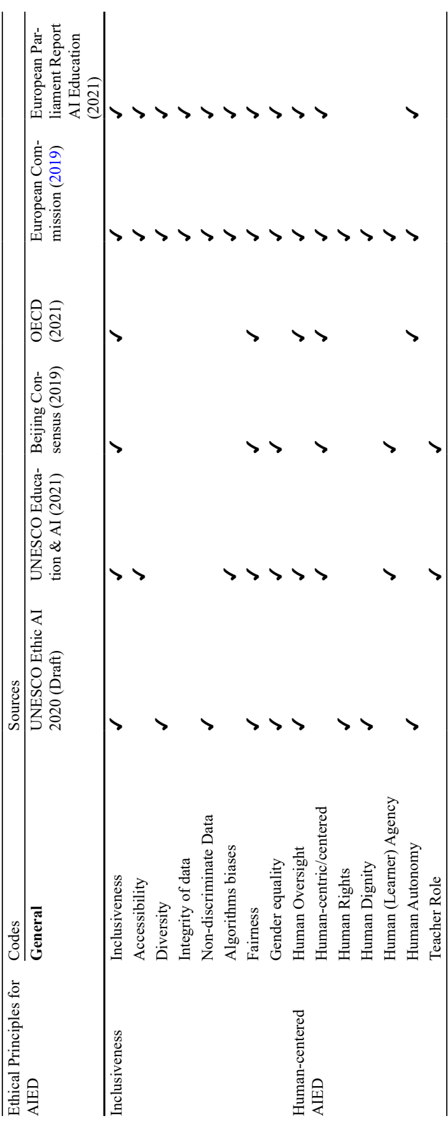
- The authors analyzed ethical guidelines and reports from 6 international sources: UNESCO Ethics AI (AHEG, 2020), UNESCO Education & AI (Miao et al., 2021), Beijing Consensus (UNESCO, 2019), OECD (2021), European Commission (2019), and European Parliament Report AI Education (2021).
- Their thematic analysis produced 39 codes that were collated into 7 themes (principles) for AIED.
- The proposed principles are: governance and stewardship, transparency and accountability, sustainability and proportionality, privacy, security and safety, inclusiveness, and human-centered AIED.
- The paper states that AIED raises concerns about personal data, learner autonomy, privacy, bias, fairness, accountability, inclusiveness, and human rights, while also offering benefits such as personalization and improved learning performance.
## Methods
- The study used thematic analysis based on Braun & Clarke (2012) to examine ethical guidelines and reports related to AIED.
- The sample consisted of policy/guideline documents from international organizations: UNESCO, OECD, European Commission, and European Parliament.
- Analysis involved familiarization, open coding, iterative theme generation, and researcher-researcher corroboration to support reliability and validity.
## Limitations
- The paper says the proposed principles are a starting point and that a precise mechanism for ethical principles in AIED “remains to be elucidated.”
- It explicitly notes that there is no universal consensus on the best ethical theory or standards for AIED, and that the issue is still evolving.
- Evident from the text: the study analyzes published policies and guidelines only, so it does not test the principles in classrooms or evaluate their effectiveness in practice.
Model-written summary. Check it against the paper before relying on it.
Integrity signals
Registry
Cites
Statistics
Figures
Verification
Claims the paper makes
12 Valid · 0 Not valid · 38 Not checked · 11 Own results and interpretations
The cited sources support only part of this claim — read each source’s verdict below.
In the paper
“Hence, there are growing evidence for the roles of AIED to “foster a transformation of knowledge, cognition, and culture” (Hwang et al., 2020, p.1).”
§ Ethical principles for artificial intelligence in education > Opportunities of artificial intelligence in education
What the sources say
- Partly supportedcites Hwang et al., 2020 matched to “Vision, challenges, roles and research issues of Artificial Intelligence in Education” (2020) sourceExperimental — accuracy not yet measured
The Conclusions (page not specified in our copy) say that integrating AI and education is a transformation of human knowledge, cognition, and cultures, supporting the central idea. The passage does not describe growing evidence for AIED’s role in that transformation, and the cited wording is not an exact quotation. (LLM, conf=0.86)
plainstates a cause- Asserted: passes — The authors put it forward as true.
- Checkable: passes — It can be checked against evidence.
- Load-bearing: unclear — It is unclear whether the paper’s conclusions depend on it.
- Based: passes — The paper gives a reason why it holds.
- Partly supported
The cited sources support only part of this claim — read each source’s verdict below.
In the paper
“However, the adoption of AIED has led to increasing ethical risks and concerns regarding several aspects such as personal data and learner autonomy.”
§ Ethical principles for artificial intelligence in education > Abstract The advancement of artificial intelligence in education (AIED) has the potential to transform the educational landscape and influence the role of all involved stakeholders. In recent years, the applications of AIED have been gradually adopted to progress our understanding of students’ learning and enhance learning performance and experience. However, the adoption of AIED has led to increasing ethical risks and concerns regarding several aspects such as personal data and learner autonomy. Despite the recent announcement of guidelines for ethical and trustworthy AIED, the debate revolves around the key principles underpinning ethical AIED. This paper aims to explore whether there is a global consensus on ethical AIED by mapping and analyzing international organizations’ current policies and guidelines. In this paper, we first introduce the opportunities offered by AI in education and potential ethical issues. Then, thematic analysis was conducted to conceptualize and establish a set of ethical principles by examining and synthesizing relevant ethical policies and guidelines for AIED. We discuss each principle and associated implications for relevant educational stakeholders, including students, teachers, technology developers, policymakers, and institutional decision-makers. The proposed set of ethical principles is expected to serve as a framework to inform and guide educational stakeholders in the development and deployment of ethical and trustworthy AIED as well as catalyze future development of related impact studies in the field.
What the sources say
- Partly supportedcites Holmes et al., 2021 matched to “Ethics of AI in Education: Towards a Community-Wide Framework” (2022) sourceExperimental — accuracy not yet measured
“The Ethics of AIED in Particular” identifies privacy concerns about the data collected by AIED, and “Most Ignored Yet Critical Ethical Issues for AIED” identifies lack of human agency as a concern. These passages support the cited concerns, but do not establish that adoption has caused risks concerning personal data and learner autonomy to increase over time. Page numbers are unavailable in our copy. (LLM, conf=0.84)
- Not matchedcites Akgun & Greenhow, 2021
An author–year citation the paper’s reference list doesn’t settle. We don’t search these by name.
- Not matchedcites Miao et al., 2021
An author–year citation the paper’s reference list doesn’t settle. We don’t search these by name.
plainstates a cause- Asserted: passes — The authors put it forward as true.
- Checkable: passes — It can be checked against evidence.
- Load-bearing: passes — The paper’s conclusions depend on it.
- Based: passes — The paper gives a reason why it holds.
- Partly supported
The cited sources support only part of this claim — read each source’s verdict below.
In the paper
“Indeed, a proliferation of studies has revealed the emergence of contrasting ethical themes relating to general AI and AIED, most of which are associated with the liability of data across settings, such as in higher education (Zawacki-Richter et al., 2019), K-12 (Holstein et al., 2019), schools (Luckin, 2017), and subjects (Hwang & Tu, 2021).”
§ Ethical principles for artificial intelligence in education > Ethical issues of AI in education Despite its capability to revolutionize education, numerous challenges also linger for researchers and practitioners who are involved in associated activities or systems (Kay & Kummerfeld, 2019) as AIED is, by nature, a “highly technology-dependent and cross-disciplinary field” (Hwang et al., 2020, p.2). At a global level, UNESCO (2019) pinpointed six challenges in achieving sustainable development of AIED: comprehensive public policy, inclusion and equity in AIED, preparing teachers for AI-powered education,preparing AI to understand education, developing quality and inclusive data systems, making research on AIED significant, ensuring ethics and transparency in data collection, use, and dissemination. At the individual level, challenges range from critical societal drawbacks such as systemic bias, discrimination, inequality for marginalized groups of students, and xenophobia (Hwang et al., 2020) to thorny ethical issues relating to privacy and bias in data collection and processing (Holmes et al., 2021). In fact, the widespread ramifications of AIED have also led to emerging concerns over the negative realities that it brings, such as the widening gaps of inequalities among learners’ commercialization of education, or the home-school divide in education (Reiss, 2021). AI may become pervasive in every sense where those involved may be exposed to risks without being aware of them, and the situation can be even intensified under the ongoing impacts of the COVID-19 pandemic (Borenstein & Howard, 2021). Such obstacles essentialize an urgent demand to induct and acquaint teachers and students with the ethical concerns surrounding AIED and how to navigate them. Furthermore, AIED also carries ethical implications and privacy risks which call for critical attention to differentiate between doing ethical things and doing things ethically (Holmes et al., 2021), or as in the words of Russell and Norvig (2002) “all AI researchers should be concerned with the ethical implications of their work” (p. 1020). Indeed, a proliferation of studies has revealed the emergence of contrasting ethical themes relating to general AI and AIED, most of which are associated with the liability of data across settings, such as in higher education (Zawacki-Richter et al., 2019), K-12 (Holstein et al., 2019), schools (Luckin, 2017), and subjects (Hwang & Tu, 2021). These covered the issues of informed consent, privacy breach, biased data assumption, fairness, accountability, and statistical apophenia. Others also question the impacts of AI-related fields such as surveillance and consent, learner privacy (Sacharidis et al., 2020), identity configuration, user confidentiality, integrity, and inclusiveness (Deshpande et al., 2017). Another stream of discussion has been drawn upon the ethics of data designated for educational use and analytics learning (e.g., Kay & Kummerfeld 2019; Kitto & Knight, 2019; Slade & Prinsloo, 2013). These incorporate the spheres of data interpretation and management, different perspective on the data usage, and the power relation among involved stakeholders such as students, teachers, and the educational objectives (Slade & Prinsloo, 2013). Other ethical issues for AIED include the problems with data collection, restricted availability of data sources, bias and representation, data ownership and control, data autonomy, AIED systems, and human agency (Akgun & Greenhow, 2021; Miao et al., 2021). That said, it is crucial to fully comprehend these values and principals before making ethically and accountability-driven decisions, and being aware of possible, even unexpected outcomes in education. Although recent work has attempted to establish different ethical frameworks for general AI use (e.g., Ashok et al., 2022), ethical and privacy issues are suggested to be contextualized (Ifenthaler & Schumacher, 2016), hence the prior guidelines established in other disciplines might not be appropriate for education. The contextual approach to the ethical design and use of AIED could play an essential role in addressing the issues of ethical and privacy concerns in education context. Prior research has emphasised the importance of the sociotechnical context configured by educational technology and educations practices in ethical considerations (Kitto & Knight, 2019). The understanding of ethics and privacy from various perspectives could promote the design of ethical and trustworthy AIED and the adoption of such systems. Furthermore, we extended the ethical view from published studies reviewed by Ashok et al., (2022) to the policies and guidelines proposed by the international organizations such as UNESCO, OECD, and European Union. The consensus assessment of policies and guidelines would inform a comprehensive and integrated instructions for different stakeholders in adopting AIED. This contributes to establishing a common ground and solid foundation for further development and implementation of AIED.
What the sources say
- Partly supportedcites Zawacki-Richter et al., 2019 matched to “Systematic review of research on artificial intelligence applications in higher education – where are the educators?” (2019) sourceExperimental — accuracy not yet measured
The Introduction identifies privacy and data protection as ethical risks of AI applications in higher education, supporting that part of the claim. But the section ‘Understanding of AI and critical reflection of challenges and risks’ reports that only two of 146 reviewed articles critically reflected on ethical implications; it does not support the claim that a proliferation of studies revealed ethical themes, most concerning data liability. (LLM, conf=0.88)
- Not checked — no full text of the sourcecites Holstein et al., 2019 matched to “Designing for Complementarity: Teacher and Student Needs for Orchestration Support in AI-Enhanced Classrooms” (2019) source
- Not checked — no full text of the sourcecites Luckin, 2017 matched to “Towards artificial intelligence-based assessment systems” (2017) source
boostedstates an association- Asserted: passes — The authors put it forward as true.
- Checkable: passes — It can be checked against evidence.
- Load-bearing: passes — The paper’s conclusions depend on it.
- Based: passes — The paper gives a reason why it holds.
- Partly supported
Every source the paper cites for this claim was checked and supports it.
In the paper
“Bostrom & Yudkowsky (2014) pointed out that AI systems must be “robust against human adversaries deliberately searching for exploitable flaws in the algorithm” (p. 317).”
§ Ethical principles for artificial intelligence in education > Ethical principles for artificial intelligence in education (AIED) > Principle of Security and Safety
What the sources say
- Supportedcites Bostrom & Yudkowsky (2014) matched to “The ethics of artificial intelligence” (2014) source
Section 1 (cited as p. 317) says AI algorithms should be robust against manipulation. It then gives a machine-vision system as an example that must withstand human adversaries searching for exploitable flaws. The quoted wording matches that example. (LLM, conf=0.94)
plain- Asserted: passes — The authors put it forward as true.
- Checkable: passes — It can be checked against evidence.
- Load-bearing: passes — The paper’s conclusions depend on it.
- Based: passes — The paper gives a reason why it holds.
- Supported
The cited sources support only part of this claim — read each source’s verdict below.
In the paper
“Data ethics emphasized the need for transparency in data usage in AIED (Larsson & Heintz, 2020).”
§ Ethical principles for artificial intelligence in education > Ethical principles for artificial intelligence in education (AIED) > Principle of transparency and accountability
What the sources say
- Partly supportedcites Larsson & Heintz, 2020 matched to “Transparency in artificial intelligence” (2020) sourceExperimental — accuracy not yet measured
The Introduction (listed under Abstract; no page given) identifies transparency as a key principle in AI ethics guidelines. Section 2, “A multidisciplinary notion of transparency” (no page given), links AI transparency to the origins of data and how personal data travels. The paper does not address data usage specifically in artificial intelligence in education (AIED), so the educational setting is unsupported. (LLM, conf=0.86)
plainstates a cause- Asserted: passes — The authors put it forward as true.
- Checkable: passes — It can be checked against evidence.
- Load-bearing: passes — The paper’s conclusions depend on it.
- Based: passes — The paper gives a reason why it holds.
- Partly supported
19 more claims
Create a free account to see all 61 claims and to verify the 8 references still open.
- It may state two separate claims as one. 19
- Probably not a substantial claim. 28
Claims other papers make about this one
Each is checked against this paper’s own text: does it say what the citing paper says it does?
The source backs part of the claim, not all of it — or backs it for a different population, condition or comparison.
In the citing paper
“The rise of AI-generated content necessitates a shift towards authentic assessment strategies emphasising higher-order thinking, creativity, and ethical responsibility [ 26 ].”
From Redefining student assessment in AI-infused learning environments: a systematic review of challenges and strategies for academic integrity (2026) · cites this paper as [26]
Experimental — accuracy not yet measuredThe cited source says what the claim attributes to it.
In the citing paper
“There is a real danger of AI becoming pervasive in every sense where those involved may be exposed to risks without being aware of them [32,90].”
From New Era of Artificial Intelligence in Education: Towards a Sustainable Multifaceted Revolution (2023) · cites this paper as [32]
The check wasn’t confident either way, so it gives no verdict — never disputed.
In the citing paper
“This aligns with the sociocultural view that ethical reasoning is dialogic and socially constructed (Nguyen et al., 2023).”
From Generative AI in Design Thinking Pedagogy: Enhancing Creativity, Critical Thinking, and Ethical Reasoning in Higher Education (2025) · cites this paper as Nguyen et al., 2023
Experimental — accuracy not yet measuredThe check wasn’t confident either way, so it gives no verdict — never disputed.
In the citing paper
“Research suggests that assessments should prioritise critical thinking, problemsolving, and creativity over rote memorisation [ 26, 34].”
From Redefining student assessment in AI-infused learning environments: a systematic review of challenges and strategies for academic integrity (2026) · cites this paper as [26]
Experimental — accuracy not yet measuredIn the citing paper
“Although many AI-related guidelines were published before the release of ChatGPT, most are generic and do not specifically address issues and challenges caused by GenAI in higher education”
From Investigating the higher education institutions’ guidelines and policies regarding the use of generative AI in teaching, learning, research, and administration (2025) · cites this paper as Nguyen et al., 2023
1 more claim about this paper
Create a free account to see every claim other papers make about this one.
Citations
Cites
The "what" and "why" of goal pursuits: Human needs and the self-determination of behavior
Deci, E. L., & Ryan, R. M. (2000) · Psychological Inquiry · doi:10.1207/s15327965pli1104_01 · Cited by 34,210
Braun, V., & Clarke, V. (2012) · APA handbook of research methods in psychology, Vol 2: Research designs: Quantitative, qualitative, neuropsychological, and biological. · doi:10.1037/13620-004 · Cited by 10,299
Zawacki-Richter, O., Marín, V. I., Bond, M., & Gouverneur, F. (2019) · International Journal of Educational Technology in Higher Education · doi:10.1186/s41239-019-0171-0 · Cited by 7,242 · cited 2×
“…the emergence of contrasting ethical themes relating to general AI and AIED, most of which are associated with the liability of data across settings, such as in higher education (Zawacki-Richter et al., 2019), K-12 (Holstein et al., 2019), schools (Luckin, 2017 ), and subjects (Hwang & Tu, 2021 ).”
Background(2014) · Medical Entomology and Zoology · Cited by 6,828
The global landscape of AI ethics guidelines
Jobin, A., Ienca, M., & Vayena, E. (2019) · Nature Machine Intelligence · doi:10.1038/s42256-019-0088-2 · Cited by 6,220 · cited 2×
“The objective is to cultivate trust among learners and provide them with insights to leverage their skills across contexts while maintaining control of their respective data and digital identities (Jobin et al., 2019).”
BackgroundThe Ethics of AI Ethics: An Evaluation of Guidelines
Hagendorff, T. (2020) · Minds and Machines · doi:10.1007/s11023-020-09517-8 · Cited by 1,911 · cited 1×
“…and open communica - tions with beneficiaries: educators, students, parents, AI developers, and policymak - ers (Berendt et al., 2020 ; Nigam et al., 2021 ; Hagendorff, 2020 ) stated that more emphasis is necessary to enforce ethical guidelines for AI systems to better align with societal values.”
BackgroundThe Ethics of AI Ethics -- An Evaluation of Guidelines
Hagendorff, T. (2019) · arXiv · doi:10.48550/arxiv.1903.03425 · Cited by 1,907 · cited 1×
“…and open communica - tions with beneficiaries: educators, students, parents, AI developers, and policymak - ers (Berendt et al., 2020 ; Nigam et al., 2021 ; Hagendorff, 2020 ) stated that more emphasis is necessary to enforce ethical guidelines for AI systems to better align with societal values.”
BackgroundArtificial Intelligence in Human Resources Management: Challenges and a Path Forward
Tambe, P., Cappelli, P., & Yakubovich, V. (2019) · California Management Review · doi:10.1177/0008125619867910 · Cited by 1,609
Artificial intelligence in education: Addressing ethical challenges in K-12 settings
Akgun, S., & Greenhow, C. (2022) · AI and Ethics · doi:10.1007/s43681-021-00096-7 · Cited by 1,473 · cited 2×
“…collaborative learning or asynchronous discussion groups, allows cost-wise personalized learning through a navigation system underpinned by algorithms (Nye, 2015 ), promoted by the use of automated assessment,facial recognition systems, and predictive analytics (Akgun & Greenhow, 2021 ).”
BackgroundMethodEthics of AI in Education: Towards a Community-Wide Framework
Holmes, W., Porayska-Pomsta, K., Holstein, K., Sutherland, E., Baker, T., Shum, S. B., Santos, O. C., Rodrigo, M. T., Cukurova, M., Bittencourt, I. I., et al. (2022) · International Journal of Artificial Intelligence in Education · doi:10.1007/s40593-021-00239-1 · Cited by 1,437 · cited 8×
“…ethical implications and privacy risks which call for critical attention to differentiate between doing ethical things and doing things ethically (Holmes et al., 2021 ), or as in the words of Russell and Norvig ( 2002 ) “all AI researchers should be concerned with the ethical implications of…”
BackgroundInfluential
Research works printed but not linked: 1
- Russel, S. J., & Norvig, P. R. (2002). Artificial Intelligence: A modern approach (2nd Ed.) Prentice Hall Upper Saddle River, NJ, USA
Cited by
Items 301–400 of 1,202
Akbar, M., N.A., J. P. S., Ramayah, T., & Alkashami, M. (2025) · Cogent Education · doi:10.1080/2331186x.2025.2479401 · Cited by 18
“AI has transformed the whole educational landscape, indicating a shift from traditional to AI-enhanced learning environments (Nguyen et al., 2023), and now educational institutions are implementing different AI applications, including automated assessment systems to facilitate educators, facial…”
Doktora Öğrencilerinin Yapay Zeka Kullanımı Üzerine Nitel Bir Çalışma
Aruğaslan, E. (2025) · Üniversite Araştırmaları Dergisi · doi:10.32329/uad.1557111 · Cited by 11
Guo, K., Zhan, C., & Li, X. (2025) · International Journal of Systems Assurance Engineering and Management · doi:10.1007/s13198-025-02772-x · Cited by 16
Sun, Y., & Liu, F. (2025) · Computers & Education · doi:10.1016/j.compedu.2025.105388 · Cited by 13
Ethical Framework for AI in Education: Navigating Challenges and Building Solutions
Farooqi, S. A. (2025) · Advances in computational intelligence and robotics book series · doi:10.4018/979-8-3373-5550-4.ch007 · Cited by 10
Harisanty, D., Anna, N. E. V., Sin, S. J., Srirahayu, D. P., Kusumaningtiyas, T., Santos, Y. T. P., & Mannan, E. F. (2025) · The Electronic Library · doi:10.1108/el-10-2024-0341 · Cited by 15
AI in Higher Education: The Risk of Excluding Vulnerable Learners
Kayyali, M. (2025) · IGI Global eBooks · doi:10.4018/979-8-3373-2685-6.ch003 · Cited by 28
University english teaching evaluation using artificial intelligence and data mining technology
Huang, Q., Li, W., Muhamad, M. M., Nawi, N. R. C., & Liu, X. (2025) · Scientific Reports · doi:10.1038/s41598-025-16498-0 · Cited by 30
Becerra, Á., Cobos, R., & Lang, C. (2025) · Behaviour and Information Technology · doi:10.1080/0144929x.2025.2562322 · Cited by 28
“However, their large-scale deployment still faces logistical, financial, and ethical challenges, particularly in terms of privacy, data sensitivity, and student acceptance [81], [135].”
Stracke, C. M. (2024) · Lecture notes in educational technology · doi:10.1007/978-981-97-8638-1_7 · Cited by 19
Navigating Ethical Frameworks to Mitigate Academic Misconduct While Leveraging Generative AIPreprint
Uddın, M. M., & Abu, S. (2024) · Research Square · doi:10.21203/rs.3.rs-4607113/v1 · Cited by 14
Tripathi, A., Yadav, V., & Kumar, S. (2025) · Preprints.org · doi:10.20944/preprints202504.0598.v1 · Cited by 9
Gerlich, M. (2025) · IEEE Engineering Management Review · doi:10.1109/emr.2024.3441468 · Cited by 8
Equality, Diversity, and Access in Digitalized Teaching in Higher Education
Gwala, R. S., & Mashau, P. (2023) · Advances in higher education and professional development book series · doi:10.4018/978-1-6684-9179-9.ch006 · Cited by 8
Use of Generative AI Tools to Facilitate Personalized Learning in the Flipped Classroom
Zhen, H., & Yahaya, W. A. J. W. (2024) · Advances in educational technologies and instructional design book series · doi:10.4018/979-8-3693-1351-0.ch016 · Cited by 11
Mahboob, A., Ullah, Z., Ovais, A., Rasheed, M. W., Edalatpanah, S. A., & Yasin, K. (2024) · Frontiers in Artificial Intelligence · doi:10.3389/frai.2024.1347626 · Cited by 10
Artificial intelligence applied to early childhood education: A focus for educational research?
Medina, M. J. L., & Abdelmaula-Mesaud, S. (2024) · Contemporary Issues in Early Childhood · doi:10.1177/14639491241303746 · Cited by 11
Artificial Intelligence and Student Engagement: Drivers and Consequences
Singh, P. (2024) · Advances in educational technologies and instructional design book series · doi:10.4018/979-8-3693-5633-3.ch008 · Cited by 19
Chávez, R. E. G. (2025) · Revista Científica Multidisciplinar G-nerando · doi:10.60100/rcmg.v6i1.392 · Cited by 28
Galán-Rodríguez, N. M., Bobadilla-Pérez, M., & Barros-Grela, E. (2025) · Texto Livre Linguagem e Tecnologia · doi:10.1590/1983-3652.2025.51692 · Cited by 18
Meynhardt, C., Meybohm, P., Kranke, P., & Hölzing, C. R. (2025) · Electronics · doi:10.3390/electronics14051028 · Cited by 13
Ethical considerations and data privacy in artificial intelligence
Gaisie, E., Owusu-Boateng, O., Yidana, I., & Ghansah, B. (2025) · doi:10.70593/978-93-49307-53-7_5 · Cited by 11
Li, J., & Huang, Q. (2025) · International Journal of Knowledge Management · doi:10.4018/ijkm.382384 · Cited by 18
Artificial intelligence in pre-service teacher education: Bibliometrics analysis
Kuzu, S. (2025) · Pedagogical Research · doi:10.29333/pr/17402 · Cited by 21
“Nguyen et al. ’ s (2023) ethical principles (145 citations yr) and González-Calatayud ’ s (2021) systematic review on AI for assessment (44 citations yr) sit alongside classic horizon-scanning pieces (Luan et al., 2020).”
GenAI: Opportunities, Disruptions, and the New Learning Paradigm
Mir, S. A., Saini, N., Kumar, A. V. S., Ganaie, N. A., Rautrao, R. R., -, A. C., Sehgal, S., & Khandelwal, A. R. R. (2025) · IGI Global eBooks · doi:10.4018/979-8-3373-5157-5.ch012 · Cited by 8
Rui, X., Celik, I., & Edwards, J. (2025) · Computers and Education Open · doi:10.1016/j.caeo.2025.100317 · Cited by 23
Guiding the future: developing an ethical framework for generative AI use in education
Ofosu-Asare, Y. (2025) · International Journal of Information and Learning Technology · doi:10.1108/ijilt-06-2024-0113 · Cited by 33
Landa–Blanco, M. (2026) · Frontiers in Education · doi:10.3389/feduc.2025.1681836 · Cited by 27
Abbas, A., Azar, B. B., Mahrishi, M., Núñez, J. L. M., & Mishra, D. (2025) · Equilibrium Quarterly Journal of Economics and Economic Policy · doi:10.24136/eq.3551 · Cited by 21
“Traditional academic leadership models must prioritize managerial and transactional approaches and sustainability-centered pursuits (Shal et al. , 2024; Nguyen et al. , 2023).”
Ajayi, O. E., & Letseka, M. (2026) · Trends in Higher Education · doi:10.3390/higheredu5010016 · Cited by 22
“…model-agnostic attributions) clarify why a learner is flagged and can direct attention to plausible levers (e.g., pacing, assessment preparation), but decision quality ultimately hinges on educator capacity and institutional policy frameworks for fairness, privacy, and accountability [27–29].”
Inteligencia Artificial en la Educación: Estado del Arte
Sambola, D.-M. (2023) · Wani · doi:10.5377/wani.v39i79.16806 · Cited by 33
“…numerosos desafíos e implicaciones éticas para los investigadores y profesionales que participan en actividades o sistemas asociados a este dominio (Nguyen et al., 2023); ya que la IAEd es, por naturaleza, un campo interdisciplinario y altamente dependiente de la tecnología (Hwang & Tu, 2021).”
Generative AI in Terms of Its Ethical Problems for Both Teachers and Learners: Striking a Balance
Le-Nguyen, H.-T., & Tran, T. T. (2023) · Advances in educational technologies and instructional design book series · doi:10.4018/979-8-3693-0074-9.ch006 · Cited by 24
Subiyantoro, S., Degeng, I. N. S., Kuswandi, D., & Ulfa, S. U. (2023) · Jurnal Pekommas · doi:10.56873/jpkm.v8i2.5206 · Cited by 37
Recent Advances in Steganography
Bamanga, M. A., Babando, A. K., & Shehu, M. A. (2024) · IntechOpen eBooks · doi:10.5772/intechopen.1004521 · Cited by 15
Bibliometric Analysis of Artificial Intelligence in STEM Education
Jantakun, T., Jantakun, K., & Jantakoon, T. (2024) · Higher Education Studies · doi:10.5539/hes.v15n1p69 · Cited by 16
“Despite the ethical concerns and risks associated with AI, such as data privacy and learner autonomy, developing ethical guidelines and principles can help mitigate these issues and ensure trustworthy AI deployment in education (Nguyen et al., 2023).”
Jaber, S. A., Hasan, H. E., Alzoubi, K. H., & Khabour, O. F. (2024) · Heliyon · doi:10.1016/j.heliyon.2024.e41331 · Cited by 11
Ethical Considerations in the Application of Artificial Intelligence in Education
Ding, N. (2025) · International Journal of Education and Humanities · doi:10.54097/78e6gr15 · Cited by 12
“These include potential violations of student privacy through data collection and usage [2], the risk of creating “echo chambers” through over-customized AI-recommended learning content [3], and the possible erosion of fundamental teacher-student relationships through inappropriate technological…”
Patil, D. (2025) · SSRN Electronic Journal · doi:10.2139/ssrn.5057400 · Cited by 14
Riapina, N. E. (2023) · Advances in educational technologies and instructional design book series · doi:10.4018/979-8-3693-1022-9.ch002 · Cited by 10
Adapting Teaching and Learning in Higher Education Using Explainable Student Agency Analytics
Heilala, V., Jääskelä, P., Saarela, M., & Kärkkäinen, T. (2023) · Advances in computational intelligence and robotics book series · doi:10.4018/979-8-3693-0230-9.ch002 · Cited by 8
STUDENTS’ PERCEPTIONS OF GENERATIVE AI USAGE AND RISKS IN A FINNISH HIGHER EDUCATION INSTITUTION
Suonpää, M., Heikkilä, J., & Dimkar, A. (2024) · INTED proceedings · doi:10.21125/inted.2024.0825 · Cited by 11
Oyekunle, D. O. T., Nwaiku, M., Matthew, U. O., Onyedibe, O. N., Nwanakwaugwu, A. C., Adebola, N. T., Oladipupo, M. A., & Olawoyin, O. O. (2024) · Advances in higher education and professional development book series · doi:10.4018/979-8-3693-6765-0.ch002 · Cited by 8
Conceptualizing and enhancing metaverse literacy for education
Nguyen, A., Huynh, L., Dang, B., Pohjolainen, S., Mattila, J., Paajala, I. J., Tikkanen, R., Lehto, E., Poikonen, F., & Karppinen, P. (2025) · Education and Information Technologies · doi:10.1007/s10639-025-13486-9 · Cited by 26
“Previous research emphasizes the need to contextualize ethical and privacy issues, particularly within educational settings (Ifenthaler & Schumacher, 2016; Nguyen et al., 2023).”
Self-citationNeupane, B. P., Paudel, P., Dahal, N., Karki, S., Paudel, G. R., Ghimire, P., & Thapa, B. (2025) · Advances in Mobile Learning Educational Research · doi:10.25082/amler.2025.01.011 · Cited by 18
“AI in education is regarded as a powerful tool to support technological advancements, new paradigms of instruction, and pioneering educational research that is considered impractical in traditional classroom settings (Nguyen et al., 2022).”
Wang, X., Xie, F., Cheng, G., & Shehzadi, K. (2025) · Information Development · doi:10.1177/02666669251329032 · Cited by 15
Ali, I. M., & Arpacı, İ. (2025) · Computers in Human Behavior Reports · doi:10.1016/j.chbr.2025.100681 · Cited by 10
Student perspectives on the use of AI-based language tools in academic writing
Boillos, M. M., & Mondragón, N. I. (2025) · Journal of Writing Research · doi:10.17239/jowr-2025.17.01.06 · Cited by 29
“Following Nguyen et al. (2023), it can be concluded that students tend to utilize technology passively rather than actively (Nguyen et al. 2023).”
Bian, X., Wang, B., Kunxiang, L. I., & Zemeng, D. U. (2025) · Humanities and Social Sciences Communications · doi:10.1057/s41599-025-05184-1 · Cited by 15
Yeniçeri, Ü., & Kenan, A. (2025) · Ege Eğitim Dergisi · doi:10.12984/egeefd.1625648 · Cited by 13
Kozan, K., Hur, J., Kim, I., & Barrett, A. J. (2025) · Education Sciences · doi:10.3390/educsci15091133 · Cited by 17
Patrick, P., Yip, S. Y., & Campbell, C. (2025) · Higher Education Quarterly · doi:10.1111/hequ.70069 · Cited by 37
Hu, Y., Curdt‐Christiansen, X. L., & Wang, J. (2025) · Journal of English for Academic Purposes · doi:10.1016/j.jeap.2025.101586 · Cited by 15
Şenocak, D., Bozkurt, A., & Koçdar, S. (2024) · Advances in educational technologies and instructional design book series · doi:10.4018/979-8-3693-1351-0.ch010 · Cited by 16
Omoush, M. H. A., Salih, S. E., & Mehigan, T. J. (2023) · IEEE Canada International Humanitarian Technology Conference · doi:10.1109/ihtc58960.2023.10508879 · Cited by 9
“As technology becomes more integrated in classrooms, it is imperative to address the potential implications for student data protection and the overall ethical use of educational technologies [75].”
BackgroundInfluentialIntegrating AI in Higher Education: Applications, Strategies, Ethical Considerations
Daraai, S. B. A., Maqrashi, M. A., Zakwani, M. A., & Shaikh, Z. A. (2024) · Advances in educational technologies and instructional design book series · doi:10.4018/979-8-3693-2145-4.ch008 · Cited by 10
Rodrigo, T. A. V., & Nicolayo, B. M. R. (2024) · Magazine de las Ciencias: Revista de Investigación e Innovación · doi:10.33262/rmc.v9i2.3104 · Cited by 28
Alenezi, W. (2024) · International Journal of Education in Mathematics Science and Technology · doi:10.46328/ijemst.4177 · Cited by 17
“These results are similar to the study by Nguyen et al. (2023), emphasizing the potential of AI for education and other different fields but with the condition of formulating an AI ethical framework to be used in education.”
ResultEthics in AI for energy systems safety
Arunthavanathan, R., Sajid, Z., & Amin, M. T. (2024) · Methods in chemical process safety · doi:10.1016/bs.mcps.2024.08.002 · Cited by 10
Artificial Intelligence in Education: Emerging Trends, Ethical Considerations, and Future Directions
Boumediene, H., & Bouakkaz, M. (2024) · Advances in educational technologies and instructional design book series · doi:10.4018/979-8-3693-7220-3.ch014 · Cited by 10
Innovating Education: The Impact of Artificial Intelligence and Technology on Teaching
Haq, A. U. (2025) · Inverge Journal of Social Sciences · doi:10.63544/ijss.v4i2.125 · Cited by 17
Hachoumi, N., Eddabbah, M., & Adib, A. R. E. (2025) · Informatics and Health · doi:10.1016/j.infoh.2025.05.002 · Cited by 23
Farina, A., & Stevenson, C. N. (2024) · Advances in computational intelligence and robotics book series · doi:10.4018/979-8-3693-1565-1.ch005 · Cited by 6
Isop, W. A. (2025) · Frontiers in Artificial Intelligence · doi:10.3389/frai.2024.1377938 · Cited by 17
Khojasteh, L., Shokrpour, N., & Moslehi, S. (2025) · Teaching and Teacher Education · doi:10.1016/j.tate.2025.104952 · Cited by 13
Christou, P. (2024) · International Workshop on Artificial Intelligence and Education (WAIE) · doi:10.1109/waie63876.2024.00017 · Cited by 14
“As such, this theme embraces educational policies that are shaping the integration of AI in educational institutes, including the development of international, national, and institutional principles and guidelines for the use of AI [39] [40].”
Adapting to the AI Disruption: Reshaping the IT Landscape and Educational Paradigms
Özer, M., Köse, Y., Kucukkaya, G., Mukasheva, A., & Ciris, K. (2025) · Communications in computer and information science · doi:10.1007/978-3-031-85930-4_33 · Cited by 34
Bridging Gaps: AI-Driven Accessibility in Language Education
Asrifan, A., Shafa, S., Pratiwi, W. R., Bahri, A., Siregar, S. R., & Ingilan, S. S. (2025) · Advances in computational intelligence and robotics book series · doi:10.4018/979-8-3693-7260-9.ch006 · Cited by 7
Licardo, M., Kranjec, E., Lipovec, A., Dolenc, K., Arcet, B., Flogie, A., Plavčak, D., Grmek, M. I., Rošer, B. B., Petek, B. S., et al. (2025) · doi:10.18690/um.pef.1.2025 · Cited by 39
Secondary School Teachers’ Experiences with Generative AI in Maltese Language Teaching
Żammit, J. (2025) · Technology Knowledge and Learning · doi:10.1007/s10758-025-09861-7 · Cited by 27
“Furthermore, ethical concerns, including data privacy, bias, and equitable access necessitate strong frameworks and collaborative efforts to ensure fair and inclusive AI-enhanced education (Nguyen et al., 2023).”
The Evolution of AI in Education From Concept to Classroom
Kayyali, M. (2025) · Advances in computational intelligence and robotics book series · doi:10.4018/979-8-3373-1827-1.ch013 · Cited by 11
Ethical Considerations of AI in Education: A Case Study Based on Pythia Learning Enhancement System
Röhrl, S., Staufer, S., Bugert, F., Nadimpalli, V. K., Häuser, F., Grabinger, L., Bittner, D., Ezer, T., Altweck, R., Graf, S., et al. (2025) · IEEE Access · doi:10.1109/access.2025.3583975 · Cited by 10
“…[2], [6], [18], [23] Fairness and Bias [2], [6], [19], [27], [24], [25], [22], [23], [28] Non-Maleficence [2], [27], [22], [26], [23] Accessibility [2], [19], [24], [28] Psychological Impact [6], [21], [19], [23], [20] Duty to Act [21] Conflict of Interest [25] These ethical issues correspond to…”
InfluentialWhat Artificial Intelligence Means to Us – Students’ Insights
Pisica, A. I., & ZAHARIA, R. M. (2025) · European Journal of Interdisciplinary Studies · doi:10.24818/ejis.2025.09 · Cited by 8
Kaliisa, R., Baker, R. S., Wasson, B., & Prinsloo, P. (2025) · Journal of Learning Analytics · doi:10.18608/jla.2025.8495 · Cited by 11
“For Nguyen et al. (2023), ethical principles and regulation are inseparable, and they propose a set of ethical principles to guide policy and regulation of AI in education that includes 1) governance and stewardship; 2) transparency and accountability; 3) sustainability and proportionality; 4)…”
Alli, A. A., Magombe, Y., Ibrahim, L., & Kasadha, J. (2025) · IST-Africa Conference (IST-Africa) · doi:10.23919/ist-africa67297.2025.11060512 · Cited by 8
“Researchers advocate for robust data protection measures and transparent AI algorithms to ensure responsible handling of data [33] – [36].”
A learning agreement for generative AI use in university courses: A pilot study
Beardsley, M., Santos, P., Amarasinghe, I., Theophilou, E., Vujović, M., & Hernández‐Leo, D. (2025) · Innovations in Education and Teaching International · doi:10.1080/14703297.2025.2535444 · Cited by 10
“The issue of bias in produced content is a significant ethical challenge (Ferrer et al., 2021; Zhou, et al., 2023) as the models learn from data, and if that data reflects societal biases, the generated content can introduce or reinforce these biases in its outputs (Akter et al., 2021).”
Ethical Considerations of AI Use by the Elderly
Klímová, B., & Kacetl, J. (2025) · International Journal of Human-Computer Interaction · doi:10.1080/10447318.2025.2531274 · Cited by 9
“…(e.g., Busch et al., 2023; Ienca et al., 2018; Kacetl & Maresova, 2016; Klimova et al., 2023; Koimizu et al., 2018; Mittelstadt et al., 2011; Nguyen et al., 2023; Pirzada et al., 2022) have addressed the ethical issues associated with the introduction of new technologies and AI in these two…”
Saleem, T., Saleem, A., & Aslam, M. (2025) · PLoS ONE · doi:10.1371/journal.pone.0333352 · Cited by 36
“While these issues have been flagged in broader AI discourse [41,42], this study contextualizes them within Pakistani ESL classrooms, showing how such biases can reinforce linguistic hierarchies and undermine motivation.”
Alkubaisi, M. (2025) · Discover Artificial Intelligence · doi:10.1007/s44163-025-00522-3 · Cited by 17
“Previous research extensively discussed ethical principles of AI in education especially those related to data privacy, transparency, accountability and inclusiveness [1, 12, 28].”
Intelligent deep learning model for recommending ideological and political music education resources
Zhang, L. (2025) · Scientific Reports · doi:10.1038/s41598-025-20535-3 · Cited by 10
“…of audio and text information, enabling dynamic integration of the two modalities. z = σ ( W xz X audio + W hz h t 1 ) (3) ∼ h = tanh ( W xh X audio + r ⊙ W hh h t 1 ) (5) z is the update gate and r is the reset gate, and the fusion feature X music is output through iterative calculation 26 .”
Rahman, M. I. (2026) · Nurse Education in Practice · doi:10.1016/j.nepr.2026.104756 · Cited by 13
ChatGPT on campus: how top U.S. universities govern generative AI across higher education
Alba, C., McIlwain, C. D., & An, R. (2026) · Policy Reviews in Higher Education · doi:10.1080/23322969.2026.2622674 · Cited by 15
Pérez-García, E., Ramírez, A. S., Quintana-Suárez, M. A., Conde‐Felipe, M., Carrascosa, C., Fariña, I. M., Sánchez, J. A. C., Sanjuan, E. C., & Jaber, J. R. (2026) · Veterinary Sciences · doi:10.3390/vetsci13020181 · Cited by 11
“As artificial intelligence becomes increasingly embedded in educational ecosystems, concerns surrounding ethics, equity, academic integrity and professional responsibility have been widely identified as central issues for veterinary institutions [81].”
Artificial Intelligence in Higher Education and Its Socioscientific Evaluation
Çıldır, S. (2024) · Advances in educational technologies and instructional design book series · doi:10.4018/979-8-3693-2145-4.ch010 · Cited by 7
Role of Ethical and Responsible AI in Education for Next Generation Inventors
Kathala, K. C. R., Arroyo, I., & Mannuru, N. R. (2024) · Communications in computer and information science · doi:10.1007/978-3-031-64312-5_9 · Cited by 10
Techno-solutionism a Fact or Farce? A Critical Assessment of GenAI in Open and Distance Education
Olojede, H. T. (2024) · Journal of Ethics in Higher Education · doi:10.26034/fr.jehe.2024.5963 · Cited by 16
Ética e Responsabilidade na Era da Inteligência Artificial: Um Survey com Estudantes de Computação
da Silva, M., Seixas, E. F. R., Ferro, M., Viterbo, J., Seixas, F. L., & Salgado, L. C. D. C. (2024) · Anais do Workshop sobre Educação em Computação (WEI) · doi:10.5753/wei.2024.3148 · Cited by 6
Al-Othman, A. A.-A. M. (2024) · Arab World English Journal · doi:10.24093/awej/call10.7 · Cited by 21
“…Arab World English Journal www.awej.org ISSN: 2229-9327 89 which empowered learning in higher education, (Rahiman & Kodikal, 2023), however, there are some challenges for utilizing artificial intelligence tools in teaching and learning (Chen et al., 2022; Nguyen et al., 2023; Sharma et al., 2019).”
Mohamed, A., Faisal, R., & Shaalan, K. (2024) · Lecture Notes in Computer Science · doi:10.1007/978-3-031-71713-0_8 · Cited by 6
Yadav, M., Singh, S. K., Sharma, P., & Hung, T. H. (2024) · Advances in educational technologies and instructional design book series · doi:10.4018/979-8-3693-0884-4.ch003 · Cited by 7
Artificial Intelligence in Nursing Education: Challenges and Opportunities in the Chinese Context
Jiang, Y. (2024) · Open Journal of Social Sciences · doi:10.4236/jss.2024.1211004 · Cited by 12
Equilibrio entre la privacidad y la ética en el uso de la inteligencia artificial en la educación
Peña, J. M., Moreno, O. B., Herrera, Á. L. O., & Moreno, T. (2024) · Sapiens International Multidisciplinary Journal · doi:10.71068/m4gqp119 · Cited by 6
The Future of Artificial Intelligence in Education 4.0: How to Go Green in the Post-COVID-19 Context
Polas, M. R. H., Jahanshahi, A. A., Ahamed, B., & Molla, M. O. F. (2023) · Advances in educational technologies and instructional design book series · doi:10.4018/978-1-6684-9103-4.ch001 · Cited by 6
Application of artificial intelligence in Ukrainian education of the future
Vasylyuk-Zaitseva, S., Kosenyuk, H., Танасійчук, Ю. М., & Boyko, J. (2023) · Futurity Education · doi:10.57125/fed.2023.09.25.05 · Cited by 24
DEVELOPMENT OF DIGITAL COMPETENCE OF FUTURE PHILOLOGISTS: CASE OF TURKISH AND UKRAINIAN UNIVERSITIES
Baranovska, L., Simkova, I., Akıllı, E., Tarnavska, T., & Glushanytsıa, N. (2023) · Advanced Education · doi:10.20535/2410-8286.295458 · Cited by 19
Ethics in AI-based online assessment in higher education
Heil, J., & Ifenthaler, D. (2024) · Elsevier eBooks · doi:10.1016/b978-0-443-18851-0.00008-1 · Cited by 8
von Lucke, J., & Frank, S. (2025) · Digital Government Research and Practice · doi:10.1145/3665333 · Cited by 14
“There have are numerous soft law initiatives, such as recommendations, strategy papers, declarations of intent, or guidelines [18][10], which address the ethical development and principles of the use of AI or critique the guidelines themselves [31][33][46][49].”
BackgroundEslit, E. R. (2023) · Preprints.org · doi:10.20944/preprints202308.1494.v1 · Cited by 8
Peer-Reviews and AI Feedback Compared: University Students’ PreferencesPreprint
Zapata, G. C., Saini, A. K., Cope, B., Kalantzis, M., & Searsmith, D. (2024) · EdArXiv (OSF Preprints) · doi:10.35542/osf.io/uy8qp · Cited by 12
AI and Personalised Grading Criteria
Ahmed, S., Zaki, A., & Bentley, Y. (2024) · Advances in Educational Technologies and Instructional Design · doi:10.4018/979-8-3693-2145-4.ch004 · Cited by 6
Turková, K., Krásničan, V., Prázová, I., Turčínek, P., & Foltýnek, T. (2025) · International Journal for Educational Integrity · doi:10.1007/s40979-025-00203-9 · Cited by 13
Metadata
- Authors
- Nguyen, A., Ngo, H. N., Hong, Y., Dang, B., & Nguyen, B.-P. T.
- Affiliations
- University of Oulu (FI)
- Victoria University of Wellington (NZ)
- University of Languages and International Studies (VN)
- Corresponding author
- Nguyen, Andy
- Venue
- Education and Information Technologies
- Published
- 2022-10-13
- Volume
- 28
- Issue
- 4
- Pages
- 4221-4241
- ISSN
- 1360-2357 (ISSN-L)
- 1573-7608
- PMC
- PMC9558020
- OpenAlex
- W4304943299
- Semantic Scholar
- ec13995de8797a4e977024942d79fc0d27e20b7b
- Cited by
- 1,228
- References
- 71
- Citations by year
- 2026: 367 · 2025: 479 · 2024: 303 · 2023: 78
- FWCI
- 249.31
- Type
- journal article
- Language
- en
- Open access
- hybrid
- doi.org
- Licence
- cc-by
- creativecommons.org/licenses/by/4.0 (tdm)
- creativecommons.org/licenses/by/4.0 (vor)
- Locations
- Education and Information Technologies (publishedVersion, cc-by)
- PubMed Central (publishedVersion, cc-by)
- PubMed (publishedVersion)
- Open Access Victoria University of Wellington | Te Herenga Waka (Figshare) (submittedVersion, cc-by-nc-nd)
- Victoria University of Wellington
- Funders
- University of Oulu including Oulu University Hospital
- Topics
- Physical Sciences › Computer Science › Artificial Intelligence › Ethics and Social Impacts of AI
- Social Sciences › Education › Artificial Intelligence in Education
- Physical Sciences › Computer Science › Artificial Intelligence › Intelligent Tutoring Systems and Adaptive Learning
- Keywords
- artificial intelligence in education, ethical principles, AI ethics, trustworthy AI, moral norms, personal data, learner autonomy, educational stakeholders, ethical frameworks
About these checks
Registry, retraction, Cites and statistics results are computed, not judged, with one exception: a printed reference that no index lists is read once by a model before it counts as a citation error. Claims are extracted by a model and kept only when their quote appears verbatim in the text; each cited source is then checked, with a model’s help, for whether it says what the claim relies on. Those verdicts can be wrong — read the claim’s quote and the cited source before relying on one.
The claim verdicts this report counts are experimental: their accuracy is not yet measured.
A language model drew the claims from the paper on 2026-10-10, under version 3 of the claim definition (model deepseek-v4.1-flash, prompt extract-v3).
A second model labelled each claim on 2026-10-10 (model jev-1.13-20260917, definition revision gold-guideline-v0.2).
Cited sources are checked with a language model’s help (gpt-6-sol).
Statistics and arithmetic are recomputed, not judged.
Confidence bands are shown only for fields calibrated on our annotated test set. None is calibrated yet, so no band is shown.
What counts as a claim ›How we measure confidence ›How we check this ›
Are you an author, or do you see a problem with this page? Request a review
Data sources
Bibliographic data: Semantic Scholar, OpenAlex, Crossref.
Contains information from the Semantic Scholar Academic Graph Datasets, made available under the ODC Attribution License (ODC-BY 1.0).
Semantic Scholar’s data is described in: Kinney, R., et al. (2023). The Semantic Scholar Open Data Platform. arXiv:2301.10140.
