

The DOI matches its Crossref record; 116 of the 116 references it cites were found in a registry or an index.
Extending the technology acceptance model (TAM) to predict university students’ intentions to use metaverse-based learning platforms
Open accessAbstract
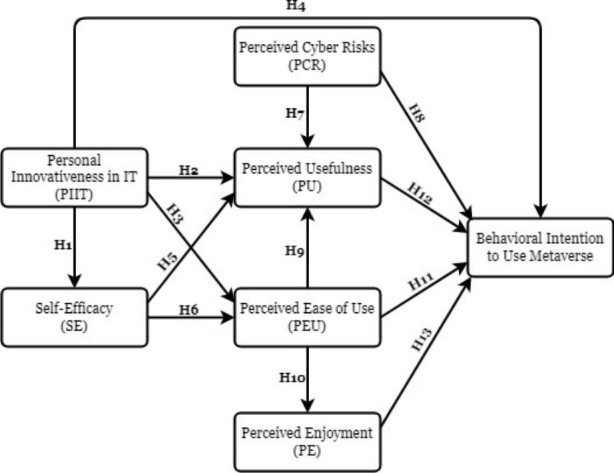
Metaverse, which combines a number of information technologies, is the Internet of the future. A media for immersive learning, metaverse could set future educational trends and lead to significant reform in education. Although the metaverse has the potential to improve the effectiveness of online learning experiences, metaverse-based educational implementations are still in their infancy. Additionally, what factors impact higher education students' adoption of the educational metaverse remains unclear. Consequently, the aim of this study is to explore the main factors that affect higher education students' behavioral intentions to adopt metaverse technology for education. This study has proposed an extended Technology Acceptance Model (TAM) to achieve this aim. The novelty of this study resides in its conceptual model, which incorporates both technological, personal, and inhibiting/enabling factors. The empirical data were collected via online questionnaires from 574 students in both private and public universities in Jordan. Based on the PLS-SEM analysis, the study identifies perceived usefulness, personal innovativeness in IT, and perceived enjoyment as key enablers of students' behavioral intentions to adopt the metaverse. Additionally, perceived cyber risk is found as the main inhibitor of students' metaverse adoption intentions. Surprisingly, the effect of perceived ease of use on metaverse adoption intentions is found to be insignificant. Furthermore, it is found that self-efficacy, personal innovativeness, and perceived cyber risk are the main determinants of perceived usefulness and perceived ease of use. While the findings of this study contribute to the extension of the TAM model, the practical value of these findings is significant since they will help educational authorities understand each factor's role and enable them to plan their future strategies.
Overview
The claims and statistics of this paper haven’t been checked yet.
Run the check — free, no account needed. It reads the open-access text and checks the sources it cites.
Integrity signals
Registry
Cites
Statistics
Figures
Verification
Claims the paper makes
The claims and statistics of this paper haven’t been checked yet.
Run the check — free, no account needed. It reads the open-access text and checks the sources it cites.
Claims other papers make about this one
Each is checked against this paper’s own text: does it say what the citing paper says it does?
The source backs part of the claim, not all of it — or backs it for a different population, condition or comparison.
In the citing paper
“They also aligned with evidence from mobile learning research showing that positive attitudes can strengthen students’ intention to use new technologies [91].”
From Advancing Undergraduate Student Mental Healthcare of Social Anxiety Disorder: Evaluating the Acceptance of AR-Assisted Cognitive Behavioral Therapy Through TAM-Based Constructs. (2026) · cites this paper as [91]
Experimental — accuracy not yet measured
Self-check
Percentages, sums and reported differences re-computed from the paper’s own numbers.
The self-check needs the paper’s full text.
Citations
Cites
Evaluating Structural Equation Models with Unobservable Variables and Measurement Error
Fornell, C., & Larcker, D. F. (1981) · Journal of Marketing Research · doi:10.2307/3151312 · Cited by 109,314
Evaluating structural equation models with unobservable variables and measurement error
Fornell, C., & Larcker, D. F. (1981) · Journal of Marketing Research · doi:10.1177/002224378101800104 · Cited by 109,190 · cited 1×
“As demonstrated in Table 4, this condition is met, concluding that discriminant validity is present (Fornell & Larcker, 1981 ).”
BackgroundThe theory of planned behavior
Ajzen, I. (1991) · Organizational Behavior and Human Decision Processes · doi:10.1016/0749-5978(91)90020-t · Cited by 90,587 · cited 1×
“According to Ajzen (1991), SE designates the confidence that one possesses in one’s capability to engage in a specific behavior.”
MethodPodsakoff, P. M., MacKenzie, S. B., Lee, J.-Y., & Podsakoff, N. P. (2003) · Journal of Applied Psychology · doi:10.1037/0021-9010.88.5.879 · Cited by 82,194 · cited 1×
“The finding showed that the loading of all measurement items in the dataset at once yielded a total variation of 44.678%, which is below the 50% threshold, indicating that CMB is absent (Podsakoff et al., 2003 ).”
BackgroundInfluentialStructural equation modeling in practice: A review and recommended two-step approach
Anderson, J. C., & Gerbing, D. W. (1988) · Psychological Bulletin · doi:10.1037/0033-2909.103.3.411 · Cited by 41,941 · cited 1×
“As instructed, we conducted the data analysis in two steps (Anderson & Gerbing, 1988 ).”
MethodA new criterion for assessing discriminant validity in variance-based structural equation modeling
Henseler, J., Ringle, C. M., & Sarstedt, M. (2015) · Journal of the Academy of Marketing Science · doi:10.1007/s11747-014-0403-8 · Cited by 38,459 · cited 1×
“Moreover, the result of the “Heterotrait–Mono - trait Ratio-HTMT” test indicates that all HTMT values < 0.85 (Henseler et al., 2015), endorsing the findings in terms of Fornell and Larcker’s criterion.”
ResultInfluentialWhen to Use and How to Report the Results of PLS-SEM
Hair, J. F., Risher, J. J., Sarstedt, M., & Ringle, C. M. (2019) · European Business Review · doi:10.1108/ebr-11-2018-0203 · Cited by 27,541 · cited 5×
“The outcomes showed that each construct in the research model acquired an accept - able Cronbech’s Alpha ( > 0.7) (Hair et al., 2019).”
BackgroundMethodResultInfluentialUser Acceptance of Computer Technology: A Comparison of Two Theoretical Models
Davis, F. D., Bagozzi, R. P., & Warshaw, P. R. (1989) · Management Science · doi:10.1287/mnsc.35.8.982 · Cited by 25,709 · cited 3×
“PU describes the extent to which individuals perceive that the usage of a specific technology enhances their performance (Davis et al., 1989).”
BackgroundInfluentialValente, T. W. (2003) · Genetics in Medicine · doi:10.1097/01.gim.0000061743.67794.c4 · Cited by 20,559
Venkatesh, V., Thong, J. Y. L., & Xu, X. (2012) · MIS Quarterly · doi:10.2307/41410412 · Cited by 15,756 · cited 1×
“Intrinsic motivation underpins the enjoyment concept (Abdullah & Ward, 2016), and is considered a hedonic motivation conceptualization (Venkatesh et al., 2012 ).”
Background
Research works printed but not linked: 5
- Bada, S. O., & Olusegun, S. (2015). Constructivism learning theory: A paradigm for teaching and learning. Journal of Research & Method in Education, 5(6), 66–70. https://doi.org/10.9790/7388-05616670 · DOI
- Kim, J. H., Lee, B. S., & Choi, S. J. (2022). A study on metaverse construction and use cases for non-face-to-face education. The Journal of the Convergence on Culture Technology, 8(1), 483–497. https://doi.org/10.17703/JCCT.2022.8.1.483 · DOI
- Lee, J., Kim, J., & Choi, J. Y. (2019b). The adoption of virtual reality devices: The technology acceptance model integrating enjoyment, social interaction, and strength of the social ties. Telematics and Informatics, 39, 37–48. https://doi.org/10.1016/j.tele.2018.12.006. · DOI · Paper page
- Mikusa, M. E. (2015). The effect of technology self-efficacy and personal engagement on students’ and teachers’ attitudes toward technology use in education (Doctoral dissertation). Appalachian State University.
- Saleh, S. S., Nat, M., & Aqel, M. (2022b). Sustainable adoption of E-Learning from the TAM Perspective. Sustainability, 14(6), 3690. https://doi.org/10.3390/su14063690. · DOI
Cited by
Sorted by citations
Exploring User Adoption of ChatGPT: A Technology Acceptance Model Perspective
Ma, J., Wang, P., Li, B., Wang, T., Pang, X. S., & Wang, D. (2024) · International Journal of Human-Computer Interaction · doi:10.1080/10447318.2024.2314358 · Cited by 308
“While this study did not consider variables such as initial trust, perceived risk, and anthropomorphic traits within the TAM framework (Al-Adwan et al., 2023; Quan et al., 2023), it is critical to acknowledge the importance of these factors in prior research.”
Dahri, N. A., Yahaya, N., Al-Rahmi, W. M., Aldraiweesh, A., Alturki, U., Almutairy, S., Shutaleva, A., & Soomro, R. B. (2024) · Heliyon · doi:10.1016/j.heliyon.2024.e29317 · Cited by 239
“Venkatesh et al. and Davis conducted research that emphasizes the significance of intention as a predictor of technology adoption [91,96].”
BackgroundThe meta-commerce paradox: exploring consumer non-adoption intentions
Al‐Adwan, A. S. (2024) · Online Information Review · doi:10.1108/oir-01-2024-0017 · Cited by 206
The Government Metaverse: Charting the Coordinates of Citizen Acceptance
Al‐Adwan, A. S. (2024) · Telematics and Informatics · doi:10.1016/j.tele.2024.102109 · Cited by 187
Al‐Adwan, A. S., Jafar, R. M. S., & Sitar‐Tăut, D. (2024) · Asia Pacific Management Review · doi:10.1016/j.apmrv.2024.09.004 · Cited by 196
Metadata
- Authors
- Al-Adwan, A. S., Li, N., Al-Adwan, A., Abbasi, G. A., Albelbisi, N. A., & Habibi, A.
- Affiliations
- Xi’an Jiaotong-Liverpool University (CN)
- Al-Ahliyya Amman University (JO)
- King Fahd University of Petroleum and Minerals (SA)
- University of Malaya (MY)
- Universitas Jambi (ID)
- Corresponding author
- Al-Adwan, Amer
- ORCID
- Venue
- Education and Information Technologies
- Published
- 2023-04-28
- Volume
- 28
- Issue
- 11
- Pages
- 15381-15413
- ISSN
- 1360-2357 (ISSN-L)
- 1573-7608
- PMC
- PMC10140721
- OpenAlex
- W4367316498
- Cited by
- 637
- References
- 116
- Citations by year
- 2026: 169 · 2025: 244 · 2024: 191 · 2023: 33
- FWCI
- 732.78
- Type
- book chapter
- Language
- en
- Update notices
- correction (2023-06-02)
- Open access
- hybrid
- doi.org
- Locations
- Education and Information Technologies (publishedVersion, cc-by)
- PubMed Central (publishedVersion, cc-by)
- PubMed (publishedVersion)
- Figshare (submittedVersion, cc-by)
- Funders
- Hamad bin Khalifa University
- Topics
- Social Sciences › Decision Sciences › Information Systems and Management › Technology Adoption and User Behaviour
- Social Sciences › Education › Education and Learning Interventions
- Social Sciences › Education › Online and Blended Learning
- Keywords
- metaverse, technology acceptance model, technology adoption, behavioral intention, university students, perceived usefulness, perceived ease of use, perceived enjoyment, personal innovativeness, self-efficacy, immersive learning, online learning
About these checks
Registry, retraction, Cites and statistics results are computed, not judged, with one exception: a printed reference that no index lists is read once by a model before it counts as a citation error. Claims are extracted by a model and kept only when their quote appears verbatim in the text; each cited source is then checked, with a model’s help, for whether it says what the claim relies on. Those verdicts can be wrong — read the claim’s quote and the cited source before relying on one.
Statistics and arithmetic are recomputed, not judged.
Confidence bands are shown only for fields calibrated on our annotated test set. None is calibrated yet, so no band is shown.
What counts as a claim ›How we measure confidence ›How we check this ›
Are you an author, or do you see a problem with this page? Request a review
