

Making Sense of Generative Learning
Open accessThe DOI matches its Crossref record; 211 of the 212 references it cites were found in a registry or an index.
Abstract
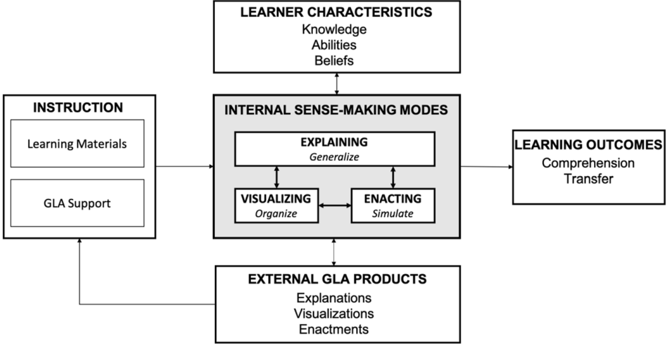
How do learners make sense of what they are learning? In this article, I present a new framework of sense-making based on research investigating the benefits and boundaries of generative learning activities (GLAs). The generative sense-making framework distinguishes among three primary sense-making modes—explaining, visualizing, and enacting—that each serve unique and complementary cognitive functions. Specifically, the framework assumes learners mentally organize and simulate the learning material (via the visualizing and enacting modes) to facilitate their ability to generalize the learning material (via the explaining mode). I present evidence from research on GLAs illustrating how visualizations and enactments (instructor-provided and/or learner-generated) can facilitate higher quality learner explanations and subsequent learning outcomes. I also discuss several barriers to sense-making that help explain when GLAs are not effective and describe possible ways to overcome these barriers by appropriately guiding and timing GLAs. Finally, I discuss implications of the generative sense-making framework for theory and practice and provide recommendations for future research.
Overview
The claims and statistics of this paper haven’t been checked yet.
Free: it reads the open-access text and checks the first 5 claims that cite a source we can check. Create a free account to check every claim.
Integrity signals
Registry
Cites
Statistics
Figures
Verification
Claims the paper makes
The claims and statistics of this paper haven’t been checked yet.
Free: it reads the open-access text and checks the first 5 claims that cite a source we can check. Create a free account to check every claim.
Claims other papers make about this one
Each is checked against this paper’s own text: does it say what the citing paper says it does?
The source backs part of the claim, not all of it — or backs it for a different population, condition or comparison.
In the citing paper
“Theory: Learning requires motivation and self-regulation.”
From Assigning AI: Seven Approaches for Students, with Prompts (2023) · cites this paper as Fiorella, 2023
Experimental — accuracy not yet measuredThe source backs part of the claim, not all of it — or backs it for a different population, condition or comparison.
In the citing paper
“They also need to continually monitor and regulate their own thinking and learning (Fiorella, 2023).”
From Assigning AI: Seven Approaches for Students, with Prompts (2023) · cites this paper as Fiorella, 2023
Experimental — accuracy not yet measuredThe cited source says what the claim attributes to it.
In the citing paper
“Learners must be motivated to put in the work to make sense of new ideas.”
From Assigning AI: Seven Approaches for Students, with Prompts (2023) · cites this paper as Fiorella, 2023
Self-check
Percentages, sums and reported differences re-computed from the paper’s own numbers.
The self-check needs the paper’s full text.
Citations
Cites
Barsalou, L. W. (2008) · Annual Review of Psychology · doi:10.1146/annurev.psych.59.103006.093639 · Cited by 5,936 · cited 3×
“Function According to embodied theories of cognition, thinking is grounded in sensorimotor processing that functions to simulate knowledge (Barsalou, 2008; Glenberg et al., 2013; Lindgren & Johnson-Glenberg, 2013).”
BackgroundWhy a Diagram is (Sometimes) Worth Ten Thousand Words
Larkin, J. H., & Simon, H. A. (1987) · Cognitive Science · doi:10.1016/s0364-0213(87)80026-5 · Cited by 3,733 · cited 1×
“Function Early research in cognitive science suggests that visualizations are more computationally efficient than purely linguistic representations because they explicitly organize information in conceptually meaningful ways (Cox, 1999; Larkin & Simon, 1987; Stenning & Oberlander, 1995).”
BackgroundDunlosky, J., Rawson, K. A., Marsh, E. J., Nathan, M. J., & Willingham, D. T. (2013) · Psychological Science in the Public Interest · doi:10.1177/1529100612453266 · Cited by 3,138
The ICAP framework: Linking cognitive engagement to active learning outcomes
Chi, M. T. H., & Wylie, R. (2014) · Educational Psychologist · doi:10.1080/00461520.2014.965823 · Cited by 2,911 · cited 3×
“The ICAP framework (Chi & Wylie, 2014) distinguishes among four modes of cognitive engagement reflected by learners’ overt behavioral activity during learning.”
BackgroundMethodGlenberg, A. M., & Kaschak, M. P. (2002) · Psychonomic Bulletin & Review · doi:10.3758/bf03196313 · Cited by 2,361 · cited 1×
“Indeed, research suggests the human motor system is involved in a wide range of cognitive tasks, including language production and comprehension (Glenberg & Kaschak, 2002; GoldinMeadow & Alibali, 2013), mathematics (Alibali & Nathan, 2012), and social cognition (Sommerville et al., 2005).”
BackgroundCognitive Architecture and Instructional Design: 20 Years Later
Sweller, J., van Merriënboer, J. J. G., & Paas, F. (2019) · Educational Psychology Review · doi:10.1007/s10648-019-09465-5 · Cited by 2,337 · cited 3×
“…on individual GLAs (e.g., Fiorella & Zhang, 2018; McNamara, 2017) and are analogous to guidance recommendations derived by cognitive load theory (Sweller et al., 2019) : progressing from explicit instruction (worked examples) to scaffolded practice (partial problems) to independent practice…”
BackgroundMethodInfluentialHow are habits formed: modelling habit formation in the real world
Lally, P., van Jaarsveld, C. H. M., Potts, H. W. W., & Wardle, J. (2010) · European Journal of Social Psychology · doi:10.1002/ejsp.674 · Cited by 2,036 · cited 1×
“” With repeated practice in stable and supportive contexts, the decision to use GLAs should become more automatic over time (Lally et al., 2009).”
BackgroundWai, J., Lubinski, D., & Benbow, C. P. (2009) · Journal of Educational Psychology · doi:10.1037/a0016127 · Cited by 1,846
Handbook of Self-Regulation of Learning and Performance
(2017) · Routledge eBooks · doi:10.4324/9781315697048 · Cited by 1,816
Self‐Explanations: How Students Study and Use Examples in Learning to Solve Problems
Chi, M. T. H., Bassok, M., Lewis, M. W., Reimann, P., & Glaser, R. (1989) · Cognitive Science · doi:10.1207/s15516709cog1302_1 · Cited by 1,714 · cited 2×
“Learners may not spontaneously generate principle-based explanations when studying worked examples (Chi et al., 1989; Renkl, 1997), and so they often need explicit prompting and support to engage in self-explaining.”
Background
Research works printed but not linked: 6
- 117. Leinhardt, G. (2001). Instructional explanations: A commonplace for teaching and location for contrast. In Richardson (Ed.), Handbook of research on teaching (pp. 333-357). American Educational Research Association.
- 131. Mayer, R. E. (2022). The cognitive theory of multimedia learning. In R. E. Mayer & L. Fiorella (Eds.), The Cambridge handbook of multimedia learning (3rd ed., pp. 57-72). Cambridge University Press.
- 132. Mayer, R. E., & Fiorella, L. (Eds.). (2022). The Cambridge handbook of multimedia learning (3rd ed.). Cambridge University Press.
- 161. Richland, L. E., Kornell, N., & Kao, L. S. (2009). The pretesting effect: Do unsuccessful retrieval attempts enhance learning? Journal of Experimental Psychology: Applied, 15(3), 243-257.
- 181. Sibley, L., Fiorella, L., & Lachner, A. (2022). It's better when I see it: Students benefit more from open-book than closed-book teaching. Advance online publication.
- 206. Willingham, D. T. (2007). Critical thinking: Why is it so hard to teach? American Educator, Summer, 2007, 8-19.
Cited by
Items 101–200 of 252
Pi, Z., Cao, Y., Zhang, Y., Ma, Y., Cao, W., & Li, X. (2026) · Computers & Education · doi:10.1016/j.compedu.2026.105722 · Cited by 1
Mulyani, R. D., Muchtadi, M., & Hodiyanto, H. (2026) · AL KHAWARIZMI Jurnal Pendidikan Matematika · doi:10.46368/kjpm.v6i2.5367 · Cited by 1
“Ketika siswa diminta mengenali informasi yang relevan, mengubah konteks menjadi model matematika, dan menjelaskan alasan pemilihan strategi, mereka mengorganisasi pengetahuan secara generatif serta membangun hubungan antara konsep dan prosedur (Fiorella, 2023; Fiorella & Mayer, 2016).”
Ding, L., Rodenberg, R., Er, E., Nguyen, H., & Yoon, M. (2026) · Interactive Learning Environments · doi:10.1080/10494820.2026.2702559 · Cited by 1
G'ofurova Sh., M. (2026) · Ilgʻor iqtisodiyot va pedagogik texnologiyalar. · doi:10.60078/3060-4842-2026-vol3-iss4-pp127-134 · Cited by 1
Human-Centered Approaches to Generative AI in Education
Diordiev, E.-A., & Makransky, G. (2026) · Springer eBooks · doi:10.1007/978-3-032-24819-0_6 · Cited by 1
Hamidi, L. R., Manullang, J. G., & Tambunan, G. K. (2026) · JP JOK (Jurnal Pendidikan Jasmani Olahraga dan Kesehatan) · doi:10.33503/jp.jok.v10i1.2898 · Cited by 1
Further Redefining Motivation with Situated Cognition, Power, and Belonging
Hickey, D. T., & Lam, C. (2026) · Educational Psychology Review · doi:10.1007/s10648-026-10219-3 · Cited by 1
“However, the search for generative learning that transfers readily and widely has inspired generations of educational psychologists (e.g., Wittrock, 1974; Fiorella & Mayer, 2016 ; Fiorella, 2023).”
The Effectiveness Of Gallery Walk Method In English Language Learning For Health Science Students
Putri, N. W., & Krissandi, A. D. S. (2026) · ALINEA Jurnal Bahasa Sastra dan Pengajarannya · doi:10.58218/alinea.v6i1.2567 · Cited by 1
DEVELOPMENT OF ANDROID-BASED INTERACTIVE E-MODULES FOR PHYSICS LEARNING ON MECHANICAL WAVE MATERIAL
Ratna, Z. (2025) · Jurnal Inovasi Fisika dan Edukasi · Cited by 1
Learning by Teaching in the Wild: Domain, Grades, and School Track MatterPreprint
Sibley, L., Russ, H., & Lachner, A. (2023) · PsyArXiv (OSF Preprints) · doi:10.31234/osf.io/d293m · Cited by 1
Exploring generative learning environments
Warren, A. (2025) · Iowa Research Online (The University of Iowa) · doi:10.25820/etd.007858 · Cited by 1
Saraswati, E., Kristiawan, M., & Risdianto, E. (2026) · Research Square · doi:10.21203/rs.3.rs-9435119/v1 · Cited by 1
Assuah, D. S., Agyei, C. A., & Ateko, K. D. (2024) · EAST AFRICAN JOURNAL OF EDUCATION AND SOCIAL SCIENCES · doi:10.46606/eajess2024v05i03.0378
“…of the Generative Learning Strategy has been examined across a wide range of curriculum areas, learning levels and learner ages, including what Fiorella (2023, Pi et al. (2023), Buchner (2022), George and Abumchukwu (2021), Olagbaju (2019), Appiah-Twumasi (2018), Bot (2018), Wittrock and…”
BackgroundLanguage, Technology, and Social Media
(2024) · Language, Technology, and Social Media. · doi:10.70211/ltsm
Beyond Verbal Self-Explanations: Student Annotations of a Code-Tracing Example Produced by ChatGPT
Gandhi, A. (2024) · Carleton University's Institutional Repository (MacOdrum Library, Carleton University) · doi:10.22215/etd/2024-16309
Veterinary School Instructor Knowledge of Learning Strategies
Osborn, R. M., Penn, M. J. C., & Rhodes, M. G. (2025) · Journal of Veterinary Medical Education · doi:10.3138/jvme-2024-0118
Üben aus Sicht der Lernpsychologie: Wie kann Üben das nachhaltige Lernen fördern?
Roelle, J., & Richter, T. (2025) · Unterrichtswissenschaft · doi:10.1007/s42010-025-00227-7
“Auf einer allgemeineren Ebene ist hier das Verhältnis von Üben zu generativen Lernaktivitäten angesprochen, die eine Nutzung des Vor-wissens für das Verständnis, die Organisation und die Integration des Gelernten in den Vordergrund stellen (Fiorella 2023).”
Kudus, U. M., & Prasetya, A. (2025) · Jurnal Guru Sekolah Dasar. · doi:10.70277/jgsd.v1i6.3
Signaling Information into Storybooks: The Effects on Preschool Children’s Comprehension
Colliot, T. (2025) · The Journal of Experimental Education · doi:10.1080/00220973.2025.2513251 · Cited by 1
Withdrawn: Exploring Middle-Aged Women’s Post-Session Perceptions of Generative AI UtilizationPreprint
Ha, J. E., Lee, S., & Chung, J. (2025) · Preprints.org · doi:10.20944/preprints202506.2362.v1
I KNOW AND I LEARN! PRE-SERVICE TEACHERS REFLECT ON KWL IN TAIWAN
Yunus, M. H., & Romadhon, M. G. E. (2025) · Indonesian EFL Journal · doi:10.25134/ieflj.v11i2.11677
Sense-making amidst reform: FES educators’ perspectives on ITE changes in England
Bariso, E. U. (2025) · Research in Post-Compulsory Education · doi:10.1080/13596748.2025.2522552
“The concept has also become prominent in science education research, influencing areas such as generative learning (Fiorella 2023), teaching practices (Fitzgerald and Palincsar 2019) and learning analytics (Poquet 2024).”
Pragmatic Adaptive Leadership: building the supports for self-regulated learning
Leonard, S. N., Fowler, S., Kennedy, J., & Devis, D. (2025) · Policy Press eBooks · doi:10.51952/9781447376996.ch006
Leonard, S. N., Fowler, S., Kennedy, J., & Devis, D. (2025) · Policy Press eBooks · doi:10.51952/9781447376996.bm001
Leonard, S. N., Fowler, S., Kennedy, J., & Devis, D. (2025) · Policy Press eBooks · doi:10.51952/9781447376996.bm002
Leonard, S. N., Fowler, S., Kennedy, J., & Devis, D. (2025) · Policy Press eBooks · doi:10.51952/9781447376996.bm003
Future-oriented decision making
Leonard, S. N., Fowler, S., Kennedy, J., & Devis, D. (2025) · Policy Press eBooks · doi:10.51952/9781447376996.ch002
Pragmatic Adaptive Modelling: expanding the educational world
Leonard, S. N., Fowler, S., Kennedy, J., & Devis, D. (2025) · Policy Press eBooks · doi:10.51952/9781447376996.ch005
The complexity of learning contexts
Leonard, S. N., Fowler, S., Kennedy, J., & Devis, D. (2025) · Policy Press eBooks · doi:10.51952/9781447376996.ch004
Leonard, S. N., Fowler, S., Kennedy, J., & Devis, D. (2025) · Policy Press eBooks · doi:10.51952/9781447376996.ch003
Navigating the complexity of schooling
Leonard, S. N., Fowler, S., Kennedy, J., & Devis, D. (2025) · Policy Press eBooks · doi:10.51952/9781447376996.ch001
Leonard, S. N., Fowler, S., Kennedy, J., & Devis, D. (2025) · Policy Press eBooks · doi:10.51952/9781447376996.fm001
Ibraheem, N. K., & Jameel, A. S. (2025) · Journal of Tikrit University for Humanities · doi:10.25130/jtuh.32.3.2.2025.01
Piloting a Research Roundtable for Occupational Therapy Students
Wu, R., Tom, D., & Shea, C. (2025) · Occupational Therapy In Health Care · doi:10.1080/07380577.2025.2576252
Mardiah, A., Ahmad, R. E., Bakar, A., Sulkipli, M., & Tamelab, N. (2025) · Al-Jabar Jurnal Pendidikan Matematika · doi:10.24042/ajpm.v16i2.28721
Battaglia, M. V. (2025) · Form re - Open Journal per la formazione in rete · doi:10.36253/form-17638
“…organizzato in modo progressivo, con un approccio che permetta agli studenti di acquisire conoscenze gradualmente, senza sentirsi sopraffatti, prevedendo tappe intermedie, esercitazioni pratiche e momenti di verifica (Fiorella, 2023), in modo da consentire una costruzione graduale delle competenze.”
Oku, G. K., & Xenyo, S. Y. (2025) · International Journal of Educational Management and Development Studies · doi:10.53378/ijemds.353283
Chouvalova, A., Navlekar, A. S., Mills, D. J., Adams, M., Daye, S., Anda, F. D., & Limeri, L. B. (2024) · Figshare · doi:10.6084/m9.figshare.26727622
Chouvalova, A., Navlekar, A. S., Mills, D. J., Adams, M., Daye, S., Anda, F. D., & Limeri, L. B. (2024) · Figshare · doi:10.6084/m9.figshare.26727625
Chouvalova, A., Navlekar, A. S., Mills, D. J., Adams, M., Daye, S., Anda, F. D., & Limeri, L. B. (2024) · Figshare · doi:10.6084/m9.figshare.26727619
Ribosa, J. (2023) · Dipòsit Digital de Documents de la UAB (Universitat Autònoma de Barcelona)
An Exploration of the State of Distance Learning in New Zealand’s School Sector
Barbour, M. K., & Wenmoth, D. (2024) · Touro Scholar (Touro College)
Kang, D. M. A. (2025) · JISR management and social sciences & economics · doi:10.31384/jisrmsse/2025.23.3.5
Social and emotional learning and generative artificial intelligence in higher education
Lipovec, A., Košir, K., Perše, T. V., Kozmus, A., & Licardo, M. (2025) · University of Maribor digital library (University of Maribor)
Possibilities of using generative artificial intelligence for children with special needs
Plavčak, D. (2025) · University of Maribor digital library (University of Maribor)
Pedagogical foundations for the use of generative artificial intelligence in education
Flogie, A., & Škrobar, J. (2025) · University of Maribor digital library (University of Maribor)
The effectiveness of generative artificial intelligence for personalized mathematics learning
Lipovec, A., & Arcet, B. (2025) · University of Maribor digital library (University of Maribor)
Licardo, M., Puncer, M., & Todorović, T. (2025) · University of Maribor digital library (University of Maribor)
Retrieval Practice and Sentence Generation Effects on Vocabulary Learning in Middle‐School Children
de Menezes, J. P. C., Silva, J. B. L., & Jaeger, A. (2026) · Applied Cognitive Psychology · doi:10.1002/acp.70306
Symbiotic Minds: A Neuroeducational Map of AI and Natural Intelligence
Verma, K. L., Pathak, V., & Aich, T. K. (2026) · Journal of Neuroeducation · doi:10.1344/joned.v6i2.51915
Obergassel, N., Renkl, A., Endres, T., Nückles, M., Carpenter, S. K., & Roelle, J. (2026) · Applied Cognitive Psychology · doi:10.1002/acp.70188
Optimizing Case-based Instruction in Teacher Education
Carbonneau, K. J., & Jernigan, M. A. (2025) · The Teacher Educators Journal · doi:10.66196/qfgt6468
Tekoäly opiskelun tukena : opiskelijaopas vastuulliseen hyödyntämiseen
Valkonen, N. (2026) · Theseus (Ammattikorkeakoulujen)
Syahrul, M., Bahri, H., Syamsul Bahri, H. S., Hetharia, M., Wonley, E. M., & Riska Herlena, S. (2026) · JPBI (Jurnal Pendidikan Biologi Indonesia) · doi:10.22219/jpbi.v12i1.43218
Tan, L.-P., Huang, W.-W., Lang, Y.-R., & Gong, S.-Y. (2026) · European Journal of Psychology of Education · doi:10.1007/s10212-026-01084-3
“Cognitive prompts further help learners concentrate on conceptual relationships (Fiorella, 2023) and may facilitate the generation of conceptual maps.”
InfluentialPark, H. (2026) · Marketing Education Review · doi:10.1080/10528008.2026.2658090
Learning by Creating Teaching Materials: Seven Decisions Teachers Need to Make
Ribosa, J., Durán, D., & Topping, K. J. (2026) · Springer eBooks · doi:10.1007/978-981-95-5997-8_18
Zhang, K., Zheng, P., & Chen, Z. (2026) · IEEE Transactions on Education · doi:10.1109/te.2026.3682747
“[14], [15], [16].”
Assimilate: Principles to Help Learners Actively Make Sense of Incoming Information
Mayer, R. E. (2026) · Cambridge University Press eBooks · doi:10.1017/9781009776660.027
Mayer, R. E. (2026) · Cambridge University Press eBooks · doi:10.1017/9781009776660.029
No Causal Self‐Explanation Effect for Factual Knowledge
Harders, B., & Ebersbach, M. (2026) · Applied Cognitive Psychology · doi:10.1002/acp.70174
Putting Maps Into Perspective: Drawing Territory and Landscape in Geography
Cardoso, V., Espinheira, L., & Lopes, N. D. C. (2025) · Portuguese National Funding Agency for Science, Research and Technology (RCAAP Project by FCT) · doi:10.34626/i2ads/2025-0010
Mazhar, B., Haq, I. U., Haq, E. U., Iqbal, M. A., Pokharel, M., & Maqsood, F. (2026) · Journal of Visual Literacy · doi:10.1080/1051144x.2026.2676908
“However, MVL extends these traditions by adding metacognitive self-regulation as a central mechanism for evaluating AI-generated visual explanations (Fiorella, 2023).”
Rahmawati, F., & Fathurrohman (2026) · Diniyah Jurnal Pendidikan Dasar · doi:10.31332/dy.v7i1.14426
Ding, D., Kim, M., Park, M., & Ahn, C. R. (2026) · Journal of Management in Engineering · doi:10.1061/jmenea.meeng-7457
Genato, S. K. G., & Pelobello, D. P. (2026) · Cognizance Journal of Multidisciplinary Studies · doi:10.47760/cognizance.2026.v06i06.018
Purnama, B. M., Wıdodo, W., Suryanti, S., & Isbadrianingtyas, N. (2026) · Jurnal Ragam Pengabdian · doi:10.62710/p0bx2x18
Improving students’ digital literacy in biology learning through a RICOSRE-based digital module
Wicaksono, I. A. M., Mahanal, S., & Setiowati, F. K. (2026) · Journal of Research in Instructional · doi:10.30862/jri.v6i1.22
Febrianti, F., & Arifin, A. S. (2026) · Inisiatif Jurnal Dedikasi Pengabdian Masyarakat · doi:10.61227/inisiatif.v5i1.801
Nainggolan, V., Nasbey, H., & Nurjannah, N. (2026) · Journal of Education Research · doi:10.37985/jer.v7i3.4022
Medico, G., & Morales, M. S. (2026) · International Journal of Education, Research, and Innovation Perspectives · doi:10.5281/zenodo.21423574
Lu, Y.-C., Hwang, G., & Tu, Y. (2026) · Journal of Computer Assisted Learning · doi:10.1002/jcal.70296
Pratama, D., & R, A. A. M. (2026) · Research Square · doi:10.21203/rs.3.rs-10408567/v1
Susanto, Y. B., Princes, E., & Pangaribuan, C. H. (2026) · International Conference on Applying New Technology in Green Buildings (ATiGB) · doi:10.1109/atigb70203.2026.11628464
“Adaptive learning involves the ability of organizations to respond to changes effectively [1], while generative learning emphasizes the deeper exploration of knowledge that enables transformational changes [2].”
Immersive Virtual Reality for Molecular Visualization: A Preliminary Study in Outreach Contexts
Costa, A., & Filipe, H. A. L. (2026) · Lecture notes in computer science · doi:10.1007/978-3-032-33500-5_27
Are learning strategies recommended by teachers aligned with the science of learning?
de Menezes, J. P. C., & Jaeger, A. (2026) · Trends in Neuroscience and Education · doi:10.1016/j.tine.2026.100298
McLain, T. R. (2026) · Digital Commons (Liberty University)
Peer instruction in chemistry stratified exercises: Cognitive and metacognitive effects
Zheng, Y., Wang, X., Zhang, Y., & Mei, H. (2026) · Learning and Instruction · doi:10.1016/j.learninstruc.2026.102460
Nkomo, N. (2026) · UpSpace Institutional Repository (University of Pretoria) · doi:10.25403/upresearchdata.29467211
Bridging the Gap Between Study Skills and the First-Year Chemistry Curriculum
Adams, G. M., & McCarren, E. M. (2026) · Journal of Chemical Education · doi:10.1021/acs.jchemed.5c01302
Scale-Model Teaching Practice for Building Water Supply and Drainage in Production Internship
李, 琪. (2026) · Advances in Education · doi:10.12677/ae.2026.1691904
Bridging generative learning research and retrieval practice research
Obergassel, N. (2026) · Dokumentenrepositorium der RUB (Ruhr University Bochum) · doi:10.13154/294-14460
Dawoud, A. (2026) · مجلة رابطة التربويين الفلسطينيين للآداب والدراسات التربوية والنفسية.
Petersen, G. B., Santoso, M., Fauville, G., Hancock, J. T., & Bailenson, J. N. (2026) · Computers & Education X Reality · doi:10.1016/j.cexr.2026.100181
“Finally, to address the fact that generating questions is a cognitively demanding learning activity (Fiorella, 2023), we implemented prompts during the AI conversation that provided suggestions on what to inquire about: “ Try asking about (1) encounters with fishing nets, (2) difficulties finding…”
Zheng, M., Tian, H., Rao, X., Tan, H., Li, S., & Zhang, M. (2026) · NeuroImage · doi:10.1016/j.neuroimage.2026.122208
Worked Examples and Transfer: An Integrative Review, Design Framework, and Practitioner Checklist
Bourgaux, L., Tricot, A., & PAAS, F. G. W. C. (2026) · Educational Psychology Review · doi:10.1007/s10648-026-10206-8
“Self-explanation is a metacognitive strategy in which learners actively construct meaning by generating inferences about the steps, goals, and underlying principles (Aleven & Koedinger, 2002; Chi et al., 1989, 1994; Fiorella, 2023; Fiorella & Mayer, 2016; Rittle-Johnson et al., 2017 ).”
Learning-Science Grounded Design for Generative Artificial Intelligence in Education
Lin, J., & Hu, X. (2026) · Springer eBooks · doi:10.1007/978-3-032-24819-0_7
Russ, H., Endres, T., Sibley, L., Flegr, S., Kühn, J., Hoogerheide, V., Scheiter, K., & Lachner, A. (2026) · Learning and Instruction · doi:10.1016/j.learninstruc.2026.102462 · Cited by 1
Siegel, S. T., Sidler, C., & Dilger, B. (2026) · Zeitschrift für Hochschulentwicklung · doi:10.21240/zfhe/21-3/10
“Learning activities aim at cognitively activating participants through demanding de-sign tasks, as generative processing drives durable learning (Fiorella, 2023).”
InfluentialResearch on an Active Classroom Model for Undergraduate Students Based on Generative AI
Chunhua, S., & Wei, Y. (2026) · International Conference on Educational Digitalization and Computer Science in the Guangdong-Hong Kong-Macao Greater Bay Area · doi:10.1145/3828183.3828469
“Its essence lies in activating students’ learning motivation, cognitive engagement, and sense of responsibility through problem-based learning, interactive communication, collaborative inquiry, and generative expression [ 9 ] .”
Niegemann, H., Weinberger, A., Korbach, A., & Malone, S. (2026) · Springer eBooks · doi:10.1007/978-3-662-73355-4_9
Just Explain It to Yourself: On Integrating Self-Explanations into Explainable AI
de Zoeten, M., Ernst, C.-P. H., Staegemann, D. G., & Rothlauf, F. (2026) · Proceedings of the International Conference on Information Systems Development · doi:10.62036/isd.2026.76
Yılmaz, H., & Polat, D. (2026) · Clinical Anatomy · doi:10.1002/ca.70205
Kuo, L.-H., Chang, C.-H., Huang, C., Huang, S.-F., Huang, K., & Guo, J. (2026) · Educational Gerontology · doi:10.1080/03601277.2026.2733869
Kurniyah, S., Badarudin, B., & Rahmawati, B. F. (2026) · Discourse · doi:10.69875/djosse.v3i3.435
“Students who only view an infographic may therefore engage in less generative processing than those asked to interpret, complete, explain, or construct one (Fiorella, 2023).”
Saadi, K. K. A., Hussain, R. M., & Hwang, G. (2026) · Discover Artificial Intelligence · doi:10.1007/s44163-026-02234-8
“According to generative learning theory, comprehension deepens when learners actively select pertinent information, establish relationships among ideas, and connect new information with prior knowledge through self-generated representations [9].”
InfluentialKarisma, E., Hamu, F. J., & Winei, A. A. D. (2026) · Journal of Scientific Research Education and Technology (JSRET) · doi:10.58526/jsret.v5i3.1218
“…illustrations serve as a cognitive bridge that facilitates memory retrieval of faith content, consistent with the principle of generative learning described by (Fiorella, 2023) : learning is most effective when learners actively construct meaning from material, rather than receiving it passively.”
Metadata
- Authors
- Fiorella, L.
- Affiliations
- University of Georgia (US)
- Corresponding author
- Fiorella, Logan
- ORCID
- Fiorella, Logan
- Venue
- Educational Psychology Review
- Published
- 2023-04-26
- Volume
- 35
- Issue
- 2
- ISSN
- 1040-726X (ISSN-L)
- 1573-336X
- OpenAlex
- W4367053854
- Semantic Scholar
- 0710367c82ed805e3add1fd2afbae69966f080a6
- Cited by
- 135
- References
- 212
- Citations by year
- 2026: 56 · 2025: 41 · 2024: 27 · 2023: 11
- FWCI
- 35.35
- Type
- journal article
- Language
- en
- Open access
- hybrid
- doi.org
- Licence
- cc-by
- creativecommons.org/licenses/by/4.0 (tdm)
- creativecommons.org/licenses/by/4.0 (vor)
- Locations
- Educational Psychology Review (publishedVersion, cc-by)
- Funders
- Directorate for Education and Human Resources (1955349, 2055117)
- Spencer Foundation (Postdoctoral Fellowship)
- Topics
- Social Sciences › Psychology › Experimental and Cognitive Psychology › Visual and Cognitive Learning Processes
- Social Sciences › Psychology › Developmental and Educational Psychology › Innovative Teaching and Learning Methods
- Social Sciences › Education › Innovative Teaching Methods
- Keywords
- sensemaking, explanation, visualization, enactment, generalization, cognitive function, instructional guidance
About these checks
Registry, retraction, Cites and statistics results are computed, not judged, with one exception: a printed reference that no index lists is read once by a model before it counts as a citation error. Claims are extracted by a model and kept only when their quote appears verbatim in the text; each cited source is then checked, with a model’s help, for whether it says what the claim relies on. Those verdicts can be wrong — read the claim’s quote and the cited source before relying on one.
Statistics and arithmetic are recomputed, not judged.
Confidence bands are shown only for fields calibrated on our annotated test set. None is calibrated yet, so no band is shown.
What counts as a claim ›How we measure confidence ›How we check this ›
Are you an author, or do you see a problem with this page? Request a review
Data sources
Bibliographic data: Semantic Scholar, OpenAlex, Crossref.
Contains information from the Semantic Scholar Academic Graph Datasets, made available under the ODC Attribution License (ODC-BY 1.0).
Semantic Scholar’s data is described in: Kinney, R., et al. (2023). The Semantic Scholar Open Data Platform. arXiv:2301.10140.
