

Making Sense of Generative Learning
Open accessThe DOI matches its Crossref record; 211 of the 212 references it cites were found in a registry or an index.
Abstract
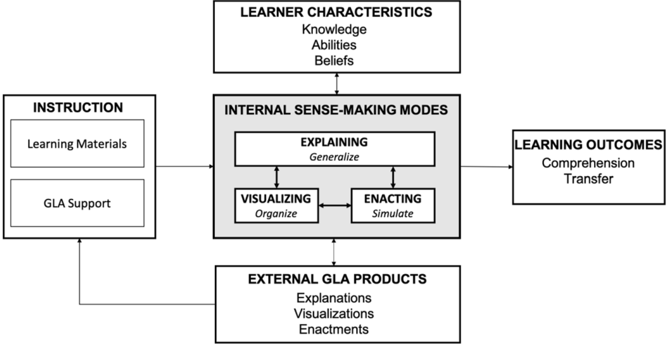
How do learners make sense of what they are learning? In this article, I present a new framework of sense-making based on research investigating the benefits and boundaries of generative learning activities (GLAs). The generative sense-making framework distinguishes among three primary sense-making modes—explaining, visualizing, and enacting—that each serve unique and complementary cognitive functions. Specifically, the framework assumes learners mentally organize and simulate the learning material (via the visualizing and enacting modes) to facilitate their ability to generalize the learning material (via the explaining mode). I present evidence from research on GLAs illustrating how visualizations and enactments (instructor-provided and/or learner-generated) can facilitate higher quality learner explanations and subsequent learning outcomes. I also discuss several barriers to sense-making that help explain when GLAs are not effective and describe possible ways to overcome these barriers by appropriately guiding and timing GLAs. Finally, I discuss implications of the generative sense-making framework for theory and practice and provide recommendations for future research.
Overview
The claims and statistics of this paper haven’t been checked yet.
Free: it reads the open-access text and checks the first 5 claims that cite a source we can check. Create a free account to check every claim.
Integrity signals
Registry
Cites
Statistics
Figures
Verification
Claims the paper makes
The claims and statistics of this paper haven’t been checked yet.
Free: it reads the open-access text and checks the first 5 claims that cite a source we can check. Create a free account to check every claim.
Claims other papers make about this one
Each is checked against this paper’s own text: does it say what the citing paper says it does?
The source backs part of the claim, not all of it — or backs it for a different population, condition or comparison.
In the citing paper
“Theory: Learning requires motivation and self-regulation.”
From Assigning AI: Seven Approaches for Students, with Prompts (2023) · cites this paper as Fiorella, 2023
Experimental — accuracy not yet measuredThe source backs part of the claim, not all of it — or backs it for a different population, condition or comparison.
In the citing paper
“They also need to continually monitor and regulate their own thinking and learning (Fiorella, 2023).”
From Assigning AI: Seven Approaches for Students, with Prompts (2023) · cites this paper as Fiorella, 2023
Experimental — accuracy not yet measuredThe cited source says what the claim attributes to it.
In the citing paper
“Learners must be motivated to put in the work to make sense of new ideas.”
From Assigning AI: Seven Approaches for Students, with Prompts (2023) · cites this paper as Fiorella, 2023
Self-check
Percentages, sums and reported differences re-computed from the paper’s own numbers.
The self-check needs the paper’s full text.
Citations
Cites
Items 201–211 of 211
Correcting Student Errors and Misconceptions
Marsh, E. J., & Eliseev, E. D. (2019) · Cambridge University Press eBooks · doi:10.1017/9781108235631.018 · Cited by 18 · cited 1×
“Scaffolded and independent practice is most effective when it is followed by appropriate feedback: information designed to help learners evaluate and correct their performance (see Johnson & Marraffino, 2022; Marsh & Eliseev, 2019).”
BackgroundFiorella, L., Pyres, M., & Hebert, R. (2021) · Applied Cognitive Psychology · doi:10.1002/acp.3871 · Cited by 15 · cited 1×
“Scaffolded practice involves providing specific prompts or hints (e.g., Berthold et al., 2009; Roelle et al., 2017) , or partial representations for learners to complete (e.g., Fiorella et al., 2021; Ponce et al., 2020; Schwamborn et al., 2010).”
BackgroundSelf-citationThe Mapping Principle in Multimedia Learning
Adesope, O., Nesbit, J. C., & Sundararajan, N. (2021) · Cambridge University Press eBooks · doi:10.1017/9781108894333.037 · Cited by 15 · cited 1×
“…external visuals that spatially arrange text (using lines and shapes) to convey abstract conceptual relationships (for recent reviews, see Adesope et al., 2022; Schroeder et al., 2018), such as creating a graphic organizer to compare eastern and western steamboats (Ponce & Mayer, 2014)…”
BackgroundEffects of instructor-provided visuals on learner-generated explanations
Kuhlmann, S. L., & Fiorella, L. (2022) · Educational Psychology · doi:10.1080/01443410.2022.2117276 · Cited by 12 · cited 1×
“Of course, visualizations often afford multiple types of inferences, such as a knowledge map that conveys hierarchical and temporal relationships (e.g., Kuhlmann & Fiorella, 2022).”
BackgroundSelf-citationWakefield, E. M., & Goldin-Meadow, S. (2019) · Cambridge University Press eBooks · doi:10.1017/9781108235631.010 · Cited by 11 · cited 3×
“For example, gestures can be used to simulate the events described in a story (Dargue et al., 2019) , the directions for navigating a route (So et al., 2014), or strategies for solving abstract mathematics problems (Wakefield & Goldin-Meadow, 2019).”
BackgroundMethodResultProblem Solving in Mathematics with Multiple Representations
Stylianou, D. A. (2020) · Routledge eBooks · doi:10.4324/9780429443961-9 · Cited by 10
The Cognitive Load Self-Management Principle in Multimedia Learning
Zhang, S., de Koning, B. B., Agostinho, S., Tindall‐Ford, S., Chandler, P., & PAAS, F. G. W. C. (2021) · Cambridge University Press eBooks · doi:10.1017/9781108894333.044 · Cited by 10
The Imagination Principle in Multimedia Learning
Leopold, C. (2021) · Cambridge University Press eBooks · doi:10.1017/9781108894333.039 · Cited by 10 · cited 1×
“Imagining involves generating an internal visual representation of physical structures or conceptual relationships (for a recent review, see Leopold, 2022), such as forming mental images of the structure of the human respiratory system (Leopold & Mayer, 2015).”
BackgroundLafay, A., Osana, H. P., & Guillan, J. (2021) · Educational Psychology · doi:10.1080/01443410.2021.1900546 · Cited by 9
Using gestures to signal lesson structure and foster meaningful learning
Pilegard, C., & Fiorella, L. (2021) · Applied Cognitive Psychology · doi:10.1002/acp.3866 · Cited by 9 · cited 1×
“Taken together, this pattern provides strong evidence for the role of gestures in facilitating inference generation and knowledge generalization (see also Cutica et al., 2014; Nathan et al., 2021; Pilegard & Fiorella, 2021).”
BackgroundSelf-citationManalo, E. (2018) · Cited by 5
Research works printed but not linked: 6
- 117. Leinhardt, G. (2001). Instructional explanations: A commonplace for teaching and location for contrast. In Richardson (Ed.), Handbook of research on teaching (pp. 333-357). American Educational Research Association.
- 131. Mayer, R. E. (2022). The cognitive theory of multimedia learning. In R. E. Mayer & L. Fiorella (Eds.), The Cambridge handbook of multimedia learning (3rd ed., pp. 57-72). Cambridge University Press.
- 132. Mayer, R. E., & Fiorella, L. (Eds.). (2022). The Cambridge handbook of multimedia learning (3rd ed.). Cambridge University Press.
- 161. Richland, L. E., Kornell, N., & Kao, L. S. (2009). The pretesting effect: Do unsuccessful retrieval attempts enhance learning? Journal of Experimental Psychology: Applied, 15(3), 243-257.
- 181. Sibley, L., Fiorella, L., & Lachner, A. (2022). It's better when I see it: Students benefit more from open-book than closed-book teaching. Advance online publication.
- 206. Willingham, D. T. (2007). Critical thinking: Why is it so hard to teach? American Educator, Summer, 2007, 8-19.
Cited by
Assigning AI: Seven Approaches for Students, with Prompts
Mollick, E., & Mollick, L. (2023) · arXiv · doi:10.48550/arxiv.2306.10052 · Cited by 586
Wu, D., Zhang, S., Ma, Z., Yue, X.-G., & Dong, R. K. (2024) · Systems · doi:10.3390/systems12090332 · Cited by 91
Research Avenues Supporting Embodied Cognition in Learning and Instruction
Castro-Alonso, J. C., Ayres, P., Zhang, S., de Koning, B. B., & PAAS, F. G. W. C. (2024) · Educational Psychology Review · doi:10.1007/s10648-024-09847-4 · Cited by 163
“Generative actions are effective learning strategies because they allow students to make personal connections between the learning materials and their existing knowledge or experience (see Fiorella & Mayer, 2016b; see also Castro-Alonso et al., 2021a; Fiorella, 2023).”
Skulmowski, A. (2024) · Educational Psychology Review · doi:10.1007/s10648-024-09869-y · Cited by 112
“Currently, forms of activity-based learning known as generative learning are of particular interest in the literature (Fiorella, 2023; Fiorella & Mayer, 2016).”
de Jong, T., Lazonder, A. W., Chinn, C. A., Fischer, F., Gobert, J. D., Hmelo‐Silver, C. E., Koedinger, K. R., Krajcik, J. S., Kyza, E. Α., Linn, M. C., et al. (2024) · Educational Research Review · doi:10.1016/j.edurev.2024.100623 · Cited by 83
Metadata
- Authors
- Fiorella, L.
- Affiliations
- University of Georgia (US)
- Corresponding author
- Fiorella, Logan
- ORCID
- Fiorella, Logan
- Venue
- Educational Psychology Review
- Published
- 2023-04-26
- Volume
- 35
- Issue
- 2
- ISSN
- 1040-726X (ISSN-L)
- 1573-336X
- OpenAlex
- W4367053854
- Semantic Scholar
- 0710367c82ed805e3add1fd2afbae69966f080a6
- Cited by
- 135
- References
- 212
- Citations by year
- 2026: 56 · 2025: 41 · 2024: 27 · 2023: 11
- FWCI
- 35.35
- Type
- journal article
- Language
- en
- Open access
- hybrid
- doi.org
- Licence
- cc-by
- creativecommons.org/licenses/by/4.0 (tdm)
- creativecommons.org/licenses/by/4.0 (vor)
- Locations
- Educational Psychology Review (publishedVersion, cc-by)
- Funders
- Directorate for Education and Human Resources (1955349, 2055117)
- Spencer Foundation (Postdoctoral Fellowship)
- Topics
- Social Sciences › Psychology › Experimental and Cognitive Psychology › Visual and Cognitive Learning Processes
- Social Sciences › Psychology › Developmental and Educational Psychology › Innovative Teaching and Learning Methods
- Social Sciences › Education › Innovative Teaching Methods
- Keywords
- sensemaking, explanation, visualization, enactment, generalization, cognitive function, instructional guidance
About these checks
Registry, retraction, Cites and statistics results are computed, not judged, with one exception: a printed reference that no index lists is read once by a model before it counts as a citation error. Claims are extracted by a model and kept only when their quote appears verbatim in the text; each cited source is then checked, with a model’s help, for whether it says what the claim relies on. Those verdicts can be wrong — read the claim’s quote and the cited source before relying on one.
Statistics and arithmetic are recomputed, not judged.
Confidence bands are shown only for fields calibrated on our annotated test set. None is calibrated yet, so no band is shown.
What counts as a claim ›How we measure confidence ›How we check this ›
Are you an author, or do you see a problem with this page? Request a review
Data sources
Bibliographic data: Semantic Scholar, OpenAlex, Crossref.
Contains information from the Semantic Scholar Academic Graph Datasets, made available under the ODC Attribution License (ODC-BY 1.0).
Semantic Scholar’s data is described in: Kinney, R., et al. (2023). The Semantic Scholar Open Data Platform. arXiv:2301.10140.
