

The DOI matches its Crossref record; 70 of the 70 references it cites were found in a registry or an index.
Mendelian randomisation for mediation analysis: current methods and challenges for implementation
Open accessPublished version of a preprint
Abstract
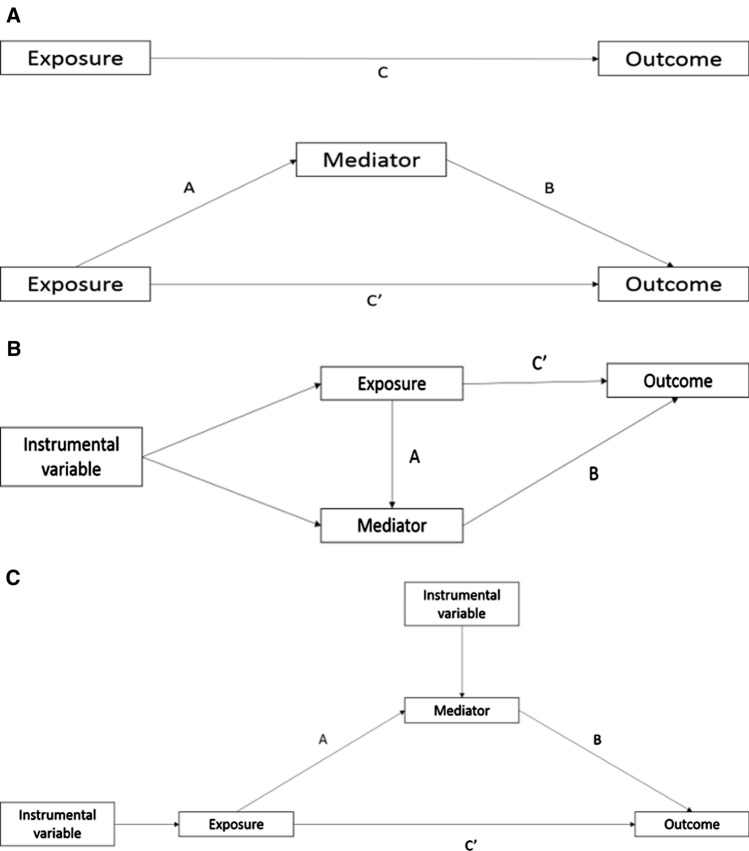
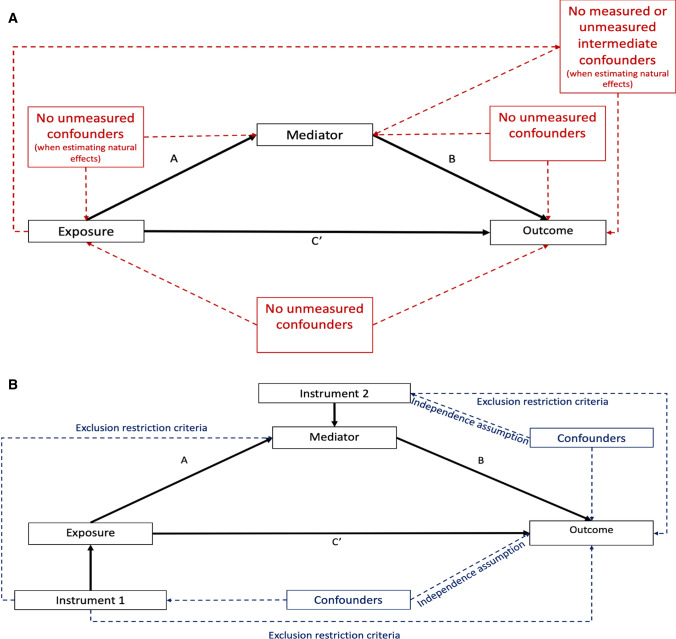
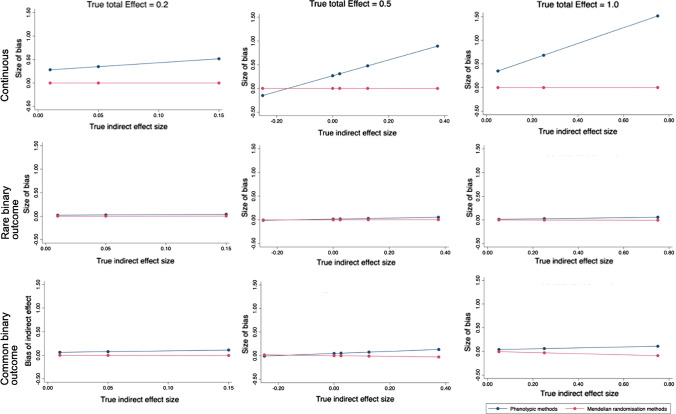
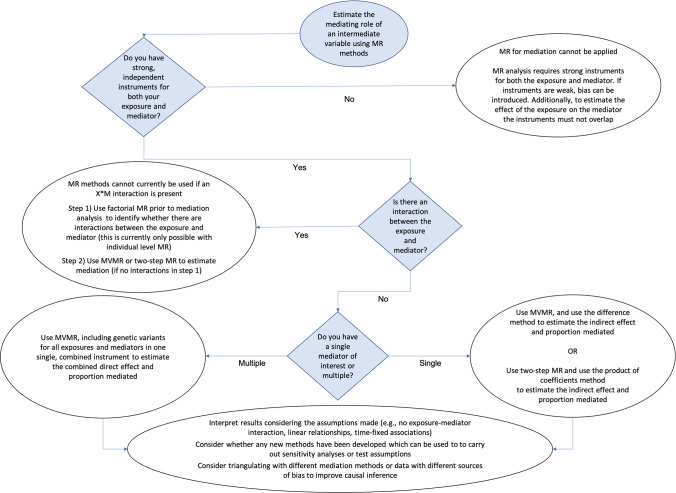
Mediation analysis seeks to explain the pathway(s) through which an exposure affects an outcome. Traditional, non-instrumental variable methods for mediation analysis experience a number of methodological difficulties, including bias due to confounding between an exposure, mediator and outcome and measurement error. Mendelian randomisation (MR) can be used to improve causal inference for mediation analysis. We describe two approaches that can be used for estimating mediation analysis with MR: multivariable MR (MVMR) and two-step MR. We outline the approaches and provide code to demonstrate how they can be used in mediation analysis. We review issues that can affect analyses, including confounding, measurement error, weak instrument bias, interactions between exposures and mediators and analysis of multiple mediators. Description of the methods is supplemented by simulated and real data examples. Although MR relies on large sample sizes and strong assumptions, such as having strong instruments and no horizontally pleiotropic pathways, our simulations demonstrate that these methods are unaffected by confounders of the exposure or mediator and the outcome and non-differential measurement error of the exposure or mediator. Both MVMR and two-step MR can be implemented in both individual-level MR and summary data MR. MR mediation methods require different assumptions to be made, compared with non-instrumental variable mediation methods. Where these assumptions are more plausible, MR can be used to improve causal inference in mediation analysis.
Overview
The claims and statistics of this paper haven’t been checked yet.
Run the check — free, no account needed. It reads the open-access text and checks the sources it cites.
Integrity signals
Registry
Cites
Statistics
Figures
Verification
Claims the paper makes
The claims and statistics of this paper haven’t been checked yet.
Run the check — free, no account needed. It reads the open-access text and checks the sources it cites.
Claims other papers make about this one
Each is checked against this paper’s own text: does it say what the citing paper says it does?
In the citing paper
“If all of the IV conditions are satisfied, this estimate will differ from a univariable MR estimate where all or part of the effect of the exposure on the outcome acts through a mediating phenotype included in the multivariable MR estimation.104”
From Mendelian randomization (2022) · cites this paper as [104]
In the citing paper
“MR can be used to estimate the proportion of the effect of an exposure on an outcome that is mediated by an intermediate phenotype.104,105”
From Mendelian randomization (2022) · cites this paper as [104]
In the citing paper
“the directional effects between diseases and longevity persisted after adjustment for socioeconomic factors73,74.”
From Genetic trade-offs in fertility and longevity explain the maintenance of disease-associated alleles in humans (2026) · cites this paper as [74]
Self-check
Percentages, sums and reported differences re-computed from the paper’s own numbers.
The self-check needs the paper’s full text.
Citations
Cites
Baron, R. M., & Kenny, D. A. (1986) · Journal of Personality and Social Psychology · doi:10.1037/0022-3514.51.6.1173 · Cited by 91,532
Bowden, J., Davey Smith, G., & Burgess, S. (2015) · International Journal of Epidemiology · doi:10.1093/ije/dyv080 · Cited by 9,816
A comparison of methods to test mediation and other intervening variable effects
MacKinnon, D. P., Lockwood, C. M., Hoffman, J. M., West, S. G., & Sheets, V. (2002) · Psychological Methods · doi:10.1037/1082-989x.7.1.83 · Cited by 9,406
Bowden, J., Davey Smith, G., Haycock, P. C., & Burgess, S. (2016) · Genetic Epidemiology · doi:10.1002/gepi.21965 · Cited by 8,922
Mendelian Randomization Analysis With Multiple Genetic Variants Using Summarized Data
Burgess, S., Butterworth, A., & Thompson, S. G. (2013) · Genetic Epidemiology · doi:10.1002/gepi.21758 · Cited by 6,050
Davey Smith, G., & Ebrahim, S. (2003) · International Journal of Epidemiology · doi:10.1093/ije/dyg070 · Cited by 5,882
MacKinnon, D. P., Fairchild, A. J., & Fritz, M. S. (2007) · Annual Review of Psychology · doi:10.1146/annurev.psych.58.110405.085542 · Cited by 5,688
Mendelian randomization: genetic anchors for causal inference in epidemiological studies
Davey Smith, G., & Hemani, G. (2014) · Human Molecular Genetics · doi:10.1093/hmg/ddu328 · Cited by 4,677
Mendelian randomization: Using genes as instruments for making causal inferences in epidemiology
Lawlor, D. A., Harbord, R. M., Sterne, J. A. C., Timpson, N., & Davey Smith, G. (2008) · Statistics in Medicine · doi:10.1002/sim.3034 · Cited by 4,618
Genetic studies of body mass index yield new insights for obesity biology
Study, T. L. C., Locke, A. E., The ADIPOGen Consortium, The AGEN-BMI Working Group, The CARDIOGRAMplusC4D Consortium, The CKDGen Consortium, The, G. L. G. C., The, I. C. B. P., The MAGIC Investigators, The MuTHER Consortium, et al. (2015) · Nature · doi:10.1038/nature14177 · Cited by 4,534
Research works printed but not linked: 1
- Richardson TG, Sanderson E, Elsworth B, Tilling K, Davey SG. Use of genetic variation to separate the effects of early and later life adiposity on disease risk: mendelian randomisation study. BMJ. 2020;369:m1203. https://doi.org/10.1136/bmj.m1203. · DOI · Paper page
Cited by
Sorted by citations
Items 1,001–1,001 of 1,001
Wen, J., Zhang, J., Zhang, H., Zhang, N., Lei, R., Deng, Y., Cheng, Q., Li, H., & Luo, P. (2024) · Figshare · doi:10.6084/m9.figshare.25720120
Metadata
- Authors
- Carter, A. R., Sanderson, E., Hammerton, G., Richmond, R. C., Davey Smith, G., Heron, J., Taylor, A. E., Davies, N. M., & Howe, L. D.
- Affiliations
- University of Bristol (GB)
- University Hospitals Bristol NHS Foundation Trust (GB)
- Norwegian University of Science and Technology (NO)
- Corresponding author
- Carter, Alice R.
- ORCID
- Venue
- European Journal of Epidemiology
- Published
- 2021-05
- Volume
- 36
- Issue
- 5
- Pages
- 465-478
- ISSN
- 0393-2990 (ISSN-L)
- 1573-7284
- PMC
- PMC8159796
- OpenAlex
- W3159102563
- Cited by
- 1,215
- References
- 67
- Citations by year
- 2026: 196 · 2025: 407 · 2024: 386 · 2023: 143 · 2022: 54 · 2021: 18
- FWCI
- 117.42
- Type
- journal article
- Language
- en
- Open access
- hybrid
- doi.org
- Locations
- European Journal of Epidemiology (publishedVersion, cc-by)
- bioRxiv (Cold Spring Harbor Laboratory) (acceptedVersion, cc-by)
- PubMed Central (publishedVersion, cc-by)
- PubMed (publishedVersion)
- Bristol Research (University of Bristol) (submittedVersion, cc-by)
- Funders
- UK Medical Research Council (MC_UU_00011/1, MR/M020894)
- UK Economic and Social Research Council (ES/N000757/1)
- Wellcome Trust (209138/Z/17/Z)
- Norwegian Research Council (295989)
- Topics
- Physical Sciences › Mathematics › Statistics and Probability › Advanced Causal Inference Techniques
- Life Sciences › Biochemistry, Genetics and Molecular Biology › Genetics › Genetic Associations and Epidemiology
- Physical Sciences › Mathematics › Statistics and Probability › Statistical Methods in Epidemiology
- Keywords
- Mendelian randomization, mediation analysis, causal inference, confounding, measurement error, weak instrument bias, pleiotropy, multiple mediators
- MeSH terms
- Mediation Analysis, Humans, Genetic Variation, Bias, Causality, Genome-Wide Association Study, Mendelian Randomization Analysis, Genetic Pleiotropy
About these checks
Registry, retraction, Cites and statistics results are computed, not judged, with one exception: a printed reference that no index lists is read once by a model before it counts as a citation error. Claims are extracted by a model and kept only when their quote appears verbatim in the text; each cited source is then checked, with a model’s help, for whether it says what the claim relies on. Those verdicts can be wrong — read the claim’s quote and the cited source before relying on one.
Statistics and arithmetic are recomputed, not judged.
Confidence bands are shown only for fields calibrated on our annotated test set. None is calibrated yet, so no band is shown.
What counts as a claim ›How we measure confidence ›How we check this ›
Are you an author, or do you see a problem with this page? Request a review
