

Guidelines for conducting and reporting case study research in software engineering
Open accessThe DOI matches its Crossref record; 74 of the 75 references it cites were found in a registry or an index.
Abstract
Case study is a suitable research methodology for software engineering research since it studies contemporary phenomena in its natural context. However, the understanding of what constitutes a case study varies, and hence the quality of the resulting studies. This paper aims at providing an introduction to case study methodology and guidelines for researchers conducting case studies and readers studying reports of such studies. The content is based on the authors’ own experience from conducting and reading case studies. The terminology and guidelines are compiled from different methodology handbooks in other research domains, in particular social science and information systems, and adapted to the needs in software engineering. We present recommended practices for software engineering case studies as well as empirically derived and evaluated checklists for researchers and readers of case study research.
Overview
The claims and statistics of this paper haven’t been checked yet.
Free: it reads the open-access text and checks the first 5 claims that cite a source we can check. Create a free account to check every claim.
Integrity signals
Registry
Cites
Statistics
Figures


Verification
Claims the paper makes
The claims and statistics of this paper haven’t been checked yet.
Free: it reads the open-access text and checks the first 5 claims that cite a source we can check. Create a free account to check every claim.
Claims other papers make about this one
Each is checked against this paper’s own text: does it say what the citing paper says it does?
In the citing paper
“it is common to include construct validity, reliability, internal validity, and external validity, according to the guideline proposed in other works [222,255], which we adopted in the following.”
From Sustainability in computing education: A systematic literature review (2024) · cites this paper as [222]
Self-check
Percentages, sums and reported differences re-computed from the paper’s own numbers.
The self-check needs the paper’s full text.
Citations
Cites
(1984) · Cited by 81,983
Case Study Research: Design and Methods
Chaiklin, H. (1991) · The Journal of Nervous and Mental Disease · doi:10.1097/00005053-199102000-00025 · Cited by 39,535
Basics of Qualitative Research
Ozanne, J. L., Strauss, A., & Corbin, J. (1992) · Journal of Marketing Research · doi:10.1177/002224379202900312 · Cited by 17,868
Basics of Qualitative Research
Ozanne, J. L., Strauss, A., & Corbin, J. (1992) · Journal of Marketing Research · doi:10.2307/3172751 · Cited by 17,850
Building Theories from Case Study Research
Eisenhardt, K. M. (1989) · The Academy of Management Review · doi:10.2307/258557 · Cited by 17,455
The Art of Case Study Research
Johnson, K. E., & Stake, R. E. (1996) · The Modern Language Journal · doi:10.2307/329758 · Cited by 15,826 · cited 4×
“Four different types of triangulation may be applied ( Stake 1995 ):”
BackgroundMethodInfluentialHartley, J. (2004) · Essential Guide to Qualitative Methods in Organizational Research · doi:10.4135/9781446280119.n26 · Cited by 15,461
Five misunderstandings about case-study research
Flyvbjerg, B. (2006) · Qualitative Inquiry · doi:10.1177/1077800405284363 · Cited by 14,266 · cited 4×
“2 Case study methodology was originally used primarily for exploratory purposes, and some researchers still limit case studies for this purpose, as discussed by Flyvbjerg (2007).”
BackgroundMethodInfluentialAn Experimental Application of the DELPHI Method to the Use of Experts
Dalkey, N., & Helmer, O. (1963) · Management Science · doi:10.1287/mnsc.9.3.458 · Cited by 6,061
A Set of Principles for Conducting and Evaluating Interpretive Field Studies in Information Systems1
Klein, H. K., & Myers, M. D. (1999) · MIS Quarterly · doi:10.2307/249410 · Cited by 5,263 · cited 7×
“We prefer to consider ethnographic studies as a specialized type of case studies with focus on cultural practices (Easterbrook et al. 2008) or long duration studies with large amounts of participant-observer data (Klein and Myers 1999).”
BackgroundMethodInfluential
Research works printed but not linked: 2
- Shull F, Singer J, Sjøberg D (eds) (2008) Guide to Advanced Empirical Software Engineering. Springer- Verlag: London
- Martin Höst is an Associate Professor in Software Engineering in the Software Engineering Research Group at the Department of Computer Science, Lund University, Sweden. He received an M.Sc. degree from Lund University in 1992 and a Ph.D. degree in Software Engineering from the same university in 1999. His main research interests include software process improvement, software quality, empirical software engineering, and computer simulation of software development processes. The research is mainly conducted through empirical methods such as case studies, controlled experiments, and surveys. He has published more than 40 papers in international journals and conference proceedings.
Cited by
Items 601–700 of 1,013
Scalable authentic assessment of collaborative work assignments in wikis
Balderas, A., Palomo‐Duarte, M., Dodero, J. M., Sáiz, M. S. I., & Gómez, G. R. (2018) · International Journal of Educational Technology in Higher Education · doi:10.1186/s41239-018-0122-1 · Cited by 36
Bottleneck Identification and Performance Modeling of OPC UA Communication Models
Burger, A., Koziolek, H., Rückert, J., Platenius‐Mohr, M., & Stomberg, G. (2019) · ACM/SPEC International Conference on Performance Engineering (ICPE) · doi:10.1145/3297663.3309670 · Cited by 33
“We review construct validity, internal validity, and external validity [12].”
BackgroundAmorim, T., Vogelsang, A., Pudlitz, F., Gersing, P., & Philipps, J. (2019) · IEEE/ACM International Conference on Software Engineering: Software Engineering in Practice (ICSE-SEIP) · doi:10.1109/icse-seip.2019.00030 · Cited by 33
“The method provides insights into the examined topic and gives essential information to understand the phenomenon in its real context [9], [10].”
MethodRainer, A., & Williams, A. H. (2019) · Journal of Software Evolution and Process · doi:10.1002/smr.2197 · Cited by 37
Using static analysis tools to assist student project evaluation
Molnar, A.-J., Motogna, S., & Cristina, V. (2020) · doi:10.1145/3412453.3423195 · Cited by 33
“We evaluated the threats that might influence the validity of our study according to existing best practices [18] at each of the steps in our process: data collection, integration with Pylint, and result analysis.”
MethodChallenges and practices of deep learning model reengineering: A case study on computer vision
Jiang, W., Banna, V., Vivek, N., Goel, A., Synovic, N. M., Thiruvathukal, G. K., & Davis, J. C. (2024) · Empirical Software Engineering · doi:10.1007/s10664-024-10521-0 · Cited by 38
“To answer our research questions, we used a case study approach (Perry et al. 2004; Runeson and Höst 2009) that combined two perspectives (Johnson and Onwuegbuzie 2004).”
MethodEspinosa‐Curiel, I. E., Rodríguez‐Jacobo, J., & Fernández‐Zepeda, J. A. (2011) · Journal of Software Evolution and Process · doi:10.1002/smr.569 · Cited by 35
“To increase the precision of the research results and to ensure their validity, we used triangulation in the case studies [46].”
BackgroundMethodInfluentialDoes Transactional Memory Keep Its Promises? Results from an Empirical Study
Pankratius, V., Adl-Tabatabai, A.-R., & Otto, F. (2009) · Repository KITopen (Karlsruhe Institute of Technology) · doi:10.5445/ir/1000012980 · Cited by 35
Scaling up the Planning Game: Collaboration Challenges in Large-Scale Agile Product Development
Evbota, F., Knauss, E., & Sandberg, A. (2016) · Lecture notes in business information processing · doi:10.1007/978-3-319-33515-5_3 · Cited by 33
“We choose a qualitative case study approach that allows studying large-scale agile planning in its context [12, 15, 16].”
MethodWays to Cross the Rubicon: Pivoting in Software Startups
Terho, H., Suonsyrjä, S., Karisalo, A., & Mikkonen, T. (2015) · Lecture notes in computer science · doi:10.1007/978-3-319-26844-6_41 · Cited by 33
Do Programmers do Change Impact Analysis in Debugging?
Jiang, S., McMillan, C., & Santelices, R. (2016) · Empirical Software Engineering · doi:10.1007/s10664-016-9441-9 · Cited by 41
Dynamic-SoS: An Approach for the Simulation of Systems-of-Systems Dynamic Architectures
Manzano, W., Neto, V. V. G., & Nakagawa, E. Y. (2019) · The Computer Journal · doi:10.1093/comjnl/bxz028 · Cited by 33
Breaking the flow: a study of contradictions in information systems development (ISD)
Dennehy, D., & Conboy, K. (2019) · Information Technology and People · doi:10.1108/itp-02-2018-0102 · Cited by 39
In Dependencies We Trust: How vulnerable are dependencies in software modules?
Hejderup, J. (2015) · Research Repository (Delft University of Technology) · Cited by 33
A Survey of Source Code Representations for Machine Learning-Based Cybersecurity Tasks
Casey, B., Santos, J. C. S., & Perry, G. (2025) · ACM Computing Surveys · doi:10.1145/3721977 · Cited by 36
“In this section, we will discuss the threats to validity of this survey around construct, internal, and external validity threats as outlined by Runeson and Höst [210].”
Reporting experiments to satisfy professionals’ information needs
Jedlitschka, A., Juristo, N., & Rombach, D. (2013) · Empirical Software Engineering · doi:10.1007/s10664-013-9268-6 · Cited by 36
“Specific guidelines for reporting case studies were published by Runeson and Höst (2009).”
BackgroundReproducibility of Environment-Dependent Software Failures: An Experience Report
Cavezza, D. G., Pietrantuono, R., Alonso, J., Russo, S., & Trivedi, K. S. (2014) · Proceedings/Proceedings - International Symposium on Software Reliability Engineering · doi:10.1109/issre.2014.19 · Cited by 32
“The validity of a case study has to be analyzed under four aspects: construct validity, internal validity, external validity and reliability [27].”
BackgroundSupporting Large-Scale Agile Development with Domain-Driven Design
Uludağ, Ö., Hauder, M., Kleehaus, M., Schimpfle, C., & Matthes, F. (2018) · Lecture notes in business information processing · doi:10.1007/978-3-319-91602-6_16 · Cited by 32
“As direct methods, we made observations with high degree of interactions [21] in several event storming workshops [25] and conducted structured interviews.”
BackgroundMethodInfluentialBazarhanova, A., Yli-Huumo, J., & Smolander, K. (2019) · Electronic Markets · doi:10.1007/s12525-019-00331-4 · Cited by 40
“Interviews followed the funnel model (Runeson and Höst 2009) principle, proceeding from open to more specific questions.”
MethodSilva, W., Steinmacher, I., & Conte, T. U. (2019) · IEEE Access · doi:10.1109/access.2019.2929507 · Cited by 35
“We designed our interview script according to the literature recommendations [54], [55].”
BackgroundMethodUse and Misuse of the Term “Experiment” in Mining Software Repositories Research
Ayala, C. P., Turhan, B., Franch, X., & Juristo, N. (2021) · IEEE Transactions on Software Engineering · doi:10.1109/tse.2021.3113558 · Cited by 37
“mature a great variety of empirical methods and instruments such as experiments, case studies, surveys and systematic literature reviews used in other consolidated experimental disciplines [26], [28], [31], [32], [33], [34], [46], [51], [53], [58], [62], [66], [67].”
BackgroundTowards an Interdisciplinary Development of IoT-Enhanced Business Processes
Valderas, P., Torres, V., & Serral, E. (2022) · Business & Information Systems Engineering · doi:10.1007/s12599-022-00770-y · Cited by 39
“Rigorous methods have been applied to the construction (Avison et al. 1999; Larman and Basili 2003) and the evaluation (Runeson and Ho¨st 2009) of the designed artifact”
MethodHow do software developers experience team performance in lean and agile environments?
Fagerholm, F., Ikonen, M., Kettunen, P., Münch, J., Roto, V., & Abrahamsson, P. (2014) · International Conference on Evaluation and Assessment in Software Engineering (EASE) · doi:10.1145/2601248.2601285 · Cited by 37
“Case studies aim at investigating contemporary phenomena in their context [54] and are suitable for research questions of an exploratory and explanatory nature [63].”
BackgroundTheorizing about software development practices
Päivärinta, T., & Smolander, K. (2014) · Science of Computer Programming · doi:10.1016/j.scico.2014.11.012 · Cited by 38
“We also recognize that there are general principles and models for empirical research and experimentation in software engineering (such as [67,59,37]).”
Change-based test selection: an empirical evaluation
Soetens, Q. D., Demeyer, S., Zaidman, A., & Pérez, J. (2015) · Empirical Software Engineering · doi:10.1007/s10664-015-9405-5 · Cited by 32
“To address the research questions in Section 1 we perform a case study and follow the guidelines for case study research by Runeson and H¨ost (2009).”
MethodTowards clone-and-own support: locating relevant methods in legacy products
Lapeña, R., Ballarín, M., & Cetina, C. (2016) · International Software Product Line Conference (SPLC) · doi:10.1145/2934466.2934485 · Cited by 32
Accelerating Software Engineering Research Adoption with Analysis Bots
Beschastnikh, I., Lungu, M. F., & Zhuang, Y. (2017) · IEEE/ACM International Conference on Software Engineering: New Ideas and Emerging Results (ICSE-NIER) · doi:10.1109/icse-nier.2017.17 · Cited by 37
Requirements Engineering for Safety-Critical Systems: An Interview Study with Industry Practitioners
Martins, L. E. G., & Gorschek, T. (2018) · IEEE Transactions on Software Engineering · doi:10.1109/tse.2018.2854716 · Cited by 41
“We coded all the answers obtained from the open-ended questions in order to create categories to organize the analysis process [19], [21].”
MethodExtracting core requirements for software product lines
Reinhartz-Berger, I., & Kemelman, M. (2019) · Requirements Engineering · doi:10.1007/s00766-018-0307-0 · Cited by 32
“Although the examples used in these parts cannot be considered case studies, as they may not appear in their “natural” context, we followed the suggestion in [37] for reporting case studies in software engineering in order to systematically elaborate on the objectives, design, results, and conclusions of the method fe…”
MethodDocumentation of Quality Requirements in Agile Software Development
Behutiye, W., Seppänen, P., Rodríguez, P., & Oivo, M. (2020) · International Conference on Evaluation and Assessment in Software Engineering (EASE) · doi:10.1145/3383219.3383245 · Cited by 35
“Case study is best suited for investigating a specific phenomenon in its context [30].”
BackgroundMethodApplying Human Values Theory to Software Engineering Practice: Lessons and Implications
Ferrario, M. A., & Winter, E. (2022) · IEEE Transactions on Software Engineering · doi:10.1109/tse.2022.3170087 · Cited by 37
“Our research is based on empirical observations [39] and takes a two-pronged perspective: explanatory and exploratory [39], [40]; critical and reflective [41].”
MethodQuality gatekeepers: investigating the effects of code review bots on pull request activities
Wessel, M. S., Serebrenik, A., Wiese, I., Steinmacher, I., & Gerosa, M. A. (2022) · Empirical Software Engineering · doi:10.1007/s10664-022-10130-9 · Cited by 44
“As little is known about the effects of code review bots’ adoption in the dynamics of pull requests, we conducted an exploratory case study (Runeson and Höst 2009; Yin 2003) to formulate hypotheses to further investigate in our main study.”
MethodTHE IMPACT OF CULTURAL DIFFERENCES ON ENTERPRISE ARCHITECTURE EFFECTIVENESS: A CASE STUDY
Faller, H., & de Kinderen, S. (2014) · Open Repository and Bibliography (University of Luxembourg) · Cited by 34
Automated generation of test oracles using a model-driven approach
Lamancha, B. P., Polo, M., Caivano, D., Piattini, M. G., & Visaggio, G. (2012) · Information and Software Technology · doi:10.1016/j.infsof.2012.08.009 · Cited by 31
“According to Runeson and Höst [21], the steps to follow in a case study process are: (i) Case Study design and planning, (ii) Preparation of data collection (definition of procedures and protocols for data collection), (iii) Collecting evidence, (iv) Analysis of collected data, and (v) Reporting.”
BackgroundMethodvan Heesch, U., Avgeriou, P., & Tang, A. (2013) · Journal of Systems and Software · doi:10.1016/j.jss.2013.01.057 · Cited by 35
A preliminary structure of software security assurance model
Khan, R. A., & Khan, S. U. (2018) · IEEE International Conference on Global Software Engineering (ICGSE) · doi:10.1145/3196369.3196385 · Cited by 35
“Case study is an appropriate research methodology in the field of Software Engineering, because in natural circumstances it studies up-to-date phenomena [21, 24].”
BackgroundMeridji, K., Al‐Sarayreh, K. T., Abran, A., & Trudel, S. (2019) · Computer Standards & Interfaces · doi:10.1016/j.csi.2019.04.005 · Cited by 31
Empirical software product line engineering: A systematic literature review
Chacón-Luna, A. E., Fernández, A. M. G., Galindo, J. Á., & Benavides, D. (2020) · Information and Software Technology · doi:10.1016/j.infsof.2020.106389 · Cited by 31
Compliance Requirements in Large-Scale Software Development: An Industrial Case Study
Usman, M., Felderer, M., Unterkalmsteiner, M., Klotins, E., Méndez, D., & Alégroth, E. (2020) · Lecture notes in computer science · doi:10.1007/978-3-030-64148-1_24 · Cited by 31
“To do so, we conducted an exploratory case study [32].”
MethodModel-Based Testing in Practice: An Industrial Case Study using GraphWalker
Zafar, M. N., Afzal, W., Enoiu, E. P., Stratis, A., Arrieta, A., & Sagardui, G. (2021) · Innovations in Software Engineering Conference (ISEC) · doi:10.1145/3452383.3452388 · Cited by 31
“With slight modifications, we report our case study results influenced by the guidelines of Runeson and Höst [21] and the paper by Schulze et al.”
MethodCrowd-based requirements elicitation via pull feedback: method and case studies
Wouters, J., Menkveld, A., Brinkkemper, S., & Dalpiaz, F. (2022) · Requirements Engineering · doi:10.1007/s00766-022-00384-6 · Cited by 35
“We discuss the limitations of our research by reporting on the validity threats using the four types of validity suggested by Runeson and Höst for case study research [55]: construct, internal, external, and reliability.”
MethodCoordination Strategies When Working from Anywhere: A Case Study of Two Agile Teams
Sporsem, T., & Moe, N. B. (2022) · Lecture notes in business information processing · doi:10.1007/978-3-031-08169-9_4 · Cited by 31
Dissanayake, N., Zahedi, M., Jayatilaka, A., & Babar, M. A. (2022) · Proceedings of the ACM on Human-Computer Interaction · doi:10.1145/3555087 · Cited by 48
“In this section, we discuss the potential threats to validity and how they were mitigated following the guidelines proposed by [33, 45, 56].”
BackgroundHow have views on Software Quality differed over time? Research and practice viewpoints
Ndukwe, I. G., Licorish, S. A., Tahir, A., & MacDonell, S. G. (2022) · Journal of Systems and Software · doi:10.1016/j.jss.2022.111524 · Cited by 40
Which Challenges Do Exist With Agile Culture in Practice?
Kuchel, T., Neumann, M., Diebold, P., & Schön, E.-M. (2023) · ACM Symposium on Applied Computing · doi:10.1145/3555776.3578726 · Cited by 31
“We used appropriate guidelines for developing our questionnaire [13, 15, 28] and pre tested it with five participants.”
MethodAn Architectural Technical Debt Index Based on Machine Learning and Architectural Smells
Sas, D., & Avgeriou, P. (2023) · IEEE Transactions on Software Engineering · doi:10.1109/tse.2023.3286179 · Cited by 31
“Each interview invitation contained (1) a one-pager with the definitions of the smell types discussed in the interviews; and (2) a letter informing the participant of the confidentiality of the interview as well as their right to not answer any question they do not wish to answer [47].”
BackgroundMethodInfluentialOlsson, H. H., & Bosch, J. (2014) · Springer eBooks · doi:10.1007/978-3-319-11283-1_2 · Cited by 40
“The main data collection method used is semi-structured interviews with openended questions [15].”
MethodThe process and structure of user participation: a BPM system implementation case study
Waal, B. M. E. D., & Batenburg, R. S. (2014) · Business Process Management Journal · doi:10.1108/bpmj-05-2012-0045 · Cited by 41
“The interviews were analysed using an cumulative editing approach as summarized in Table II (Runeson and Höst, 2009).”
BackgroundMethodGalster, M., Avgeriou, P., & Tofan, D. (2012) · Information and Software Technology · doi:10.1016/j.infsof.2012.09.011 · Cited by 31
“– Indirect techniques: We participated in an expert meeting with twelve experts, and studied technical reports and process descriptions [48].”
MethodMigrating a large scale legacy application to SOA: Challenges and lessons learned
Khadka, R., Saeidi, A., Jansen, S., Hage, J., & Haas, G. P. (2013) · Working Conference on Reverse Engineering (WCRE) · doi:10.1109/wcre.2013.6671318 · Cited by 31
“Data collection in this case study is performed based on the participant observation method [18], wherein two of the researchers were directly involved in the migration project.”
MethodEmpirical evidence of code decay: A systematic mapping study
Bandi, A., Williams, B. J., & Allen, E. B. (2013) · Working Conference on Reverse Engineering (WCRE) · doi:10.1109/wcre.2013.6671309 · Cited by 33
“and examples [6], [7], [17], [38] we developed quality criteria”
MethodKoutonen, J., & Leppänen, M. (2013) · Lecture notes in business information processing · doi:10.1007/978-3-642-38314-4_10 · Cited by 31
Vanhanen, J., Lehtinen, T. O. A., & Lassenius, C. (2017) · Journal of Systems and Software · doi:10.1016/j.jss.2017.11.021 · Cited by 31
Engineering secure systems: Models, patterns and empirical validation
Hamid, B., & Weber, D. (2018) · Computers & Security · doi:10.1016/j.cose.2018.03.016 · Cited by 31
Minimum Viable Products for Internet of Things Applications: Common Pitfalls and Practices
Nguyen‐Duc, A., Khalid, K., Bajwa, S. S., & Lønnestad, T. (2019) · Future Internet · doi:10.3390/fi11020050 · Cited by 46
“The advantage of semi-structured interviews is that it allows improvisation and exploration of the objects studied [37].”
BackgroundInfluentialDevOps in practice: an exploratory case study
Díaz, J., Almaraz, R., Pérez, J., & Garbajosa, J. (2018) · International Conference on Agile Software Development · doi:10.1145/3234152.3234199 · Cited by 36
“According the guidelines for conducting case study research in software engineering by Runeson and Höst [5], we describe the research questions, the data collection procedure, analysis and validation procedures, and the subjects participating in the case study, as follows.”
MethodRegression testing for large-scale embedded software development – Exploring the state of practice
Minhas, N. M., Petersen, K., Börstler, J., & Wnuk, K. (2019) · Information and Software Technology · doi:10.1016/j.infsof.2019.106254 · Cited by 37
“We choose to conduct semi-structured interviews, since it allows improvisation and exploration of the studied objects [26]. suggested by the practitioners?”
MethodStudying Onboarding in Distributed Software Teams: A Case Study and Guidelines
Moe, N. B., Stray, V. G., & Goplen, M. R. (2020) · International Conference on Evaluation and Assessment in Software Engineering (EASE) · doi:10.1145/3383219.3383235 · Cited by 45
“Runeson and Höst [21] found interviews, observations, archival data, and metrics to be applicable to software engineering case studies.”
MethodZhou, X., Liang, P., Zhang, B., Li, Z., Ahmad, A., Shahin, M., & Waseem, M. (2025) · Journal of Systems and Software · doi:10.1016/j.jss.2024.112204 · Cited by 30
Arora, C., Sabetzadeh, M., Briand, L., Zimmer, F., & Gnaga, R. (2013) · Proceedings of the ... ACM-IEEE International Symposium on Empirical Software Engineering and Measurement/International Symposium on Empirical Software Engineering and Measurement · doi:10.1109/esem.2013.13 · Cited by 30
“Our case study can thus be viewed as an exploratory case study [20].”
MethodRule-Based Impact Analysis for Heterogeneous Software Artifacts
Lehnert, S., Farooq, Q.-U.-A., & Riebisch, M. (2013) · Euromicro Conference on Software Maintenance and Reengineering (CSMR) · doi:10.1109/csmr.2013.30 · Cited by 33
“There are four categories of potential threats limiting the validity of our initial case study [18], [46].”
BackgroundMethodTüzün, E., Tekinerdoğan, B., Macit, Y., & İnce, K. (2018) · Journal of Systems and Software · doi:10.1016/j.jss.2018.11.021 · Cited by 30
"Hopefully We Are Mostly Secure": Views on Secure Code in Professional Practice
López, T., Sharp, H., Tun, T. T., Bandara, A. K., Levine, M., & Nuseibeh, B. (2019) · International Workshop on Cooperative and Human Aspects of Software Engineering (CHASE) · doi:10.1109/chase.2019.00023 · Cited by 43
“Threats to validity relating to this study have been compiled using Runeson et al’s guidelines [40].”
MethodA guidance to implement or reinforce a DevOps approach in organizations: A case study
Muñoz, M., & Negrete, M. (2021) · Journal of Software Evolution and Process · doi:10.1002/smr.2342 · Cited by 30
Evaluation Methods and Replicability of Software Architecture Research Objects
Konersmann, M., Kaplan, A., Kühn, T., Heinrich, R., Koziolek, A., Reussner, R., Jürjens, J., Al-Doori, M., Boltz, N., Ehl, M., et al. (2022) · IEEE International Conference on Software Architecture (ICSA) · doi:10.1109/icsa53651.2022.00023 · Cited by 38
Saarikallio, M., & Tyrväinen, P. (2022) · Journal of Software Evolution and Process · doi:10.1002/smr.2504 · Cited by 35
“A case study strategy focuses on understanding the dynamics present in a single setting.(39) Although multiple teams were investigated, they all share a similar context, rendering this more of a single setting.”
BackgroundEngineering Challenges of Stationary Wireless Smart Ocean Observation Systems
Nguyen, N.-T., Heldal, R., Lima, K., Oyetoyan, T. D., Pelliccione, P., Kristensen, L. M., Høydal, K. W., Reiersgaard, P. A., & Kvinnsland, Y. (2023) · IEEE Internet of Things Journal · doi:10.1109/jiot.2023.3283252 · Cited by 34
“We discuss our reasoning concerning the threats to validity and limitations of this study in accordance with the scheme proposed by Runeson and Höst [20].”
MethodInfluentialTime to Say 'Good Bye': Feature Lifecycle
Fabijan, A., Olsson, H. H., & Bosch, J. (2016) · Euromicro Conference on Software Engineering and Advanced Applications (SEAA) · doi:10.1109/seaa.2016.59 · Cited by 35
Mårtensson, T., Ståhl, D., & Bosch, J. (2017) · Lecture notes in computer science · doi:10.1007/978-3-319-69926-4_26 · Cited by 30
“The test method was validated using the following methods to achieve method and data triangulation [12]: (cid:129) Systematic literature review : Comparison of the test method and related work found in literature.”
MethodReproducibility and replicability of software defect prediction studies
Mahmood, Z., Bowes, D., Hall, T., Lane, P. C. R., & Petrić, J. (2018) · Information and Software Technology · doi:10.1016/j.infsof.2018.02.003 · Cited by 35
“These should be based on existing guidelines, including Runeson and H¨ost’s [32] on case study de-sign, Kitchenham et al. ’s [33] on empirical software engineering, Carver’s [34] on reporting replications, da Silva et al. ’s [4] on designing and reporting replication studies and Mende’s (Rep[9]) on…”
MethodA Systematic Mapping Study on Privacy by Design in Software Engineering
Morales-Trujillo, M. E., García‐Mireles, G. A., Matla-Cruz, E. O., & Piattini, M. G. (2019) · CLEI electronic journal · doi:10.19153/cleiej.22.1.4 · Cited by 38
Excellence in Exploratory Testing: Success Factors in Large-Scale Industry Projects
Mårtensson, T., Martini, A., Ståhl, D., & Bosch, J. (2019) · Lecture notes in computer science · doi:10.1007/978-3-030-35333-9_21 · Cited by 30
Shafiee, S., Wautelet, Y., Friis, S., Lis, L., Harlou, U., & Hvam, L. (2021) · Computers in Industry · doi:10.1016/j.compind.2021.103432 · Cited by 30
“Construct validity reflects to what extent the operational measurements that are studied really represent what the researchers have in mind and what is investigated according to the research questions [69,70].”
BackgroundMethodInfluentialIt's the Activities, Stupid! A New Perspective on RE Quality
Femmer, H., Mund, J., & Méndez, D. (2015) · IEEE/ACM International Workshop on Requirements Engineering and Testing (RET) · doi:10.1109/ret.2015.11 · Cited by 30
“Our approach, in particular the industrial validation, offers some threats to validity, let alone those inherent to case study research [19] such as subjectivity.”
BackgroundHow do ML practitioners perceive explainability? an interview study of practices and challenges
Habiba, U.-E., Habib, M. K., Bogner, J., Fritzsch, J., & Wagner, S. (2024) · Empirical Software Engineering · doi:10.1007/s10664-024-10565-2 · Cited by 37
Ethical, Legal and Social Aspects (ELSA) for AI: An assessment tool for Agri-food
van Hilten, M., Ryan, M., Blok, V., & de Roo, N. (2024) · Smart Agricultural Technology · doi:10.1016/j.atech.2024.100710 · Cited by 29
Adoption and use of cloud-based testing in practice
Riungu-Kalliosaari, L., Taipale, O., Smolander, K., & Richardson, I. (2014) · Software Quality Journal · doi:10.1007/s11219-014-9256-0 · Cited by 29
“Hence, the results may be relevant for organizations with similar characteristics as those featured in this study (Runeson and Höst 2009).”
ResultA multiple case study on risk-based testing in industry
Felderer, M., & Ramler, R. (2014) · International Journal on Software Tools for Technology Transfer · doi:10.1007/s10009-014-0328-z · Cited by 29
“The research design follows the guidelines for conducting and reporting case study research proposed by Runeson and Höst [2].”
BackgroundMethodInfluentialPost-deployment Data Collection in Software-Intensive Embedded Products
Olsson, H. H., & Bosch, J. (2013) · Lecture notes in business information processing · doi:10.1007/978-3-642-39336-5_9 · Cited by 33
Adapting usability techniques for application in open source Software: A multiple case study
Llerena, L., Rodríguez, N., Castro, J. W., & Acuña, S. T. (2018) · Information and Software Technology · doi:10.1016/j.infsof.2018.10.011 · Cited by 32
On Understanding How Developers Perceive and Interpret Privacy Requirements Research Preview
Peixoto, M., Ferreira, D., Cavalcanti, M., Silva, C., Vilela, J., Araújo, J., & Gorschek, T. (2020) · Lecture notes in computer science · doi:10.1007/978-3-030-44429-7_8 · Cited by 29
Software reliability prediction and management: A multiple change‐point model approach
Ke, S., & Huang, C. (2020) · Quality and Reliability Engineering International · doi:10.1002/qre.2653 · Cited by 33
“53 In this section, we will pre-sent the results of our study that answers some research questions.”
BackgroundSteglich, C., Salerno, L., Fernandes, T., Marczak, S. D. S., Dutra, A., Bacelo, A. P. T., & Trindade, C. (2020) · Brazilian Symposium on Software Engineering · doi:10.1145/3422392.3422479 · Cited by 29
“Aiming to answer these research questions, we decided to follow a qualitative approach, using the Case study method proposed by Runeson and Höst [12], collecting information by interviews and observation during the event.”
MethodRequirements on Explanations: A Quality Framework for Explainability
Chazette, L., Klös, V., Herzog, F., & Schneider, K. A. (2022) · IEEE International Requirements Engineering Conference (RE) · doi:10.1109/re54965.2022.00019 · Cited by 36
“We followed the five steps for case study research by Runeson and Höst [19]: (1) Two of the authors designed the study based on our three research questions.”
MethodScripted and scriptless GUI testing for web applications: An industrial case
Bons, A., Marín, B., Aho, P., & Vos, T. E. J. (2023) · Information and Software Technology · doi:10.1016/j.infsof.2023.107172 · Cited by 29
Business process modeling language selection for research modelers
Farshidi, S., Kwantes, I. B., & Jansen, S. (2023) · Software & Systems Modeling · doi:10.1007/s10270-023-01110-8 · Cited by 34
“We employed a holistic multiple-case design and followed the guidelines by Yin [82] and Runeson and Holst [85] to conduct and plan the case studies.”
Optimising agile development practices for the maintenance operation: nine heuristics
Heeager, L. T., & Rose, J. (2014) · Empirical Software Engineering · doi:10.1007/s10664-014-9335-7 · Cited by 34
“Action research is an appropriate form of research for optimising organisational performance (Susman and Evered 1978) and accepted both in information systems research (Baskerville and Wood-Harper 1998) and software engineering research (Runeson and Höst 2009).”
BackgroundBuilding lean thinking in a telecom software development organization: strengths and challenges
Rodríguez, P., Mikkonen, K., Kuvaja, P., Oivo, M., & Garbajosa, J. (2013) · International Conference on Software and System Process · doi:10.1145/2486046.2486064 · Cited by 34
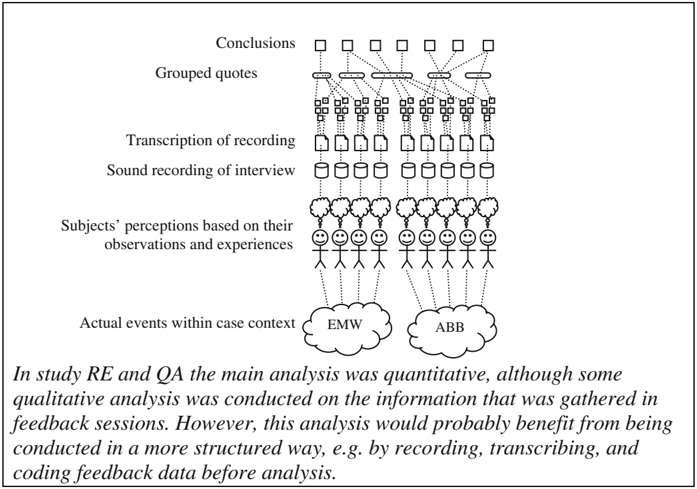
“The goal of the sessions was to define a set of statements that represent the essential aspects of Ericsson R&D’s Lean way of working.”
BackgroundData mining for software engineering and humans in the loop
Minku, L. L., Mendes, E., & Turhan, B. (2016) · Progress in Artificial Intelligence · doi:10.1007/s13748-016-0092-2 · Cited by 32
“As explained by Runeson and Host [44], software engineering case studies differ from other areas in that the study objects are developing rather than using software, they are project-oriented rather than line or function-oriented, and the subjects have advanced software engineering knowledge, rather…”
The Effect of Team Exploratory Testing -- Experience Report from F-Secure
Raappana, P., Saukkoriipi, S., Tervonen, I., & Mäntylä, M. (2016) · IEEE International Conference on Software Testing, Verification and Validation Workshops (ICSTW) · doi:10.1109/icstw.2016.13 · Cited by 29
“The research can be classified as a case study [24], but as two main authors are actually working in the company it might be fair to describe this as an experience report instead.”
BackgroundMethodInfluentialRamler, R., Wetzlmaier, T., & Klammer, C. (2017) · ACM Symposium on Applied Computing · doi:10.1145/3019612.3019830 · Cited by 29
“3.3 Design, Analysis and Evaluation The study design is based on the guidelines for conducting and reporting case study research in software engineering [13].”
BackgroundMethodInfluentialNeto, F. G. D. O., Horkoff, J., Knauss, E., Kasauli, R., & Liebel, G. (2017) · IEEE International Requirements Engineering Conference Workshops (REW) · doi:10.1109/rew.2017.33 · Cited by 29
“principle [14], we begin by questioning them about their requirements artifacts and then we narrow the questions down to specific aspects of test activities.”
BackgroundFrom MVPs to Pivots: A Hypothesis-Driven Journey of Two Software Startups
Khanna, D., Nguyen‐Duc, A., & Wang, X. (2018) · Lecture notes in business information processing · doi:10.1007/978-3-030-04840-2_12 · Cited by 38
On 5G network slice modelling: Service-, resource-, or deployment-driven?
Papageorgiou, A., Fernández–Fernández, A., Siddiqui, S., & Carrozzo, G. (2019) · Computer Communications · doi:10.1016/j.comcom.2019.10.024 · Cited by 29
Understanding Ajax Applications by Connecting Client and Server-Side Execution Traces
Zaidman, A., Matthijssen, N., Storey, M. A. (., & Arie Van Deursen, A. (2012) · Data Archiving and Networked Services (DANS) · Cited by 29
Chavez, J. V., & Vicente, M. B. (2024) · Multidisciplinary Science Journal · doi:10.31893/multiscience.2025259 · Cited by 33
On the Utility of Domain Modeling Assistance with Large Language Models
Chaaben, M. B., Burgueño, L., Dávid, I., & Sahraoui, H. A. (2026) · ACM Transactions on Software Engineering and Methodology · doi:10.1145/3744920 · Cited by 32
“To avoid mono-method bias [47], we used two distinct metrics for questions 2 and 3.”
Variability in Multi-tenant Environments: Architectural Design Patterns from Industry
Kabbedijk, J., & Jansen, S. (2011) · Lecture notes in computer science · doi:10.1007/978-3-642-24574-9_20 · Cited by 28
“Additional validation of the VRTs was done conducting interviews with software architects within the two case companies [13].”
MethodA decision support framework for metrics selection in goal-based measurement programs: GQM-DSFMS
Gencel, Ç., Petersen, K., Mughal, A. A., & Iqbal, M. I. (2013) · Journal of Systems and Software · doi:10.1016/j.jss.2013.07.022 · Cited by 28
“Reliability: This threat is concerned with the degree to which the outcome of the study is dependent on the researcher [47].”
BackgroundMethodInfluentialA case study on the application of an artefact-based requirements engineering approach
Méndez, D., Lochmann, K., Penzenstadler, B., & Wagner, S. (2011) · International Conference on Evaluation and Assessment in Software Engineering (EASE) · doi:10.1049/ic.2011.0013 · Cited by 28
“We organise the case study according to Runeson and Höst (2009).”
Method
Metadata
- Authors
- Runeson, P., & Höst, M.
- Affiliations
- Lund University (SE)
- Corresponding author
- Runeson, Per
- Venue
- Empirical Software Engineering
- Published
- 2008-12-19
- Volume
- 14
- Issue
- 2
- Pages
- 131-164
- ISSN
- 1382-3256 (ISSN-L)
- 1573-7616
- OpenAlex
- W2162739315
- Cited by
- 3,862
- References
- 75
- Citations by year
- 2026: 204 · 2025: 225 · 2024: 244 · 2023: 241 · 2022: 246 · 2021: 299 · 2020: 312 · 2019: 268 · 2018: 280 · 2017: 237 · 2016: 260 · 2015: 263 · 2014: 252 · 2013: 198 · 2012: 151
- FWCI
- 186.23
- Type
- journal article
- Language
- en
- Open access
- hybrid
- doi.org
- Licence
- cc-by-nc
- Locations
- Empirical Software Engineering (publishedVersion, cc-by-nc)
- Lund University Publications (Lund University) (submittedVersion, other-oa)
- Funders
- Vetenskapsrådet
- Topics
- Physical Sciences › Computer Science › Information Systems › Software Engineering Techniques and Practices
- Social Sciences › Sociology and Political Science › Qualitative Comparative Analysis Research
- Physical Sciences › Computer Science › Information Systems › Software Engineering Research
- Keywords
- case study method, software engineering research, reporting guidelines, research quality, naturalistic study, qualitative research practice
About these checks
Registry, retraction, Cites and statistics results are computed, not judged, with one exception: a printed reference that no index lists is read once by a model before it counts as a citation error. Claims are extracted by a model and kept only when their quote appears verbatim in the text; each cited source is then checked, with a model’s help, for whether it says what the claim relies on. Those verdicts can be wrong — read the claim’s quote and the cited source before relying on one.
Statistics and arithmetic are recomputed, not judged.
Confidence bands are shown only for fields calibrated on our annotated test set. None is calibrated yet, so no band is shown.
What counts as a claim ›How we measure confidence ›How we check this ›
Are you an author, or do you see a problem with this page? Request a review
Data sources
Bibliographic data: Semantic Scholar, OpenAlex, Crossref.
Contains information from the Semantic Scholar Academic Graph Datasets, made available under the ODC Attribution License (ODC-BY 1.0).
Semantic Scholar’s data is described in: Kinney, R., et al. (2023). The Semantic Scholar Open Data Platform. arXiv:2301.10140.
