

Exploring Relationships Between Undergraduate Students’ Perceived Community of Inquiry, Engagement, and Shared Metacognition in Asynchronous Online Courses
Open accessThe DOI matches its Crossref record; 44 of the 45 references it cites were found in a registry or an index; 6 of the 37 sources its claims cite were checked for support.
Abstract
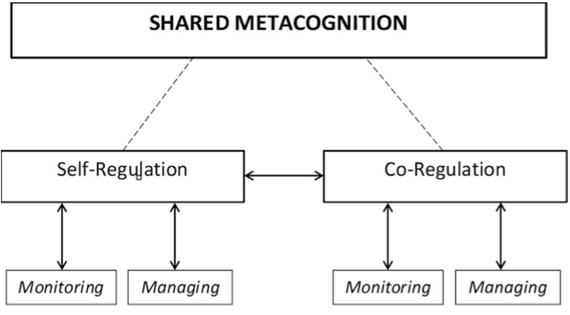
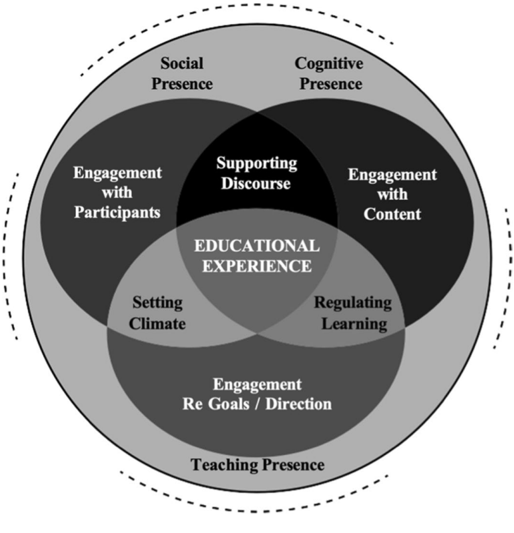
This study examined asynchronous online courses that were pre‑designed with the Community of Inquiry (CoI) framework to foster teaching presence (TP), cognitive presence (CP), and social presence (SP). It focused on how these CoI elements relate to student engagement and shared metacognition in activities such as case‑based discussions, peer reviews, role‑based tasks, Practical Inquiry Model‑based learning, and scenario‑based exercises. The findings revealed that students perceived shared metacognition more strongly than they did the individual CoI presences or engagement. All three presences were significantly and positively correlated. CP and TP correlated with shared metacognition in both self‑regulation and co‑regulation aspects. Overall engagement correlated with shared metacognition, suggesting that courses deliberately built around the CoI framework can enhance shared metacognition through their presences and, consequently, student engagement.
Overview
CoChat Summary
## TL;DR
This exploratory correlational study found that in 88 undergraduates’ asynchronous online courses pre-designed around the Community of Inquiry (CoI), all three CoI presences were positively related to engagement and shared metacognition. Teaching presence was rated highest and social presence lowest, while shared metacognition was rated higher than overall CoI presence and engagement.
## Key findings
- In the 88-student sample, perceived means were: teaching presence 4.18 (SD .70), cognitive presence 3.99 (SD .60), social presence 3.69 (SD .86), engagement 3.75 (SD .58), and shared metacognition 4.07 (SD .52).
- All three CoI presences were significantly and positively correlated with each other: cognitive with teaching (r = .624, p < .01), cognitive with social (r = .607, p < .01), and teaching with social (r = .653, p < .01).
- CoI presences were positively related to overall engagement: cognitive presence (r = .656), teaching presence (r = .414), social presence (r = .500), and overall CoI presence (r = .590), all p < .01.
- CoI presences were also positively related to shared metacognition: cognitive presence (r = .587), teaching presence (r = .512), social presence (r = .428), and overall CoI presence (r = .582), all p < .01; social presence was not significantly related to self-regulation (r = .169, p > .05).
- Overall engagement was significantly correlated with self-regulation (r = .546, p < .01), co-regulation (r = .408, p < .01), and overall shared metacognition (r = .597, p < .01); performance engagement was not significantly associated with co-regulation (r = .140, p > .05).
## Methods
- Correlational research design using undergraduate students enrolled in asynchronous online courses pre-designed around CoI principles.
- Sample: 88 undergraduates from a public university in the Mid-Atlantic US; 12 pre-designed courses across summer 2022 to summer 2024, including case-based, peer-review, role-based, Practical Inquiry Model-based, and scenario-based designs.
- Measures were collected via Qualtrics: demographic survey, CoI survey, Online Student Engagement Scale, and shared metacognition questionnaire; analysis used descriptive statistics and Pearson correlations in SPSS.
## Limitations
- The paper states the study used a correlational design, so the results show associations rather than causation.
- The paper states no additional instrument validation was performed for this study.
- Evident from the text: the sample was small (n = 88) and drawn from one public university, which limits generalizability.
Model-written summary. Check it against the paper before relying on it.
Integrity signals
Registry
Cites
Statistics
Figures
Verification
Claims the paper makes
5 Valid · 3 Not valid · 27 Not checked · 114 Own results and interpretations
Every source the paper cites for this claim was checked and supports it.
In the paper
“CP can be a strong predictor of students' emotional, cognitive, and behavioral engagement”
What the sources say
- Supportedcites Kucuk & Richardson, 2019 matched to “A structural equation model of predictors of online learners’ engagement and satisfaction” (2019) source
The Discussion (p. of passage 1) states directly that 'cognitive presence is the dominant determinant of emotional, cognitive, and behavioral engagement,' and the Hypothesis Testing section (passage 6) plus Table 5 (passage 2) report significant standardized effects of CP on emotional engagement (β = .458), cognitive engagement (β = .555) and behavioral engagement (β = .376). The citing sentence is hedged ('can be'), which is weaker than the source's own claim, so it is not an overstatement. (LLM, conf=0.92)
boostedstates an association- Asserted: passes — The authors put it forward as true.
- Checkable: passes — It can be checked against evidence.
- Load-bearing: passes — The paper’s conclusions depend on it.
- Based: passes — The paper gives a reason why it holds.
- Supported
Every source the paper cites for this claim was checked and supports it.
In the paper
“Despite these challenges, our findings demonstrated moderate and significant correla -tions between CP, TP, and both self- and co-regulation, suggesting that shared metacognition is shaped by the overlap between CP and TP (Garrison, 2022).”
What the sources say
- Supportedcites Garrison, 2022 matched to “Shared Metacognition in a Community of Inquiry” (2022) source
The Abstract of Garrison (2022) states almost verbatim that 'shared metacognition is shaped by the teaching presence construct (planning, facilitation, and direction instruction) and its overlap with cognitive presence operationalized by the phases of the Practical Inquiry model,' which is exactly the theoretical point the citing sentence attributes to it. The keywords list (shared metacognition, self-regulation, co-regulation, cognitive presence, teaching presence, practical inquiry) confirms the same framing. The preceding clause about the citing authors' own correlations is their own finding, not attributed content, so nothing in the attributed part is unsupported; the source is a conceptual review rather than an empirical demonstration, but it asserts the claim with equal or greater confidence. (LLM, conf=0.90)
hedgedstates a cause- Asserted: passes — The authors put it forward as true.
- Checkable: passes — It can be checked against evidence.
- Load-bearing: passes — The paper’s conclusions depend on it.
- Based: passes — The paper gives a reason why it holds.
- Supported
The cited sources support only part of this claim — read each source’s verdict below.
In the paper
“Similarly to previous research, our study confirmed the central role of CP in relation to learner engagement in asynchronous online courses (Kucuk & Richardson, 2019 ; Law et al., 2019 ; Yulian et al., 2025 ).”
What the sources say
- Supportedcites Kucuk & Richardson, 2019 matched to “A structural equation model of predictors of online learners’ engagement and satisfaction” (2019) source
The Discussion of Kucuk & Richardson (2019) states directly, as this study's own finding, that 'cognitive presence is the dominant determinant of emotional, cognitive, and behavioral engagement, and had an indirect effect on agentic engagement,' concluding that 'cognitive presence is very important to maintaining engagement' — i.e., the central role of CP in relation to learner engagement. The Hypothesis Testing section reports the supporting paths (CP→emotional engagement β=.458, p=.000; CP→cognitive engagement β=.555, p=.000; CP→behavioral engagement β=.376, p=.000), and the Introduction frames CP as 'central to the student learning process.' The study's setting is described as fully online, CoI-designed graduate courses (Participants section), which matches the claim's asynchronous online-course framing. (LLM, conf=0.82)
- Not checked — no full text of the sourcecites Law et al., 2019 matched to “Student enrollment, motivation and learning performance in a blended learning environment: The mediating effects of social, teaching, and cognitive presence” (2019) source
- Partly supportedcites Yulian et al., 2025 matched to “Modelling the Relationship of Community of Inquiry and Critical Thinking Skills in Project-Based Learning with Digital Storytelling” (2025) sourceExperimental — accuracy not yet measured
Our copy does support a significant positive role of cognitive presence in driving engagement: the Results (Table 5) report a path coefficient of 0.239 (P = 0.004) for cognitive presence -> engagement, and the Conclusion states the study 'highlights the significant role of cognitive and social presence in enhancing student engagement'. However, the setting is not asynchronous online courses: the Methods describe 100 Indonesian EAP students in a one-month project-based digital storytelling course, and the Discussion attributes the non-significant teaching-presence result to 'the blended nature of the course'. Also, cognitive presence was not the dominant predictor of engagement — social presence's path was 0.607 (P = 0.000), so 'central role' overstates this source's own ranking of the predictors. (LLM, conf=0.78)
boostedstates an association- Asserted: passes — The authors put it forward as true.
- Checkable: passes — It can be checked against evidence.
- Load-bearing: passes — The paper’s conclusions depend on it.
- Based: passes — The paper gives a reason why it holds.
- Supported
A result the paper reports from its own data — it cites no other source for it, so there is none to check. The quote shows it is in the paper.
In the paper
“TP and SP showed only weak to moderate but significant correlations with engagement”
plainstates an association- Asserted: passes — The authors put it forward as true.
- Checkable: passes — It can be checked against evidence.
- Load-bearing: unclear — It is unclear whether the paper’s conclusions depend on it.
- Based: passes — The paper gives a reason why it holds.
A result the paper reports from its own data — it cites no other source for it, so there is none to check. The quote shows it is in the paper.
In the paper
“The findings revealed that students perceived shared metacognition more strongly than they did the individual CoI presences or engagement.”
plain- Asserted: passes — The authors put it forward as true.
- Checkable: passes — It can be checked against evidence.
- Load-bearing: passes — The paper’s conclusions depend on it.
- Based: passes — The paper gives a reason why it holds.
82 more claims
Create a free account to see all 149 claims and to verify the 9 references still open.
- It may state two separate claims as one. 38
- Probably not a substantial claim. 30
Citations
Cites
Critical Inquiry in a Text-Based Environment: Computer Conferencing in Higher Education
Garrison, D. R., Anderson, T., & Archer, W. (1999) · The Internet and Higher Education · doi:10.1016/s1096-7516(00)00016-6 · Cited by 6,619
Critical thinking, cognitive presence, and computer conferencing in distance education
Garrison, D. R., Anderson, T., & Archer, W. (2001) · American Journal of Distance Education · doi:10.1080/08923640109527071 · Cited by 3,044
ASSESSING TEACHING PRESENCE IN A COMPUTER CONFERENCING CONTEXT
Anderson, T., Rourke, L., Garrison, R., & Archer, W. (2001) · Online Learning · doi:10.24059/olj.v5i2.1875 · Cited by 1,885
The first decade of the community of inquiry framework: A retrospective
Garrison, D. R., Anderson, T., & Archer, W. (2010) · The Internet and Higher Education · doi:10.1016/j.iheduc.2009.10.003 · Cited by 1,219
Arbaugh, J. B., Cleveland-Innes, M., Diaz, S. R., Garrison, D. R., Ice, P., Richardson, J. C., & Swan, K. P. (2008) · The Internet and Higher Education · doi:10.1016/j.iheduc.2008.06.003 · Cited by 1,065
Shea, P., Sau Li, C., & Pickett, A. (2006) · The Internet and Higher Education · doi:10.1016/j.iheduc.2006.06.005 · Cited by 740
Measuring Student Engagement in the Online Course: The Online Student Engagement Scale (OSE)
Dixson, M. D. (2015) · Online Learning · doi:10.24059/olj.v19i4.561 · Cited by 707
Shea, P., & Bidjerano, T. (2009) · Computers & Education · doi:10.1016/j.compedu.2008.10.007 · Cited by 641
Akyol, Z., & Garrison, D. R. (2008) · Online Learning · doi:10.24059/olj.v12i3.66 · Cited by 565
Law, K. M. Y., Geng, S., & Li, T. (2019) · Computers & Education · doi:10.1016/j.compedu.2019.02.021 · Cited by 426
Research works printed but not linked: 3
- Garrison, D. R. (2018). Shared metacognition the community of inquiry. Online learning, 26 (1), 6-18.
- Seaman, J., Allen, I. E., & Seaman, J. E. (2024). Review Session: 12 Years and 20 Reports Tracking Online. Bay View Analytics . h t t p s : / / w w w . b a y v i e w a n a l y t i c s . c o m / d i s t a n c e . h t ml
- Vaughan, N., & Wah, J. L. (2020). The community of inquiry framework: Future practical directions - shared metacognition. International Journal of E-Learning & Distance Education/revue Internationale Du E-Learning Et La Formation À Distance, 35 (1), 1-25.
Cited by
Task Design in AI-ALL: The Need for Scaffolded Engagement
Otaif, F. A. (2026) · Advances in computational intelligence and robotics book series · doi:10.4018/979-8-3373-6420-9.ch001
Macías-Rodríguez, L. E., Santana, R., Carranza, E. K. G., Rybarczyk, Y. P., Vera, F., & Delgado, J. F. (2026) · Frontiers in Education · doi:10.3389/feduc.2026.1771906
Zhang, Z., & Xu, Q. (2026) · Education Sciences · doi:10.3390/educsci16071169 · Cited by 1
“Researchers often rely on the two broad subscales of SRC and CRC when examining relationships among regulatory activity, cognitive presence, and learning outcomes (e.g., Al-Salti et al., 2025; Olesova et al., 2026; Zhang et al., 2026).”
黄文群, Yang, J., & Liu, J. (2026) · Discover Artificial Intelligence · doi:10.1007/s44163-026-02090-6
“The evaluation metrics are accuracy, macro-average F1 score, AUC, sequence consistency score and anomaly detection recall rate, which assist in the unified evaluation of following feature fusion, state recognition, and anomaly pattern analysis [17, 18].”
Metadata
- Authors
- Olesova, L., Sadaf, A., & Yan, W.
- Affiliations
- University of Florida (US)
- University of North Carolina at Charlotte (US)
- Idaho State University (US)
- Corresponding author
- Olesova, Larisa
- Venue
- Technology, Knowledge and Learning
- Published
- 2026-02-19
- Volume
- 31
- Issue
- 1
- Pages
- 383-407
- ISSN
- 2211-1662 (ISSN-L)
- 2211-1670
- OpenAlex
- W7130511435
- Cited by
- 4
- References
- 40
- Citations by year
- 2026: 4
- FWCI
- 84.82
- Type
- journal article
- Language
- en
- Open access
- hybrid
- doi.org
- Licence
- cc-by-nc-nd
- creativecommons.org/licenses/by-nc-nd/4.0 (tdm)
- creativecommons.org/licenses/by-nc-nd/4.0 (vor)
- Locations
- Technology Knowledge and Learning (publishedVersion, cc-by-nc-nd)
- Topics
- Social Sciences › Education › Online and Blended Learning
- Social Sciences › Psychology › Developmental and Educational Psychology › Innovative Teaching and Learning Methods
- Social Sciences › Psychology › Experimental and Cognitive Psychology › Visual and Cognitive Learning Processes
- Keywords
- community of inquiry, teaching presence, cognitive presence, social presence, student engagement, student self-regulation, co-regulated learning, asynchronous online courses, undergraduate students, case-based discussion, peer review, scenario-based learning, instructional design
About these checks
Registry, retraction, Cites and statistics results are computed, not judged, with one exception: a printed reference that no index lists is read once by a model before it counts as a citation error. Claims are extracted by a model and kept only when their quote appears verbatim in the text; each cited source is then checked, with a model’s help, for whether it says what the claim relies on. Those verdicts can be wrong — read the claim’s quote and the cited source before relying on one.
The claim verdicts this report counts are experimental: their accuracy is not yet measured.
A language model drew the claims from the paper on 2026-10-10, under version 3 of the claim definition (model deepseek-v4.1-flash, prompt extract-v3).
A second model labelled each claim on 2026-10-10 (model jev-1.13-20260917, definition revision gold-guideline-v0.2).
Cited sources are checked with a language model’s help (qwen3.8-omni-flash).
Statistics and arithmetic are recomputed, not judged.
Confidence bands are shown only for fields calibrated on our annotated test set. None is calibrated yet, so no band is shown.
What counts as a claim ›How we measure confidence ›How we check this ›
Are you an author, or do you see a problem with this page? Request a review
How to cite
Cite CoChat for the checks on this page, and the paper for its own findings.
- This page
- CoChat. (2026). Citation check: Exploring Relationships Between Undergraduate Students’ Perceived Community of Inquiry, Engagement, and Shared Metacognition in Asynchronous Online Courses. https://app.cochat.ai/papers/10.1007/s10758-026-09953-y
- The paper
- Olesova, L., Sadaf, A., & Yan, W. (2026). Exploring Relationships Between Undergraduate Students’ Perceived Community of Inquiry, Engagement, and Shared Metacognition in Asynchronous Online Courses. Technology, Knowledge and Learning. https://doi.org/10.1007/s10758-026-09953-y
Data sources
Bibliographic data: Semantic Scholar, OpenAlex, Crossref.
Contains information from the Semantic Scholar Academic Graph Datasets, made available under the ODC Attribution License (ODC-BY 1.0).
Semantic Scholar’s data is described in: Kinney, R., et al. (2023). The Semantic Scholar Open Data Platform. arXiv:2301.10140.
