

The DOI matches its Crossref record; 53 of the 54 references it cites were found in a registry or an index; none of the 31 sources its claims cite is checked for support yet.
Toward AI Governance: Identifying Best Practices and Potential Barriers and Outcomes
Open accessAbstract
In recent years artificial intelligence (AI) has been seen as a technology with tremendous potential for enabling companies to gain an operational and competitive advantage. However, despite the use of AI, businesses continue to face challenges and are unable to immediately realize performance gains. Furthermore, firms need to introduce robust AI systems and mitigate AI risks, which emphasizes the importance of creating suitable AI governance practices. This study, explores how AI governance is applied to promote the development of robust AI applications that do not introduce negative effects, based on a comparative case analysis of three firms in the energy sector. The study illustrates which practices are placed to produce knowledge that assists with decision making while at the same time overcoming barriers with recommended actions leading to desired outcomes. The study contributes by exploring the main dimensions relevant to AI’s governance in organizations and by uncovering the practices that underpin them.
Overview
AI snapshot
Written from the paper’s full text.
TL;DR
This comparative case study of three Norwegian energy firms examines how AI governance practices help organizations develop robust AI applications while mitigating risks. It identifies procedural, relational, and structural governance practices, the barriers they address, and outcomes such as cost reduction, flexibility, robustness, and competitive advantage.
Key findings
- AI governance is organized around procedural, relational, and structural practices: ML pipelines, dashboards, data quality at source, domain experts leading projects, AI education for employees, internal AI teams, unified tools, and weak AI applications focused on specific tasks.
- Firms faced barriers including difficult AI cloud development, AI development differing from traditional software, lack of data or domain knowledge, employee AI-phobia and misunderstanding of AI capabilities, legal constraints/GDPR, and hard-to-predict costs and effort. Recommended actions included offline recommendation systems, standardized executable components, shared libraries, domain experts leading, AI training, clear data management roles, KPIs, and internal AI teams.
- Outcomes reported across cases were reducing maintenance costs, increasing flexibility and robustness, improving confidence in results, and gaining competitive advantage. One respondent reported maintenance costs falling from around two million a year to around ten thousand a year; another cited an estimated 20–30% reduction in maintenance costs based on big data.
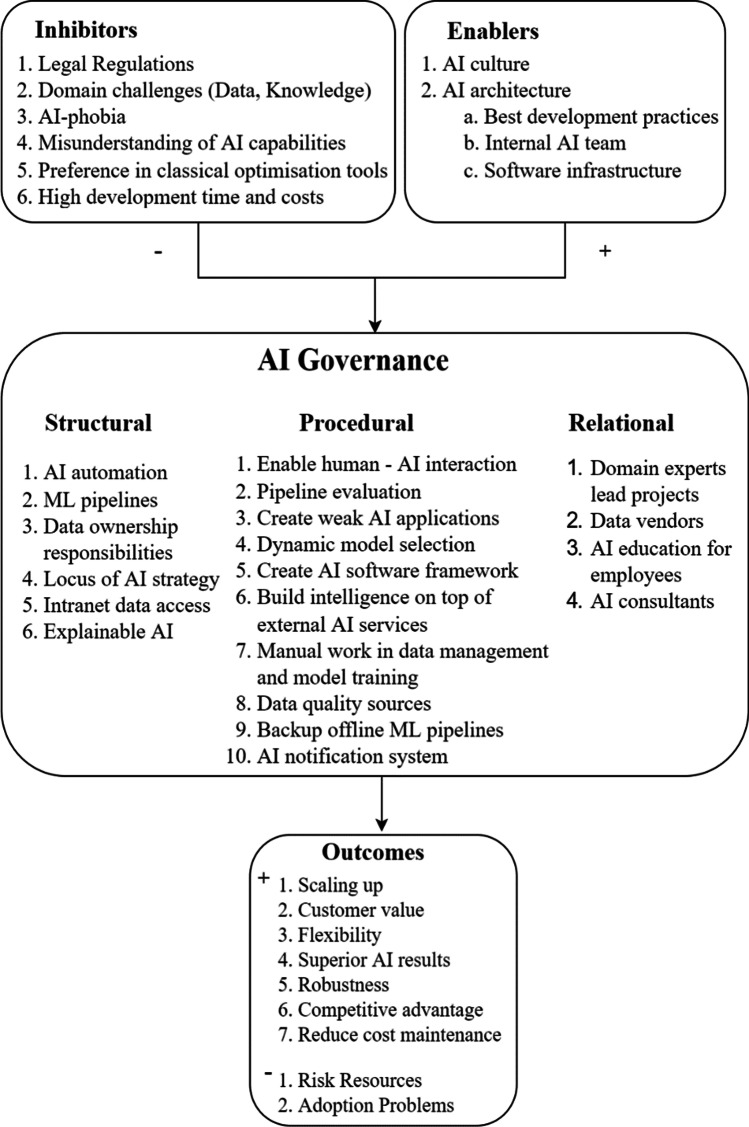
- The proposed model links enablers such as existing AI culture and architecture, and inhibitors such as legal constraints, domain challenges, high development costs, and AI-phobia, to desired outcomes including competitive advantage, cost reduction, and dependable AI systems.
Methods
- Exploratory comparative multi-case study of three Norwegian energy firms (Company A: 200 employees, 180 million dollars turnover; Company B: 530 employees, 260 million dollars; Company C: 100 employees, 23 million dollars).
- Data collection included 15 semi-structured interviews with business and IT respondents who had key positions, good understanding of AI technologies, and at least one year in their current position and five years relative experience; interviews averaged 55 min, ranged from 25 to 90 min, were conducted via Zoom, recorded, and transcribed verbatim. Secondary data included annual reports, vision and firm structure documents, and internal documents.
- Analysis used narrative analysis, NVivo, open and axial coding, and cross-case analysis. Initial 200 descriptive codes were reduced to 95 after iteration; three iterations of data analysis were conducted, with independent coding by three authors and triangulation across sources.
Limitations
- Stated: the data came from companies that do not require extensive use of sensitive data, so there may be bias or an incomplete picture of challenges around relevant practices; data collection was a snapshot in time and may not reflect the complete breadth of practices; all cases are from the same sector, so generalizability may be an issue.
- Evident: the study is qualitative and based on three firms and 15 interviews, so findings are not statistically generalizable; the paper itself calls for future research with firms from different sectors and for positivist testing of antecedents and effects.
Model-written summary. Check it against the paper before relying on it.
Integrity signals
Registry
Cites
Statistics
Figures
Verification
Claims the paper makes
71 Own result · 30 No basis given · 23 Not checked yet · 22 Own interpretation · 17 Own method
A result the paper reports from its own data — it cites no other source for it, so there is none to check. The quote shows it is in the paper.
In the paper
“Standardization and unification of AI technologies was an issue because the team is consisted of people from different backgrounds and with different skills creating obstacles in AI development.”
§ Toward AI Governance: Identifying Best Practices and Potential Barriers and Outcomes > Case Analysis > Within Case Analysis
plaindirectSingle case- Asserted: passes — The authors put it forward as true.
- Checkable: passes — It can be checked against evidence.
- Load-bearing: unclear — It is unclear whether the paper’s conclusions depend on it.
- Based: passes — The paper gives a reason why it holds.
- Rests on an assumption: The interviewees' accounts accurately reflect the firms' AI governance practices.
The paper states this without a source or data behind it here, so there is nothing to check it against. The quote shows it is in the paper.
In the paper
“Thirdly, data privacy (GDPR) is not a genuine concern (expect in the last case) since their data mainly consists of environmental data that anyone could access or buy”
§ Toward AI Governance: Identifying Best Practices and Potential Barriers and Outcomes > Case Analysis > Within Case Analysis
plaindirect- Asserted: passes — The authors put it forward as true.
- Checkable: passes — It can be checked against evidence.
- Load-bearing: unclear — It is unclear whether the paper’s conclusions depend on it.
- Based: passes — The paper gives a reason why it holds.
- Rests on an assumption: The interviewees' accounts accurately reflect the firms' AI governance practices.
A result the paper reports from its own data — it cites no other source for it, so there is none to check. The quote shows it is in the paper.
In the paper
“Among the outcomes of the study, AI was found to be most helpful for (1) reducing maintenance costs, (2) increasing flexibility and robustness of the development process, (3) improving confidence in the results and final products, and (4) gaining a competitive edge over the competition.”
§ Toward AI Governance: Identifying Best Practices and Potential Barriers and Outcomes > Introduction
plaindirect- Asserted: passes — The authors put it forward as true.
- Checkable: passes — It can be checked against evidence.
- Load-bearing: passes — The paper’s conclusions depend on it.
- Based: passes — The paper gives a reason why it holds.
A result the paper reports from its own data — it cites no other source for it, so there is none to check. The quote shows it is in the paper.
In the paper
“The evaluation of ML pipelines was a continuous process that took place at different points of the pipeline for ensuring robustness and quality.”
§ Toward AI Governance: Identifying Best Practices and Potential Barriers and Outcomes > Case Analysis > Between Case Analysis
plain- Asserted: passes — The authors put it forward as true.
- Checkable: passes — It can be checked against evidence.
- Load-bearing: unclear — It is unclear whether the paper’s conclusions depend on it.
- Based: passes — The paper gives a reason why it holds.
- Rests on an assumption: The interviewees' accounts accurately reflect the firms' AI governance practices.
- Rests on an assumption: The three case companies are representative of firms in the energy sector or of AI governance best practices, so practices identified in them can be recommended for other companies.
A result the paper reports from its own data — it cites no other source for it, so there is none to check. The quote shows it is in the paper.
In the paper
“Employees did not trust the outcomes, sometimes they described the recommendations as naive, and most importantly, employees saw AI and automation as a way of losing their status and position.”
§ Toward AI Governance: Identifying Best Practices and Potential Barriers and Outcomes > Case Analysis > Between Case Analysis
plainn = 2- Asserted: passes — The authors put it forward as true.
- Checkable: passes — It can be checked against evidence.
- Load-bearing: passes — The paper’s conclusions depend on it.
- Based: passes — The paper gives a reason why it holds.
A result the paper reports from its own data — it cites no other source for it, so there is none to check. The quote shows it is in the paper.
In the paper
“As for the structural practices, AI strategy for current or feature development projects seems to be the centre for top managers as they need to design products that focus on specific needs, while adding business value.”
§ Toward AI Governance: Identifying Best Practices and Potential Barriers and Outcomes > Case Analysis > Between Case Analysis
hedged- Asserted: passes — The authors put it forward as true.
- Checkable: passes — It can be checked against evidence.
- Load-bearing: unclear — It is unclear whether the paper’s conclusions depend on it.
- Based: passes — The paper gives a reason why it holds.
- Rests on an assumption: The interviewees' accounts accurately reflect the firms' AI governance practices.
- Rests on an assumption: The three case companies are representative of firms in the energy sector or of AI governance best practices, so practices identified in them can be recommended for other companies.
A result the paper reports from its own data — it cites no other source for it, so there is none to check. The quote shows it is in the paper.
In the paper
“All firms attempted to fix potential issues in the data sources, through data collection corrections and the use of APIs, instead of extending their cleaning process”
§ Toward AI Governance: Identifying Best Practices and Potential Barriers and Outcomes > Case Analysis > Between Case Analysis
plain- Asserted: passes — The authors put it forward as true.
- Checkable: passes — It can be checked against evidence.
- Load-bearing: unclear — It is unclear whether the paper’s conclusions depend on it.
- Based: passes — The paper gives a reason why it holds.
- Rests on an assumption: The interviewees' accounts accurately reflect the firms' AI governance practices.
- Rests on an assumption: The three case companies are representative of firms in the energy sector or of AI governance best practices, so practices identified in them can be recommended for other companies.
The paper states this without a source or data behind it here, so there is nothing to check it against. The quote shows it is in the paper.
In the paper
“The outcomes were similar in all cases.”
§ Toward AI Governance: Identifying Best Practices and Potential Barriers and Outcomes > Case Analysis > Between Case Analysis
plain- Asserted: passes — The authors put it forward as true.
- Checkable: passes — It can be checked against evidence.
- Load-bearing: unclear — It is unclear whether the paper’s conclusions depend on it.
- Based: passes — The paper gives a reason why it holds.
A result the paper reports from its own data — it cites no other source for it, so there is none to check. The quote shows it is in the paper.
In the paper
“Nevertheless, data roles and data management were not always in the spotlight as almost all employees could access data since the company’s size was small.”
§ Toward AI Governance: Identifying Best Practices and Potential Barriers and Outcomes > Case Analysis > Within Case Analysis
plaindirectSingle case- Asserted: passes — The authors put it forward as true.
- Checkable: passes — It can be checked against evidence.
- Load-bearing: unclear — It is unclear whether the paper’s conclusions depend on it.
- Based: passes — The paper gives a reason why it holds.
- Rests on an assumption: The interviewees' accounts accurately reflect the firms' AI governance practices.
- The quote only partly states this claim. 3
- Probably not a substantial claim. 75
- It may state two separate claims as one. 82
A result the paper reports from its own data — it cites no other source for it, so there is none to check. The quote shows it is in the paper.
In the paper
“Among the outcomes of the study, AI was found to be most helpful for (1) reducing maintenance costs, (2) increasing flexibility and robustness of the development process, (3) improving confidence in the results and final products, and (4) gaining a competitive edge over the competition.”
§ Toward AI Governance: Identifying Best Practices and Potential Barriers and Outcomes > Introduction
plaindirect- Asserted: passes — The authors put it forward as true.
- Checkable: passes — It can be checked against evidence.
- Load-bearing: passes — The paper’s conclusions depend on it.
- Based: passes — The paper gives a reason why it holds.
The quote only partly states this claim.
The paper states this without a source or data behind it here, so there is nothing to check it against. The quote shows it is in the paper.
In the paper
“while legal regulations restrict them to using AI in specific areas, for instance they are not allowed to speculate on prices.”
§ Toward AI Governance: Identifying Best Practices and Potential Barriers and Outcomes > Case Analysis > Within Case Analysis
plaindirect- Asserted: passes — The authors put it forward as true.
- Checkable: passes — It can be checked against evidence.
- Load-bearing: fails — The paper’s conclusions may not depend on it.
- Based: passes — The paper gives a reason why it holds.
Probably not a substantial claim. The paper’s conclusions may not depend on it.
- Rests on an assumption: The interviewees' accounts accurately reflect the firms' AI governance practices.
The paper states this without a source or data behind it here, so there is nothing to check it against. The quote shows it is in the paper.
In the paper
“The necessary data was collected through vendors, so it was possible to compare data and ensure high quality outcomes for the trained models.”
§ Toward AI Governance: Identifying Best Practices and Potential Barriers and Outcomes > Case Analysis > Within Case Analysis
hedgeddirectSingle case- Asserted: passes — The authors put it forward as true.
- Checkable: passes — It can be checked against evidence.
- Load-bearing: fails — The paper’s conclusions may not depend on it.
- Based: passes — The paper gives a reason why it holds.
Probably not a substantial claim. The paper’s conclusions may not depend on it. It may state two separate claims as one.
- Rests on an assumption: The interviewees' accounts accurately reflect the firms' AI governance practices.
A result the paper reports from its own data — it cites no other source for it, so there is none to check. The quote shows it is in the paper.
In the paper
“Also, domain experts participated in the evaluation so they can provide their insights and feedback to make the model outputs reliable and trustworthy.”
§ Toward AI Governance: Identifying Best Practices and Potential Barriers and Outcomes > Case Analysis > Within Case Analysis
plaindirectSingle case- Asserted: passes — The authors put it forward as true.
- Checkable: passes — It can be checked against evidence.
- Load-bearing: fails — The paper’s conclusions may not depend on it.
- Based: passes — The paper gives a reason why it holds.
Probably not a substantial claim. The paper’s conclusions may not depend on it.
- Rests on an assumption: The interviewees' accounts accurately reflect the firms' AI governance practices.
A result the paper reports from its own data — it cites no other source for it, so there is none to check. The quote shows it is in the paper.
In the paper
“Control of key domain knowledge was one of the main concerns for firm. Company A did not want to give away domain knowledge to external partners, who offer specialized AI products, since they could build and sell similar AI products to their rivals”
§ Toward AI Governance: Identifying Best Practices and Potential Barriers and Outcomes > Case Analysis > Within Case Analysis
plaindirectSingle case- Asserted: passes — The authors put it forward as true.
- Checkable: passes — It can be checked against evidence.
- Load-bearing: unclear — It is unclear whether the paper’s conclusions depend on it.
- Based: passes — The paper gives a reason why it holds.
It may state two separate claims as one.
- Rests on an assumption: The interviewees' accounts accurately reflect the firms' AI governance practices.
A result the paper reports from its own data — it cites no other source for it, so there is none to check. The quote shows it is in the paper.
In the paper
“The AI team brought value to the firm by forecasting energy consumption, assisting in decision-making for the end-users and automating repetitive tasks.”
§ Toward AI Governance: Identifying Best Practices and Potential Barriers and Outcomes > Case Analysis > Within Case Analysis
plaindirectSingle case- Asserted: passes — The authors put it forward as true.
- Checkable: passes — It can be checked against evidence.
- Load-bearing: unclear — It is unclear whether the paper’s conclusions depend on it.
- Based: passes — The paper gives a reason why it holds.
It may state two separate claims as one.
- Rests on an assumption: The interviewees' accounts accurately reflect the firms' AI governance practices.
A result the paper reports from its own data — it cites no other source for it, so there is none to check. The quote shows it is in the paper.
In the paper
“In the beginning, data was exchanged through Excel files. These files were not secure, and at the same time they realized that they could not scale up, so APIs were used to replace Excel files.”
§ Toward AI Governance: Identifying Best Practices and Potential Barriers and Outcomes > Case Analysis > Within Case Analysis
plaindirectSingle case- Asserted: passes — The authors put it forward as true.
- Checkable: passes — It can be checked against evidence.
- Load-bearing: unclear — It is unclear whether the paper’s conclusions depend on it.
- Based: passes — The paper gives a reason why it holds.
It may state two separate claims as one.
- Rests on an assumption: The interviewees' accounts accurately reflect the firms' AI governance practices.
The paper states this without a source or data behind it here, so there is nothing to check it against. The quote shows it is in the paper.
In the paper
“Lastly, the set-up goals mainly concern reducing costs and forecasting energy demands.”
§ Toward AI Governance: Identifying Best Practices and Potential Barriers and Outcomes > Case Analysis > Within Case Analysis
plain- Asserted: passes — The authors put it forward as true.
- Checkable: passes — It can be checked against evidence.
- Load-bearing: fails — The paper’s conclusions may not depend on it.
- Based: passes — The paper gives a reason why it holds.
Probably not a substantial claim. The paper’s conclusions may not depend on it.
- Rests on an assumption: The interviewees' accounts accurately reflect the firms' AI governance practices.
The paper states this without a source or data behind it here, so there is nothing to check it against. The quote shows it is in the paper.
In the paper
“Firstly, all the cases operate in the same industry and have overlapping areas of operation.”
§ Toward AI Governance: Identifying Best Practices and Potential Barriers and Outcomes > Case Analysis > Within Case Analysis
plain- Asserted: passes — The authors put it forward as true.
- Checkable: passes — It can be checked against evidence.
- Load-bearing: fails — The paper’s conclusions may not depend on it.
- Based: fails — The paper may give no reason why it holds.
Probably not a substantial claim. The paper’s conclusions may not depend on it. The paper may give no reason why it holds. It may state two separate claims as one.
- Rests on an assumption: The interviewees' accounts accurately reflect the firms' AI governance practices.
The paper states this without a source or data behind it here, so there is nothing to check it against. The quote shows it is in the paper.
In the paper
“As a result, performance was boosted and maintenance costs were down.”
§ Toward AI Governance: Identifying Best Practices and Potential Barriers and Outcomes > Case Analysis > Within Case Analysis
plaindirectSingle case- Asserted: passes — The authors put it forward as true.
- Checkable: passes — It can be checked against evidence.
- Load-bearing: unclear — It is unclear whether the paper’s conclusions depend on it.
- Based: passes — The paper gives a reason why it holds.
It may state two separate claims as one.
- Rests on an assumption: The interviewees' accounts accurately reflect the firms' AI governance practices.
A result the paper reports from its own data — it cites no other source for it, so there is none to check. The quote shows it is in the paper.
In the paper
“The development team aimed for automation and flexibility but they did not want to develop the entire software from scratch since it would be time-consuming to do everything. At the same time, they did not prefer to use software of other companies, so they decided to develop the intelligence that runs on top of cloud services”
§ Toward AI Governance: Identifying Best Practices and Potential Barriers and Outcomes > Case Analysis > Within Case Analysis
plaindirectSingle case- Asserted: passes — The authors put it forward as true.
- Checkable: passes — It can be checked against evidence.
- Load-bearing: fails — The paper’s conclusions may not depend on it.
- Based: passes — The paper gives a reason why it holds.
Probably not a substantial claim. The paper’s conclusions may not depend on it. It may state two separate claims as one.
- Rests on an assumption: The interviewees' accounts accurately reflect the firms' AI governance practices.
A result the paper reports from its own data — it cites no other source for it, so there is none to check. The quote shows it is in the paper.
In the paper
“To govern the process of data cleaning and model evaluation, ML pipelines were created in the cloud. This made it easier to oversee the overall process and apply quantifiable metrics on the ML results.”
§ Toward AI Governance: Identifying Best Practices and Potential Barriers and Outcomes > Case Analysis > Within Case Analysis
plaindirectSingle case- Asserted: passes — The authors put it forward as true.
- Checkable: passes — It can be checked against evidence.
- Load-bearing: unclear — It is unclear whether the paper’s conclusions depend on it.
- Based: passes — The paper gives a reason why it holds.
It may state two separate claims as one.
- Rests on an assumption: The interviewees' accounts accurately reflect the firms' AI governance practices.
A result the paper reports from its own data — it cites no other source for it, so there is none to check. The quote shows it is in the paper.
In the paper
“In case of failure, local systems (ML pipelines) were ready to support decision-making, ensuring a reliable and robust system that could always generate output and assists employees with their everyday tasks”
§ Toward AI Governance: Identifying Best Practices and Potential Barriers and Outcomes > Case Analysis > Within Case Analysis
plaindirectSingle case- Asserted: passes — The authors put it forward as true.
- Checkable: passes — It can be checked against evidence.
- Load-bearing: fails — The paper’s conclusions may not depend on it.
- Based: passes — The paper gives a reason why it holds.
Probably not a substantial claim. The paper’s conclusions may not depend on it. It may state two separate claims as one.
- Rests on an assumption: The interviewees' accounts accurately reflect the firms' AI governance practices.
A result the paper reports from its own data — it cites no other source for it, so there is none to check. The quote shows it is in the paper.
In the paper
“The most common perspective among the selected firms is that AI must be developed, expanded and adopted in the following years as it will be crucial for gaining or maintaining their competitive advantage over rivals or new companies entering the frame and seeking a piece of the pie.”
§ Toward AI Governance: Identifying Best Practices and Potential Barriers and Outcomes > Methodology > Case Selection
plain- Asserted: passes — The authors put it forward as true.
- Checkable: passes — It can be checked against evidence.
- Load-bearing: fails — The paper’s conclusions may not depend on it.
- Based: passes — The paper gives a reason why it holds.
Probably not a substantial claim. The paper’s conclusions may not depend on it.
The paper states this without a source or data behind it here, so there is nothing to check it against. The quote shows it is in the paper.
In the paper
“Secondly, development best practices were followed such as the use of Git, documentation and containerization platforms like Docker.”
§ Toward AI Governance: Identifying Best Practices and Potential Barriers and Outcomes > Case Analysis > Within Case Analysis
plain- Asserted: passes — The authors put it forward as true.
- Checkable: passes — It can be checked against evidence.
- Load-bearing: fails — The paper’s conclusions may not depend on it.
- Based: passes — The paper gives a reason why it holds.
Probably not a substantial claim. The paper’s conclusions may not depend on it.
- Rests on an assumption: The interviewees' accounts accurately reflect the firms' AI governance practices.
The paper states this without a source or data behind it here, so there is nothing to check it against. The quote shows it is in the paper.
In the paper
“AI contributes to the reduction of predictive maintenance costs, which is challenging in Norway due to its harsh weather conditions, especially during winter.”
§ Toward AI Governance: Identifying Best Practices and Potential Barriers and Outcomes > Case Analysis > Within Case Analysis
plaindirectSingle case- Asserted: passes — The authors put it forward as true.
- Checkable: passes — It can be checked against evidence.
- Load-bearing: fails — The paper’s conclusions may not depend on it.
- Based: fails — The paper may give no reason why it holds.
Probably not a substantial claim. The paper’s conclusions may not depend on it. The paper may give no reason why it holds. It may state two separate claims as one.
- Rests on an assumption: The interviewees' accounts accurately reflect the firms' AI governance practices.
A result the paper reports from its own data — it cites no other source for it, so there is none to check. The quote shows it is in the paper.
In the paper
“To increase security, data access was only possible through intranet, but the company did not define clear data management roles, making the data request process time consuming”
§ Toward AI Governance: Identifying Best Practices and Potential Barriers and Outcomes > Case Analysis > Within Case Analysis
plaindirectSingle case- Asserted: passes — The authors put it forward as true.
- Checkable: passes — It can be checked against evidence.
- Load-bearing: unclear — It is unclear whether the paper’s conclusions depend on it.
- Based: passes — The paper gives a reason why it holds.
It may state two separate claims as one.
- Rests on an assumption: The interviewees' accounts accurately reflect the firms' AI governance practices.
A result the paper reports from its own data — it cites no other source for it, so there is none to check. The quote shows it is in the paper.
In the paper
“Rather than increase profit margins, the model outputs emphasize reducing errors, because Company A places higher priority on prediction safety instead of profitability.”
§ Toward AI Governance: Identifying Best Practices and Potential Barriers and Outcomes > Case Analysis > Within Case Analysis
plaindirectSingle case- Asserted: passes — The authors put it forward as true.
- Checkable: passes — It can be checked against evidence.
- Load-bearing: unclear — It is unclear whether the paper’s conclusions depend on it.
- Based: passes — The paper gives a reason why it holds.
It may state two separate claims as one.
- Rests on an assumption: The interviewees' accounts accurately reflect the firms' AI governance practices.
A result the paper reports from its own data — it cites no other source for it, so there is none to check. The quote shows it is in the paper.
In the paper
“Among the outcomes of the study, AI was found to be most helpful for (1) reducing maintenance costs, (2) increasing flexibility and robustness of the development process, (3) improving confidence in the results and final products, and (4) gaining a competitive edge over the competition.”
§ Toward AI Governance: Identifying Best Practices and Potential Barriers and Outcomes > Introduction
plaindirect- Asserted: passes — The authors put it forward as true.
- Checkable: passes — It can be checked against evidence.
- Load-bearing: unclear — It is unclear whether the paper’s conclusions depend on it.
- Based: passes — The paper gives a reason why it holds.
The quote only partly states this claim.
A result the paper reports from its own data — it cites no other source for it, so there is none to check. The quote shows it is in the paper.
In the paper
“The team decided through internal workshops to unify the used tools (e.g., programming languages, databases) while creating a shared vocabulary through collaborative wiki pages”
§ Toward AI Governance: Identifying Best Practices and Potential Barriers and Outcomes > Case Analysis > Within Case Analysis
plainSingle case- Asserted: passes — The authors put it forward as true.
- Checkable: passes — It can be checked against evidence.
- Load-bearing: unclear — It is unclear whether the paper’s conclusions depend on it.
- Based: passes — The paper gives a reason why it holds.
It may state two separate claims as one.
- Rests on an assumption: The interviewees' accounts accurately reflect the firms' AI governance practices.
A result the paper reports from its own data — it cites no other source for it, so there is none to check. The quote shows it is in the paper.
In the paper
“To build the AI capabilities data were gathered internally and externally from various vendors as it needed to verify and ensure the quality of the data since it is crucial for the AI models”
§ Toward AI Governance: Identifying Best Practices and Potential Barriers and Outcomes > Case Analysis > Within Case Analysis
plaindirectSingle case- Asserted: passes — The authors put it forward as true.
- Checkable: passes — It can be checked against evidence.
- Load-bearing: fails — The paper’s conclusions may not depend on it.
- Based: passes — The paper gives a reason why it holds.
Probably not a substantial claim. The paper’s conclusions may not depend on it.
- Rests on an assumption: The interviewees' accounts accurately reflect the firms' AI governance practices.
A result the paper reports from its own data — it cites no other source for it, so there is none to check. The quote shows it is in the paper.
In the paper
“To ensure robustness, the development team has created procedures that covers extensively any AI behavior change and when the timeline that these changes are allowed to be published, for example, not before a big event, in production to avoid AI failures.”
§ Toward AI Governance: Identifying Best Practices and Potential Barriers and Outcomes > Case Analysis > Within Case Analysis
plainSingle case- Asserted: passes — The authors put it forward as true.
- Checkable: passes — It can be checked against evidence.
- Load-bearing: fails — The paper’s conclusions may not depend on it.
- Based: passes — The paper gives a reason why it holds.
Probably not a substantial claim. The paper’s conclusions may not depend on it. It may state two separate claims as one.
- Rests on an assumption: The interviewees' accounts accurately reflect the firms' AI governance practices.
A result the paper reports from its own data — it cites no other source for it, so there is none to check. The quote shows it is in the paper.
In the paper
“we find that the obstacles that are identified during the process of deploying AI are observable at different phases and concern different job roles.”
§ Toward AI Governance: Identifying Best Practices and Potential Barriers and Outcomes > Discussion
plaincorrelational- Asserted: passes — The authors put it forward as true.
- Checkable: passes — It can be checked against evidence.
- Load-bearing: passes — The paper’s conclusions depend on it.
- Based: passes — The paper gives a reason why it holds.
It may state two separate claims as one.
A result the paper reports from its own data — it cites no other source for it, so there is none to check. The quote shows it is in the paper.
In the paper
“The need for reducing maintenance costs and forecasting energy consumption were the top priorities since most of the business value come from these two outcomes”
§ Toward AI Governance: Identifying Best Practices and Potential Barriers and Outcomes > Case Analysis > Between Case Analysis
plaindirect- Asserted: passes — The authors put it forward as true.
- Checkable: passes — It can be checked against evidence.
- Load-bearing: unclear — It is unclear whether the paper’s conclusions depend on it.
- Based: passes — The paper gives a reason why it holds.
It may state two separate claims as one.
A result the paper reports from its own data — it cites no other source for it, so there is none to check. The quote shows it is in the paper.
In the paper
“Due to radical changes in processes and operations AI training for end-users was more than necessary.”
§ Toward AI Governance: Identifying Best Practices and Potential Barriers and Outcomes > Case Analysis > Within Case Analysis
plaindirectSingle case- Asserted: passes — The authors put it forward as true.
- Checkable: passes — It can be checked against evidence.
- Load-bearing: fails — The paper’s conclusions may not depend on it.
- Based: passes — The paper gives a reason why it holds.
Probably not a substantial claim. The paper’s conclusions may not depend on it.
- Rests on an assumption: The interviewees' accounts accurately reflect the firms' AI governance practices.
A result the paper reports from its own data — it cites no other source for it, so there is none to check. The quote shows it is in the paper.
In the paper
“Also, with the help of AI developers they built notifications systems, by declaring which notifications should be sent via email and which should be displayed in dashboards”
§ Toward AI Governance: Identifying Best Practices and Potential Barriers and Outcomes > Case Analysis > Between Case Analysis
plain- Asserted: passes — The authors put it forward as true.
- Checkable: passes — It can be checked against evidence.
- Load-bearing: fails — The paper’s conclusions may not depend on it.
- Based: passes — The paper gives a reason why it holds.
Probably not a substantial claim. The paper’s conclusions may not depend on it.
- Rests on an assumption: The interviewees' accounts accurately reflect the firms' AI governance practices.
- Rests on an assumption: The three case companies are representative of firms in the energy sector or of AI governance best practices, so practices identified in them can be recommended for other companies.
A result the paper reports from its own data — it cites no other source for it, so there is none to check. The quote shows it is in the paper.
In the paper
“In addition, intelligence systems should include notification systems, error detection and decision-making tools. By doing so, firms measure the credibility of their systems and evaluate the performance gained through KPIs”
§ Toward AI Governance: Identifying Best Practices and Potential Barriers and Outcomes > Case Analysis > Between Case Analysis
plaindirect- Asserted: passes — The authors put it forward as true.
- Checkable: passes — It can be checked against evidence.
- Load-bearing: fails — The paper’s conclusions may not depend on it.
- Based: passes — The paper gives a reason why it holds.
Probably not a substantial claim. The paper’s conclusions may not depend on it. It may state two separate claims as one.
- Rests on an assumption: The interviewees' accounts accurately reflect the firms' AI governance practices.
- Rests on an assumption: The three case companies are representative of firms in the energy sector or of AI governance best practices, so practices identified in them can be recommended for other companies.
A result the paper reports from its own data — it cites no other source for it, so there is none to check. The quote shows it is in the paper.
In the paper
“Another way to ensure robust outcomes after deployment was to test the models against real-time datasets. Through This, they were able to make adjustments to the models, obtain a better understanding of the data, and improve the overall quality of the system”
§ Toward AI Governance: Identifying Best Practices and Potential Barriers and Outcomes > Case Analysis > Within Case Analysis
plaindirectSingle case- Asserted: passes — The authors put it forward as true.
- Checkable: passes — It can be checked against evidence.
- Load-bearing: unclear — It is unclear whether the paper’s conclusions depend on it.
- Based: passes — The paper gives a reason why it holds.
It may state two separate claims as one.
- Rests on an assumption: The interviewees' accounts accurately reflect the firms' AI governance practices.
A result the paper reports from its own data — it cites no other source for it, so there is none to check. The quote shows it is in the paper.
In the paper
“Domain experts manage the projects as their knowledge and expertise are needed at each step of the development phase. For example, their insights could determine, which data should be needed for the machine learning models.”
§ Toward AI Governance: Identifying Best Practices and Potential Barriers and Outcomes > Case Analysis > Within Case Analysis
hedgeddirectSingle case- Asserted: passes — The authors put it forward as true.
- Checkable: passes — It can be checked against evidence.
- Load-bearing: unclear — It is unclear whether the paper’s conclusions depend on it.
- Based: passes — The paper gives a reason why it holds.
It may state two separate claims as one.
- Rests on an assumption: The interviewees' accounts accurately reflect the firms' AI governance practices.
A result the paper reports from its own data — it cites no other source for it, so there is none to check. The quote shows it is in the paper.
In the paper
“In all cases, domain experts were involved in all development phases for two reasons. Firstly, their domain knowledge was crucial to the success of the project, and secondly, they led the projects as project managers.”
§ Toward AI Governance: Identifying Best Practices and Potential Barriers and Outcomes > Case Analysis > Between Case Analysis
plaindirect- Asserted: passes — The authors put it forward as true.
- Checkable: passes — It can be checked against evidence.
- Load-bearing: unclear — It is unclear whether the paper’s conclusions depend on it.
- Based: passes — The paper gives a reason why it holds.
It may state two separate claims as one.
- Rests on an assumption: The interviewees' accounts accurately reflect the firms' AI governance practices.
- Rests on an assumption: The three case companies are representative of firms in the energy sector or of AI governance best practices, so practices identified in them can be recommended for other companies.
A result the paper reports from its own data — it cites no other source for it, so there is none to check. The quote shows it is in the paper.
In the paper
“they have begun developing AI models in conjunction with domain experts.”
§ Toward AI Governance: Identifying Best Practices and Potential Barriers and Outcomes > Case Analysis > Within Case Analysis
plainSingle case- Asserted: passes — The authors put it forward as true.
- Checkable: passes — It can be checked against evidence.
- Load-bearing: fails — The paper’s conclusions may not depend on it.
- Based: passes — The paper gives a reason why it holds.
Probably not a substantial claim. The paper’s conclusions may not depend on it.
- Rests on an assumption: The interviewees' accounts accurately reflect the firms' AI governance practices.
The paper states this without a source or data behind it here, so there is nothing to check it against. The quote shows it is in the paper.
In the paper
“It is common in AI projects to reuse parts of one pipeline for another, which reduces the overall development time considerably.”
§ Toward AI Governance: Identifying Best Practices and Potential Barriers and Outcomes > Case Analysis > Between Case Analysis
plaindirect- Asserted: passes — The authors put it forward as true.
- Checkable: passes — It can be checked against evidence.
- Load-bearing: fails — The paper’s conclusions may not depend on it.
- Based: passes — The paper gives a reason why it holds.
Probably not a substantial claim. The paper’s conclusions may not depend on it. It may state two separate claims as one.
- Rests on an assumption: The interviewees' accounts accurately reflect the firms' AI governance practices.
- Rests on an assumption: The three case companies are representative of firms in the energy sector or of AI governance best practices, so practices identified in them can be recommended for other companies.
A result the paper reports from its own data — it cites no other source for it, so there is none to check. The quote shows it is in the paper.
In the paper
“We had a cost of around two million a year and it has been reduced to around ten thousand a year, almost nothing”
§ Toward AI Governance: Identifying Best Practices and Potential Barriers and Outcomes > Case Analysis > Within Case Analysis
plaindirectSingle case- Asserted: passes — The authors put it forward as true.
- Checkable: passes — It can be checked against evidence.
- Load-bearing: fails — The paper’s conclusions may not depend on it.
- Based: passes — The paper gives a reason why it holds.
Probably not a substantial claim. The paper’s conclusions may not depend on it.
- Rests on an assumption: The interviewees' accounts accurately reflect the firms' AI governance practices.
A result the paper reports from its own data — it cites no other source for it, so there is none to check. The quote shows it is in the paper.
In the paper
“The complexity of the system was kept low to prevent high development costs while the end-users were introduced to AI capabilities to enable them to trust and adopt AI in their daily work.”
§ Toward AI Governance: Identifying Best Practices and Potential Barriers and Outcomes > Case Analysis > Within Case Analysis
plaindirectSingle case- Asserted: passes — The authors put it forward as true.
- Checkable: passes — It can be checked against evidence.
- Load-bearing: unclear — It is unclear whether the paper’s conclusions depend on it.
- Based: passes — The paper gives a reason why it holds.
It may state two separate claims as one.
- Rests on an assumption: The interviewees' accounts accurately reflect the firms' AI governance practices.
A result the paper reports from its own data — it cites no other source for it, so there is none to check. The quote shows it is in the paper.
In the paper
“By contrast, a containerization platform like Docker was adopted from the start to let developers to package applications into containers. Thus, these standardized executable components boosted flexibility and the cloud services were put aside.”
§ Toward AI Governance: Identifying Best Practices and Potential Barriers and Outcomes > Case Analysis > Within Case Analysis
plaindirectSingle case- Asserted: passes — The authors put it forward as true.
- Checkable: passes — It can be checked against evidence.
- Load-bearing: unclear — It is unclear whether the paper’s conclusions depend on it.
- Based: passes — The paper gives a reason why it holds.
It may state two separate claims as one.
- Rests on an assumption: The interviewees' accounts accurately reflect the firms' AI governance practices.
A result the paper reports from its own data — it cites no other source for it, so there is none to check. The quote shows it is in the paper.
In the paper
“AI unit tests are also in place to ensure the system's outputs are reliable.”
§ Toward AI Governance: Identifying Best Practices and Potential Barriers and Outcomes > Case Analysis > Within Case Analysis
plainSingle case- Asserted: passes — The authors put it forward as true.
- Checkable: passes — It can be checked against evidence.
- Load-bearing: fails — The paper’s conclusions may not depend on it.
- Based: passes — The paper gives a reason why it holds.
Probably not a substantial claim. The paper’s conclusions may not depend on it.
- Rests on an assumption: The interviewees' accounts accurately reflect the firms' AI governance practices.
A result the paper reports from its own data — it cites no other source for it, so there is none to check. The quote shows it is in the paper.
In the paper
“Data management practices consider mostly securing data, using secure databases and intranet access, and creating a few roles for data access, where usually there are two types of roles, (1) developers with full access and (2) end-users with access to specific data”
§ Toward AI Governance: Identifying Best Practices and Potential Barriers and Outcomes > Case Analysis > Between Case Analysis
plain- Asserted: passes — The authors put it forward as true.
- Checkable: passes — It can be checked against evidence.
- Load-bearing: unclear — It is unclear whether the paper’s conclusions depend on it.
- Based: passes — The paper gives a reason why it holds.
It may state two separate claims as one.
- Rests on an assumption: The interviewees' accounts accurately reflect the firms' AI governance practices.
- Rests on an assumption: The three case companies are representative of firms in the energy sector or of AI governance best practices, so practices identified in them can be recommended for other companies.
The paper states this without a source or data behind it here, so there is nothing to check it against. The quote shows it is in the paper.
In the paper
“It is worth mentioning that Company C never experienced any problems related to AI fear since all employees have a good understanding of what AI can offer and how it helps them in their everyday lives.”
§ Toward AI Governance: Identifying Best Practices and Potential Barriers and Outcomes > Case Analysis > Within Case Analysis
plaindirectSingle case- Asserted: passes — The authors put it forward as true.
- Checkable: passes — It can be checked against evidence.
- Load-bearing: unclear — It is unclear whether the paper’s conclusions depend on it.
- Based: passes — The paper gives a reason why it holds.
It may state two separate claims as one.
- Rests on an assumption: The interviewees' accounts accurately reflect the firms' AI governance practices.
A result the paper reports from its own data — it cites no other source for it, so there is none to check. The quote shows it is in the paper.
In the paper
“Also, managers need to allocate the right resources and plan precisely as the costs and timelines for AI projects do not follow the usual software projects”
§ Toward AI Governance: Identifying Best Practices and Potential Barriers and Outcomes > Case Analysis > Between Case Analysis
plaindirect- Asserted: passes — The authors put it forward as true.
- Checkable: passes — It can be checked against evidence.
- Load-bearing: fails — The paper’s conclusions may not depend on it.
- Based: passes — The paper gives a reason why it holds.
Probably not a substantial claim. The paper’s conclusions may not depend on it. It may state two separate claims as one.
- Rests on an assumption: The interviewees' accounts accurately reflect the firms' AI governance practices.
- Rests on an assumption: The three case companies are representative of firms in the energy sector or of AI governance best practices, so practices identified in them can be recommended for other companies.
The paper states this without a source or data behind it here, so there is nothing to check it against. The quote shows it is in the paper.
In the paper
“Nevertheless, the end-users had to follow the AI suggestions intuitively and use their domain knowledge to fill gaps that AI was not capable of.”
§ Toward AI Governance: Identifying Best Practices and Potential Barriers and Outcomes > Case Analysis > Between Case Analysis
plain- Asserted: passes — The authors put it forward as true.
- Checkable: passes — It can be checked against evidence.
- Load-bearing: unclear — It is unclear whether the paper’s conclusions depend on it.
- Based: passes — The paper gives a reason why it holds.
It may state two separate claims as one.
- Rests on an assumption: The interviewees' accounts accurately reflect the firms' AI governance practices.
- Rests on an assumption: The three case companies are representative of firms in the energy sector or of AI governance best practices, so practices identified in them can be recommended for other companies.
A result the paper reports from its own data — it cites no other source for it, so there is none to check. The quote shows it is in the paper.
In the paper
“As far as the procedural practices are concerned, all firms aimed to build new capabilities using external software. Algorithms, trading strategies and machine learning pipelines are developed by the internal AI teams, using platforms from third partners, keeping domain knowledge in house.”
§ Toward AI Governance: Identifying Best Practices and Potential Barriers and Outcomes > Case Analysis > Between Case Analysis
plain- Asserted: passes — The authors put it forward as true.
- Checkable: passes — It can be checked against evidence.
- Load-bearing: unclear — It is unclear whether the paper’s conclusions depend on it.
- Based: passes — The paper gives a reason why it holds.
It may state two separate claims as one.
- Rests on an assumption: The interviewees' accounts accurately reflect the firms' AI governance practices.
- Rests on an assumption: The three case companies are representative of firms in the energy sector or of AI governance best practices, so practices identified in them can be recommended for other companies.
The paper states this without a source or data behind it here, so there is nothing to check it against. The quote shows it is in the paper.
In the paper
“To sum up, company B uses AI as a tool for prediction for identifying market opportunities and reducing maintenance costs.”
§ Toward AI Governance: Identifying Best Practices and Potential Barriers and Outcomes > Case Analysis > Within Case Analysis
plaindirectSingle case- Asserted: passes — The authors put it forward as true.
- Checkable: passes — It can be checked against evidence.
- Load-bearing: unclear — It is unclear whether the paper’s conclusions depend on it.
- Based: passes — The paper gives a reason why it holds.
It may state two separate claims as one.
- Rests on an assumption: The interviewees' accounts accurately reflect the firms' AI governance practices.
The paper states this without a source or data behind it here, so there is nothing to check it against. The quote shows it is in the paper.
In the paper
“Despite the use of ML applications with neural networks, all the applications are considered to be weak AI (AI that is limited to a narrow task).”
§ Toward AI Governance: Identifying Best Practices and Potential Barriers and Outcomes > Case Analysis > Within Case Analysis
plainSingle case- Asserted: passes — The authors put it forward as true.
- Checkable: passes — It can be checked against evidence.
- Load-bearing: fails — The paper’s conclusions may not depend on it.
- Based: passes — The paper gives a reason why it holds.
Probably not a substantial claim. The paper’s conclusions may not depend on it.
- Rests on an assumption: The interviewees' accounts accurately reflect the firms' AI governance practices.
A result the paper reports from its own data — it cites no other source for it, so there is none to check. The quote shows it is in the paper.
In the paper
“the developers spent many hours explaining what a statistical output is and how the model actually make predictions. Furthermore, they elaborated on what is possible and what is not doable, which took a long time for the end-users to digest all these new information and the training process lasted for months.”
§ Toward AI Governance: Identifying Best Practices and Potential Barriers and Outcomes > Case Analysis > Within Case Analysis
plainSingle case- Asserted: passes — The authors put it forward as true.
- Checkable: passes — It can be checked against evidence.
- Load-bearing: unclear — It is unclear whether the paper’s conclusions depend on it.
- Based: passes — The paper gives a reason why it holds.
It may state two separate claims as one.
- Rests on an assumption: The interviewees' accounts accurately reflect the firms' AI governance practices.
The paper states this without a source or data behind it here, so there is nothing to check it against. The quote shows it is in the paper.
In the paper
“Nevertheless, when people start using the applications, they misunderstand the AI capabilities. End-users had unrealistic expectations of what the model could or should predict”
§ Toward AI Governance: Identifying Best Practices and Potential Barriers and Outcomes > Case Analysis > Within Case Analysis
plaindirectSingle case- Asserted: passes — The authors put it forward as true.
- Checkable: passes — It can be checked against evidence.
- Load-bearing: unclear — It is unclear whether the paper’s conclusions depend on it.
- Based: passes — The paper gives a reason why it holds.
It may state two separate claims as one.
- Rests on an assumption: The interviewees' accounts accurately reflect the firms' AI governance practices.
A result the paper reports from its own data — it cites no other source for it, so there is none to check. The quote shows it is in the paper.
In the paper
“As previously mentioned, the firm uses private data, so a dedicated team was formed to deal with privacy issues by introducing procedures during the data transformation and data storage phases”
§ Toward AI Governance: Identifying Best Practices and Potential Barriers and Outcomes > Case Analysis > Within Case Analysis
plainSingle case- Asserted: passes — The authors put it forward as true.
- Checkable: passes — It can be checked against evidence.
- Load-bearing: fails — The paper’s conclusions may not depend on it.
- Based: passes — The paper gives a reason why it holds.
Probably not a substantial claim. The paper’s conclusions may not depend on it.
- Rests on an assumption: The interviewees' accounts accurately reflect the firms' AI governance practices.
The paper states this without a source or data behind it here, so there is nothing to check it against. The quote shows it is in the paper.
In the paper
“At the same time, pipelines provide confidence in the quality of the end result as the final product is robust, easily maintainable and extendable for new features.”
§ Toward AI Governance: Identifying Best Practices and Potential Barriers and Outcomes > Case Analysis > Between Case Analysis
plaindirect- Asserted: passes — The authors put it forward as true.
- Checkable: passes — It can be checked against evidence.
- Load-bearing: fails — The paper’s conclusions may not depend on it.
- Based: passes — The paper gives a reason why it holds.
Probably not a substantial claim. The paper’s conclusions may not depend on it. It may state two separate claims as one.
- Rests on an assumption: The interviewees' accounts accurately reflect the firms' AI governance practices.
- Rests on an assumption: The three case companies are representative of firms in the energy sector or of AI governance best practices, so practices identified in them can be recommended for other companies.
A result the paper reports from its own data — it cites no other source for it, so there is none to check. The quote shows it is in the paper.
In the paper
“Nevertheless, it is expensive to add many features and takes a lot of time to develop.”
§ Toward AI Governance: Identifying Best Practices and Potential Barriers and Outcomes > Case Analysis > Within Case Analysis
plainSingle case- Asserted: passes — The authors put it forward as true.
- Checkable: passes — It can be checked against evidence.
- Load-bearing: fails — The paper’s conclusions may not depend on it.
- Based: passes — The paper gives a reason why it holds.
Probably not a substantial claim. The paper’s conclusions may not depend on it. It may state two separate claims as one.
- Rests on an assumption: The interviewees' accounts accurately reflect the firms' AI governance practices.
A result the paper reports from its own data — it cites no other source for it, so there is none to check. The quote shows it is in the paper.
In the paper
“Reducing maintenance costs and errors, as well as creating flexible systems that can scale, were all top priorities.”
§ Toward AI Governance: Identifying Best Practices and Potential Barriers and Outcomes > Case Analysis > Within Case Analysis
plainSingle case- Asserted: passes — The authors put it forward as true.
- Checkable: passes — It can be checked against evidence.
- Load-bearing: fails — The paper’s conclusions may not depend on it.
- Based: passes — The paper gives a reason why it holds.
Probably not a substantial claim. The paper’s conclusions may not depend on it. It may state two separate claims as one.
- Rests on an assumption: The interviewees' accounts accurately reflect the firms' AI governance practices.
A result the paper reports from its own data — it cites no other source for it, so there is none to check. The quote shows it is in the paper.
In the paper
“External AI consultants assisted only at the beginning, and they were only called on in rare cases when the development team was unsure how to proceed with a particular project”
§ Toward AI Governance: Identifying Best Practices and Potential Barriers and Outcomes > Case Analysis > Between Case Analysis
plainSingle case- Asserted: passes — The authors put it forward as true.
- Checkable: passes — It can be checked against evidence.
- Load-bearing: fails — The paper’s conclusions may not depend on it.
- Based: passes — The paper gives a reason why it holds.
Probably not a substantial claim. The paper’s conclusions may not depend on it. It may state two separate claims as one.
- Rests on an assumption: The interviewees' accounts accurately reflect the firms' AI governance practices.
- Rests on an assumption: The three case companies are representative of firms in the energy sector or of AI governance best practices, so practices identified in them can be recommended for other companies.
A result the paper reports from its own data — it cites no other source for it, so there is none to check. The quote shows it is in the paper.
In the paper
“All these changes caused human agents to feel phobic when interacting with the machine, as they had the overall watch and check periodically that everything is in working order. From the employees’ point of view, these automations raised concerns as they saw themselves being automated and driven away from their posts, which could result in unemployment”
§ Toward AI Governance: Identifying Best Practices and Potential Barriers and Outcomes > Case Analysis > Within Case Analysis
plaindirectSingle case- Asserted: passes — The authors put it forward as true.
- Checkable: passes — It can be checked against evidence.
- Load-bearing: unclear — It is unclear whether the paper’s conclusions depend on it.
- Based: passes — The paper gives a reason why it holds.
It may state two separate claims as one.
- Rests on an assumption: The interviewees' accounts accurately reflect the firms' AI governance practices.
A result the paper reports from its own data — it cites no other source for it, so there is none to check. The quote shows it is in the paper.
In the paper
“In addition, cloud services are used to cover areas that the members of the development team have no expertise or the time to develop”
§ Toward AI Governance: Identifying Best Practices and Potential Barriers and Outcomes > Case Analysis > Within Case Analysis
plainSingle case- Asserted: passes — The authors put it forward as true.
- Checkable: passes — It can be checked against evidence.
- Load-bearing: fails — The paper’s conclusions may not depend on it.
- Based: passes — The paper gives a reason why it holds.
Probably not a substantial claim. The paper’s conclusions may not depend on it.
- Rests on an assumption: The interviewees' accounts accurately reflect the firms' AI governance practices.
A result the paper reports from its own data — it cites no other source for it, so there is none to check. The quote shows it is in the paper.
In the paper
“The growth in numbers led to the decision of introducing data management roles and restrictions on the data types and situations under which employees can access data. This was accomplished through data-gates where employees had to ask for permission from the supervisor of the system”
§ Toward AI Governance: Identifying Best Practices and Potential Barriers and Outcomes > Case Analysis > Within Case Analysis
plaindirectSingle case- Asserted: passes — The authors put it forward as true.
- Checkable: passes — It can be checked against evidence.
- Load-bearing: unclear — It is unclear whether the paper’s conclusions depend on it.
- Based: passes — The paper gives a reason why it holds.
It may state two separate claims as one.
- Rests on an assumption: The interviewees' accounts accurately reflect the firms' AI governance practices.
The paper states this without a source or data behind it here, so there is nothing to check it against. The quote shows it is in the paper.
In the paper
“This simplicity in roles and the fact that they do not deal with private data in their applications led to the decision to not have a dedicated employee responsible for data management.”
§ Toward AI Governance: Identifying Best Practices and Potential Barriers and Outcomes > Case Analysis > Within Case Analysis
plaindirectSingle case- Asserted: passes — The authors put it forward as true.
- Checkable: passes — It can be checked against evidence.
- Load-bearing: unclear — It is unclear whether the paper’s conclusions depend on it.
- Based: passes — The paper gives a reason why it holds.
It may state two separate claims as one.
- Rests on an assumption: The interviewees' accounts accurately reflect the firms' AI governance practices.
The paper states this without a source or data behind it here, so there is nothing to check it against. The quote shows it is in the paper.
In the paper
“Because of that the company still uses conventional and traditional ways in parallel with AI, while they plan to replace them over time in the future”
§ Toward AI Governance: Identifying Best Practices and Potential Barriers and Outcomes > Case Analysis > Within Case Analysis
plaindirectSingle case- Asserted: passes — The authors put it forward as true.
- Checkable: passes — It can be checked against evidence.
- Load-bearing: fails — The paper’s conclusions may not depend on it.
- Based: passes — The paper gives a reason why it holds.
Probably not a substantial claim. The paper’s conclusions may not depend on it. It may state two separate claims as one.
- Rests on an assumption: The interviewees' accounts accurately reflect the firms' AI governance practices.
A result the paper reports from its own data — it cites no other source for it, so there is none to check. The quote shows it is in the paper.
In the paper
“The AI applications focus on specific needs, which usually involve forecasting ancillary services, customer needs (AI assistants) and reducing maintenance costs by minimizing business risks at the same time.”
§ Toward AI Governance: Identifying Best Practices and Potential Barriers and Outcomes > Case Analysis > Within Case Analysis
plaindirectSingle case- Asserted: passes — The authors put it forward as true.
- Checkable: passes — It can be checked against evidence.
- Load-bearing: unclear — It is unclear whether the paper’s conclusions depend on it.
- Based: passes — The paper gives a reason why it holds.
It may state two separate claims as one.
- Rests on an assumption: The interviewees' accounts accurately reflect the firms' AI governance practices.
The paper states this without a source or data behind it here, so there is nothing to check it against. The quote shows it is in the paper.
In the paper
“Two could be the main reasons for that. Firstly, employees have an extensive onboarding training process and secondly, people who applied to the company are aware that the firm uses extensive AI products; thus, work candidates have prior knowledge of AI technology and AI products or are willing to embrace AI.”
§ Toward AI Governance: Identifying Best Practices and Potential Barriers and Outcomes > Case Analysis > Within Case Analysis
hedgeddirectSingle case- Asserted: passes — The authors put it forward as true.
- Checkable: passes — It can be checked against evidence.
- Load-bearing: unclear — It is unclear whether the paper’s conclusions depend on it.
- Based: passes — The paper gives a reason why it holds.
It may state two separate claims as one.
- Rests on an assumption: The interviewees' accounts accurately reflect the firms' AI governance practices.
A result the paper reports from its own data — it cites no other source for it, so there is none to check. The quote shows it is in the paper.
In the paper
“To gather the data for their AI models, Company C uses APIs from different vendors.”
§ Toward AI Governance: Identifying Best Practices and Potential Barriers and Outcomes > Case Analysis > Within Case Analysis
plainSingle case- Asserted: passes — The authors put it forward as true.
- Checkable: passes — It can be checked against evidence.
- Load-bearing: fails — The paper’s conclusions may not depend on it.
- Based: passes — The paper gives a reason why it holds.
Probably not a substantial claim. The paper’s conclusions may not depend on it.
- Rests on an assumption: The interviewees' accounts accurately reflect the firms' AI governance practices.
A result the paper reports from its own data — it cites no other source for it, so there is none to check. The quote shows it is in the paper.
In the paper
“A direct effect was that customers came with constructive feedback driving the firm to become even more efficient and building new services that were highly demanded”
§ Toward AI Governance: Identifying Best Practices and Potential Barriers and Outcomes > Case Analysis > Within Case Analysis
plaindirectSingle case- Asserted: passes — The authors put it forward as true.
- Checkable: passes — It can be checked against evidence.
- Load-bearing: unclear — It is unclear whether the paper’s conclusions depend on it.
- Based: passes — The paper gives a reason why it holds.
It may state two separate claims as one.
- Rests on an assumption: The interviewees' accounts accurately reflect the firms' AI governance practices.
A result the paper reports from its own data — it cites no other source for it, so there is none to check. The quote shows it is in the paper.
In the paper
“so we had regular meetings explaining what AI can do and not”
§ Toward AI Governance: Identifying Best Practices and Potential Barriers and Outcomes > Case Analysis > Within Case Analysis
plainSingle case- Asserted: passes — The authors put it forward as true.
- Checkable: passes — It can be checked against evidence.
- Load-bearing: fails — The paper’s conclusions may not depend on it.
- Based: passes — The paper gives a reason why it holds.
Probably not a substantial claim. The paper’s conclusions may not depend on it.
- Rests on an assumption: The interviewees' accounts accurately reflect the firms' AI governance practices.
A result the paper reports from its own data — it cites no other source for it, so there is none to check. The quote shows it is in the paper.
In the paper
“Initially, the team used cloud services, but they were not flexible enough, or at least to their liking, so they moved to influx databases that allow storing and retrieving time series data.”
§ Toward AI Governance: Identifying Best Practices and Potential Barriers and Outcomes > Case Analysis > Within Case Analysis
plaindirectSingle case- Asserted: passes — The authors put it forward as true.
- Checkable: passes — It can be checked against evidence.
- Load-bearing: fails — The paper’s conclusions may not depend on it.
- Based: passes — The paper gives a reason why it holds.
Probably not a substantial claim. The paper’s conclusions may not depend on it. It may state two separate claims as one.
- Rests on an assumption: The interviewees' accounts accurately reflect the firms' AI governance practices.
A result the paper reports from its own data — it cites no other source for it, so there is none to check. The quote shows it is in the paper.
In the paper
“Company C realized that there was a big gap in the market since energy-producing companies did not offer any customized services.”
§ Toward AI Governance: Identifying Best Practices and Potential Barriers and Outcomes > Case Analysis > Within Case Analysis
plaindirectSingle case- Asserted: passes — The authors put it forward as true.
- Checkable: passes — It can be checked against evidence.
- Load-bearing: fails — The paper’s conclusions may not depend on it.
- Based: passes — The paper gives a reason why it holds.
Probably not a substantial claim. The paper’s conclusions may not depend on it.
- Rests on an assumption: The interviewees' accounts accurately reflect the firms' AI governance practices.
The paper states this without a source or data behind it here, so there is nothing to check it against. The quote shows it is in the paper.
In the paper
“On top of that legal regulations forbid certain uses of AI, for example, the prediction of energy prices.”
§ Toward AI Governance: Identifying Best Practices and Potential Barriers and Outcomes > Case Analysis > Between Case Analysis
plaindirect- Asserted: passes — The authors put it forward as true.
- Checkable: passes — It can be checked against evidence.
- Load-bearing: fails — The paper’s conclusions may not depend on it.
- Based: fails — The paper may give no reason why it holds.
Probably not a substantial claim. The paper’s conclusions may not depend on it. The paper may give no reason why it holds.
A result the paper reports from its own data — it cites no other source for it, so there is none to check. The quote shows it is in the paper.
In the paper
“Employees did not trust the outcomes, sometimes they described the recommendations as naive, and most importantly, employees saw AI and automation as a way of losing their status and position.”
§ Toward AI Governance: Identifying Best Practices and Potential Barriers and Outcomes > Case Analysis > Between Case Analysis
plainn = 2- Asserted: passes — The authors put it forward as true.
- Checkable: passes — It can be checked against evidence.
- Load-bearing: passes — The paper’s conclusions depend on it.
- Based: passes — The paper gives a reason why it holds.
It may state two separate claims as one.
A result the paper reports from its own data — it cites no other source for it, so there is none to check. The quote shows it is in the paper.
In the paper
“Flexibility, productivity, and reduction of costs were the immediate effects that the company saw as positive results allowing them to remain a competitive player while achieving their set up goals of their overall AI strategy.”
§ Toward AI Governance: Identifying Best Practices and Potential Barriers and Outcomes > Case Analysis > Within Case Analysis
plaindirectSingle case- Asserted: passes — The authors put it forward as true.
- Checkable: passes — It can be checked against evidence.
- Load-bearing: unclear — It is unclear whether the paper’s conclusions depend on it.
- Based: passes — The paper gives a reason why it holds.
It may state two separate claims as one.
- Rests on an assumption: The interviewees' accounts accurately reflect the firms' AI governance practices.
A result the paper reports from its own data — it cites no other source for it, so there is none to check. The quote shows it is in the paper.
In the paper
“In addition, domain experts help with the creation of meaningful dashboards that are responsible for alerting information to employees, explaining historical data and assisting in decision making for end users.”
§ Toward AI Governance: Identifying Best Practices and Potential Barriers and Outcomes > Case Analysis > Within Case Analysis
plaindirectSingle case- Asserted: passes — The authors put it forward as true.
- Checkable: passes — It can be checked against evidence.
- Load-bearing: unclear — It is unclear whether the paper’s conclusions depend on it.
- Based: passes — The paper gives a reason why it holds.
It may state two separate claims as one.
- Rests on an assumption: The interviewees' accounts accurately reflect the firms' AI governance practices.
A result the paper reports from its own data — it cites no other source for it, so there is none to check. The quote shows it is in the paper.
In the paper
“Furthermore, it became essential to increase the speed of models and scale up because the company increased the amount of data while creating new intelligence based on the data.”
§ Toward AI Governance: Identifying Best Practices and Potential Barriers and Outcomes > Case Analysis > Between Case Analysis
plaindirectSingle case- Asserted: passes — The authors put it forward as true.
- Checkable: passes — It can be checked against evidence.
- Load-bearing: fails — The paper’s conclusions may not depend on it.
- Based: passes — The paper gives a reason why it holds.
Probably not a substantial claim. The paper’s conclusions may not depend on it.
A result the paper reports from its own data — it cites no other source for it, so there is none to check. The quote shows it is in the paper.
In the paper
“Based on these inputs, autoregressive (AR) models were developed to detect anomalies in the system, saving time and effort, which means fewer maintenance costs in the long run”
§ Toward AI Governance: Identifying Best Practices and Potential Barriers and Outcomes > Case Analysis > Within Case Analysis
plaindirectSingle case- Asserted: passes — The authors put it forward as true.
- Checkable: passes — It can be checked against evidence.
- Load-bearing: unclear — It is unclear whether the paper’s conclusions depend on it.
- Based: passes — The paper gives a reason why it holds.
It may state two separate claims as one. The quote only partly states this claim.
- Rests on an assumption: The interviewees' accounts accurately reflect the firms' AI governance practices.
A result the paper reports from its own data — it cites no other source for it, so there is none to check. The quote shows it is in the paper.
In the paper
“These changes were boosting efficiency and employees liked automation that lifted the heavy load of the work”
§ Toward AI Governance: Identifying Best Practices and Potential Barriers and Outcomes > Case Analysis > Between Case Analysis
plaindirectSingle case- Asserted: passes — The authors put it forward as true.
- Checkable: passes — It can be checked against evidence.
- Load-bearing: fails — The paper’s conclusions may not depend on it.
- Based: passes — The paper gives a reason why it holds.
Probably not a substantial claim. The paper’s conclusions may not depend on it. It may state two separate claims as one.
The paper states this without a source or data behind it here, so there is nothing to check it against. The quote shows it is in the paper.
In the paper
“companies in this study tried to create ML pipelines and interactive dashboards, but not all of them had a real focus on explainability of the results since they are still in early stages and focus on parts that they believe are more urgent.”
§ Toward AI Governance: Identifying Best Practices and Potential Barriers and Outcomes > Discussion > Research Implications
plaindirect- Asserted: passes — The authors put it forward as true.
- Checkable: passes — It can be checked against evidence.
- Load-bearing: unclear — It is unclear whether the paper’s conclusions depend on it.
- Based: passes — The paper gives a reason why it holds.
It may state two separate claims as one.
The paper states this without a source or data behind it here, so there is nothing to check it against. The quote shows it is in the paper.
In the paper
“In addition, different concerns emerge at different phases of AI projects, so AI governance also encapsulates a temporal angle in its formation and deployment.”
§ Toward AI Governance: Identifying Best Practices and Potential Barriers and Outcomes > Discussion
plaindirect- Asserted: passes — The authors put it forward as true.
- Checkable: passes — It can be checked against evidence.
- Load-bearing: unclear — It is unclear whether the paper’s conclusions depend on it.
- Based: passes — The paper gives a reason why it holds.
It may state two separate claims as one.
The paper states this without a source or data behind it here, so there is nothing to check it against. The quote shows it is in the paper.
In the paper
“One of the main challenges we identify is that AI governance requires continuous adaptation and modification as new data emerges or conditions change, for instance how employees perceive AI.”
§ Toward AI Governance: Identifying Best Practices and Potential Barriers and Outcomes > Discussion > Research Implications
plain- Asserted: passes — The authors put it forward as true.
- Checkable: passes — It can be checked against evidence.
- Load-bearing: passes — The paper’s conclusions depend on it.
- Based: passes — The paper gives a reason why it holds.
Probably not a substantial claim.
The paper states this without a source or data behind it here, so there is nothing to check it against. The quote shows it is in the paper.
In the paper
“Firms should use AI for automating tasks that are repetitive, which is appreciated by employees since they do not want to do monotonous work”
§ Toward AI Governance: Identifying Best Practices and Potential Barriers and Outcomes > Discussion > Practical Implications
plaindirect- Asserted: passes — The authors put it forward as true.
- Checkable: passes — It can be checked against evidence.
- Load-bearing: fails — The paper’s conclusions may not depend on it.
- Based: fails — The paper may give no reason why it holds.
Probably not a substantial claim. The paper’s conclusions may not depend on it. The paper may give no reason why it holds.
The paper states this without a source or data behind it here, so there is nothing to check it against. The quote shows it is in the paper.
In the paper
“the study reveals not only that AI governance is a multi-faceted issue for organizations but that it spans multiple levels, therefore requiring a structured approach when it is deployed.”
§ Toward AI Governance: Identifying Best Practices and Potential Barriers and Outcomes > Discussion
plaindirect- Asserted: passes — The authors put it forward as true.
- Checkable: passes — It can be checked against evidence.
- Load-bearing: passes — The paper’s conclusions depend on it.
- Based: passes — The paper gives a reason why it holds.
It may state two separate claims as one.
The paper states this without a source or data behind it here, so there is nothing to check it against. The quote shows it is in the paper.
In the paper
“The firms we looked at were leveraging AI to help them reinvent their operations. Instead of having an information collection approach, these firms followed an information analysis approach.”
§ Toward AI Governance: Identifying Best Practices and Potential Barriers and Outcomes > Discussion
plain- Asserted: passes — The authors put it forward as true.
- Checkable: passes — It can be checked against evidence.
- Load-bearing: unclear — It is unclear whether the paper’s conclusions depend on it.
- Based: passes — The paper gives a reason why it holds.
It may state two separate claims as one.
A conclusion the paper draws from its own results — it cites no other source for it, so there is none to check. The quote shows it is in the paper.
In the paper
“This means they are experienced, and they gained a solid understanding of AI development over time.”
§ Toward AI Governance: Identifying Best Practices and Potential Barriers and Outcomes > Methodology > Data Collection
plainn = 15- Asserted: passes — The authors put it forward as true.
- Checkable: passes — It can be checked against evidence.
- Load-bearing: passes — The paper’s conclusions depend on it.
- Based: passes — The paper gives a reason why it holds.
Probably not a substantial claim. It may state two separate claims as one.
What the paper did — it cites no source for this, so there is none to check. The quote shows it is in the paper.
In the paper
“The audio files were transcribed in a verbatim way so that the text remains identical to the audio, meaning that all raw data are transparent, and the findings and results could be reproduced and tracked down rigorously.”
§ Toward AI Governance: Identifying Best Practices and Potential Barriers and Outcomes > Methodology > Data Collection
plaindirect- Asserted: passes — The authors put it forward as true.
- Checkable: passes — It can be checked against evidence.
- Load-bearing: fails — The paper’s conclusions may not depend on it.
- Based: passes — The paper gives a reason why it holds.
Probably not a substantial claim. The paper’s conclusions may not depend on it. It may state two separate claims as one.
In the paper
“While AI has the potential to generate business value in terms of performance, productivity and effectiveness, it is not autonomous, as it works in concert with human capabilities (Zhang et al., 2021).”
§ Toward AI Governance: Identifying Best Practices and Potential Barriers and Outcomes > Introduction
What the sources say
- Not checked yetcites Zhang et al., 2021 source
plainconditional- Asserted: passes — The authors put it forward as true.
- Checkable: passes — It can be checked against evidence.
- Load-bearing: unclear — It is unclear whether the paper’s conclusions depend on it.
- Based: passes — The paper gives a reason why it holds.
It may state two separate claims as one.
In the paper
“Consequently, organizational capabilities are the results of combining and deploying multiple complementary resources within a firm to achieve competitive advantage (Mikalef & Gupta, 2021).”
§ Toward AI Governance: Identifying Best Practices and Potential Barriers and Outcomes > Introduction
What the sources say
- Not checked yetcites Mikalef & Gupta, 2021 source
plaindirect- Asserted: passes — The authors put it forward as true.
- Checkable: passes — It can be checked against evidence.
- Load-bearing: fails — The paper’s conclusions may not depend on it.
- Based: passes — The paper gives a reason why it holds.
Probably not a substantial claim. The paper’s conclusions may not depend on it.
What the paper did — it cites no source for this, so there is none to check. The quote shows it is in the paper.
In the paper
“Comparing the selected companies is fair because (1) they are all allocated in Norway, (2) they have similar AI teams in terms of size and experience, although the size of the companies ranges, and (3) their cultural differences are limited.”
§ Toward AI Governance: Identifying Best Practices and Potential Barriers and Outcomes > Methodology > Case Selection
plaindirect- Asserted: passes — The authors put it forward as true.
- Checkable: passes — It can be checked against evidence.
- Load-bearing: passes — The paper’s conclusions depend on it.
- Based: passes — The paper gives a reason why it holds.
It may state two separate claims as one.
None of the sources cited for this claim have been checked yet.
In the paper
“Simultaneously, the AI algorithms can be considered performative in the sense that they assist in decision-making, the extent to which their use can form organizational processes, or even take autonomous decisions (Faraj et al., 2018; Grønsund & Aanestad, 2020) that leads to new organization capabilities through AI.”
§ Toward AI Governance: Identifying Best Practices and Potential Barriers and Outcomes > Introduction
What the sources say
plaindirect- Asserted: passes — The authors put it forward as true.
- Checkable: passes — It can be checked against evidence.
- Load-bearing: fails — The paper’s conclusions may not depend on it.
- Based: passes — The paper gives a reason why it holds.
Probably not a substantial claim. The paper’s conclusions may not depend on it. It may state two separate claims as one.
A conclusion the paper draws from its own results — it cites no other source for it, so there is none to check. The quote shows it is in the paper.
In the paper
“Also, the nature of AI projects undertaken by firms indicates that they face similar challenges, so they require similar solutions.”
§ Toward AI Governance: Identifying Best Practices and Potential Barriers and Outcomes > Methodology > Case Selection
hedgeddirect- Asserted: passes — The authors put it forward as true.
- Checkable: passes — It can be checked against evidence.
- Load-bearing: passes — The paper’s conclusions depend on it.
- Based: fails — The paper may give no reason why it holds.
Probably not a substantial claim. The paper may give no reason why it holds. It may state two separate claims as one.
What the paper did — it cites no source for this, so there is none to check. The quote shows it is in the paper.
In the paper
“As part of the process, we had to go through the text and the audio to make sure everything was looking good since we wanted our text to match the audio and the only way to guarantee that was by checking all results manually.”
§ Toward AI Governance: Identifying Best Practices and Potential Barriers and Outcomes > Methodology > Data Collection
plain- Asserted: passes — The authors put it forward as true.
- Checkable: passes — It can be checked against evidence.
- Load-bearing: fails — The paper’s conclusions may not depend on it.
- Based: passes — The paper gives a reason why it holds.
Probably not a substantial claim. The paper’s conclusions may not depend on it.
None of the sources cited for this claim have been checked yet.
In the paper
“In order to gain a competitive advantage over their competitors (Raisch & Krakowski, 2021), businesses have implemented and deployed AI solutions to automate their processes, increase efficiency and reduce costs (Frank et al., 2019; Gregory et al., 2020).”
§ Toward AI Governance: Identifying Best Practices and Potential Barriers and Outcomes > Introduction
What the sources say
plaindirect- Asserted: passes — The authors put it forward as true.
- Checkable: passes — It can be checked against evidence.
- Load-bearing: unclear — It is unclear whether the paper’s conclusions depend on it.
- Based: passes — The paper gives a reason why it holds.
It may state two separate claims as one.
What the paper did — it cites no source for this, so there is none to check. The quote shows it is in the paper.
In the paper
“Dependability was achieved by being consistent in the analysis process and being in line with the accepted standards.”
§ Toward AI Governance: Identifying Best Practices and Potential Barriers and Outcomes > Methodology
plaindirect- Asserted: passes — The authors put it forward as true.
- Checkable: passes — It can be checked against evidence.
- Load-bearing: fails — The paper’s conclusions may not depend on it.
- Based: passes — The paper gives a reason why it holds.
Probably not a substantial claim. The paper’s conclusions may not depend on it. It may state two separate claims as one.
In the paper
“However, despite the use of AI, businesses continue to face challenges and are unable to immediately realize performance gains.”
§ Toward AI Governance: Identifying Best Practices and Potential Barriers and Outcomes > Abstract
What the sources say
- Not checked yetcites Van den Broek et al., 2021
plain- Asserted: passes — The authors put it forward as true.
- Checkable: passes — It can be checked against evidence.
- Load-bearing: passes — The paper’s conclusions depend on it.
- Based: passes — The paper gives a reason why it holds.
It may state two separate claims as one.
What the paper did — it cites no source for this, so there is none to check. The quote shows it is in the paper.
In the paper
“In terms of transferability, the firms have common traits and operations, but they have some key differences in their business strategy.”
§ Toward AI Governance: Identifying Best Practices and Potential Barriers and Outcomes > Methodology
plain- Asserted: passes — The authors put it forward as true.
- Checkable: passes — It can be checked against evidence.
- Load-bearing: fails — The paper’s conclusions may not depend on it.
- Based: passes — The paper gives a reason why it holds.
Probably not a substantial claim. The paper’s conclusions may not depend on it. It may state two separate claims as one.
In the paper
“There is, however, a gap in AI governance, which deals with both IT governance and data governance, and has a direct relationship with AI (Mikalef et al., 2020).”
§ Toward AI Governance: Identifying Best Practices and Potential Barriers and Outcomes > Background > Governance of AI Projects
What the sources say
- Not checked yetcites Mikalef et al., 2020 source
plaincorrelational- Asserted: passes — The authors put it forward as true.
- Checkable: passes — It can be checked against evidence.
- Load-bearing: passes — The paper’s conclusions depend on it.
- Based: passes — The paper gives a reason why it holds.
It may state two separate claims as one.
None of the sources cited for this claim have been checked yet.
In the paper
“Trustworthiness in the evaluation process and the findings themselves were of the utmost importance; thus, we enhanced the research methodology by strengthening credibility, dependability, transferability and confirmability (Korstjens & Moser, 2018; Sikolia et al., 2013).”
§ Toward AI Governance: Identifying Best Practices and Potential Barriers and Outcomes > Methodology
What the sources say
- Not checked yetcites Korstjens & Moser, 2018 source
- Not checked yetcites Sikolia et al., 2013
plaindirect- Asserted: passes — The authors put it forward as true.
- Checkable: passes — It can be checked against evidence.
- Load-bearing: passes — The paper’s conclusions depend on it.
- Based: passes — The paper gives a reason why it holds.
Probably not a substantial claim.
None of the sources cited for this claim have been checked yet.
In the paper
“Furthermore, firms need to introduce robust AI systems and mitigate AI risks, which emphasizes the importance of creating suitable AI governance practices.”
- Also stated in: § Governance of AI Projects · hedged
“Allowing the development of AI applications that are not under any supervision could be harmful (Chatterjee et al., 2020; Mishra & Pani, 2020); thus, it is important to promote a trustworthy AI that is lawful (complying with laws and regulations), ethical (ensuring ethical principles and values) and robust (from a technical and social perspective).”
§ Toward AI Governance: Identifying Best Practices and Potential Barriers and Outcomes > Abstract
What the sources say
- Not checked yetcites Chatterjee et al., 2020
- Not checked yetcites Mishra & Pani, 2020 source
plain- Asserted: passes — The authors put it forward as true.
- Checkable: fails — It may be too vague to check against evidence.
- Load-bearing: passes — The paper’s conclusions depend on it.
- Based: passes — The paper gives a reason why it holds.
Probably not a substantial claim. It may be too vague to check against evidence. It may state two separate claims as one.
- Also stated in: § Governance of AI Projects · hedged
What the paper did — it cites no source for this, so there is none to check. The quote shows it is in the paper.
In the paper
“What is more, data were analyzed and coded independently by three authors bringing various insights and points of view so that the authors could identify similarities and differences in their results, creating a comprehensible and coherent framework.”
§ Toward AI Governance: Identifying Best Practices and Potential Barriers and Outcomes > Methodology
plaindirect- Asserted: passes — The authors put it forward as true.
- Checkable: passes — It can be checked against evidence.
- Load-bearing: passes — The paper’s conclusions depend on it.
- Based: passes — The paper gives a reason why it holds.
Probably not a substantial claim. It may state two separate claims as one.
What the paper did — it cites no source for this, so there is none to check. The quote shows it is in the paper.
In the paper
“These documents served both as validations for our findings as well as information that we did not have prior to the interviews, assisting us to obtain a better understanding of the vision, objectives and regulations of each company.”
§ Toward AI Governance: Identifying Best Practices and Potential Barriers and Outcomes > Methodology > Data Collection
plain- Asserted: passes — The authors put it forward as true.
- Checkable: passes — It can be checked against evidence.
- Load-bearing: fails — The paper’s conclusions may not depend on it.
- Based: passes — The paper gives a reason why it holds.
Probably not a substantial claim. The paper’s conclusions may not depend on it.
In the paper
“When a firm optimizes its firm-level resources and adopts AI technological innovations, it can enhance its transformed projects' business value which drives business value and impacts performance (Wamba-Taguimdje et al., 2020).”
§ Toward AI Governance: Identifying Best Practices and Potential Barriers and Outcomes > Introduction
What the sources say
- Not checked yetcites Wamba-Taguimdje et al., 2020 source
plaindirect- Asserted: passes — The authors put it forward as true.
- Checkable: passes — It can be checked against evidence.
- Load-bearing: fails — The paper’s conclusions may not depend on it.
- Based: passes — The paper gives a reason why it holds.
Probably not a substantial claim. The paper’s conclusions may not depend on it. It may state two separate claims as one.
What the paper did — it cites no source for this, so there is none to check. The quote shows it is in the paper.
In the paper
“All firms operate in the same industry and have similar capabilities in terms of collecting, analyzing and interpreting data for making business decisions.”
§ Toward AI Governance: Identifying Best Practices and Potential Barriers and Outcomes > Methodology > Case Selection
plain- Asserted: passes — The authors put it forward as true.
- Checkable: passes — It can be checked against evidence.
- Load-bearing: passes — The paper’s conclusions depend on it.
- Based: fails — The paper may give no reason why it holds.
Probably not a substantial claim. The paper may give no reason why it holds. It may state two separate claims as one.
What the paper did — it cites no source for this, so there is none to check. The quote shows it is in the paper.
In the paper
“Hence, in order to develop a theory based on empirical data, it was necessary to establish three iterations of data analysis.”
§ Toward AI Governance: Identifying Best Practices and Potential Barriers and Outcomes > Methodology
plaindirect- Asserted: passes — The authors put it forward as true.
- Checkable: passes — It can be checked against evidence.
- Load-bearing: fails — The paper’s conclusions may not depend on it.
- Based: passes — The paper gives a reason why it holds.
Probably not a substantial claim. The paper’s conclusions may not depend on it.
What the paper did — it cites no source for this, so there is none to check. The quote shows it is in the paper.
In the paper
“In order to obtain a high level of confidence, researchers validated findings by examining reports, public information and presentations related to this research and focused on the AI aspects (Table 3).”
§ Toward AI Governance: Identifying Best Practices and Potential Barriers and Outcomes > Methodology > Data Analysis and Theory Building
plain- Asserted: passes — The authors put it forward as true.
- Checkable: passes — It can be checked against evidence.
- Load-bearing: fails — The paper’s conclusions may not depend on it.
- Based: passes — The paper gives a reason why it holds.
Probably not a substantial claim. The paper’s conclusions may not depend on it.
What the paper did — it cites no source for this, so there is none to check. The quote shows it is in the paper.
In the paper
“A total of 15 individuals were interviewed, including both domain and technical experts who have worked in their current positions for at least one year, but have relative experience of at least five years.”
§ Toward AI Governance: Identifying Best Practices and Potential Barriers and Outcomes > Methodology > Data Collection
plainn = 15- Asserted: passes — The authors put it forward as true.
- Checkable: passes — It can be checked against evidence.
- Load-bearing: passes — The paper’s conclusions depend on it.
- Based: passes — The paper gives a reason why it holds.
Probably not a substantial claim. It may state two separate claims as one.
In the paper
“The value of AI in organizations varies based on the sector and the organization's activity(Collins et al., 2021).”
§ Toward AI Governance: Identifying Best Practices and Potential Barriers and Outcomes > Background > Typologies of AI Organizational Value
What the sources say
- Not checked yetcites Collins et al., 2021 source
plaincorrelational- Asserted: passes — The authors put it forward as true.
- Checkable: passes — It can be checked against evidence.
- Load-bearing: fails — The paper’s conclusions may not depend on it.
- Based: passes — The paper gives a reason why it holds.
Probably not a substantial claim. The paper’s conclusions may not depend on it.
A conclusion the paper draws from its own results — it cites no other source for it, so there is none to check. The quote shows it is in the paper.
In the paper
“That could be because their desired goals were similar.”
§ Toward AI Governance: Identifying Best Practices and Potential Barriers and Outcomes > Case Analysis > Between Case Analysis
hedgedconditional- Asserted: passes — The authors put it forward as true.
- Checkable: passes — It can be checked against evidence.
- Load-bearing: fails — The paper’s conclusions may not depend on it.
- Based: fails — The paper may give no reason why it holds.
Probably not a substantial claim. The paper’s conclusions may not depend on it. The paper may give no reason why it holds.
A conclusion the paper draws from its own results — it cites no other source for it, so there is none to check. The quote shows it is in the paper.
In the paper
“Enablers include existing AI culture and architecture within a company, whereas inhibitors are mostly legal constraints, domain challenges, high development costs, and AI-phobia.”
§ Toward AI Governance: Identifying Best Practices and Potential Barriers and Outcomes > Case Analysis > Between Case Analysis
plaindirect- Asserted: passes — The authors put it forward as true.
- Checkable: passes — It can be checked against evidence.
- Load-bearing: passes — The paper’s conclusions depend on it.
- Based: passes — The paper gives a reason why it holds.
It may state two separate claims as one.
A conclusion the paper draws from its own results — it cites no other source for it, so there is none to check. The quote shows it is in the paper.
In the paper
“Another inhibitor could be lack of domain knowledge or lack of data for creating business intelligence.”
§ Toward AI Governance: Identifying Best Practices and Potential Barriers and Outcomes > Case Analysis > Between Case Analysis
hedgedconditional- Asserted: passes — The authors put it forward as true.
- Checkable: passes — It can be checked against evidence.
- Load-bearing: fails — The paper’s conclusions may not depend on it.
- Based: passes — The paper gives a reason why it holds.
Probably not a substantial claim. The paper’s conclusions may not depend on it. It may state two separate claims as one.
A conclusion the paper draws from its own results — it cites no other source for it, so there is none to check. The quote shows it is in the paper.
In the paper
“Building these AI capabilities though would be impossible if the company did not follow best development practices.”
§ Toward AI Governance: Identifying Best Practices and Potential Barriers and Outcomes > Case Analysis > Within Case Analysis
hedgeddirectSingle case- Asserted: passes — The authors put it forward as true.
- Checkable: passes — It can be checked against evidence.
- Load-bearing: fails — The paper’s conclusions may not depend on it.
- Based: passes — The paper gives a reason why it holds.
Probably not a substantial claim. The paper’s conclusions may not depend on it.
- Rests on an assumption: The interviewees' accounts accurately reflect the firms' AI governance practices.
A conclusion the paper draws from its own results — it cites no other source for it, so there is none to check. The quote shows it is in the paper.
In the paper
“A note of caution is that AI development is usually more expensive than traditional software development”
§ Toward AI Governance: Identifying Best Practices and Potential Barriers and Outcomes > Case Analysis > Between Case Analysis
plaincorrelationalSingle case- Asserted: passes — The authors put it forward as true.
- Checkable: passes — It can be checked against evidence.
- Load-bearing: fails — The paper’s conclusions may not depend on it.
- Based: passes — The paper gives a reason why it holds.
Probably not a substantial claim. The paper’s conclusions may not depend on it.
- Rests on an assumption: The interviewees' accounts accurately reflect the firms' AI governance practices.
- Rests on an assumption: The three case companies are representative of firms in the energy sector or of AI governance best practices, so practices identified in them can be recommended for other companies.
A conclusion the paper draws from its own results — it cites no other source for it, so there is none to check. The quote shows it is in the paper.
In the paper
“The lack of AI understanding could lead to AI phobia, which is a huge inhibitor when digital transformation process is in place.”
§ Toward AI Governance: Identifying Best Practices and Potential Barriers and Outcomes > Case Analysis > Between Case Analysis
hedgeddirect- Asserted: passes — The authors put it forward as true.
- Checkable: passes — It can be checked against evidence.
- Load-bearing: fails — The paper’s conclusions may not depend on it.
- Based: fails — The paper may give no reason why it holds.
Probably not a substantial claim. The paper’s conclusions may not depend on it. The paper may give no reason why it holds.
A conclusion the paper draws from its own results — it cites no other source for it, so there is none to check. The quote shows it is in the paper.
In the paper
“Our model (Fig. 1), which includes the structural, procedural, and relational components as key components, illustrates the techniques that companies have used over the last five years.”
§ Toward AI Governance: Identifying Best Practices and Potential Barriers and Outcomes > Case Analysis > Between Case Analysis
plain- Asserted: passes — The authors put it forward as true.
- Checkable: passes — It can be checked against evidence.
- Load-bearing: passes — The paper’s conclusions depend on it.
- Based: passes — The paper gives a reason why it holds.
Probably not a substantial claim. It may state two separate claims as one.
A conclusion the paper draws from its own results — it cites no other source for it, so there is none to check. The quote shows it is in the paper.
In the paper
“AI culture promotes the acceptance of AI, meaning that employees use and trust AI.”
§ Toward AI Governance: Identifying Best Practices and Potential Barriers and Outcomes > Case Analysis > Between Case Analysis
plaindirect- Asserted: passes — The authors put it forward as true.
- Checkable: passes — It can be checked against evidence.
- Load-bearing: fails — The paper’s conclusions may not depend on it.
- Based: fails — The paper may give no reason why it holds.
Probably not a substantial claim. The paper’s conclusions may not depend on it. The paper may give no reason why it holds. It may state two separate claims as one.
A conclusion the paper draws from its own results — it cites no other source for it, so there is none to check. The quote shows it is in the paper.
In the paper
“The model's most essential results are a competitive advantage, cost reduction, and dependable AI systems, all of which are critical to any business's success, particularly in competitive marketplaces.”
§ Toward AI Governance: Identifying Best Practices and Potential Barriers and Outcomes > Case Analysis > Between Case Analysis
plaindirect- Asserted: passes — The authors put it forward as true.
- Checkable: passes — It can be checked against evidence.
- Load-bearing: passes — The paper’s conclusions depend on it.
- Based: passes — The paper gives a reason why it holds.
Probably not a substantial claim. It may state two separate claims as one.
A conclusion the paper draws from its own results — it cites no other source for it, so there is none to check. The quote shows it is in the paper.
In the paper
“This superiority in results, boosts confidence in decisions and the potential customer value is high, especially for firms that have a more direct relationship with their clients.”
§ Toward AI Governance: Identifying Best Practices and Potential Barriers and Outcomes > Case Analysis > Between Case Analysis
plaindirect- Asserted: passes — The authors put it forward as true.
- Checkable: passes — It can be checked against evidence.
- Load-bearing: fails — The paper’s conclusions may not depend on it.
- Based: fails — The paper may give no reason why it holds.
Probably not a substantial claim. The paper’s conclusions may not depend on it. The paper may give no reason why it holds. It may state two separate claims as one.
A conclusion the paper draws from its own results — it cites no other source for it, so there is none to check. The quote shows it is in the paper.
In the paper
“since numerous impediments can lead to failure and waste of company resources”
§ Toward AI Governance: Identifying Best Practices and Potential Barriers and Outcomes > Case Analysis > Between Case Analysis
plaindirect- Asserted: passes — The authors put it forward as true.
- Checkable: fails — It may be too vague to check against evidence.
- Load-bearing: passes — The paper’s conclusions depend on it.
- Based: passes — The paper gives a reason why it holds.
Probably not a substantial claim. It may be too vague to check against evidence.
A conclusion the paper draws from its own results — it cites no other source for it, so there is none to check. The quote shows it is in the paper.
In the paper
“As a result, companies gain a significant competitive advantage over the competition as they can reduce the overall product cost and provide clients with exceptional services that adopt in their specific needs.”
§ Toward AI Governance: Identifying Best Practices and Potential Barriers and Outcomes > Case Analysis > Between Case Analysis
plaindirect- Asserted: passes — The authors put it forward as true.
- Checkable: passes — It can be checked against evidence.
- Load-bearing: fails — The paper’s conclusions may not depend on it.
- Based: passes — The paper gives a reason why it holds.
Probably not a substantial claim. The paper’s conclusions may not depend on it. It may state two separate claims as one.
A conclusion the paper draws from its own results — it cites no other source for it, so there is none to check. The quote shows it is in the paper.
In the paper
“The significance of governing AI can be critical in attaining digital innovation.”
§ Toward AI Governance: Identifying Best Practices and Potential Barriers and Outcomes > Discussion
hedgedconditional- Asserted: passes — The authors put it forward as true.
- Checkable: fails — It may be too vague to check against evidence.
- Load-bearing: fails — The paper’s conclusions may not depend on it.
- Based: passes — The paper gives a reason why it holds.
Probably not a substantial claim. It may be too vague to check against evidence. The paper’s conclusions may not depend on it.
A conclusion the paper draws from its own results — it cites no other source for it, so there is none to check. The quote shows it is in the paper.
In the paper
“Hence, the system will be more robust as it will be easier to maintain and improve different components of the system.”
§ Toward AI Governance: Identifying Best Practices and Potential Barriers and Outcomes > Discussion > Practical Implications
plaindirect- Asserted: passes — The authors put it forward as true.
- Checkable: passes — It can be checked against evidence.
- Load-bearing: passes — The paper’s conclusions depend on it.
- Based: passes — The paper gives a reason why it holds.
Probably not a substantial claim.
What the paper did — it cites no source for this, so there is none to check. The quote shows it is in the paper.
In the paper
“Second, while we conducted several interviews with key employees within the organizations, our data collection was based on a snapshot in time and may not accurately reflect the complete breadth of practices.”
§ Toward AI Governance: Identifying Best Practices and Potential Barriers and Outcomes > Discussion > Limitations and Future Research
hedged- Asserted: passes — The authors put it forward as true.
- Checkable: passes — It can be checked against evidence.
- Load-bearing: unclear — It is unclear whether the paper’s conclusions depend on it.
- Based: passes — The paper gives a reason why it holds.
It may state two separate claims as one.
In the paper
“It is worth mention that emotional intelligence is not part of these systems although understanding how people deal with emotional challenges is crucial for AI systems to emulate human reasoning (Luong et al., 2021).”
§ Toward AI Governance: Identifying Best Practices and Potential Barriers and Outcomes > Discussion
What the sources say
- Not checked yetcites Luong et al., 2021 source
plaindirect- Asserted: passes — The authors put it forward as true.
- Checkable: passes — It can be checked against evidence.
- Load-bearing: fails — The paper’s conclusions may not depend on it.
- Based: passes — The paper gives a reason why it holds.
Probably not a substantial claim. The paper’s conclusions may not depend on it.
A conclusion the paper draws from its own results — it cites no other source for it, so there is none to check. The quote shows it is in the paper.
In the paper
“That way the black-box nature of models and AI in general can be less problematic because the use of data visualizations simplifies complex data sets and provides end-users useful information that can affect business performance.”
§ Toward AI Governance: Identifying Best Practices and Potential Barriers and Outcomes > Discussion > Practical Implications
plaindirect- Asserted: passes — The authors put it forward as true.
- Checkable: passes — It can be checked against evidence.
- Load-bearing: fails — The paper’s conclusions may not depend on it.
- Based: passes — The paper gives a reason why it holds.
Probably not a substantial claim. The paper’s conclusions may not depend on it.
What the paper did — it cites no source for this, so there is none to check. The quote shows it is in the paper.
In the paper
“First, the data are collected through interviews with companies that do not require extensive use of sensitive data; thus, there might be bias in our data or provide an incomplete picture of the entire challenges around relevant practices.”
§ Toward AI Governance: Identifying Best Practices and Potential Barriers and Outcomes > Discussion > Limitations and Future Research
hedgedconditional- Asserted: passes — The authors put it forward as true.
- Checkable: passes — It can be checked against evidence.
- Load-bearing: unclear — It is unclear whether the paper’s conclusions depend on it.
- Based: passes — The paper gives a reason why it holds.
It may state two separate claims as one.
A conclusion the paper draws from its own results — it cites no other source for it, so there is none to check. The quote shows it is in the paper.
In the paper
“This in turn facilitates greater transparency and a more direct way of revising the models used to analyze data.”
§ Toward AI Governance: Identifying Best Practices and Potential Barriers and Outcomes > Discussion > Practical Implications
plaindirect- Asserted: passes — The authors put it forward as true.
- Checkable: passes — It can be checked against evidence.
- Load-bearing: passes — The paper’s conclusions depend on it.
- Based: passes — The paper gives a reason why it holds.
Probably not a substantial claim. It may state two separate claims as one.
In the paper
“second, it allows them to gather online behavioral data and store it for a set period of time (e.g. one year) in accordance with GDPR regulations (Trocin et al., 2021a).”
§ Toward AI Governance: Identifying Best Practices and Potential Barriers and Outcomes > Discussion
What the sources say
- Not checked yetcites Trocin et al., 2021a
plaindirect- Asserted: passes — The authors put it forward as true.
- Checkable: passes — It can be checked against evidence.
- Load-bearing: fails — The paper’s conclusions may not depend on it.
- Based: passes — The paper gives a reason why it holds.
Probably not a substantial claim. The paper’s conclusions may not depend on it.
A conclusion the paper draws from its own results — it cites no other source for it, so there is none to check. The quote shows it is in the paper.
In the paper
“In other words, humans will be able to evaluate results and detect any outliers or anomalies in processed data.”
§ Toward AI Governance: Identifying Best Practices and Potential Barriers and Outcomes > Discussion > Practical Implications
plain- Asserted: passes — The authors put it forward as true.
- Checkable: passes — It can be checked against evidence.
- Load-bearing: passes — The paper’s conclusions depend on it.
- Based: passes — The paper gives a reason why it holds.
Probably not a substantial claim. It may state two separate claims as one.
In the paper
“It is worth mention that emotional intelligence is not part of these systems although understanding how people deal with emotional challenges is crucial for AI systems to emulate human reasoning (Luong et al., 2021).”
§ Toward AI Governance: Identifying Best Practices and Potential Barriers and Outcomes > Discussion
What the sources say
- Not checked yetcites Luong et al., 2021 source
plain- Asserted: passes — The authors put it forward as true.
- Checkable: passes — It can be checked against evidence.
- Load-bearing: fails — The paper’s conclusions may not depend on it.
- Based: passes — The paper gives a reason why it holds.
Probably not a substantial claim. The paper’s conclusions may not depend on it.
A conclusion the paper draws from its own results — it cites no other source for it, so there is none to check. The quote shows it is in the paper.
In the paper
“Our proposed model suggests that although there are inhibitors and barriers and despite the different ways of approaching AI governance, it offers positive outcomes, if best practices are followed, and this study identified specific procedural, structural and relational components that are necessary for achieving this.”
§ Toward AI Governance: Identifying Best Practices and Potential Barriers and Outcomes > Discussion > Research Implications
hedgedconditional- Asserted: passes — The authors put it forward as true.
- Checkable: passes — It can be checked against evidence.
- Load-bearing: passes — The paper’s conclusions depend on it.
- Based: passes — The paper gives a reason why it holds.
It may state two separate claims as one.
A conclusion the paper draws from its own results — it cites no other source for it, so there is none to check. The quote shows it is in the paper.
In the paper
“This could be crucial for the company’s internal stability as people might lose trust in the leadership, they might leave the company taking their expertise with them or resist using new technologies and try to undermine the value of AI.”
§ Toward AI Governance: Identifying Best Practices and Potential Barriers and Outcomes > Discussion > Practical Implications
hedgedconditional- Asserted: passes — The authors put it forward as true.
- Checkable: fails — It may be too vague to check against evidence.
- Load-bearing: passes — The paper’s conclusions depend on it.
- Based: passes — The paper gives a reason why it holds.
Probably not a substantial claim. It may be too vague to check against evidence. It may state two separate claims as one.
What the paper did — it cites no source for this, so there is none to check. The quote shows it is in the paper.
In the paper
“Through a multi-case study of three organizations that have been using AI for several years, we conducted a series of interviews with key respondents and identified a set of activities that were relevant under each of the three dimensions”
§ Toward AI Governance: Identifying Best Practices and Potential Barriers and Outcomes > Discussion
plain- Asserted: passes — The authors put it forward as true.
- Checkable: passes — It can be checked against evidence.
- Load-bearing: passes — The paper’s conclusions depend on it.
- Based: passes — The paper gives a reason why it holds.
It may state two separate claims as one.
The paper relies on this without support.
AI governance is essential to achieve goals such as automating processes, increasing efficiency and reducing costs.
“To achieve these goals, AI governance is essential.”
The paper relies on this without support.
Input from both business and IT departments is needed to understand how AI governance is designed.
“as input from both departments is needed in order to understand how AI governance is designed.”
The paper relies on this without support.
AI value realization is not yet fully understood.
“Hence, we argue that AI value realization is not yet fully understood and called for and specific governance practices may help in doing.”
The paper relies on this without support.
AI Governance practices are not consolidated.
“AI Governance in both the public sector and private sector is a set of practices that still have not been consolidated.”
The paper relies on this without support.
There is no established framework or theoretical model commonly accepted by industry that describes in detail the overall governance firms should adopt.
“In addition, there is no established framework or theoretical model that is commonly accepted by the industry and describes in detail the overall governance firms should adopt.”
The paper relies on this without support.
Inadequate empirical data on mechanisms and procedures that firms deploy.
“The inadequate empirical data on mechanisms and procedures that firms deploy led us to engage this research using an exploratory, comparative case study approach that boosts generalizability while at the same time giving room for extending theory via cross-case analyses (Ramesh et al., 2017).”
The paper relies on this without support.
The interviewees' accounts accurately reflect the firms' AI governance practices.
“The interviewees talked about how their company transformed over the years and the necessary steps that were taken in order to expand and maintain a competitive advantage, while minimizing AI risks.”
The paper relies on this without support.
The three case companies are representative of firms in the energy sector or of AI governance best practices, so practices identified in them can be recommended for other companies.
“In the course of the discussion, we identified a number of patterns that were either similar or different and explored the reasons behind them through open discussion, trying to establish consistency and cohesion, arguing which interpretation seems most reasonable to our goal and how AI Governance is created among these cases and which practices companies should adopt or introduce.”
The paper relies on this without support.
Not all companies have managed to build AI solutions that have had significant organizational effects and resulted in added business value.
“However, not all companies have managed to build AI solutions that have had significant organizational effects and resulted in added business value.”
Claims other papers make about this one
Each is checked against this paper’s own text: does it say what the citing paper says it does?
In the citing paper
“Recent research have proposed solutions to these problems, including the adoption of hybrid data governance models, explainable AI models, stakeholder training and staged digital transformation plans68–70.”
From A decision-support framework for evaluating AI-enabled ESG strategies in the context of sustainable manufacturing systems (2025) · cites this paper as [70]
Citations
Cites
Building Theories from Case Study Research
Eisenhardt, K. M. (1989) · The Academy of Management Review · doi:10.2307/258557 · Cited by 17,455
(2014) · Cited by 15,747
Series: Practical guidance to qualitative research. Part 4: Trustworthiness and publishing
Korstjens, I., & Moser, A. (2018) · European Journal of General Practice · doi:10.1080/13814788.2017.1375092 · Cited by 3,217
Artificial Intelligence and Management: The Automation–Augmentation Paradox
Raisch, S., & Krakowski, S. (2021) · Academy of Management Review · doi:10.5465/amr.2018.0072 · Cited by 2,755
Qualitative Research in Information Systems
Myers, M. D. (1997) · MIS Quarterly · doi:10.2307/249422 · Cited by 2,485
(2018) · MIS Quarterly Executive · doi:10.17705/2msqe · Cited by 1,994
Mikalef, P., & Gupta, M. (2021) · Information & Management · doi:10.1016/j.im.2021.103434 · Cited by 1,700
Self-citationThe qualitative research interview
Qu, S. Q., & Dumay, J. (2011) · Qualitative Research in Accounting & Management · doi:10.1108/11766091111162070 · Cited by 1,653
Software Engineering for Machine Learning: A Case Study
Amershi, S., Begel, A., Bird, C., DeLine, R. A., Gall, H. C., Kamar, E. S., Nagappan, N., Nushi, B., & Zimmermann, T. (2019) · IEEE/ACM International Conference on Software Engineering: Software Engineering in Practice (ICSE-SEIP) · doi:10.1109/icse-seip.2019.00042 · Cited by 1,401
Wamba-Taguimdje, S.-L., Fosso Wamba, S., Kala Kamdjoug, J. R., & Tchatchouang Wanko, C. E. (2020) · Business Process Management Journal · doi:10.1108/bpmj-10-2019-0411 · Cited by 1,280 · cited 1×
“When a firm optimizes its firm-level resources and adopts AI technological innovations, it can enhance its transformed projects' business value which drives business value and impacts performance (Wamba-Taguimdje et al., 2020).”
BackgroundResearching Information Systems and Computing
Oates, B. J., Griffiths, D. M., & McLean, R. (2022) · SAGE Publications Ltd eBooks · doi:10.4135/9781036231330 · Cited by 1,196
Artificial Intelligence and Business Value: a Literature Review
Enholm, I. M., Papagiannidis, E., Mikalef, P., & Krogstie, J. (2022) · Information Systems Frontiers · doi:10.1007/s10796-021-10186-w · Cited by 1,046 · cited 1×
“As businesses adopt Artificial Intelligence (AI), they are faced with new value propositions, but they also have to deal with new challenges, such as reducing the gap between intent and action(Amershi et al., 2019; Enholm et al., 2021; Mishra & Pani, 2020).”
BackgroundSelf-citationWorking and organizing in the age of the learning algorithm
Faraj, S., Pachidi, S., & Sayegh, K. (2018) · Information and Organization · doi:10.1016/j.infoandorg.2018.02.005 · Cited by 929
Managing artificial intelligence
Berente, N., Gu, B., Recker, J., & Santhanam, R. (2021) · MIS Quarterly · doi:10.25300/misq/2021/16274 · Cited by 898
Collins, C., Dennehy, D., Conboy, K., & Mikalef, P. (2021) · International Journal of Information Management · doi:10.1016/j.ijinfomgt.2021.102383 · Cited by 783
Self-citationGoverning artificial intelligence: ethical, legal and technical opportunities and challenges
Cath, C. (2018) · Philosophical Transactions of the Royal Society A: Mathematical, Physical and Engineering Sciences · doi:10.1098/rsta.2018.0080 · Cited by 745 · cited 1×
“(Cath, 2018).”
Toward understanding the impact of artificial intelligence on labor
Frank, M. R., Autor, D., Bessen, J. E., Brynjolfsson, E., Cebrian, M., Deming, D. J., Feldman, M., Groh, M., Lobo, J., Moro, E., et al. (2019) · Proceedings of the National Academy of Sciences · doi:10.1073/pnas.1900949116 · Cited by 713
Big Data Research in Information Systems: Toward an Inclusive Research Agenda
University of Virginia, Abbasi, A., Sarker, S., University of Virginia, Aalto University, Chiang, R., & University of Cincinnati (2016) · Journal of the Association for Information Systems · doi:10.17705/1jais.00423 · Cited by 688
Qualitative Case Study Guidelines
Baškarada, S. (2014) · The Qualitative Report · doi:10.46743/2160-3715/2014.1008 · Cited by 648
Principles for Conducting Critical Realist Case Study Research in Information Systems1
Wynn, & Williams, C. K. (2012) · MIS Quarterly · doi:10.2307/41703481 · Cited by 646
From AI to digital transformation: The AI readiness framework
Holmström, J. (2021) · Business Horizons · doi:10.1016/j.bushor.2021.03.006 · Cited by 592
The Role of Artificial Intelligence and Data Network Effects for Creating User Value
Gregory, R. W., Henfridsson, O., Kaganer, E., & Kyriakou, H. (2021) · Academy of Management Review · doi:10.5465/amr.2019.0178 · Cited by 540
Health information technology and digital innovation for national learning health and care systems
Sheikh, A., Anderson, M., Albala, S. A., Casadei, B., Franklin, B. D., Richards, M. A., Taylor, D. G., Tibble, H., & Mossialos, E. A. (2021) · The Lancet Digital Health · doi:10.1016/s2589-7500(21)00005-4 · Cited by 465
Will Humans-in-the-Loop Become Borgs? Merits and Pitfalls of Working with AI
Fügener, A., Grahl, J., Gupta, A., & Ketter, W. (2021) · MIS Quarterly · doi:10.25300/misq/2021/16553 · Cited by 368
Augmenting the algorithm: Emerging human-in-the-loop work configurations
Grønsund, T., & Aanestad, M. (2020) · The Journal of Strategic Information Systems · doi:10.1016/j.jsis.2020.101614 · Cited by 364 · cited 1×
“…AI algorithms can be considered per-formative in the sense that they assist in decision-making, the extent to which their use can form organizational processes, or even take autonomous decisions (Faraj et al., 2018; Grønsund & Aanestad, 2020) that leads to new organization capabilities through AI.”
BackgroundThe EU Approach to Ethics Guidelines for Trustworthy Artificial Intelligence
Smuha, N. A. (2019) · Computer Law Review International · doi:10.9785/cri-2019-200402 · Cited by 356
When the Machine Meets the Expert: An Ethnography of Developing AI for Hiring
van den Broek, E., Sergeeva, A., & Huysman, M. (2021) · MIS Quarterly · doi:10.25300/misq/2021/16559 · Cited by 330
The Information Artifact in IT Governance: Toward a Theory of Information Governance
Tallon, P. P., Ramirez, R. V., & Short, J. E. (2013) · Journal of Management Information Systems · doi:10.2753/mis0742-1222300306 · Cited by 325
The role of information governance in big data analytics driven innovation
Mikalef, P., Boura, M., Lekakos, G., & Krogstie, J. (2020) · Information & Management · doi:10.1016/j.im.2020.103361 · Cited by 260
Self-citationA Review of IT Governance: A Taxonomy to Inform Accounting Information Systems
Wilkin, C. L., & Chenhall, R. H. (2010) · Journal of Information Systems · doi:10.2308/jis.2010.24.2.107 · Cited by 253
Strategic Directions for AI: The Role of CIOs and Boards of Directors
Li, J., Li, M., Wang, X., & Thatcher, J. B. (2021) · MIS Quarterly · doi:10.25300/misq/2021/16523 · Cited by 244
Zhang, D., Pee, L. G., & Cui, L. (2021) · International Journal of Information Management · doi:10.1016/j.ijinfomgt.2020.102304 · Cited by 228 · cited 1×
“While AI has the potential to generate business value in terms of performance, productivity and effectiveness, it is not autonomous, as it works in concert with human capabilities (Zhang et al., 2021).”
BackgroundMultiple-case Study Methods in Governance-related Research
Stewart, J. (2011) · Public Management Review · doi:10.1080/14719037.2011.589618 · Cited by 221
Failures of Fairness in Automation Require a Deeper Understanding of Human–ML Augmentation
Teodorescu, M. H., Morse, L., Awwad, Y., & Kane, G. C. (2021) · MIS Quarterly · doi:10.25300/misq/2021/16535 · Cited by 219
Responsible AI for Digital Health: a Synthesis and a Research Agenda
Trocin, C., Mikalef, P., Papamitsiou, Z., & Conboy, K. (2023) · Information Systems Frontiers · doi:10.1007/s10796-021-10146-4 · Cited by 205
Self-citationTrocin, C., Hovland, I. V., Mikalef, P., & Dremel, C. (2021) · Technological forecasting & social change · doi:10.1016/j.techfore.2021.121081 · Cited by 199
Self-citationWhat is the State of Artificial Intelligence Governance Globally?
Butcher, J., & Beridze, I. (2019) · The RUSI Journal · doi:10.1080/03071847.2019.1694260 · Cited by 190
Kar, A. K., & Kushwaha, A. K. (2023) · Information Systems Frontiers · doi:10.1007/s10796-021-10219-4 · Cited by 182
Mariani, M. M., & Nambisan, S. (2021) · Technological Forecasting and Social Change · doi:10.1016/j.techfore.2021.121009 · Cited by 173
Chatterjee, S., Ghosh, S. K., & Chaudhuri, R. (2020) · Business Process Management Journal · doi:10.1108/bpmj-05-2019-0183 · Cited by 122
Using Reflexive Interviewing to Foster Deep Understanding of Research Participants’ Perspectives
Pessoa, A. S. G., Harper, E. A., Santos, I. S., & Gracino, M. C. D. S. (2019) · International Journal of Qualitative Methods · doi:10.1177/1609406918825026 · Cited by 117
Special Issue: Information Technology and Organizational Governance: The IT Governance Cube
Tiwana, A., Konsynski, B. R., & Venkatraman, N. V. (2013) · Journal of Management Information Systems · doi:10.2753/mis0742-1222300301 · Cited by 109
Johnson, M., Albizri, A., & Harfouche, A. (2023) · Information Systems Frontiers · doi:10.1007/s10796-021-10137-5 · Cited by 88
Business value appropriation roadmap for artificial intelligence
Mishra, A. N., & Pani, A. K. (2021) · VINE Journal of Information and Knowledge Management Systems · doi:10.1108/vjikms-07-2019-0107 · Cited by 82 · cited 2×
“Allowing the development of AI applications that are not under any supervision could be harmful (Chatterjee et al., 2020; Mishra & Pani, 2020); thus, it is important to promote a trustworthy AI that is lawful (complying with laws and regulations), ethical (ensuring ethical principles and values)…”
BackgroundResearch on IT Governance, Risk, and Value: Challenges and Opportunities
Debreceny, R. S. (2013) · Journal of Information Systems · doi:10.2308/isys-10339 · Cited by 79
Developing an Artificial Intelligence Capability: A Theoretical Framework for Business Value
Mikalef, P., Fjørtoft, S. O., & Torvatn, H. Y. (2019) · Lecture Notes in Business Information Processing · doi:10.1007/978-3-030-36691-9_34 · Cited by 72
Self-citationAI management beyond the hype: exploring the co-constitution of AI and organizational context
Holmström, J., & Hällgren, M. (2021) · AI & Society · doi:10.1007/s00146-021-01249-2 · Cited by 49
Lebovitz, S., Levina, N., & Lifshitz-Assaf, H. (2021) · MIS Quarterly · doi:10.25300/misq/2021/16564 · Cited by 49
Do Agile Managed Information Systems Projects Fail Due to a Lack of Emotional Intelligence?
Luong, T. T., Sivarajah, U., & Weerakkody, V. (2021) · Information Systems Frontiers · doi:10.1007/s10796-019-09962-6 · Cited by 45
Scalable growth in IT-enabled service provisioning: a sensemaking perspective
Lewis, M. O., Mathiassen, L., & Rai, A. (2011) · European Journal of Information Systems · doi:10.1057/ejis.2011.5 · Cited by 38
The Evolution of Information Governance at Intel
Tallon, P. P., Short, J. E., & Harkins, M. W. (2013) · Journal of the Association for Information Systems · Cited by 25
Conflicts and complements between eastern cultures and agile methods: an empirical investigation
Ramesh, B., Cao, L., Kim, J., Mohan, K., & James, T. L. (2017) · European Journal of Information Systems · doi:10.1057/s41303-016-0023-0 · Cited by 23
Toward big data and analytics governance: redefining structural governance mechanisms
Fadler, M., & Legner, C. (2021) · Hawaii International Conference on System Sciences (HICSS) · doi:10.24251/hicss.2021.691 · Cited by 15
Research works printed but not linked: 2
- Saunders, C., Benlian, A., Henfridsson, O., & Wiener, M. (2020). IS Control & Governance. M. Quarterly.
- Sikolia, D., Biros, D., Mason, M., & Weiser, M. (2013). Trustworthiness of grounded theory methodology research in information systems Proceedings of the Eighth Midwest Association for Information Systems Conference, Illinois.
Cited by
Sorted by citations
Ooi, K.-B., Tan, G. W.-H., Al-Emran, M., Al-Sharafi, M. A., Capatina, A., Chakraborty, A., Dwivedi, Y. K., Huang, T.-L., Kar, A. K., Lee, V.-H., et al. (2025) · Journal of Computer Information Systems · doi:10.1080/08874417.2023.2261010 · Cited by 746
Self-citationResponsible Artificial Intelligence Governance: A Review and Research Framework
Papagiannidis, E., Mikalef, P., & Conboy, K. (2025) · The Journal of Strategic Information Systems · doi:10.1016/j.jsis.2024.101885 · Cited by 565
Self-citationAI governance: themes, knowledge gaps and future agendas
Birkstedt, T., Minkkinen, M., Tandon, A., & Mäntymäki, M. (2023) · Internet Research · doi:10.1108/intr-01-2022-0042 · Cited by 469
Camilleri, M. A. (2024) · Expert Systems · doi:10.1111/exsy.13406 · Cited by 331
AI Governance: A Systematic Literature Review
Batool, A., Zowghi, D., & Bano, M. (2025) · AI and Ethics · doi:10.1007/s43681-024-00653-w · Cited by 314
Metadata
- Authors
- Papagiannidis, E., Enholm, I. M., Dremel, C., Mikalef, P., & Krogstie, J.
- Affiliations
- Norwegian University of Science and Technology (NO)
- Corresponding author
- Papagiannidis, Emmanouil
- Venue
- Information Systems Frontiers
- Published
- 2022-04-20
- Volume
- 25
- Issue
- 1
- Pages
- 123-141
- ISSN
- 1387-3326 (ISSN-L)
- 1572-9419
- PMC
- PMC9018249
- OpenAlex
- W4224250711
- Semantic Scholar
- cbc38e465a14adcfc541c4ae82659955e636762b
- Cited by
- 191
- References
- 54
- Citations by year
- 2026: 82 · 2025: 57 · 2024: 32 · 2023: 16 · 2022: 4
- FWCI
- 31.61
- Type
- journal article
- Language
- en
- Open access
- hybrid
- doi.org
- Locations
- Information Systems Frontiers (publishedVersion, cc-by)
- PubMed Central (publishedVersion, cc-by)
- PubMed (publishedVersion)
- RePEc: Research Papers in Economics (submittedVersion)
- NORA - Norwegian Open Research Archives (submittedVersion, cc-by)
- Funders
- NTNU Norwegian University of Science and Technology
- Topics
- Physical Sciences › Computer Science › Artificial Intelligence › Ethics and Social Impacts of AI
- Social Sciences › Business, Management and Accounting › Management Information Systems › Information Technology Governance and Strategy
- Physical Sciences › Computer Science › Artificial Intelligence › Artificial Intelligence Applications
- Keywords
- AI governance, artificial intelligence in organizations, energy sector, AI risk mitigation, best practices, implementation barriers, organizational decision-making
About these checks
Registry, retraction, Cites and statistics results are computed, not judged, with one exception: a printed reference that no index lists is read once by a model before it counts as a citation error. Claims are extracted by a model and kept only when their quote appears verbatim in the text; each cited source is then checked, with a model’s help, for whether it says what the claim relies on. Those verdicts can be wrong — read the claim’s quote and the cited source before relying on one.
A language model drew the claims from the paper on 2026-10-08, under version 3 of the claim definition (model deepseek-v4.1-flash, prompt extract-v3).
A second model labelled each claim on 2026-10-08 (model jev-1.13-20260917, definition revision gold-guideline-v0.2).
Statistics and arithmetic are recomputed, not judged.
Confidence bands are shown only for fields calibrated on our annotated test set. None is calibrated yet, so no band is shown.
What counts as a claim ›How we measure confidence ›How we check this ›
Are you an author, or do you see a problem with this page? Request a review
