

Randomized Controlled Caregiver Mediated Joint Engagement Intervention for Toddlers with Autism
Open accessThe DOI matches its Crossref record; 27 of the 27 references it cites were found in a registry or an index.
Abstract
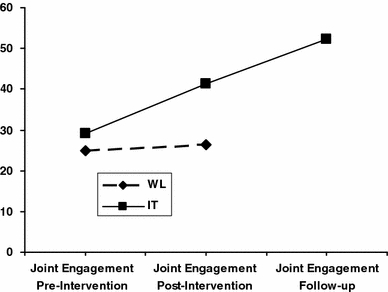
This study aimed to determine if a joint attention intervention would result in greater joint engagement between caregivers and toddlers with autism. The intervention consisted of 24 caregiver-mediated sessions with follow-up 1 year later. Compared to caregivers and toddlers randomized to the waitlist control group the immediate treatment (IT) group made significant improvements in targeted areas of joint engagement. The IT group demonstrated significant improvements with medium to large effect sizes in their responsiveness to joint attention and their diversity of functional play acts after the intervention with maintenance of these skills 1 year post-intervention. These are among the first randomized controlled data to suggest that short-term parent-mediated interventions can have important effects on core impairments in toddlers with autism. Clinical Trials #: NCT00065910.
Overview
The claims and statistics of this paper haven’t been checked yet.
Free: it reads the open-access text and checks the first 5 claims that cite a source we can check. Create a free account to check every claim.
Integrity signals
Registry
Cites
Statistics
Figures
Verification
Claims the paper makes
The claims and statistics of this paper haven’t been checked yet.
Free: it reads the open-access text and checks the first 5 claims that cite a source we can check. Create a free account to check every claim.
Claims other papers make about this one
Each is checked against this paper’s own text: does it say what the citing paper says it does?
The source backs part of the claim, not all of it — or backs it for a different population, condition or comparison.
In the citing paper
“both of the comprehensive intervention programs (Early Start Denver Model [ESDM] and the UCLA/Lovaas model) and the 4 targeted interventions (focusing on social communication or imitation skills) exhibited significantly improved outcomes relative to comparison groups after therapeutic durations of 8 weeks to 2 to 3 years.”
From Early Intervention for Children With Autism Spectrum Disorder Under 3 Years of Age: Recommendations for Practice and Research (2015) · cites this paper as [20]
Experimental — accuracy not yet measuredThe source backs part of the claim, not all of it — or backs it for a different population, condition or comparison.
In the citing paper
“This may facilitate generalisation and maintenance of skills over time, as well as providing the most meaningful social context for learning.9”
From Telehealth-delivered naturalistic developmental behavioural intervention with and without caregiver acceptance and commitment therapy for autistic children and their caregivers: Protocol for a multi-arm parallel group randomised clinical trial (2023) · cites this paper as [9]
Experimental — accuracy not yet measuredThe source backs part of the claim, not all of it — or backs it for a different population, condition or comparison.
In the citing paper
“Many NDBI programmes teach caregivers to be the primary support agents, thus providing opportunities for NDBI techniques to be implemented throughout the day and across environments.”
From Telehealth-delivered naturalistic developmental behavioural intervention with and without caregiver acceptance and commitment therapy for autistic children and their caregivers: Protocol for a multi-arm parallel group randomised clinical trial (2023) · cites this paper as [9]
Experimental — accuracy not yet measuredThe cited source says what the claim attributes to it.
In the citing paper
“Joint attention training, which uses behavioral and developmental techniques to scaffold and enhance the child’s ability to share attention to objects and activities with adults, is effective for young children with autism (Charman, 2011; Dawson et al., 2010; Kasari, Gulsrud, Wong, Kwon, & Locke, 2010).”
From From early markers to neuro-developmental mechanisms of autism (2014) · cites this paper as Kasari, Gulsrud, Wong, Kwon, & Locke, 2010
The cited source says what the claim attributes to it.
In the citing paper
“Kasari 23 reported some behavioral gains but no data regarding changes on standardized measures of development or primary autism symptoms.”
4 more claims about this paper
Create a free account to see every claim other papers make about this one.
Self-check
Percentages, sums and reported differences re-computed from the paper’s own numbers.
The self-check needs the paper’s full text.
Citations
Cites
Mullen Scales of Early Learning
Bradley-Johnson, S. (1997) · Psychology in the Schools · doi:10.1002/(sici)1520-6807(199710)34:4<379::aid-pits14>3.0.co;2-e · Cited by 2,325
Joint attention and early language
Tomasello, M., & Farrar, M. J. (1986) · Child Development · doi:10.2307/1130423 · Cited by 1,822 · cited 2×
“Studies of both typically developing children and children with autism find that children who engage the caregiver in sharing communications (e.g., pointing to events or toys of interest, showing toys, and looking between events and people to share interest) acquire language faster (Mundy et al. 1990; Tomasello and Fa…”
BackgroundJoint Attention and Early Language
Tomasello, M., & Farrar, M. J. (1986) · Child Development · doi:10.1111/j.1467-8624.1986.tb00470.x · Cited by 1,815
Coordinating Attention to People and Objects in Mother-Infant and Peer-Infant Interaction
Bakeman, R., & Adamson, L. B. (1984) · Child Development · doi:10.2307/1129997 · Cited by 1,439
Early recognition of children with autism: a study of first birthday home videotapes
Osterling, J., & Dawson, G. (1994) · Journal of Autism and Developmental Disorders · doi:10.1007/bf02172225 · Cited by 1,290
A longitudinal study of joint attention and language development in autistic children
Mundy, P., Sigman, M., & Kasari, C. (1990) · Journal of Autism and Developmental Disorders · doi:10.1007/bf02206861 · Cited by 1,119 · cited 4×
“This is possibly because joint attention skills mark the development of the child’s awareness that other people can see the same objects and/or events that the child sees and regulates attention and affect between self, other, and these events/objects (Bakeman and Adamson 1984; Rheingold et al. 1976; Mundy et al. 1990…”
BackgroundInfluentialSelf-citationDefining the social deficits of autism: the contribution of non-verbal communication measures
Mundy, P., Sigman, M., Ungerer, J., & Sherman, T. (1986) · Journal of Child Psychology and Psychiatry · doi:10.1111/j.1469-7610.1986.tb00190.x · Cited by 956
Kasari, C., Freeman, S., & Paparella, T. (2006) · Journal of Child Psychology and Psychiatry · doi:10.1111/j.1469-7610.2005.01567.x · Cited by 951 · cited 11×
“Previous research has found this coding system to be reliable, correlates as expected with other measures of social-communication, and sensitive to treatment-related changes (Kasari et al. 2006, 2008).”
BackgroundMethodResultInfluentialSelf-citationTreatment fidelity in outcome studies
Moncher, F. J., & Prinz, R. J. (1991) · Clinical Psychology Review · doi:10.1016/0272-7358(91)90103-2 · Cited by 797 · cited 2×
“Treatment fidelity has been a longstanding concern with studies finding that when individuals implement interventions with a high degree of fidelity they achieve better treatment success (e.g., Moncher and Prinz 1991 ).”
BackgroundLanguage outcome in autism: randomized comparison of joint attention and play interventions
Kasari, C., Paparella, T., Freeman, S., & Jahromi, L. B. (2008) · Journal of Consulting and Clinical Psychology · doi:10.1037/0022-006x.76.1.125 · Cited by 592
Self-citation
Cited by
Items 201–300 of 900
Joint attention revisited: Finding strengths among children with autism
Hurwitz, S., & Watson, L. R. (2015) · Autism · doi:10.1177/1362361315593536 · Cited by 51
Bahado-Singh, R. O., Vishweswaraiah, S., Aydas, B., Mishra, N. K., Yılmaz, A., Guda, C., & Radhakrishna, U. (2019) · Brain Research · doi:10.1016/j.brainres.2019.146457 · Cited by 51
Rooks-Ellis, D. L., Howorth, S. K., Kunze, M. G., Boulette, S., & Sulinski, E. (2020) · Journal of Childhood Education & Society · doi:10.37291/2717638x.20201242 · Cited by 52
Wilson, K. P., & Landa, R. J. (2019) · Frontiers in Education · doi:10.3389/feduc.2019.00027 · Cited by 54
Sustained Community Implementation of JASPER Intervention with Toddlers with Autism
Shire, S. Y., Shih, W., Chang, Y., Bracaglia, S., Kodjoe, M., & Kasari, C. L. (2019) · Journal of Autism and Developmental Disorders · doi:10.1007/s10803-018-03875-0 · Cited by 49
Self-citationMcKinney, A., Weisblatt, E., Hotson, K. L., Ahmed, Z. B., Días, C., Shalom, D. B., Foster, J., Murphy, S., Villar, S. S., & Belmonte, M. K. (2021) · Autism · doi:10.1177/1362361321998916 · Cited by 49
Warreyn, P., & Roeyers, H. (2013) · Autism · doi:10.1177/1362361313493834 · Cited by 49
Play Assessments and Developmental Skills in Young Children With Autism Spectrum Disorders
Pierucci, J. M., Barber, A. B., Gilpin, A. T., Crisler, M. E., & Klinger, L. G. (2014) · Focus on Autism and Other Developmental Disabilities · doi:10.1177/1088357614539837 · Cited by 49
Assessment of Motor Behavior Among Children and Adolescents with Autism Spectrum Disorder
Staples, K. L., MacDonald, M., & Zimmer, C. (2012) · International review of research in developmental disabilities · doi:10.1016/b978-0-12-394284-5.00007-3 · Cited by 49
Impact of robot-mediated interaction system on joint attention skills for children with autism
Zheng, Z., Lian, Z., Bekele, E., Swanson, A. R., Crittendon, J. A., Warren, Z. E., & Sarkar, N. (2013) · International Conference on Rehabilitation Robotics · doi:10.1109/icorr.2013.6650408 · Cited by 48
Biggs, E. E., & Meadan, H. (2018) · International review of research in developmental disabilities · doi:10.1016/bs.irrdd.2018.08.005 · Cited by 47
Valeri, G., Casula, L., Menghini, D., Amendola, F. A., Napoli, E., Pasqualetti, P., & Vicari, S. (2019) · European Child & Adolescent Psychiatry · doi:10.1007/s00787-019-01395-5 · Cited by 47
Yurkovic‐Harding, J., Lisandrelli, G., Shaffer, R. C., Dominick, K. C., Pedapati, E. V., Erickson, C. A., Kennedy, D. P., & Yu, C. (2021) · Scientific Reports · doi:10.1038/s41598-021-81102-0 · Cited by 47
Chiang, C.-H., Chu, C.-L., & Lee, T.-C. (2016) · Autism · doi:10.1177/1362361315575725 · Cited by 38
Teaching joint attention to children with autism through a sibling-mediated behavioral intervention
Ferraioli, S. J. (2008) · Rutgers University Community Repository (Rutgers University) · doi:10.7282/t3tb177d · Cited by 47
SMARTer Approach to Personalizing Intervention for Children With Autism Spectrum Disorder
Kasari, C., Sturm, A., & Shih, W. (2018) · Journal of Speech, Language, and Hearing Research · doi:10.1044/2018_jslhr-l-rsaut-18-0029 · Cited by 46
“We found significant increases in joint engagement, responding to joint attention and functional play skills (Kasari et al., 2010) in the experimental group compared with the wait-list control group, and these skills were maintained over a year of follow-up.”
BackgroundSelf-citationReichow, B., Kogan, C. S., Barbui, C., Maggin, D. M., Salomone, E., Smith, I. C., Yasamy, M. T., & Servili, C. (2023) · Developmental Medicine & Child Neurology · doi:10.1111/dmcn.15764 · Cited by 48
Preece, D., Symeou, L., Stošić, J., Troshanska, J., Mavrou, K., Theodorou, E., & Škrinjar, J. F. (2016) · European Journal of Special Needs Education · doi:10.1080/08856257.2016.1223399 · Cited by 46
Magaña, S., Dababnah, S., Xu, Y., Torres, M. G., Rieth, S. R., Corsello, C. M., Rangel, E., Brookman-Frazee, L. I., & Vanegas, S. B. (2021) · International review of research in developmental disabilities · doi:10.1016/bs.irrdd.2021.07.005 · Cited by 47
Flippin, M., & Watson, L. R. (2011) · Journal of Early Intervention · doi:10.1177/1053815111427445 · Cited by 46
Kasari, C. L., Shire, S. Y., Factor, R. S., & McCracken, C. M. (2014) · Current Psychiatry Reports · doi:10.1007/s11920-014-0512-6 · Cited by 46
Self-citationHealy, S., Marchand, G., & Williams, E. (2018) · Research in Developmental Disabilities · doi:10.1016/j.ridd.2018.08.014 · Cited by 45
Barokova, M. D., Valle, C. L., Hassan, S., Lee, C., Xu, M., McKechnie, R., Johnston, E., Krol, M. A., Leano, J., & Tager-Flusberg, H. B. (2020) · Autism Research · doi:10.1002/aur.2380 · Cited by 45
Montiel‐Nava, C., Tregnago, M., Marshall, J., Sohl, K., Curran, A. B., Mahurin, M. A., Warne-Griggs, M. D., WHO CST Team, & Dixon, P. (2022) · Frontiers in Psychiatry · doi:10.3389/fpsyt.2022.909947 · Cited by 46
Shire, S. Y., Shih, W., Barriault, T., & Kasari, C. L. (2021) · Autism · doi:10.1177/13623613211066132 · Cited by 44
Self-citationNordahl-Hansen, A., Fletcher-Watson, S., McConachie, H., & Kaale, A. (2016) · Research in Autism Spectrum Disorders · doi:10.1016/j.rasd.2016.05.005 · Cited by 43
Language Development in Individuals With Intellectual and Developmental Disabilities
(2016) · International Review of Research in Developmental Disabilities · doi:10.1016/bs.irrdd.2016.05.006 · Cited by 43
Salomone, E., Settanni, M., McConachie, H., Suma, K., Ferrara, F., Foletti, G., Salandin, A., WHO CST Team, Brown, F. L., Pacione, L. R., et al. (2021) · Journal of Autism and Developmental Disorders · doi:10.1007/s10803-021-05297-x · Cited by 44
What do Cochrane systematic reviews say about interventions for autism spectrum disorders?
Lyra, L., Rizzo, L. E., Sunahara, C. S., Pachito, D. V., Latorraca, C. D. O. C., Martimbianco, A. L. C., & Riera, R. (2017) · Sao Paulo Medical Journal · doi:10.1590/1516-3180.2017.0058200317 · Cited by 45
Pellecchia, M., Nuske, H. J., Straiton, D., Hassrick, E. M., Gulsrud, A. C., Iadarola, S., Vejnoska, S., Bullen, B., Haine‐Schlagel, R., Kasari, C. L., et al. (2018) · Journal of Child and Family Studies · doi:10.1007/s10826-018-1144-y · Cited by 43
Self-citationWaddington, H. L., van der Meer, L. A. J., Sigafoos, J., & Whitehouse, A. (2019) · Autism · doi:10.1177/1362361319876495 · Cited by 43
Shire, S. Y., Worthman, L. B., Shih, W., & Kasari, C. L. (2020) · Journal of Behavioral Education · doi:10.1007/s10864-020-09376-4 · Cited by 42
Self-citationShire, S. Y., & Kasari, C. L. (2014) · American Journal on Intellectual and Developmental Disabilities · doi:10.1352/1944-7558-119.5.436 · Cited by 42
Self-citationSalomone, E., Ferrante, C., Salandin, A., Ferrara, F., Torchio, E., Foletti, G., Ghersi, S., CST Italy Team, WHO CST Team, Pacione, L., et al. (2022) · Autism · doi:10.1177/13623613211035228 · Cited by 39
Ingersoll, B. R., Wainer, A., Berger, N. I., & Walton, K. M. (2017) · Developmental Neurorehabilitation · doi:10.1080/17518423.2016.1278054 · Cited by 39
Wergeland, G. J., Posserud, M.-B. R., Fjermestad, K. W., Njarðvík, U., & Öst, L. (2022) · Clinical Psychology Science and Practice · doi:10.1037/cps0000106 · Cited by 39
The Power of Symbolic Play in Emotional Development Through the DIR Lens
Wieder, S. (2017) · Topics in Language Disorders · doi:10.1097/tld.0000000000000126 · Cited by 40
Martins, E. P. (2025) · STUDIES IN HEALTH SCIENCES · doi:10.54022/shsv6n4-043 · Cited by 38
Harrop, C., Gulsrud, A. C., Shih, W., Hovsepyan, L., & Kasari, C. L. (2016) · Autism Research · doi:10.1002/aur.1732 · Cited by 38
Self-citationYuen, T., Carter, M. T., Szatmári, P., & Ungar, W. J. (2018) · Journal of Autism and Developmental Disorders · doi:10.1007/s10803-018-3571-4 · Cited by 38
McDaniel, J., Brady, N. C., & Warren, S. F. (2021) · Journal of Autism and Developmental Disorders · doi:10.1007/s10803-021-05331-y · Cited by 38
Developmental Approaches to Understanding and Treating Autism
Charman, T. (2010) · Folia Phoniatrica et Logopaedica · doi:10.1159/000314032 · Cited by 39
Shire, S. Y., Shih, W., Chang, Y., & Kasari, C. L. (2016) · Autism · doi:10.1177/1362361316674092 · Cited by 38
Self-citationExtending the Parent-Delivered Early Start Denver Model to Young Children with Fragile X Syndrome
Vismara, L. A., McCormick, C. E. B., Shields, R. H., & Hessl, D. R. (2018) · Journal of Autism and Developmental Disorders · doi:10.1007/s10803-018-3833-1 · Cited by 38
Unraveling the Spectrum: A Comprehensive Review of Autism Spectrum Disorder in India
Uke, P., Gaikwad, S. B., Vagha, K. J., & Wandile, S. (2024) · Cureus · doi:10.7759/cureus.62753 · Cited by 38
Qu, L., Chen, H., Miller, H. L., Miller, A. L., Colombi, C., Chen, W., & Ulrich, D. A. (2022) · Frontiers in Psychology · doi:10.3389/fpsyg.2022.859145 · Cited by 38
Zachor, D. A., & Curatolo, P. (2013) · European Journal of Paediatric Neurology · doi:10.1016/j.ejpn.2013.09.002 · Cited by 40
Brian, J. A., Solish, A., Dowds, E., Roth, I., Bernardi, K., Perry, K., Daoud, S., Jilderda, S., MacWilliam, S., Smith, I. M., et al. (2022) · Journal of Autism and Developmental Disorders · doi:10.1007/s10803-022-05554-7 · Cited by 36
Dubin, A. H., & Lieberman‐Betz, R. G. (2019) · Review Journal of Autism and Developmental Disorders · doi:10.1007/s40489-019-00184-9 · Cited by 35
Valle, C. L., Chenausky, K. V., & Tager-Flusberg, H. B. (2021) · Autism & Developmental Language Impairments · doi:10.1177/23969415211035065 · Cited by 36
Methods to improve joint attention in young children with autism: a review
Paparella, T., & Freeman, S. F. N. (2015) · Pediatric Health Medicine and Therapeutics · doi:10.2147/phmt.s41921 · Cited by 35
McConachie, H., Fletcher‐Watson, S., & Working Group 4, C. A. ‘. T. S. S. O. E. A. (2014) · Child Care Health and Development · doi:10.1111/cch.12185 · Cited by 36
Broder‐Fingert, S., Walls, M., Augustyn, M. C., Beidas, R. S., Mandell, D. S., Stirman, S. W., Silverstein, M., & Feinberg, E. (2018) · BMC Psychiatry · doi:10.1186/s12888-018-1661-7 · Cited by 35
Interventions for Infants and Toddlers at Risk for Autism Spectrum Disorder
Rogers, S. J., & Vismara, L. (2014) · Handbook of Autism and Pervasive Developmental Disorders, Fourth Edition · doi:10.1002/9781118911389.hautc29 · Cited by 29
Wass, S. V., Greenwood, E., Esposito, G., Smith, C. G., Necef, I., & Phillips, E. (2024) · Journal of Child Psychology and Psychiatry · doi:10.1111/jcpp.13960 · Cited by 34
Charman, T. (2014) · International Journal of Speech-Language Pathology · doi:10.3109/17549507.2013.859732 · Cited by 33
“…may be more amenable to change, in particular when measured using dyadic interaction measures of joint attention and symbolic play (Kasari et al., 2006, 2008); joint engagement (Kasari et al., 2010); parental synchrony (Green et al., 2010); and socially engaged imitation (Landa et al., 2011).”
BackgroundEarly Identification and Early Treatment of Autism Spectrum Disorder
Rogers, S. J., & Talbott, M. R. (2016) · International review of research in developmental disabilities · doi:10.1016/bs.irrdd.2016.05.004 · Cited by 33
Hampton, L. H., Kaiser, A. P., Nietfeld, J. P., & Khachoyan, A. (2020) · Journal of Autism and Developmental Disorders · doi:10.1007/s10803-020-04521-4 · Cited by 33
Guo, Y. J., Dynia, J. M., Logan, J. A. R., Justice, L. M., Breit‐Smith, A., & Kaderavek, J. N. (2016) · Early Childhood Research Quarterly · doi:10.1016/j.ecresq.2016.06.001 · Cited by 33
Blanche, E. I., Chang, M., Gutiérrez, J., & Gunter, J. S. (2016) · American Journal of Occupational Therapy · doi:10.5014/ajot.2016.018481 · Cited by 33
Schlebusch, L., Chambers, N., Rosenstein, D., Erasmus, P., WHO CST Team, & de Vries, P. J. (2024) · Autism · doi:10.1177/13623613221133182 · Cited by 32
“The WHO CST Group Session Feedback Form for Caregivers (adapted from Kasari et al., 2010) was used to evaluate aspects of acceptability.”
MethodShire, S. Y., Shih, W., & Kasari, C. L. (2018) · Journal of Autism and Developmental Disorders · doi:10.1007/s10803-017-3454-0 · Cited by 32
Self-citationGabbatore, I., Longobardi, C., & Bosco, F. M. (2021) · Language Learning and Development · doi:10.1080/15475441.2021.1924177 · Cited by 32
Roemer, E. J., Kushner, E. H., & Iverson, J. M. (2021) · Journal of Autism and Developmental Disorders · doi:10.1007/s10803-021-05099-1 · Cited by 33
Puppets facilitate attention to social cues in children with ASD
Macari, S. L., Chen, X., Brunissen, L., Yhang, E., Brennan‐Wydra, E., Vernetti, A., Volkmar, F. R., Chang, J. T., & Chawarska, K. (2021) · Autism Research · doi:10.1002/aur.2552 · Cited by 33
Joint Attention and Its Relationship with Autism Risk Markers at 18 Months of Age
Montagut-Asunción, M., Crespo-Martín, S., Cerezuela, G. P., & Giménez, A. D. (2022) · Children · doi:10.3390/children9040556 · Cited by 32
Abercrombie, J., Wiggins, L. D., & Green, K. K. (2022) · PubMed · Cited by 32
Venuti, P., Bentenuto, A., Cainelli, S., Landi, I., Suvini, F., Tancredi, R., Igliozzi, R., & Muratori, F. (2016) · Health Psychology Report · doi:10.5114/hpr.2017.63985 · Cited by 32
Playful interaction with Teo, a Mobile Robot for Children with Neurodevelopmental Disorders
Bonarini, A., Clasadonte, F., Garzotto, F., Gelsomini, M., & Romero, M. E. (2016) · International Conference on Software Development and Technologies for Enhancing Accessibility and Fighting Info-exclusion (DSAI) · doi:10.1145/3019943.3019976 · Cited by 32
Feinberg, E., Kuhn, J., Eilenberg, J. S., Levinson, J., Patts, G. J., Cabral, H., & Broder‐Fingert, S. (2020) · Academic Pediatrics · doi:10.1016/j.acap.2020.04.007 · Cited by 32
The Behavioral Manifestations of Autism Spectrum Disorders
Kim, S. H., & Lord, C. (2013) · The Neuroscience of Autism Spectrum Disorders · doi:10.1016/b978-0-12-391924-3.00002-8 · Cited by 31
Prelock, P., Calhoun, J., Morris, H., & Platt, G. (2011) · Topics in Language Disorders · doi:10.1097/tld.0b013e318227bd3f · Cited by 31
Tachibana, Y., Miyazaki, C., Mikami, M., Ota, E., Mori, R., Hwang, Y., Terasaka, A., Kobayashi, E., & Kamio, Y. (2018) · PLoS ONE · doi:10.1371/journal.pone.0196272 · Cited by 33
Update on behavioral interventions for autism and developmental disabilities
Kasari, C. L. (2015) · Current Opinion in Neurology · doi:10.1097/wco.0000000000000185 · Cited by 31
Self-citationUsing the Double ABCX Model to Integrate Services for Families of Children with ASD
Pickard, K. E., & Ingersoll, B. R. (2016) · Journal of Child and Family Studies · doi:10.1007/s10826-016-0605-4 · Cited by 32
White matter as a monitoring biomarker for neurodevelopmental disorder intervention studies
Swanson, M. R., & Hazlett, H. C. (2019) · Journal of Neurodevelopmental Disorders · doi:10.1186/s11689-019-9295-8 · Cited by 31
Assisted Robots in Therapies for Children with Autism in Early Childhood
Gómez-Espinosa, A., Moreno, J. C., & la Cruz, S. P. (2024) · Sensors · doi:10.3390/s24051503 · Cited by 30
Yazdani, S., Capuano, A., Ghaziuddin, M., & Colombi, C. (2020) · Brain Sciences · doi:10.3390/brainsci10020099 · Cited by 30
Mrachko, A. A., & Kaczmarek, L. A. (2016) · Topics in Early Childhood Special Education · doi:10.1177/0271121416662870 · Cited by 30
Life Course Health Development in Autism Spectrum Disorders
Drmic, I., Szatmári, P., & Volkmar, F. R. (2017) · Springer eBooks · doi:10.1007/978-3-319-47143-3_11 · Cited by 30
Lane, J. D., Shepley, C., & Lieberman‐Betz, R. G. (2016) · Journal of Autism and Developmental Disorders · doi:10.1007/s10803-016-2856-8 · Cited by 29
Engaged Moments: Mediated Action and Children with Autism in the Classroom Setting
Bagatell, N. (2011) · OTJR Occupational Therapy Journal of Research · doi:10.3928/15394492-20110722-01 · Cited by 29
Chawarska, K., Macari, S. L., Volkmar, F. R., Kim, S. H., & Shic, F. (2014) · Wiley eBooks · doi:10.1002/9781118911389.hautc05 · Cited by 29
Play Development in Children With Autism Spectrum Disorders: Skills, Object Play, and Interventions
Kasari, C. L., & Chang, Y. (2014) · Wiley eBooks · doi:10.1002/9781118911389.hautc11 · Cited by 29
Self-citationvan Noorden, L. E., Sigafoos, J., & Waddington, H. L. (2022) · Advances in Neurodevelopmental Disorders · doi:10.1007/s41252-022-00264-8 · Cited by 29
Mothers’ Scaffolding Techniques Used During Play in Toddlers with Autism Spectrum Disorder
Pierucci, J. M. (2015) · Journal of Developmental and Physical Disabilities · doi:10.1007/s10882-015-9459-8 · Cited by 28
Hansen, R. L., Blum, N. J., Gaham, A., & Shults, J. (2016) · PEDIATRICS · doi:10.1542/peds.2015-2851f · Cited by 28
Brief Report: A Novel System to Evaluate Autism Spectrum Disorders Using Two Humanoid Robots
Kumazaki, H., Muramatsu, T., Yoshikawa, Y., Yoshimura, Y., Ikeda, T., Hasegawa, C., Saito, D. N., Shimaya, J., Ishiguro, H., Mimura, M., et al. (2018) · Journal of Autism and Developmental Disorders · doi:10.1007/s10803-018-3848-7 · Cited by 28
Naturalistic Developmental Behavioral Interventions for Children with Autism
Vivanti, G., & Zhong, H. N. (2020) · Best Practices in Child and Adolescent Behavioral Health Care · doi:10.1007/978-3-030-41160-2_6 · Cited by 27
Latif, N., Francesco, C. D., Custo-Blanch, M., Hyde, K. L., Sharda, M., & Nadig, A. (2021) · Neurorehabilitation · doi:10.3233/nre-208012 · Cited by 27
Promoting Communication Development in Young Children with or at Risk for Disabilities
Lane, J. D., & Brown, J. A. (2016) · Springer eBooks · doi:10.1007/978-3-319-28492-7_12 · Cited by 27
Kitzerow, J., Hackbusch, M., Jensen, K., Kieser, M., Noterdaeme, M. A., Fröhlich, U., Taurines, R., Geissler, J. M., Wolff, N., Roessner, V., et al. (2020) · Trials · doi:10.1186/s13063-019-3881-7 · Cited by 27
Barber, A. B., Swineford, L. B., Cook, C., & Belew, A. (2020) · Perspectives of the ASHA Special Interest Groups · doi:10.1044/2020_persp-20-10005 · Cited by 26
Butler, L. K., Valle, C. L., Schwartz, S., Palana, J., Liu, C., Peterman, N., Shen, L., & Tager-Flusberg, H. B. (2022) · Frontiers in Communication · doi:10.3389/fcomm.2022.820564 · Cited by 26
Telepractice Delivery of an Autism Communication Intervention Program to Parent Groups
Garnett, R., Davidson, B. J., & Eadie, P. A. (2021) · Research in Autism · doi:10.1016/j.rasd.2021.101902 · Cited by 26
Thompson, C. K., & Jenkins, T. (2016) · Journal of Communication Disorders Deaf Studies & Hearing Aids · doi:10.4172/2375-4427.1000147 · Cited by 26
Pinchover, S., Shulman, C., & Bundy, A. C. (2016) · Early Child Development and Care · doi:10.1080/03004430.2015.1136622 · Cited by 26
Increasing Functional Leisure Engagement for Children With Autism Using Backward Chaining
Edwards, C. K., Landa, R. K., Frampton, S. E., & Shillingsburg, M. A. (2017) · Behavior Modification · doi:10.1177/0145445517699929 · Cited by 25
Praphatthanakunwong, N., Kiatrungrit, K., Hongsanguansri, S., & Nopmaneejumruslers, K. (2018) · General Psychiatry · doi:10.1136/gpsych-2018-000009 · Cited by 28
Metadata
- Authors
- Kasari, C., Gulsrud, A. C., Wong, C., Kwon, S., & Locke, J.
- Affiliations
- University of California, Los Angeles (US)
- Cleveland State University (US)
- Corresponding author
- Kasari, Connie
- Venue
- Journal of Autism and Developmental Disorders
- Published
- 2010-02-10
- Volume
- 40
- Issue
- 9
- Pages
- 1045-1056
- ISSN
- 0162-3257 (ISSN-L)
- 1573-3432
- PMC
- PMC2922697
- OpenAlex
- W2045147308
- Cited by
- 751
- References
- 27
- Citations by year
- 2026: 30 · 2025: 40 · 2024: 38 · 2023: 31 · 2022: 46 · 2021: 58 · 2020: 54 · 2019: 55 · 2018: 85 · 2017: 41 · 2016: 58 · 2015: 46 · 2014: 50 · 2013: 48 · 2012: 36
- FWCI
- 22.50
- Type
- journal article
- Language
- en
- Open access
- hybrid
- doi.org
- Licence
- cc-by-nc
- Locations
- Journal of Autism and Developmental Disorders (publishedVersion, cc-by-nc)
- PubMed Central (publishedVersion, cc-by-nc)
- PubMed (publishedVersion)
- eScholarship (California Digital Library) (submittedVersion)
- Funders
- Autism Speaks (AS2280)
- National Institute of Mental Health (MH064927, R21MH064927)
- Topics
- Life Sciences › Neuroscience › Cognitive Neuroscience › Autism Spectrum Disorder Research
- Social Sciences › Psychology › Developmental and Educational Psychology › Behavioral and Psychological Studies
- Social Sciences › Psychology › Developmental and Educational Psychology › Child and Animal Learning Development
- Keywords
- autism spectrum disorder, toddlers, joint attention, joint engagement, caregiver-mediated intervention, parent-mediated intervention, caregiver responsiveness, functional play, skill retention, early intervention
- MeSH terms
- Adult, Attention, Autistic Disorder, Child, Preschool, Female, Humans, Infant, Male, Parent-Child Relations, Parents, Play and Playthings, Treatment Outcome, Caregivers
About these checks
Registry, retraction, Cites and statistics results are computed, not judged, with one exception: a printed reference that no index lists is read once by a model before it counts as a citation error. Claims are extracted by a model and kept only when their quote appears verbatim in the text; each cited source is then checked, with a model’s help, for whether it says what the claim relies on. Those verdicts can be wrong — read the claim’s quote and the cited source before relying on one.
Statistics and arithmetic are recomputed, not judged.
Confidence bands are shown only for fields calibrated on our annotated test set. None is calibrated yet, so no band is shown.
What counts as a claim ›How we measure confidence ›How we check this ›
Are you an author, or do you see a problem with this page? Request a review
Data sources
Bibliographic data: Semantic Scholar, OpenAlex, Crossref.
Contains information from the Semantic Scholar Academic Graph Datasets, made available under the ODC Attribution License (ODC-BY 1.0).
Semantic Scholar’s data is described in: Kinney, R., et al. (2023). The Semantic Scholar Open Data Platform. arXiv:2301.10140.
