

Experiences of Autism Acceptance and Mental Health in Autistic Adults
Open accessThe DOI matches its Crossref record; 67 of the 71 references it cites were found in a registry or an index; 3 of the 60 sources its claims cite were checked for support.
Abstract
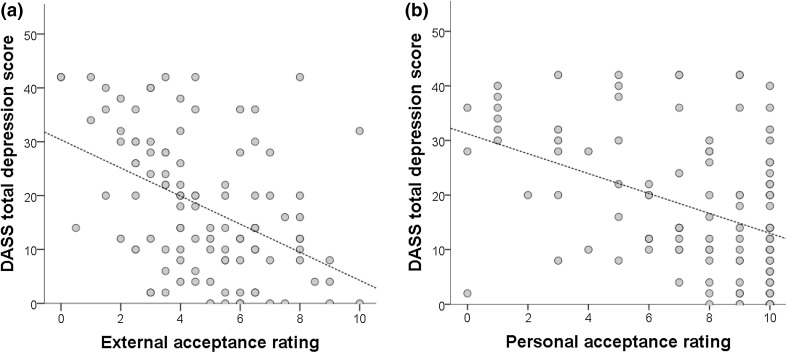
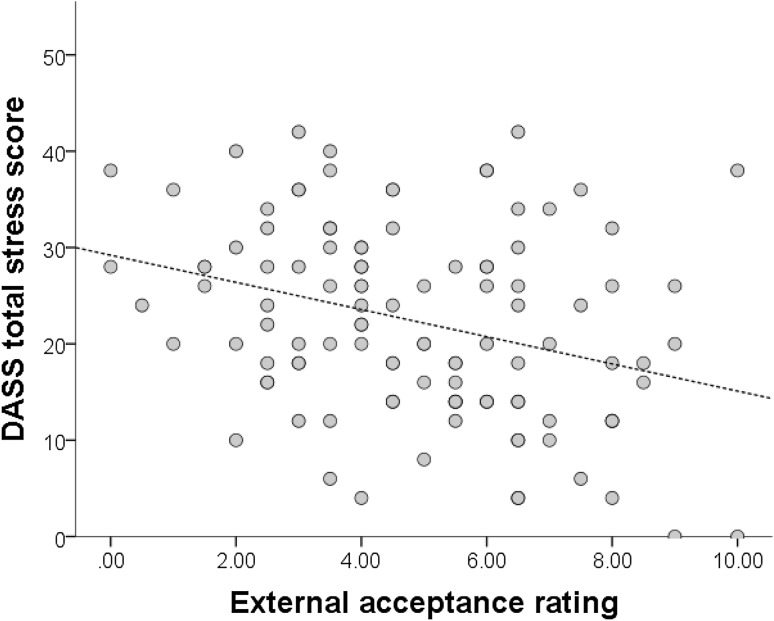
Mental health difficulties are highly prevalent in individuals on the autism spectrum. The current study examined how experiences and perceptions of autism acceptance could impact on the mental health of autistic adults. 111 adults on the autism spectrum completed an online survey examining their experiences of autism acceptance, along with symptoms of depression, anxiety and stress. Regression analyses showed that autism acceptance from external sources and personal acceptance significantly predicted depression. Acceptance from others also significantly predicted stress but acceptance did not predict anxiety. Further analyses suggested that experiences of "camouflaging" could relate to higher rates of depression. The current study highlights the importance of considering how autism acceptance could contribute to mental health in autism.
Overview
CoChat Summary
TL;DR
In 111 autistic adults, perceived autism acceptance from external sources and personal acceptance predicted lower depression, and external acceptance also predicted lower stress, but acceptance did not predict anxiety. Exploratory qualitative reports of camouflaging were linked to higher depression and lower recent acceptance.
Key findings
- Only 7% said society generally accepted them as autistic, 43% said “no,” and 48% said “sometimes”; 24.3% agreed/strongly agreed they had felt accepted by society in the past week, while 41.4% disagreed/strongly disagreed.
- In hierarchical regressions, the final depression model explained 52.1% of variance; external acceptance (β = −0.284, p = .004) and personal acceptance (β = −0.307, p = .001) significantly predicted depression. For stress, external acceptance significantly predicted stress (β = −0.198, p = .037), but adding acceptance variables was a non-significant change (p = .11). Acceptance did not predict anxiety.
- DASS means were depression 17.8 (SD = 12.7), anxiety 12.9 (SD = 9.14), and stress 22.3 (SD = 9.96), described as higher than non-autistic population means cited from Henry and Crawford (2005).
- Of 63 qualitative responders, 27 spontaneously reported camouflaging/masking; camouflaging interacted with DASS scores (F(2, 212) = 4.55, p = .012), with only depression differing between those who reported camouflaging and those who did not (t(107) = −0.256, p = .012, g = 0.56), and camouflagers were more likely to disagree they had experienced acceptance (X²(2) = 6.68, p = .035).
Methods
- Cross-sectional online survey of 111 autistic adults over 18, recruited via social media and UK autism organisations/groups; data collected June–October 2016; median completion time 12 min; 84% self-reported additional mental health diagnoses or developmental conditions.
- Measures included newly developed autism acceptance items (societal, family/friend, and personal acceptance; past-week societal acceptance; categorical societal acceptance), the DASS-21, and open-text qualitative responses analyzed by content analysis with two independent coders.
- Analyses included Spearman correlations, PCA that combined societal and family/friend acceptance into “external sources” while treating personal acceptance separately, and three hierarchical regressions predicting depression, anxiety, and stress while controlling age, age of diagnosis, gender, and other DASS scales; exploratory mixed ANOVA examined camouflaging.
Limitations
- Stated by the paper: online self-report may be unreliable; the sample was predominantly female, limiting generalisability, though gender was not a significant predictor; many participants reported additional diagnoses, possibly attracting those already experiencing mental health difficulties; and the sample was mainly well-educated and not representative of the whole autism spectrum.
- Evident from the text: the cross-sectional correlational design cannot establish causality or direction; the autism acceptance items were not a pre-existing validated measure, with PCA KMO = 0.528, personal acceptance loading 0.462, and Cronbach’s alpha improving only from 0.51 to 0.64 after removing personal acceptance; 27 participants were excluded from final regression analyses due to missing data, and 11 without a formal diagnosis were excluded from regressions.
Model-written summary. Check it against the paper before relying on it.
Integrity signals
Registry
Cites
Statistics
Figures
Verification
Claims the paper makes
3 Valid · 0 Not valid · 44 Not checked · 65 Own results and interpretations
Every source the paper cites for this claim was checked and supports it.
In the paper
“Sasson et al. (2017) found that non-autistic individuals tend to make rapid unfavourable judgements about those on the autism spectrum.”
§ Experiences of Autism Acceptance and Mental Health in Autistic Adults > Introduction
What the sources say
- Supportedcites Sasson et al. 2017 matched to “Neurotypical Peers are Less Willing to Interact with Those with Autism based on Thin Slice Judgments” (2017) source
The Abstract (p. 1) states that across three studies, first impressions of individuals with ASD made from thin slices of real-world social behavior by typically-developing observers were 'far less favorable across a range of trait judgments compared to controls' and that these patterns 'occur within seconds'. The Discussion (p. 1) likewise reports robustly less favorable first impressions by neurotypical observers, associated with reduced intentions to engage. The claim's 'rapid unfavourable judgements' by non-autistic individuals is therefore directly stated; the only qualifier the source adds (that the bias vanishes for conversational content without audiovisual cues) does not contradict the hedged 'tend to'. (LLM, conf=0.92)
plain- Asserted: passes — The authors put it forward as true.
- Checkable: passes — It can be checked against evidence.
- Load-bearing: passes — The paper’s conclusions depend on it.
- Based: passes — The paper gives a reason why it holds.
- Supported
The sources with a verdict support this claim; the rest weren’t checked yet, have no full text we could read, or their verdicts aren’t rated yet.
In the paper
“many autistic individuals frequently report “masking” or “camouflaging”—that is, they may use strategies to camouflage the fact they are on the autism spectrum in order to “fit in” to the non-autistic world (Dean et al. 2016; Hull et al. 2017).”
§ Experiences of Autism Acceptance and Mental Health in Autistic Adults > Introduction
What the sources say
- Not checked yetcites Dean et al. 2016 matched to “The art of camouflage: Gender differences in the social behaviors of girls and boys with autism spectrum disorder” (2017) source
- Supportedcites Hull et al. 2017 matched to ““Putting on My Best Normal”: Social Camouflaging in Adults with Autism Spectrum Conditions” (2017) source
The Discussion opening states that 'the vast majority of participants (male, female, and of other genders) reported camouflaging to some degree', and the Conclusions (p. last) that 'camouflaging of ASC-related characteristics in social situations may be a common behaviour amongst adults with ASC' and 'is motivated by the desire to fit in with others'. The Masking theme section describes hiding/suppressing ASC-associated behaviours and adopting personas so as not to appear autistic, with some respondents camouflaging at all times — matching the citing sentence's 'strategies to camouflage the fact they are on the autism spectrum in order to fit in'. The only scope difference is that Hull et al. sampled diagnosed adults, whereas the citing sentence speaks of autistic individuals generally; the citing hedge ('may use strategies') is no stronger than the source's own. (LLM, conf=0.85)
hedged- Asserted: passes — The authors put it forward as true.
- Checkable: passes — It can be checked against evidence.
- Load-bearing: unclear — It is unclear whether the paper’s conclusions depend on it.
- Based: passes — The paper gives a reason why it holds.
A result the paper reports from its own data — it cites no other source for it, so there is none to check. The quote shows it is in the paper.
In the paper
“Further analyses suggested that experiences of “camouflaging” could relate to higher rates of depression.”
§ Experiences of Autism Acceptance and Mental Health in Autistic Adults > Abstract
hedgedstates an associationn = 111- Asserted: passes — The authors put it forward as true.
- Checkable: passes — It can be checked against evidence.
- Load-bearing: unclear — It is unclear whether the paper’s conclusions depend on it.
- Based: passes — The paper gives a reason why it holds.
- Rests on an assumption not shown here.
A result the paper reports from its own data — it cites no other source for it, so there is none to check. The quote shows it is in the paper.
In the paper
“Regression analyses showed that autism acceptance from external sources and personal acceptance significantly predicted depression.”
§ Experiences of Autism Acceptance and Mental Health in Autistic Adults > Abstract
plainstates an associationn = 111- Asserted: passes — The authors put it forward as true.
- Checkable: passes — It can be checked against evidence.
- Load-bearing: passes — The paper’s conclusions depend on it.
- Based: passes — The paper gives a reason why it holds.
- Rests on an assumption not shown here.
A result the paper reports from its own data — it cites no other source for it, so there is none to check. The quote shows it is in the paper.
In the paper
“Acceptance from others also significantly predicted stress but acceptance did not predict anxiety.”
§ Experiences of Autism Acceptance and Mental Health in Autistic Adults > Abstract
plainstates an associationn = 111 ·- Asserted: passes — The authors put it forward as true.
- Checkable: passes — It can be checked against evidence.
- Load-bearing: passes — The paper’s conclusions depend on it.
- Based: passes — The paper gives a reason why it holds.
- Rests on an assumption not shown here.
45 more claims
Create a free account to see all 112 claims and to verify the 55 references still open.
- Probably not a substantial claim. 41
- It may state two separate claims as one. 30
- The quote only partly states this claim. 3
Claims other papers make about this one
Each is checked against this paper’s own text: does it say what the citing paper says it does?
The source backs part of the claim, not all of it — or backs it for a different population, condition or comparison.
In the citing paper
“evidence suggested that experiences of stigma and not feeling accepted by others was associated with increased camouflaging (Cage et al., 2018;Perry et al., 2021)”
From Camouflaging in autism: A systematic review (2021) · cites this paper as Cage et al., 2018
Experimental — accuracy not yet measuredThe cited source says what the claim attributes to it.
In the citing paper
“Results of three exploratory studies using predominately qualitative methodologies were not suggestive of sex or gender differences in camouflaging (Cage et al., 2018;Hull et al., 2017;Livingston et al. 2020).”
From Camouflaging in autism: A systematic review (2021) · cites this paper as Cage et al., 2018
The cited source says what the claim attributes to it.
In the citing paper
“Importantly, acceptance of autism by others is correlated with lower levels of stress and depression in Autistic adults (Cage et al., 2018).”
From Neurodiversity and Autism Intervention: Reconciling Perspectives Through a Naturalistic Developmental Behavioral Intervention Framework (2022) · cites this paper as Cage et al., 2018
The cited source says what the claim attributes to it.
In the citing paper
“Previous research has found that lack of societal understanding of autism and feeling misunderstood may contribute to stress, isolation, and depression among autistic adults (Cage et al., 2018;Gotham et al., 2014;Griffith et al., 2012;Han et al., 2022).”
From A mixed methods study of autistic adults' mental health therapy experiences (2023) · cites this paper as Cage et al., 2018
The cited source says what the claim attributes to it.
In the citing paper
“The negative mental effects of “camouflaging” and “masking” in society are described in recent research, and support the need for considering societal approaches for promoting autistic identity (e.g. Cage et al., 2018; Cage & Troxell-Whitman, 2019).”
From Listening to the autistic voice: Mental health priorities to guide research and practice in autism from a stakeholder-driven project (2020) · cites this paper as Cage et al., 2018
6 more claims about this paper
Create a free account to see every claim other papers make about this one.
Statistics that don’t add up
Each reported p-value recomputed from its test statistic and degrees of freedom, each partial η² from its F, and each ratio, mean difference or B printed with a p checked against its own confidence interval.
Rated major: it would touch a result — a value a result rests on, reported and recomputed p-values on opposite sides of the significance level, two passages that conflict with no sign which is right, or a cited work retracted before this paper was published.
In the paper
“t (107) = − 0.256, p = .012”
§ Experiences of Autism Acceptance and Mental Health in Autistic Adults > Results > Content Analysis of Qualitative Results
Reported p = .012 · recomputed p = .798
Statistics recomputed
Every reported test result, recomputed from its test statistic and degrees of freedom. A result shows as not adding up only once an independent check has confirmed it.
- Doesn’t add upt(107) = -0.256reported p = .012 · recomputed p = .798The two fall on opposite sides of .05
“t (107) = − 0.256, p = .012”
- Consistentχ²(3) = 33.66reported p < .001 · recomputed p < .001
“χ2 (3) = 33.66, p < .001”
- Consistentt(110) = 7.93reported p < .001 · recomputed p < .001
“t(110) = 7.93, p < .001”
- ConsistentF(7, 83) = 11.8reported p < .001 · recomputed p < .001
“F (7, 83) = 11.80, p < .001”
- ConsistentF(7, 83) = 14.32reported p < .001 · recomputed p < .001
“F (7, 83) = 14.32, p < .001”
6 more recomputed tests
Create a free account to see every test the Stats check recomputed.
Self-check
Percentages, sums and reported differences re-computed from the paper’s own numbers.
Each contradiction between two passages listed here was confirmed by an independent check.
Rated minor: it would not touch a result — a value no result rests on, a p-value that stays on the same side of the significance level, or a conflict that is clerical, resolved elsewhere in the paper, or outside its own findings.
In the paper
§ Experiences of Autism Acceptance and Mental Health in Autistic Adults > Results > Autism Acceptance and Mental Health
“Next, stress was entered as the outcome variable.”
§ Experiences of Autism Acceptance and Mental Health in Autistic Adults > Results > Autism Acceptance and Mental Health
“The first step explained 54% of the variance in depression scores”
Rated minor: it would not touch a result — a value no result rests on, a p-value that stays on the same side of the significance level, or a conflict that is clerical, resolved elsewhere in the paper, or outside its own findings.
In the paper
§ Experiences of Autism Acceptance and Mental Health in Autistic Adults > Results > Content Analysis of Qualitative Results
“t (107) = − 0.256”
§ Experiences of Autism Acceptance and Mental Health in Autistic Adults > Results > Content Analysis of Qualitative Results
“p = .012, g = 0.56”
Rated minor: it would not touch a result — a value no result rests on, a p-value that stays on the same side of the significance level, or a conflict that is clerical, resolved elsewhere in the paper, or outside its own findings.
In the paper
§ Experiences of Autism Acceptance and Mental Health in Autistic Adults > Results > Autism Acceptance and Mental Health
“Finally, anxiety was tested as the outcome variable”
§ Experiences of Autism Acceptance and Mental Health in Autistic Adults > Results > Autism Acceptance and Mental Health
“here the first step explained 52% of the variance in depression scores”
Rated minor: it would not touch a result — a value no result rests on, a p-value that stays on the same side of the significance level, or a conflict that is clerical, resolved elsewhere in the paper, or outside its own findings.
In the paper
§ Experiences of Autism Acceptance and Mental Health in Autistic Adults > Results > Autism Acceptance and Mental Health
“| DASS anxiety | 0.371 | 0.195 | 0.411 | 0.061 |”
§ Experiences of Autism Acceptance and Mental Health in Autistic Adults > Results > Autism Acceptance and Mental Health
“| DASS anxiety | 0.431 | 0.170 | 0.285 | 0.013 |”
Rated minor: it would not touch a result — a value no result rests on, a p-value that stays on the same side of the significance level, or a conflict that is clerical, resolved elsewhere in the paper, or outside its own findings.
In the paper
§ Experiences of Autism Acceptance and Mental Health in Autistic Adults > Results > Autism Acceptance
“The KMO statistic was acceptable (0.528)”
§ Experiences of Autism Acceptance and Mental Health in Autistic Adults > Results > Autism Acceptance
“individual item KMO values were above 0.74”
1 more finding
Create a free account to see every finding of this check.
Citations
Cites
Diagnostic and Statistical Manual of Mental Disorders
American Psychiatric Association (2013) · doi:10.1176/appi.books.9780890425596 · Cited by 116,369
Diagnostic and Statistical Manual of Mental Disorders
Williams, J. B. W., & First, M. (2013) · Encyclopedia of Social Work · doi:10.1093/acrefore/9780199975839.013.104 · Cited by 109,519
The Measurement of Observer Agreement for Categorical Data
Landis, J. R., & Koch, G. G. (1977) · Biometrics · doi:10.2307/2529310 · Cited by 81,148
The need to belong: Desire for interpersonal attachments as a fundamental human motivation.
Baumeister, R. F., & Leary, M. R. (1995) · Psychological Bulletin · doi:10.1037//0033-2909.117.3.497 · Cited by 23,245 · cited 1×
“Indeed, sense of belonging is argued to be vital to the well being of all individuals, irrespective of autism (Baumeister and Leary 1995).”
Background(2017) · Cited by 16,319
Lovibond, P. F., & Lovibond, S. H. (1995) · Behaviour Research and Therapy · doi:10.1016/0005-7967(94)00075-u · Cited by 14,523
Does the autistic child have a “theory of mind” ?
Baron-Cohen, S., Leslie, A. M., & Frith, U. (1985) · Cognition · doi:10.1016/0010-0277(85)90022-8 · Cited by 8,599
(1995) · Cited by 6,909
Henry, J. D., & Crawford, J. R. (2005) · British Journal of Clinical Psychology · doi:10.1348/014466505x29657 · Cited by 5,801 · cited 1×
“2007), along with good construct validity (Henry and Crawford 2005).”
Antony, M. M., Bieling, P. J., Cox, B. J., Enns, M. W., & Swinson, R. P. (1998) · Psychological Assessment · doi:10.1037/1040-3590.10.2.176 · Cited by 4,874
Research works printed but not linked: 1
- Freelon D ReCal: Intercoder reliability calculation as a web service International Journal of Internet Science 2010 5 1 20 33
Cited by
Items 401–500 of 638
Stigma, Disability, and Autism
Lester, J. N., & O’Reilly, M. J. (2021) · Education, equity, economy · doi:10.1007/978-94-024-2134-7_7 · Cited by 4
A Therapeutic Welcome: Mental Health within the Reality Ministries Disability Community
Fowler, M., & Gheith, J. M. (2022) · Journal of Disability & Religion · doi:10.1080/23312521.2022.2078758 · Cited by 2
EM PERSPECTIVA: O EMPODERAMENTO DE AUTISTAS NAS REDES SOCIAIS
Dias, F. M. D. A., Dias, L., Rodrigues, D. F., & de Souza, C. H. M. (2022) · Editora Científica Digital eBooks · doi:10.37885/220408488 · Cited by 2
Taelman, A., Goffart, K., Dijck, A. V., & Lebeer, J. (2023) · Tijdschrift voor Geneeskunde · doi:10.47671/tvg.78.22.145 · Cited by 2
Monahan, J. L., Freedman, B. H., Singh, V., Kalb, L. G., & Edmondson, C. (2023) · Measurement and Evaluation in Counseling and Development · doi:10.1080/07481756.2023.2170246 · Cited by 2
“Many report the need to mask (hiding autistic traits to fit within neurotypical norms) as a common cause of mental health concerns (Cage et al., 2018; Cage & Troxell-Whitman, 2019; Mandy, 2019).”
BackgroundCamouflaging Autistic Traits Questionnaire (CAT-Q)
Hull, L., & Mandy, W. (2019) · Springer eBooks · doi:10.1007/978-1-4614-6435-8_102327-1 · Cited by 2
“I like being autistic”: Assessing the benefit of autistic-led psychoeducation for autistic childrenPreprint
Mullally, S. L., Edwards, C. C., Wood, A. E., Connolly, S. E., Constable, H., Watson, S., & Rodgers, J. (2024) · medRxiv · doi:10.1101/2024.07.12.24310317 · Cited by 3
Czapla, K., & Krzysztofik, K. (2019) · Annales Universitatis Paedagogicae Cracoviensis Studia Psychologica · doi:10.24917/20845596.12.10 · Cited by 1
Akrofi, J. N. S., Murthi, K., Patten, K. K., Riccio, A., Martin, W. B., & Onwumere, D. D. (2023) · American Journal of Occupational Therapy · doi:10.5014/ajot.2023.77s2-po81 · Cited by 1
Wood, P. (2024) · Human Systems Therapy Culture and Attachments · doi:10.1177/26344041241269294 · Cited by 1
“The development of a safe, supportive space in which to explore diagnosis and what it means may provide children safety in which to develop their sense of self, minimising later associated dif fi culties (Cage et al., 2018).”
Hepburn, S. (2024) · International review of research in developmental disabilities · doi:10.1016/bs.irrdd.2024.09.010 · Cited by 1
Abdallah, S., Fiorelli, N. M., Reardon, K. W., & Poreh, A. (2025) · Autism in Adulthood · doi:10.1089/aut.2024.0278 · Cited by 1
Sharma, A., Fogler, J., Scoyoc, A. V., Phelps, R. A., & Augustyn, M. C. (2025) · Journal of Developmental & Behavioral Pediatrics · doi:10.1097/dbp.0000000000001375 · Cited by 1
Meta‐Analysis of Soft Skills Interventions for Transition‐Age Autistic Individuals
Choi, H., Ju, H., & Sung, C. Y. Y. (2025) · Autism Research · doi:10.1002/aur.70085 · Cited by 2
What factors are associated with the age at which autistic adults receive their diagnosis?
Hewitt, N., Wilkinson, E., & Wee, C. (2025) · Advances in Autism · doi:10.1108/aia-07-2024-0046 · Cited by 1
Malone, D., Keating, K., & Ryan, C. (2025) · Journal of Autism and Developmental Disorders · doi:10.1007/s10803-025-07044-y · Cited by 2
A Qualitative Study of the Diagnostic Experiences of Young Autistic Adults in China
Li, C., Chang, Y., Zhang, J., & Liao, Y. (2025) · Journal of Autism and Developmental Disorders · doi:10.1007/s10803-025-07073-7 · Cited by 2
Weiss, J. A., Modica, P. T., Gallant, C., Roudbarani, F., Weaver, C., Bouma, A., Goldsmith, L., Leef, J., & Lunsky, Y. (2025) · Health Research Policy and Systems · doi:10.1186/s12961-025-01403-y · Cited by 2
“Therefore, investigating ways to support the mental health of autistic people is a key research priority [14].”
Autism Acceptance, Peer Belonging, and Mental Health in U.S. High Schools
Oduro, P., Asamoah, B. K., & Khan, A. (2025) · Open Journal of Social Sciences · doi:10.4236/jss.2025.1310037 · Cited by 1
Transtorno do Espectro Autista em adultos: características, desafios e intervenções terapêuticas
Pedrotti, G. M. D. A., Calabria, F. B., Junior, R. R. D. O., VIEIRA, C. C., & Kochenborger, L. (2025) · Caderno Pedagógico · doi:10.54033/cadpedv22n12-284 · Cited by 3
Lei, J., Attwood, J., & Russell, A. (2025) · Autism · doi:10.1177/13623613251379945 · Cited by 1
“…are more likely to expect to be liked less by others (have a greater expectation of social rejection) compared with non-autistic adults (Gurbuz et al., 2024), a finding that is not so surprising when only 7% of autistic people feel accepted by society as an autistic person (Cage et al., 2018).”
Gardiner, J. H. (2025) · mBio · doi:10.1128/mbio.00873-25 · Cited by 1
Reframing schizophrenia as a neurodevelopmental syndrome: The scientific and social imperative
Nagendra, A., Mesholam‐Gately, R. I., Shafrin, J. T., & Keshavan, M. S. (2026) · Schizophrenia Research · doi:10.1016/j.schres.2026.03.001 · Cited by 3
Cliffe, C., Rees, H., Childs, H. S., Day, R., Shade, E., Simmons, L., Jennison, J., Allely, C. S., & Mukherjee, R. (2026) · BJPsych Bulletin · doi:10.1192/bjb.2026.10217 · Cited by 1
Adamou, M., Kehagias, A., & Antoniou, G. (2026) · Frontiers in Psychiatry · doi:10.3389/fpsyt.2026.1787120 · Cited by 1
“During social interactions, people with ASD often show declining engagement over time, particularly in interactions lacking clear structure or alignment with their interests (55).”
Trew, S., & Russell, D. H. (2026) · Child Psychiatry & Human Development · doi:10.1007/s10578-026-02023-5 · Cited by 1
Raish, S. M. A., Shokr, M. M., Eladawy, R. M., & Azar, Y. O. (2026) · Biology · doi:10.3390/biology15100745 · Cited by 1
“…manifests as camouflaging (71% prevalence, OR = 2.8 for depression), exhaustion (r = 0.62 with mental health decline), and early/lifelong rejection/bullying (66% lifetime prevalence), creating sustained depression risk distinct from episodic social stressors in the general population [79–82].”
InfluentialGatekeeping potentially harmful research: The case of autism genetics
Gopakumar, M. (2026) · Synthese · doi:10.1007/s11229-026-05597-8 · Cited by 1
“However, since research suggests that psychiatric issues in autistic individuals are more likely rooted in social factors like stigma and lack of societal acceptance rather than genetics (Botha & Frost, 2020; Cage et al., 2018; Pearson & Rose, 2021 ), this explanation was insufficient.”
DeMonte, K. H., Lugo‐Neris, M. J., & Perry, B. J. (2026) · Language Speech and Hearing Services in Schools · doi:10.1044/2026_lshss-25-00080 · Cited by 1
Unmasking Authenticity: Introducing the Integrative Neuroaffirming Framework for Theory and Practice
Pyland, C. P., & Tackett, A. R. (2026) · The Counseling Psychologist · doi:10.1177/00110000261462571 · Cited by 4
Binsfeld, C. R., Grubba, L. S., Schmidt, C., & Lopes, L. F. D. (2026) · Journal of Autism and Developmental Disorders · doi:10.1007/s10803-026-07467-1 · Cited by 1
Personal Assistance to People with ASD in Czechia: Between Positive Discrimination and Ableism
Вадюрова, Х., & Шмидт, В. (2019) · The Journal of Social Policy Studies · doi:10.17323/727-0634-2019-17-4-629-642 · Cited by 1
Additional (and not leaky) pipelines: Online faculty positions to diversify I-O psychology
Bernard, L., Martinez, L. R., & Kulason, K. (2022) · Industrial and Organizational Psychology · doi:10.1017/iop.2022.20 · Cited by 1
Cañari, B., Moya‐Salazar, J., & Contreras‐Pulache, H. (2023) · Revista de Medicina y Cine · doi:10.14201/rmc.31195 · Cited by 1
(2023) · Journal of Population Therapeutics and Clinical Pharmacology · doi:10.47750/jptcp.2023.30.04.039 · Cited by 1
Altruistic ASD (Autism Spectrum Disorder) Virtual Reality Game
Alshalan, T., Alamri, G., & Alabullhafith, M. (2023) · The International journal of Multimedia & Its Applications · doi:10.5121/ijma.2023.15301 · Cited by 1
Ashworth, M., Heasman, B., Crane, L., & Remington, A. (2025) · Neurodiversity · doi:10.1177/27546330241311472 · Cited by 1
“…health conditions compared to the general population and several factors have been identi fi ed as important in predicting mental health, including age, gender, intellectual functioning, country of study, acceptance from external sources and personal acceptance (Cage et al., 2018; Lai et al., 2019).”
Riosa, P. B., Phan, J., Whittingham, L. M., Kenyeres, N., Bishop, C., Roberts, W., Rezze, B. D., Wan, Q., Walker, N., & Seymour, J. (2025) · Autism in Adulthood · doi:10.1089/aut.2024.0179 · Cited by 1
Brickwood, E. (2025) · IGI Global eBooks · doi:10.4018/979-8-3373-4445-4.ch007 · Cited by 1
Banks, A. L. (2022) · The Scholars Repository - LLU (Loma Linda University) · Cited by 1
Enabling autistic sociality: unrealised potentials intwo-sided social interaction
Heasman, B. (2018) · London School of Economics and Political Science Theses Online (London School of Economics and Political Science) · Cited by 13
Camouflaging Autistic Traits Questionnaire (CAT-Q)
Hull, L., & Mandy, W. (2021) · Springer eBooks · doi:10.1007/978-3-319-91280-6_102327 · Cited by 3
Autism Acceptance and Mental Health
Cage, E. (2021) · Springer eBooks · doi:10.1007/978-3-319-91280-6_102427 · Cited by 2
Self-citationSocial Camouflaging in Adults with ASD
Hull, L., & Mandy, W. (2021) · Springer eBooks · doi:10.1007/978-3-319-91280-6_102389 · Cited by 1
Identity-First vs. Person-First Language: Preferences and Impact of Use
Taboas, A. (2022) · ISU Red - Research and eData (Illinois State University) · doi:10.30707/etd2023.20231004061830214665.999941 · Cited by 6
Perich, E. (2024) · Queensland University of Technology · doi:10.5204/thesis.eprints.254565 · Cited by 1
Wilde, J. (2025) · QUT ePrints (Queensland University of Technology) · doi:10.5204/thesis.eprints.258460 · Cited by 1
Autism Spectrum Conditions; the Age of, Recency of and Lack of Diagnosis
Dodd, M. (2022) · Kent Academic Repository (University of Kent) · doi:10.22024/unikent/01.02.97372 · Cited by 2
Pritchard-Rowe, E. (2024) · Apollo (University of Cambridge) · doi:10.17863/cam.108972 · Cited by 1
Foster, A. (2022) · Kent Academic Repository (University of Kent) · doi:10.22024/unikent/01.02.95638 · Cited by 2
Disability Discourse: How and when do parents talk to their children about autism?
Brown, S. T. (2018) · ResearchWorks at the University of Washington (University of Washington)
Young people's experiences of receiving a diagnosis of Autism Spectrum Disorder
Anilmis, J. (2018) · Cited by 1
Recognising Autistic women: A minority within a minority
Hefferon, K. A. (2020) · Research Commons (University of Waikato) · Cited by 2
Maloret, P. (2020) · University of Hertfordshire Research Archive (University of Hertfordshire) · doi:10.18745/th.23058 · Cited by 2
“Cage et al (2018) acknowledge that the challenge of acceptance of autism from external sources as well as personal acceptance significantly increases the potential for depression.”
BackgroundExploring the Self-Reported Experiences of Autistic High School Students
Lebenhagen, C. (2021) · doi:10.11575/prism/38568
Allen, L. J. (2020) · Massey Research Online (Massey University)
Parkington, K. B. (2021) · UWSpace (University of Waterloo)
CAT-Q MSCS BASC2 Pre-PrintPreprint
Aime, H., Scheerer, N. E., Boucher, T. Q., & Iarocci, G. (2021) · PsyArXiv (OSF Preprints) · doi:10.31234/osf.io/s93c4
Social Motivation and Friendship Experiences of Autistic Adolescents
Sedgewick, F., & Pellicano, E. (2020) · Springer eBooks · doi:10.1007/978-1-4614-6435-8_102396-1
Social Motivation and Friendship Experiences of Autistic Adolescents
Sedgewick, F., & Pellicano, E. (2021) · Springer eBooks · doi:10.1007/978-3-319-91280-6_102396
Autistic Women's Experiences of Self Compassion and Receiving Their Diagnosis in Adulthood
(2020) · Case Medical Research · doi:10.31525/ct1-nct04302753
“Specifically, autism acceptance from external sources and personal acceptance significantly reduced depression (Cage et al., 2017).”
BackgroundSocial Camouflaging in Adults with ASD
Hull, L., & Mandy, W. (2020) · Springer eBooks · doi:10.1007/978-1-4614-6435-8_102389-1
Analyses of Obstacles That Individuals with Autism Meet and Related Factors
Jiang, H. (2022) · Advances in Social Science, Education and Humanities Research/Advances in social science, education and humanities research · doi:10.2991/assehr.k.220504.161
Tecnologia da Informação e Comunicação: pesquisas em inovações tecnológicas - Volume 2
Martins, E. R. (2022) · Editora Científica Digital eBooks · doi:10.37885/978-65-5360-106-2
Referrers Perceptions of the Autistic Presentation: A Content Analysis
Adamou, M., Fullen, T., Abbott, K., & Galab, N. (2022) · Psychology · doi:10.4236/psych.2022.137071
“depression and anxiety being most common (Cage et al., 2018; Charlot et al., 2008).”
Social camouflaging and mental health in adolescence: differences by sex and diagnosis
Bernardin, C. J. (2021) · MOspace Institutional Repository (University of Missouri) · doi:10.32469/10355/90961
“Camouflaging has been related to higher rates of depression, anxiety, and reduced feelings of acceptance in autistic adults, particularly for autistic women (Bargiela et al., 2016; Cage et al., 2018; Hull et al., 2017; Lai et al., 2017).”
BackgroundRelationship between autistic traits and depression among married couples
Sakata, Y., Sugawara, M., Matsumoto, S., Saito, A., & Yoshitake, N. (2022) · The Japanese journal of psychology · doi:10.4992/jjpsy.93.20052
Arriagada, A. K. (2022) · Gredos (University of Salamanca) · doi:10.14201/gredos.150959 · Cited by 1
Accepting autism: An interactive documentary
Jaafar, R., Azlan, K. A. K., & Din, S. (2022) · AIP conference proceedings · doi:10.1063/5.0119664
Mas’ut, A. M., & Ali, M. M. (2023) · International Journal of Academic Research in Business and Social Sciences · doi:10.6007/ijarbss/v13-i2/16345
“and experiences of their parents (Ang & Loh, 2019; Cage et al., 2018; Cai et al., 2020; Efstratopoulou et al., 2022; Kutuk et al., 2021; Wang et al., 2020; Yaacob et al., 2021) to exploring the relationships and experiences of ASD individuals with their typically developing siblings.”
BackgroundMeaningful Social Interactions as a Foundation for Affection and Learning for Autistic Individuals
Wachholtz, D., Vidal, V., Latimer, O., & Jiménez, M. (2023) · Springer eBooks · doi:10.1007/978-3-031-31709-5_33 · Cited by 1
Why Keep it a Secret? Implications of Disclosure of a Diagnosis of Autism for Children and Families
Malhi, P., & SINGHI, P. D. (2023) · Indian Journal of Social Psychiatry · doi:10.4103/ijsp.ijsp_155_21
Understanding and Supporting Autistic Adults in Livestreaming
Mok, T. (2023) · ACM Conference on Computer Supported Cooperative Work (CSCW) · doi:10.1145/3584931.3608918 · Cited by 1
“Some of the factors that negatively influence the QoL of autistic adults include not having supportive relationships [15], experiencing isolation and social exclusion [18] and masking one’s true self during social interactions [6].”
Yang, S., Mani, M., & Omar, N. (2023) · Theory and Practice in Language Studies · doi:10.17507/tpls.1311.32 · Cited by 1
“Additionally, acceptance of one's autistic identity and perceived acceptance from family and friends have been linked to well-being among autistic adults (Cage et al., 2018).”
BackgroundConditions Associated with Autism
(2023) · DHR Proceedings · doi:10.47488/dhrp.v3is2.100
Toward a Theory of Social Codepoeisis and its Relevance for Marginalized PeoplePreprint
Spring, D. (2023) · PsyArXiv (OSF Preprints) · doi:10.31234/osf.io/z4vbp
Providing effective care and support for autistic adults with mental health issues
Barber, C. F. (2023) · Nursing Standard · doi:10.7748/ns.2023.e12042
True Inclusion: Fostering and Affirming Neurodiversity in Postsecondary Education
Jackson, C. L., & Sibbald, L. K. (2023) · Advances in religious and cultural studies (ARCS) book series · doi:10.4018/978-1-6684-8731-0.ch002
Hernández, F. L. C. (2023) · Gredos (University of Salamanca) · doi:10.14201/gredos.155915 · Cited by 1
Bellalou, L. (2019) · theses.fr (ABES) · doi:10.70675/1cc23caaz6c21z4d57z8c7dze2df6b9a6c02
Xie, Q., Li, X., Lin, L., Weng, X., Wang, S., Zhang, K., Pan, N., & Wang, X. (2024) · Research Square · doi:10.21203/rs.3.rs-4419703/v1
Karaminis, T. N., Gabrielatos, C., Maden-Weinberger, U., & Beattie, G. W. (2024) · OSF Preprints (OSF Preprints) · doi:10.31219/osf.io/7udnr
Expressions during World Autism Awareness Week on Twitter
Gama, J. L. G., de Lima, H. C., de Oliveira, A. P. C., Pereira, N. D., & Harmuch, C. (2024) · Pensar Enfermagem - Revista Científica | Journal of Nursing · doi:10.56732/pensarenf.v28i1.325
Wachholtz, D., Vidal, V., Latimer, O., & Jiménez, M. (2024) · Springer eBooks · doi:10.1007/978-3-031-58979-9_33
Scheerer, N. E., Hargreaves, A., Ng, C. S. M., & Lerner, M. (2024) · Frontiers research topics · doi:10.3389/978-2-8325-5703-7
Empowering Albanian Youth with Autism and Disabilities Through Positive Development
Caushllari, M. (2025) · Mediterranean Journal of Social Sciences · doi:10.36941/mjss-2025-0005
“Furthermore, the strong positive correlation between social inclusion and psychological well-being (r = 0.78) in our study mirrors the conclusions drawn by Cage et al. (2018), who found that experiences of autism acceptance are closely linked to mental health in autistic adults.”
InfluentialThe Relationship Between Newspaper Reading Preferences and Attitudes Toward Autism.Preprint
Karaminis, T. N., & Dickinson, M. (2025) · OSF Preprints (OSF Preprints) · doi:10.31219/osf.io/yr387_v1
Grant, S., Norton, S., & Hoekstra, R. A. (2025) · Autism in Adulthood · doi:10.1089/aut.2024.0186
Larashati, T. M., & Paramita, P. P. (2025) · KnE Social Sciences · doi:10.18502/kss.v10i7.18301
“Self-acceptance, the feeling that an individual is positively accepted and valued by others and themselves as an autistic person and as a whole identity (9)(12) may also be a significant challenge for adults with autism.”
de Jesus, L. A., Sousa, E. M. D. S., Alves, M. E. D. S., Barbosa, P. H. O., Nobre, N. D. S., & de Araújo, L. F. (2025) · Revista de Gestão Social e Ambiental · doi:10.24857/rgsa.v19n3-129
“Another study showed that 77% of the adults with autism had been diagnosed with anxiety, depression and bipolar disorder (Cage et al., 2018).”
Sousa, A. C. D. S., da Conceição, A. P. F., Cirino, C. T. S., Ferreira, J. P. D. L., & Montenegro, K. S. (2025) · doi:10.56238/colestudovo7-002 · Cited by 3
Gogne, A. (2025) · Springer eBooks · doi:10.1007/978-3-031-86588-6_10
Toward a Theory of Social Codepoiesis and its Relevance for Marginalized PeoplePreprint
Spring, D. (2023) · PsyArXiv (OSF Preprints) · doi:10.31234/osf.io/z4vbp_v1
Abdallah, O. A., Radic, B., Almasri, L., Palermo, A., GIACOMO, A. D., Asselti, M. G., Guerra, F. L. B., Guerra, A. J. D. P., Ferrante, L., Semjonova, A., et al. (2025) · Oral & Implantology · doi:10.11138/oi.v17i2.123
“Addressing their oral health needs is not merely a matter of dental care—it is a critical component of improving their overall well-being and quality of life in conflict-affected environments (75–79).”
Lisik, M., Adams, D., & Malone, S. A. (2025) · OSF Preprints (OSF Preprints) · doi:10.31219/osf.io/w8e5j_v1
Tucker‐Retter, E. K., & Westermeyer, H. D. (2025) · Veterinary Ophthalmology · doi:10.1111/vop.70030 · Cited by 1
“As this study is predominantly descriptive, a “control” group was not utilized, which is in line with similar qualitative studies on the experiences of neurominorities [19, 23–26].”
Wilkinson, E. (2024) · Scholars Archive - University at Albany (University at Albany, State University of New York) · doi:10.54014/7sew-4fp4
Agency in Defining Autism: A Hierarchical Regression Analysis
Zhou, K., Park, S., & Qin, S. (2025) · Rehabilitation Counseling Bulletin · doi:10.1177/00343552251349504
“Research has shown that self-acceptance is a significant predictor of quality of life (QOL) and other psychosocial outcomes (Cage et al., 2018; Lee et al., 2022; Zhou & Kim, 2024).”
InfluentialUma Análise das Demandas e Recursos do Trabalho de Adultos com Transtorno do Espectro Autista
da Silva, D. Z., & Sousa, A. A. (2025) · Revista Psicologia Organizações e Trabalho · doi:10.5935/rpot/2025.25963
Metadata
- Authors
- Cage, E., Di Monaco, J., & Newell, V.
- Affiliations
- Royal Holloway University of London (GB)
- Corresponding author
- Cage, Eilidh
- Venue
- Journal of Autism and Developmental Disorders
- Published
- 2017-10-25
- Volume
- 48
- Issue
- 2
- Pages
- 473-484
- ISSN
- 0162-3257 (ISSN-L)
- 1573-3432
- PMC
- PMC5807490
- OpenAlex
- W2766434912
- Semantic Scholar
- 97e77090b6b7073196f62b6e0797b4a8bdfc4319
- Cited by
- 538
- References
- 71
- Citations by year
- 2026: 65 · 2025: 79 · 2024: 84 · 2023: 87 · 2022: 73 · 2021: 70 · 2020: 40 · 2019: 30 · 2018: 9 · 2017: 1
- FWCI
- 12.55
- Type
- journal article
- Language
- en
- Open access
- hybrid
- doi.org
- Locations
- Journal of Autism and Developmental Disorders (publishedVersion, cc-by)
- PubMed Central (publishedVersion, cc-by)
- PubMed (publishedVersion)
- Stirling Online Research Repository (University of Stirling) (submittedVersion, cc-by)
- Topics
- Life Sciences › Neuroscience › Cognitive Neuroscience › Autism Spectrum Disorder Research
- Social Sciences › Psychology › Clinical Psychology › Family and Disability Support Research
- Social Sciences › Psychology › Clinical Psychology › Mindfulness and Compassion Interventions
- Keywords
- autism acceptance, autistic adults, mental health, depression, anxiety, stress, camouflaging, social acceptance, autism spectrum disorder
- MeSH terms
- Adolescent, Adult, Aged, Anxiety, Autistic Disorder, Depression, Female, Humans, Male, Mental Health, Middle Aged, Surveys and Questionnaires, Stress, Psychological, Young Adult, Social Stigma
About these checks
Registry, retraction, Cites and statistics results are computed, not judged, with one exception: a printed reference that no index lists is read once by a model before it counts as a citation error. Claims are extracted by a model and kept only when their quote appears verbatim in the text; each cited source is then checked, with a model’s help, for whether it says what the claim relies on. Those verdicts can be wrong — read the claim’s quote and the cited source before relying on one.
A language model drew the claims from the paper on 2026-10-05, under version 3 of the claim definition (model deepseek-v4.1-flash, prompt extract-v3).
A second model labelled each claim on 2026-10-05 (model jev-1.13-20260917, definition revision gold-guideline-v0.2).
Cited sources are checked with a language model’s help (qwen3.8-omni-flash).
Statistics and arithmetic are recomputed, not judged.
Confidence bands are shown only for fields calibrated on our annotated test set. None is calibrated yet, so no band is shown.
What counts as a claim ›How we measure confidence ›How we check this ›
Are you an author, or do you see a problem with this page? Request a review
Data sources
Bibliographic data: Semantic Scholar, OpenAlex, Crossref.
Contains information from the Semantic Scholar Academic Graph Datasets, made available under the ODC Attribution License (ODC-BY 1.0).
Semantic Scholar’s data is described in: Kinney, R., et al. (2023). The Semantic Scholar Open Data Platform. arXiv:2301.10140.
