

Experiences of Autism Acceptance and Mental Health in Autistic Adults
Open accessThe DOI matches its Crossref record; 67 of the 71 references it cites were found in a registry or an index; 3 of the 60 sources its claims cite were checked for support.
Abstract
Mental health difficulties are highly prevalent in individuals on the autism spectrum. The current study examined how experiences and perceptions of autism acceptance could impact on the mental health of autistic adults. 111 adults on the autism spectrum completed an online survey examining their experiences of autism acceptance, along with symptoms of depression, anxiety and stress. Regression analyses showed that autism acceptance from external sources and personal acceptance significantly predicted depression. Acceptance from others also significantly predicted stress but acceptance did not predict anxiety. Further analyses suggested that experiences of "camouflaging" could relate to higher rates of depression. The current study highlights the importance of considering how autism acceptance could contribute to mental health in autism.
Overview
CoChat Summary
TL;DR
In 111 autistic adults, perceived autism acceptance from external sources and personal acceptance predicted lower depression, and external acceptance also predicted lower stress, but acceptance did not predict anxiety. Exploratory qualitative reports of camouflaging were linked to higher depression and lower recent acceptance.
Key findings
- Only 7% said society generally accepted them as autistic, 43% said “no,” and 48% said “sometimes”; 24.3% agreed/strongly agreed they had felt accepted by society in the past week, while 41.4% disagreed/strongly disagreed.
- In hierarchical regressions, the final depression model explained 52.1% of variance; external acceptance (β = −0.284, p = .004) and personal acceptance (β = −0.307, p = .001) significantly predicted depression. For stress, external acceptance significantly predicted stress (β = −0.198, p = .037), but adding acceptance variables was a non-significant change (p = .11). Acceptance did not predict anxiety.
- DASS means were depression 17.8 (SD = 12.7), anxiety 12.9 (SD = 9.14), and stress 22.3 (SD = 9.96), described as higher than non-autistic population means cited from Henry and Crawford (2005).
- Of 63 qualitative responders, 27 spontaneously reported camouflaging/masking; camouflaging interacted with DASS scores (F(2, 212) = 4.55, p = .012), with only depression differing between those who reported camouflaging and those who did not (t(107) = −0.256, p = .012, g = 0.56), and camouflagers were more likely to disagree they had experienced acceptance (X²(2) = 6.68, p = .035).
Methods
- Cross-sectional online survey of 111 autistic adults over 18, recruited via social media and UK autism organisations/groups; data collected June–October 2016; median completion time 12 min; 84% self-reported additional mental health diagnoses or developmental conditions.
- Measures included newly developed autism acceptance items (societal, family/friend, and personal acceptance; past-week societal acceptance; categorical societal acceptance), the DASS-21, and open-text qualitative responses analyzed by content analysis with two independent coders.
- Analyses included Spearman correlations, PCA that combined societal and family/friend acceptance into “external sources” while treating personal acceptance separately, and three hierarchical regressions predicting depression, anxiety, and stress while controlling age, age of diagnosis, gender, and other DASS scales; exploratory mixed ANOVA examined camouflaging.
Limitations
- Stated by the paper: online self-report may be unreliable; the sample was predominantly female, limiting generalisability, though gender was not a significant predictor; many participants reported additional diagnoses, possibly attracting those already experiencing mental health difficulties; and the sample was mainly well-educated and not representative of the whole autism spectrum.
- Evident from the text: the cross-sectional correlational design cannot establish causality or direction; the autism acceptance items were not a pre-existing validated measure, with PCA KMO = 0.528, personal acceptance loading 0.462, and Cronbach’s alpha improving only from 0.51 to 0.64 after removing personal acceptance; 27 participants were excluded from final regression analyses due to missing data, and 11 without a formal diagnosis were excluded from regressions.
Model-written summary. Check it against the paper before relying on it.
Integrity signals
Registry
Cites
Statistics
Figures
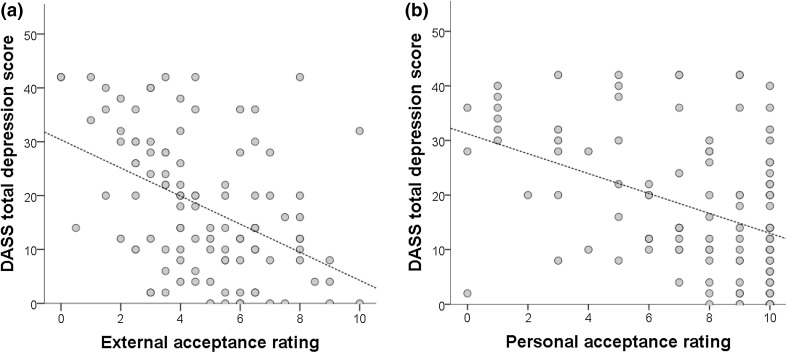
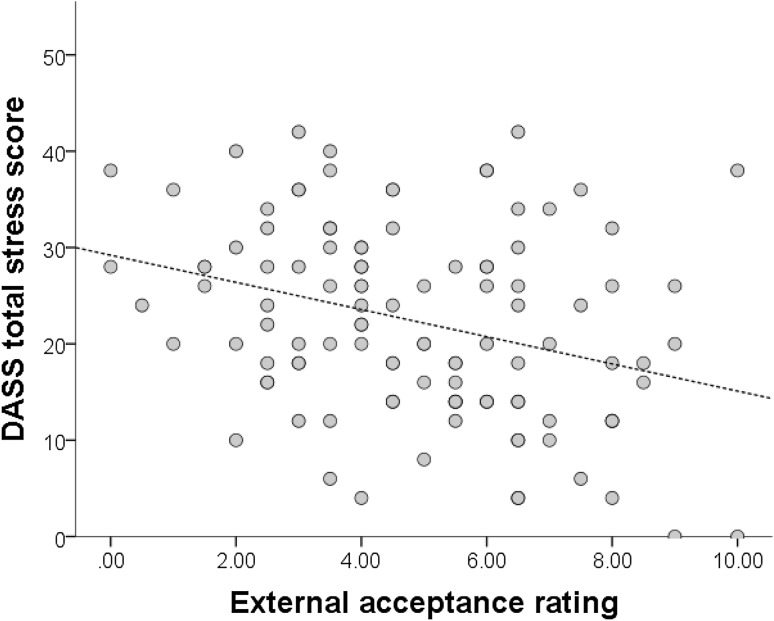
Verification
Claims the paper makes
3 Valid · 0 Not valid · 44 Not checked · 65 Own results and interpretations
Every source the paper cites for this claim was checked and supports it.
In the paper
“Sasson et al. (2017) found that non-autistic individuals tend to make rapid unfavourable judgements about those on the autism spectrum.”
§ Experiences of Autism Acceptance and Mental Health in Autistic Adults > Introduction
What the sources say
- Supportedcites Sasson et al. 2017 matched to “Neurotypical Peers are Less Willing to Interact with Those with Autism based on Thin Slice Judgments” (2017) source
The Abstract (p. 1) states that across three studies, first impressions of individuals with ASD made from thin slices of real-world social behavior by typically-developing observers were 'far less favorable across a range of trait judgments compared to controls' and that these patterns 'occur within seconds'. The Discussion (p. 1) likewise reports robustly less favorable first impressions by neurotypical observers, associated with reduced intentions to engage. The claim's 'rapid unfavourable judgements' by non-autistic individuals is therefore directly stated; the only qualifier the source adds (that the bias vanishes for conversational content without audiovisual cues) does not contradict the hedged 'tend to'. (LLM, conf=0.92)
plain- Asserted: passes — The authors put it forward as true.
- Checkable: passes — It can be checked against evidence.
- Load-bearing: passes — The paper’s conclusions depend on it.
- Based: passes — The paper gives a reason why it holds.
- Supported
The sources with a verdict support this claim; the rest weren’t checked yet, have no full text we could read, or their verdicts aren’t rated yet.
In the paper
“many autistic individuals frequently report “masking” or “camouflaging”—that is, they may use strategies to camouflage the fact they are on the autism spectrum in order to “fit in” to the non-autistic world (Dean et al. 2016; Hull et al. 2017).”
§ Experiences of Autism Acceptance and Mental Health in Autistic Adults > Introduction
What the sources say
- Not checked yetcites Dean et al. 2016 matched to “The art of camouflage: Gender differences in the social behaviors of girls and boys with autism spectrum disorder” (2017) source
- Supportedcites Hull et al. 2017 matched to ““Putting on My Best Normal”: Social Camouflaging in Adults with Autism Spectrum Conditions” (2017) source
The Discussion opening states that 'the vast majority of participants (male, female, and of other genders) reported camouflaging to some degree', and the Conclusions (p. last) that 'camouflaging of ASC-related characteristics in social situations may be a common behaviour amongst adults with ASC' and 'is motivated by the desire to fit in with others'. The Masking theme section describes hiding/suppressing ASC-associated behaviours and adopting personas so as not to appear autistic, with some respondents camouflaging at all times — matching the citing sentence's 'strategies to camouflage the fact they are on the autism spectrum in order to fit in'. The only scope difference is that Hull et al. sampled diagnosed adults, whereas the citing sentence speaks of autistic individuals generally; the citing hedge ('may use strategies') is no stronger than the source's own. (LLM, conf=0.85)
hedged- Asserted: passes — The authors put it forward as true.
- Checkable: passes — It can be checked against evidence.
- Load-bearing: unclear — It is unclear whether the paper’s conclusions depend on it.
- Based: passes — The paper gives a reason why it holds.
A result the paper reports from its own data — it cites no other source for it, so there is none to check. The quote shows it is in the paper.
In the paper
“Further analyses suggested that experiences of “camouflaging” could relate to higher rates of depression.”
§ Experiences of Autism Acceptance and Mental Health in Autistic Adults > Abstract
hedgedstates an associationn = 111- Asserted: passes — The authors put it forward as true.
- Checkable: passes — It can be checked against evidence.
- Load-bearing: unclear — It is unclear whether the paper’s conclusions depend on it.
- Based: passes — The paper gives a reason why it holds.
- Rests on an assumption not shown here.
A result the paper reports from its own data — it cites no other source for it, so there is none to check. The quote shows it is in the paper.
In the paper
“Regression analyses showed that autism acceptance from external sources and personal acceptance significantly predicted depression.”
§ Experiences of Autism Acceptance and Mental Health in Autistic Adults > Abstract
plainstates an associationn = 111- Asserted: passes — The authors put it forward as true.
- Checkable: passes — It can be checked against evidence.
- Load-bearing: passes — The paper’s conclusions depend on it.
- Based: passes — The paper gives a reason why it holds.
- Rests on an assumption not shown here.
A result the paper reports from its own data — it cites no other source for it, so there is none to check. The quote shows it is in the paper.
In the paper
“Acceptance from others also significantly predicted stress but acceptance did not predict anxiety.”
§ Experiences of Autism Acceptance and Mental Health in Autistic Adults > Abstract
plainstates an associationn = 111 ·- Asserted: passes — The authors put it forward as true.
- Checkable: passes — It can be checked against evidence.
- Load-bearing: passes — The paper’s conclusions depend on it.
- Based: passes — The paper gives a reason why it holds.
- Rests on an assumption not shown here.
45 more claims
Create a free account to see all 112 claims and to verify the 55 references still open.
- Probably not a substantial claim. 41
- It may state two separate claims as one. 30
- The quote only partly states this claim. 3
Claims other papers make about this one
Each is checked against this paper’s own text: does it say what the citing paper says it does?
The source backs part of the claim, not all of it — or backs it for a different population, condition or comparison.
In the citing paper
“evidence suggested that experiences of stigma and not feeling accepted by others was associated with increased camouflaging (Cage et al., 2018;Perry et al., 2021)”
From Camouflaging in autism: A systematic review (2021) · cites this paper as Cage et al., 2018
Experimental — accuracy not yet measuredThe cited source says what the claim attributes to it.
In the citing paper
“Results of three exploratory studies using predominately qualitative methodologies were not suggestive of sex or gender differences in camouflaging (Cage et al., 2018;Hull et al., 2017;Livingston et al. 2020).”
From Camouflaging in autism: A systematic review (2021) · cites this paper as Cage et al., 2018
The cited source says what the claim attributes to it.
In the citing paper
“Importantly, acceptance of autism by others is correlated with lower levels of stress and depression in Autistic adults (Cage et al., 2018).”
From Neurodiversity and Autism Intervention: Reconciling Perspectives Through a Naturalistic Developmental Behavioral Intervention Framework (2022) · cites this paper as Cage et al., 2018
The cited source says what the claim attributes to it.
In the citing paper
“Previous research has found that lack of societal understanding of autism and feeling misunderstood may contribute to stress, isolation, and depression among autistic adults (Cage et al., 2018;Gotham et al., 2014;Griffith et al., 2012;Han et al., 2022).”
From A mixed methods study of autistic adults' mental health therapy experiences (2023) · cites this paper as Cage et al., 2018
The cited source says what the claim attributes to it.
In the citing paper
“The negative mental effects of “camouflaging” and “masking” in society are described in recent research, and support the need for considering societal approaches for promoting autistic identity (e.g. Cage et al., 2018; Cage & Troxell-Whitman, 2019).”
From Listening to the autistic voice: Mental health priorities to guide research and practice in autism from a stakeholder-driven project (2020) · cites this paper as Cage et al., 2018
6 more claims about this paper
Create a free account to see every claim other papers make about this one.
Statistics that don’t add up
Each reported p-value recomputed from its test statistic and degrees of freedom, each partial η² from its F, and each ratio, mean difference or B printed with a p checked against its own confidence interval.
Rated major: it would touch a result — a value a result rests on, reported and recomputed p-values on opposite sides of the significance level, two passages that conflict with no sign which is right, or a cited work retracted before this paper was published.
In the paper
“t (107) = − 0.256, p = .012”
§ Experiences of Autism Acceptance and Mental Health in Autistic Adults > Results > Content Analysis of Qualitative Results
Reported p = .012 · recomputed p = .798
Statistics recomputed
Every reported test result, recomputed from its test statistic and degrees of freedom. A result shows as not adding up only once an independent check has confirmed it.
- Doesn’t add upt(107) = -0.256reported p = .012 · recomputed p = .798The two fall on opposite sides of .05
“t (107) = − 0.256, p = .012”
- Consistentχ²(3) = 33.66reported p < .001 · recomputed p < .001
“χ2 (3) = 33.66, p < .001”
- Consistentt(110) = 7.93reported p < .001 · recomputed p < .001
“t(110) = 7.93, p < .001”
- ConsistentF(7, 83) = 11.8reported p < .001 · recomputed p < .001
“F (7, 83) = 11.80, p < .001”
- ConsistentF(7, 83) = 14.32reported p < .001 · recomputed p < .001
“F (7, 83) = 14.32, p < .001”
6 more recomputed tests
Create a free account to see every test the Stats check recomputed.
Self-check
Percentages, sums and reported differences re-computed from the paper’s own numbers.
Each contradiction between two passages listed here was confirmed by an independent check.
Rated minor: it would not touch a result — a value no result rests on, a p-value that stays on the same side of the significance level, or a conflict that is clerical, resolved elsewhere in the paper, or outside its own findings.
In the paper
§ Experiences of Autism Acceptance and Mental Health in Autistic Adults > Results > Autism Acceptance and Mental Health
“Next, stress was entered as the outcome variable.”
§ Experiences of Autism Acceptance and Mental Health in Autistic Adults > Results > Autism Acceptance and Mental Health
“The first step explained 54% of the variance in depression scores”
Rated minor: it would not touch a result — a value no result rests on, a p-value that stays on the same side of the significance level, or a conflict that is clerical, resolved elsewhere in the paper, or outside its own findings.
In the paper
§ Experiences of Autism Acceptance and Mental Health in Autistic Adults > Results > Content Analysis of Qualitative Results
“t (107) = − 0.256”
§ Experiences of Autism Acceptance and Mental Health in Autistic Adults > Results > Content Analysis of Qualitative Results
“p = .012, g = 0.56”
Rated minor: it would not touch a result — a value no result rests on, a p-value that stays on the same side of the significance level, or a conflict that is clerical, resolved elsewhere in the paper, or outside its own findings.
In the paper
§ Experiences of Autism Acceptance and Mental Health in Autistic Adults > Results > Autism Acceptance and Mental Health
“Finally, anxiety was tested as the outcome variable”
§ Experiences of Autism Acceptance and Mental Health in Autistic Adults > Results > Autism Acceptance and Mental Health
“here the first step explained 52% of the variance in depression scores”
Rated minor: it would not touch a result — a value no result rests on, a p-value that stays on the same side of the significance level, or a conflict that is clerical, resolved elsewhere in the paper, or outside its own findings.
In the paper
§ Experiences of Autism Acceptance and Mental Health in Autistic Adults > Results > Autism Acceptance and Mental Health
“| DASS anxiety | 0.371 | 0.195 | 0.411 | 0.061 |”
§ Experiences of Autism Acceptance and Mental Health in Autistic Adults > Results > Autism Acceptance and Mental Health
“| DASS anxiety | 0.431 | 0.170 | 0.285 | 0.013 |”
Rated minor: it would not touch a result — a value no result rests on, a p-value that stays on the same side of the significance level, or a conflict that is clerical, resolved elsewhere in the paper, or outside its own findings.
In the paper
§ Experiences of Autism Acceptance and Mental Health in Autistic Adults > Results > Autism Acceptance
“The KMO statistic was acceptable (0.528)”
§ Experiences of Autism Acceptance and Mental Health in Autistic Adults > Results > Autism Acceptance
“individual item KMO values were above 0.74”
1 more finding
Create a free account to see every finding of this check.
Citations
Cites
Diagnostic and Statistical Manual of Mental Disorders
American Psychiatric Association (2013) · doi:10.1176/appi.books.9780890425596 · Cited by 116,369
Diagnostic and Statistical Manual of Mental Disorders
Williams, J. B. W., & First, M. (2013) · Encyclopedia of Social Work · doi:10.1093/acrefore/9780199975839.013.104 · Cited by 109,519
The Measurement of Observer Agreement for Categorical Data
Landis, J. R., & Koch, G. G. (1977) · Biometrics · doi:10.2307/2529310 · Cited by 81,148
The need to belong: Desire for interpersonal attachments as a fundamental human motivation.
Baumeister, R. F., & Leary, M. R. (1995) · Psychological Bulletin · doi:10.1037//0033-2909.117.3.497 · Cited by 23,245 · cited 1×
“Indeed, sense of belonging is argued to be vital to the well being of all individuals, irrespective of autism (Baumeister and Leary 1995).”
Background(2017) · Cited by 16,319
Lovibond, P. F., & Lovibond, S. H. (1995) · Behaviour Research and Therapy · doi:10.1016/0005-7967(94)00075-u · Cited by 14,523
Does the autistic child have a “theory of mind” ?
Baron-Cohen, S., Leslie, A. M., & Frith, U. (1985) · Cognition · doi:10.1016/0010-0277(85)90022-8 · Cited by 8,599
(1995) · Cited by 6,909
Henry, J. D., & Crawford, J. R. (2005) · British Journal of Clinical Psychology · doi:10.1348/014466505x29657 · Cited by 5,801 · cited 1×
“2007), along with good construct validity (Henry and Crawford 2005).”
Antony, M. M., Bieling, P. J., Cox, B. J., Enns, M. W., & Swinson, R. P. (1998) · Psychological Assessment · doi:10.1037/1040-3590.10.2.176 · Cited by 4,874
Research works printed but not linked: 1
- Freelon D ReCal: Intercoder reliability calculation as a web service International Journal of Internet Science 2010 5 1 20 33
Cited by
Items 501–600 of 638
Exposing Socialization and Systemic Exclusion Barriers in UK Universities
Dean, L. A. (2025) · IGI Global eBooks · doi:10.4018/979-8-3693-8920-1.ch006 · Cited by 1
The potential of outdoor education experiences for autistic girls: a narrative literature review
Groen-Sylvester, E. (2025) · Journal of Adventure Education & Outdoor Learning · doi:10.1080/14729679.2025.2547232
Andrade, C., Cáceres, N., Escobar, A., Fuentes, C., Muñoz, J., Keating, C. T., & Oliveros, J. C. (2025) · PsyArXiv (OSF Preprints) · doi:10.31234/osf.io/crp3f_v1
The Impact of Autism-Affirming and Autism-Stigmatizing Cues on Autistic Adults’ Camouflaging Efforts
Cottington, A. C. K., & Shoda, Y. (2025) · Autism in Adulthood · doi:10.1177/25739581251379187
Exploring Open Dialogue and autism: A qualitative client-perspective study
Lorenz-Artz, K., Bierbooms, J. J. P. A., Kneepkens, M., & Bongers, I. M. B. (2025) · PLOS mental health. · doi:10.1371/journal.pmen.0000449
“Given the common experience of social exclusion in autism, which often contributes to a sense of disconnection [70], this emphasis on mutual respect and equality is especially valuable.”
Vieira, M., & Spritzer, D. T. (2024) · Revista Brasileira de Psicoterapia · doi:10.5935/2318-0404.20240030
Assessing pediatricians’ preparedness for autism detection in Kyrgyzstan
Лобзова, А. В., Lobzova, V. V., Turdiev, A., Turdieva, A. S., Kanan, A., & Faiz, Y. A. (2025) · Autism and Developmental Disorders · doi:10.17759/autdd.2025230301
Autistic Students’ Experiences of Access: Navigating University in Canada
Urbaniak, K., & D’Amico, M. (2025) · Canadian Journal of Disability Studies · doi:10.15353/cjds.v14i3.1286
“Autism acceptance, from both external sources and self-acceptance, reduces rates of both depression and stress (Cage et al., 2018).”
Pineo, E. (2023) · University Libraries (University of Maryland) · doi:10.13016/dspace/h4dw-nbwn · Cited by 1
The Experience of the Welfare System for Autistic Benefit Applicants
Turff, G. (2024) · University of Hertfordshire Research Archive (University of Hertfordshire) · doi:10.18745/th.28081
Waldock, K. E. (2024) · Kent Academic Repository (University of Kent) · doi:10.22024/unikent/01.02.107678 · Cited by 4
Oshima, F., Takahashi, T., Tamura, M., Guan, S., Seto, M., Hull, L., Mandy, W., Tsuchiya, K., & Shimizu, E. (2024) · Figshare · doi:10.6084/m9.figshare.26660942
Zdorovtsova, N. (2023) · Apollo (University of Cambridge) · doi:10.17863/cam.106410
Tillett, J. I. S. (2024) · VTechWorks (Virginia Tech) · doi:10.13140/rg.2.2.17148.04489 · Cited by 1
Goldblum, J. (2023) · Carolina Digital Repository (University of North Carolina at Chapel Hill) · doi:10.17615/mcr8-ea83
Hull, L., Levy, L., Lai, M., Petrides, K. V., Baron‐Cohen, S., Allison, C. L., Smith, P. L., & Mandy, W. (2021) · Figshare · doi:10.6084/m9.figshare.14052675
Neurodiversity : affirming practice through the lens of lived autistic experience
Dmyterko, J. (2025) · cIRcle (University of British Columbia) · doi:10.14288/1.0448594 · Cited by 6
Marsden, S. J. E. (2023) · Lancaster EPrints (Lancaster University) · doi:10.17635/lancaster/thesis/2083
Oshima, F., Takahashi, T., Tamura, M., Guan, S., Seto, M., Hull, L., Mandy, W., Tsuchiya, K., & Shimizu, E. (2024) · Figshare · doi:10.6084/m9.figshare.26660939
Adults with ASD Perceptions of Inclusion Education
Weiss, S. M. (2021) · ScholarWorks (Walden University) · Cited by 5
Hietala, S. (2025) · UTUPub (University of Turku)
Huovinen, K. (2025) · UTUPub (University of Turku) · Cited by 1
Post-diagnostic psychoeducation and autistic adult’s experiences of disclosure
Au‐Yeung, S. K. (2025) · White Rose eTheses Online (University of Leeds, The University of Sheffield, University of York) · Cited by 1
Turja, P. (2021) · Jyväskylä University Digital Archive (University of Jyväskylä) · Cited by 2
How do we perceive autistic individuals in a non-social context?
Jaffrani, A. A. (2022) · Nottingham ePrints (University of Nottingham) · Cited by 3
Le trouble du spectre de l’autisme au féminin : les facteurs pouvant contribuer au sous-diagnostic
Auger, C. (2025) · Le dépôt institutionnel (Université du Québec à Trois-Rivières)
Sánchez Cueva, M. S. (2023) · Repository of Digital Objects for Teaching Research and Culture (University of Valencia) · Cited by 1
Between loneliness and belonging : A scoping review on adults with autism spectrum disorder
Nelin, S. (2025) · DiVA (Digitala Vetenskapliga Arkivet)
Crawford, B. (2024) · UCL Discovery (University College London)
Charnick, C. L. (2024) · ePrints Soton (University of Southampton)
Exploring the Experiences of Autistic Graduate Women in Navigating the World of Work
Gleeson, C. (2024) · Trinity's Access to Research Output (TARA) (Trinity College Dublin)
Les obstacles au diagnostic du trouble du spectre de l’autisme (TSA) chez les femmes
Bournival, A. (2025) · Le dépôt institutionnel (Université du Québec à Trois-Rivières)
Naylor, C. (2023) · Nottingham ePrints (University of Nottingham) · Cited by 8
A cross-cultural study of autistic traits in the general population
Abu Bakar, S. (2022) · Nottingham ePrints (University of Nottingham)
Improving Psychological Therapies for Autistic Adults
Chwaszczewska, M. (2024) · Open Research Exeter (University of Exeter)
Everett, S. (2024) · UCL Discovery (University College London) · Cited by 2
Developing a new self-harm assessment tool with and for autistic adults
Newell, V. (2025) · Nottingham ePrints (University of Nottingham)
Self-citationLiñares-de-Maarcos, J. (2024) · Gredos (University of Salamanca)
Macdonald, A. (2022) · Research Commons (University of Waikato)
Fox, L. (2023) · White Rose eTheses Online (University of Leeds, The University of Sheffield, University of York) · Cited by 1
Masculinity, femininity and autistic traits
Chieng, Z. J. (2023) · Nottingham ePrints (University of Nottingham)
Alhusayni, A. (2024) · Nottingham ePrints (University of Nottingham)
Umagami, K. (2023) · UCL Discovery (University College London) · Cited by 7
Broughton, T. (2023) · ORCA Online Research @Cardiff (Cardiff University)
Barnhart, G. (2021) · ScholarWorks (Walden University)
Atkinson, E. K. (2023) · ePrints Soton (University of Southampton) · Cited by 2
St-Jean, E. (2023) · Papyrus : Institutional Repository (Université de Montréal) · doi:10.71781/28206 · Cited by 1
Neuroinkluusion tukeminen työpaikoilla
Kivialho, I. (2024) · Theseus (Ammattikorkeakoulujen)
Three Sisters Gathering Peat on Achill Island and the past, present, and future of Irish bogs
Power, G. (2023) · UEA Digital Repository (University of East Anglia)
Backman, A. (2023) · Open Archive (Karolinska Institutet)
Koniou, I. (2023) · Papyrus : Institutional Repository (Université de Montréal) · doi:10.71781/25652 · Cited by 1
Exploring social isolation and loneliness in adults over 50 with high autistic traits
Medeisyte, R. (2024) · UCL Discovery (University College London) · Cited by 1
Ashworth, M. (2024) · UCL Discovery (University College London)
Ayala Avellaneda, D. H. (2024) · Dalarna University College Electronic Archive
Predictive Perception in Autism
Harlow, R. (2025) · PEARL (University of Plymouth) · doi:10.24382/a2qy-yq54
Neurovähemmistöjen osallisuus yhteiskunnassa : Kyselytutkimus neurovähemmistöjen edustajille
Ojala, K. (2025) · Theseus (Ammattikorkeakoulujen)
Volwassen worden: een multi-methode onderzoek naar jongvolwassenheid & autisme
Mattys, L. (2019) · Lirias
Primary Caregiver’s Experiences of School Accessibility for Neurodivergent Children
Spinosa-Pike, L. (2025) · University of Hertfordshire Research Archive (University of Hertfordshire) · doi:10.18745/00026228
Three papers examining mental health service provision with autistic adults in Canada
Morris, R. (2025) · cIRcle (University of British Columbia) · doi:10.14288/1.0451046
When Lived Experience Becomes Clinical Expertise: Perspectives of Autistic Mental Health Therapists
Hogan, J., Anderson-Gutierrez, J., Holmgren, I., Neff, M. A., Laksman, C., & Mills, D. (2025) · Autism in Adulthood · doi:10.1177/25739581251406897
Altschuler, M. R., Krueger, R. F., Mohr, A. H., & Faja, S. (2026) · Development and Psychopathology · doi:10.1017/s0954579425101077 · Cited by 1
“…put on their best normal, ” as people who camouflage autistic behaviors have been found to have worse depression, anxiety, and stress across multiple studies (Bernardin et al., 2021; Cage et al., 2018; Cage & Troxell-Whitman, 2019; Hull et al., 2021; Livingston et al., 2018; Zhuang et al., 2023).”
Professional Perspectives on the Barriers to Autistic Adult Mental Health in Ottawa, Canada
van Rensburg, M. J. (2025) · Carleton University's Institutional Repository (MacOdrum Library, Carleton University) · doi:10.22215/etd/2025-16694
MDMA and Psychosocial Change in Autistic Adults: Implications for Mental Health
Witham, L. (2025) · UCL Discovery (University College London)
D’Acunto, G., Sarno, C. D., Lenzi, F., Liboni, F., Ricci, M., Narzisi, A., Masi, G., & Mucci, M. (2026) · Brain Sciences · doi:10.3390/brainsci16030250
“Although it may initially promote apparent adapta‑ tion, it has been linked to poorer long‑term mental health outcomes and reduced function‑ ing [38,39].”
Developing a neurodiversity-affirming group therapy program for autistic adults through co-design
Fisher, C. A., Grace, N., Tsang, E., & Pieters, J. (2026) · Academia Mental Health and Well-Being · doi:10.20935/mhealthwellb7975
Klein, J., Krahn, R., Howe, S. J., Cormier, A., Rush, J., Ames, M. E., McMorris, C. A., & Macoun, S. J. (2026) · BMJ Open · doi:10.1136/bmjopen-2025-111221
Blanco‐Inostroza, C. (2026) · International Journal of Developmental Disabilities · doi:10.1080/20473869.2026.2650545
Hendershott, B. (2026) · PDXScholar (Portland State University)
Ferrie, J., & Hafetz, J. S. (2026) · Review Journal of Autism and Developmental Disorders · doi:10.1007/s40489-026-00548-y
Bureau, R. (2023) · theses.fr (ABES) · doi:10.70675/febd4b68zb137z40d4z9941z5df349b8a9ff · Cited by 1
The Lived Experiences of Employed Middle-Aged Adults Having Autism Spectrum in Batangas Province
Quicho, J. D., Ocampo, L. Q. D., Villa, K. M. D., Evangelista, A. E., & Ramos, D. R. (2026) · International Journal of Multidisciplinary Applied Business and Education Research · doi:10.11594/ijmaber.07.03.30
Discursive constructions of autism on social media: a multilingual analysis across five languages
López-Resa, P., Skafle, I., Rebecchi, K., Kalandadze, T., Nordahl‐Hansen, A., & Gabarrón, E. (2026) · Frontiers in Psychology · doi:10.3389/fpsyg.2026.1769965
Dvir, T., Elefant, C., & Rabinowitch, T.-C. (2026) · The Arts in Psychotherapy · doi:10.1016/j.aip.2026.102477
Drawing the inner world: exploring autistic perception through virtual reality art-making
Savickaite, S., Airlie, R., McDonnell, N., & Simmons, D. (2026) · Frontiers in Psychology · doi:10.3389/fpsyg.2026.1739991
“…is common in qualitative autism research that recruits adults through community or online networks, where self-reported diagnosis is typically accepted to reduce barriers to participation and respect participants’ autonomy (e.g., Cage et al., 2018; Botha et al., 2021; Nicolaidis et al., 2019).”
Scandurra, C., Alfieri, E., Amodeo, A. L., Liccardo, T., Magri, V., Montola, M. C., Nasti, L., Nocchetti, C., Santoro, A., Valerio, P., et al. (2026) · Mediterranean Journal of Clinical Psychology · doi:10.13129/2282-1619/mjcp-5369
Alwis, S. D., Pearson, A., & Hodgetts, S. (2026) · Feminism & Psychology · doi:10.1177/09593535261445110
“However, Cage et al. (2018) found that masking was associated with poor mental health outcomes for autistic individuals.”
Mikołajewska, J., & Płatos, M. (2026) · Research in Neurodiversity · doi:10.1016/j.rin.2026.100034 · Cited by 1
Understanding the Impact of Camouflaging in Autistic People
Osborne, C. (2025) · UEA Digital Repository (University of East Anglia)
Leadership Role of Higher Education in Enhancing Mental Health in Oman’s Universities
AlSaadi, A., & Awashreh, R. A. (2026) · Studies in systems, decision and control · doi:10.1007/978-3-032-23645-6_65
Lin, H., Westover, A. N., Lutz, A. S. F., & Jha, M. K. (2026) · Autism Research · doi:10.1002/aur.70287
“…(camouflaging autistic traits) is often reported qualitatively as a significant, energy-depleting stressor that may also lower the threshold for irritability (Cage et al. 2018), resulting in outbursts that can be “implo-sive” (shutdowns) or “explosive” (verbal anger) (Raymaker et al. 2020).”
KIZILASLAN, İ. G. (2026) · International Journal of Innovative Approaches in Social Sciences · doi:10.29329/ijiasos.2026.1425.5
Attitudes and Knowledge Regarding Autism in Israeli Society
Ferman, S., & Segal, O. (2026) · Autism & Developmental Language Impairments · doi:10.1177/23969415261454218
“Despite these differences, research points to the persistence of negative stereotypes, including the dehumanization and avoidance of autistic adults (Cage et al., 2018; Ko fi dou & Mantzikos, 2020).”
Klotz, R. D., Aoki, E., Faw, M., & Hepburn, S. (2026) · doi:10.25675/3.027161
From feeling different to becoming collective: the process of acquiring an autistic identity
Rodríguez-Zafra, A., & García-Molina, I. (2026) · Current Psychology · doi:10.1007/s12144-026-09629-x
“These responses arise in highly demanding cultural environments that value adaptation and conformity as markers of competence (Paula, 2023 ), despite the negative impact on mental health (Cage et al., 2018 ; Garcia-Molina, 2024 ).”
Experiencing Independence: A Qualitative Study with Autistic Adults in India
Bhattacharya, P., Banerjee, M., Ray, D., Rasool, T., Swaminathan, S., Heath, H., Woodcock, K. A., & Surtees, A. D. R. (2026) · Autism in Adulthood · doi:10.1177/25739581261457361 · Cited by 1
Portelli, C., & Camilleri, L. J. (2026) · International Journal of Inclusive Education · doi:10.1080/13603116.2026.2688235
Abdolmohamadi, K., Alimohamadi, A., & Hull, L. (2026) · Autism · doi:10.1177/13623613261452296
“Although these practices may temporarily enhance social acceptance, research indicates they are frequently linked to adverse mental health consequences, such as elevated stress, anxiety, depression, and emotional exhaustion (Cage et al., 2017; Lai & Baron-Cohen, 2015; Milner et al., 2022).”
Gibbs, V., Edwards, C., Cai, R. Y., Love, A. M. A., & Pearson, A. (2026) · Autism in Adulthood · doi:10.1177/25739581261463939
(2026) · Frontiers research topics · doi:10.3389/978-2-8325-8279-4
Courcy, I., Bélanger, M., Rivières‐Pigeon, C. D., Guerrero, L., & Soulières, I. (2026) · Santé mentale au Québec · doi:10.7202/1126816ar
Conociendo las experiencias de estudiantes universitarios autistas: el impacto de la salud mental
Mira, A., López-Fernández, M., Pérez, F., Diaz, C., Salinas, J., & Cruz, F. S. (2026) · Cadernos Brasileiros de Terapia Ocupacional · doi:10.1590/2526-8910.cto421241593
Building the Mask: A Grounded Theory Study on Women and Gender Diverse AuDHD Adults
Swecker, K. (2026) · ThinkTech (Texas Tech University)
Metadata
- Authors
- Cage, E., Di Monaco, J., & Newell, V.
- Affiliations
- Royal Holloway University of London (GB)
- Corresponding author
- Cage, Eilidh
- Venue
- Journal of Autism and Developmental Disorders
- Published
- 2017-10-25
- Volume
- 48
- Issue
- 2
- Pages
- 473-484
- ISSN
- 0162-3257 (ISSN-L)
- 1573-3432
- PMC
- PMC5807490
- OpenAlex
- W2766434912
- Semantic Scholar
- 97e77090b6b7073196f62b6e0797b4a8bdfc4319
- Cited by
- 538
- References
- 71
- Citations by year
- 2026: 65 · 2025: 79 · 2024: 84 · 2023: 87 · 2022: 73 · 2021: 70 · 2020: 40 · 2019: 30 · 2018: 9 · 2017: 1
- FWCI
- 12.55
- Type
- journal article
- Language
- en
- Open access
- hybrid
- doi.org
- Locations
- Journal of Autism and Developmental Disorders (publishedVersion, cc-by)
- PubMed Central (publishedVersion, cc-by)
- PubMed (publishedVersion)
- Stirling Online Research Repository (University of Stirling) (submittedVersion, cc-by)
- Topics
- Life Sciences › Neuroscience › Cognitive Neuroscience › Autism Spectrum Disorder Research
- Social Sciences › Psychology › Clinical Psychology › Family and Disability Support Research
- Social Sciences › Psychology › Clinical Psychology › Mindfulness and Compassion Interventions
- Keywords
- autism acceptance, autistic adults, mental health, depression, anxiety, stress, camouflaging, social acceptance, autism spectrum disorder
- MeSH terms
- Adolescent, Adult, Aged, Anxiety, Autistic Disorder, Depression, Female, Humans, Male, Mental Health, Middle Aged, Surveys and Questionnaires, Stress, Psychological, Young Adult, Social Stigma
About these checks
Registry, retraction, Cites and statistics results are computed, not judged, with one exception: a printed reference that no index lists is read once by a model before it counts as a citation error. Claims are extracted by a model and kept only when their quote appears verbatim in the text; each cited source is then checked, with a model’s help, for whether it says what the claim relies on. Those verdicts can be wrong — read the claim’s quote and the cited source before relying on one.
A language model drew the claims from the paper on 2026-10-05, under version 3 of the claim definition (model deepseek-v4.1-flash, prompt extract-v3).
A second model labelled each claim on 2026-10-05 (model jev-1.13-20260917, definition revision gold-guideline-v0.2).
Cited sources are checked with a language model’s help (qwen3.8-omni-flash).
Statistics and arithmetic are recomputed, not judged.
Confidence bands are shown only for fields calibrated on our annotated test set. None is calibrated yet, so no band is shown.
What counts as a claim ›How we measure confidence ›How we check this ›
Are you an author, or do you see a problem with this page? Request a review
Data sources
Bibliographic data: Semantic Scholar, OpenAlex, Crossref.
Contains information from the Semantic Scholar Academic Graph Datasets, made available under the ODC Attribution License (ODC-BY 1.0).
Semantic Scholar’s data is described in: Kinney, R., et al. (2023). The Semantic Scholar Open Data Platform. arXiv:2301.10140.
