

The DOI matches its Crossref record; 100 of the 101 references it cites were found in a registry or an index.
The Prevalence of Self-injurious Behaviour in Autism: A Meta-analytic Study
Open accessAbstract
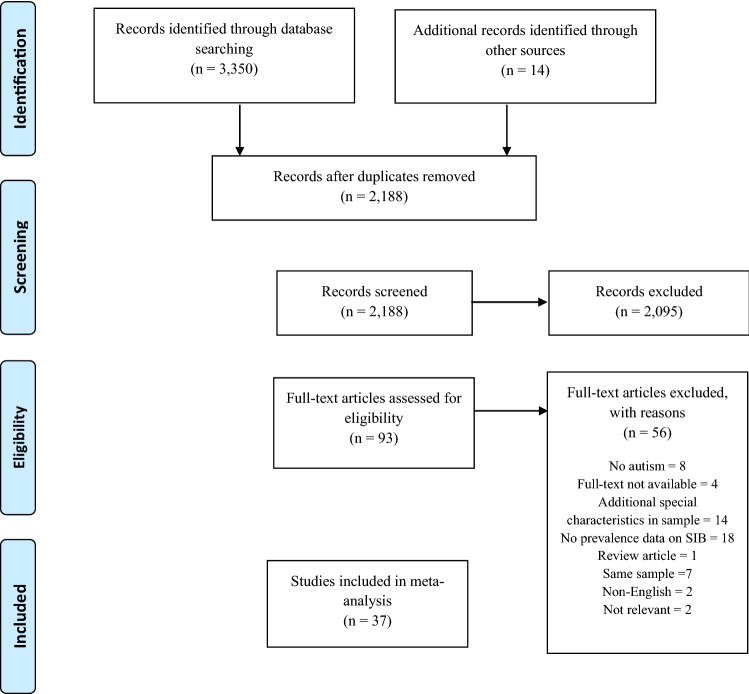
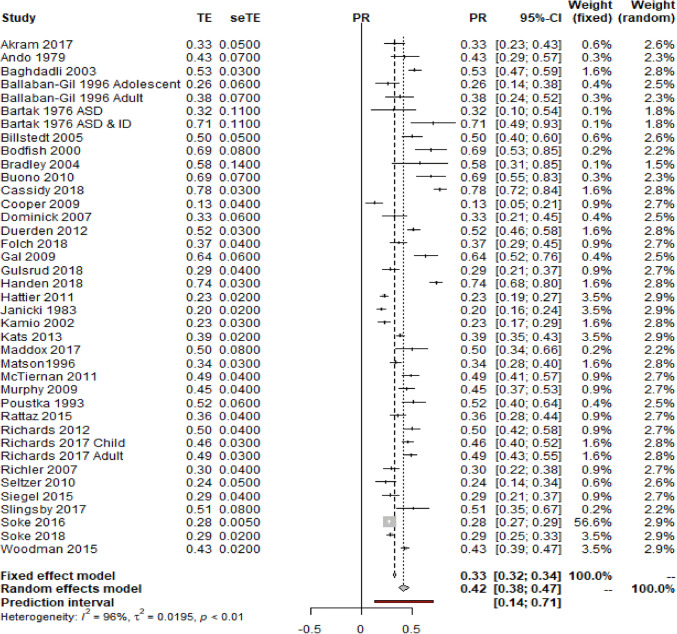
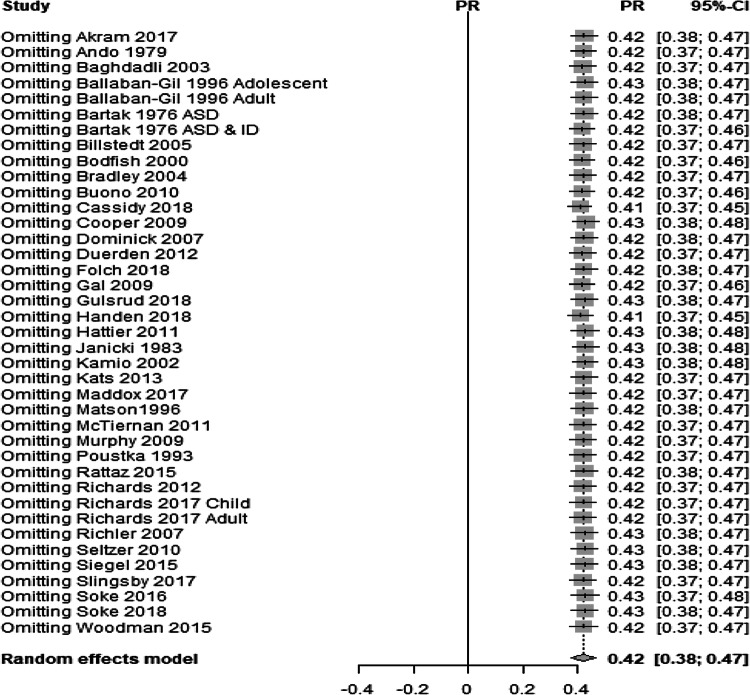
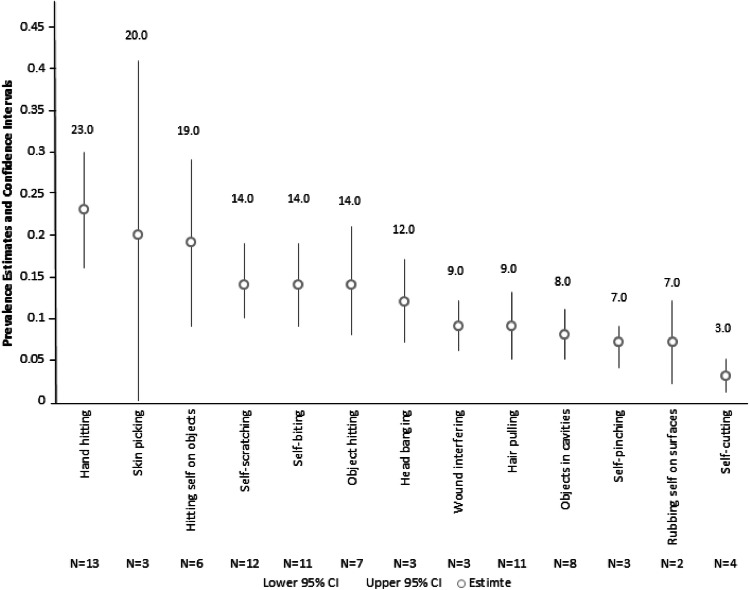
Self-injurious behaviour is purportedly common in autism, but prevalence rates have not yet been synthesised meta-analytically. In the present study, data from 14,379 participants in thirty-seven papers were analysed to generate a pooled prevalence estimate of self-injury in autism of 42% (confidence intervals 0.38–0.47). Hand-hitting topography was the most common form of self-injury (23%), self-cutting topography the least common (3%). Sub-group analyses revealed no association between study quality, participant intellectual disability or age and overall prevalence rate of self-injury. However, females obtained higher prevalence rates than males ( p = .013) and hair pulling and self-scratching were associated with intellectual disability ( p = .008 and p = .002, respectively). The results confirm very high rates of self-injury in autism and highlight within group risk-markers.
Overview
The claims and statistics of this paper haven’t been checked yet.
Run the check — free, no account needed. It reads the open-access text and checks the sources it cites.
Integrity signals
Registry
Cites
Statistics
Figures
Verification
Claims the paper makes
The claims and statistics of this paper haven’t been checked yet.
Run the check — free, no account needed. It reads the open-access text and checks the sources it cites.
Claims other papers make about this one
Each is checked against this paper’s own text: does it say what the citing paper says it does?
The cited source says what the claim attributes to it.
In the citing paper
“A recent meta-study reported that prevalence rates of SIB in the ASD population may be as high as 42% [121].”
From Pharmacological treatment in autism: a proposal for guidelines on common co-occurring psychiatric symptoms (2025) · cites this paper as [121]
The cited source says what the claim attributes to it.
In the citing paper
“A meta-analysis including 37 studies revealed a prevalence of self-harm of 42% in autistic individuals, irrespective of age and the presence or the absence of intellectual disability (ID) (Steenfeldt-Kristensen et al., 2020).”
From Feasibility, Acceptability and Preliminary Efficacy of Dialectical Behavior Therapy for Autistic Adults without Intellectual Disability: A Mixed Methods Study (2022) · cites this paper as Steenfeldt-Kristensen et al., 2020
In the citing paper
“Behaviors such as impulsivity and/or inattention can be contributing factors for injuries and unintentional incidents in children with ASD/ADHD.58,59”
From Mortality in Persons With Autism Spectrum Disorder or Attention-Deficit/Hyperactivity Disorder: A Systematic Review and Meta-analysis (2022) · cites this paper as [58]
Self-check
Percentages, sums and reported differences re-computed from the paper’s own numbers.
The self-check needs the paper’s full text.
Citations
Cites
Preferred Reporting Items for Systematic Reviews and Meta-Analyses: the PRISMA statement
Moher, D., Liberati, A., Tetzlaff, J., Altman, D. G., & for the PRISMA Group (2009) · BMJ · doi:10.1136/bmj.b2535 · Cited by 83,823
Preferred Reporting Items for Systematic Reviews and Meta-Analyses: The PRISMA Statement
Moher, D., Liberati, A., Tetzlaff, J., Altman, D. G., & The PRISMA Group (2009) · PLoS Medicine · doi:10.1371/journal.pmed.1000097 · Cited by 64,042
Preferred reporting items for systematic reviews and meta-analyses: the PRISMA Statement.
(2009) · PubMed Central · Cited by 44,859
Cochrane Handbook for Systematic Reviews of Interventions: Cochrane Book Series
(2008) · doi:10.1002/9780470712184 · Cited by 25,048
Wang, G., Ma, R., Qiao, G., Wada, K., Aizawa, Y., & Satoh, T. (2015) · Integrative Medicine International · doi:10.1159/000368408 · Cited by 18,762
Journal of Clinical Psychiatry
(2018) · Journal of Clinical Psychiatry · doi:10.5505/kpd · Cited by 13,703
Toward a functional analysis of self-injury
Iwata, B. A., Dorsey, M. F., Slifer, K. J., Bauman, K. E., & Richman, G. S. (1994) · Journal of Applied Behavior Analysis · doi:10.1901/jaba.1994.27-197 · Cited by 2,644
Baird, G., Simonoff, E., Pickles, A., Chandler, S., Loucas, T., Meldrum, D., & Charman, T. (2006) · The Lancet · doi:10.1016/s0140-6736(06)69041-7 · Cited by 2,104
Epidemiology of Pervasive Developmental Disorders
Fombonne, E. (2009) · Pediatric Research · doi:10.1203/pdr.0b013e31819e7203 · Cited by 1,971
Varieties of Repetitive Behavior in Autism: Comparisons to Mental Retardation
Bodfish, J. W., Symons, F. J., Parker, D. E., & Lewis, M. H. (2000) · Journal of Autism and Developmental Disorders · doi:10.1023/a:1005596502855 · Cited by 1,223
Research works printed but not linked: 1
- Weiss, J. (2002). Self-injurious behaviors in autism: A literature review. Journal on Developmental Disabilities, 9, 129–143.
Cited by
Sorted by citations
Items 101–150 of 150
أنتشار سلوک إيذاء الذات لدي عينه من أطفال أضطراب طيف التوحد
(2020) · Al-Mağallah Al-ʿilmiyyaẗ Li Kulliyyaẗ Al-Tarbiyyaẗ - Ǧāmiʿaẗ Awadī Al-Ǧadīd/Al-Mağallah Al-ʿilmiyyaẗ Li Kulliyyaẗ Al-Tarbiyyaẗ - Ǧāmiʿaẗ El-Wadī Al-Ǧadīd · doi:10.21608/sjsw.2020.209116
Fusar‐Poli, L., Concerto, C., Rodolico, A., & Aguglia, E. (2023) · Springer eBooks · doi:10.1007/978-3-030-98711-4_161-1
مفهوم الذات وعلاقته ببعض المشكلات السلوكیة والأسریة لدى عینة من أطفال طیف التوحد
الزایدی, ف. ع. (2022) · مجلة الدراسات التربوية والإنسانية · doi:10.21608/jehs.2023.290284
Fitting in an Unfit Society With Autism Spectrum Disorder: Case Report
Morrisroe, K., Longo, K., Pebley, P., & Jain, L. (2023) · Cureus · doi:10.7759/cureus.36966
Lacroix, A. (2023) · UGA Éditions eBooks · doi:10.4000/books.ugaeditions.29935
Sloman, K. N., Vollmer, T. R., Tate, S. A., & Lloveras, L. A. (2023) · Autism and child psychopathology series · doi:10.1007/978-3-031-27587-6_14
Purinergic Signaling in Autism Spectrum Disorder
Deckmann, I., Santos‐Terra, J., & Gottfried, C. (2023) · Springer eBooks · doi:10.1007/978-3-031-26945-5_6
Authority, P. S. (2020) · Patient Safety · doi:10.33940/001c.84876
MIND: A Multimodal AI Framework for Detecting and Forecasting Motor RRBs among Children with ASDPreprint
Shen, M., Cantin-Garside, K. D., Kim, S., & Nussbaum, M. A. (2023) · SSRN Electronic Journal · doi:10.2139/ssrn.4598049
Pang, F., & Datu, J. A. D. (2023) · International Journal of Developmental Disabilities · doi:10.1080/20473869.2023.2255769
Family Engagement in Mental Health Interventions for Children with Developmental Disabilities
Malone, K. M., Smith, L. A., Cosby, K. W., & Campbell, J. M. (2023) · Springer series on child and family studies · doi:10.1007/978-3-031-47917-5_4
Curtis, K. L., & Lipner, S. R. (2024) · Skin Appendage Disorders · doi:10.1159/000537906
FEATURES OF AUTOAGGRESSIVE BEHAVIOR IN AUTISTIC AND SCHIZOPHRENIC SPECTRUM DISORDERS IN CHILDREN
Shushpanova, O. V., Шалина, Н. С., Балакирева, Е. А., Коваль-Зайцев, А. А., Yakupova, L. P., Геннадьевна, Н. С., Блинова, Т. Е., & Kulikov, A. V. (2023) · Bulletin of Medical Science · doi:10.31684/25418475-2023-4-43
Chen, M., Dutt, A. S. K., & Nair, R. (2024) · Behavioral Interventions · doi:10.1002/bin.2038
Chapter 66. Treatment of Autism Spectrum Disorder
Hegarty, J. P., & Hardan, A. Y. (2024) · American Psychiatric Association Publishing eBooks · doi:10.1176/appi.books.9781615375523.as66
Harris, J. C., & Coyle, J. T. (2024) · Oxford University Press eBooks · doi:10.1093/med/9780199928118.003.0020
Jessel, J., Saini, V., Rajaraman, A., & Gover, H. C. (2024) · Autism and child psychopathology series · doi:10.1007/978-3-031-66902-6_11
Practical considerations and clinical contributions of different functional assessment methods
Metras, R., Staubitz, J. L., & Staubitz, J. E. (2024) · Elsevier eBooks · doi:10.1016/b978-0-443-21769-2.00011-1
A Blueprint for Assessment of Automatically Maintained Self-Injurious Behavior in Schools
Franzmann, T. K., & Renshaw, T. L. (2024) · Journal of Applied School Psychology · doi:10.1080/15377903.2024.2429813
Myers, S. M., & Challman, T. D. (2024) · Elsevier eBooks · doi:10.1016/b978-0-12-824060-1.00038-9
Gender differences in repetitive behaviours in children diagnosed with autism spectrum disorder
Behin, M., Stošić, J., & Šimleša, S. (2024) · Hrvatska revija za rehabilitacijska istraživanja · doi:10.31299/hrri.60.2.4
Grundlagen der Diagnostik und Therapie
(2024) · Elsevier eBooks · doi:10.1016/b978-3-437-22487-4.16001-0
Werner, N., & Eckert, A. (2025) · Journal of Autism and Developmental Disorders · doi:10.1007/s10803-025-06830-y
Toward Behavioral Stability with Psychotropic Medication
Cox, A. D., & Valdovinos, M. G. (2025) · Autism and child psychopathology series · doi:10.1007/978-3-031-88594-5_13
A CRH2-ACTH theory of autism spectrum disorder
Rappoport, A. (2025) · Elsevier eBooks · doi:10.1016/b978-0-44-345008-2.00007-2
Hyperconnectivity and Disrupted Signal-to-Noise Processing in Autism
Limón, A., & Corona-Moreno, M. (2025) · Springer eBooks · doi:10.1007/978-3-031-40858-8_179-1 · Cited by 1
Keles, G., Rajakumar, A., & Wilson, C. M. (2025) · Cureus · doi:10.7759/cureus.90262
Al-Dubayan, M. N., & Yakubova, G. (2025) · Education and Training in Autism and Developmental Disabilities · doi:10.1177/21541647251385909
Wearable Technology to Measure the Occurrence of Self-Injury During a Functional Analysis
Neely, L. C., Holloway, K., Miller, S., Cantero, K., Alaeddini, A., & Oyama, S. (2025) · Behavior Modification · doi:10.1177/01454455251397910
Unmasking social functions: Outcomes from a retrospective consecutive case series of 19 applications
Kaur, J., Frank‐Crawford, M. A., & Borrero, J. C. (2025) · Journal of Applied Behavior Analysis · doi:10.1002/jaba.70045
Newell, V., Phillips, L., Jones, C. A., Townsend, E., Richards, C., & Cassidy, S. (2023) · Figshare · doi:10.6084/m9.figshare.22625015
Self-citationOyama, S., Neely, L., Davis, J. L., Gonzalez, G., & Galaviz, M. (2025) · Next research. · doi:10.1016/j.nexres.2025.100744
Bottini, S. B., McMahon, M., Slocum, S. K., Cook, T., & Scheithauer, M. (2025) · Research in Autism · doi:10.1016/j.reia.2025.202775
Utilization of psychotropic medications in individuals with autism spectrum disorder
Jaimes-Buitron, P. A., Neely, L. C., Svoboda, M., Gemeinhardt, G. L., & Vivas-Valencia, C. (2025) · BMC Psychiatry · doi:10.1186/s12888-025-07714-2
Mithani, K., Coleman, S. C., Breitbart, S. C., Fasano, A. A., Gorodetsky, C., & Ibrahim, G. M. (2026) · Brain stimulation · doi:10.1016/j.brs.2026.103026
Taniguchi, E., & Kim, S. J. (2026) · Pediatric Annals · doi:10.3928/19382359-20251112-02
Lacroix, A., Burnel, M., Baciu, M., Occelli, P., Perrone‐Bertolotti, M., David, M., & Ego, A. (2026) · Autism · doi:10.1177/13623613261428668
Jouma, A. B. (2026) · Surgical Neurology International · doi:10.25259/sni_1456_2025
Mithani, K., Tate, S. A., Hagopian, L. P., Breitbart, S. C., Sriharan, S., Kisteroff, F., Huynh, M., Malik, S., Thorpe, K. E., Huber, J. F., et al. (2026) · BMJ Open · doi:10.1136/bmjopen-2025-110222
Aksoy, F., Aksoy, V., Alp, Z. A., Koçak, F., & Güneş, D. B. (2026) · Ankara Üniversitesi Eğitim Bilimleri Fakültesi Özel Eğitim Dergisi · doi:10.21565/ozelegitimdergisi.1898356
Mukula, H. M., Opondo, H., Ndeezi, M., Kateregga, A., Musanje, K., & Ouma, S. (2026) · PLOS mental health. · doi:10.1371/journal.pmen.0000627
Evidence-Based Intervention With Autistic Youth
Quetsch, L. B., Brown, C., Moreno, P., Houck, A., & Ortiz, S. R. (2026) · Elsevier eBooks · doi:10.1016/b978-0-443-29009-1.00110-4
Xu, P., Ding, D., Han, X., Liu, J., & Tang, H. (2026) · Frontiers in Psychiatry · doi:10.3389/fpsyt.2026.1800695
Kim, J., Sung, S. M., & 장대연 (2026) · Child and Adolescent Social Work Journal · doi:10.1007/s10560-026-01124-3
Wang, W. J., & Dong, R. (2026) · Journal of Pediatric Nursing · doi:10.1016/j.pedn.2026.07.014
Keller, R., Giacchero, M., Capiotto, F., Masoero, M., Corna, S., Figliano, G., de Matos, M. B., & Liloia, D. (2026) · Frontiers in Psychiatry · doi:10.3389/fpsyt.2026.1925564
Engagement of Children with Moderate and High Support Needs Autism in Motor Program Sessions
Svensson, L., Stylianou, M., Hill, J. R., Wilson, L., Trost, S. G., & Cairney, J. (2026) · Physical & Occupational Therapy In Pediatrics · doi:10.1080/01942638.2026.2722992
Ward, J. H., Happe, F. G. E., & Fazel, M. S. (2026) · Child Care Health and Development · doi:10.1111/cch.70357
Comparing mental health treatment outcomes for autistic and non-autistic people: a systematic reviewPreprint
Griffiths, J., Elise, F., Thompson, J., Li, S., Olive, R. R., Bhutta, A., Liu, W., Holden, M., Mandiangu, M., Baptiste, D., et al. (2026) · medRxiv · doi:10.64898/2026.10.08.26364831
Metadata
- Authors
- Steenfeldt-Kristensen, C., Jones, C. A., & Richards, C.
- Affiliations
- Coventry and Warwickshire Partnership NHS Trust (GB)
- University of Birmingham (GB)
- Corresponding author
- Richards, Caroline
- Venue
- Journal of Autism and Developmental Disorders
- Published
- 2020-04-15
- Volume
- 50
- Issue
- 11
- Pages
- 3857-3873
- ISSN
- 0162-3257 (ISSN-L)
- 1573-3432
- PMC
- PMC7557528
- OpenAlex
- W3016276573
- Cited by
- 150
- References
- 101
- Citations by year
- 2026: 20 · 2025: 31 · 2024: 33 · 2023: 27 · 2022: 25 · 2021: 10 · 2020: 4
- FWCI
- 2.23
- Type
- journal article
- Language
- en
- Open access
- hybrid
- doi.org
- Locations
- Journal of Autism and Developmental Disorders (publishedVersion, cc-by)
- PubMed Central (publishedVersion, cc-by)
- PubMed (publishedVersion)
- University of Birmingham Research Portal (University of Birmingham) (publishedVersion, cc-by)
- Topics
- Life Sciences › Neuroscience › Cognitive Neuroscience › Autism Spectrum Disorder Research
- Social Sciences › Psychology › Clinical Psychology › Suicide and Self-Harm Studies
- Social Sciences › Psychology › Developmental and Educational Psychology › Behavioral and Psychological Studies
- Keywords
- self-harm, autism spectrum disorder, prevalence, self-cutting, intellectual disability, sex differences, hair pulling, risk indicators
- MeSH terms
- Adolescent, Autistic Disorder, Female, Humans, Male, Intellectual Disability, Prevalence, Self-Injurious Behavior
About these checks
Registry, retraction, Cites and statistics results are computed, not judged, with one exception: a printed reference that no index lists is read once by a model before it counts as a citation error. Claims are extracted by a model and kept only when their quote appears verbatim in the text; each cited source is then checked, with a model’s help, for whether it says what the claim relies on. Those verdicts can be wrong — read the claim’s quote and the cited source before relying on one.
Statistics and arithmetic are recomputed, not judged.
Confidence bands are shown only for fields calibrated on our annotated test set. None is calibrated yet, so no band is shown.
What counts as a claim ›How we measure confidence ›How we check this ›
Are you an author, or do you see a problem with this page? Request a review
