

The DOI matches its Crossref record; 100 of the 101 references it cites were found in a registry or an index.
The Prevalence of Self-injurious Behaviour in Autism: A Meta-analytic Study
Open accessAbstract
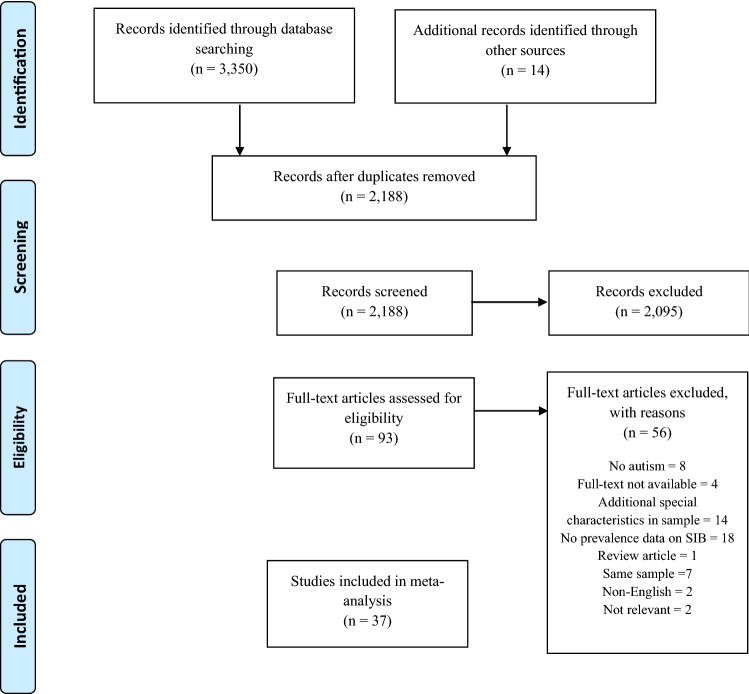
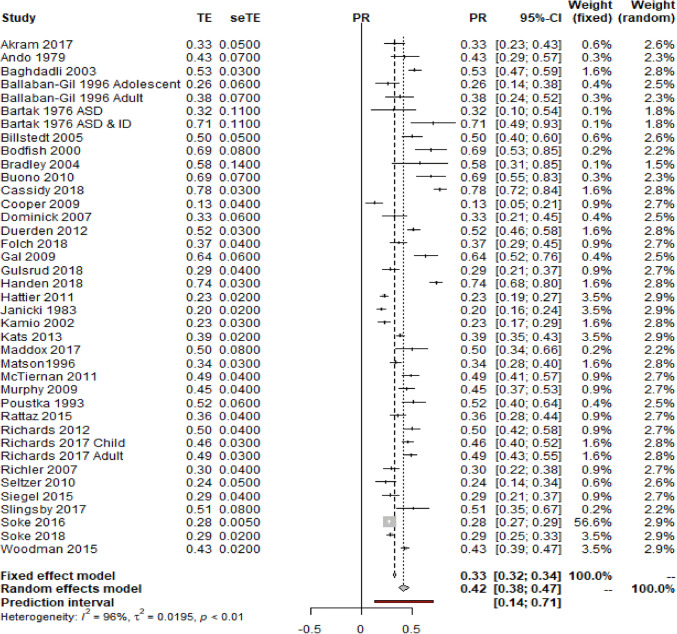
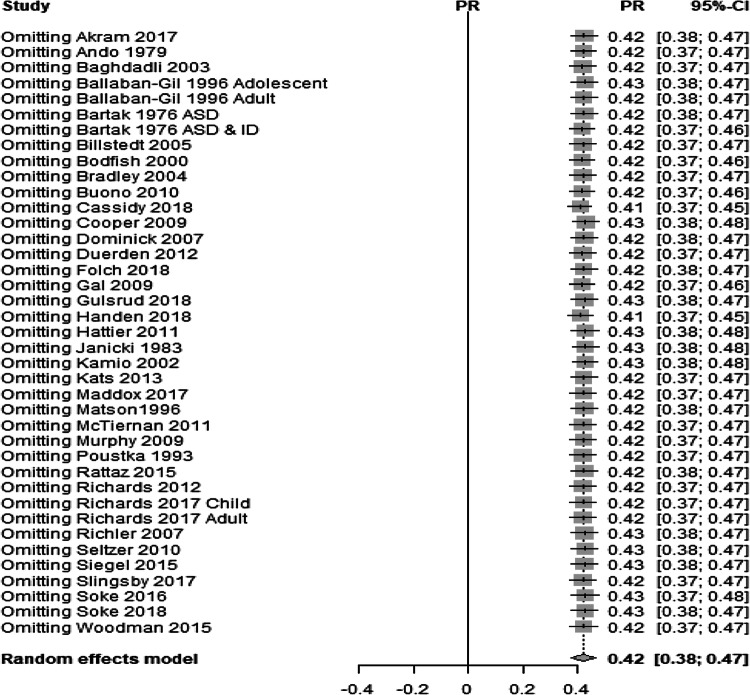
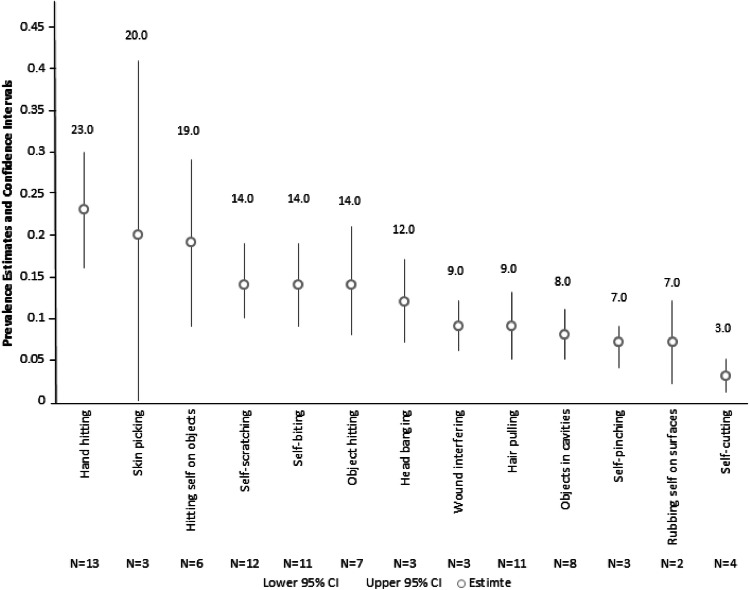
Self-injurious behaviour is purportedly common in autism, but prevalence rates have not yet been synthesised meta-analytically. In the present study, data from 14,379 participants in thirty-seven papers were analysed to generate a pooled prevalence estimate of self-injury in autism of 42% (confidence intervals 0.38–0.47). Hand-hitting topography was the most common form of self-injury (23%), self-cutting topography the least common (3%). Sub-group analyses revealed no association between study quality, participant intellectual disability or age and overall prevalence rate of self-injury. However, females obtained higher prevalence rates than males ( p = .013) and hair pulling and self-scratching were associated with intellectual disability ( p = .008 and p = .002, respectively). The results confirm very high rates of self-injury in autism and highlight within group risk-markers.
Overview
The claims and statistics of this paper haven’t been checked yet.
Run the check — free, no account needed. It reads the open-access text and checks the sources it cites.
Integrity signals
Registry
Cites
Statistics
Figures
Verification
Claims the paper makes
The claims and statistics of this paper haven’t been checked yet.
Run the check — free, no account needed. It reads the open-access text and checks the sources it cites.
Claims other papers make about this one
Each is checked against this paper’s own text: does it say what the citing paper says it does?
The cited source says what the claim attributes to it.
In the citing paper
“A recent meta-study reported that prevalence rates of SIB in the ASD population may be as high as 42% [121].”
From Pharmacological treatment in autism: a proposal for guidelines on common co-occurring psychiatric symptoms (2025) · cites this paper as [121]
The cited source says what the claim attributes to it.
In the citing paper
“A meta-analysis including 37 studies revealed a prevalence of self-harm of 42% in autistic individuals, irrespective of age and the presence or the absence of intellectual disability (ID) (Steenfeldt-Kristensen et al., 2020).”
From Feasibility, Acceptability and Preliminary Efficacy of Dialectical Behavior Therapy for Autistic Adults without Intellectual Disability: A Mixed Methods Study (2022) · cites this paper as Steenfeldt-Kristensen et al., 2020
In the citing paper
“Behaviors such as impulsivity and/or inattention can be contributing factors for injuries and unintentional incidents in children with ASD/ADHD.58,59”
From Mortality in Persons With Autism Spectrum Disorder or Attention-Deficit/Hyperactivity Disorder: A Systematic Review and Meta-analysis (2022) · cites this paper as [58]
Self-check
Percentages, sums and reported differences re-computed from the paper’s own numbers.
The self-check needs the paper’s full text.
Citations
Cites
Preferred Reporting Items for Systematic Reviews and Meta-Analyses: the PRISMA statement
Moher, D., Liberati, A., Tetzlaff, J., Altman, D. G., & for the PRISMA Group (2009) · BMJ · doi:10.1136/bmj.b2535 · Cited by 83,823
Preferred Reporting Items for Systematic Reviews and Meta-Analyses: The PRISMA Statement
Moher, D., Liberati, A., Tetzlaff, J., Altman, D. G., & The PRISMA Group (2009) · PLoS Medicine · doi:10.1371/journal.pmed.1000097 · Cited by 64,042
Preferred reporting items for systematic reviews and meta-analyses: the PRISMA Statement.
(2009) · PubMed Central · Cited by 44,859
Cochrane Handbook for Systematic Reviews of Interventions: Cochrane Book Series
(2008) · doi:10.1002/9780470712184 · Cited by 25,048
Wang, G., Ma, R., Qiao, G., Wada, K., Aizawa, Y., & Satoh, T. (2015) · Integrative Medicine International · doi:10.1159/000368408 · Cited by 18,762
Journal of Clinical Psychiatry
(2018) · Journal of Clinical Psychiatry · doi:10.5505/kpd · Cited by 13,703
Toward a functional analysis of self-injury
Iwata, B. A., Dorsey, M. F., Slifer, K. J., Bauman, K. E., & Richman, G. S. (1994) · Journal of Applied Behavior Analysis · doi:10.1901/jaba.1994.27-197 · Cited by 2,644
Baird, G., Simonoff, E., Pickles, A., Chandler, S., Loucas, T., Meldrum, D., & Charman, T. (2006) · The Lancet · doi:10.1016/s0140-6736(06)69041-7 · Cited by 2,104
Epidemiology of Pervasive Developmental Disorders
Fombonne, E. (2009) · Pediatric Research · doi:10.1203/pdr.0b013e31819e7203 · Cited by 1,971
Varieties of Repetitive Behavior in Autism: Comparisons to Mental Retardation
Bodfish, J. W., Symons, F. J., Parker, D. E., & Lewis, M. H. (2000) · Journal of Autism and Developmental Disorders · doi:10.1023/a:1005596502855 · Cited by 1,223
Research works printed but not linked: 1
- Weiss, J. (2002). Self-injurious behaviors in autism: A literature review. Journal on Developmental Disabilities, 9, 129–143.
Cited by
Sorted by citations
The Lancet Commission on the future of care and clinical research in autism
Lord, C., Charman, T., Havdahl, A., Carbone, P., Anagnostou, E., Boyd, B., Carr, T., de Vries, P. J., Dissanayake, C., Divan, G., et al. (2022) · The Lancet · doi:10.1016/s0140-6736(21)01541-5 · Cited by 924
Mental health problems in children with intellectual disability
Totsika, V., Liew, A., Absoud, M., Adnams, C. M., & Emerson, E. (2022) · The Lancet Child & Adolescent Health · doi:10.1016/s2352-4642(22)00067-0 · Cited by 191
Catalá-López, F., Hutton, B., Page, M. J., Driver, J. A., Ridao, M., Alonso-Arroyo, A., Valencia, A., Macías Saint-Gerons, D., & Tabarés-Seisdedos, R. (2022) · JAMA Pediatrics · doi:10.1001/jamapediatrics.2021.6401 · Cited by 148
Newell, V., Phillips, L., Jones, C., Townsend, E., Richards, C., & Cassidy, S. (2023) · Molecular Autism · doi:10.1186/s13229-023-00544-7 · Cited by 143
Self-citationRisk of Self-harm in Children and Adults With Autism Spectrum Disorder
Blanchard, A. M., Chihuri, S. T., DiGuiseppi, C. G., & Li, G. (2021) · JAMA Network Open · doi:10.1001/jamanetworkopen.2021.30272 · Cited by 138
Cannabinoids for People with ASD: A Systematic Review of Published and Ongoing Studies
Fusar‐Poli, L., Cavone, V., Tinacci, S., Concas, I., Petralia, A., Signorelli, M. S., Díaz‐Caneja, C. M., & Aguglia, E. (2020) · Brain Sciences · doi:10.3390/brainsci10090572 · Cited by 87
Mental health challenges faced by autistic people
Lai, M. (2023) · Nature Human Behaviour · doi:10.1038/s41562-023-01718-2 · Cited by 88
May, T., Pilkington, P. D., Younan, R., & Williams, K. J. (2021) · Autism Research · doi:10.1002/aur.2619 · Cited by 83
Bemmouna, D., Coutelle, R., Weibel, S., & Weiner, L. (2022) · Journal of Autism and Developmental Disorders · doi:10.1007/s10803-021-05317-w · Cited by 64
Manter, M. A., Birtwell, K. B., Bath, J., Friedman, N. D. B., Keary, C. J., Neumeyer, A. M., Palumbo, M. L., Thom, R. P., Stonestreet, E., Brooks, H., et al. (2025) · BMC Medicine · doi:10.1186/s12916-024-03814-0 · Cited by 51
“A recent meta-study reported that prevalence rates of SIB in the ASD population may be as high as 42% [121].”
Self-Harm Events and Suicide Deaths Among Autistic Individuals in Ontario, Canada
Lai, M., Saunders, N. R., Huang, A., Artani, A., Wilton, A. S., Zaheer, J., Ameis, S. H., Brown, H. K., & Lunsky, Y. (2023) · JAMA Network Open · doi:10.1001/jamanetworkopen.2023.27415 · Cited by 51
Molecular Alterations of the Endocannabinoid System in Psychiatric Disorders
Navarro, D., Gasparyan, A., Navarrete, F., Torregrosa, A. B., Rubio, G., Marín, M., Acosta, G. B., García‐Gutiérrez, M. S., & Manzanares, J. (2022) · International Journal of Molecular Sciences · doi:10.3390/ijms23094764 · Cited by 47
Edwards, G., Jones, C. A., Pearson, E., Royston, R., Oliver, C., Tarver, J., Crawford, H., Shelley, L., & Waite, J. (2022) · Neuroscience & Biobehavioral Reviews · doi:10.1016/j.neubiorev.2022.104719 · Cited by 46
Self-citationAdams, D., Dargue, N., & Paynter, J. M. (2023) · Clinical Psychology Review · doi:10.1016/j.cpr.2023.102320 · Cited by 37
Yan, H., Elkaim, L. M., Gouveia, F. V., Huber, J. F., Germann, J., Loh, A., Benedetti‐Isaac, J. C., Doshi, P. K., Torres, C. V., Segar, D. J., et al. (2022) · Journal of neurosurgery · doi:10.3171/2021.11.jns21928 · Cited by 33
Moseley, R. L., Gregory, N. J., Smith, P. L., Allison, C. L., Cassidy, S., & Baron‐Cohen, S. (2022) · Molecular Autism · doi:10.1186/s13229-022-00495-5 · Cited by 39
Moseley, R. L., Gregory, N. J., Smith, P. L., Allison, C. L., Cassidy, S., & Baron‐Cohen, S. (2022) · Molecular Autism · doi:10.1186/s13229-022-00522-5 · Cited by 30
Bemmouna, D., Lagzouli, A., & Weiner, L. (2023) · Molecular Autism · doi:10.1186/s13229-023-00580-3 · Cited by 27
Ding, H., Zhu, L., Hua, W., Geng, J., Huang, F., & Lei, L. (2022) · International Journal of Environmental Research and Public Health · doi:10.3390/ijerph191912236 · Cited by 29
Northrup, J. B., Goodwin, M. S., Peura, C. B., Chen, Q., Taylor, B. J., Siegel, M. S., & Mazefsky, C. A. (2022) · Autism Research · doi:10.1002/aur.2773 · Cited by 24
Jaffey, S., & Ashwin, C. (2022) · Research in Autism · doi:10.1016/j.rasd.2022.102021 · Cited by 25
Gorodetsky, C., Mithani, K., Breitbart, S. C., Yan, H., Zhang, K., Gouveia, F. V., Warsi, N. M., Suresh, H., Wong, S. M., Huber, J. F., et al. (2024) · Biological Psychiatry · doi:10.1016/j.biopsych.2024.12.001 · Cited by 23
Autistic adults’ subjective experiences of hoarding and self-injurious behaviors
Goldfarb, Y., Zafrani, O., Hedley, D., Yaari, M., & Gal, E. (2021) · Autism · doi:10.1177/1362361321992640 · Cited by 25
Vandewalle, K., & Melia, Y. (2020) · Research in Autism · doi:10.1016/j.rasd.2020.101713 · Cited by 22
Bemmouna, D., & Weiner, L. (2023) · Frontiers in Psychiatry · doi:10.3389/fpsyt.2023.1238116 · Cited by 27
Ferguson, E. F., Spackman, E. K., Cai, R. Y., Hardan, A. Y., & Uljarević, M. (2024) · Autism Research · doi:10.1002/aur.3269 · Cited by 21
Schwartzman, J. M., McMorris, C. A., Brown, C. M., Trollor, J. N., Uljarević, M., Stokes, M. A., Williams, Z. J., & Hedley, D. (2025) · Autism in Adulthood · doi:10.1089/aut.2024.0225 · Cited by 19
The behavioural phenotype of SATB2-associated syndrome: a within-group and cross-syndrome analysis
Bissell, S., Oliver, C., Moss, J. F., Heald, M., Waite, J., Crawford, H., Kothari, V., Rumbellow, L., Walters, G. W. M., & Richards, C. (2022) · Journal of Neurodevelopmental Disorders · doi:10.1186/s11689-022-09426-0 · Cited by 20
Self-citationOmotehinwa, T. O., Lawrence, M. O., Oyewola, D. O., & Dada, E. G. (2024) · Journal of Computational Mathematics and Data Science · doi:10.1016/j.jcmds.2024.100105 · Cited by 17
Is language ability associated with behaviors of concern in autism? A systematic review
Chan, Y. Z. C., Williams, K. J., May, T., Wan, W. H., & Brignell, A. (2022) · Autism Research · doi:10.1002/aur.2855 · Cited by 24
Restrictive Practice Use in People with Neurodevelopmental Disorders: A Systematic Review
Younan, B., Jorgensen, M. L., Chan, J. B., Winata, T., & Gillies, D. M. (2023) · Advances in Neurodevelopmental Disorders · doi:10.1007/s41252-023-00367-w · Cited by 16
Deep brain stimulation for autism spectrum disorder
Marini, S., D’Agostino, L., Ciamarra, C., & Gentile, A. (2023) · World Journal of Psychiatry · doi:10.5498/wjp.v13.i5.174 · Cited by 17
Marsden, S. J. E., Eastham, R., & Kaley, A. (2024) · Autism · doi:10.1177/13623613241271931 · Cited by 21
Baweja, R. K., Waschbusch, D. A., & Mayes, S. D. (2023) · JAACAP Open · doi:10.1016/j.jaacop.2023.07.004 · Cited by 15
Development and Psychometric Evaluation of the Open-Source Challenging Behavior Scale (OS-CBS)
Frazier, T. W., Khaliq, I. N., Scullin, K. M., Uljarević, M., Shih, A. J., & Karpur, A. (2022) · Journal of Autism and Developmental Disorders · doi:10.1007/s10803-022-05750-5 · Cited by 13
Measurement properties of tools used to assess self-harm in autistic and general population adults
Newell, V., Townsend, E., Richards, C., & Cassidy, S. (2024) · Clinical Psychology Review · doi:10.1016/j.cpr.2024.102412 · Cited by 17
Self-citationMoore, T. R., Lee, S., Freeman, R., Mahmoundi, M., Dimian, A. F., Riegelman, A., & Simacek, J. J. (2024) · Behavior Modification · doi:10.1177/01454455231218742 · Cited by 12
Elshahawy, M., Bakhaty, M., Ahmed, G., Aboelnaga, K., & Sharaf, N. (2022) · Lecture notes in networks and systems · doi:10.1007/978-3-031-04286-7_10 · Cited by 12
Empathic Disequilibrium as a Predictor of Nonsuicidal Self-Injury in Autistic and Nonautistic People
Moseley, R. L., Shalev, I., Gregory, N. J., & Uzefovsky, F. (2024) · Autism in Adulthood · doi:10.1089/aut.2023.0134 · Cited by 11
Ferguson, E. F., Russell, K. M., Licona, S., Cai, R. Y., Frazier, T. W., Vivanti, G., Gengoux, G. W., Hardan, A. Y., & Uljarević, M. (2024) · Autism Research · doi:10.1002/aur.3289 · Cited by 11
Rad, A. B., Villavicencio, T., Kiarashi, Y., Anderson, C., Foster, J., Kwon, H., Hamlin, T., Lantz, J. F., & Clifford, G. D. (2025) · Physiological Measurement · doi:10.1088/1361-6579/ada51b · Cited by 14
Weike, Z., Cai, K., Xiong, X., Zhu, L., Sun, Z., Yang, S., Cheng, W. D., Mao, H., & Chen, A. (2025) · Scientific Reports · doi:10.1038/s41598-025-87248-5 · Cited by 13
Suicide and Autism: A Lifespan Perspective
Hedley, D., Hayward, S. M., Clarke, A., Uljarević, M., & Stokes, M. A. (2022) · Springer eBooks · doi:10.1007/978-3-030-98697-1_3 · Cited by 9
Tromans, S. J., Henley, W., Summers, I., Bilkey, D., Datson, J., Doherty, N. N., Morpeth, L., Benbow, S., Jelbert, R., Roy, A., et al. (2023) · BJPsych Open · doi:10.1192/bjo.2023.57 · Cited by 8
Scheithauer, M. C., Hiremath, S. K., Southerland, A., Rozga, A., Plötz, T., Rock, C., & Call, N. A. (2022) · Research in Autism · doi:10.1016/j.rasd.2022.102043 · Cited by 8
Lundy, E., Healy, O., Ramey, D., Carolan, T., Dempsey, R., & Holloway, J. (2021) · European Journal of Behavior Analysis · doi:10.1080/15021149.2021.1981752 · Cited by 8
Fusar‐Poli, L., Martinez, M., Surace, T., Meo, V., Patania, F., Avanzato, C., Signorelli, M. S., & Aguglia, E. (2022) · Brain Sciences · doi:10.3390/brainsci12010116 · Cited by 7
Badgett, N. M., Sadikova, E., Menezes, M., & Mazurek, M. O. (2022) · Journal of Autism and Developmental Disorders · doi:10.1007/s10803-022-05503-4 · Cited by 10
Protective procedures in functional analysis of self‐injurious behavior: An updated scoping review
Frank‐Crawford, M. A., Piersma, D. E., Fernandez, N., Tate, S. A., & Bustamante, E. A. (2024) · Journal of Applied Behavior Analysis · doi:10.1002/jaba.2906 · Cited by 7
Kildahl, A. N., Hellerud, J. M. A., Halvorsen, M. B., & Helverschou, S. B. (2025) · Journal of Autism and Developmental Disorders · doi:10.1007/s10803-024-06697-5 · Cited by 7
Frackowiak, J., & Mazur‐Kolecka, B. (2023) · Frontiers in Molecular Neuroscience · doi:10.3389/fnmol.2023.1160967 · Cited by 8
Lacroix, A., Tzang, C.-C., Yu, J., Jacob, B. K., Alexandrovsky, M., Winge-Breen, A., Rodak, T., & Lai, M. (2025) · Frontiers in Neuroendocrinology · doi:10.1016/j.yfrne.2025.101229 · Cited by 9
Shawler, L. A., Becraft, J. L., & Hagopian, L. P. (2023) · Autism and child psychopathology series · doi:10.1007/978-3-031-24926-6_37 · Cited by 6
Brzóska‐Konkol, E., Remberk, B., & Papasz‐Siemieniuk, A. (2022) · Postępy Psychiatrii i Neurologii · doi:10.5114/ppn.2022.115244 · Cited by 6
Ferina, J., Dando, E., Anderson, C., Foster, J., Lantz, J. F., Hamlin, T., & Hahn, J. (2025) · Journal of Personalized Medicine · doi:10.3390/jpm15100453 · Cited by 8
Hong, S., Chae, Y. K., Lee, C., Choi, S. C., & Nam, O. H. (2021) · International Journal of Environmental Research and Public Health · doi:10.3390/ijerph18179249 · Cited by 5
Predicting self‐injurious behavior at age three among infant siblings of children with autism
Dimian, A. F., Estes, A. M., Dager, S. R., Piven, J., Wolff, J. J., & for the IBIS Network (2023) · Autism Research · doi:10.1002/aur.2981 · Cited by 5
Bitter, I., Czobor, P., Kakuszi, B., & Réthelyi, J. (2023) · Orvosi Hetilap · doi:10.1556/650.2023.32843 · Cited by 5
Behavioral Disorders in Young Children with Autism Spectrum Disorder
Huete, J. M., Jeglum, S. R., Schmidt, J. D., & López‐Arvizu, C. (2024) · Autism and child psychopathology series · doi:10.1007/978-3-031-64499-3_27 · Cited by 5
Álvarez-Couto, M., García-Villamisar, D. A., & Armentia, A. D. P. (2024) · Journal of Mental Health Research in Intellectual Disabilities · doi:10.1080/19315864.2024.2333244 · Cited by 4
Podesta, L. M., & Bosman, A. M. T. (2025) · Emerging Adulthood · doi:10.1177/21676968251327246 · Cited by 4
A Deep Neural Framework for Self-Injurious Behavior Detection in Autistic Children
Singh, U., Shukla, S., & Gore, M. M. (2025) · Procedia Computer Science · doi:10.1016/j.procs.2025.04.605 · Cited by 5
Dudas, R. B., & Cheney, L. B. (2025) · American Journal of Psychotherapy · doi:10.1176/appi.psychotherapy.20230049 · Cited by 4
Madden, R., & Coffey, L. (2025) · Health & Social Care in the Community · doi:10.1155/hsc/9828118 · Cited by 4
Antezana, L., Conner, C. M., Eldeeb, S. M., Turecki, S. C., Siegel, M. S., Karim, H. T., & Mazefsky, C. A. (2025) · Psychological Medicine · doi:10.1017/s0033291725000637 · Cited by 4
Lew‐Koralewicz, A., & Gagat‐Matuła, A. (2021) · Research in Developmental Disabilities · doi:10.1016/j.ridd.2021.104032 · Cited by 4
The Future of General Psychiatry Must Include Autism Spectrum Disorder and Intellectual Disability
Westover, A. N. (2024) · Academic Psychiatry · doi:10.1007/s40596-024-01985-9 · Cited by 4
Challenging Behaviors in Adults with Intellectual Disabilities and ASD: Related Variables
Álvarez-Couto, M. (2024) · Springer eBooks · doi:10.1007/978-3-031-40858-8_63-1 · Cited by 5
Antezana, L., Conner, C. M., Feldman, J., Manna, L. L., Ionadi, A., Su, D. J., Eldeeb, S. M., Gastgeb, H. Z., Sivathasan, S., Northrup, J. B., et al. (2026) · Autism in Adulthood · doi:10.1177/25739581261423792 · Cited by 3
French, B., Newell, V., Nalbant, G., Wright, H., Daley, D., & Cassidy, S. (2026) · Frontiers in Psychiatry · doi:10.3389/fpsyt.2026.1702822 · Cited by 4
Headache in Individuals with Neurodevelopmental Disorders
Chadehumbe, M. A. (2023) · Current Pain and Headache Reports · doi:10.1007/s11916-023-01153-y · Cited by 3
Musich, F. M., Berardo, C., & Aragón-Daud, A. (2024) · Vertex Revista Argentina de Psiquiatría · doi:10.53680/vertex.v35i163.526 · Cited by 3
Preference for Prompting Procedures to Address Escape-Maintained Behavior in Autistic Adolescents
Scheithauer, M. C., Bottini, S. B., & McMahon, M. X. H. (2024) · Journal of Developmental and Physical Disabilities · doi:10.1007/s10882-024-09965-5 · Cited by 3
Mental Health Crises in Autistic Children
Vasa, R. A., Neamsapaya, K., Cross, E. A., & Kalb, L. G. (2024) · Pediatric Clinics of North America · doi:10.1016/j.pcl.2024.01.005 · Cited by 3
Association between autism spectrum disorder and intentional self-harm
Blanchard, A. M., Chihuri, S. T., Ing, C. H., DiGuiseppi, C. G., & Li, G. (2025) · Injury Epidemiology · doi:10.1186/s40621-025-00591-z · Cited by 2
Prevalence of Autism in Psychiatric Inpatient Settings: a Meta-analysis
Tivey, P., FitzHerbert, H., Jones, C. A., & Surtees, A. D. R. (2025) · Review Journal of Autism and Developmental Disorders · doi:10.1007/s40489-025-00525-x · Cited by 2
Self-citationNonsuicidal Self-Injury: A Nurse-Led Quality Improvement Project to Address Self-Harm.
Goodman, D., Pletch, A., Paul, P., Anderson, E., & Kverno, K. S. (2022) · Journal of Psychosocial Nursing and Mental Health Services · doi:10.3928/02793695-20220208-02 · Cited by 2
Fong, A., Friedlander, R. I., Richardson, A., Allen, K., & Zhang, Q. (2022) · International Journal of Developmental Disabilities · doi:10.1080/20473869.2022.2113321 · Cited by 2
Marlow, K., Agar, G., Jones, C., Devine, R. T., & Richards, C. (2024) · Review Journal of Autism and Developmental Disorders · doi:10.1007/s40489-024-00450-5 · Cited by 2
Self-citationTeaching a Child to Wear Prescription Eyeglasses
McKeown, C. A., & Vollmer, T. R. (2024) · Journal of Developmental and Physical Disabilities · doi:10.1007/s10882-024-09972-6 · Cited by 2
Teaching Practitioners to Use the Bristol Stool Form Scale
Yensen, C. P., Pendergrass, J. A., Smith, S. W., Lloveras, L. A., & Vollmer, T. R. (2025) · Behavior Analysis in Practice · doi:10.1007/s40617-025-01052-1 · Cited by 2
Scheithauer, M. C., Londoño, F. V., Naugle, B., Walker, A., Hodnett, J. M., Mevers, J. L., Muething, C., & Call, N. A. (2025) · Journal of Intellectual Disability Research · doi:10.1111/jir.13240 · Cited by 2
A Qualitative Exploration of Self-Harm Among Autistic Women
Rebbettes, J., & Bacon, A. M. (2025) · Journal of Autism and Developmental Disorders · doi:10.1007/s10803-025-06955-0 · Cited by 2
Alberts, L. B., & Kettering, T. L. (2022) · Journal of Doctoral Nursing Practice · doi:10.1891/jdnp-2021-0034 · Cited by 2
Özel Gereksinimli Bireylerin Cinsel Problem Davranışları Konulu Makalelerin Sistematik Derlemesi
Sezik, A., Alp, Z. A., & Aksoy, V. (2024) · İnönü Üniversitesi Eğitim Fakültesi Dergisi · doi:10.17679/inuefd.1507590 · Cited by 1
Byiers, B. J., Gunderson, J. A., Huebner, A. R., & Symons, F. J. (2025) · Journal of Intellectual Disability Research · doi:10.1111/jir.13228 · Cited by 1
Rysstad, A. L., Skoglund, J., & Kildahl, A. N. (2025) · Journal of Intellectual Disabilities · doi:10.1177/17446295251392061 · Cited by 1
Jiang, T., Wilson, M., Whitehouse, A. J. O., Sainsbury, W., & Waddington, H. (2026) · Journal of Autism and Developmental Disorders · doi:10.1007/s10803-025-07207-x · Cited by 1
Mithani, K., Breitbart, S. C., Dinger, T. F., Suresh, H., LeBlanc‐Millar, A., Huber, J. F., Kerr, E. N., Taylor, M. J., Fasano, A. A., Sauter, S., et al. (2026) · Molecular Psychiatry · doi:10.1038/s41380-026-03710-4 · Cited by 1
Spackman, E. K., Chetcuti, L., Leekam, S., Whitehouse, A., Krueger, R. F., Hedley, D., Frazier, T. W., Hardan, A. Y., & Uljarević, M. (2026) · Journal of the American Academy of Child & Adolescent Psychiatry · doi:10.1016/j.jaac.2026.07.1224 · Cited by 1
McLaughlin, C. J., Childress, P., Armen, S. B., & Allen, S. R. (2021) · Injury · doi:10.1016/j.injury.2021.09.003 · Cited by 1
Siddiqua, H., Akter, Y., Mia, M. A., Ahmed, M. S., Chowdhury, M. A., & Marzan, L. W. (2022) · Asian Journal of Medical and Biological Research · doi:10.3329/ajmbr.v8i2.59511 · Cited by 1
Self-injurious behavior of children with autism in Vietnam: A cross sectional study
Phan, T. M., Nguyen, B. T. N., Nguyen, B. U., Pham, T. T. H., Mai, T. T. T., & Nguyen, H. A. (2022) · Journal for Educators Teachers and Trainers · doi:10.47750/jett.2022.13.01.003 · Cited by 1
Mournet, A. M., Millner, A. J., & Kleiman, E. M. (2024) · Journal of Affective Disorders Reports · doi:10.1016/j.jadr.2024.100796 · Cited by 1
Massaguer-Bardají, B., Grau, A., & Gómez-Hinojosa, T. (2024) · Revista de Neurología · doi:10.33588/rn.7902.2024047 · Cited by 1
Self-Injurios Behaviour in an Adult with Autism Spectrum Desorder
Guazzo, G. M. (2024) · European Journal of Medical and Health Research · doi:10.59324/ejmhr.2024.2(5).09 · Cited by 1
Idiopathic Autism Spectrum Disorder
Carroll, H. M., Thom, R. P., & McDougle, C. J. (2024) · Springer eBooks · doi:10.1007/978-3-031-76269-7_1 · Cited by 1
Ferguson, E. F., Spackman, E. K., Hardan, A. Y., & Uljarević, M. (2025) · Autism · doi:10.1177/13623613251396036 · Cited by 1
Fusar‐Poli, L., Concerto, C., Rodolico, A., & Aguglia, E. (2023) · Springer eBooks · doi:10.1007/978-3-031-31547-3_161 · Cited by 1
Nyakundi, J. K., & Wairungu, G. (2021) · International journal of research and innovation in social science · doi:10.47772/ijriss.2021.5725 · Cited by 1
Metadata
- Authors
- Steenfeldt-Kristensen, C., Jones, C. A., & Richards, C.
- Affiliations
- Coventry and Warwickshire Partnership NHS Trust (GB)
- University of Birmingham (GB)
- Corresponding author
- Richards, Caroline
- Venue
- Journal of Autism and Developmental Disorders
- Published
- 2020-04-15
- Volume
- 50
- Issue
- 11
- Pages
- 3857-3873
- ISSN
- 0162-3257 (ISSN-L)
- 1573-3432
- PMC
- PMC7557528
- OpenAlex
- W3016276573
- Cited by
- 150
- References
- 101
- Citations by year
- 2026: 20 · 2025: 31 · 2024: 33 · 2023: 27 · 2022: 25 · 2021: 10 · 2020: 4
- FWCI
- 2.23
- Type
- journal article
- Language
- en
- Open access
- hybrid
- doi.org
- Locations
- Journal of Autism and Developmental Disorders (publishedVersion, cc-by)
- PubMed Central (publishedVersion, cc-by)
- PubMed (publishedVersion)
- University of Birmingham Research Portal (University of Birmingham) (publishedVersion, cc-by)
- Topics
- Life Sciences › Neuroscience › Cognitive Neuroscience › Autism Spectrum Disorder Research
- Social Sciences › Psychology › Clinical Psychology › Suicide and Self-Harm Studies
- Social Sciences › Psychology › Developmental and Educational Psychology › Behavioral and Psychological Studies
- Keywords
- self-harm, autism spectrum disorder, prevalence, self-cutting, intellectual disability, sex differences, hair pulling, risk indicators
- MeSH terms
- Adolescent, Autistic Disorder, Female, Humans, Male, Intellectual Disability, Prevalence, Self-Injurious Behavior
About these checks
Registry, retraction, Cites and statistics results are computed, not judged, with one exception: a printed reference that no index lists is read once by a model before it counts as a citation error. Claims are extracted by a model and kept only when their quote appears verbatim in the text; each cited source is then checked, with a model’s help, for whether it says what the claim relies on. Those verdicts can be wrong — read the claim’s quote and the cited source before relying on one.
Statistics and arithmetic are recomputed, not judged.
Confidence bands are shown only for fields calibrated on our annotated test set. None is calibrated yet, so no band is shown.
What counts as a claim ›How we measure confidence ›How we check this ›
Are you an author, or do you see a problem with this page? Request a review
